



Abstract
High throughput solid phase synthesis can be performed with application of the centrifugation based liquid removal. This technique uses readily available standard microtiterplates and eliminates filtration step. It is therefore applicable to simultaneous processing of unlimited number of reaction compartments. Its use is illustrated on the synthesis of an array of 380 tetrahydroisoquinolinones.
Introduction
Combinatorial techniques (for reviews see e.g. 1 ) require new methods for automation of synthetic processes. Solid phase synthesis is optimal for automation, since the complicating factor of unique behavior of different organic molecules is replaced by predictable behavior of the solid support. Instruments available on the market today are relatively complicated and expensive. The instrument that would be rather simple, therefore inexpensive, and would allow each chemist to synthesize 100–1000 compounds in a batch would be welcome by a number of medicinal chemists anxious to discover the next Zantac or Viagra. Such instrument would be used for deconvolution of active compound from biologically active mixtures, synthesis of arrays of compounds for general screening, or for compound optimization, so called “lead explosion”.
Even though solid phase synthesis brought about the potential of relatively simple processing of large arrays of synthetic vessels, some problems in realization of machine capable of parallel processing of multitude of samples remain. One of the basic problems is parallel separation of liquid and solid phases. Commercial solid phase synthesizers utilize filtration as the principle for separation of solid and liquid phase (for reviews see e.g. 2 ). Filtration can lead to significant complications, especially in the case of multiple synthesizers, since clogging of one vessel can result in overflowing of this particular vessel during the next solvent addition and distribution of the solid support from this vessel into neighboring ones. The principle of “surface suction” for removal of supernatant from the sedimented suspension of solid phase particles3,4, which we have successfully used in our robotic synthesizer in which up to 72 deep-well microtiterplates can be processed simultaneously 3 , is also limited. The surface suction removal of liquid phase is based on the fact, that the flat-end needle lowered against the surface of the liquid while the suction is applied through the needle, does not disturb the bulk of the liquid and only the surface layer of the liquid is removed. In this way, the needle can be lowered very close to the sedimented resin without removing any solid support particles. However, this technique still does not allow to process unlimited number of reaction vessels simultaneously - the number of processed vessels depend on the number of needles performing the suction.
Results and discussion
We have found the simpler way for simultaneous processing of hundreds of reaction vessels. We call this new technique “tilted centrifugation”. The principle of tilted centrifugation is shown in Figure 1.
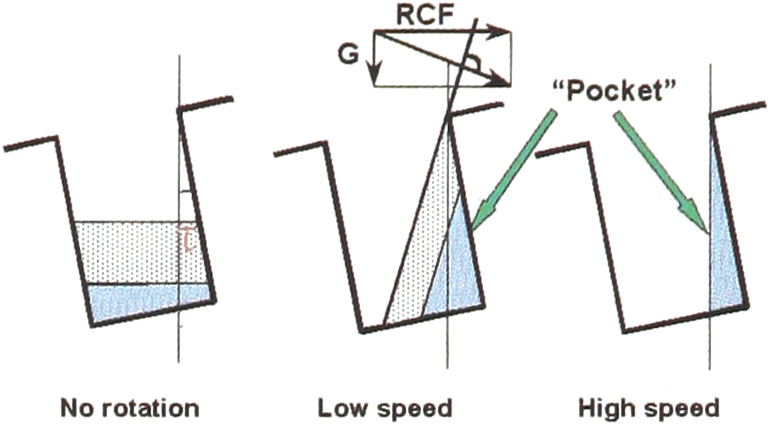
Formation of the pocket in the well of a tilted plate during centrifugation (direction: left to right). The solid support is collected in the pocket, while the liquid is expelled from the well. The liquid surface angle is perpendicular to the resulting force vector of the relative centrifugal force (RCF) and gravity (G).
Resin suspended in the tilted flask placed at the perimeter of the centrifugal plate and spun, will not remain at the bottom of the flask. As the surface of liquid supernatant will move, the solid support layer will move as well. If the speed of rotation is increased, the centrifugal force created by rotation (which depends on the radius of rotation and the speed) combines with gravitation and the resulting force causes liquid surface to stabilize at the angle perpendicular to the resulting force vector. At the ratio of relative centrifugal force (RCF) to G of 3, the angle of the liquid surface will be about 61 degrees, if the speed is increased so that the ratio of these forces is more than 50, we will be getting close to the situation where RCF is infinity -therefore the liquid (and resin layer) angle will be close to 90 degrees. The pocket created by the tilt should allow only solid phase to remain in the pocket and all of the liquid should be expelled. The pocket can be created in the vessel of basically any shape (see Figure 2) - flat bottom, U bottom, or V bottom vessel, as well as in the array of vessels, e.g. in the commonly used microtiterplates.
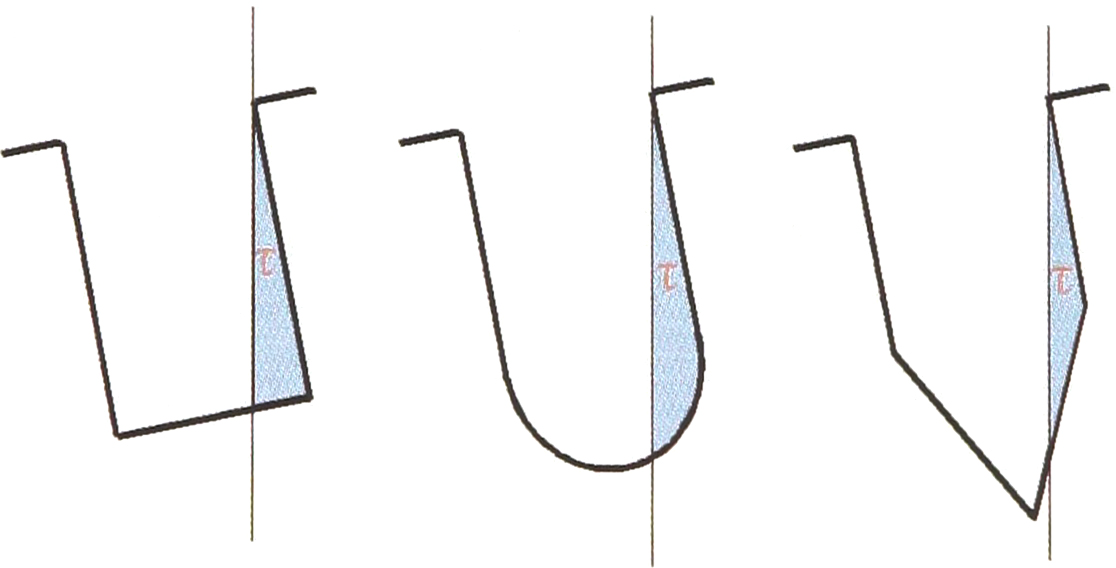
Pocket formed by centrifugation in vessel of different geometry
Situation of wells in microtiterplates placed on the perimeter of the centrifuge depends on the distance of the individual well from the axis of rotation. The volume of the “pocket” created by centrifugation in the wells closer to the axis is bigger than the volume of the pocket created in the wells more distant from the center of rotation. The volume of the pocket is not as important as the ratio of volumes of pockets in different wells of the microtiter plate. This ratio depends on the dimension of the centrifugal rotor, speed of the rotation, and the tilt of a plate. Wells placed on a rotor of very large diameter, or rotor spun very fast, will have insignificant difference between forces exerted onto “inside” and “outside” wells. In the example given here, we were working with the tilt of 9 degrees, 350 rpm, and the diameter of centrifugal rotor of 48 cm. Under these conditions the volume of the pocket in inner and outer wells differed by 8%, which we found to be an acceptable difference.
If drilling of holes into inert material would create the array of wells, the liquid expelled from one well would inadvertently enter another well placed closer to the perimeter of the centrifuge. However, 96 well shallow microtiterplate is actually composed of 96 small cylinders attached to a flat polypropylene sheet and connected by a thin “rib”, creating thus an array of 96 round wells plus 117 interwell spaces. The liquid expelled by centrifugal force from the well comes into the interwell space, flies across this space and ends up on the outer wall of the adjacent well (see Figure 3). Then it flows along the well until it detaches and flies across another interwell space, eventually ending at the edge of the plate from where it flies onto the well of the centrifuge drum. We have tested the transfer of liquid and/or solid material from one well into another in several ways. We have loaded the wells with the amount of colorized solid support (resin) which exceeded the capacity of the pocket and observed the fate of the resin expelled from the well. As can be observed on Figure 4, overflow of the resin ended in the interwell space and we have never observed any transfer of the resin beads into adjacent wells. In another experiment we have analyzed products synthesized in all wells of the microtiterplate by HPLC and mass spectroscopy. We have not found any traces of contamination by liquid or solid transfer between wells in our model experiments. Figure 5A shows HPLC traces of products synthesized in adjacent wells and Figure 5B shows the mass spectra of the products from the same wells.
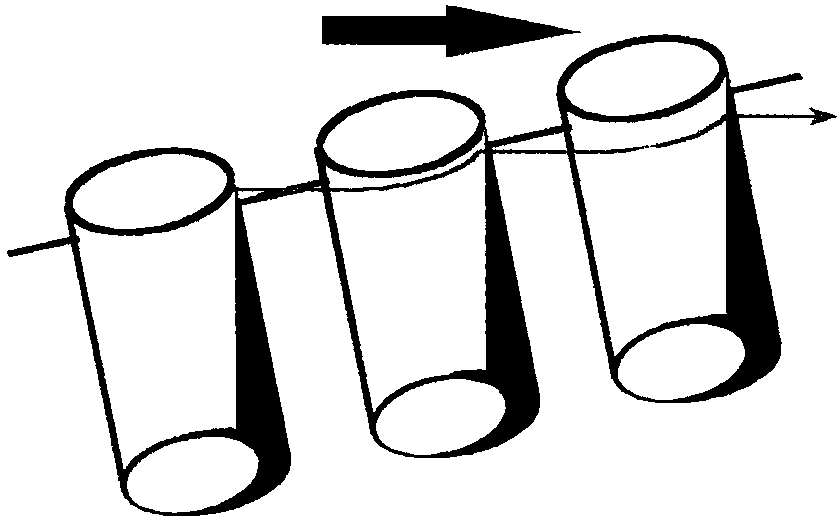
Trajectory of liquid removed by centrifugation from the well of the tilted microtiterplate. Liquid and/or resin expelled from the wells cannot contaminate neighboring wells, but is caught in the interwell space.
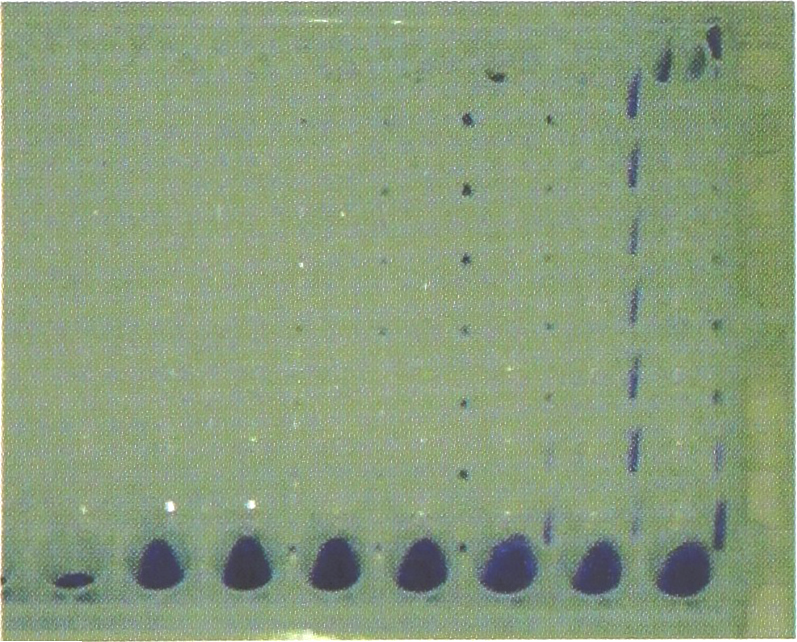
Image of the section of plate which contained various amounts of the resin in each well of the first row (from the left: 3, 3, 4, 5, 6, 7, 8, 9 mg) after centrifugation (resin was colorized by bromophenol blue for easier observation).
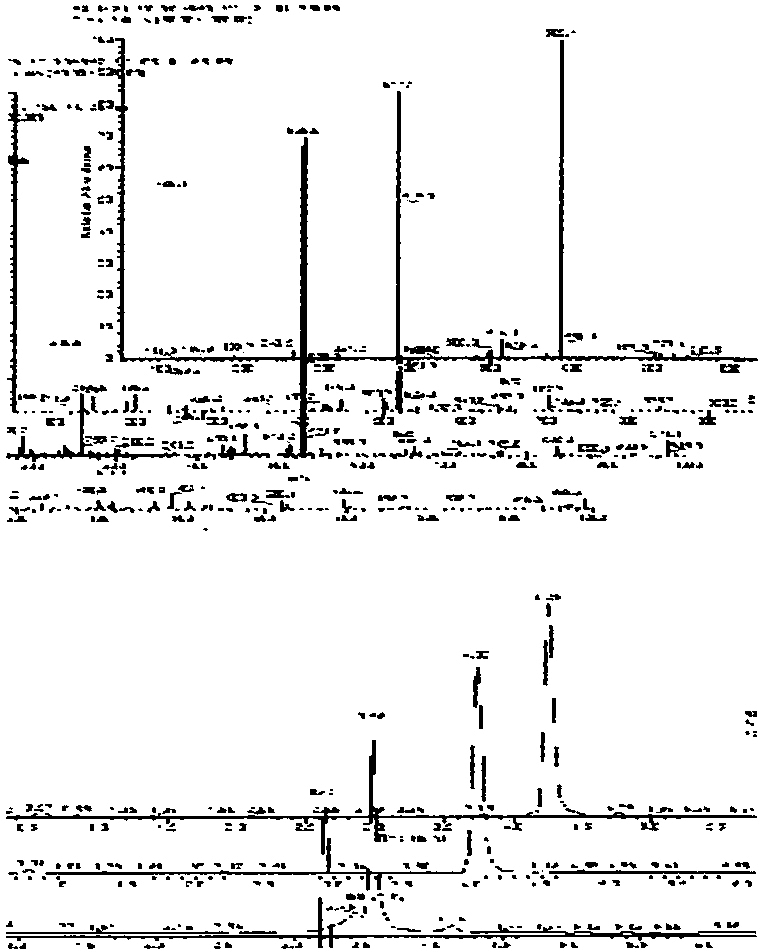
HPLC traces (A) and mass spectra (B) of compounds synthesized in adjacent wells in the microtiterplate.
The first experiments using tilted plate centrifugation were performed in the Savant centrifuge, which we have equipped with custom-built rotor. Later we have built the dedicated centrifuge with 8 positions for microtiter plates. This centrifuge is driven from the computer and all centrifugation parameters can be flexibly changed. 96-channel distributor (Figure 6) connected to 6 port selector valve performs the delivery of washing solvents and common reagents. We have integrated the centrifuge with Packard Multiprobe 104 liquid distribution system for the delivery of individual building blocks and reagents. Inclusion of the pipetting system allows us to perform the whole synthesis in completely automatic regimen. Figure 7 shows the view of this instrument. This compact system can be easily enclosed in inert atmosphere.
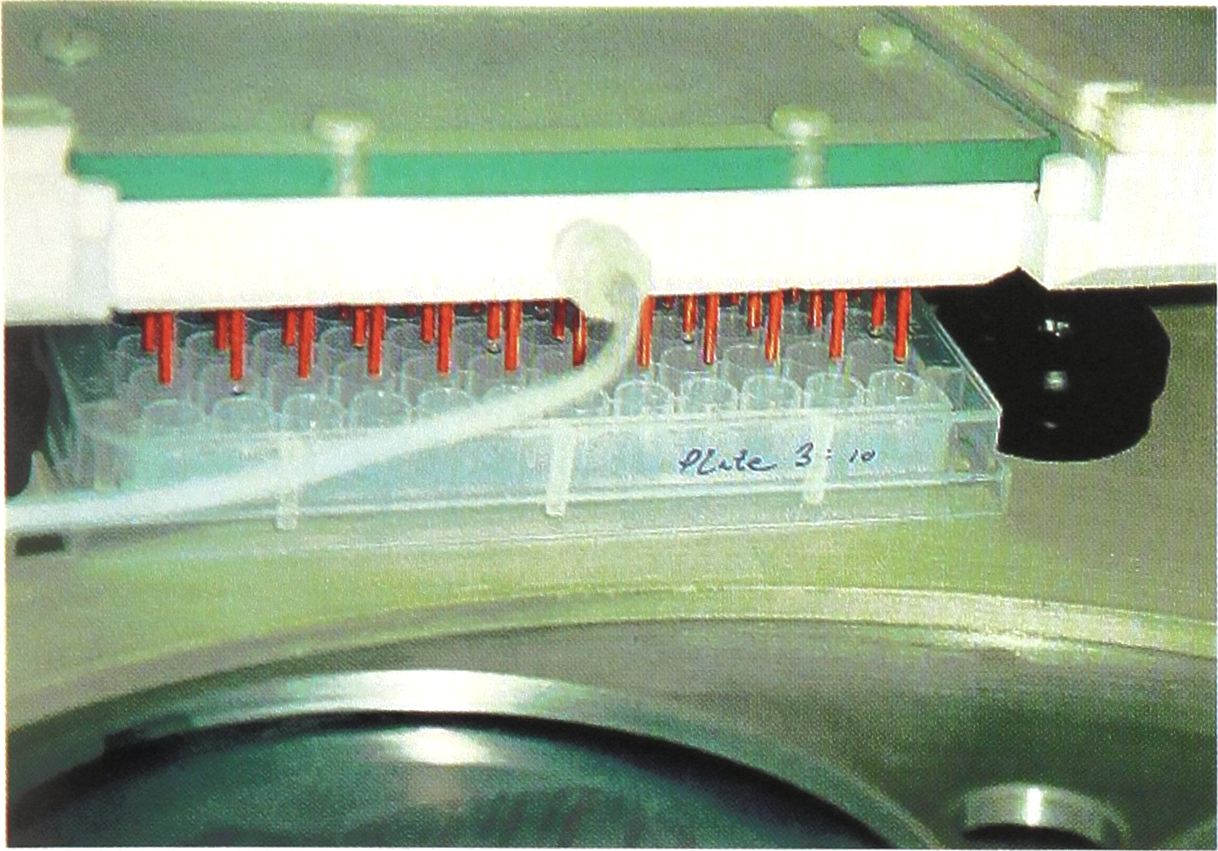
Detail of 96 channel liquid distributor with microtiterplate placed under it. Note the black knob serving as the attachment of the plate.
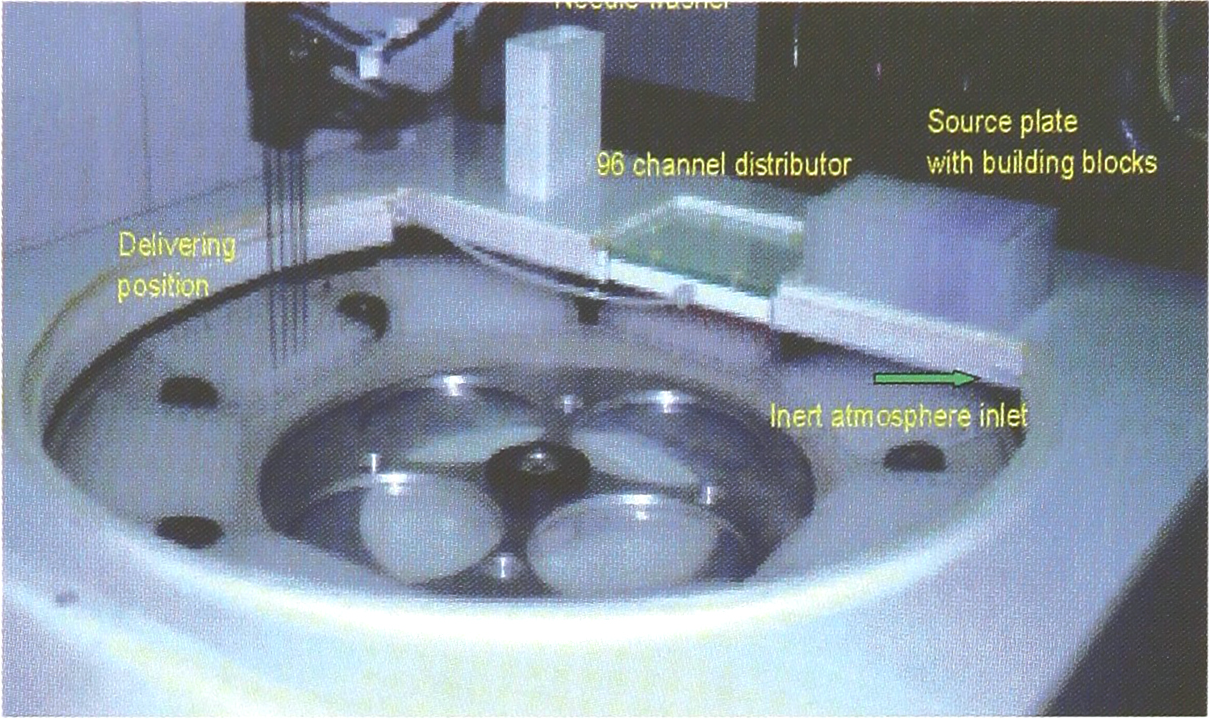
Centrifuge integrated with robotic liquid distributor Packard Canberra Multiprobe 104.
The synthesis is performed in the following way. Microtiterplate with slurry of solid support distributed into it is placed on the perimeter of a rotor with a permanent tilt of 9 degrees. The rotor is rotated at the speed required for complete removal of the liquid portion of the well content. After stopping the rotation, microtiterplate is placed (rotor is turned) under the multichannel (96 channel) liquid delivery head (Figure 6). The solvent selector valve is turned into the appropriate position and the washing solvent is delivered by actuating the syringe pump. This operation is repeated until all plates are serviced. The rotor is spun at the speed at which the liquid phase is just reaching the edge of the well, wetting thus all solid support in the “pocket”, and after reaching this speed, rotation is stopped. The cycle of slow rotation and stopping is repeated mixing thus the slurry of solid support in the liquid phase. After shaking for the appropriate time, the plates are spun at the high speed. The process of addition and removal of washing solvent is repeated as many times as many washes are required. The plates are then consecutively placed under the array of 96 openings in the centrifuge cover and appropriate building block solutions and coupling reagents are delivered by pipetting (Multiprobe 104) through the openings from the stock solutions placed on the centrifuge cover.
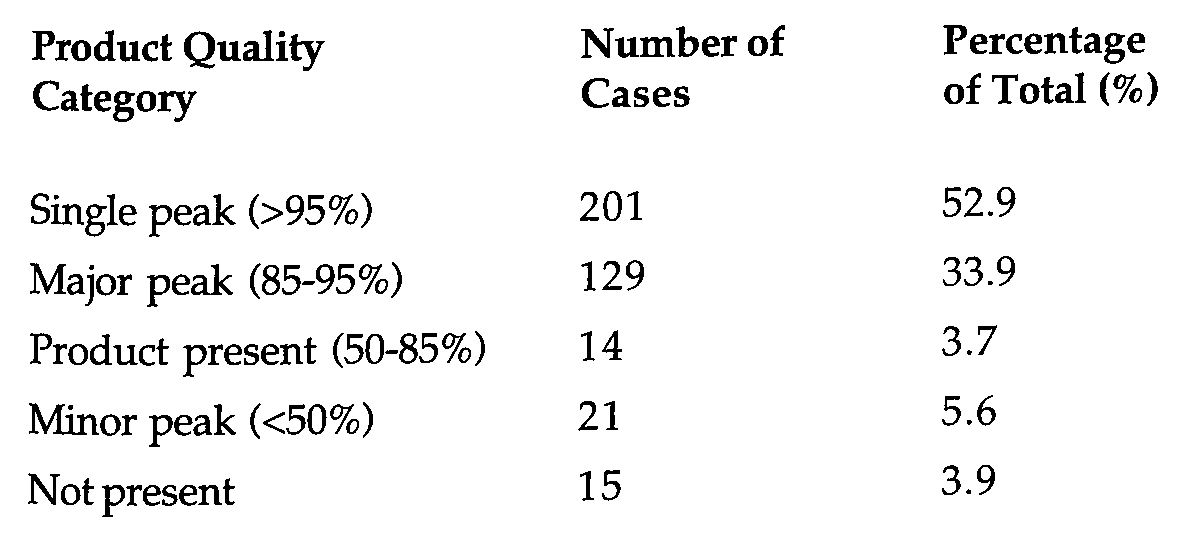
To demonstrate the simultaneous processing power of the tilted centrifugation technique, we have prepared an array of 380 substituted tetrahydroisoquinolinones. The protocol for the synthesis was developed earlier in our laboratories 5 and therefore we could compare our results with the results obtained in the solid phase synthesis performed in so called “tea bags” (technique developed earlier by Houghten 6 ). Synthesis was performed in four shallow-well polypropylene microtiterplates using Tentagel resin (0.24 mmol/g, Rapp Polymere, Tubingen, Germany). Products of the synthesis were cleaved by trifluoroacetic acid and extracted by Multiprobe 104. Extracts were transferred to deep well polypropylene microtiterplates and evaporated in SpeedVac. All wells were analysed by LCMS. Purities of prepared compounds were ranked into four categories and the results are given in Table 1. In general, the results of centrifugation synthesis were found superior to results obtained earlier in “tea bag” synthesis.
Analyses of crude products. Purities were evaluated by HPLC on the reversed phase (Vydac C-18,10 × 0.2 cm, gradient 0 to 70% acetonitrile in water/0.05% trifluoroacetic acid in 7 min, HP 1060) with total ion current trace generated by mass spectrometer (Finnigan Mat LCQ) as detector.
Conclusion
We have found tilted centrifugation to be the most effective and simplest method for liquid removal from multiplicity of vessels and polypropylene microtiterplates ideal reaction vessels for tilted centrifugation based synthesis. The fact that tilted centrifugation is the only way for removal of liquids from unlimited number of reaction vessels simultaneously is suggesting its application in ultraminiaturized synthesizers.