



Abstract

In an age of diverse computer systems, the development of a computer communication system, both hardware and software, to support communications between a variety of systems is essential. Communication hardware may be implemented with several forms of medium such as shielded twisted pair, non-shielded twisted pair, coaxial, infrared (IR), radio frequency (RF), and fiber optics. The hardware system may be configured with various toplogies such as bus, star, ring, or mesh. Furthermore, the communication software for the purpose of communicating between two computer systems from different manufacturers or different models from the same manufacturer can pose an even more time-consuming and expensive task. In today's world of computer networking, it seems every manufacturer uses their own data format and protocols.
This variety of vendor proprietary protocols creates a scenario of customization for integration of any computer network system. In essence, the cost and time-to-market of many systems increases with the lack of a standard computer communication protocol. Many customers are in a position to require that a standard protocol be implemented in their products. Therefore, many of these computer system manufacturers would benefit from the use of a communication standard that is widely accepted, and feel it will make their products more marketable.
The chore of implementing a protocol that everyone in a particular industry can agree upon for their computer communication requirements can be a monumental task. To be able to develop this standard as one project would be a much too complex project to handle independently. There exist many different types of computers today that differ in operating system, CPU, character set, speed, mass storage characteristics, network interfaces, etc.
There is an assortment of standards organizations today including Consultative Committee for International Telegraphy and Telephony (CCITT), International Standards Organization (ISO), Industrial Technology Institute (ITI), National Institute of Standards and Technology (NIST), and the Institute of Electrical and Electronics Engineers (IEEE). These organizations have published a collection of standards for a variety of requirements. Unfortunately, these standards are not complete standards that can be universally implemented for an open system environment.
In 1977, the International Standards Organization (ISO) established a subcommittee to develop an architectural design to breakdown the task of communication between a variety of computer systems to several sub-tasks. This “divide and conquer approach” made the task of instituting an open system protocol more manageable. It accomplished this task by breaking this large communication problem into several small problems that could be more easily solved by the better understanding of each small problem to solve and optimizing its solution. This model of a framework for the development of an open communication system standard was adapted in 1984 and is known as the Open Systems Interconnect (OSI) Model.
To establish this concept of sub-tasks for open system standard development, the idea of layering was used. Each small problem to solve, sub-task, was represented by a layer on a vertical partition of a problem structure. The OSI Model contains a total of seven layers, or partitions, to create a structure of a vertical stack. Seven layers were chosen as a manageable number of sub-tasks to solve without becoming overwhelming to the standard developers. Likewise, seven layers allowed the sub-tasks to be broken down into solvable sized problems.
These seven layers must be represented by the communication standard in both computer systems that are communicating with each other. Only the lowest layer on each vertical stack, known as the Physical layer, is directly communicating between the computer systems. The computer system's other six layers on the OSI stack communicate with the equivalent layer on the connected computer system and must accomplish this by sending its message through the OSI layers below it on its own computer's vertical stack and back up the remote computer's vertical OSI stack.
Generically explained in the simplest terms: layer N uses the services of layer N-1 and provides services to layer N+1. Each layer must determine what its peer layer, on the remote computer system's vertical stack, is requesting. The information package that is sent between communicating systems contains a section of control information that is known as the header. This header contains the request from the equivalent layer of the communicating computer. The rest of the package that the layer receives is known as data. Each layer views a message as having two parts: header and data. Each layer will add its own header and the previous layer's header will then become part of that header's data. The package will then be handed down to the layer below it on the vertical stack. The receiving computer system strips off the headers in reverse order as it climbs up its vertical stack of layers and performs its services for the layers above it.
The concept of the OSI Model is an abstract plan to create an open system communication standard. The OSI Model itself is not a complete standard. It alone does not implement computer communication between computer systems. It requires a process known as the protocol. A protocol is a set of specifications that dictate a specific implementation of the OSI Model and when adapted by a standards organization becomes a standard. This standard protocol provides better flexibility, reliability, and modularity than non-standardized methods.
Below is a brief description of each of the various OSI layers:
Physical Layer:
This layer defines the mechanical, electrical, functional, and procedural specifications of the communication link medium and link interface hardware, how they connect to one another, and how data is placed on and retrieved from the link medium. The layer contains the number and function of various pins in a network connector, how ones and zeroes are sent via electrical or other (RF, optical, etc.) signals over the network medium (ie. voltage levels, pulse widths, etc.), what type of cables may be used, and other related specifications. This layer is responsible for activation, maintenance, and deactivation of the physical connection between the two communicating computer systems. By activating the physical link, the transmission medium is prepared for two-way communication in both a synchronous and asynchronous method.
Data Link Layer:
This layer is responsible for organizing the physical layer's 1's and 0′s (bits) into
In addition, this layer must provide error detection caused by formatting errors or errors due to transmission. If the data link layer detects an error, it must retransmit the erroneous transmission. Furthermore, one of the data link tasks is identifying specific communicating entities on the communication system. This layer adds its additional control information to the data frame which usually include a source and destination address, and information about the frame. Finally, flow control is performed at the data link layer. Flow control is a form of traffic control of data transmission across the physical medium. Flow control's function is to indicate to the transmitting end of the communication link that the receiving end cannot process the incoming data quickly enough and there are no more receiving buffers available. When the receiving buffers become available, flow control makes the transmitting end of the link aware that the transmission of additional data may resume.
Network Layer:
This layer's objective is to move information across a network made up of multiple network segments, known as an internet. Each sub-network has its own network address. The destination network address is examined, and the data is sent to the next network node point. Each node point contains the logic necessary to decide what the next optimum node in the path to the receiving entity is by utilizing a realtime calculation or by looking up in a static table.
The network layer is different from the other layers of the OSI Model stack in one very important and complex way. It not only has to be involved in the transmission of data between the two communicating systems, but also the interconnecting sub-networks at this layer. The Network layer, in servicing the other sub-networks on the system, relieves the upper layer application from having to concern itself with the details of network communication such as routing, relay control, connection, and disconnection.
Transport Layer:
The Transport layer is considered the highest layer of what is grouped the “lower layers” (Physical, Data Link, Network, Transport). In general, the lower layers are most concerned with the transmission of data across the medium between two communicating computer systems in a reliable and maintainable fashion. First of all, the Transport layer ensures reliable data delivery by compensating for the lack of reliability in the layers below it. Secondly, this layer serves as a blockade so that the upper layers do not have to be concerned with actual transmission of the data form one system to another. If data is not delivered correctly at the receiving link, the Transport layer will inform the upper layers which eventually inform the user application software. The reliability is accomplished by orderly connection establishment and tear-down, confirmation messages (one end of the link informs the other end of the link it successfully received data), sequence numbers (one end of the link tells the other end of the link which data was received correctly), and flow control (one end of the link tells the other end of the link when sending rate should be slowed down). The Transport layer maps the transport address to the network address and establishes and releases transport connections. This layer also must multiplex data over multiple channels by dividing the messages into smaller groups of data for transmission. These segments of data must be recombined at the link's receiving end Transport layer. In addition, the Transport layer must provide end-to-end link control over error detection, retransmission, and flow control.
Session Layer:
The Session layer is the bottom of the “upper layers” of the OSI Model stack (Session, Presentation, Application). The upper layers are most concerned with the user's application requirements and specifications. The Session may operate knowing that if it releases or receives a data unit, it has been transmitted correctly from one end of the link to the other. The reliability of this transmission has been provided by the layers below the Session layer. This layer adds control mechanisms to the data that establish, maintain, synchronize, and manage dialog between presentation entities and communicating applications. It provides management of normal and expedited data exchange, as well as, all the interaction management. In addition to the session connection establishment and release with the Transport layer, it also handles upper-layer problems such as insufficient disk space or lack of paper for the printer.
Presentation Layer:
The communication between the Presentation layer and the Session layer is much greater than between other layers. This is due to the fact the Presentation layer does not add much to the data provided by the lower layers. Instead, it must concern itself with the organization of the data and how it will be presented to the Application layer. The Presentation layer translates the data into a format, or syntax, that can be understood by each user application. The syntax that the Presentation layer formats the data into is a standard protocol for the OSI Model. This syntax must be selected, or even negotiated, based on the computer system that it is running on. The layer forms a data structure that the application can utilize for the user application. In addition, it may expand and compress data, as well as encrypt and decrypt data.
Application Layer:
This layer specifies the communication interfacein use and manages this interface. It must provide and take from the user information after the intended user has been identified and given the authority for connection establishment. In addition, this connection establishment may include some mechanism for security of data, agreement of error detection and recovery, as well as data syntax usage. Finally, the Application layer services may include communication between computer applications, such as file transfer/access, network management, directory services, and mail transfer services.
Conclusion
Therefore, the important question to ask yourself when deciding what standard to use when implementing a computer communication system is whether the standard you have chosen is a standard at all. If we are following the guidelines of the OSI Model, you'd be hard pressed to find any existing standard that is a complete standard covering the full seven layer stack. We can choose from numerous so-called standards for communication, but they don't always cover all the layers of the OSI Model. Ethernet, for example, only covers the lowest two layers of the OSI stack. TCP/IP covers the OSI stack from the middle of the Network layer to the middle of the Session layer. Novell Netware covers the middle of the Network layer to the top of the Application layer.
So as you can see, being compatible with one standard that covers the entire OSI Model stack is not often found in computer communication systems. All these standards solve a piece of the communication problem but not all of it. In practice, a combination of standards that cover all the layers of the stack is usually implemented.
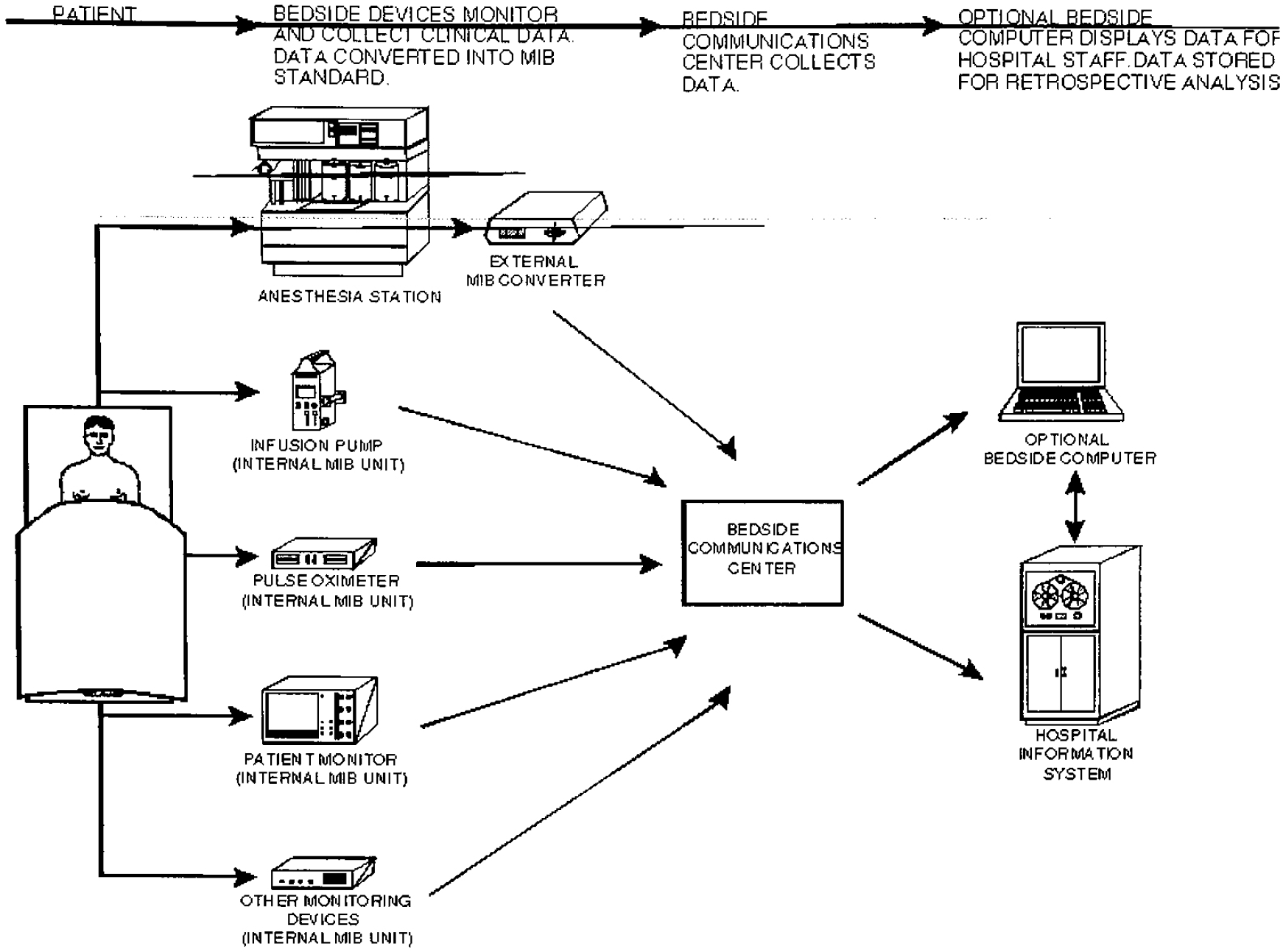
With the advent of medical automation on the horizon, the issue of data connectivity becomes more prevalent and the requirement of standardization in this area more pertinent. More and more devices are moving to the patients, not the patients moving to the devices. The IEEE 1073 Medical Information Bus (MIB) Standard challenges the medical industry of patient-connected medical data capture to communicate using a standard that was not only designed for the acute care environment but addresses the entire OSI Model 7-layer stack. Using the entire stack greatly reduces the integration time of a communication system by setting, not only physical hardware guidelines, but the upper layer software guidelines.
Presently, the MIB standard has IEEE 1073 published documents that address the Physical layer through the Transport layer. The IEEE 1073.4.1 Physical Layer Interface-Cable Connected Standard sets the MIB standard for the Physical layer of the OSI Model stack. The IEEE 1073.3.1 Transport Profile-Connection Mode Standard addresses the Data Link through Transport layer of the OSI Model stack. Both of these standards became published IEEE standards in December of 1994.
Furthermore, the upper layers covering the Session through Application layers of the OSI Model are under development. These upper layer standards will consist of two key components: the IEEE 1073.2 Medical Device Application Profile (MDAP) and IEEE 1073.1 Medical Device Data Language (MDDL). The IEEE 1073.2 Medical Device Application Profile (MDAP) Framework and Overview passed ballot approval in November, 1995. This Framework and Overview specifies the use of mOSI (minimal OSI Model implementation), a streamlined version of the OSI Model upper layers: Session, Presentation, and Application layers. The upper layer documents will dictate a standard application encoding rule set, as well as a standard set of terminology and parameters based on the specific medical device type-By incorporating the MIB standard that addresses the entire OSI Model, the medical industry will now have a “complete” standard that covers the entire task of implementing computer communications. The standard not only addresses the bedside environment but allows for the internetworking of these local bedside MIB networks to the hospital host information system using the existing hospital information network system and topology. In addition to the standard being specifically designed for the acute care environment, the use of the entire OSI Model will allow rapid time-to-market for patient-connected devices that enable true “Plug and Play” design, from hardware to software. In an industry as technologically advanced as the medical industry, it is only fitting that such an advanced communication standard addresses this field as it enters the age of automation.