




Abstract

New Sciences Creating New Opportunities
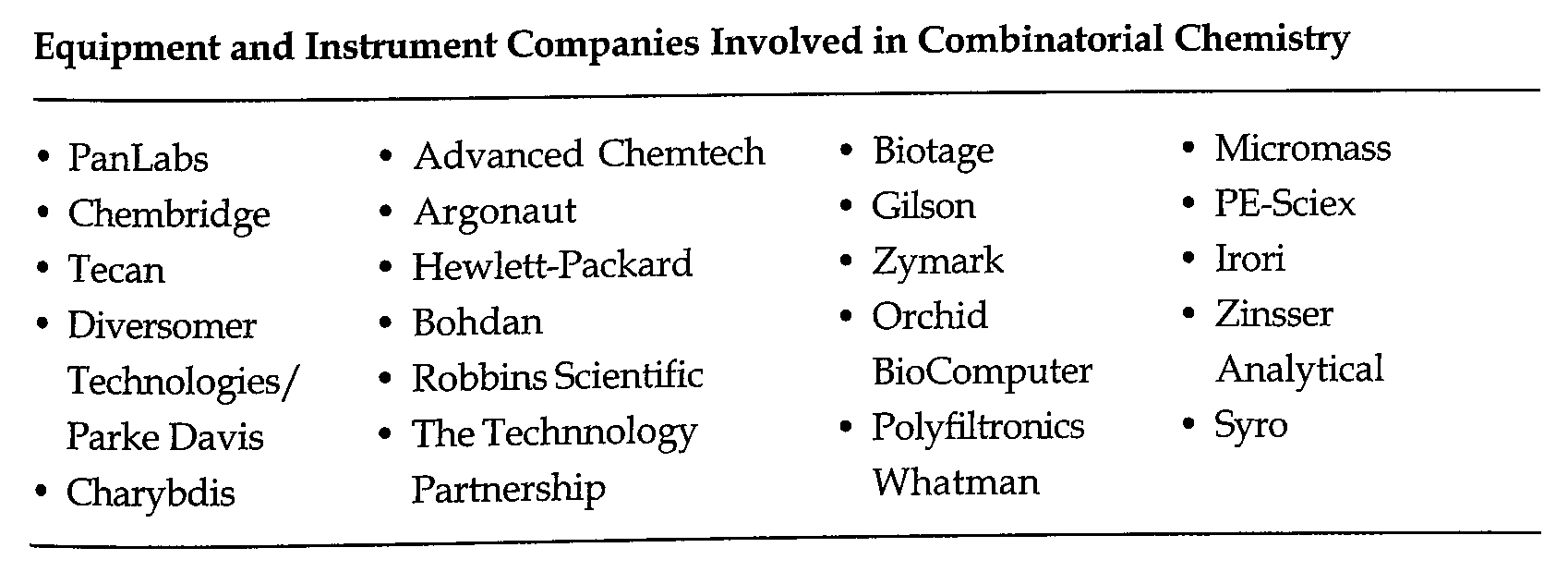
Combinatorial techniques continue to evolve at a blinding pace. New vendors of combinatorial technology are appearing on the market every month (see the table below) as chemists, who were early adopters of this exciting technique, realize that there is a good market for hardware and expertise. The high demand for this technology centers around its ability to create large libraries of drugs rapidly.

Traditionally, medicinal chemists synthesized compounds one by one and then passed them on to the screening laboratories. Using combinatorial chemistry techniques, it is not unusual for a medicinal chemist to increase their productivity from 50 compounds per year to 1,000's per year!
What will be the impact of such high rates of production? Certainly, the medicinal chemist will become the fair haired child of the pharmaceutical industry. High rates of productivity and presumably an increased rate of novel pharmaceutical lead generation will translate into elevation of the status of the combinatorial group within the pharmaceutical enterprise. There is a trend toward increased funding of medicinal chemistry groups in the industry. However, increasing the rate of one process without concomitant increase in all aspects of drug development will lead to a shifting of the burden to the next bottleneck in the production chain. Creation of new bottlenecks will lead to new opportunities for pharmaceutical development scientists to create new technologies (and new businesses) to improve the development effort.
The lead story in this issue focuses on the purification of the products of the prolific medicinal combinatorial chemist. While the industry is excited about the prospects of thousands of new compounds, medicinal chemists and pharmacologists are cautioning that there is a need to clean up and purify this bountiful harvest. Biotage, and its competitors have developed novel HPLC technology that will reduce the burden of post-synthetic purification and concentration. Furthermore, Biotage has made a significant investment in one of the most important aspects of parallel synthesis, information handling. As the purification technologies mature, look for a movement from parallel to massively parallel purification techniques in the near future.
Equipment and Instrument Companies Involved in Combinatorial Chemistry
Mass spectrometry is emerging as the most promising analytical technique to handle the needs of large scale drug development. Mass spectrometry was once reserved for esoteric drug analysis projects due to its complexity, relatively high cost, and slow throughput. Technological advances have promoted the mass spectrometer to be the leading tool in the drug discovery arsenal. The article which begins on page 28 highlights the use of the mass spectrometer for high throughput analysis of peptides.
The wide array of high productivity technologies that are appearing in pharmaceutical laboratories across the world is fueled by the need to develop new thrapeutic compounds quickly. Laboratory automation is at the forefront of technologies that will significantly reduce the cost of health care. This theme was pervasive throughout the LabAutomation conference held in San Diego in January (reviewed on page 17). The success of this year's meeting emphasizes that laboratory automation is a stimulating science of evaluation, understanding, reengineering, and producing that will continue to offer opportunities for the brightest minds in the field.
Sincerely,
