




Abstract
New methodologies for the quantitation of drugs and metabolites in biological fluids have increased the need for automation. A growing application area for sample preparation is the automation of solid phase extraction (SPE). An automated SPE solution based on the new 96-well microplate format (opposite) has proven to be a successful alternative to manual extraction procedures. This format makes it quite attractive to automate with the MultiPROBE, figure 1 (Packard Instrument Company, Meriden, Connecticut, USA) and, when coupled with analysis by liquid chromatography and mass spectrometry (LC-MS), a five fold increase in sample throughput can be achieved.
Introduction
Solid phase extraction is a common procedure utilized in many pharmaceutical biometabolism laboratories. These departments often screen biological fluids (e.g., serum, plasma, and urine) for drug metabolites as part of clinical trials. In the past, these samples were analyzed by HPLC or GC. Since analysis of a single sample often took up to 15 minutes, manual pipetting procedures or single tip automation for sample preparation was acceptable. New technologies such as LC-MS have provided higher sensitivity and specificity in addition to faster analysis. A single sample is now analyzed in two to five minutes. In addition, LC-MS requires less sample. As a result of this shift to faster analytical methods, the process bottleneck has now become sample preparation.
The need for high throughput sample preparation and the ability to miniaturize has led to the creation of the 96-well solid phase extraction (SPE) block. These blocks have begun to replace larger column technologies, which required much more elaborate automation solutions. The blocks are similar in size to a standard deep-well block with sorbent material placed in each well. In addition, each well has a funnel at the bottom, allowing liquid to flow through the sorbent and out of the well. Solid phase extraction blocks in 96-well format are available from a variety of suppliers, including the 3M Company (St. Paul, Minnesota, USA) and Porvair Scientific (Shepperton, UK); see Figure 2.
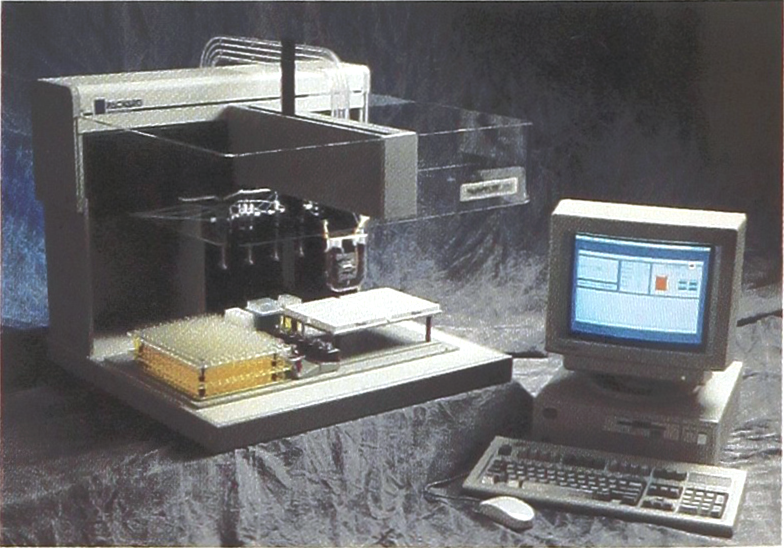
Packard MultiPROBE 104
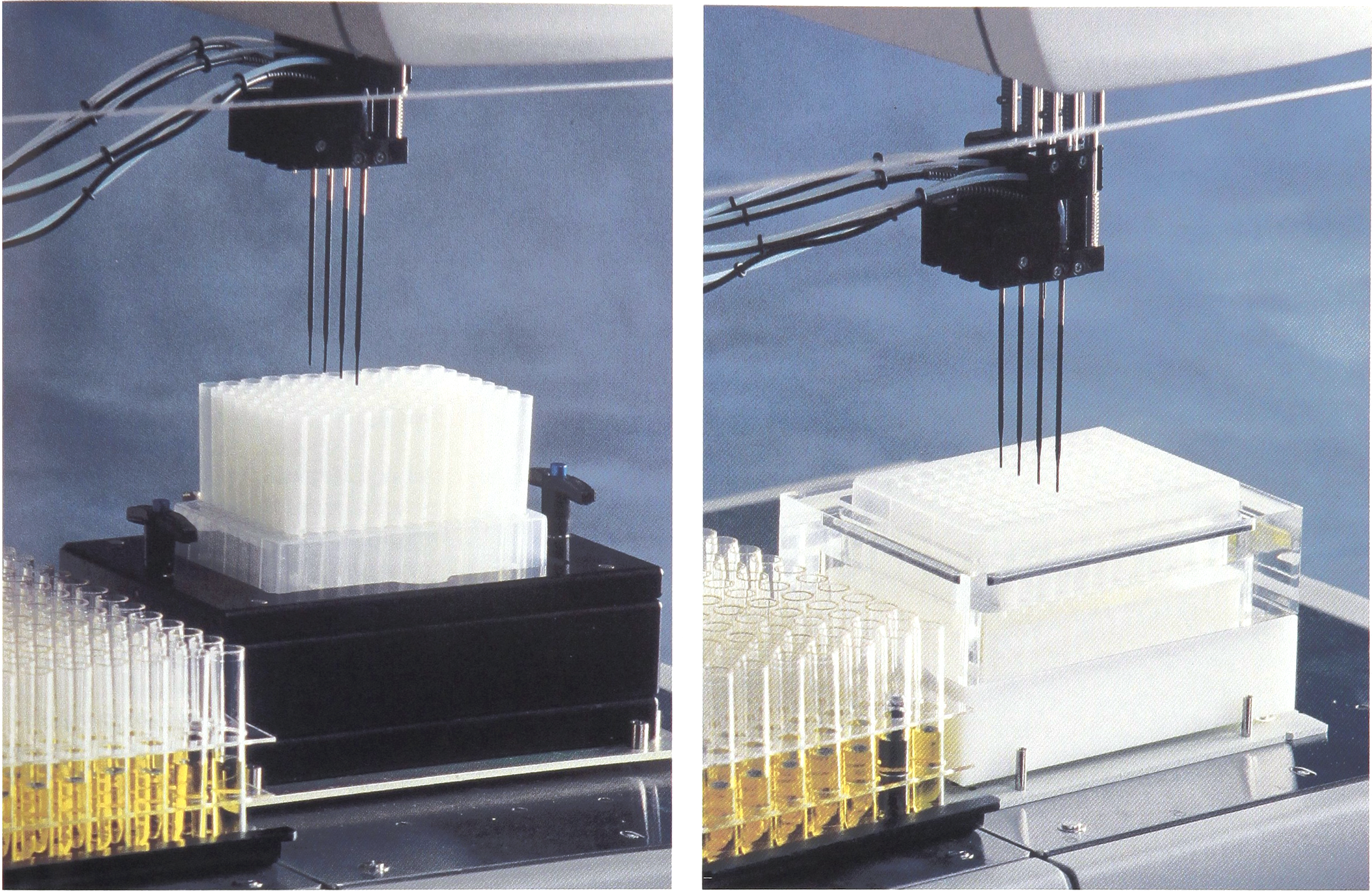
A variety of vacuum manifolds can be incorporated directly onto the deck of the MultiPROBE for automation of all liquid handling steps and direct vacuum control
The SPE Procedure
There are a variety of different SPE products available based upon the type and quantity of separation material required. For any of them, the process of SPE is very similar. It consists of four stages: column conditioning, sample loading, column washing and elution.
Column conditioning prepares the sorbent material to extract the metabolites of interest from the sample. A series of different solvents are added, including methanol, water, buffer, and acetonitrile and others in varying volumes and concentrations. After each conditioning reagent is dispensed to the wells, the user must apply vacuum to the block. The vacuum pulls the reagent through the separation material in the wells. After applying vacuum, the next reagent is added to the wells and the vacuum is again applied. The liquid that flows through the wells (eluant) is evacuated as waste.
After all conditioning reagents have been applied, samples are loaded into the SPE wells. The samples are bodily fluid samples taken from humans or animals who have been taking the drug. Each of the 96 samples is dispensed into a separate well. In addition, an internal standard is dispensed into the well along with the serum. The drug metabolites will be attracted to the separation material and will attach to it. Vacuum is then applied. Again, any liquid that flows through the wells is evacuated as waste.
After sample loading the sorbent is washed with the same solvents used in the conditioning process. Typically the order of addition will be reversed. Eluant is again evacuated as waste.
Finally, an elution reagent is added to all wells and vacuum is applied. The elution reagent releases the metabolites from the sorbent. Now, the eluant is collected into a 96-well format collection plate. The type of plate chosen, standard or deep-well will depend upon the volume of eluant. Before analysis in the LC-MS, the eluant may be concentrated. The deep-well block will then be transferred onto the deck of an autoinjector for injection into the LC-MS.
MultiPROBE Automation of SPE
Typically, the MultiPROBE is used in a semi-automated mode for SPE. In semi-automated SPE, the MultiPROBE automates all of the liquid handling steps. Just prior to elution, the user places a 96-well collection plate into the vacuum manifold, and then the remainder of the application is completed by the MultiPROBE. Figure 3 illustrates the steps required to complete an example assay by both the user and the MultiPROBE. The volumes and reagents referenced in Figure 3 are used for purposes of example only.
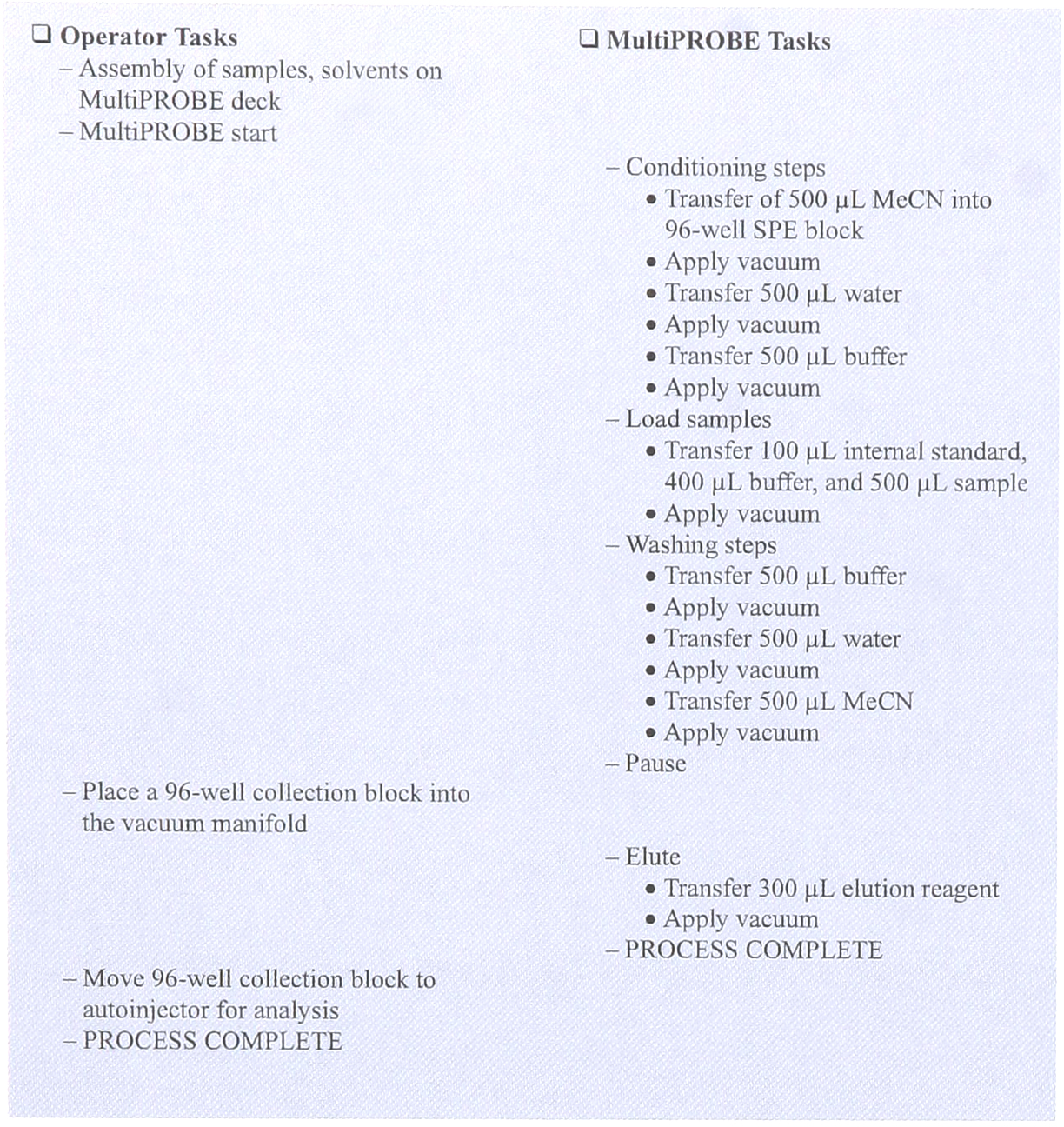
Automation of an example 96-well microplate SPE process with the MicroPROBE
In addition to labware for samples ant reagents, the vacuum manifold may also be placed directly on the deck of the MultiPROBE. The flexible deck design of the MultiPROBE allows an adapter plate to be placed on the deck that reproducibly positions the vacuum manifold. The 96-well SPE block is placed on top of the manifold. In this way, all the liquid handling steps can be completed with a minimum of user intervention. Figure 4 illustrates a typical MultiPROBE deck layout for SPE.
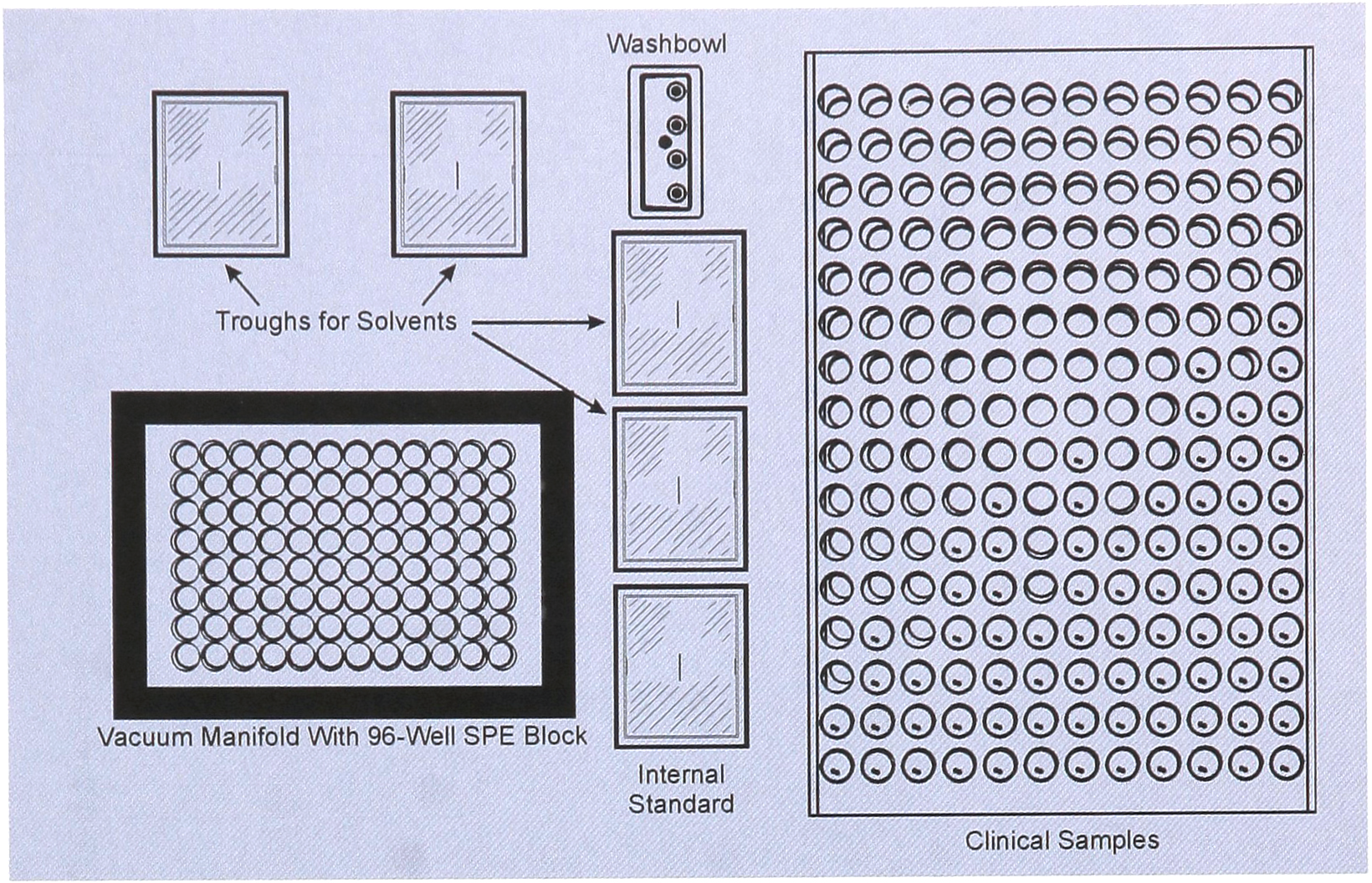
An example of the Multi PROBE deck layout for SPE
All liquid handling steps are easily programmed using EasyPrep, the user interface and applications development software for the MultiPROBE. Each reagent or sample addition is a single test. This modular approach enhances application development, enabling new SPE methods to be quickly developed by using currently existing tests as building blocks to create a new assay.
The samples prepared for analysis with SPE are typically human plasma or urine, and there is significant variation in the volume from one sample to the next. Independent liquid sensing allows the user to place the sample directly onto the deck of the MultiPROBE, eliminating the need for additional sample preparation steps. The samples used in SPE procedures are most commonly delivered in tubes to biometabolism labs. Since the wells of the SPE blocks are in microplate (9 mm) format, Varispan™ enables four tip sample processing in both the sample tubes and the SPE block, thereby enabling maximum multi-tipped throughput.
The MultiPROBE is also used to control the application of vacuum to the 96-well SPE block. By use of commonly available power switching hardware, vacuum can be applied to the manifold to effect the flow of sample and reagent through the sorbent material. Control of the switching hardware is effected from within the EasyPrep test, allowing for seamless integration of the vacuum application with liquid handling steps. Control of the amount of vacuum applied to the SPE block is achieved by opening and closing a valve which is placed in-line with the vacuum and manifold. The user can control the duration and number of vacuum pulses applied to the 96-well block on a test by test basis, so that each step of the process can have a unique vacuum application.
Occasionally, a well will become blocked and liquid will not be able to flow through the sorbent. This typically happens after sample is loaded into the wells. If a washing or elution reagent is later dispensed into a blocked well, it will overflow and contaminate adjacent wells in the SPE block. To overcome this problem, after samples have been loaded and vacuum applied to the 96-well block, the MultiPROBE checks each well to determine if it is blocked by using liquid level sensing. If a well is found to contain an excessive volume of liquid, that well is defined to be blocked and is excluded from further processing. A list of the wells which were blocked will be displayed to the user and may be archived to a file.
In addition to checking for blocked wells, liquid level sensing plays a crucial role in other parts of the SPE application. All of the commonly used solvents in SPE, even methanol and acetonitrile, are readily sensed by the MultiPROBE. In addition, ultrasensitive liquid level sensing allows the use of minimal volumes of precious samples without the need to overimmerse the sampling tip.
Before the elution reagent is added to the SPE block, a 96-well microplate is manually placed inside the vacuum manifold. As the vacuum is applied, the eluant from each well is collected in the collection plate. This plate can then be moved to an autoinjector for injection and analysis via LC-MS.
Discussion
The trend toward the application of LC-MS by drug metabolism labs to analysis of clinical samples in high throughput laboratories will continue due to its sensitivity, specificity and speed. As a result of the gain in analytical throughput sample preparation will become the rate limiting step. These labs will discover that additional resources will have to be applied to the automation of sample preparation. The ability of the MultiPROBE to respond to diverse sample preparation requirements will prove to be a critical element in responding to these demands. EasyPrep supports all of the liquid handling steps for SPE: column conditioning, loading, washing, and eluting. EasyPrep meets sample preparation requirements to spike samples with internal standard or to dilute them with buffer prior to column loading.
Ultimately, any measure of the success of a biometabolism lab must include a measurement of how quickly samples are analyzed. The combination of sample preparation on the MultiPROBE and analysis by LC-MS has been found to result in up to a five fold increase in throughput over traditional methods of sample preparation and analysis. In addition, the design of the sorbent material in the 96-well blocks creates uniform flow rates in all wells. Excellent well-to-well reproducibility of results means that biometabolism labs have a reliable means of achieving quality and high throughput. The trend towards 96-well SPE will continue to grow.