




Abstract

Automate and integrate, and
Learn to use information technology as a strategic tool
Although the “corporatization” of health care in the United States is not complete, it is far enough along for the practical purpose of decision making. After all, two-thirds of employer-insured people are in managed care. HMOs now operate in 46 of 50 states. The rates of mergers and acquisitions show signs of peaking. Large integrated players are emerging and pervasive profit motivation has set in.
In my interpretation, the value of diagnostic information in this wide-area, integrated environment is higher than in the former days of stand-alone hospitals treating an in-patient population. The laboratories that will do well are those that automate their “plant” floor and develop the skill to use information management as a marketing and service tool.
Market Share is Key
In “corporatized” health care, market share is key. In the long term, the market will favor those providers who pay attention to cost, quality of care, treatment outcome and patient satisfaction. Since the laboratory makes a significant contribution to those measurements, its leverage will increase. If I were a hospital director, I would automate the laboratory because a good automation program:
has the potential to help with labor costs which would help the hospital's margins,
can significantly speed up turnaround time and reduce processing errors, both of which contribute to the quality of care and to patient satisfaction,
could bring to my lab some of the efficiencies of commercial laboratories,
would increase capacity, which may be important in consolidating workload from other institutions, and
may help to cut the volume of blood needed for testing, contributing to patient comfort and satisfaction.
Non-Automaters May Fall Behind
I would automate because the laboratory could make a significant contribution to my corporate mission and because my competitors are expected to automate. EAC estimates that by the year 2001, there will be between 700 and 1,300 automated installations. Laboratory automation product and services revenues are expected to rise dramatically over the next 10 years to nearly $ 1.4 billion by 2006 (Figure 1).
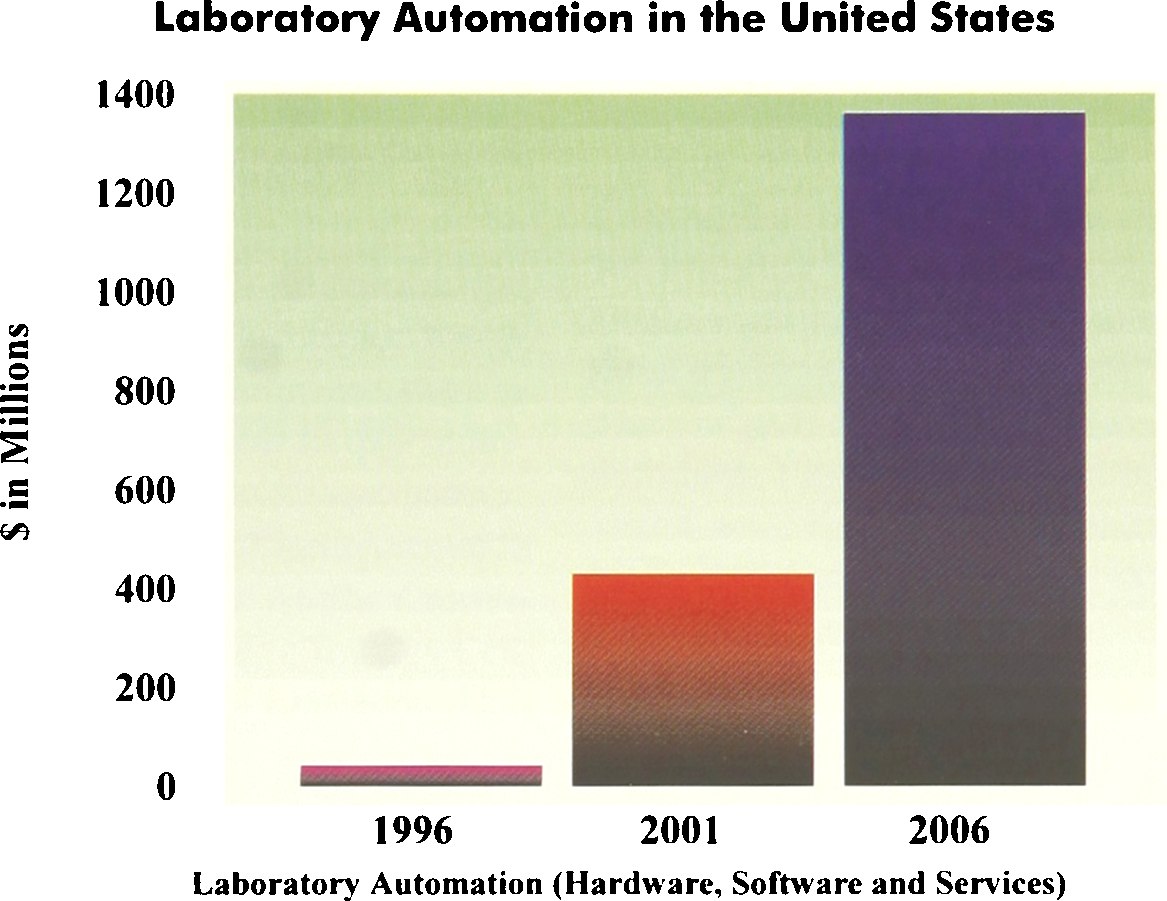
Anticipated laboratory automation growth in the United States over the next 10 years (© 1995, Enterprise Analysis Corporation).
I might automate the front end first, the back end second, robotic loading and unloading next, and finally, sample transport. The point is, I'd definitely start an automation program.
In fact, if my lab were considered to be one of the few “superlabs,” I might consider automating the entire laboratory all at once.
Information Technology as a Competitive Tool
Several providers have already begun to install computer-based patient record (CPR) systems, which I see as the gateway to digital medicine. I see decision support (expert or knowledge-based) systems starting to trickle down from the CPR level and I would employ them in:
In-bound services to optimize orders
Intra-lab processes which offer far better, dynamic QC (new technologies like biological validation)
Out-bound services for medical interpretation for physicians
Combining these knowledge-based, value-added services with wide-area communications (wireless or wired) techniques would differentiate my hospital and laboratory and elevate laboratory science to a higher scientific and commercial level.
Final Thoughts…
My laboratory of the future would be integrated, automated and highly skilled in the use of advanced information technology tools. It would also be a solid platform of laboratory science capable of competing effectively in a commercial arena.
Company Profile
Enterprise Analysis Corporation (EAC) is a Connecticut-based, international consulting company serving the diagnostic health care industry. EAC consultants work with manufacturers, hospitals, commercial laboratories and standard-setting organizations providing fact-based market research to support marketing, R & D, strategy assessment and product development and management.
In addition, EAC provides technical expertise in laboratory integration and automation. Their goal is to challenge clients in strategic or tactical terms in order to provoke insights and to improve decision-making and understanding.