




Abstract
In the early stages of drug discovery, high-throughput screening (HTS) of compound libraries against pharmaceutical targets is a common method to identify potential lead molecules. For these HTS campaigns to be efficient and successful, continuous quality control of the compound collection is necessary and crucial. However, the large number of compound samples and the limited sample amount pose unique challenges. Presented here is a proof-of-concept study for a novel process flow for the quality control screening of small-molecule compound libraries that consumes only minimal amounts of samples and affords compound-specific molecular data. This process employs an acoustic sample deposition (ASD) technique for the offline sample preparation by depositing nanoliter volumes in an array format onto microscope glass slides followed by matrix-assisted laser desorption/ionization mass spectrometric (MALDI-MS) analysis. An initial study of a 384-compound array employing the ASD-MALDI-MS workflow resulted in a 75% first-pass positive identification rate with an analysis time of <1 s per sample.
Introduction
High-throughput screening (HTS) of compound libraries against pharmaceutical targets is a common method to discover potential lead molecules in the early stages of drug discovery. A centralized compound management (CM) organization typically stores these compound collections as dry materials or as discrete solutions in DMSO in a controlled environment. Due to potential chemical degradation, particularly after long storage periods, 1 or database discrepancies, the continuous quality control of the inventory is a prerequisite for an effective lead discovery screening operation since the HTS paradigm focuses on compound identity. Screening hits and lead compounds are resynthesized by medicinal chemists with high purity for retesting and to expand on the core chemical structure.
For the quality control on compounds to be an efficient process, it should utilize molecular-specific detection to afford data on structural integrity, perform the analysis with rapid turnaround due to large sample numbers, and consume only minimal amounts of limited and valuable sample.
Current methods for small-molecule analysis utilize an in-line liquid chromatography (LC) system for sample introduction coupled with a UV detector for purity assessment and a mass spectrometer (MS) for specific detection affording LC-UV/MS data. 2 However, compound consumption, sample preparation, online sample manipulation by the LC autosampler, and analysis time are concerns when dealing with library collections within CM.
Matrix-assisted laser desorption/ionization (MALDI-MS) is an alternative MS technique that can be employed for molecular analysis. Due to the requirement of a matrix to assist in the ionization of the analyte, this technique has been historically used for high-molecular-weight compounds, that is, peptides and proteins, while small-molecule analysis has been limited primarily due to the interference of matrix noise with the analyte signal.3,4 Sample preparation has also been a constraint, as typically MALDI spots are prepared with relatively larger volumes (1 µL) using a pipetting system resulting in nonhomogeneous co-crystallization that may translate to poor shot-to-shot reproducibility. However, MALDI-MS has advantages, as it requires only minimal sample amounts for analysis and permits a short analysis time per sample (<1 s).
Acoustic sample deposition (ASD) is a noncontact liquid handling technique employing focused sound waves to transfer nanoliter volumes of compound solutions between assay plates without using consumables such as pipette tips and which also generates no sample waste. This technology can rapidly and accurately deposit or “print” solutions in standard or custom arrays onto flat surfaces or well plates.5,6 A notable application of ASD in the context of MS assays is the deposition of MALDI matrix onto tissue sections for analyte profiling by imaging MS.7,8
Presented here is a proof-of-concept study on a novel process flow for quality control screening of compound libraries. ASD is first utilized to print a MALDI matrix in arrays on microscope glass slides and then to overlay with compounds. Next, the slides are placed onto a MALDI target carrier and submitted to analysis by MALDI-MS. The obtained data are then processed to qualify the analytes. The ASD-MALDI-MS methodology consumes only a small amount of compound, requires only low-cost glass slides, and affords rapid analysis times.
Materials and Methods
All reagents were obtained from Sigma-Aldrich (St. Louis, MO) unless otherwise indicated. All compounds were obtained from Bristol-Myers Squibb’s (Wallingford, CT) compound collection. The indium tin oxide (ITO)–coated glass slides and a MTP Slide Adapter II were obtained from Bruker Daltonics (Billerica, MA).
The MALDI matrix α-cyano-4-hydroxycinammic acid (CHCA) was prepared as a 7.5 mg/mL solution in 70% acetonitrile, 30% water, and 0.1% trifluoroacetic acid. Compounds were diluted using a Tecan Freedom EVO from 10 mM (DMSO, liquid storage) to 300 µM with DMSO and transferred to a µClear 384-well nonbinding plate (Greiner Bio-One, Frickenhausen, Germany). Acoustic sample deposition was performed using the Acoustic Transfer System (ATS-100) Biosero (San Diego, CA) and TransferTrack software for plate map generation from the 384-well source plate onto the glass slide. Samples were prepared on the ITO-coated glass slides by first spotting the matrix (5 nL), drying the slide under vacuum for 2 h, spotting the compounds (20 nL), and then finally drying under vacuum before analysis. Mass spectral data in full-scan mode were acquired on a Bruker UltraFlex III MALDI-TOF/TOF using system control software FlexControl and data analysis software FlexAnalysis.
Results and Discussion
Process Flow for Quality Control Screening of Compound Libraries
For compound libraries to be efficiently and successfully screened against pharmaceutical targets, a quality control process for the chemical entities needs to be in place This procedure should require only a small amount of analyte, be performed with fast analysis times, and be automatable. A novel process flow was developed to address these requirements utilizing acoustic sample deposition (ASD) and MALDI-MS, which is demonstrated with a proof-of-concept study for compound quality control screening. As illustrated in Scheme 1 , a MALDI matrix and compounds are printed via ASD in layers in an array format onto glass microscope slides, which are subsequently submitted to analysis by MALDI-MS. The acquired data are then processed offline.

Process flow for quality control screening of compound libraries by ASD-MALDI-MS methodology. Small volumes (nL) of MALDI matrix and samples are printed onto glass microscope slides via ASD. An analysis (<1 s per sample) is then performed via MALDI-MS. Lastly, the acquired data are processed and reviewed offline.
Optimization of Acoustic Sample Deposition and Matrix Ratio
Compound analysis by MALDI-MS requires the sample and a matrix to be co-spotted onto a MALDI surface. Several techniques are being used for sample preparation: premixing the sample with matrix prior to spotting the mixture onto the MALDI target, or a layering approach where the matrix is spotted first and then the sample is placed on top of the matrix spot.
To enable automated sample handling and to minimize compound usage, ASD was used to first spot the MALDI matrix and then to overlay the sample. The minimum amount of MALDI matrix needed for ion generation was determined by printing increasing volumes onto the glass slide to assess the feasibility of locating the sample, to generate ions, and to collect data. Figure 1A depicts the shape of a 1 µL spot applied manually. Figure 1B is a 2 nL spot generated from a single shot from the acoustic dispenser, and Figure 1C is a 20 nL spot generated from multiple iterations of 2 nL dispenses. The efficiency of ASD technology is shown by the uniformity of the shape of a 2 nL spot in comparison to the 1 µL spot, and that the 2 nL spot was sufficient for MALDI-MS data collection. Reduction in the requirement of the spot size correlates to a reduction of compound material needed and time required for drying and improved laser shot-to-shot reproducibility.
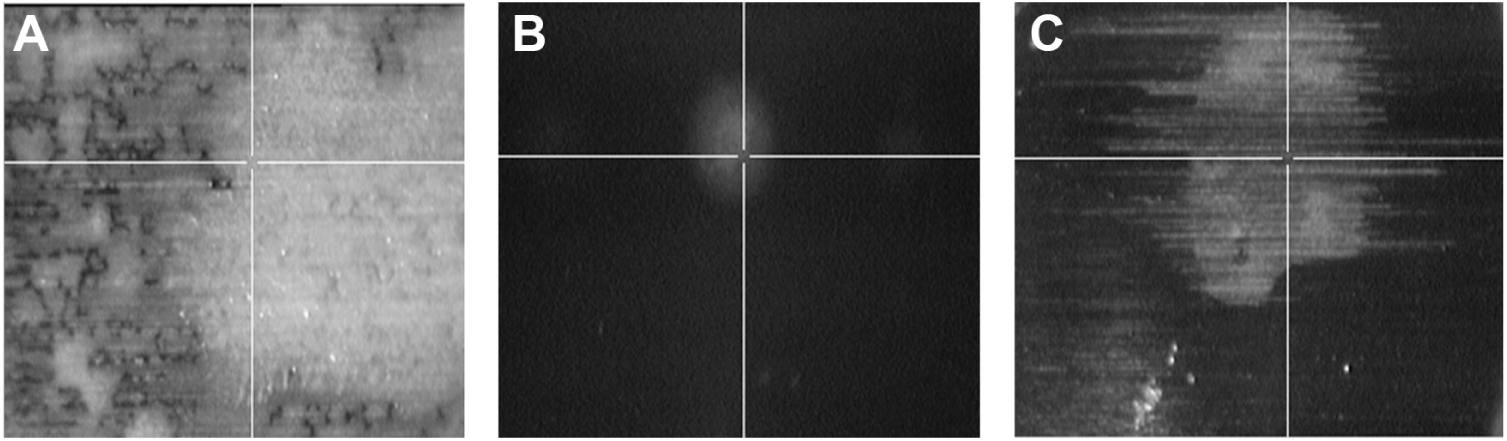
The system control software of the MALDI-MS instrument needs to be able to recognize sample spots on the glass microscope slides in order to execute automated sample analysis. A comparison is shown of (
Improvement in the applications of the MALDI spots allowed a systematic evaluation of the matrix-to-compound ratio needed for data analysis. Figure 2A displays the data collected from a 1:1 overlay of the matrix-to-compound ratio, the common application procedure for MALDI-MS. Small-molecule analysis using this matrix ratio is complicated due to the additional signals from the matrix. Modifying the matrix-to-compound ratio to 1:4 (by reducing the matrix volume while keeping the compound volume constant) afforded an improved compound signal (verapamil at m/z 455.3) with minimal matrix interference ( Fig. 2B ).
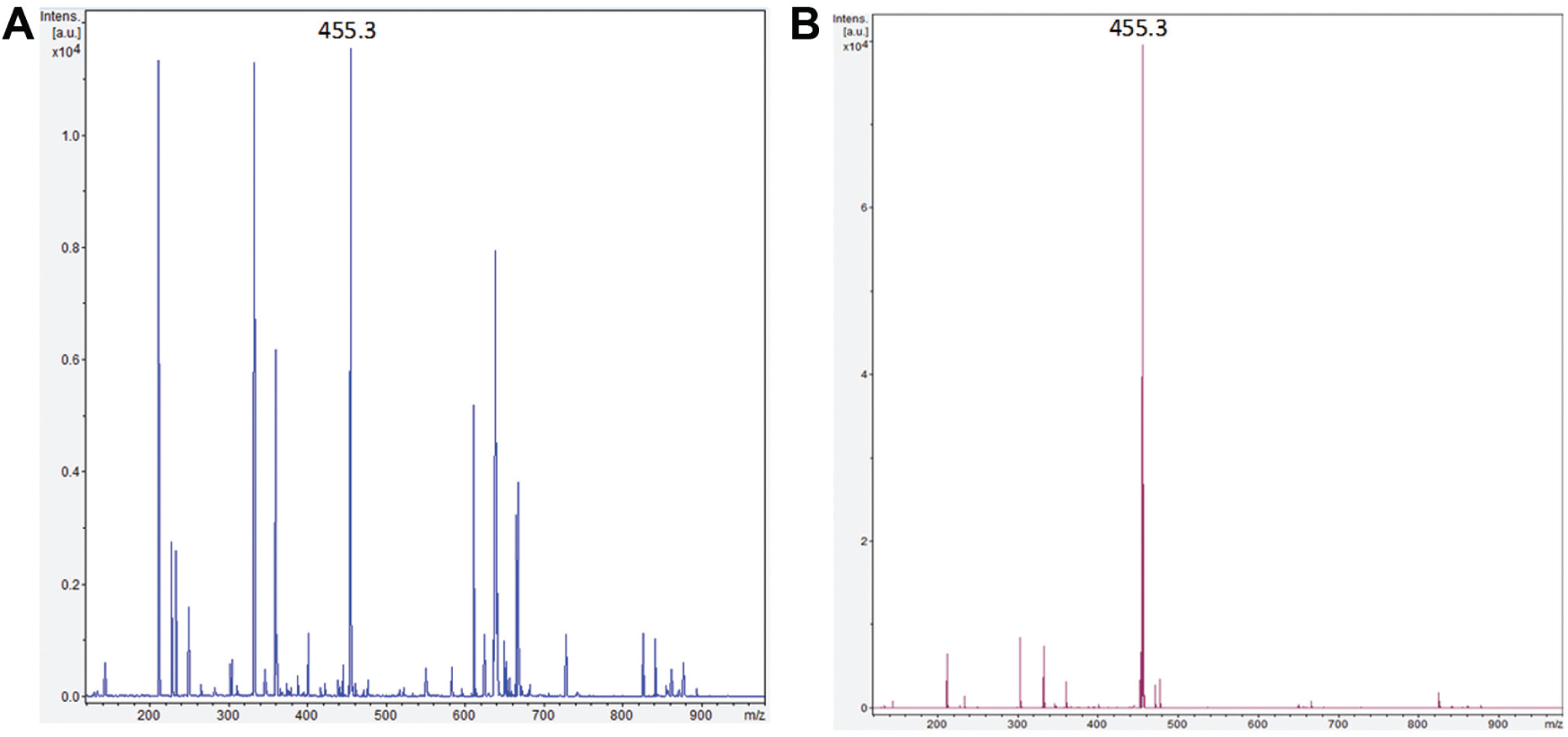
The required matrix for MALDI-MS applications generates background ions in the low-molecular-weight region that can interfere with the detection of analytes. (A) Spectrum of a 1:1 matrix-to-compound ratio where the desired compound (m/z 455) is hidden among background ions. (B) Improved spectrum resulting from a matrix reduction to a 1:4 matrix-to-compound ratio.
The reduction in sample volume and thus spot size offered an opportunity to print dense sample arrays that exceed typical MALDI target plates (1536 spots), so disposable glass slides were evaluated as sample carriers for MALDI-MS analysis.
Gradual compression of MALDI spots examined using the ITO-coated glass slides is shown in Figure 3 , with initially 384 MALDI spots ( Fig. 3A ) and then successfully applying 1536 MALDI spots ( Fig. 3B ) onto one glass slide. Figure 3C is the standard glass slide holder that has the capacity to hold two glass slides.
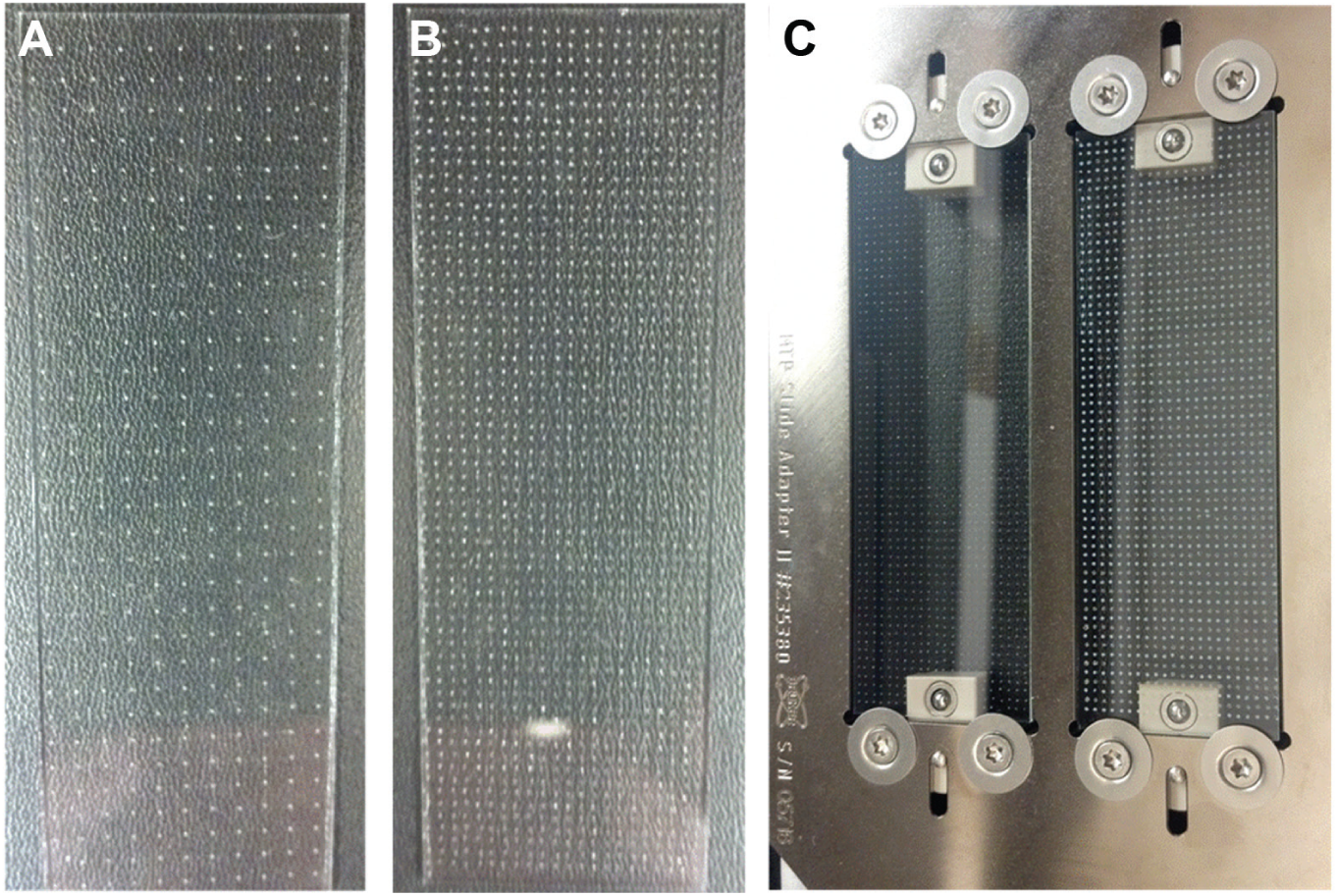
ASD allows the deposition of small volumes (nL) in dense sample arrays. Disposable ITO-coated glass microscope slides are shown with (
The utility of the ASD-MALDI-MS workflow was demonstrated with an analysis of a 384-well plate containing a library of structurally diverse compounds. The glass slide was prepared by layering each compound onto a matrix spot (deposition time ~ 10 min) and vacuum dried, and data were collected using the autoexecute data sequence of the control software summing 100 scans per sample spot. Initial manual analysis of the data demonstrated that the desired compound can be observed for 75% of the compounds within the plate. Subsequent reanalysis of the MALDI plate of the compounds not observed during the initial analysis resulted in an improvement of positive identification to 85%.
Conclusion
Presented here is a proof-of-concept study on a novel process flow for the quality control screening of compound libraries utilizing acoustic sample deposition (ASD) and MALDI-MS. An initial study of a 384-compound array afforded a 75% first-pass with an 85% second-pass positive identification rate, thus establishing the ASD-MALDI-MS methodology as a first-tier analysis technique.
With this approach, potentially four 1536-well plates can be deposited onto one glass slide, with four slides fitting onto one MALDI target carrier, thus making it possible to submit about 25,000 compounds for the quality check, which can be completed, with <1 s per sample, within about 7 h.
A challenge yet to be addressed is software development for automated processing of the acquired data against the compound database for either positive identification or resubmission of the compound to a second-tier analysis technique such as analytical or bioactivity 9 LC-UV/MS.
Footnotes
Declaration of Conflicting Interests
The authors declared no potential conflicts of interest with respect to the research, authorship, and/or publication of this article.
Funding
The authors received no financial support for the research, authorship, and/or publication of this article.