




Abstract
Plateau-Rayleigh instability describes the infinite falling stream of fluid breaks into smaller droplets. With the development of nanotechnology, more and more attention is being drawn to Plateau-Rayleigh instability. This surface tension–driven instability performs well in the preparation of the nanoparticles, especially in photonics applications, such as optical micro-resonators in nano-biosensing systems. In this article, we mainly adopt the thermal fluid coupling method. The effect of temperature field on instability is studied with the aid of numerical simulation. In addition, the radius of the inner fluid column, the thickness of the outer fluid, and the temperature gradient are also studied to explore how the factors influence the Plateau-Rayleigh instability. The wavelength of the instability is characterized by droplet diameter, which is formed through the process caused by Plateau-Rayleigh instability.
Introduction
When a particle size reaches tens of nanometers, various defects are often found in the same particle, such as stacking faults and dislocations. There is coexistence of different metastable phases. This special structure of nanoparticles results in the following effects: small size effect, surface effect, quantum size effect, and so forth. These features make the nanoparticle very sensitive to the external environment, such as temperature, light, and pressure. External changes in the environment will quickly cause valence change and electron transport. The significant change in resistance can be used to make sensors. Gold nanoparticles have been proposed as signal transducers for biosensors because of their remarkable versatility in biological and medical applications. 1 However, current approaches to the fabrication of such particles are typically finely tuned to specific monomer or polymer species, size ranges, and structures. Recently, a general scalable methodology for fabricating uniformly sized spherical particles was presented at the aid of Plateau-Rayleigh instability. The range of the particle diameters extends from the millimeter scale down to 50 nm. 2 Kaufman et al. 3 harnessed the inherent scalability of fiber production and an in-fiber Plateau-Rayleigh instability for the fabrication of uniformly sized, structured spherical particles spanning an exceptionally wide range of sizes: from 2 mm to 20 nm. Gumennik et al. 4 have fabricated nanospheres using Plateau-Rayleigh instability. It is demonstrated that the size of nanospheres is controlled by the feed speed. 5
Plateau-Rayleigh instability describes the infinite falling stream of fluid breaks into smaller droplets with the same volume but less surface area, which is common in daily phenomena, such as faucet dripping. This surface tension–driven instability performs well in the preparation of the particles, which is potentially useful in photonics applications such as micro-resonators.
4
This instability is widely studied since it was noticed by Plateau first, according to whom whenever the length of a cylindrical jet exceeds its circumference, it is always unstable.
6
Lord Rayleigh introduced the powerful tool of linear stability analysis and reconsidered inviscid water jets.
7
An attempt to account for viscous effects was made by Rayleigh, again neglecting the effect of the surrounding fluid.
8
Weber
9
extended Rayleigh’s theory by considering an effect of viscosity and that of surrounding air on the stability of a columnar jet. It was demonstrated that viscosity does not alter the value of the cutoff wave number predicted by the inviscid theory and that the influence of the ambient air is not significant if the forward speed of the jet is small.
9
Later, Tomotika
10
analyzed the instability of two fluids with different viscosities using this method. In linear stability analysis, one expands the radius R as a function of the axial coordinate
Nowadays, the majority of the literature cites the Tomotika model in the Plateau-Rayleigh instability study. This is in good agreement with the experimental results. However, there are some constraints in the Tomotika model. The Tomotika theory is based on an unbound surrounding fluid, whereas the ratio of cladding to core diameters is sometimes not sufficiently large in reality. A fundamental difficulty is that the Tomotika theory is only a crude approximation when applied to a realistic situation, in which the viscosity varies dramatically over the scale of a single λ. Besides, the interfacial instability is discussed without considering heat and mass transfer across the interface. The transfer of mass and heat across the interface is very important in many situations. Hsieh 12 formulated the problem of Rayleigh-Taylor instability and Kelvin-Helmholtz instability with heat and mass transfer across the liquid vapor interface. It was verified that when the vapor layer is hotter than the liquid layer, the effect of heat and mass transfer cannot be neglected. Later, Awasthi observed that the heat and mass transfer has a stabilizing effect on the stability of the system in the nonlinear analysis for both axisymmetric as well as asymmetric disturbance. 13
In this article, we add the energy equation in our model to study its impact on the Plateau-Rayleigh instability. To develop a quantitative understanding of Plateau-Rayleigh instability in cylindrical-shell geometry, direct numerical simulation is performed using the finite element method. It will give guidance to the fabrication of micro/nanoparticles for further application in the biosensing field.
Simulation Algorithm
Model Description
To acquire a quantitative understanding of Plateau-Rayleigh instability, direct numerical simulation is performed with the finite element method. Deng et al. 14 found that azimuthal instability may occur in the experiment. The mechanism remains unclear, which will influence the simulation result. Liang et al. 15 showed that azimuthal instability does not arise in purely cylindrical geometries. To isolate the effect of azimuthal instability, we adopt a two-dimensional (2D) model in the (r; z) plane.
The difficulty of multiphase flow modeling lies in the tracking interface. Density, viscosity, and other properties at the interface will change drastically, making the calculation rigidity enhanced. In this article, the interface capture is denoted by the level-set method. The level-set function is coupled with the NS equations, in which the interface is located at the ϕ = 0.5 contour. Because convection of the level-set function is relatively smooth, the steep gradient change of the properties caused by convection at the interface can be replaced.
The flow field (u, p) is calculated by the multiphase module. At the same time, the flow field calculated results are adopted for heat field computation. The heat field further influences the flow field. It is the coupling calculation process.
We selected common materials because it has been well acknowledged that Plateau-Rayleigh instability is related to the prosperity of the material. Considering the limitations of the material parameters, high temperature causes water gasification, and the heat transfer rate is too slow. To simulate the speedy heat transfer process in realistic situations and to have a better understanding of the temperature effect, we set the initial heat field to simulate this process.
Governing Equations
The incompressible Navier-Stokes equation is considered:

Here, u is fluid velocity, ρ is density, I is identity matrix, p is pressure, and Fst is surface tension.
The continuity equation of incompressible fluid is

Energy equation:

Here, Cp is specific heat, T is the temperature, Q is the heat source, and k is the thermal conductivity coefficient.
The heat field is coupled with the flow field through the algorithm, as shown in Figure 1 . The flow field is solved by solving eqs 1 and 2. The results are adopted in the process of solving eq 3. In turn, the heat field exerts an influence on the flow field by changing the physical properties of the materials.
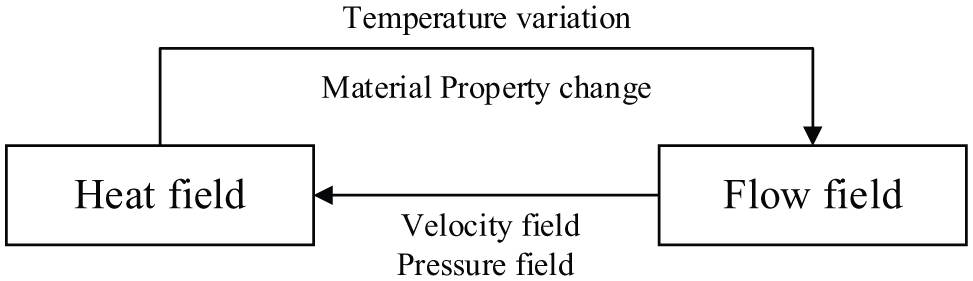
Simulation algorithm. The flow field is determined by the NS equations; the heat field is solved by the energy equation by adopting the results of the flow field. At the same time, the heat field has an influence on the flow field by changing the material properties.
Boundary Conditions
In this article, we adapt the level-set method to track the change of the interface. In the level set method, the fluid-fluid interface is represented as the 0.5 contour of the level-set function. The transport of the fluid interface separating the two phases is computed by solving the level-set equation

where ε is a parameter that controls the thickness of the interface, φ is level set, and γ is the numerical stability parameters.
Periodic boundary conditions are used on the top and bottom boundaries to mimic the effect of the jet being infinitely long in length:




Influence Factors
Recent research has revealed that some factors are related to Plateau-Rayleigh instability. In this article, the main influence factors considered are inner size, thickness, temperature, and temperature gradient.
Inner Size
As testified in the Tomotika model, the simplified model, by assuming

where a represents the radius of the inner core. 10 The inner size of the model influences the instability.
Thickness
In most theses, the Tomotika model is adopted to describe the instability. As to the thickness of the clad, they assume the thickness is thick enough to neglect it, which is consistent with the Tomotika hypothesis. However, not all of the realistic fabrication can reach that assumption. It is necessary to study the effect of thickness on the instability.
Temperature
The existing linear theory considers only the flow field. It does not take the heat into account. However, the theory has found that the heat field has a great influence on the instability in the experiment. Kaufman et al. 3 discovered that thermal processing of a multimaterial fiber controllably induces the instability, resulting in a well-ordered, oriented emulsion in three dimensions.
Temperature Gradient
Gumennik et al. 4 reported on a method for producing Si spheres in a silica fiber in which capillary breakup is controlled by an axial thermal gradient and a controlled feed speed. Thermal gradient acts in a different way from universal temperature.
Simulation Result
Verification of the Model
The Tomotika model has been universally adopted as theory guidance; hence, it is used to verify the validation of the model of Plateau-Rayleigh instability. In the Tomotika model, the radius of the fiber can be expressed in the following equation:

where
According to Tomotika, the wavelength can be obtained using the following equation:

The fastest growth factor Ω is found numerically by searching a wide range of wavelengths (
In our case, the viscosity of clad ηcore = 1.789e-5 Pa*s, the viscosity of clad ηshell = 1e-3 Pa*s. The value of x (i.e., the value of ka corresponding to the maximum instability) can be calculated through MATLAB, which makes reference to the Tomotika model. In this case, x equals 0.46, as shown in Figure 2a . In the numerical simulation, the wavelength can be obtained by calculating the distance between the droplets, as shown in Figure 2b . The wavelength corresponding to the mode of maximum instability equals 27.318 um. This is consistent with our simulation model, in which the wavelength is 25 um. The tolerance is about 8.5%. Therefore, our multiphase model is acceptable.
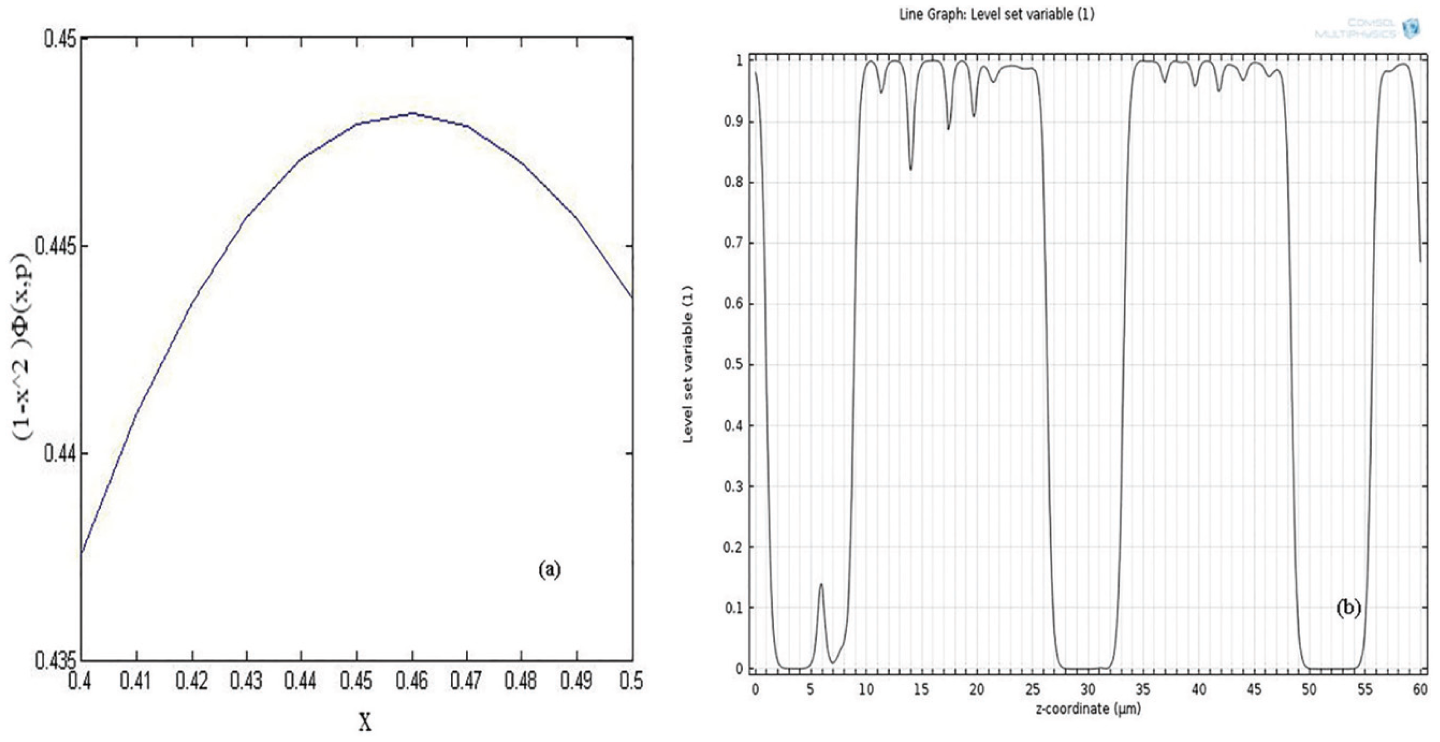
Authentication of the model and method. (
In the Tomotika model, the wavelength can be easily solved.

According to the assumption of continuity, the fluid to which a wavelength corresponds is broken into one droplet. The relationship between the wavelength and the diameter of the droplet is defined as follows.

where D is the droplet diameter and D0 is the inner diameter of the initial fluid.
The relationship of the inner diameter of the initial fluid and the droplet diameter can be obtained by solving eqs 11 and 12.

In this article, the impact of various factors on Plateau-Rayleigh instability can be further explored by studying the droplet diameter. At the same time, it provides guidance on the fabrication of micro/nanoparticles.
The development of the instability can be seen directly from Figure 3 . Initially, the inner fluid pressure is larger than the outer fluid. Initial fluctuations are further amplified, and the curvature of the interface grows greater. According to the Young-Laplace equation, the axial pressure difference increases. Fluid of high pressure flows to parts with low pressure, which will further increase the amplitude of disturbance. Related research has shown that the amplitude grows exponentially with time.6–10
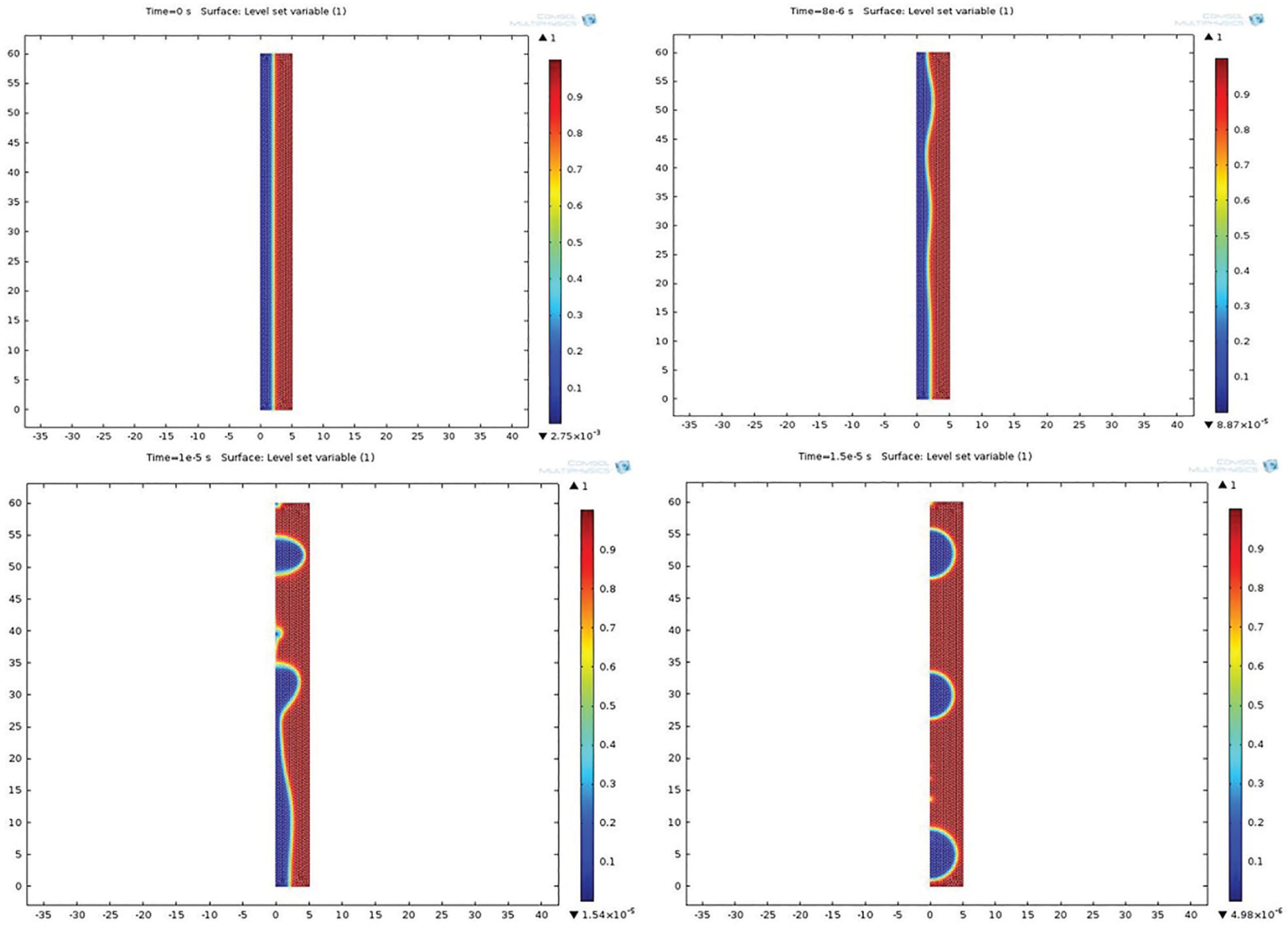
Development of Plateau-Rayleigh instability in numerical simulation. (
Effect of Inner Fluid Column Radius
The numerical result shows that the amplitude of perturbation grows exponentially with time, which verifies the theoretical assumption. It can be seen that the radius of the inner fluid column has a great influence on the Plateau-Rayleigh instability through numerical simulation. The influence of the radius of the inner fluid column on instability is shown in Figure 4a . As is shown in the graph, with the increase of the radius, the instability grows more slowly. When the radius increases to a certain amount, significant instability will not be observed. More important, it is obvious in Figure 4b that the droplet diameter is proportional to the radius, which is consistent with the analytical results of Tomotika’s work. The theatrical gradient is about 2.828427, our gradient is 3.22, and the tolerance is 13.8%, and we believe it is because the Tomotika model is established on the assumption that the thickness of the outer layer of the liquid column is infinite, which is different from our model.
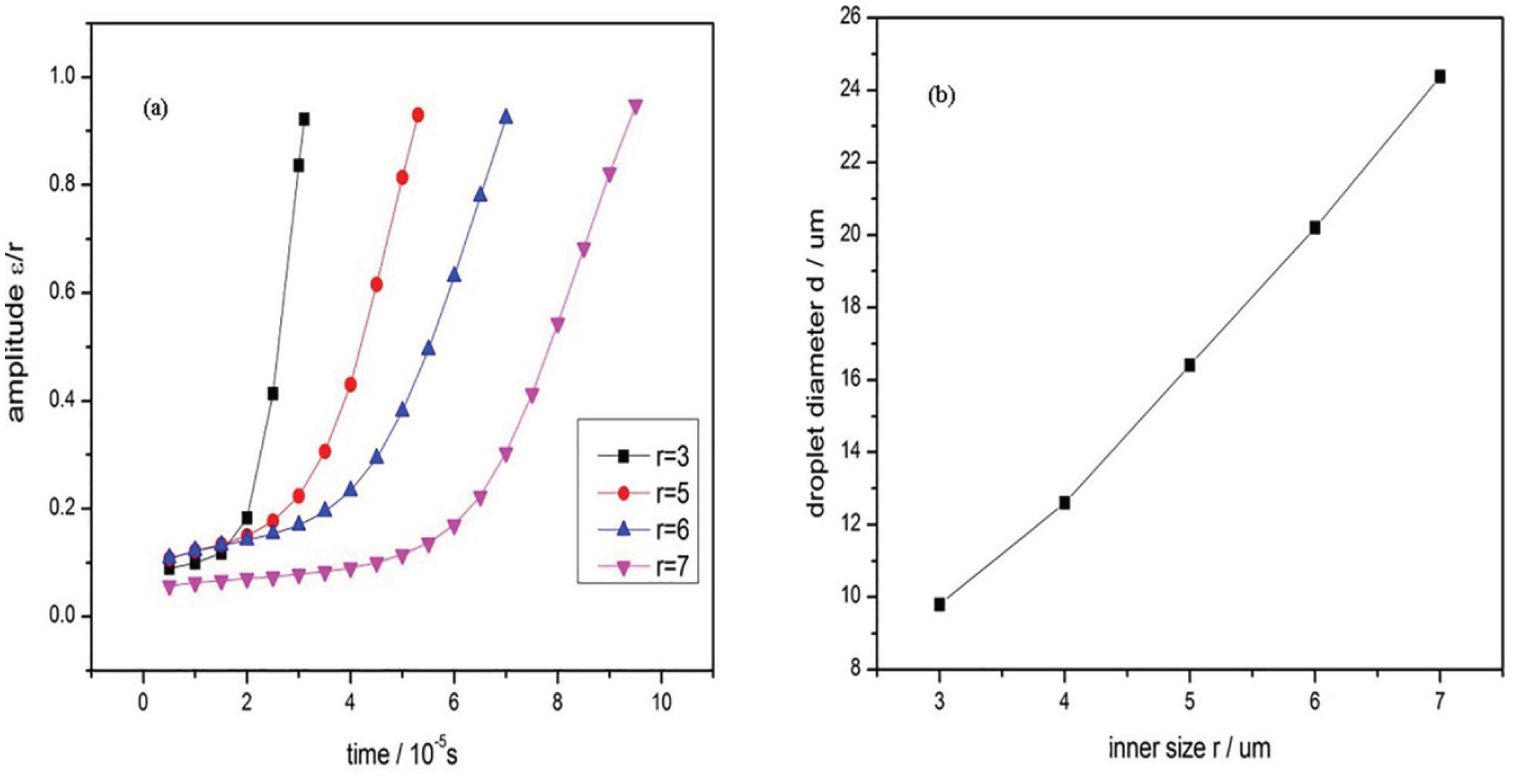
Impact of the radius of the inside fluid column on Plateau-Rayleigh instability. (
Effect of Outer Fluid Thickness
The thickness of the outer layer material is set to infinity in the Tomotika model. However, the thickness is limited in this article, which is consistent with the real situation. We set the inner radius as a fixed value to explore the effect of thickness on Plateau-Rayleigh instability. The development of fluctuations of different thicknesses is shown in Figure 5a . Here, fluctuations can be seen to develop earlier in the presence of greater thickness, which is likely related to the greater viscosity force. However, there was no significant difference observed for higher values of thickness, as shown in Figure 5b . The trends of fluctuation development coincide. We can see that this coincidence emerges from the radius ratio of 10. This provides good guidance for future work, in which the radius ratio effect can be neglected when the value is larger than 10. In these models, the Tomotika model can be applied directly. The quantitative relationship between droplet diameter and thickness is shown in Figure 5b . This is consistent with the trend of amplitude development. With the increase of the thickness, the wavelength gets smaller. When the thickness increases from 20 to 50, the diameter of the droplet decreases 1.4%. The impact of thickness on instability is small. When the thickness increases to about 50, the instability development trends are similar, which means the difference in wavelength fluctuations is small.
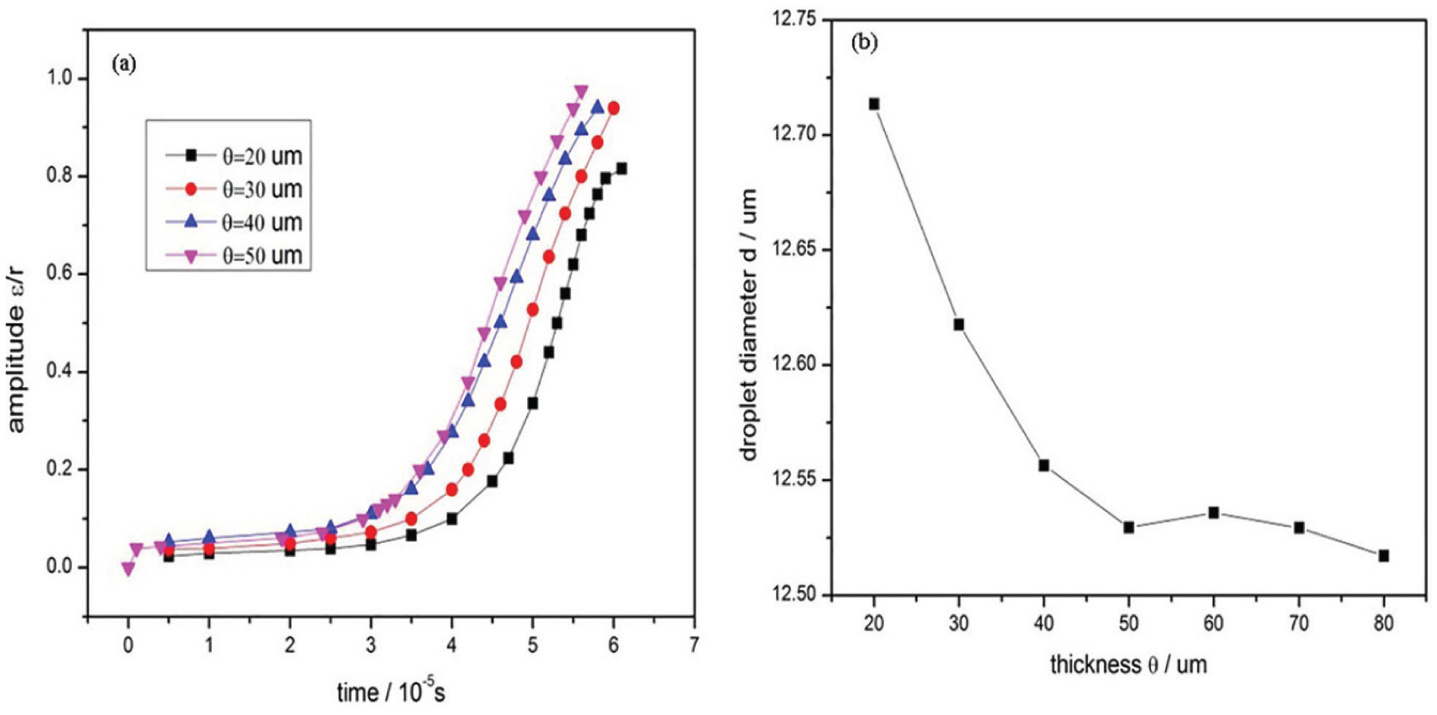
The impact of thickness on the Plateau-Rayleigh instability. (
Effect of Temperature
It has been established that temperature has a great influence on the Plateau-Rayleigh instability, which has been used in realistic applications. 7 However, theoretical mechanisms have not been well understood. The existence of difficulties in coupling makes it hard to obtain the theoretical solution. In this article, we resort to numerical simulation to explain how temperature influences the Plateau-Rayleigh instability.
First, the difference between whether the temperature field is applied has been investigated. As shown in
Figure 6a
, compared to when there is no temperature field, Plateau-Rayleigh instability develops in advance. The time scales can be obtained by fitting

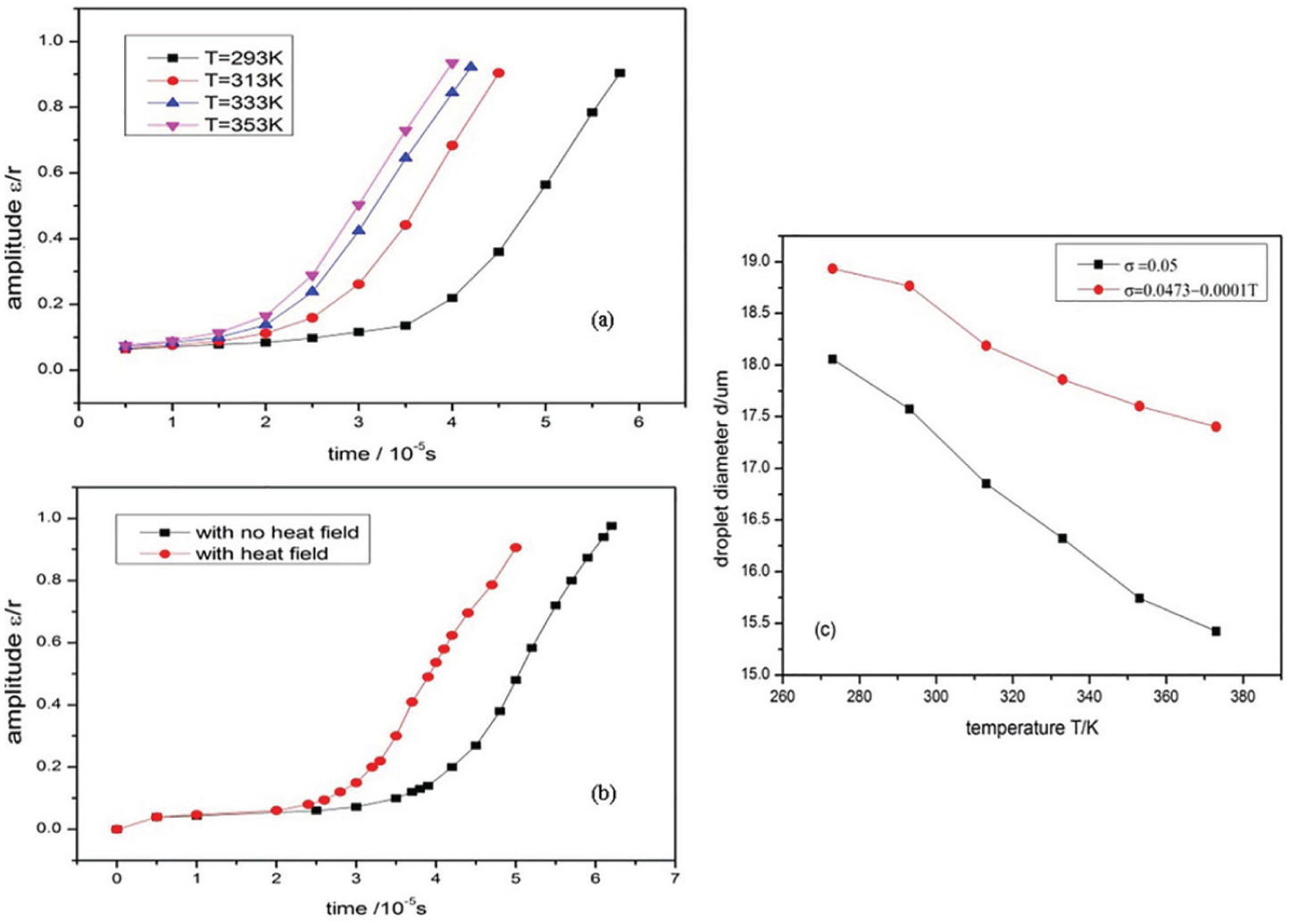
The impact of temperature on the Plateau-Rayleigh instability. (
The time scales are 1.358142E-5s and 1.299714E-5s. Temperature makes instability develop faster. We believe this is because the viscous force becomes smaller with the temperature increase. This makes the instability easier to develop. The development of instability with the increase of temperature has been further studied, as shown in Figure 6b . We can see that the instability develops faster with the increase of the temperature. However, this shows that when it comes to a certain temperature, the development of Plateau-Rayleigh instability tends to be stable. It is possible to find the right temperature to induce Plateau-Rayleigh instability. Efficiency can be improved and cost can be reduced by this means. Quantitative relations can be explored from Figure 6c . To study the effect of surface tension on Plateau-Rayleigh instability, we made two sets of analog: one set is with the same surface tension, and the surface tension of the other set changes with temperature. The two curves exhibit a consistent trend. As the temperature becomes higher, the droplet diameter gets smaller, which means the wavelength gets smaller. However, as the temperature increases from 293 to 373, the droplet diameter decreases 12.2% in the group with the same surface tension. In contrast, the droplet diameter decreases 8% in the other group. This indicates that the decreases of viscous force and the increase of surface tension are helpful for the development of instability.
Effect of Temperature Gradient
The temperature gradient mainly causes changes of material properties through regional temperature variations; gradients of the physical property intrigue the instability much more easily. To reflect the impact of this gradient, the physical properties of materials change with temperature, including surface tension. In the simulation process, it is obvious that the instability develops faster in the zone with a higher temperature. The development of instability with the increase of temperature gradient has been further studied, as shown in Figure 7a . It can be seen from this figure that the instability develops earlier when the temperature gradient becomes larger. However, with the increase of the temperature gradient, the instability development trends tend to coincide. An increase in the temperature gradient will not promote the development of the instability. We believe that the Marangoni effect contributes to the development of Plateau-Rayleigh instability. The temperature gradient causes the surface tension difference, which will aggravate the instability of the interface. The time scale decreases from 1.87091E-05s to 1.17123E-05s, whereas the temperature gradient increases from 0.05 to 0.3. This means that the instability develops faster. The relationship between wavelength and temperature can be seen quantitatively from Figure 7b . When the temperature gradient increases to 0.2, the change in diameter droplet slows down. In addition, the diameter changes from 19.00647 um to 17.40927 um; the tolerance is about 8.4%, whereas the temperature gradient changes from 0.05 to 0.2.
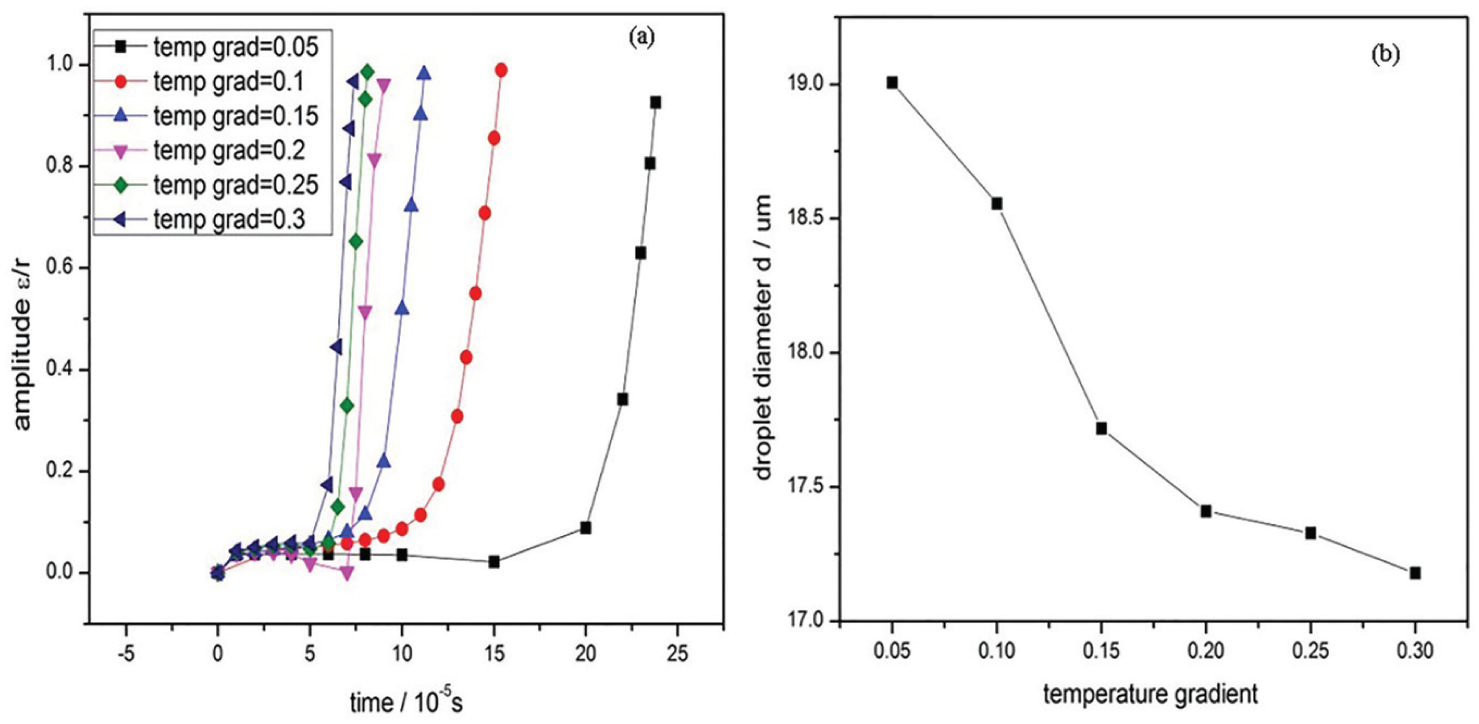
The impact of temperature on the Plateau-Rayleigh instability. (
Conclusions
In this article, motivated by recent development in the universal method of nanoparticle fabrication, we have explored Plateau-Rayleigh instability in the geometry of concentric cylindrical shell by 2D numerical simulation. The level-set method, which is adopted to simulate the Plateau-Rayleigh instability, is in good agreement with the theoretical solution. Many factors are studied, such as the radius of the inner fluid column, the thickness of the outer fluid column, temperature, and temperature gradient. This shows that there is a linear relation between the radius of the inner fluid column and the instability wavelength. However, it is not consistent with the theoretical solution because of the limitation of the theoretical assumptions. The thickness of the outer fluid also helps the development of the instability. When the radius ratio reaches 10, the influence of the thickness can be neglected. Temperature field influences the development of Plateau-Rayleigh instability through the influence on material properties. As the temperature increases, instability develops faster and the wavelength becomes smaller. The decrease of viscous force and the increase of surface tension are helpful for the development of instability. The instability develops earlier when the temperature gradient becomes larger. However, with the increase of the temperature gradient, the development trends of the instability tend to coincide. The Marangoni effect contributes to the development of Plateau-Rayleigh instability. Our study provides guidance for future experiments in many fields, such as microfluidics and nanoparticle fabrication. Using the principle of instability, droplets with a specific size can be obtained by selecting appropriate material and experiment condition. Our simulation method can be used to guide the fabrication of nanoparticles with specific size.
Footnotes
Declaration of Conflicting Interests
The authors declared no potential conflicts of interest with respect to the research, authorship, and/or publication of this article.
Funding
The authors disclosed receipt of the following financial support for the research, authorship, and/or publication of this article: This project is supported by the National Natural Science Foundation of China (grant No. 51375444, 51106137).