



Abstract
The stability of Porcine reproductive and respiratory syndrome virus (PRRSV) was evaluated for temperatures appropriate to laboratory and field settings. Four North American (type 2) isolates (ATCC VR-2332, JA-142, MN-184, and Ingelvac® PRRS ATP vaccine virus) in cell culture medium (pH 7.5) were held at 1 of 4 temperatures (4, 10, 20, and 30°C) and sampled over time. Samples were tested for infectious virus and total PRRSV RNA using median tissue culture infectious dose and quantitative reverse transcription polymerase chain reaction, respectively. The rate of loss of infectious virus was expressed in terms of the time required for virus concentration to decline by one half (i.e., half-life [T 1/2]). Statistical analysis found that temperature, but not virus isolate, had a significant effect on T 1/2, and a single nonlinear regression model was derived to predict T 1/2 for temperatures between 0 and 50°C: T 1/2 = 243.54 e(-0.109*TEMP). In contrast to changes over time in the concentration of infectious virus, no change in the concentration of quantitative reverse transcription polymerase chain reaction–detectable PRRSV was detected at any temperature and contact time. This information will be of interest to persons working in laboratory or field situations in which the control of PRRSV is important.
Porcine reproductive and respiratory syndrome virus (PRRSV; order Nidovirales, family Arteriviridae, genus Arterivirus) is an enveloped, single-stranded RNA virus 14 that is endemic in most swine-producing areas of the world and causes significant economic losses as a consequence of respiratory disease, reproductive failure, and reduced growth rates. Losses due to PRRSV infection were estimated to cost U.S. swine producers $560 million in direct losses at corn prices of $2.25 per bushel, 11 with each increase of $0.50 per bushel of corn resulting in an additional $18.5 million in PRRSV-associated costs. 9
Pigs can be infected with PRRSV by intranasal, intramuscular, oral, intrauterine, aerosol, or vaginal exposures. 17 Once infected, pigs shed PRRSV in oral fluids, nasal secretions, urine, semen, mammary secretions, and feces. 13,17 Contamination of the environment with infectious PRRSV creates the potential for indirect transmission via inanimate objects or substances (e.g., water, food), living carriers (vectors), or aerosols. 5,16
By definition, indirect transmission requires that PRRSV remain in an infectious state until it makes contact with a susceptible host. The current study addressed the question of the stability of infectious PRRSV in the environment by estimating the rate of inactivation of infectious PRRSV in solution as a function of temperature. By intent, viruses were placed in an environment intended to favor stability (i.e., cell culture maintenance medium at pH 7.5) 3 in order to provide estimates of the outer bounds of the duration of PRRSV infectivity. To test for differences in the rate of inactivation among PRRS viruses, 4 North American (type 2) PRRSV isolates were evaluated: American Type Culture Collection (ATCC) VR-2332 a (GenBank accession no. PRU87392), JA-142 (GenBank accession no. AY424271), MN-184 (GenBank accession no. AY656992), and Ingelvac® PRRS ATP vaccine virus. b
To ensure that results were more representative of field virus versus laboratory (i.e., cell culture–adapted) virus, each isolate was passed in 1 pig prior to amplification on cell culture. Four 14-day-old pigs were obtained from a herd determined to be free of PRRSV infection based on ongoing serologic monitoring. Pigs were tested by enzyme-linked immunosorbent assay c for anti-PRRSV serum antibodies upon arrival and 7 days later. Each pig was inoculated with 1 of the 4 isolates on day 0 and individually housed in high-efficiency particulate air–filtered d isolation units e to prevent virus transmission between animals.
Serum collected on day 7 postinoculation was used to amplify virus on 24-hour-old confluent MARC (cloned monkey kidney cell line)-145 cells. 10 Cells were prepared in 850-cm 2 roller bottles f containing minimal essential medium (MEM) growth medium supplemented with 5% fetal bovine serum, g 50 μg/ml gentamycin, h and 100 μg/ml penicillin–streptomycin. h After 24 hr at 37°C in a humidified 5% CO2 incubator, the MEM growth medium was discarded, and each of the 4 roller bottles was inoculated with 5 ml of serum from 1 viremic pig in 50 ml of maintenance medium. Maintenance medium consisted of MEM supplemented with 2.5% fetal bovine serum, 50 μg/ml gentamicin, and 100 μg/ml penicillin–streptomycin. After 2 hr at 37°C in a humidified 5% CO2 incubator, the inoculum was discarded, and 300 ml of maintenance medium was added. Five days after inoculation, the roller bottles were freeze:thawed (−80°C:25°C), and cell lysates were harvested. The supernatant was centrifuged at 1,300 × g for 15 min, after which the virus stock was vacuum filtered i and aliquoted into 50-ml centrifuge tubes. j To ensure sufficient virus stock to complete the stability study, virus was amplified on cell culture a second time. In the second passage, each virus isolate was propagated in 2 roller bottles and the supernatant from the 2 roller bottles pooled before vacuum filtration. Only virus stock from the second passage was used in the stability study. Virus stock was stored at −80°C until the initiation of the stability study.
To conduct the experiment, 60 ml of virus stock solution (pH 7.5) was aliquoted into one 125-ml glass bottle, k which was then stoppered k and sealed k with a hand crimper. k Three bottles (i.e., 3 replicates) of each virus isolate were maintained at each of the 4 temperatures (4, 10, 20, or 30°C) in refrigerated incubators. l Samples were collected from each bottle at time 0 and 4 additional time points (Table 1). The sampling time frame was determined on the basis of a previous report of virus inactivation by temperature. 3 To eliminate virus cross-contamination and to avoid temperature fluctuations during sampling, bottles were removed individually from the refrigerated incubator, quickly moved to a biosafety cabinet, and sprayed with 70% ethanol solution, and a 1.2-ml sample was harvested from each bottle using a single-use sterile syringe. j Samples were aliquoted into cryovials m and stored at −80°C. At the conclusion of the observation period, the entire set of samples (n = 240 samples: 4 viruses × 3 replicates × 4 temperatures × 5 sampling periods) was randomly ordered and then assayed for the concentration of total PRRSV RNA by quantitative reverse transcription polymerase chain reaction (qRT-PCR) and infectious PRRSV (median tissue culture infectious dose [TCID50]) by microtitration infectivity assays.
A PRRSV qRT-PCR assay was conducted at the Veterinary Diagnostic Laboratory, Iowa State University (Ames, IA). The PRRSV RNA for PCR amplification was extracted from 0.2 ml of sample with a commercial viral RNA kit n according to the manufacturer's protocols. The assay was performed using a commercial sequence detection system o using appropriately synthesized primers p and minor groove binder probes. q The thermal profile for amplification of PRRSV RNA was a reverse transcription at 50°C for 30 min, followed by enzyme activation at 95°C for 15 min, then 40 cycles of denaturation at 94°C for 15 sec and a combined annealing–extension step at 60°C for 60 sec. Fluorescence data capture occurred at the combined annealing–extension stage. For each assay, a standard curve was generated using standards (101–106 TCID50/ml), and positive and negative control samples were tested with the unknowns.
Sampling schedule (in hours) by temperature. *
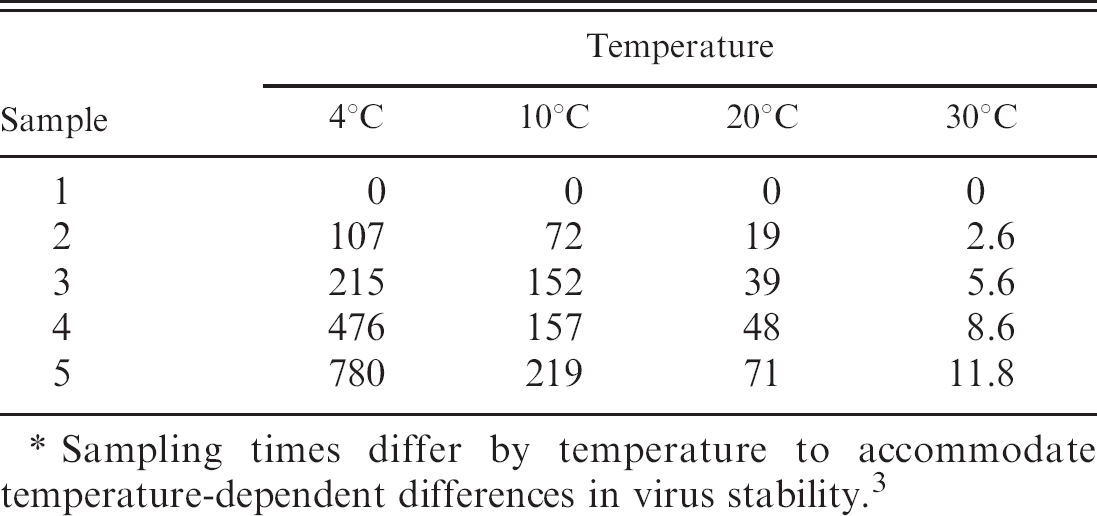
Sampling times differ by temperature to accommodate temperature-dependent differences in virus stability. 3
Microtitration infectivity assays were performed on confluent monolayers of MARC-145 cells in 96-well plates. f Cell monolayers were prepared by adding 200 μl of a solution containing 4 × 10⁵ cells/ml suspended in MEM growth medium to each well and incubating plates at 37°C in a humidified 5% CO2 incubator for 24 hr. Each sample was serially 10-fold diluted in MEM, and 8 wells were inoculated with 100 μl at each dilution. Thereafter, plates were incubated at 37°C in a humidified 5% CO2 incubator for 2 hr, the inoculum was discarded, and 200 μl of maintenance medium was added to each well. After 2 days, the cells were fixed with aqueous 80% acetone solution and stained with a PRRSV-specific fluorescein isothiocyanate–conjugated monoclonal antibody SDOW17. r Titers of infectious PRRSV were calculated using the SpearmanKärber method 8 and expressed as TCID50/ml.
Statistical analysis of PRRSV qRT-PCR results showed significant differences in virus concentration among isolates (analysis of covariance [ANCOVA], P < 0.001), but this was the result of samples not having been adjusted to a uniform concentration at the start of the experiment. Further analysis showed that temperature (ANCOVA, P > 0.05), time (ANCOVA, P > 0.05), and the interaction of temperature by time (ANCOVA, P > 0.05) did not produce statistically significant effects in total PRRSV RNA, that is, qRT-PCR–detectable PRRSV was highly stable at the assayed temperatures and sampling times. Collapsed by time and isolate, the qRT-PCR arithmetic means (expressed in log10 titers) of the temperatures evaluated were nearly identical: 1 × 105.8 TCID50/ml (4°C), 1 × 105.8 TCID50/ml (10°C), 1 × 106.0 TCID50/ml (20°C), and 1 × 105.9 TCID50/ml (30°C).
Virus titration (TCID50) results were used to estimate the rate at which the concentration of infectious virus changed. Results were expressed as half-life (T 1/2), which is the time required for the concentration of infectious virus to decline by one half. For each temperature, the T 1/2 of each replicate (bottle) was calculated by linear regression analysis of the TCID50 estimates by time, as described elsewhere. 4 Statistical analysis found no difference in T 1/2 among isolates within temperatures (analysis of variance [AN-OVA], P > 0.05), but T 1/2 between temperatures was significantly different (ANOVA, P < 0.0001; Table 2). Therefore, a single nonlinear regression model was developed to describe T 1/2 over a range of ambient temperatures (0–50°C; Fig. 1): T 1/2 = 243.54 e(-0.109*TEMP).
Mean half-life (T 1/2) of infectious Porcine reproductive and respiratory syndrome virus (PRRSV) at 4 temperatures. *
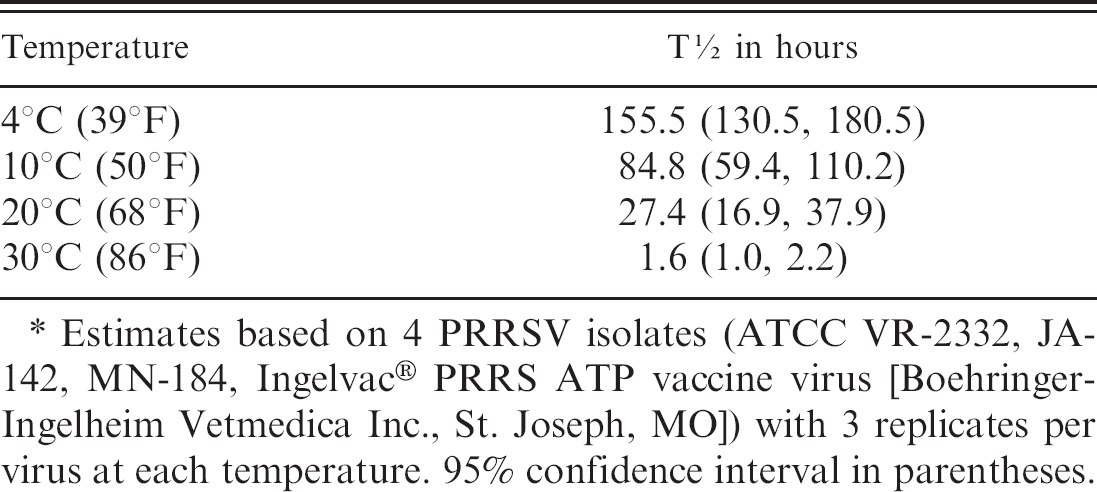
Estimates based on 4 PRRSV isolates (ATCC VR-2332, JA-142, MN-184, Ingelvac® PRRS ATP vaccine virus [Boehringer-Ingelheim Vetmedica Inc., St. Joseph, MO]) with 3 replicates per virus at each temperature. 95% confidence interval in parentheses.
Porcine reproductive and respiratory syndrome virus is considered labile and quickly inactivated by drying 12 or by extremes in pH. 1,3 Detection of infectious PRRSV over time has been described for environmental settings, 5,6,7,12 in diagnostic samples (e.g., tissue, serum 15 ), and at temperatures appropriate for laboratory studies (e.g., freezer storage, incubator, water bath). 2,3 The present study was intended to address the lack of information on PRRSV stability over a range of ambient temperatures appropriate to the field or the laboratory. By intent, the conditions of this study were designed to produce the maximum duration (“worst case scenario”) of infectious PRRSV in the environment. That is, the equation T 1/2 = 243.54 e(-0.109*TEMP) is expected to predict the outer limit of PRRSV half-life for a range of ambient temperatures appropriate for settings in which PRRSV decontamination is a concern.
Compatible with a previous report, the concentration of PRRSV RNA in solution (cell culture medium) was constant over time and unaffected by temperature or changes in virus infectivity. 7 Free RNA is considered unstable and quickly degrades in the environment, but RNA in intact, noninfectious PRRSV in sterile and buffered media was highly stable at the temperatures and periods encompassed by the present study. The finding that qRT-PCR results had no relationship with the concentration of infectious PRRSV will complicate the interpretation of PCR results from environmental samples collected in the context of PRRSV prevention and control.
Acknowledgements. The study was supported in part by Pork Checkoff funds distributed through the Iowa Pork Producers Association, P.O. Box 71009, Clive, IA 50325.
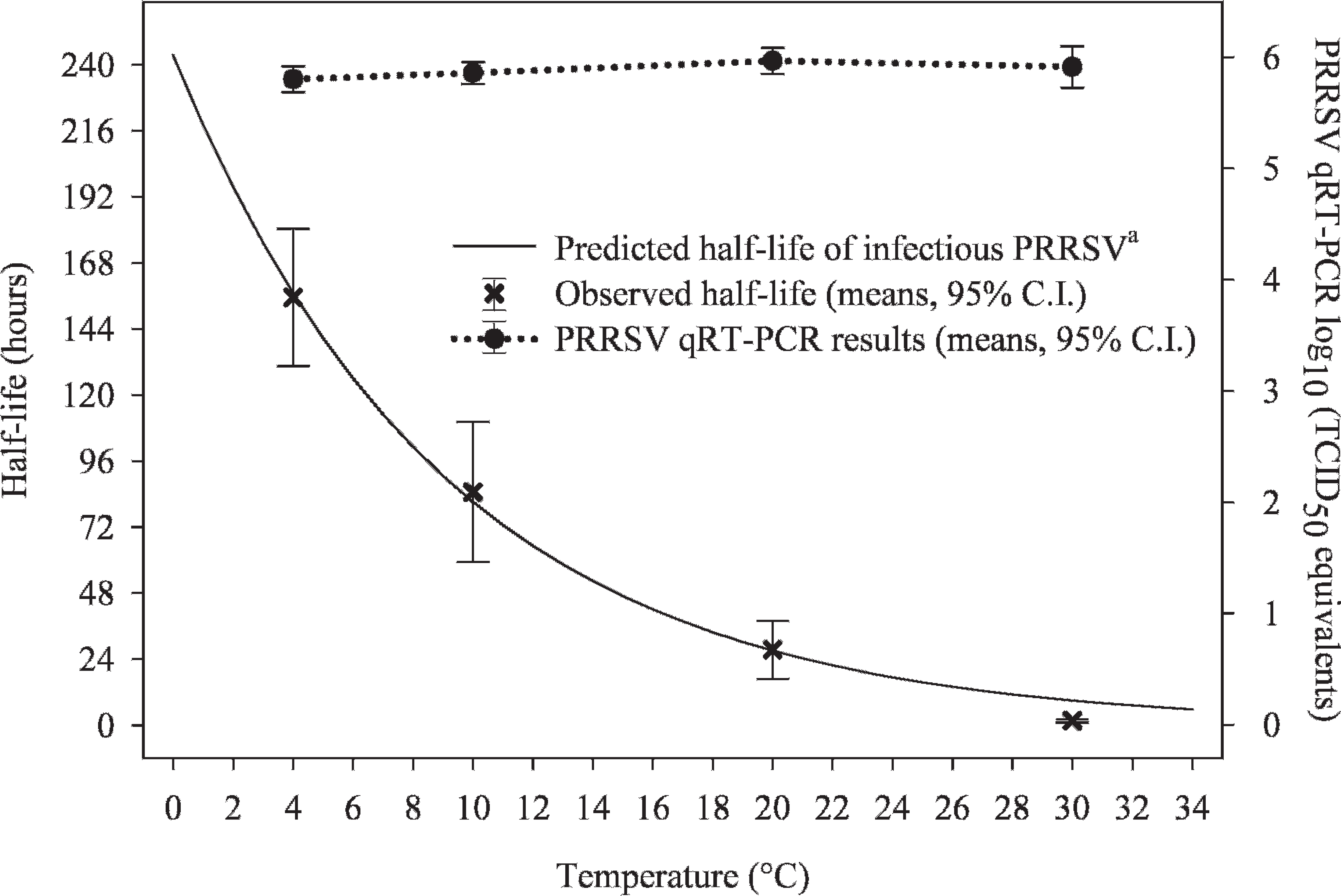
Stability of Porcine reproductive and respiratory syndrome virus (PRRSV) by temperature: infectious PRRSV (half-life) versus total PRRSV RNA. a Predicted half-life calculated as T 1/2 = 243.54 e(-0.109*TEMP). qRT-PCR = quantitative reverse transcription polymerase chain reaction; CI = confidence interval.
Footnotes
a.
American Type Culture Collection, Manassas, VA.
b.
Boehringer Ingelheim Vetmedica Inc., St. Joseph, MO.
c.
HerdChek PRRS 2XR ELISA, IDEXX Laboratories Inc., Westbrook, ME.
d.
Flanders Corp., Washington, NC.
e.
Barrier Systems Inc., Toms River, NJ.
f.
Corning Inc., Corning, NY.
g.
HyClone Laboratories Inc., Logan, UT.
h.
Sigma-Aldrich, St. Louis, MO.
i.
Nalge Nunc International Corp., Rochester, NY.
j.
BD, Franklin Lakes, NJ.
k.
Wheaton Science Products, Millville, NJ.
l.
Fisher Scientific Co., Pittsburgh, PA.
m.
Corning Incorporated Life Sciences, Lowell, MA.
n.
QIAamp® Viral RNA Mini Kit, Qiagen Inc., Valencia, CA.
o.
ABI PRISM™ 7900HT Sequence Detection System, Applied Biosystems, Foster City, CA.
p.
Integrated DNA Technologies Inc., Coralville, IA.
q.
Applied Biosystems, Foster City, CA.
r.
Rural Technologies Inc., Brookings, SD.