




Abstract
Electronic laboratory notebooks (ELNs) offer significant advantages over traditional paper laboratory notebooks (PLNs), yet most research labs today continue to use paper documentation. While biopharmaceutical companies represent the largest portion of ELN users, government and academic labs trail far behind in their usage. Our lab, a translational science laboratory at New York University School of Medicine (NYUSoM), wanted to determine if an ELN could effectively replace PLNs in an academic research setting. Over 6 months, we used the program Evernote to record all routine experimental information. We also surveyed students working in research laboratories at NYUSoM on the relative advantages and limitations of ELNs and PLNs and discovered that electronic and paper notebook users alike reported the inability to freehand into a notebook as a limitation when using electronic methods. Using Evernote, we found that the numerous advantages of ELNs greatly outweighed the inability to freehand directly into a notebook. We also used imported snapshots and drawing program add-ons to obviate the need for freehanding. Thus, we found that using Evernote as an ELN not only effectively replaces PLNs in an academic research setting but also provides users with a wealth of other advantages over traditional paper notebooks.
Keywords
The Traditional Paper Lab Notebook
Paper lab notebooks (PLNs) have long been the mainstay for scientists to record their work, and it is only within the past decade or so that the market for electronic laboratory notebooks (ELNs) has expanded. However, even with more than 30 ELNs available today, 1 most research laboratories continue to use paper notebooks. As of 2008, about 33% of biopharmaceutical companies reported at least one installation of an ELN, 2 and a mere 5% of nonprofit laboratories (government and academic labs) were estimated to use these electronic methods. 2
Factors that contribute to continued use of the PLN include familiarity, 3 ease of use, portability, and the ability to easily paste items or freehand directly into a notebook. Nevertheless, PLNs are space consuming, susceptible to physical damage, and can be impossible to comprehend due to poor penmanship. Moreover, the written nature of PLNs renders them difficult to send or share their content. The process of recording by hand is especially time-consuming given the large volumes of data generated by today’s research, much of which is generated and stored electronically (e.g., sequence data or multiplex data). The user must then maintain separate but interconnected paper and electronic laboratory records, increasing the possibility of error or data loss. Finally, no backup systems are usually in place for PLNs, which increases the risk of irretrievable data loss.
History of the ELN
Early electronic recording stemmed from the increased use of personalized computers and centralized informatics systems by pharmaceutical companies in the 1980s 4 and further developed by the need of globally distributed companies to share information between geographically disparate collaborators. 4 However, the lack of legal requirements for these systems at the time prevented replacement of paper notebooks with newer electronic methods. 4 Reconciliation of this issue began in 1997, when the Food and Drug Administration issued the Code of Federal Regulations Title 21 Part 11, outlining the guidelines by which electronic records and signatures would be considered trustworthy, reliable, and equivalent to those on paper. 5 The ESIGN Act, passed by Congress in 2000, ensured that electronic signatures in interstate or foreign commerce were otherwise equivalent to handwritten signatures. 6
Current Use of the Electronic Notebook
Shortly after the legal and regulatory requirements were in place, the market for available ELNs expanded, with many specialized for fields such as biology, chemistry, and quality assurance/quality control. 7 Biopharmaceutical laboratories spearheaded the use of ELNs and make up their largest group of users today, but nonprofit government and academic labs have trailed far behind in using electronic notebooks.
Because academic labs constitute a small portion of current ELN users, our lab, a translational science lab at New York University (NYU) School of Medicine, wanted to determine if an ELN could effectively replace a PLN in the academic research setting.
Materials and Methods
Our academic lab deals primarily with investigational work regarding the human microbiome. A subset of four researchers from our lab used Evernote to document daily workflow processes from a specific project dealing with alterations in the gut microbiome in C57BL/6 mice. We chose to use Evernote as an ELN primarily because of its reported ease of use and low cost. Most team members used the Basic (free) Evernote version, but some upgraded to Premium Evernote ($5 monthly or $45 yearly 8 ). For 6 months, our team recorded all routine experimental information in Evernote that would otherwise be recorded in the usual paper notebook format. Both established protocols as well as those under development were documented. Established protocols included those for laboratory techniques such as DNA extraction, conventional and quantitative PCR, and cloning experiments, as well as those used in mouse experimentation such as administration of antibiotics via drinking water and techniques used at sacrifice such as cardiac puncture. Notebook entries were also updated regularly for protocols under development. All notebook entries were formatted after a traditional lab notebook, including sections for Title, Aim, Methods, Results, Conclusion, and Future Plans.
To determine what constituted “effective” use of a laboratory notebook, we informally surveyed NYU School of Medicine students on the relative advantages and limitations of PLNs versus ELNs. This voluntary survey was distributed to approximately 500 students via class list-servs, and those working in research laboratories were asked to respond. It must be noted, however, that because this survey was conducted electronically, a potential bias in opinion may have been introduced, as current ELN users may have been more likely to respond electronically.
Results
Of the 80 students who responded, 8 (10%) reported using an ELN in their research laboratory. Features liked most by ELN users included accessibility from any computer with an Internet connection and ability to search, whereas the inability to draw or freehand into an entry was cited as the number one disadvantage of using an ELN. Similarly, PLN users cited the inability to freehand into a notebook as the number one reason for not switching to an ELN, followed by the comfort and familiarity of using their current method. Results of the survey are summarized in Table 1 .
Percentage of Surveyed Paper Lab Notebook (PLN) or Electronic Lab Notebook (ELN) Users Who Agreed with Each Answer Choice. a
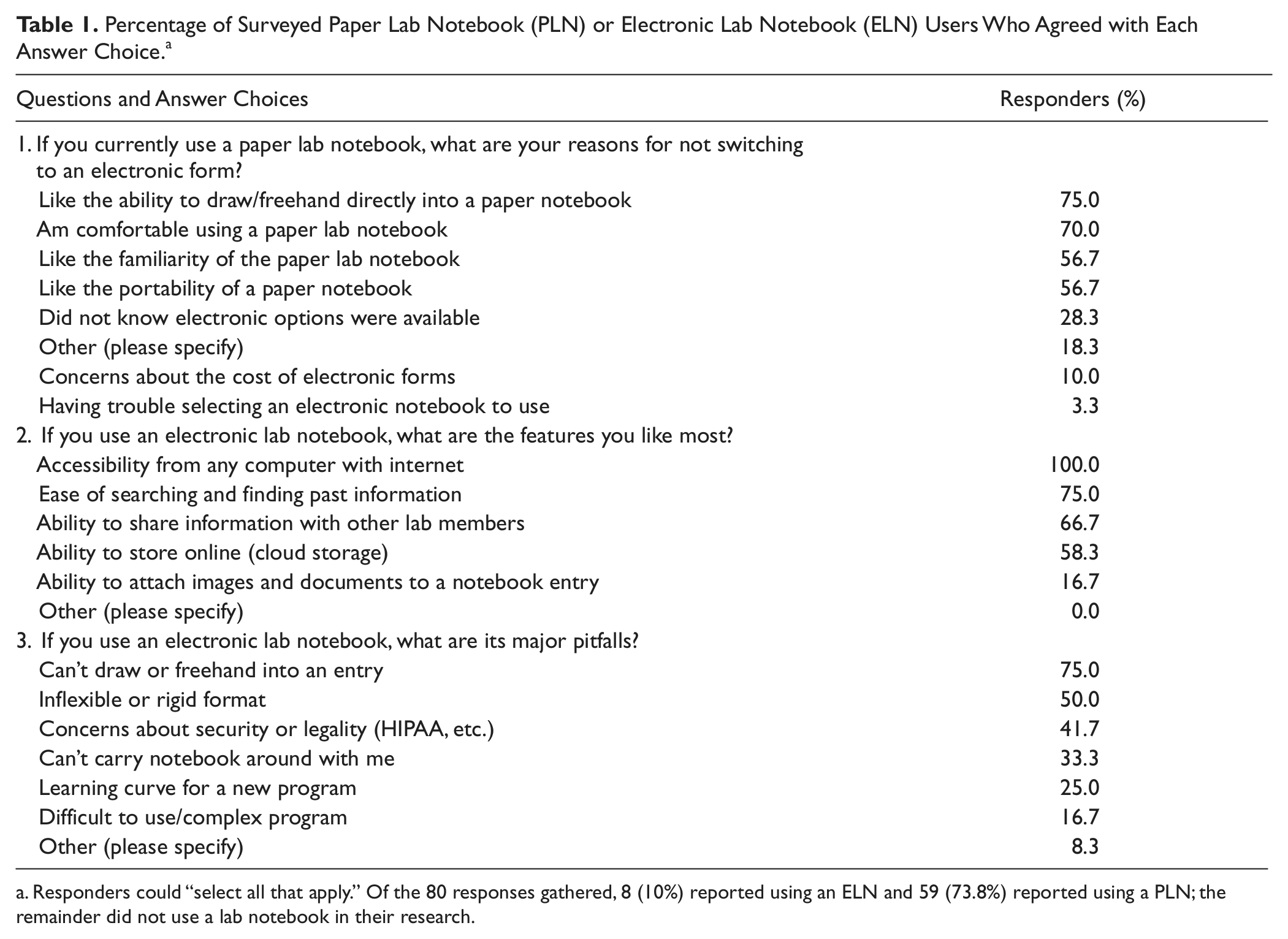
Responders could “select all that apply.” Of the 80 responses gathered, 8 (10%) reported using an ELN and 59 (73.8%) reported using a PLN; the remainder did not use a lab notebook in their research.
Our group found Evernote to provide a number of advantages over the traditional PLN, with the abilities to search content and share information with other lab members being the most valuable advances. Importantly, we felt that the inability to freehand on paper was outweighed (1) by the ability to sketch using iPads, other tablets, and Evernote add-on programs and (2) by the added advantage of directly importing snapshots taken with Evernote. Other distinct advantages included Evernote’s accessibility, spaceless storage, and archiving abilities, owing to the Web-based nature of the program. Finally, although many surveyed users expressed concern over the complexity or inflexibility of electronic notebooks, we found Evernote to be a simple, intuitive, and adaptable way to store experimental information.
Discussion
Advantages of ELNs: Using Evernote in a Translational Science Laboratory
From the responses of surveyed researchers, it became apparent that researchers in academic labs have many concerns as well as specific demands regarding use of an electronic notebook. Furthermore, there still remains a subset of researchers who are unaware of the option to document their work electronically. Although the survey results are limited by selection bias, there are very few data that examine investigators’ preferences for ELNs, and this survey provides some preliminary insight into why laboratories prefer or avoid ELNs. Here, we discuss the use of Evernote in the recording process, unique or particularly useful features that Evernote offers, and how an appropriate ELN can not only meet the demands of academic and nonprofit laboratories but also provide a wealth of advantages.
Ease of use
Notebook entries in Evernote resemble those of a typical PLN, so creation of entries is easy, quick, and intuitive. Many researchers, often students, have a limited period of employment and cannot afford the time to learn a complex new record-keeping program. 9 Simple ELNs such as Evernote have a minimal learning curve and allow rapid adoption in laboratories by anybody with basic computer skills. Furthermore, data that were generated electronically, for example, as in PCR gel images or numerical qPCR results, could be easily included in notebook entries without using the outdated “print, cut, and paste” method that is so often used in PLNs.
Flexibility
Of the ELN users we surveyed, 50% reported that a major pitfall of their ELN was an inflexible format. Although basic ELNs such as Evernote are admittedly much less structured, some specialized ELNs can be inflexible, depriving researchers the freedom to create their own workflow design and forcing their dependency on IT for support. 3 Inflexible programs can also make documentation difficult during protocol development, 9 where a great deal of freedom is needed to change and alter workflows. Although biopharmaceuticals and other large labs generating massive amounts of information may require the structure of specialized ELNs, academic and other nonprofit labs may benefit from the flexibility of more basic versions.
Evernote entries begin as a blank document, allowing the user a great deal of freedom in the format and content of entries. Numerous file types can be attached to an entry simply by “dragging and dropping” and appear either directly in the notebook content or with an icon that can be clicked to open (for larger Word documents, spreadsheets, etc.). One feature that is particularly helpful in the context of a scientific research lab is the ability to link other notebook entries to the current entry, so that protocols or other experiments can be quickly referenced, as in Figure 1 . Separate notes can also be merged, which may be helpful in organizing experiments with steps separated temporally.
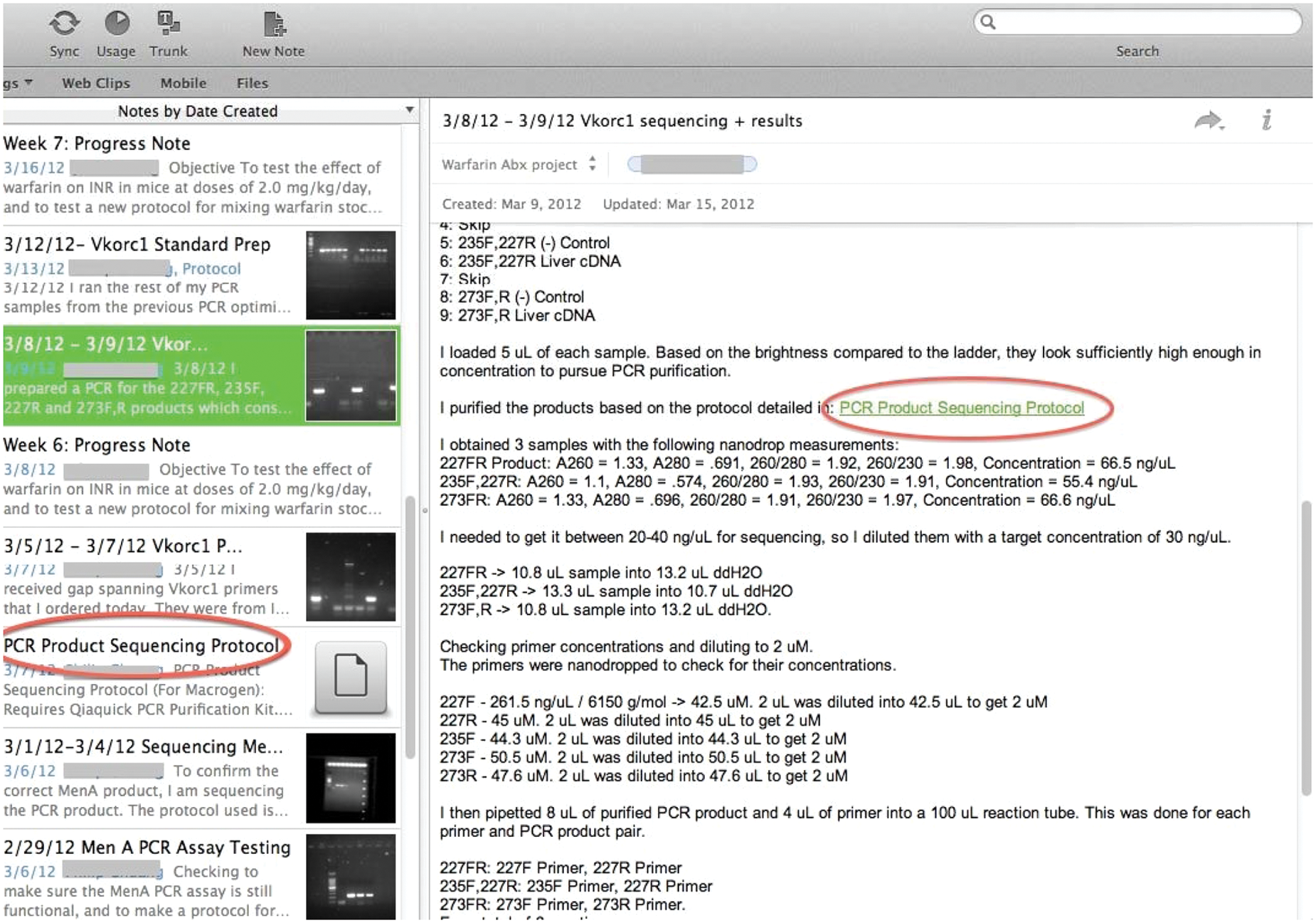
Other notebook entries, such as protocols or past experiments, can be linked to the current entry. Circled in red is the link to a past protocol within the current notebook entry (right) and a clip of the protocol in the “Snippets” view of past notebook entries (left).
Ease of searching
ELNs greatly simplify the task of searching a notebook when compared with their paper competitors. In Evernote, keywords can be used to search notebook text, attached PDFs and images, and even legible handwriting in photographs. Viewing options such as the “Snippets” view on the left of the screen, which displays text and an image from each previous entry, also help the user navigate through past notes. ELNs in general also negate the issues of deciphering illegible handwriting or making sense of corrections made to a notebook. Electronic documentation thus expedites searching both one’s own work and the work of others when collaborating on experiments or continuing projects started by another researcher.
Ease of sharing information
Today’s scientific work has become much more collaborative, very often with multiple lab members involved in a project or with one or more labs working together to share resources. One of the greatest advantages offered by ELNs when compared with PLNs is the ease of sharing information with collaborators, as multiple users in different locations can make simultaneous additions to the same notebook and view those added by others. Evernote allows notebooks or individual notes to be shared with an unlimited number of users, but only the notebook owner decides which users can add or edit entries in addition to viewing them. Researchers can then follow the parallel work done by teammates and be up to date on the most recent activity and achievements.
Accessibility
Although not physically portable, ELNs are highly accessible with the widespread use of today’s technology. Users can access Web-based notebooks from any online device including laptops, smartphones, and iPads or other tablets, many of which would be carried by the user otherwise. Evernote is compatible with both Macs and PCs, has both online and desktop programs, and has applications for iPhone, BlackBerry, Android, and other types of smartphones. 8 The Evernote desktop program may also be used from a personal computer when Internet access is not available and syncs content again when connected.
Online storage
Another distinct advantage to using a Web-based system is that all information is kept in cloud storage, erasing the need for shelf space and securing information safety in the event of a computer failure or crash. Furthermore, unlike the portable PLN, ELNs cannot be physically damaged or lost. For example, our laboratory was recently affected dramatically by Hurricane Sandy. Although a number of other laboratory processes were placed in jeopardy, documentation for our project was stored securely in Evernote, which may otherwise have been a concern using traditional PLNs.
Drawing and audio recording
A major concern of both ELN and PLN users surveyed was the inability to draw or freehand into an electronic notebook. Although PLNs remain the easier notebook version to physically manipulate, ELNs can be used with iPads or other tablets, allowing the user to draw and upload images easily. Also, some ELNs feature drawing capabilities as part of the software itself or as an add-on. For example, Skitch is a free drawing program add-on to Evernote, enabling users to electronically sketch and import drawings directly into Evernote entries.
Furthermore, images drawn on paper can be easily uploaded as photos using the “snapshot” feature of either desktop Evernote or its smartphone applications, and audio clips can also be added using these same programs, as in Figure 2 . There are also available dictation software add-ons to Evernote that automatically transcribe audio notes added to an entry.
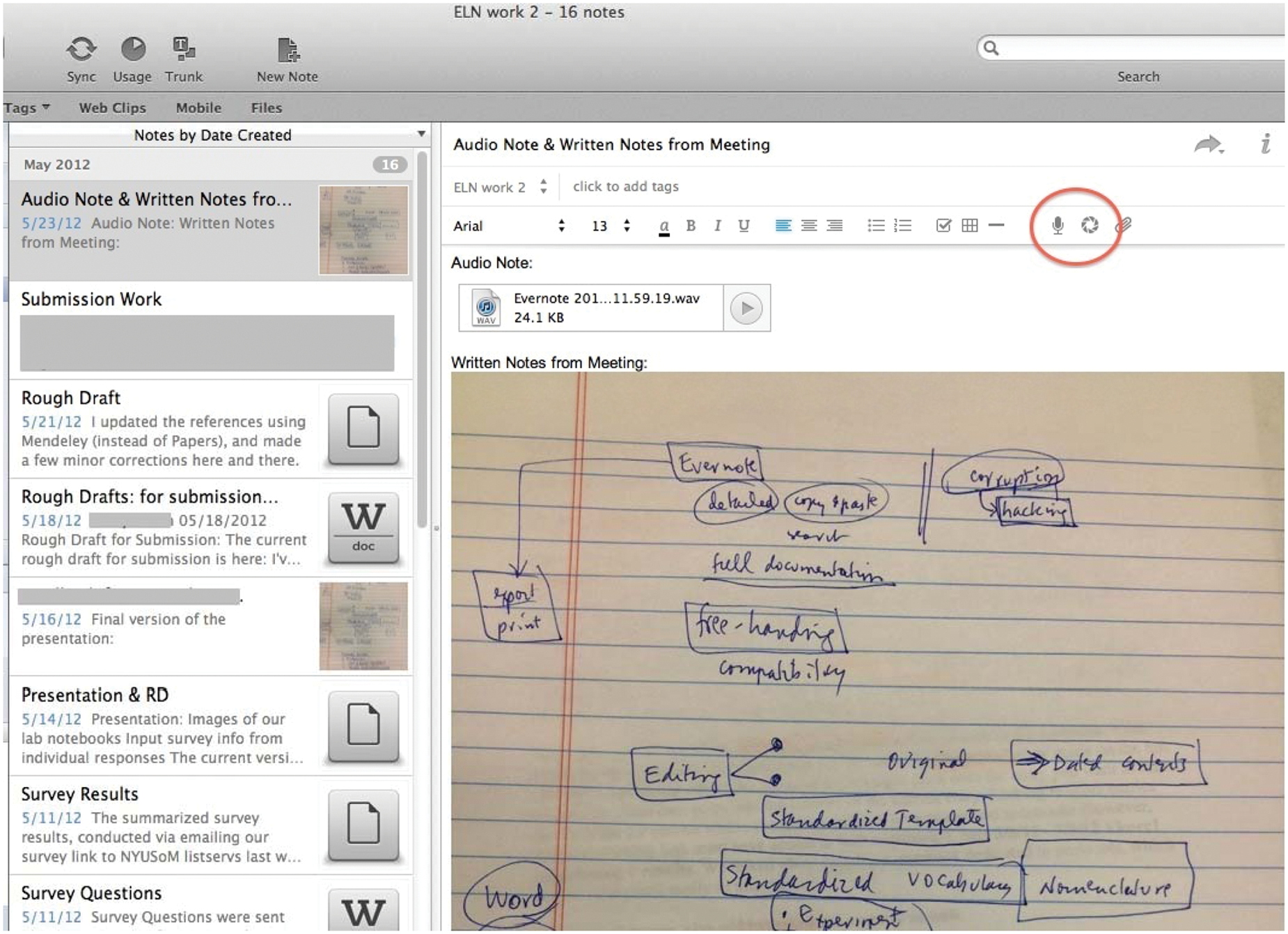
In the Evernote desktop and smartphone applications, snapshots and audio recordings can be made and attached directly into a notebook entry. The two icons for the recording and snapshot tools are circled in red.
Cost
Despite the availability of more complex, fully featured, or specialized ELNs, which can cost up to $1000,3,10 simple ELNs remain an inexpensive option for small and nonprofit laboratories. For example, companies such as Evernote and LabArchives offer free versions, Premium Evernote costs $45 a year, and Cognium Systems iPad ELN costs a one-time $55.8,11,12
Security and legality
With the passage of the ESIGN Act of 2000, electronic signatures became a valid way for authors to sign and authenticate their work, and most available ELNs meet the 21CFR Part 11 regulations in providing reliable electronic records.
Importantly, ELNs mitigate the issue of “the lost notebook” in legal matters relying on lab notebooks for information, particularly in cases related to provenance or scientific fraud. 13 Because content is dated and archived, ELNs provide a secure, reliable, and retrievable form of record keeping, in contrast to PLNs, which could be manipulated to change content, dates, or other information. Premium Evernote allows the notebook owner to view all past versions of a note, and both the Basic and Premium Evernote versions offer the ability to encrypt information for additional security.
Limitations of Evernote
HIPAA compliance
It must be noted, however, that Evernote does not seek certification with HIPAA regulations and therefore cannot contain patient-identifying information. Thus, although this ELN may be employed in many basic science laboratories, it may not be a practical option for clinical research labs dealing with patient information. One option we propose for dealing with this issue is to de-identify patient information before storing in Evernote and keep a separate, secure record of patient identifiers elsewhere.
Storage limitations
Although the Basic Evernote (free version) has an upload limitation of 60 MB monthly, the Premium version offers 1 GB of uploads per month. Still, much of today’s research involves generating data files such as sequence data, in which one file individually may be greater than these restrictions.
Simplistic and unstructured
Although Evernote may be a simple, practical solution for some laboratories, for others it may be overly simplistic in format and does not offer features specialized for fields such as biology, chemistry, or quality assurance/quality control. Importantly, larger labs generating considerable amounts of data may find a simple program like Evernote to be too flexible or unstructured for efficient use.
Selection of an ELN
As is touched on above, our selection of Evernote as an ELN stemmed from both its low cost and reported ease of use. For the types of experiments performed in our lab (mouse experimentation, PCR, qPCR, cloning experiments, etc.), we felt that Evernote allowed us to easily translate that information that would otherwise be stored in paper format into an electronic form. Our intent was not to change the paradigm of a laboratory notebook but rather to streamline and enhance the recording process utilizing the advantages of ELNs as listed above. However, this format may not be ideal for use in all research applications, and other ELNs may be better equipped for different types of experimentation done in other laboratories. The process of selecting an ELN will thus depend on the demands of the laboratory, but certain issues to consider include cost, format, storage, and uploading capacity as well as specific needs of the field of research such as equation editors, chemical structure and design programs, and so forth. Researchers should carefully weigh the need for flexibility over structure, with laboratories generating large volumes of numerical data likely requiring a more structured format.
Future of the Electronic Notebook
With advances in all electronic forms of data storage, including ELNs for experimental information and laboratory information management systems for sample and workflow management, there is increased push to integrate these systems. 10 In the future, we may expect to see systems emerge that combine the ability to manage both sample and experimental data in one, a feature that neither Evernote nor other current software can deliver.
Summary
In the context of an academic lab characterized by frequent turnover of staff and collaboration among many different users, ELNs surpass their paper competitors with the ability to quickly and easily store, search, access, and share information electronically. Evernote and other simple ELNs like it may be a good solution for the laboratory looking to transition to an electronic notebook without investing the time necessary to learn more specialized programs. Furthermore, these simple programs offer the user a great deal of freedom in composing entries.
Although the switch to electronic forms of recording has been slow for nonprofit laboratories, there are many advantages that can be gained from using an ELN, and with the number of options available today, there is certainly a feasible way for these labs to join the movement toward ELNs already under way.
Footnotes
Declaration of Conflicting Interests
The authors declared no potential conflicts of interest with respect to the research, authorship, and/or publication of this article.
Funding
The authors received no financial support for the research, authorship, and/or publication of this article.