



Abstract
Keywords
Introduction
Knee osteoarthritis (OA knee) is one of the leading causes to global disability. 1 In advanced cases, total knee replacement is a well-established treatment option. In fact, literatures reported up to 20% OA knee patients were having isolated unicompartmental osteoarthritis only. 2
Surgical treatment options for unicompartmental osteoarthritis of knee includes total knee replacement (TKR), unicompartmental knee replacement (UKR) and high tibial osteotomy (HTO). TKR was known to have satisfactory results in both short-term and long-term outcomes for OA knee patients. UKR, as another treatment option with gaining popularity, was reported to have less cost, fewer complications, better functional outcomes, and better patient satisfaction than TKR. The long-term outcomes and survivorship were found to be approaching that of TKR, while the short-term results from UKR were found to be superior to TKR.3–5
Considering this, we compared matched groups of patients receiving either UKR or TKR for various immediate and early postoperative outcomes in our locality. In this study, we also attempted to explore new parameters in reflecting the postoperative outcomes of knee replacement patients.
Methods
This is a retrospective review of the knee replacement cases in our center from 1/2018 to 1/2019. Primary UKR and TKR cases were analyzed. All the pre-operative radiographs were reviewed and only those with isolated severe medial compartment OA knee were included. The two groups of patients were matched based on age, body mass index (BMI), pre-operative range of motion (ROM), Knee Society score (KSS) and Feller patellar score. 6 Exclusion criteria were: (1) osteoarthritic changes over lateral and/or patellofemoral joint radiologically; (2) significant bone loss radiologically; (3) fixed flexion deformity more than 15°; (4) knee flexion less than 90o; (5) varus deformity more than 15o; (6) bilateral TKR or UKR at the same operation.
A retrospective cohort study comparing the two groups of patients was performed. All the operations were performed by the same group of arthroplasty surgeons in a local joint replacement center. For TKR patients, operations were performed with midline incision and medial parapatellar approach. They had posterior stabilizing implants from Persona (Zimmer, US), NexGen (Zimmer, US) or Attune (Depuy, US). For UKR patients, operations were performed with a medial parapatellar incision. They had implants from Oxford Mobile Bearing Partial Knee (Zimmer, US), Unicompartmental High Flex Knee (ZUK) system (Zimmer, US) or Journey Fixed Bearing Unicompartmental Knee system (Smith and Nephew, UK). Components were fixed with antibiotic-loaded cement for both groups of patients. Intra-articular transamin (1500 mg for TKR, 750 mg for UKR) was be given intraoperatively. Upon wound closure, a dose of periarticular analgesics (0.2% Ropivacaine mixed with 1:200,000 adrenaline) was given as local anesthesia (80 ml for TKR, 40 ml for UKR) for wound pain control. Patients were also given standardized regime of oral analgesics, as well as patient-controlled analgesia (intravenous fentanyl 20 microgram/ml) from day 1 to day 2 postoperatively.
The two groups of patients underwent a standardized postoperative rehabilitation regime. Patients were allowed full weight-bearing walking exercises and free mobilization under the supervision of physiotherapists starting from Day-1 postoperatively.
Immediate postoperative outcomes were reflected by postoperative pain (patient-controlled analgesia (PCA) use and pain score), blood loss (hemoglobin(Hb) drop), length of stay (LOS) as in-patient and the number of physiotherapy sessions attended before achieving static recovery. Early functional outcomes were measured with KSS and ROM at 3-months and 1-year follow-up postoperatively. To look for any differences in the speed of recovery between the two groups, comparisons were also made between the outcomes of UKR at 3-months follow-up with the 1-year follow-up of TKR patients, including the knee scores and range of motion. Non-paired t-test were used to compare the parameters of both groups. P values ≤ 0.05 were taken as statistically significant.
Results
26 UKR patients were identified and they are matched with 26 TKR patients. (Table 1) There were no statistically significant differences on the age of operation, preoperative BMI, preoperative range of motion, Feller patellar score, total and sub-scores (knee score, functional score) of the Knee Society Score. None of the patients suffered from significant postoperative complications including infection, fractures, deep vein thrombosis or pulmonary embolism, implant failure or loosening, that required prolonged hospital stay and treatment, or revision surgery during the study period.
Preoperative patient demographics.
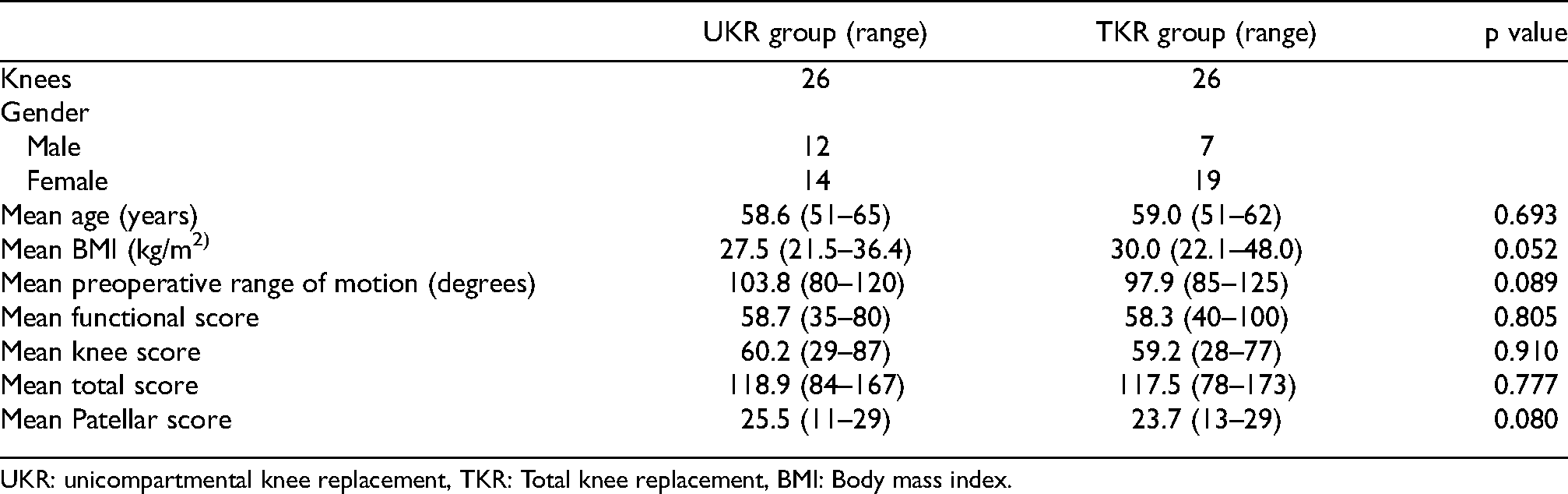
UKR: unicompartmental knee replacement, TKR: Total knee replacement, BMI: Body mass index.
Most of the immediate postoperative outcomes measured during postoperative hospital stay for the UKR group were better than the TKR group. (Table 2) Regarding postoperative pain level, there were no statistically significant differences in early postoperative pain score or postoperative daily PCA use (p > 0.05). UKR patients had less postoperative hemoglobin drop than TKR patients (1.2 g/dL for UKR, 1.6 g/dL for TKR, p = 0.04). The mean length of stay in hospital was significantly shorter for UKR patients than TKR patients (4.3 days for UKR, 6.0 days for TKR, p < 0.001). UKR patients were able to complete the postoperative rehabilitation and achieve satisfactory ambulation, with a shorter course of physiotherapy than TKR patients as reflected by the mean physiotherapy sessions required (6.9 sessions for UKR, 9.3 sessions for TKR, p < 0.05). (Table 2)
Immediate postoperative outcomes.
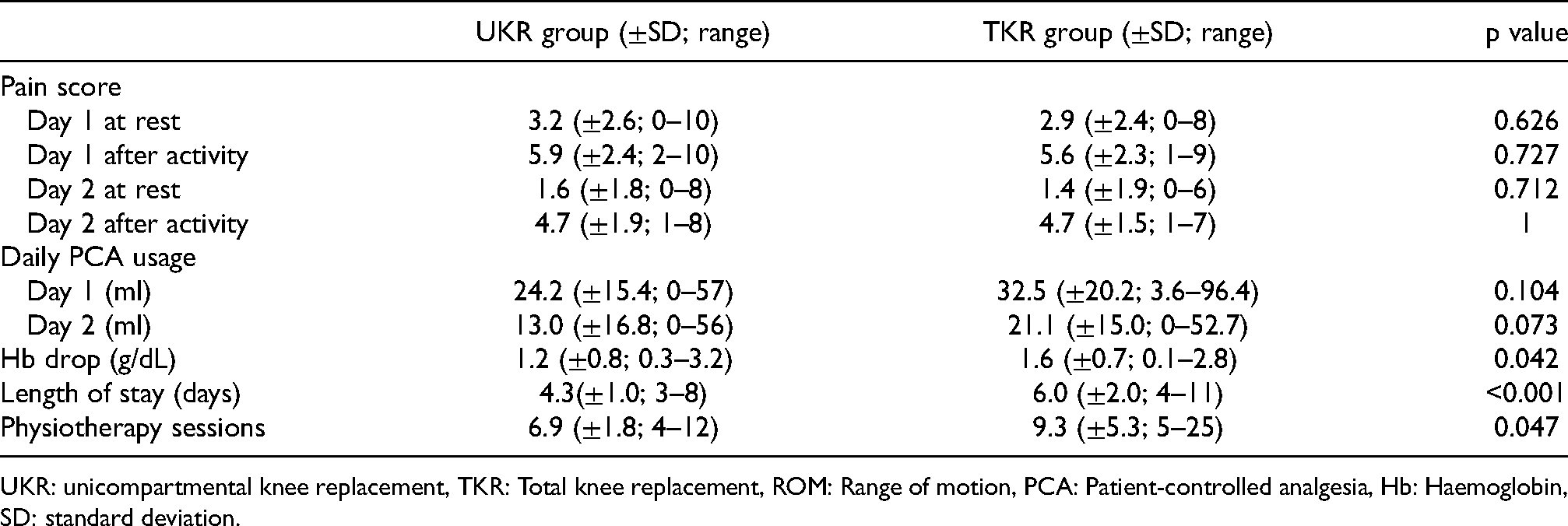
UKR: unicompartmental knee replacement, TKR: Total knee replacement, ROM: Range of motion, PCA: Patient-controlled analgesia, Hb: Haemoglobin, SD: standard deviation.
Patients of both UKR and TKR groups were all assessed at the clinic at 3-months and 1-year postoperatively. At 3-months follow-up, UKR patients had better mean total KSS (155.9 for UKR, 142.4 for TKR, p = 0.005) and ROM (115.8o for UKR, 98.8o for TKR, p < 0.001). There were no statistically significant differences in the subgroups of knee scores and functional scores between the two groups (p > 0.05). The UKR group had statistically better performance in the total KSS and ROM at 3-months postoperatively. The two groups had similar Feller patella score (p > 0.05). (Table 3)
Early postoperative outcomes at 3-month follow-up.

UKR: unicompartmental knee replacement, TKR: Total knee replacement, SD: standard deviation.
At 1-year follow-up, UKR patients had a mean total KSS 165.7 and mean ROM of 115.8o, while TKR patients had a lower mean total KSS 152.7 and mean ROM 105.0o. The UKR group still had a better performance at 1-year postoperatively (p < 0.05). There were no significant differences over the Feller patella score (p > 0.05). (Table 4)
Early postoperative outcomes at 1-year follow-up.

UKR: unicompartmental knee replacement, TKR: Total knee replacement, SD: standard deviation.
With the satisfactory results, we also compared the outcomes of UKR patients in 3-months follow-up with that of TKR patients at 1-year follow-up. UKR patients already achieved better KSS (p = 0.007) and ROM (p = 0.004) at 3-months as compared with the TKR patients at 1-year follow-up. (Table 5)
Comparison on early postoperative outcomes between unicompartmental knee replacement (UKR) patients at 3-month follow-up and total knee replacement (TKR) patients at 1-year follow-up.

UKR: unicompartmental knee replacement, TKR: Total knee replacement, SD: standard deviation.
Discussion
The development of joint replacement surgery has been advancing since the 1970s. The initial results of UKR were not promising.7,8 However, with increasing demand in minimally invasive surgery, and improvements in implant designs in 1990s, there was a renewed interest in UKR while HTO had decreasing popularity.7,8 HTO had specific risks including delayed union or non-union, and neurovascular complications. Conversions from HTO to TKR was reported to be technically demanding due to the need for hardware removal, resultant patella baja and anatomical deformity of proximal tibia after HTO, and wound complications. 9
Studies suggested that the long-term outcomes and survivorship of UKR were approaching that of TKR, while the 10-year survival rate was greater than 90%. The results were reproduced by several studies from non-designer centers worldwide. Superior short-term results, including shorter rehabilitation time, greater range of motion, less blood loss and a shorter hospital stay with UKR were also demonstrated.10,11 Furthermore, patients were reported to have fewer complications and better satisfaction with UKR.10–12
The aim of this study was to assess the short-term performances of UKR in a group of relatively younger and active patients with mainly medial knee OA when compared to a group of TKR patients with similar preoperative characteristics. Over the past two decades, there had been debates on whether patellofemoral joint degeneration affects the outcome of unicompartmental knee replacement.13,14 In our study, we attempted to minimize the influence of patellofemoral joint degeneration when comparing the outcomes between UKR and TKR groups. Hence, we matched the two groups of patients both radiologically and functionally. Preoperative knee radiographs were screened to rule out significant patellofemoral joint degenerative changes. Feller patellar score, a scoring system designed for symptomatic and functional assessment of patellofemoral joint degeneration, was charted preoperatively. 6 There were no statistically significant differences on the preoperative patella score between the two groups.
Our study showed the UKR group had less postoperative analgesics use and blood loss, shorter LOS, less physiotherapy sessions required and a faster recovery. They had better early KSS and ROM than TKR group in up to 1-year postoperatively; and could achieve better outcomes in a shorter duration, comparing the 3-months results with TKR patients at 1-year follow-up.
Pain control, measured with pain score and amount of opioid use with patient-controlled analgesia, was taken as one of the parameters for comparison in immediate postoperative outcomes between the UKR and TKR patients in this study. Opioid use was a common and well-known effective mean of pain control for TKR patients perioperatively and was well documented in various published literatures.15,16 However, postoperative pain control and opioid use was less investigated in UKR cases. 17 Among those reported, most were reporting the prescribed out-patient opioid usage for the first few months postoperatively, while none described immediate postoperative pain scores and opioid consumptions.18,19 This study demonstrated immediate postoperative pain control could be a significant parameter for assessing and comparing the immediate postoperative outcomes between UKR and TKR patients. Although we did not demonstrate statistically significant differences in pain scores or PCA use between the two groups, it was observed that the UKR group had a lower mean PCA volume use. With 12 UKR patients and 5 TKR patients having 0 ml PCA use on day 2 postoperatively, more of the UKR patients had earlier wean-off of PCA use to oral analgesics only for postoperative pain control. A wide range of volume of PCA use was also observed in the two groups of patients. Further observations on a larger group of patients may be needed to draw more conclusions on the postoperative pain between UKR and TKR.
The number of physiotherapy sessions attended by the patients to achieve a static postoperative recovery was also taken as a parameter to assess early postoperative outcomes between the two groups of patients. Both groups of patients underwent the same standard in-patient postoperative physiotherapy regime, starting from day 1 postoperatively, including limb mobilization and walking exercises. They were also arranged a standard out-patient physiotherapy program for further rehabilitation until static progress. While different knee scores, patient assessed outcomes, gait parameters and functional assessments between TKR and UKR patients were previously compared in published literatures, there was no direct comparison on the duration or the number of physiotherapy sessions these patients underwent until full recovery.20–22 In this study, there was a direct comparison on the sessions of physiotherapy required.
Nevertheless, this study had some limitations. This study was performed in a retrospective manner. Moreover, long term follow-up results are still pending. Further observations on this group of patients will be necessary for comparison in long term outcomes.
Conclusion
This retrospective cohort study demonstrated patients with mainly medial knee OA receiving UKR had better immediate and early postoperative outcomes than patients undergoing TKR. A continuous follow-up on this cohort of patients will be necessary for comparison in long term outcomes and survivorship between the two groups.
Supplemental Material
sj-pdf-1-otr-10.1177_22104917211056951 - Supplemental material for Better immediate and early postoperative outcomes of unicompartmental knee replacement comparing with total knee replacement: A matched cohort of patients with medial knee osteoarthritis
Supplemental material, sj-pdf-1-otr-10.1177_22104917211056951 for Better immediate and early postoperative outcomes of unicompartmental knee replacement comparing with total knee replacement: A matched cohort of patients with medial knee osteoarthritis by Hiu-Kiu Yu, Bruce Yan-Ho Tang, Hok-Leung Wong, Sumire Sasaki and Tai-Fong Wong in Journal of Orthopaedics, Trauma and Rehabilitation
Supplemental Material
sj-docx-2-otr-10.1177_22104917211056951 - Supplemental material for Better immediate and early postoperative outcomes of unicompartmental knee replacement comparing with total knee replacement: A matched cohort of patients with medial knee osteoarthritis
Supplemental material, sj-docx-2-otr-10.1177_22104917211056951 for Better immediate and early postoperative outcomes of unicompartmental knee replacement comparing with total knee replacement: A matched cohort of patients with medial knee osteoarthritis by Hiu-Kiu Yu, Bruce Yan-Ho Tang, Hok-Leung Wong, Sumire Sasaki and Tai-Fong Wong in Journal of Orthopaedics, Trauma and Rehabilitation
Footnotes
Declaration of conflicting interests
The author(s) declared no potential conflicts of interest with respect to the research, authorship, and/or publication of this article.
Funding
The author(s) received no financial support for the research, authorship and/or publication of this article.

Supplemental material
Supplemental material for this article is available online.
References
Supplementary Material
Please find the following supplemental material available below.
For Open Access articles published under a Creative Commons License, all supplemental material carries the same license as the article it is associated with.
For non-Open Access articles published, all supplemental material carries a non-exclusive license, and permission requests for re-use of supplemental material or any part of supplemental material shall be sent directly to the copyright owner as specified in the copyright notice associated with the article.
