



Abstract
Study Design
Topic modeling of literature.
Objectives
Our study has 2 goals: (i) to clarify key themes in degenerative cervical myelopathy (DCM) research, and (ii) to evaluate the current trends in the popularity or decline of these topics. Additionally, we aim to highlight the potential of natural language processing (NLP) in facilitating research syntheses.
Methods
Documents were retrieved from Scopus, preprocessed, and modeled using BERTopic, an NLP-based topic modeling method. We specified a minimum topic size of 25 documents and 50 words per topic. After the models were trained, they generated a list of topics and corresponding representative documents. We utilized linear regression models to examine trends within the identified topics. In this context, topics exhibiting increasing linear slopes were categorized as “hot topics,” while those with decreasing slopes were categorized as “cold topics”.
Results
Our analysis retrieved 3510 documents that were classified into 21 different topics. The 3 most frequently occurring topics were “OPLL” (ossification of the posterior longitudinal ligament), “Anterior Fusion,” and “Surgical Outcomes.” Trend analysis revealed the hottest topics of the decade to be “Animal Models,” “DCM in the Elderly,” and “Posterior Decompression” while “Morphometric Analyses,” “Questionnaires,” and “MEP and SSEP” were identified as being the coldest topics.
Conclusions
Our NLP methodology conducted a thorough and detailed analysis of DCM research, uncovering valuable insights into research trends that were otherwise difficult to discern using traditional techniques. The results provide valuable guidance for future research directions, policy considerations, and identification of emerging trends.
Introduction
Degenerative cervical myelopathy (DCM) is a condition characterized by neurological impairment stemming from the degeneration of cervical spinal structures.1,2 The gradual narrowing of the cervical spinal canal results from degenerative processes, including cervical spondylosis, ossification of the posterior longitudinal ligament (OPLL), and hypertrophy of the ligamentum flavum (OLF). 3 The progressive narrowing of the spinal canal causes chronic, non-traumatic compression of the spinal cord over time, which may ultimately result in gait impairment, tetraparesis, sensory symptoms, and bladder or bowel dysfunction. Typically, initial symptoms present in the hands, including non-dermatomal numbness in the fingertips and reduced manual dexterity.4,5 Patients may also experience poor coordination while walking and, as the disease advances, may display objective weakness on clinical examination, usually more pronounced in the distal upper extremities. 6 In severe DCM cases, patients may develop bowel and bladder dysfunction and become wheelchair-bound.
In the United States, projections show the proportion of adults aged ≥65 years will increase substantially from 13% in 2010 to 22% in 2050.7,8 Similar growth in the elderly population is occurring in other developed and developing countries, including the United Kingdom, Japan, China, Brazil, and India.8,9 With the aging global population, the prevalence of DCM has risen and is expected to continue to rise worldwide. Degenerative cervical myelopathy represents the most common cause of spinal cord impairment and injury among adults, resulting in significantly decreased quality of life and increased economic burden from medical expenditures and loss of productivity.3,6,10-13 Clinically, approximately 10% of patients ≥55 years of age exhibit symptoms of DCM, while magnetic resonance imaging (MRI) reveals radiographic cervical spondylosis in up to 50% of this age group. 6 In the United States alone, up to 20 000 patients are hospitalized annually for DCM treatment, accruing costs of several hundred million dollars.14,15 Consequently, determining optimal treatment for DCM has become a key public health priority. 8
The growing concern regarding DCM has motivated extensive research initiatives to improve the time to diagnosis, the understanding of disease pathophysiology and treatment strategies. 16 The vast amount of scientific literature on DCM poses a major challenge for clinicians, who must parse through and synthesize large bodies of information. While systematic and scoping reviews can streamline this process,8,15,17,18 these approaches often require months to years to complete.19,20 The slow pace of traditional reviews may impede the application of new research findings and the discovery of overarching patterns within the literature. Therefore, more efficient approaches are needed to analyze the expansive DCM literature. Advanced text mining techniques could enable more rapid analysis of these large volumes of data.
This study utilizes natural language processing (NLP) and topic modeling to synthesize existing DCM literature and examine associated themes and trends. The study has 2 primary aims: (i) to elucidate key topics in DCM research; and (ii) to assess current patterns related to the rising or declining prominence of these topics. Additionally, this work has a methodological goal of highlighting the utility and potential of NLP in augmenting research synthesis. This provides a more efficient approach to dissecting and comprehending the intricate academic literature landscape within DCM research.
Methods
Ethical Approval
Ethical Approval was not required for this study as it did not involve human subjects or personal data, but rather focused on analyzing existing literature.
Data Source
On July 27, 2023, the Scopus database was searched using a modified search strategy based on “search filters” previously developed for EMBASE and MEDLINE databases.21-23 These search filters were designed to gather all articles related to DCM. To further refine our search, we used filters found in Scopus, limiting the “Document Type” to “Article” and “Review” categories, selecting “Journal” as the “Source type,” and setting “English” as the language. We included articles only after the year 2000, to prioritize contemporary research within the DCM field. The downloaded documents included essential metadata elements, such as document title, abstract, author name(s), year of publication, and citation count.
Preprocessing
As an initial step, we preprocessed the downloaded data to prepare for subsequent analyses. Articles lacking abstracts were excluded. A new column combining article titles and abstracts was generated to enable analysis of these elements. Citation counts were divided into quartiles (Q1, Q2, Q3, Q4) to better comprehend citation impact across topics. The 10 most prevalent journals were identified, while the remaining journals were categorized as “Other” to simplify analysis. First and senior authors were extracted from the author lists to allow analysis of author contributions. The 10 most frequently occurring senior authors were identified, while the remaining were grouped as “Other.”
Topic Modeling
To uncover hidden patterns and identify primary topics in our dataset, we utilized NLP and a technique called topic modeling. Specifically, we used BERTopic, 24 a topic modeling approach that generates interpretable, dense topic clusters using BERT (Bidirectional Encoder Representations from Transformers) embeddings 25 and c-TF-IDF (Class-based Term Frequency - Inverse Document Frequency). BERTopic builds on BERT, a pre-trained language model that has profoundly advanced NLP by enabling context-aware understanding and improved performance. We obtained sentence embeddings using the S-PubMedBert-MS-MARCO model, a Hugging Face sentence-transformers model fine-tuned for medical text information retrieval tasks. 26 The text was further refined by removing common, non-informative words (stop words) using the NLTK library after embedding. 27 To ensure topic specificity, custom DCM-related stop words were also included.
Fundamentally, BERTopic utilizes a probability-based approach during its operation. When faced with potential topic overlaps or ambiguities, BERTopic assigns a probability score to each topic based on the specific content and context within the document. It then categorizes the document into the topic with the highest probability assigned. This probabilistic methodology enables nuanced, optimized topic assignments, even for closely related topics. Exploratory efforts were made to identify optimal parameter settings of “min_topic_size = 25” and “top_n_words = 50”. The min_topic_size parameter sets a minimum threshold for the number of documents assigned for each topic. The top_n_words parameter specifies the number of words per topic to extract. Additionally, we used a probability threshold to identify outliers, and documents with less than 5% probability of belonging to any discovered topic were marked as outliers.
After model training, a list of topics with corresponding representative documents was generated. Topic labels were determined by author consensus based on keywords and representative documents. These representative documents demonstrated the significance of each topic. Additionally, word clouds offered visual depictions of key terms for each topic. The top 10 most frequently occurring topics, as identified by the BERTopic model, were chosen for in-depth analysis based on their relevance and significance. We then examined the distribution of these 10 topics across citation quartiles, journals, first authors, and senior authors. These analyses provided insights into the popularity and impact of each topic.
Trend Analysis
Following the methodology of Bittermann and Fischer, 28 we utilized linear regression models to analyze trends among the identified topics. Topics displaying positive linear slopes were classified as “hot topics,” while those with negative slopes were deemed “cold topics.” We opted not to use non-linear approaches and multilayer perceptrons (MLPs) in our analysis in order to simplify the process, reduce the risk of overfitting, and enhance the interpretability of results.
Publication years, topic names, and topic probabilities were extracted from the dataset. Topic probabilities indicate the likelihood that a document’s content influenced its assignment to a particular topic. High probabilities denote documents with substantial relevance and represenation of a topic, while low probabilities indicate minimal relevance or representation. Individual probabilities were compiled to derive an annual mean topic probability for each topic. Mean topic probability was utilized as the dependent variable, with publication year as the independent variable to train linear regression models per topic. The slope direction of the regression lines differentiated hot and cold topics, with positive slopes signaling hot topics and negative slopes indicating cold topics.
The trend analysis was conducted in 2 phases. First, overall trends were examined from 2000 until the date of the Scopus search, providing a longitudinal topic analysis. Second, the analysis was narrowed to the current decade (2020s) to identify emerging topics.
Computational Tools and Libraries for Data Analysis
The computational analyses were performed using Python 3.1 in Google Colab. Libraries such as pandas and numpy were used for data manipulation and analysis, nltk for stop words, sentence-transformers and BERTopic for topic modeling analysis, sklearn for trend analysis, and wordcloud for generating word clouds.
Results
A total of 5533 documents were initially obtained. After refinement of “Document type” to “Article” and “Review,” “Source type” to “Journal,” “Language” to “English” and earliest publication year to 2000, 1199 documents were excluded. Two hundred and sixty-three additional documents were excluded due to their lack of abstracts. A total of 4071 documents remained, of which 3510 were classified into 21 distinct topics. The remaining 561 documents (13.8%) were considered outliers, as their probability of belonging to any one topic was below 5%.
Summary of the 21 Distinct Topics With Associated Keywords and Document Counts.
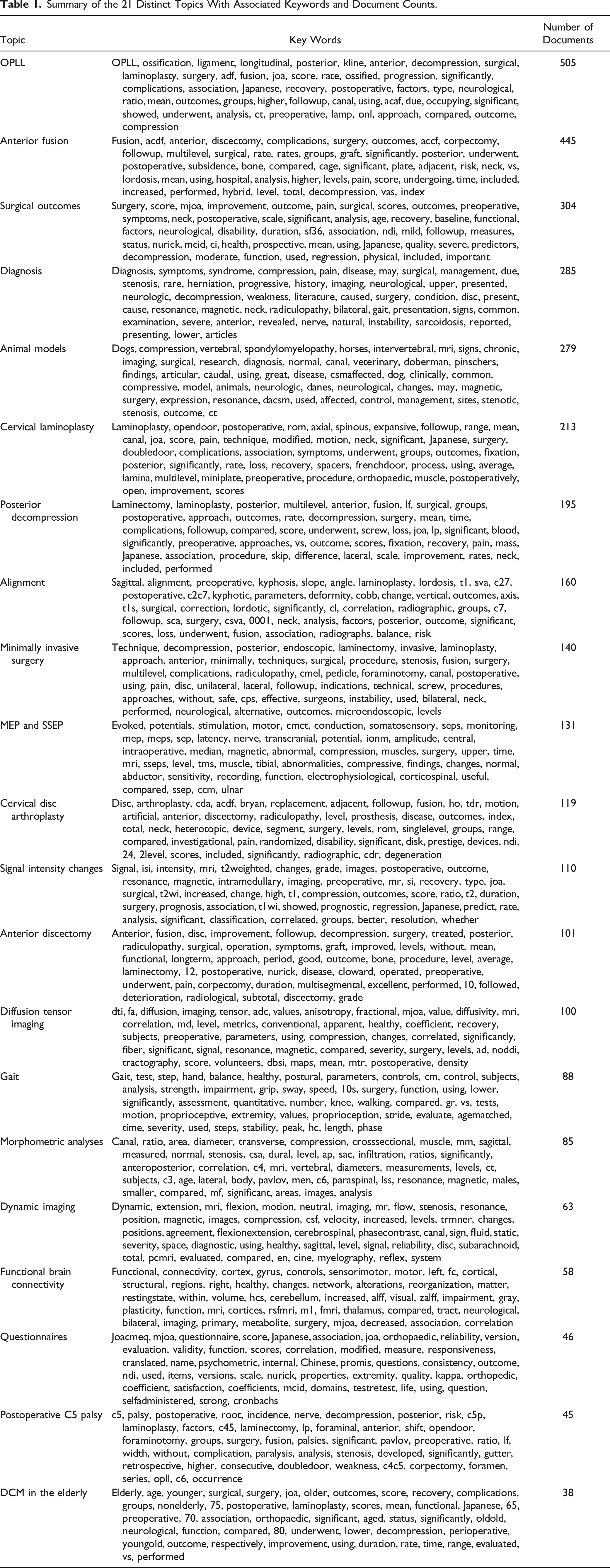
Word clouds of the top 10 topics.
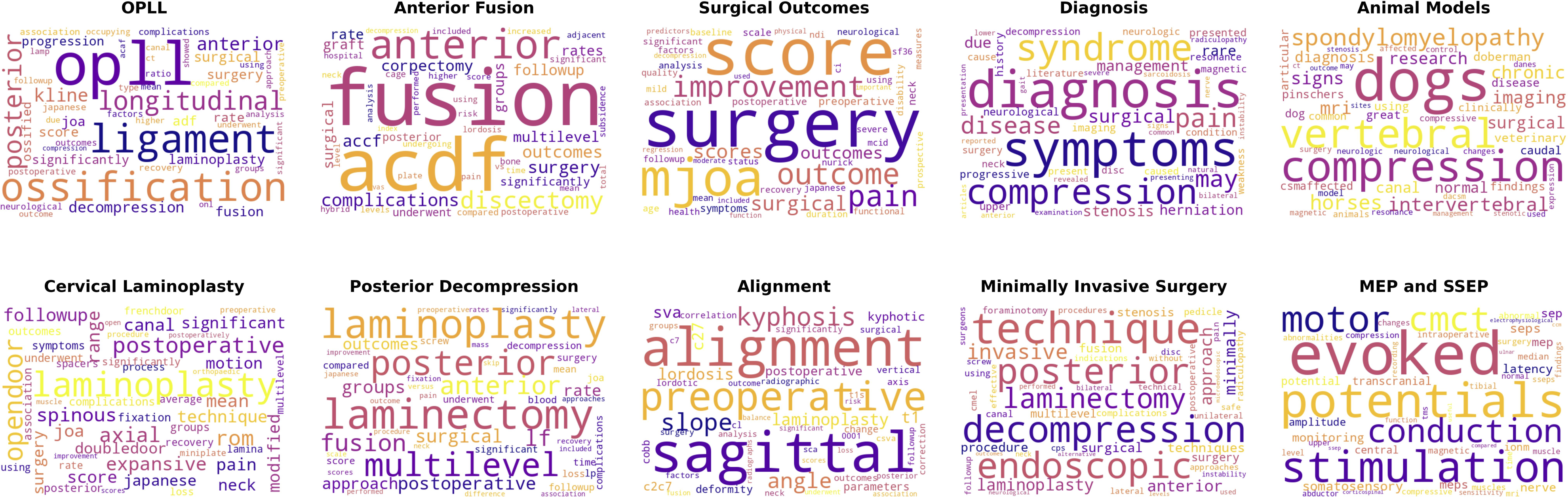
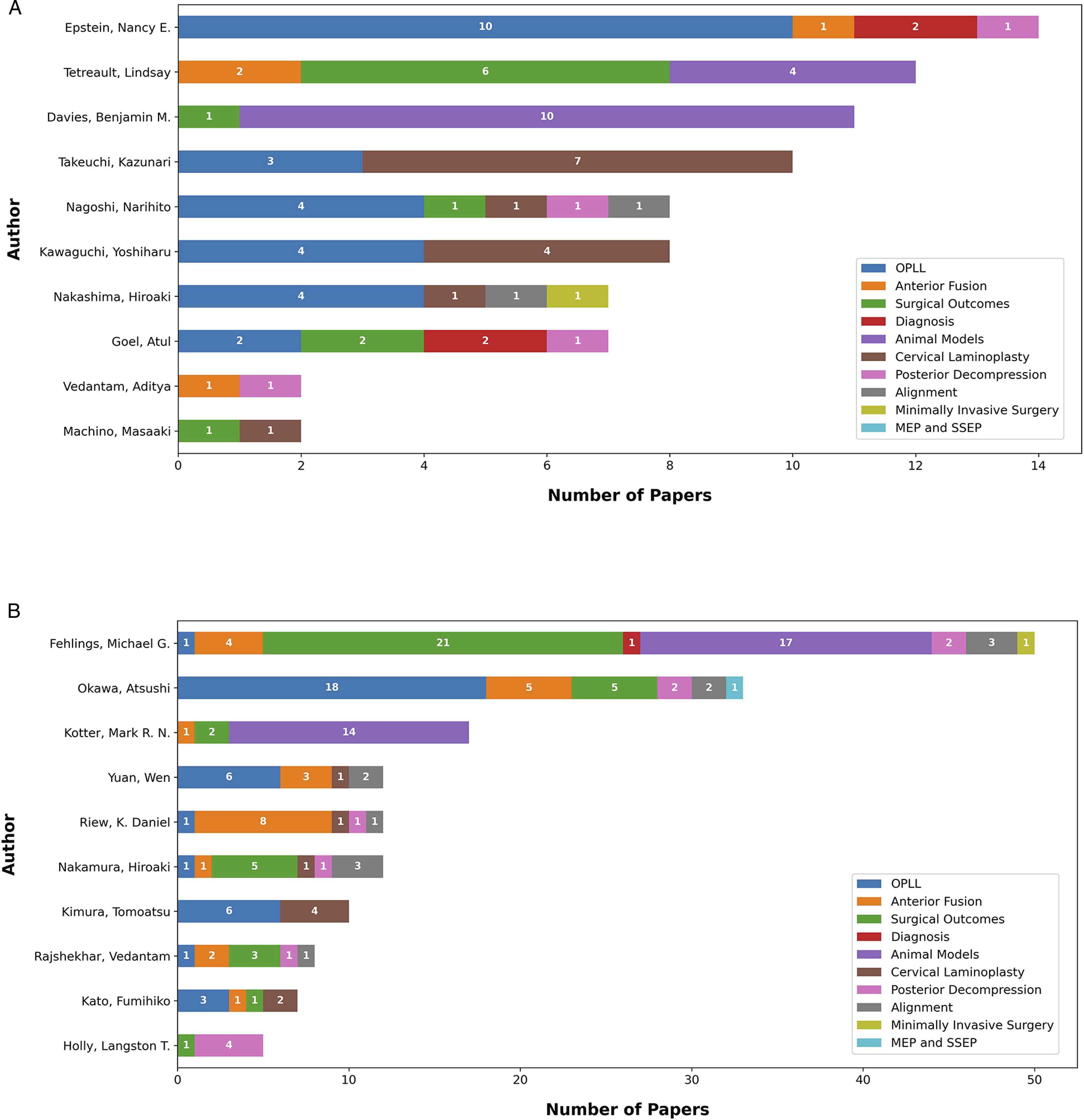
Figure 2 provides a visual representation of citation quartiles for the top 10 topics, offering insights into the recognition of these topics within the research communities. Figure 3 further shows the number of papers for the top ten topics as distributed across different journals. Figure 4A shows the top 10 first authors and the distribution of topics among the papers they authored. Figure 4B provides a similar depiction for the top 10 senior authors. Citation quartiles for the top 10 topics. Topic distribution of papers by the top 10 journals. (A) Topic distribution of papers by the top 10 first authors. (B) Topic distribution of papers by the top 10 senior authors.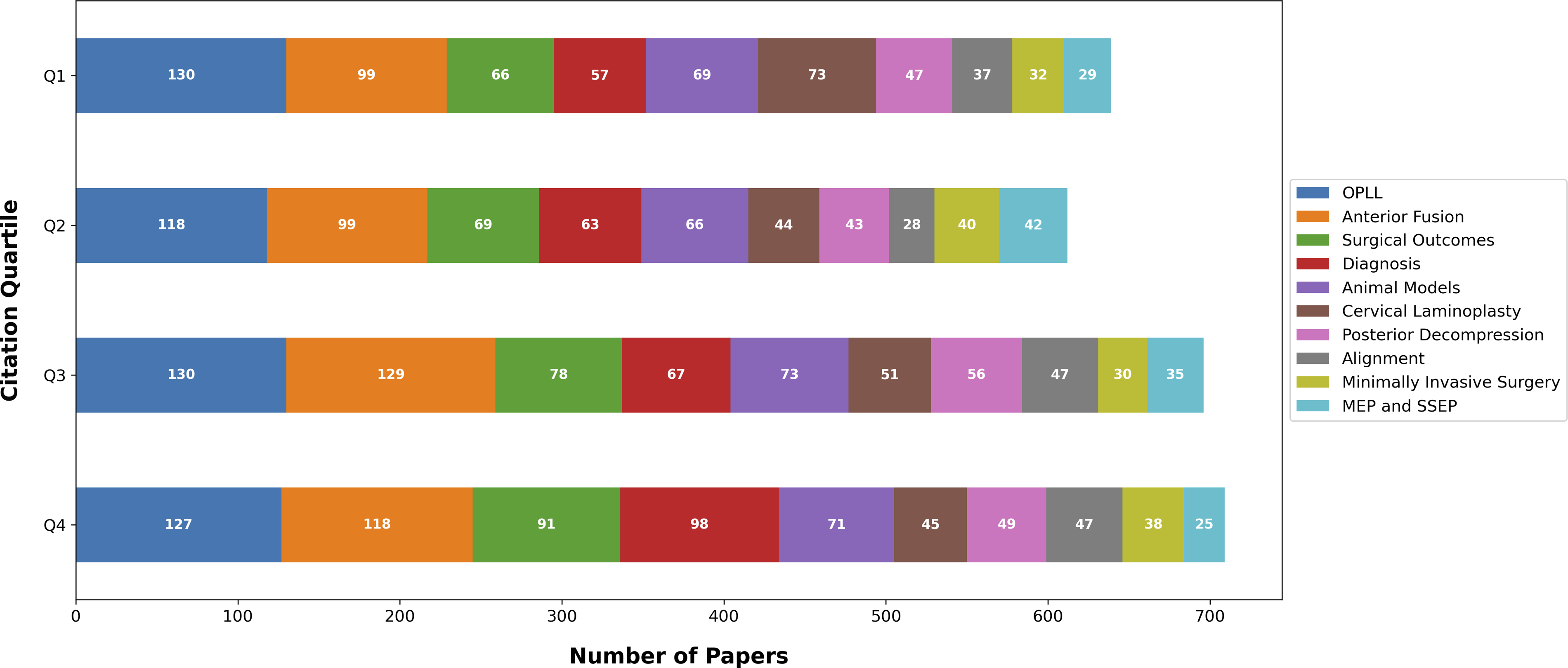
Overall Trends
We employed linear regression models to conduct an analysis of topic probabilities and uncovered significant trends from 2020 to July 27, 2023 (the date the database search was last conducted). The hottest topics, as evidenced by an increasing slope in our analysis, were “Functional Brain Connectivity,” “Signal Intensity Changes,” and “Alignment.” These topics have had a growing impact in research over the years. By contrast, “Questionnaires,” “OPLL,” and “Diffusion Tensor Imaging” were considered cold topics, as evidenced by a decreasing slope in our analysis, indicating a decline in their impact within research.
Figure 5A provides a color-coded bar chart depicting these trends. The color spectrum depicts the impact of various topics, with darker shades of purple-blue representing colder topics, and brighter shades of yellow-orange representing hotter topics. The length of each bar correlates to the magnitude of the slope values. This figure provides a straightforward visualization that easily communicates topic trends. (A) Color-coded bar chart of hot and cold topics spanning from the inception of the first publication to the most recent publication date. (B) Color-coded bar chart of hot and cold topics in the current decade.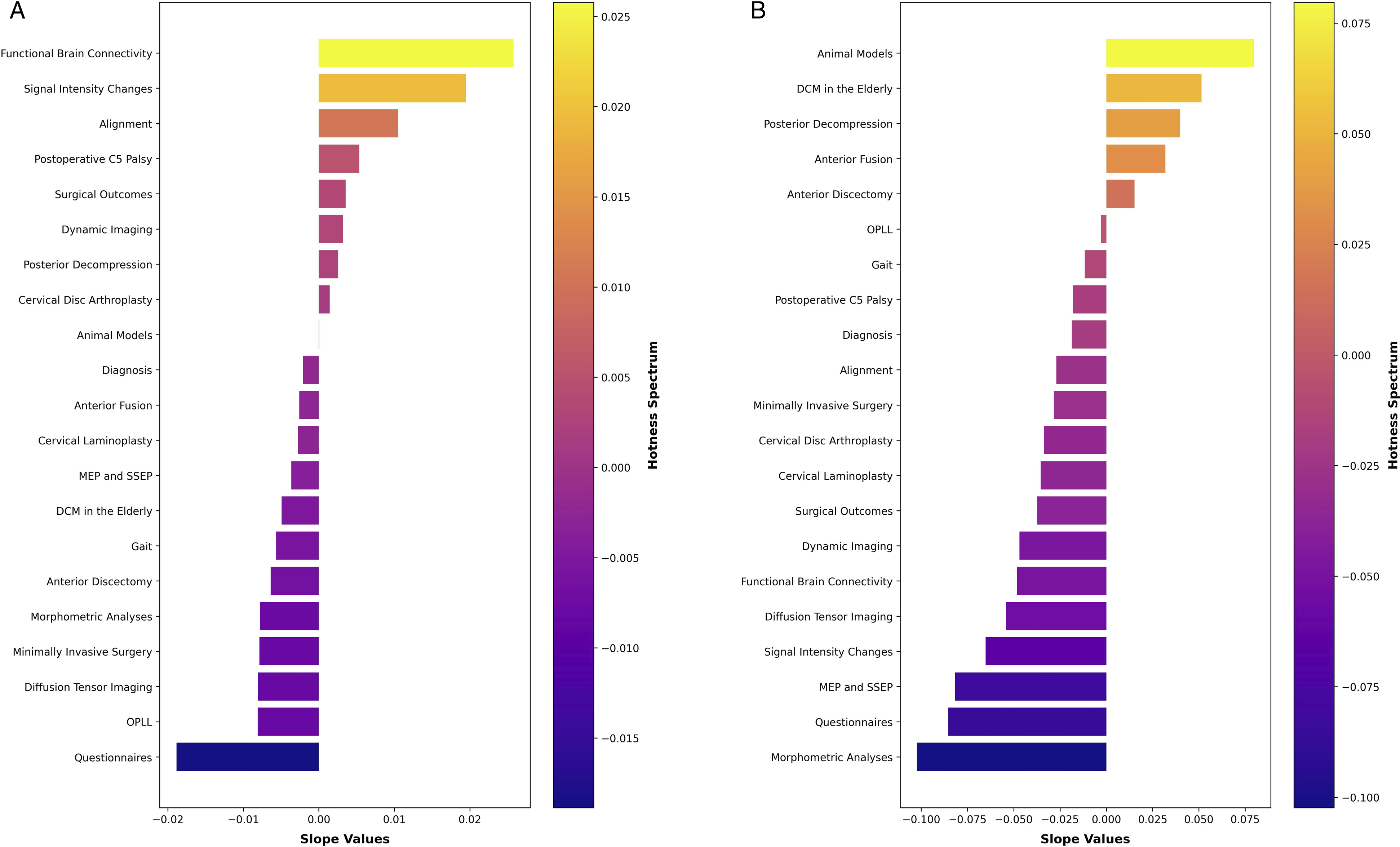
Figure 6 showcases the number of papers with each topic plotted against the year it was published. This provides a clearer visualization of temporal changes and significance of each topic throughout the years. Number of papers for the top 10 topics plotted against publication year.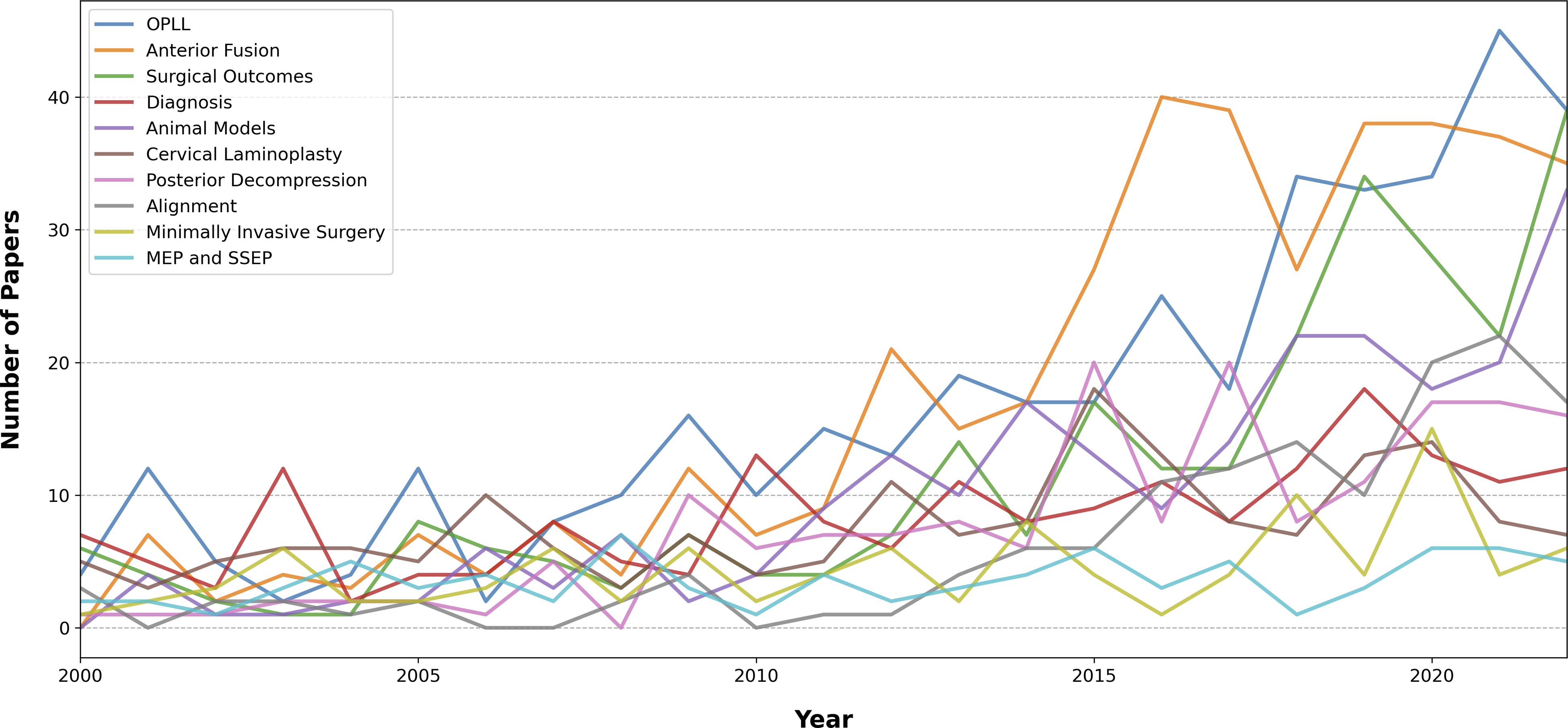
Trends in the Current Decade
Within this decade, a focused analysis revealed “Animal Models,” “DCM in the Elderly,” and “Posterior Decompression” as being the hottest topics. These topics have experienced a substantial rise in representation, signaling a shift in research emphasis towards these topics. By contrast, “Morphometric Analyses,” “Questionnaires,” and “MEP and SSEP” were identified as being the coldest topics, suggesting decreased emphasis on these topics in research (Figure 5B).
Discussion
Summary of the Main Findings
We applied the NLP method BERTopic to investigate research themes in DCM, with an emphasis on identifying salient topics and analyzing their evolution over time. This research provides valuable insights into the dynamic DCM literature, while demonstrating the potential of NLP to streamline research synthesis. Our topic modeling analysis revealed 21 distinct topics within DCM literature, with variation in topic frequency indicating the broad research interests in this community. These distinct topics spanned diverse areas of DCM research, ranging from animal models to surgical outcomes. Analyzing topic distribution across citation quartiles, first authors, and senior authors offered perspectives on topic popularity and influence. These findings can guide impactful future research by identifying high-priority areas and steering investigators toward fruitful avenues of study.
Advantages of BERTopic
The BERTopic methodology used in this study has several strengths compared to more conventional approaches like Latent Dirichlet Allocation (LDA).29-31 While LDA relies heavily on word frequency for topic identification, 32 BERTopic leverages the advanced language comprehension capabilities of transformer models such as BERT, enabling it to capture textual context and semantics. 24 This allows BERTopic to achieve more accurate topic classification. Additionally, BERTopic’s integration of UMAP (Uniform Manifold Approximation and Projection) for dimensionality reduction and HDBSCAN (Hierarchical Density-Based Spatial Clustering of Applications with Noise) for clustering enables identification of topics with varying densities, a task often challenging for LDA. This supports more nuanced understanding of the structure within textual data. Furthermore, BERTopic can handle outliers, while LDA cannot. Outliers skew LDA’s topic modeling outcomes. Thus, BERTopic’s superior accuracy, flexibility, and robustness emphasize its advantages over traditional topic modeling, making it very suitable for our study.
Our study expands on prior bibliometric investigations which provided broad overviews of DCM research aimed at identifying predominant themes.33,34 However, unlike our study, their analyses did not employ NLP for topic modeling. Instead, they manually categorized a limited set of top-cited papers, whereas our approach used NLP to automatically extract distinct topics from 5533 documents. Limiting reviews to top-cited subsets restricts generalizability and overlooks important ideas from less cited papers. Moreover, our methodology incorporated regression trend analysis on annual publication data, capturing nuanced themes easily missed by conventional bibliometrics. Other methodologies, such as scoping reviews or illustrative reviews, have similar limitations.16,35 Manual grouping introduces author selection bias and limits the scope to a few years. By automatically extracting topics, NLP provides a more comprehensive, detailed perspective on the intricate evolution of DCM research.
Common Topics in DCM Research
We identified “OPLL,” “Anterior Fusion,” and “Surgical Outcomes” as the 3 most extensively studied DCM topics. Ossification of the posterior longitudinal ligament involves ectopic lamellar bone formation around the posterior longitudinal ligament (PLL). While the etiology is unclear, high BMI and diabetes have been identified as OPLL risk factors. 36 Significant efforts have focused on exploring how overgrowth of OPLL can occlude the neural foramina and lead to DCM. 37 Ossification of the posterior longitudinal ligament is particularly notable not only because minor trauma can lead to significant spinal cord injury (SCI) and disability, but also because of its heterogeneous presentation, impact on surgical outcomes, and implications for selecting surgical approaches. 38 Currently, anterior fusion surgery in the form of anterior cervical discectomy fusion (ACDF) and anterior cervical corpectomy fusion (ACCF) are used extensively in DCM patients. 39 There is an interest on studying the anterior approach due to its preservation of the muscles and ligaments in the posterior neck. 40 Anterior cervical discectomy fusion maintains structural stability, all whilst alleviating compression by removing the disc and osteophyte. While ACDF offers benefits like minimal blood loss and restored curvature, it is important to consider post-operative complications specific to the anterior approach, such as dysphagia and dysphonia, alongside concerns of inadequate decompression and spinal cord injury. 41 Meanwhile, ACCF enables complete decompression but sacrifices column stability, increasing risk of cage displacement. 41 The focus of the literature on anterior fusion highlights the interest in comparing these techniques. While decompression helps DCM patients, 40% have only partial recovery. 42 This statistic should encourage further research on surgical technique to better inform prognosis and improve recovery. Previous studies have identified significant predictors of neurological outcomes and complications in patients undergoing surgery for DCM. This research has demonstrated that increased baseline myelopathy severity, a longer duration of symptoms, older age, smoking and presence of certain co-morbidities may influence surgical outcomes. Furthermore, a longer operative duration and a 2-stage surgery may increase the risk of perioperative complications.43,44 Better understanding of the influence of these factors on surgical outcomes can predict who is at greater risk for unfavorable outcomes, assist with surgical planning and appropriately manage patients’ expectations.
Trends in DCM Research Over Time
Our examination of research trends within the current decade revealed a significant shift in the focus and priorities of DCM studies. “Animal Models,” “DCM in the Elderly,” and “Posterior Decompression” were the 3 hottest topics of the decade. There is growing interest in employing animal models to understand DCM pathophysiology. While DCM is known to cause chronic spinal cord compression and injure the white and grey matter, the precise mechanism by which compression causes this damage remains unclear. 45 Desimone et al used a mouse model to demonstrate that DCM patients who are positive for apolipoprotein E4 (ApoE4) have significantly less improvement after decompression, and exhibit a proinflammatory response with higher TNF-α, IL-6, CCL3, and CXCL9 concentrations. 46 Studies also identified a 2-fold lower T cell count, and a 4-fold higher monocyte count in DCM patients, via animal models. 47 Improving the understanding of DCM pathophysiology through animal models is crucial for determining how certain symptoms develop and for identifying potential treatment strategies. Given DCM primarily affects the elderly, better comprehending its effects in this population can enhance knowledge of risk factors and treatment strategies. As people age, the risk of developing DCM increases, potentially leading to progressive neurological deficits. These can include severe conditions such as irreversible loss of hand dexterity, quadriplegia, and impaired bladder and bowel control. Furthermore, even after adjusting for baseline impairment and age-related factors, elderly patients show less functional improvement and lower quality of life scores after surgery compared to younger patients. However, old age alone does not increase the risk of adverse effects. 48 Though effective, surgical intervention for elderly DCM patients should involve tailored counseling in order to appropriately manage expectations and concerns. Posterior decompression has also emerged as a trending DCM research area. The optimal surgical approach also remains unclear. Sattari et al suggested that the benefits of an anterior approach include less bleeding, shorter length of stay, lower rates of infection, and reduced of C5 palsy risk. 49 Meanwhile, Lambrechts et al and Fehlings et al found similar functional outcomes following anterior vs posterior approaches.50,51
Significance of Cold Topics
The reasons for being identified as a cold topic can be manifold. Most importantly, cold topics are not considered irrelevant topics for research. Still, this categorization might reflect scientific challenges. Motor evoked potential and SSEP supplement the clinical examination to quantify the severity of spinal cord damage in DCM, can be used to assess improvement following treatment, and help predict neurological recovery.52,53 However, the sensitivity is low, especially in patients with mild DCM and anterior or central cord damage. 54 Advanced neurophysiology for quantifying the spinothalamic tract, as done with contact-heat evoked potentials (CHEPs), may increase sensitivity in these patients. 55 For routine intraoperative MEP and SSEP monitoring in DCM, there is no Class I evidence that supports improved neurological outcomes with these intraoperative techniques. 56 The limitations of MEP and SEP may partly explain why this was identified as a cold research topic; however, this should not distract from the well-established clinical utility as outlined above. Similarly, questionnaires in DCM are routinely used in clinical practice to assess functional impairment and quality of life, with the modified Japanese Orthopedic Association (mJOA) often employed to determine the severity of DCM. However, these scores have limited sensitivity for covering all aspects of DCM, 57 while other scores, such as the Neck Disability Index, were not specifically designed for patients with DCM. Improved questionnaires, developed with patient involvement, that emphasize previously underestimated domains such as pain and dexterity are urgently required. As such, the cervical myelopathy severity index (CMSI) represents a notable effort to overcome the limitations of current questionnaires. 58 Lastly, morphometric analyses were among the cold topics. Enhanced MRI protocols are indubitably needed to facilitate the early diagnosis of DCM. 59 Microstructural MRI using morphometric analysis has been shown to detect subclinical tissue injury in asymptomatic spinal cord compression 60 and to facilitate longitudinal monitoring. 61 With an increased awareness of DCM as a preventative cause of non-traumatic spinal cord injury 62 and mounting evidence for improved outcomes with timely surgery, 63 these enhanced MRI protocols will gain further relevance in the future.
Apart from elucidating key topics in DCM research and assessing their patterns related to their prominence, the presented approach holds significant implications for facilitating systematic reviews and enhancing knowledge translation. The semi-automated and unbiased thematic analysis demonstrated in this research offers a novel approach to systematically categorize and evaluate existing literature. This methodology is particularly valuable in identifying under-researched or ‘cold’ topics, thereby guiding future research directions and ensuring comprehensive coverage in systematic reviews. Moreover, the insights gained from our study can be instrumental in identifying knowledge gaps and silos within the field, especially in regions or subfields where certain surgical approaches or treatment modalities are preferred. This not only aids in guiding effective research dissemination strategies but also informs clinical practice by aligning research priorities with real-world needs. Consequently, this approach could revolutionize how researchers and clinicians understand and address the evolving landscape of DCM treatment, leading to more informed decision-making and improved patient outcomes.
Limitations
While our study is promising, it is essential to acknowledge certain limitations. First, thoroughly validating the advantages of BERTopic compared to conventional topic modeling approaches is challenging. The ideal validation would require an infeasible manual analysis of thousands of abstracts by experts. Given the extensive dataset size and complexity, this task is unrealistic. Despite confidence in BERTopic based on its methodology and our observations, we acknowledge the lack of comparative confirmation. 24 As NLP evolves, more validation research should emerge to hopefully elucidate the capabilities of various techniques. Second, potential inconsistencies in metadata could introduce bias, given this study’s heavy reliance on complete, high-quality metadata across articles. Our trend analysis employed linear models, which may oversimplify patterns and overlook nonlinear relationships. Finally, we also recognize the limitations of manual topic labeling. While we explored the potential of using advanced Large Language Models (LLMs) for automatic topic labeling, the absence of a specialized LLM in spine surgery or neurosurgery led to labels that did not fully meet our expectations. This highlights a limitation in the current availability of domain-specific LLMs for automated analysis in niche medical fields. As a result, we resorted to manual labeling of topics, which, despite our best efforts, may carry inherent subjective biases. Future studies could benefit from the development and utilization of more specialized LLMs, potentially enhancing the automation and accuracy of topic identification in specific medical domains.
Conclusion
By employing the BERTopic methodology, we conducted a thorough exploration of an extensive body of DCM research, extracting insights not easily obtained through traditional review techniques. Moreover, our approach provided valuable perspectives on the continually evolving DCM research landscape by identifying historical and current patterns. This methodology can be especially useful for DCM researchers and policymakers. For instance, funding entities could leverage the information to assess research area relevance, enabling well-informed funding allocation decisions. By delineating research trend evolution, our approach fosters a more contextual understanding of current trends and may even provide predictive insights into future directions. Consequently, our NLP-based approach holds potential for integration into data-driven approaches in academic publishing.
Supplemental Material
Supplemental Material - Mapping the Degenerative Cervical Myelopathy Research Landscape: Topic Modeling of the Literature
Supplemental Material for Mapping the Degenerative Cervical Myelopathy Research Landscape: Topic Modeling of the Literature by Mert Karabacak, Pemla Jagtiani, Carl Zipser, Lindsay Tetreault, Benjamin Davies, and Konstantinos Margetis in Global Spine Journal
Footnotes
Author Contributions
Conceptualization, MK, PJ, and KM.; Methodology, MK, and KM; Software, MK; Formal Analysis, MK; Data Curation, MK; Writing – Original Draft Preparation, MK, and PJ; Writing – Review & Editing, KM, CMZ, LT, and BD; Visualization, MK; Supervision, KM; Project Administration, MK, and KM.
Declaration of Conflicting Interests
The author(s) declared no potential conflicts of interest with respect to the research, authorship, and/or publication of this article.
Funding
The author(s) received no financial support for the research, authorship, and/or publication of this article.

Data Availability Statement
The data that support the findings of this study are available from the corresponding author upon reasonable request.
Supplemental Material
Supplemental material for this article is available online.
References
Supplementary Material
Please find the following supplemental material available below.
For Open Access articles published under a Creative Commons License, all supplemental material carries the same license as the article it is associated with.
For non-Open Access articles published, all supplemental material carries a non-exclusive license, and permission requests for re-use of supplemental material or any part of supplemental material shall be sent directly to the copyright owner as specified in the copyright notice associated with the article.
