



Abstract
Study Design
Cross-sectional.
Objectives
Spin, a prevalent bias, can distort outcomes in well-validated research. Treatment of lumbar stenosis with spondylolisthesis through decompression alone (DA) vs decompression and fusion (DF) remains a controversial topic. We aimed to identify the prevalence of spin in meta-analyses and systematic reviews regarding DA vs DF in the treatment of spinal stenosis with concomitant degenerative spondylolisthesis.
Methods
MEDLINE, Web of Science, and Google Scholar were searched for meta-analyses and systematic reviews comparing DA vs DF treatment of lumbar spinal stenosis accompanied by degenerative spondylolisthesis. Each study was evaluated for the nine most severe spin types. We also explored the association between spin and methodological quality of a systematic review using the revised A Measurement Tool to Assess Systematic Reviews appraisal tool.
Results
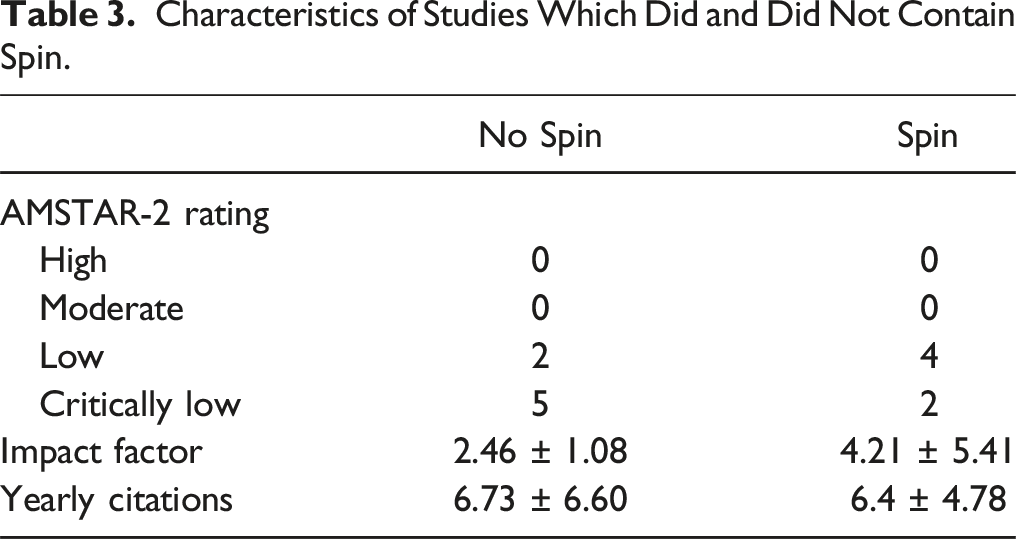
The search yielded 1506 articles, of which 13 met inclusion. It was found that 46.2% (6/13) of the articles contained spin within the abstract. Of the nine most severe types, type 5 was found to be the most prevalent (4/13, 30.8%), followed by types 9 (2/13, 15.4%), 3 (1/13, 7.7%), 4 (1/13, 7.7%), and 6 (1/13, 7.7%). Spin types 1, 2, 7 and 8 were not found. According to AMSTAR-2, 53.8% (7/13) of the studies were appraised as “critically low” quality and 46.2% (6/13) as “low” quality.
Conclusion
This study demonstrated the presence of spin in 46.2% of abstracts pertaining to the treatment for spinal stenosis with degenerative spondylolisthesis. Spine surgeons should learn to recognize spin as they review articles before implementing them into practice.
Introduction
Spinal stenosis with degenerative spondylolisthesis (DS) is a common cause of low back pain, difficulty walking, and even neurogenic claudication. It is characterized anatomically by the narrowing of the spinal canal by spondylotic changes and the displacement of one vertebral body over the subjacent vertebral body without disruption of the vertebral ring. The result is compression of central and occasionally foraminal neural tissue. With life expectancy continuing to rise, a substantial portion of the senior population will develop DS. Hence, it is critical to assess the effectiveness of laminectomy and determine the populations that would benefit more from the additional fusion.
Decompression through laminectomy has been a standard surgical treatment for spinal stenosis and spondylolisthesis for many decades. However, laminectomy alone has raised concerns regarding instability caused by several factors related to the compromised integrity of the posterior spinal column. In the early 1990s, two significant studies investigated the benefit of fusion and concluded that patients reported better outcomes after decompression and fusion.1,2 In the decades that followed, there was a dramatic increase in the rate of fusion surgeries.
There are clear benefits to both decompression alone and decompression with instrumentation. Multiple previous studies have determined that decompression alone demonstrates decreased operative time and blood loss but is associated with increased instability.3-5 In contrast, decompression and fusion with instrumentation demonstrated a decrease in the likelihood of reoperation due to instability, however, leads to increased operative time, blood loss, and possible complications related to pedicle screw placement. For these reasons, controversy continues to exist regarding the most optimal treatment for spondylolisthesis.
As spine surgeons place emphasis on practicing evidence-based medicine (EBM), continuous awareness of current literature and the shift in standard of care is necessary. However, due to the rapidly increasing body of literature, a large majority of physicians have become increasingly reliant on meta-analys
The primary objective of this cross-sectional study is to examine the characteristics and prevalence of different types of spin found in the abstracts of systematic reviews and meta-analyses that seek to determine the prognostic difference between decompression alone vs decompression and fusion. The spin classification system developed by Yavchitz et al is used as the evaluation tool in this study. 7 The secondary objective of this study includes grading manuscripts with the AMSTAR 2 criteria proposed by Shea et al, which assesses the quality of conduct of systematic reviews, and evaluating the correlation between the presence of spin and various other article characteristics such as the year of publication, number of times cited, and journal impact factor. 8 Given that previous studies have identified spin in the abstracts of other types of orthopaedic research, we hypothesize that spin would be present in ≥ 30% of abstracts of systematic reviews and meta-analyses.9,10
Methods
Training
Training was provided to data extractors and study reviewers (TT and HA) by MG. Instructions included article screening, the process of data extraction, and screening of spin types to ensure calibrated results between the two reviewers. Subsequently, a search was conducted by TT and HA in February of 2024 using MEDLINE, Web of Science, and Google Scholar with the keywords search: (lumbar) and (systematic review OR Meta-analysis) and (fusion OR decompression).
Inclusion Criteria
All systematic reviews and meta-analyses comparing the effectiveness of decompression alone vs decompression and fusion were reviewed. For an article to be included, it must have met the following criteria: 1) a systematic review with or without a meta-analysis; 2) degenerative etiology, 3) conducted only on human subjects; 4) available in English. There was no exclusion based on the date of publication or country of origin.
Review Process
Two independent authors, TT and HA, reviewed all articles provided by the keyword search. After applying the exclusion criteria, a consensus was reached on the final 13 articles. Each of the 13 manuscripts was independently reviewed by TT and HA for the nine most common forms of spin found in abstracts
Statistical Analysis
Data was collected and organized into an Excel spreadsheet. Linear regression modeling was utilized to independently examine the presence or absence of an association of AMSTAR classification, number of citations per year, and journal impact factor with the amount of spin present in abstracts. Additionally, logistic regression modeling was used to assess whether AMSTAR classification, journal impact factor, and/or number of citations per year were associated with the presence of spin. Lastly, multiple regression modeling was performed to assess if AMSTAR classification, journal impact factor, and number of yearly citations combined could predict the presence or absence of spin.
Results
The electronic database search yielded 1506 articles, as illustrated in Figure 1. Of these, 13 met our inclusion criteria and were included in the final analysis.11-23 The year of publication of the included articles ranged from 2007 to 2023. The total number of citations ranged from 0 to 293 with an average of 47 citations. The yearly citations ranged from 0 to 19.3 with an average of 6.57 citations per year. The impact factor for the journals included ranged from .7 to 15.1. Our analysis revealed no significant association between the presence of spin in the abstract of the articles and the AMSTAR 2 grade, number of citations, impact factor of the journal, or the year of publication. Flow diagram of study selection.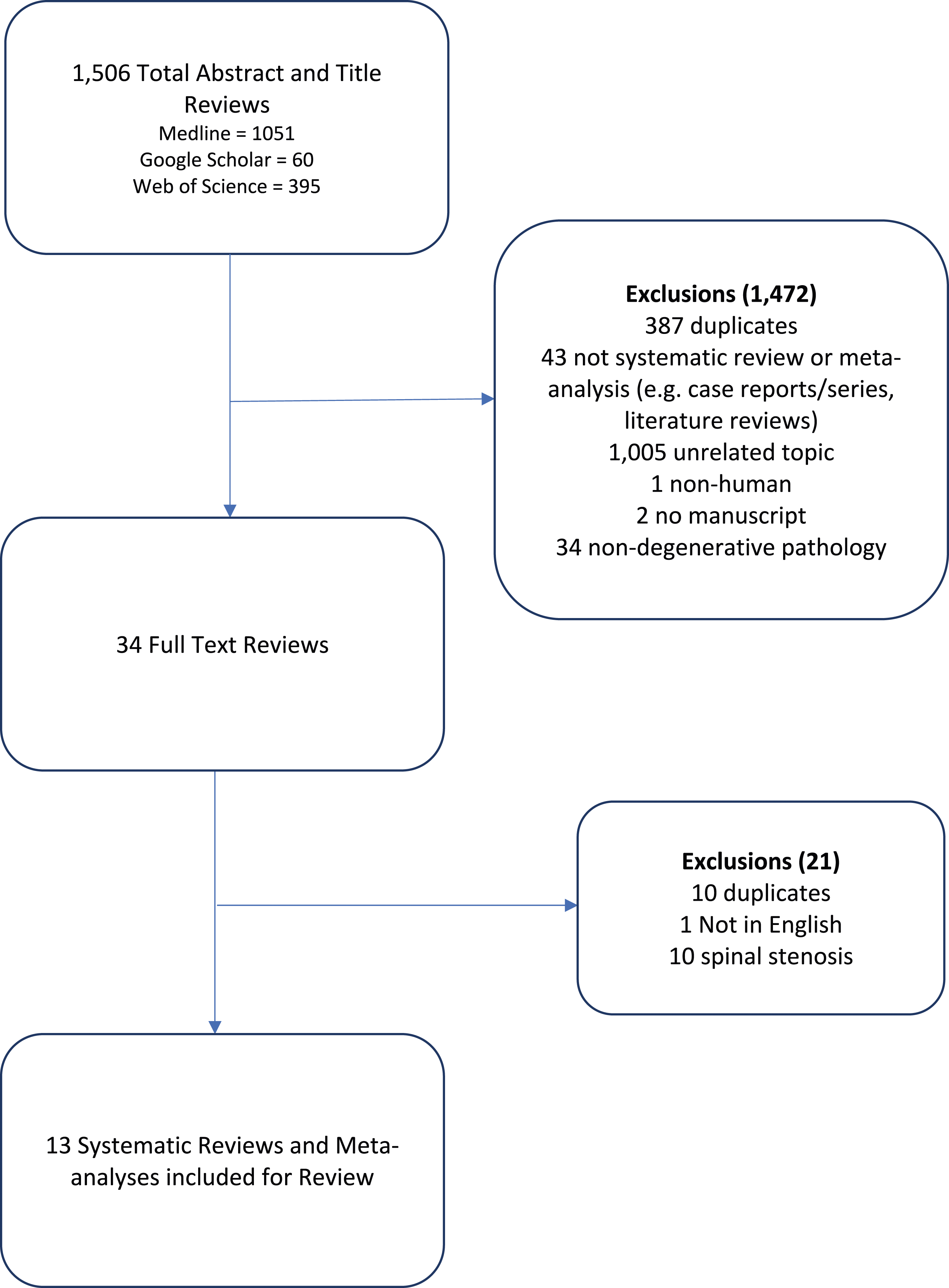
AMSTAR 2 Rating
The AMSTAR-2 survey resulted in a quality rating of the included manuscripts ranging from ‘critically low’ to ‘low’. Of the included articles, 53.8% (7/13) were rated as ‘critically low’ and 46.2% (6/13) were rated as ‘low’. Of note, none of the articles included satisfied the AMSTAR-2 criteria #10 criteria “Did the review authors report on the sources of funding for the studies included in the review?”. Conversely, all included manuscripts satisfied criteria #1 “Did the research questions and inclusion criteria for the review include the components of PICO?”
Spin Rating
Inclusion and Exclusion Criteria.

Discussion
As the medical field continues to strive towards an evidence-based model, improving the quality and accuracy of biomedical research becomes vital. The exploration of abstract spin remains a novel focus within spine research. In this study, the authors employed a similar method in the review process as previously published articles on spin bias in orthopaedic research, which have demonstrated strong inter-rater reliability.9,10,24 Through this examination, the authors aim to bolster the credibility and clarity of conclusions presented in abstracts. This is particularly important in today’s aging population, where decompression alone and decompression with fusion procedures are increasingly more common.
Nine Most Severe Types of Spin Per Yavchitz et al. 7
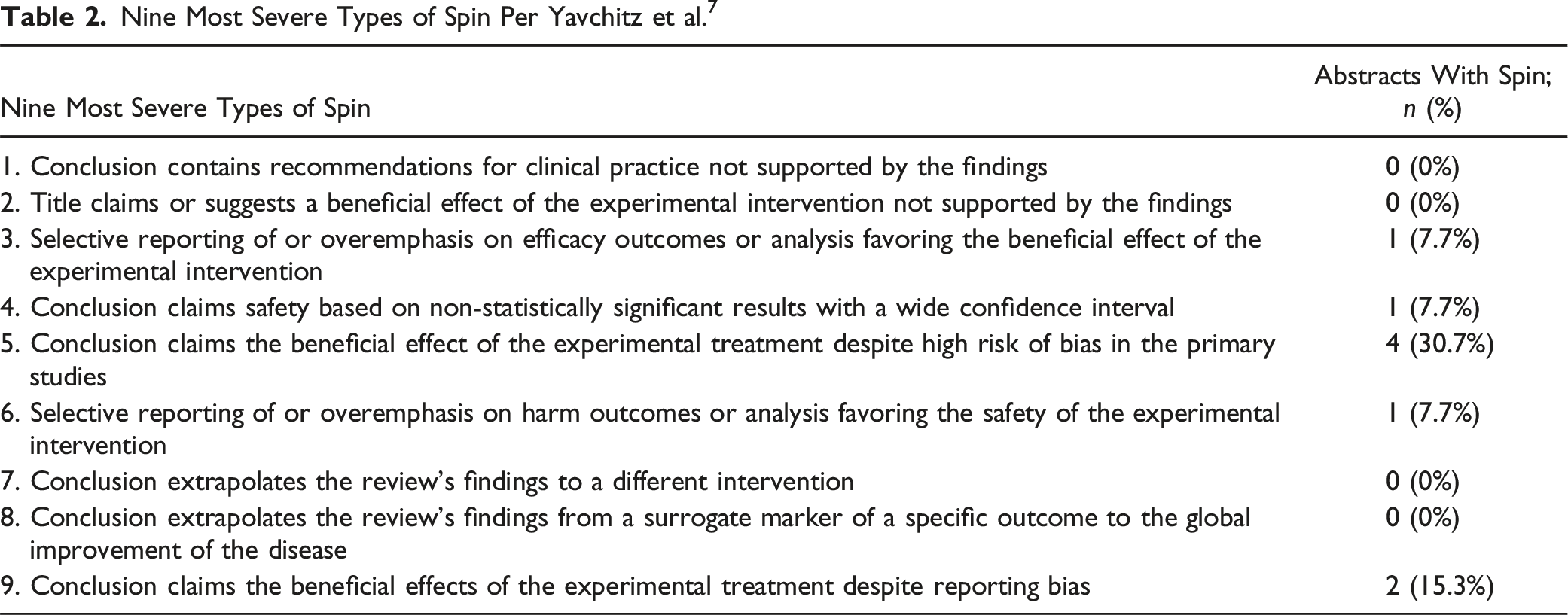
The most common level of spin identified in our study was type 5, which is when the “conclusion claims the beneficial effect of the experimental treatment despite a high risk of bias in primary studies.” An example of this was a study by Dijkerman et al, which concluded that decompression alone is the preferred method in patients with low-grade spondylolisthesis.
21
However, the primary studies analyzed in the review contained significant bias
The second most prevalent level of spin found in our study was type 9, which is defined by the “conclusion claims the beneficial effects of the experimental treatment despite reporting bias.” An example of this is an article by Wei et al. which deemed the clinical effectiveness of decompression alone comparable to that of decompression with fusion for degenerative lumbar spondylolisthesis despite reporting bias and heterogeneity in the primary studies secondary to the different definitions, tools, and follow-up periods that the included studies utilize. 14 The highlighting of this conclusion in the abstract of the study without reference to the limitations of the included studies, possibly due to abstract word count limitations, can be misleading to readers resulting in a type 9 spin.
Characteristics of Studies Which Did and Did Not Contain Spin.
Although the mechanisms behind spin bias have yet to be elucidated, multiple theories attempt to explain why this form of bias is so prevalent. Research scientists are under immense pressure to produce high volumes of research that will get published in high-impact journals. Therefore, they can be prone to reporting statistically significant differences when in reality there are none. 27 Furthermore, while more journals require adherence to the PRISMA guidelines, previous studies show no significant effect on the prevalence of spin. Additionally, most journals do not set guidelines to directly minimize the prevalence or discourage the use of spin in studies.27-29 Despite the underlying mechanisms, the presence of spin bias significantly clouds study outcomes. When these studies inform clinical decisions, the repercussions can be substantial. This is especially true when physicians are planning surgical approaches, as in the case of decompression alone vs decompression with fusion.
Fortunately, some authors have proposed mechanisms to help prevent spin bias in biomedical research. One such example is for journals to set forth strict guidelines, such as PRISMA, which is already in effect. Although our study did not demonstrate a correlation between adherence to PRISMA qualifications and the presence of spin, prior research has highlighted such a connection. 29 Therefore, increased adoption of PRISMA guidelines, along with the potential integration of spin-related measures into the guidelines, could potentially mitigate spin rates. Furthermore, granting journal access to the statistical analysis and raw data of the study can also help prevent spin. 27 Additionally, journals often set limitations on the abstract word or character count, leading authors to struggle to adequately highlight their work while abiding by journal limitations. While difficult to analyze, allowing longer abstracts may help authors more comprehensively address their results thus decreasing the prevalence of spin.
Ultimately, increasing awareness among researchers about spin bias and its implications will allow for greater recognition of the bias by readers and encourage responsible reporting of results. Instituting these measures not only fortifies the integrity of orthopaedic surgery and neurosurgical research but also fosters a culture of transparency and accountability, ultimately advancing the pursuit of reliable and impactful research.
Footnotes
Declaration of conflicting interests
The author(s) declared no potential conflicts of interest with respect to the research, authorship, and/or publication of this article.
Funding
The author(s) received no financial support for the research, authorship, and/or publication of this article.
