Response to Letter to the Editor Concerning “Subcutaneous Lumbar Spine Index as a Risk Factor for Surgical Site Infection after Lumbar Fusion Surgery: A Retrospective Matched Case-Control Study” by Ma et al.
Open accessLetterFirst published online March, 2025
Response to Letter to the Editor Concerning “Subcutaneous Lumbar Spine Index as a Risk Factor for Surgical Site Infection after Lumbar Fusion Surgery: A Retrospective Matched Case-Control Study” by Ma et al.
We would like to thank Ma et al. for their great interest in our study and the valuable comments in their letter to the editor.1 Also, they showed their concerns about this study. It is our pleasure to make this response to address these concerns.
#1: In our study, only 33 early infection cases were included in the infection group. To assure the balance between the infection group and the control group, cases without early SSI were included in the control group using the method of using the method of case-control matching according to the criteria, such as age, gender, diabetes and operation time.2,3 Then, to make the conclusion more accurate, we enrolled as many risk factors that previous studies have reported, such as obesity, multiple fusion levels and operation time,4,5 as possible in our study. Moreover, Single factor and multivariate logistic regression analysis were performed to remove the possible confounders and confirm the independent risk factors for early SSI.
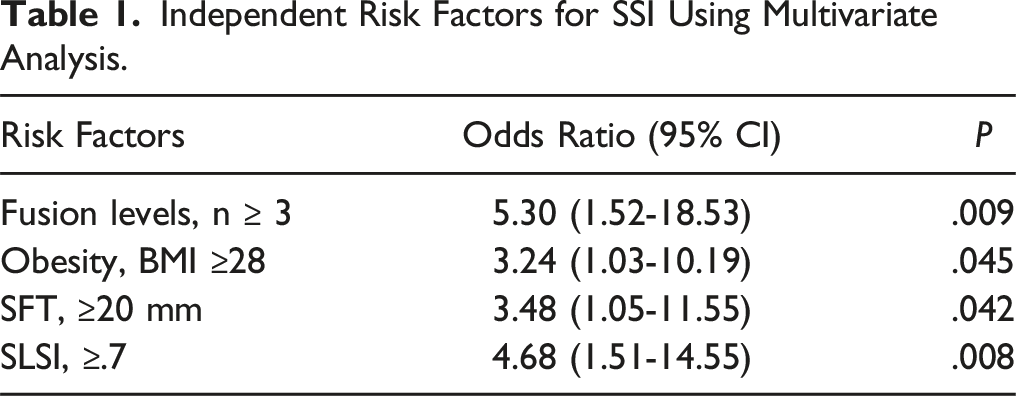
#2: Thanks for pointing it out. We have carefully reviewed the data in Table 1. We are sorry that we made some mistakes. In the process of binary logistic analysis, the variable classification was set opposite to the default classification. So, to make it easier to explain, we inverted the results (OR). However, we forgot to invert the 95%CI. In addition, there were also some data copying errors. Both led to the error represented in Table 1. We have reconducted a binary regression analysis on the data and the corrected Table 1 is shown below. The correction does not change the conclusions we showed in the original article. All the details of the correction and the latest results have been sent to the editor as well.
Independent Risk Factors for SSI Using Multivariate Analysis.
Risk Factors
Odds Ratio (95% CI)
P
Fusion levels, n ≥ 3
5.30 (1.52-18.53)
.009
Obesity, BMI ≥28
3.24 (1.03-10.19)
.045
SFT, ≥20 mm
3.48 (1.05-11.55)
.042
SLSI, ≥.7
4.68 (1.51-14.55)
.008
#3: Regarding the concern about the small size of patients in this study, it would be better to include more cases if possible. However, Eric Vittinghoff et al6 reported that a minimum of 10 outcome events per predictor variable (EPV) may be too conservative and this rule can be relaxed. In our study, we used a 1:2 matched ratio to increase the sample size. It was shown that 4 variables in the binary model had already provided enough power (P values less than .05). Besides, a relatively small sample size had been clearly described as 1 of several limitations of this study. We also suggested that a prospective study with a larger number of SSI cases was necessary to validate this result.
To summarize, we appreciate the interest and concerns raised by Ma et al. We also thank the editors for providing us with the opportunity to respond and correct the errors in the article.
Footnotes
ORCID iDs
Xu Shen
Zengxin Gao
References
1.
MaJKangHXuF. Letter to the editor concerning “Subcutaneous Lumbar Spine Index (SLSI) as a risk factor for surgical site infection after lumbar fusion surgery: A retrospective matched case-control study” by Shen et al. Global Spine J. 2023:21925682231158096. doi:10.1177/21925682231158096
2.
GuptaVKZhouYMansonJF, et al.Radiographic spine adipose index: An independent risk factor for deep surgical site infection after posterior instrumented lumbar fusion. Spine J. 2021;21:1711-1717. doi:10.1016/j.spinee.2021.04.005
3.
ShiHZhuLJiangZL, et al.Radiological risk factors for recurrent lumbar disc herniation after percutaneous transforaminal endoscopic discectomy: A retrospective matched case-control study. Eur Spine J: Official publication of the European Spine Society, the European Spinal Deformity Society, and the European Section of the Cervical Spine Research Society. 2021;30:886-892. doi:10.1007/s00586-020-06674-3
4.
DuJYPoe-KochertCThompsonGH, et al.Risk factors for early infection in pediatric spinal deformity surgery: A multivariate analysis. Spine deformity. 2019;7:410-416. doi:10.1016/j.jspd.2018.09.011
5.
FeiQLiJLinJ, et al.Risk factors for surgical site infection after spinal surgery: A meta-analysis. World Neurosurg. 2016;95:507-515. doi:10.1016/j.wneu.2015.05.059
6.
VittinghoffEMcCullochCE. Relaxing the rule of ten events per variable in logistic and Cox regression. Am J Epidemiol. 2007;165:710-718. doi:10.1093/aje/kwk052