




Abstract
Study Design:
Bibliographic analysis.
Objective:
The aim of this study is to identify the most cited studies on lumbar spondylolisthesis and report their impact in spine field.
Methods:
Thomson Reuters Web of Science–Science Citation Index Expanded was searched using title-specific search “spondylolisthesis.” All studies published in English language between 1900 and 2019 were included with no restrictions. The top 100 cited articles were identified using “Times cited” arranging articles from high to low according to citation count. Further analysis was made to obtain the following items: article title, author’s name and specialty, country of origin, institution, journal of publication, year of publication, citations number, study design.
Results:
The citation count of the top 100 articles ranged from 68 to 589. All published between 1932 and 2016. Among 20 journals, Spine had the highest number of articles (49), with citation number of 6155 out of 13 618. Second ranked was Journal of Bone and Joint Surgery with 15 articles and total citations of 3023. With regard to the primary author’s specialty, orthopedic surgeons contributed to the majority of top 100 list with 82 articles, and neurosurgery was the second specialty with 11 articles. The United States had produced more than half of the list with 59 articles. England was the second country with 7 articles. Surgical management of degenerative lumbar spondylolisthesis was the most common discussed topic.
Conclusion:
This article identifies the top 100 influential articles on lumbar spondylolisthesis and recognizes an important aspect of knowledge evolution served by leading researchers as they guided today’s clinical decision making in spondylolisthesis.
Introduction
Lumbar spondylolisthesis is a common recognized spine pathology. A significant development in our knowledge about spondylolisthesis, its etiology, different types, surgical management have occurred in the recent years owing to the expanding literature on this topic. However, few publications have had a long-lasting impact on clinical practice. Citation is a recognition of others’ work and its importance lies as an indicator of the scientific impact an article has made in its field. 1 Bibliometric analysis helps identify key articles that created an enormous distinction within the field and might have served as a base for other researches and current clinical practice. In addition, it acknowledges the contribution made by authors to science. Previous bibliographic analyses exist for various spine pathology; however, to date none have addressed lumbar spondylolisthesis. We aim by this citation analysis to identify and analyze the 100 most cited articles on lumbar spondylolisthesis through a systematic search strategy used previously in published studies in different medical specialties, which we believe will help guide future researches by highlighting the most influential previous publications. 2 -5
Methods
In February 2019, Thomson Reuters Web of Science–Science Citation Index Expanded was searched using title-specific search “spondylolisthesis.” All studies published in English language between 1900 and 2019 and confined to lumbar spondylolisthesis were included. Nonhuman studies were excluded. The top 100 cited articles were identified using “Times cited” arranging articles from high to low according to citation count. Those articles were assessed by 2 independent reviewers and confirmed their relevance to lumbar spondylolisthesis. Further analysis was made to obtain the following items: article title, author’s name and specialty, country of origin, institution, journal of publication, year of publication, citations number, average citations per year, and peak year of citation.
Results
Article Analysis
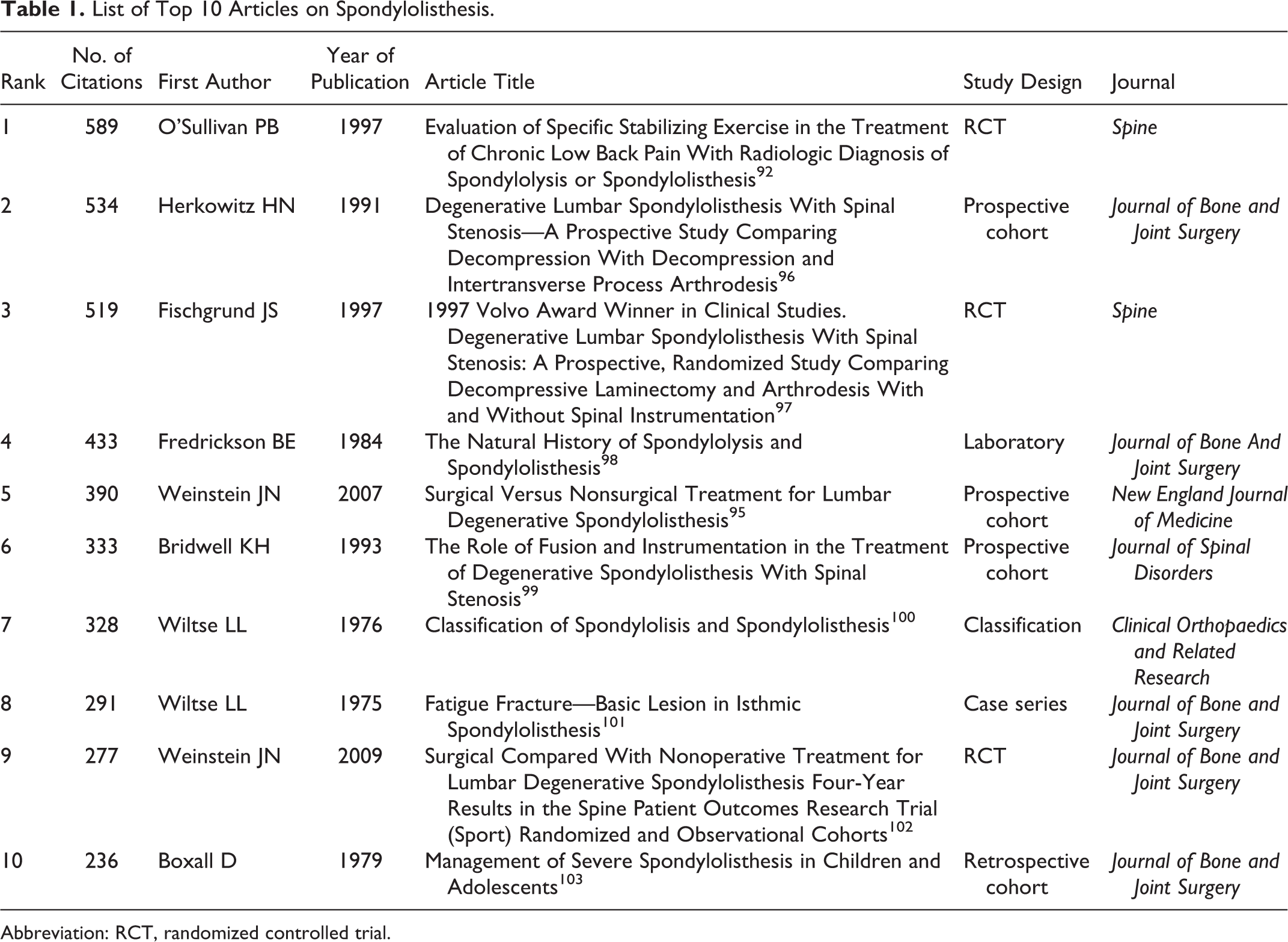
The search yielded a total of 1784 articles, of which the top 100 cited articles (see Supplementary Table) 6 -91 were identified and included for evaluation. Total number of citations was 13 618 (range 68-589). All articles were published between 1932 and 2016. The average citation number per year ranged from 0.86 to 32.5. The top article had 589 citations and was published in 1997 with peak year of citation in 2005. 92 The oldest article (43th in the list) was published by Norman Capener in 1932. 93 The most recent article (28th in the list) was published in 2016 by Ghogawala with total citations of 124. 94 The article with the top citation per year (5th in the list) was published in 2007 by Weinstein and the peak of its citation was in 2016 with total 390 citations. 95 Top 10 cited articles, their citation number, primary author, year, and journal of publication are reviewed in Table 1.
List of Top 10 Articles on Spondylolisthesis.
Abbreviation: RCT, randomized controlled trial.
Journal Analysis
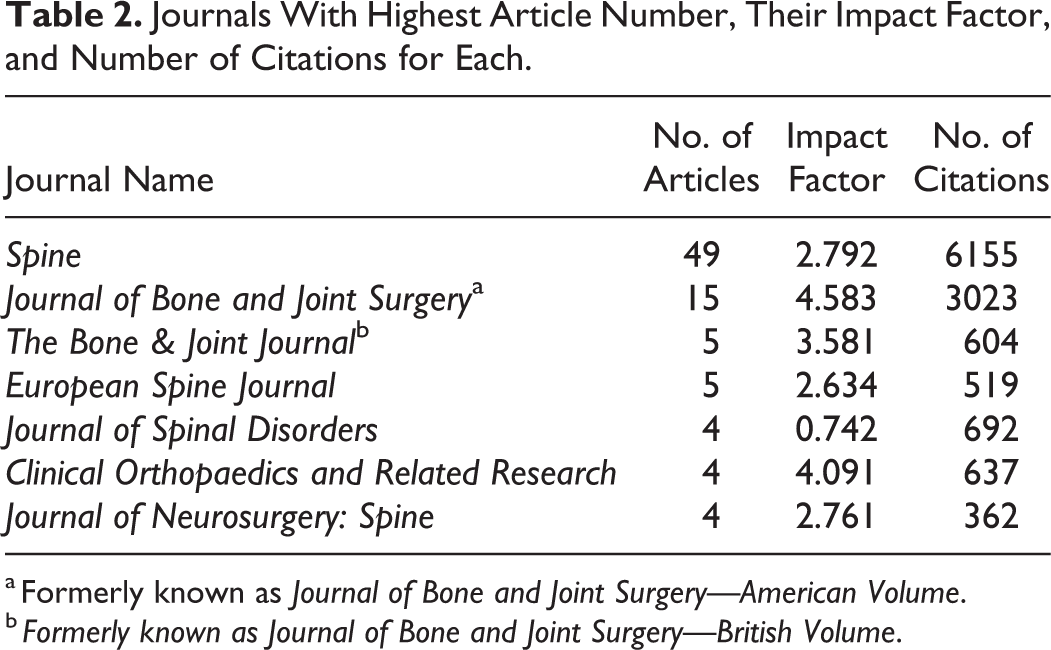
The top 100 articles were published in 20 different journals. Spine had the highest number of articles 49, with citation number of 6155 out of 13 618. Second journal with highest number of articles is Journal of Bone and Joint Surgery with 15 articles and a total number of citations of 3023 (Table 2). There were 11 journals with only 1 article for each. Journals with highest impact factor on the list were New England Journal of Medicine (79.26), Lancet (53.25), Annals of Internal Medicine (19.3), and Radiology (7.469).
Journals With Highest Article Number, Their Impact Factor, and Number of Citations for Each.
a Formerly known as Journal of Bone and Joint Surgery—American Volume.
b Formerly known as Journal of Bone and Joint Surgery—British Volume.
Author Analysis
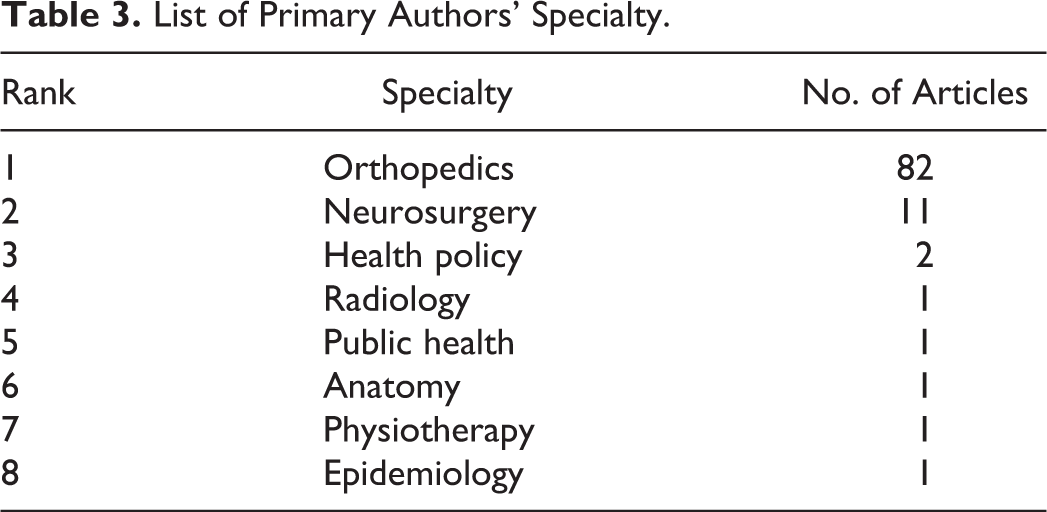
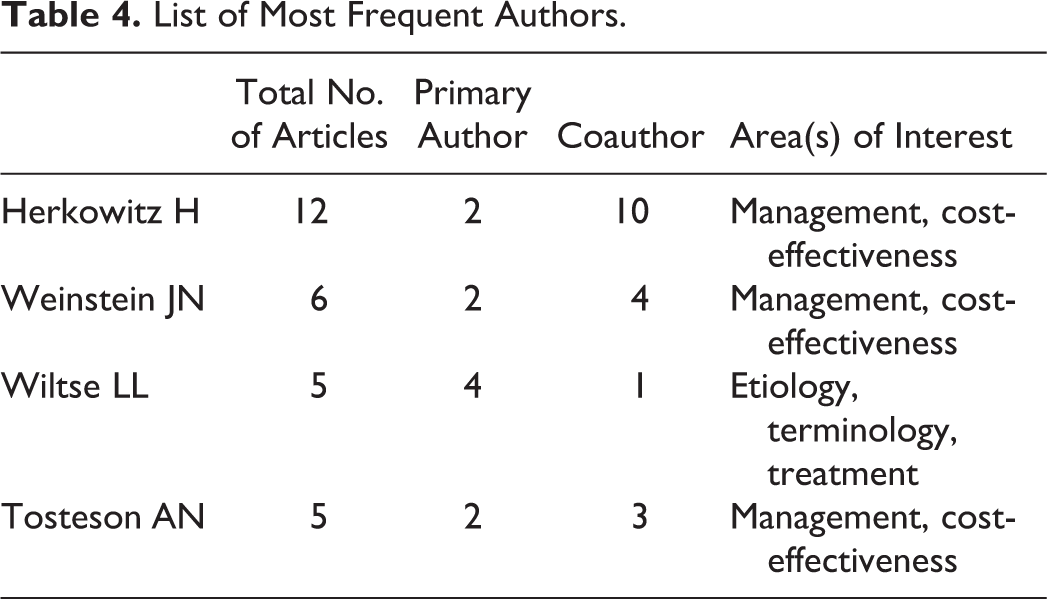
With regard to the primary author’s specialty, orthopedic surgeons contributed to the majority of top 100 list with 82 articles, Neurosurgery was the second specialty with 11 articles (Table 3). The most frequently mentioned author in all articles was Herkowitz. Most of his researches focused on management of spondylolisthesis and comparing cost-effectiveness between surgical versus conservative management. Most frequent primary author is Wiltse with 4 articles (Table 4). He has contributed to top 100 list with 5 publications, 4 of them were as primary author. He had shown interest in finding the etiology behind developing spondylolisthesis. Also, in 1983 he published a classic article on terminology and measurement system for spondylolisthesis.
List of Primary Authors’ Specialty.
List of Most Frequent Authors.
Institutions
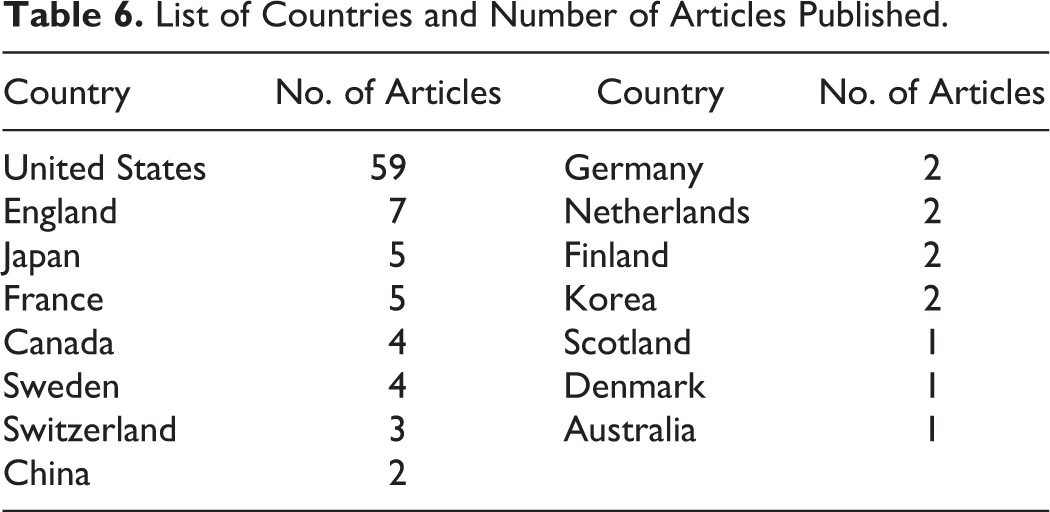
The total number of institutions responsible for top 100 cited articles was 68. Geisel School of Medicine contributed the most number of articles with 6 publications, followed by Memorial Hospital Medical Center of Long Beach and University of Minnesota with 5 articles each (Table 5). The United States had contributed to more than half of the top 100 cited articles. England is the second contributing country with 7 articles. Rest of the countries and their number of articles are shown in Table 6.
Institutions With 3 or More Publications.
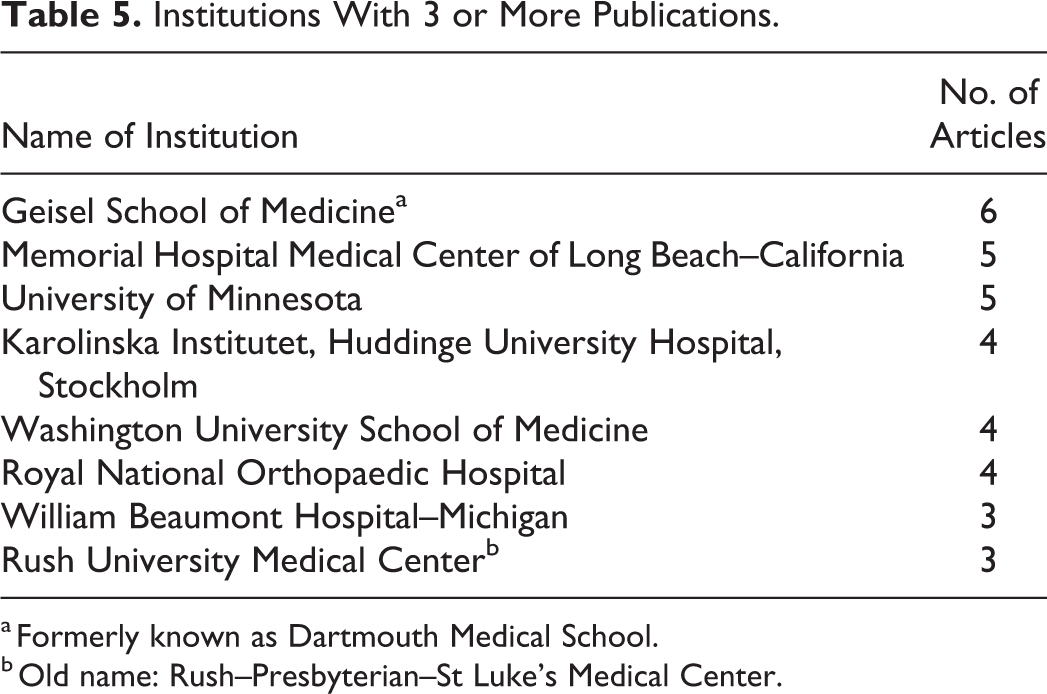
a Formerly known as Dartmouth Medical School.
b Old name: Rush–Presbyterian–St Luke’s Medical Center.
List of Countries and Number of Articles Published.
Discussion
Our study is the first to identify the top 100 cited articles in lumbar spondylolisthesis. Treatment of spinal disorders is a multidisciplinary effort where specialist from different backgrounds contribute to the care of the patient—occasionally within the same institution. In this study, we found that the first authors were from 9 different specialties. Orthopedics was the top leading specialty producing more than two-thirds of the total articles. The study with highest number of citations was a randomized controlled trial, titled “Evaluation of Specific Stabilizing Exercise in the Treatment of Chronic Low Back Pain With Radiologic Diagnosis of Spondylolysis or Spondylolisthesis,” which was published in 1997 in Spine. 92 Authors in this study aimed to assess the efficacy of a specific exercise intervention in patients with chronic back pain and radiological diagnosis of spondylolisthesis.
The second most cited article was by Herkowitz published in 1991 and titled “Degenerative Lumbar Spondylolisthesis With Spinal Stenosis—A Prospective Study Comparing Decompression With Decompression and Intertransverse Process Arthrodesis.” The main purpose of this study was to explore the role of concomitant arthrodesis with decompressive laminectomy in surgically treated degenerative lumbar spondylolisthesis. A total of 50 patients were divided equally into 2 groups; the first group underwent decompressive laminectomy alone, and the second group had decompressive laminectomy with bilateral lateral intertransverse process arthrodesis. 96 The conclusion of this study was that decompressive laminectomy combined with arthrodesis resulted in better outcomes for patients who suffer from spinal stenosis and degenerative spondylolisthesis at one level.
Fischgrund et al 97 conducted a randomized clinical trial, which was ranked third on our list. They aimed to compare the outcome of decompression and arthrodesis alone or with instrumentation for patients with degenerative spondylolisthesis. The study showed no difference between the 2 categories in terms of clinical outcomes.
“Spondylolisthesis” was the title of the oldest published article on our list in 1932, which was written by Norman Capener, an orthopedic surgeon from Princess Elizabeth Orthopaedic Hospital, England. 93 This study was the first to describe anterior lumbar interbody fusion (ALIF) for the treatment of spondylolisthesis.
The most recent publication in our list was a randomized controlled trial published in 2016 in the New England Journal of Medicine, which compared laminectomy alone with laminectomy plus instrumented fusion in 66 patients at 2-, 3-, and 4-year follow-up and found physical health-related quality of life to be better and clinically significant in the fusion group. 94 It is worth mentioning that the 2 top cited articles in our list are ranked 58th and 63th on top cited spine-related researches in a study published by Murray et al. 104
A study published in the New England Journal of Medicine by Weinstein et al 95 titled “Surgical Versus Nonsurgical Treatment for Lumbar Degenerative Spondylolisthesis” has the highest citation number per year 32.5 times from top 100 articles listed in our study.
Degenerative spondylolisthesis was the most common discussed type with 36 articles. First article was by Rosenberg in 1975 (ranked 17th in the list). 105 The authors in this article described the predisposing factors that lead to degeneration of the articular joints and permit the forward slippage.
The most recent published article on degenerative spondylolisthesis in our list was a study that compared the laminectomy alone to laminectomy accompanied by fusion, it was a randomized clinical trial published in the New England Journal of Medicine in 2016 by Ghogawala et al. 94 . This article shared the same objective with the most cited article on degenerative spondylolisthesis by Herkowitz 96 in 1997, ranked 2nd on the top 100 list.
Isthmic spondylolisthesis was the second most discussed type of spondylolisthesis. The first description was made by Wiltse 101 in 1975. He proposed that isthmic spondylolisthesis can be caused by fatigue fracture in the pars interarticularis due to repetitive trauma but also suggested that hereditary predisposition may play a role in the development of isthmic spondylolisthesis. This was the top cited article on isthmic spondylolisthesis (ranked 8th in main list). The most recent publication that primarily targeted isthmic spondylolisthesis was in 2007 by Ekman. 106 He conducted a prospective clinical trial to evaluate the outcomes of posterior lumbar interbody fusion (PLIF) in comparison to posterolateral fusion (PLF). He found no difference in the 2-year outcomes between PLIF and PLF.
Outcomes of surgical interventions in lumbar spondylolisthesis was the predominant purpose among the top 100 list (n = 49), including two articles published by Herkowitz and Kurz 96 and Fischgrund et al 97 were ranked second and third on the main list. These 49 articles purely focused on the surgical outcomes comparing 2 or more techniques or comparing surgical to conservative measures. Notably, articles discussing surgical intervention were mainly conducted to determine the value of arthrodesis following decompression as compared with decompression alone. The majority showed better outcomes in patients who underwent a concomitant arthrodesis.
Radiological measurement was the second most dominant purpose in the list with 14 articles.
Limitations
Bibliometric analysis technique has several possible limitations. Using “title specific” criteria in the searching process could have omitted some of the classic articles that did not have that specific word. To minimize this we used only spondylolisthesis as our searching term rather than “lumbar spondylolisthesis” to capture all the possible relevant studies. However, determining the relevance of a study to the topic of spondylolisthesis can be considered a potential limitation.
Another limitation is that we found difficulty in determining the primary author of study as we assumed the first author who appeared in Thomson Reuters to be the primary author. Also, complete authors’ information was not provided in few of the older articles, which led us to carry independent individual searching to obtain information for such authors. Theory of “obliteration by incorporation” effect states that a classic article has embedded into the common knowledge of the field as they no longer necessarily requires a citation when mentioned given a relative decrease number of citations for the older articles compared with the more recent papers. 107 For this, we ranked our list according to the total number of citations. Also, it has been proposed that older articles have the time effect to accumulate higher citations, which seems unfair for the recent studies. Therefore, the average citation number per year was also calculated. Finally, the most recent study in our list was published in 2016. 94 This shows a gap of 3 years (till the date of this study), which can be due to the time required from the publication date until the article gains a good number of citations. Therefore, recent influential studies with low citation number could have been missed in this review.
Conclusion
This study is the first to report the top 100 cited articles on lumbar spondylolisthesis. It provides an insight into the contribution of different authors, journals, and institutions to the evolution of our current understanding of spondylolisthesis. Most of these articles were randomized clinical trials and observational studies that served as the bases of clinical decision making and recent research works in spondylolisthesis.
Supplemental Material
Supplemental Material, GSJ868194_suppl_mat - Top 100 Cited Articles on Lumbar Spondylolisthesis: A Bibliographic Analysis
Supplemental Material, GSJ868194_suppl_mat for Top 100 Cited Articles on Lumbar Spondylolisthesis: A Bibliographic Analysis by Khalifah Aldawsari, Mohammad T. Alotaibi and Khalid Alsaleh in Global Spine Journal
Footnotes
Author Contributions
All authors contributed to the conception and data collection and are responsible for manuscript preparation and referencing.
Declaration of Conflicting Interests
The author(s) declared no potential conflicts of interest with respect to the research, authorship, and/or publication of this article.
Funding
The author(s) received no financial support for the research, authorship, and/or publication of this article.

Supplemental Material
The supplemental material is available in the online version of the article.
References
Supplementary Material
Please find the following supplemental material available below.
For Open Access articles published under a Creative Commons License, all supplemental material carries the same license as the article it is associated with.
For non-Open Access articles published, all supplemental material carries a non-exclusive license, and permission requests for re-use of supplemental material or any part of supplemental material shall be sent directly to the copyright owner as specified in the copyright notice associated with the article.
