



Abstract
The post-secondary years are marked by heightened stressors and nonsuicidal self-injury (NSSI) among emerging adults. However, the effects of university stressors on NSSI in daily life remains poorly understood. In the present study, the associations among several university stressors and NSSI urges and behaviors were examined, and the moderating role of gender was explored. The sample included 130 students (72% cisgender women, Mage = 17.96), who completed a baseline assessment followed by 14 days of daily entries, yielding 1,625 assessments. Hierarchical linear modeling revealed that total stressor occurrence predicted same-day NSSI urges and behaviors, though gender did not moderate these associations. Interpersonal stressors were linked to same-day NSSI urges and behaviors, as well as next-day urges. Balancing responsibilities were associated with same-day NSSI urges, and low grades predicted both same-day urges and behaviors. These findings emphasize the importance of post-secondary institutions tailoring mental health programs to address students’ unique needs.
Keywords
Introduction
Emerging adulthood, spanning ages 18 to 25 years, is a distinct developmental period characterized by significant life transitions (Arnett et al., 2014). During this stage, individuals often navigate new responsibilities such as beginning higher education and full-time careers, seeking financial independence, and forming new interpersonal relationships (Almeida et al., 2023). Emerging adults report more major life events and daily stressors, as well as perceive these stressors as more threatening, compared to other age groups (Aldwin, 2009; Almeida & Wong, 2009). For emerging adults in university and college, navigating stressors may be particularly challenging (Ribeiro et al., 2018). A recent survey conducted in Canada found that 80% of students experienced moderate to high levels of stressors during post-secondary education, with academic and financial pressures being among the top stressors (American College Health Association, 2022). This elevated exposure to stressors is likely one of several factors contributing to the increased prevalence of mental health challenges occurring among emerging adults in post-secondary education (Pedrelli et al., 2015).
Research and theory have long underscored the strong interaction between stressors and mental health challenges (Compas et al., 2017). The diathesis-stress model suggests that the occurrence of stressors may result in experiencing increased distress, leading to mental health concerns over time (Colodro-Conde et al., 2018). This interaction may be especially salient in emerging adulthood, given the life stage’s inherent instability and the concurrent expectations of adult-level functioning (Arnett, 2015). One common mental health concern among emerging adults (Griffin et al., 2023), which may be related to stressor exposure, is nonsuicidal self-injury (NSSI). NSSI is defined as the intentional, self-inflicted damage to one’s body tissue without suicidal intent (American Psychiatric Association, 2022). Although NSSI is conceptually and diagnostically distinct from suicidal behavior, it often co-occurs with other mental health challenges, such as depression (Kiekens et al., 2023), and is associated with an increased risk of subsequent suicidal thoughts and behaviors among post-secondary students (Kiekens et al., 2018).
Approximately 17.7% of university and college students report having engaged in NSSI at some point in their lifetime, and 8.4% have reported recent NSSI engagement within the past 12 months (Kiekens et al., 2023). Given the developmental context of emerging adulthood, stressor exposure is likely a key factor in NSSI vulnerability. Frequent exposure to stressors may increase students’ vulnerability to NSSI, as this behavior can function as a coping mechanism for managing distress and heightened reactivity to stressors (Nock, 2009; Taylor et al., 2018). The stressors that emerging adults encounter while in post-secondary education, such as academic pressures, financial instability, and interpersonal problems, are developmentally salient, carrying distinct emotional significance during this period of instability and exploration (Arnett, 2015). Given that NSSI rates may be increasing and account for a quarter of all mental health care referrals on post-secondary campuses (Xiao et al., 2017), understanding the pathways leading to NSSI is crucial for mitigating risk.
Cross-sectional research among college and university students has shown that individuals who engage in NSSI experience more stressors than students who do not engage in NSSI (Kokaliari et al., 2017; Liu et al., 2016; Tang et al., 2016). Emerging longitudinal research also suggests that greater exposure to stressors is associated with an increased risk of NSSI over time relative to lower levels of exposure (Ewing et al., 2019; Hamza et al., 2021; Kiekens et al., 2019). Although this work implicates stressors broadly in NSSI engagement, little attention has been paid to which specific stressors may be most strongly associated with NSSI. Addressing this gap in the literature could inform efforts to better tailor mental health interventions to target the distinct stressors students experience in the post-secondary context (Linden & Stuart, 2020), and disrupt pathways to NSSI.
To prevent NSSI, it is also critically important to understand not just who is most at risk (i.e., between-person effects), but when individuals are most at risk in their daily lives (Kiekens et al., 2021). Daily sampling research (i.e., the repeated assessment of the same individuals over multiple days) is a frequently overlooked methodology in the field of NSSI (Davidson et al., 2017; Kiekens et al., 2021); however, this approach can be used to examine the factors most strongly associated with NSSI in daily life and reduce recall errors commonly associated with reporting on NSSI (Lischetzke & Könen, 2020). Previous longitudinal research has primarily relied on assessing NSSI over extended intervals, such as several months or years between assessments (Gee et al., 2020; Shiffman et al., 2008). Daily diary sampling can increase ecological validity by capturing the context in which NSSI occurs (e.g., in the presence of real-world stressors), making it a useful approach for examining behaviors that cannot be assessed in laboratory contexts (Myin-Germeys et al., 2018).
Another advantage of daily diary sampling is that it can be applied to the study of NSSI urges, which have received less empirical attention (Hepp et al., 2021). NSSI urges often precede behavior and are less influenced by environmental constraints (e.g., they can occur in settings in which engaging in NSSI is not possible). Urges in the absence of NSSI may also be distressing to individuals (Hepp et al., 2020), and may impact recovery even after NSSI cessation (Kelada et al., 2018; Tatnell et al., 2014). Applying daily diary methodology to study NSSI urges, in addition to behaviors, can reveal contextual factors often overlooked when studying NSSI behaviors alone (Hepp et al., 2020). Additionally, examining both NSSI urges and behaviors provides a deeper understanding of the contexts in which urges escalate into self-injurious actions, as urges are the strongest predictors of NSSI engagement (Turner et al., 2019).
Emerging daily sampling research has revealed that daily stressors, in general, are predictive of both NSSI urges and behavior among university students (Kuburi et al., 2024; Miller et al., 2019). Further, recent research suggests that interpersonal stressors may uniquely predict NSSI among post-secondary students (Guérin-Marion et al., 2023; Haliczer & Dixon-Gordon, 2023; Turner et al., 2016). Research that examines other common developmentally and contextually relevant stressors in post-secondary education, such as academic pressures, career worries, and financial insecurities in relation to NSSI, are scarce. Elucidating key stressors implicated in NSSI urges and behavior could offer valuable insights for designing tailored mental health programs specifically for campus settings, addressing the stressors that students experience most frequently and intensely in their daily lives.
Gender Differences
Daily sampling can offer valuable insights into which individuals are at heightened risk for engaging in NSSI in their daily lives. The association between stressors and NSSI may be especially pronounced among certain gender identities, including cisgender women, transgender individuals, and non-binary individuals (Kokaliari, 2014; Liu et al., 2019). Research suggests that cisgender women, transgender individuals, and non-binary individuals often report experiencing more stressors and perceive these stressors as more severe (Hunter et al., 2021; Linden et al., 2022). This heightened vulnerability may stem from higher levels of psychological distress when faced with stressors, which could make these individuals more prone to engaging in NSSI as a result (Lutz et al., 2023). Cisgender women also have been found to be more likely than cisgender men to use emotion-focused coping strategies when managing stressors, which has previously been identified as a key function of NSSI (e.g., emotion regulation) (Taylor et al., 2018). Given prior research demonstrating that cisgender women may appraise stressors as more severe, and that heightened stress reactivity is associated with a range of psychological difficulties (Koolhaas et al., 2011), it is plausible that the association between stressors and NSSI is more pronounced among cisgender women. Based on previous research demonstrating gender differences in stressor appraisal, the current study will explore whether gender acts as a moderator of the association between stressors and NSSI.
Present Study
Emerging adulthood, especially during the post-secondary years, is a period marked by high levels of stressors and increased vulnerability for NSSI (Almeida et al., 2023; Kiekens et al., 2023). However, it has yet to be examined which stressors may be most strongly implicated in NSSI among emerging adults in post-secondary education. Further, previous research on stressors and NSSI has rarely integrated daily sampling methods, which are crucial for understanding real-time associations between stressors and NSSI and capturing when students are most at risk in their day to day lives. Additionally, there is a notable gap in examining how associations vary by gender. The current study will specifically address these gaps by: (1) replicating previous findings (Kuburi et al., 2024; Miller et al., 2019) demonstrating that stressors predict both NSSI urges and engagement among students on a daily basis, (2) exploring the moderating role of gender in the relation between stressors and NSSI to identify those that may be most at risk, and (3) uniquely investigating which specific stressors are most strongly associated with same-day and next-day NSSI urges and engagement, to aid institutions in making informed decisions about tailoring their mental health programs to better address students’ individual experiences and needs.
Methods
Participants
The current sample consisted of 130 undergraduate students (Mage = 17.96, SD = 0.79) from a large university in Canada. Participants were recruited as part of a larger ongoing research study (N = 1217), examining stress and coping among first-year undergraduate students during their transition to university. To be eligible to participate in the larger study, participants had to meet the following criteria: (1) be between 17 and 25 years, (2) currently enrolled as a first-year student at the university, and (3) reside in the city of the university or the surrounding area. A subset of participants who reported a recent history of NSSI on the baseline survey were then invited to participate in the daily diary portion of the study. These participants had to additionally meet the following eligibility criteria: (1) engaged in NSSI at least once within the previous year, and (2) experienced at least two urges to engage in NSSI in the past 14 days.
Procedure
Participants were broadly recruited across the university (e.g., posters, classroom announcements, emailing student clubs) to participate in the larger longitudinal study. As part of this larger study, participants completed a baseline survey and were screened for eligibility for the daily diary component of the study. Consistent with criteria used in other daily diary studies assessing NSSI (Hepp et al., 2020), participants were eligible for the daily diary portion of the study if they reported engaging in NSSI in the past year and had experienced at least two NSSI urges in the past two weeks. For the daily diary portion of the study, participants completed assessments each day for 14 days. The present study utilizes data from both the baseline survey and the 14 daily diary assessments. Daily diary sampling was used instead of multiple assessments within a day as findings show that community-based samples of emerging adults typically do not report multiple incidents of NSSI within a single day (Hepp et al., 2020; Lear et al., 2019). Participants received a notification at 6:00 a.m. each day and were asked to report on their experiences from the previous day. This interval was chosen to capture NSSI incidents occurring later in the evening, as NSSI tends to become more prevalent throughout the day (Turner et al., 2019). If they did not complete the survey by 2:00 p.m., a reminder email was sent, with responses accepted only until 4:00 p.m. that day.
To further enhance study compliance, several strategies were leveraged that have been shown to be effective in previous research (Wrzus & Neubauer, 2023): a built-in delay option was included for when students indicated that it was an inconvenient time to complete an assessment, mid-study check-ins with the research coordinator were organized to encourage participants to complete the remaining assessments, and financial incentives were used. Participants received $15 for completing the baseline survey, and participants in the daily diary portion of the study received $20 for the 14 days of assessments, as well as an additional $10 (totaling $30) if they completed 80% or more of their daily diary entries. This study was approved by the university’s Research Ethics Board, and all participants provided informed consent. Mental health resources were available during the surveys and daily diary assessments (i.e., click here if you’re feeling distressed). A list of resources was also provided to all participants at the end of each survey and daily assessment.
Measures
Baseline Measures
Demographics
To assess the demographics of the sample, participants were asked to provide information on their age, gender (options included cisgender man, cisgender woman, transgender man, transgender woman, non-binary, unsure, and a free-response option for specifying their gender) and ethnicity.
Nonsuicidal Self-Injury
To assess whether participants had engaged in direct forms of self-injury, they were asked to complete the Inventory of Statements about Self-Injury (ISAS) (Klonsky & Glenn, 2009). Prior to completing the inventory, participants were informed that the items were specifically designed to assess NSSI and were provided with NSSI criteria (i.e., intentional behavior without suicidal intent). Participants were presented with a list of eleven self-injurious behaviors (e.g., cutting, burning, self-hitting) and asked to report the frequency of each behavior both over their lifetime and more recently (the past 4 months). The ISAS has demonstrated strong internal consistency and test-retest reliability in previous studies with emerging adult samples (Glenn & Klonsky, 2011; Klonsky & Glenn, 2009).
Daily Diary Measures
Stressors
Participants completed a checklist of eight common stressors faced by university students (Baker et al., 2020). Specific stressor items from the checklist included: (1) too much schoolwork such as major assignments or deadlines and large workloads (e.g., excess schoolwork stressors), (2) preparing for/taking tests, exams, or quizzes (e.g., assessments stressors), (3) balancing school and other responsibilities (e.g., balancing responsibilities stressors), (4) preparing for the future and career paths such as filling out applications, finding/losing a job, not getting into major (e.g., future/career stressors), (5) issues at/with jobs (i.e., job stressors), (6) receiving a lower grade than wanted (i.e., receiving low grades stressors), (7) financial problems such as rent or bills due, being broke (e.g., financial stressors) and (8) interpersonal problems such as with prior/current romantic partner(s), roommate, family member, boss (e.g., interpersonal stressors). Participants indicated whether they had experienced each stressor on the previous day (yes/no). A total stressor score was calculated by summing the number of stressors each participant experienced per day. The daily stressor items have been validated in a post-secondary student sample (Baker et al., 2020) and were adapted from the Daily Inventory of Stressful Events, a well-established checklist of post-secondary-specific stressors (Almeida et al., 2002).
NSSI Urges and Engagement
To assess daily NSSI urges and engagement, participants were asked, ‘Did you have the urge to injure yourself yesterday?’ and ‘Did you self-injure yesterday?’ Similar to the baseline assessment, participants were informed prior to completion that each question was related to NSSI and were provided with the definition of NSSI (i.e., intentional behavior without suicidal intent). Responses were coded into two binary variables: one indicating whether participants had the urge to engage in NSSI (0 = did not have the urge to engage in NSSI, 1 = had the urge to engage in NSSI) and the other indicating whether they engaged in NSSI (0 = did not engage in NSSI, 1 = engaged in NSSI). Both NSSI urges and engagement were assessed dichotomously, consistent with previous research assessing NSSI at the daily level (Hepp et al., 2020).
Data Analysis
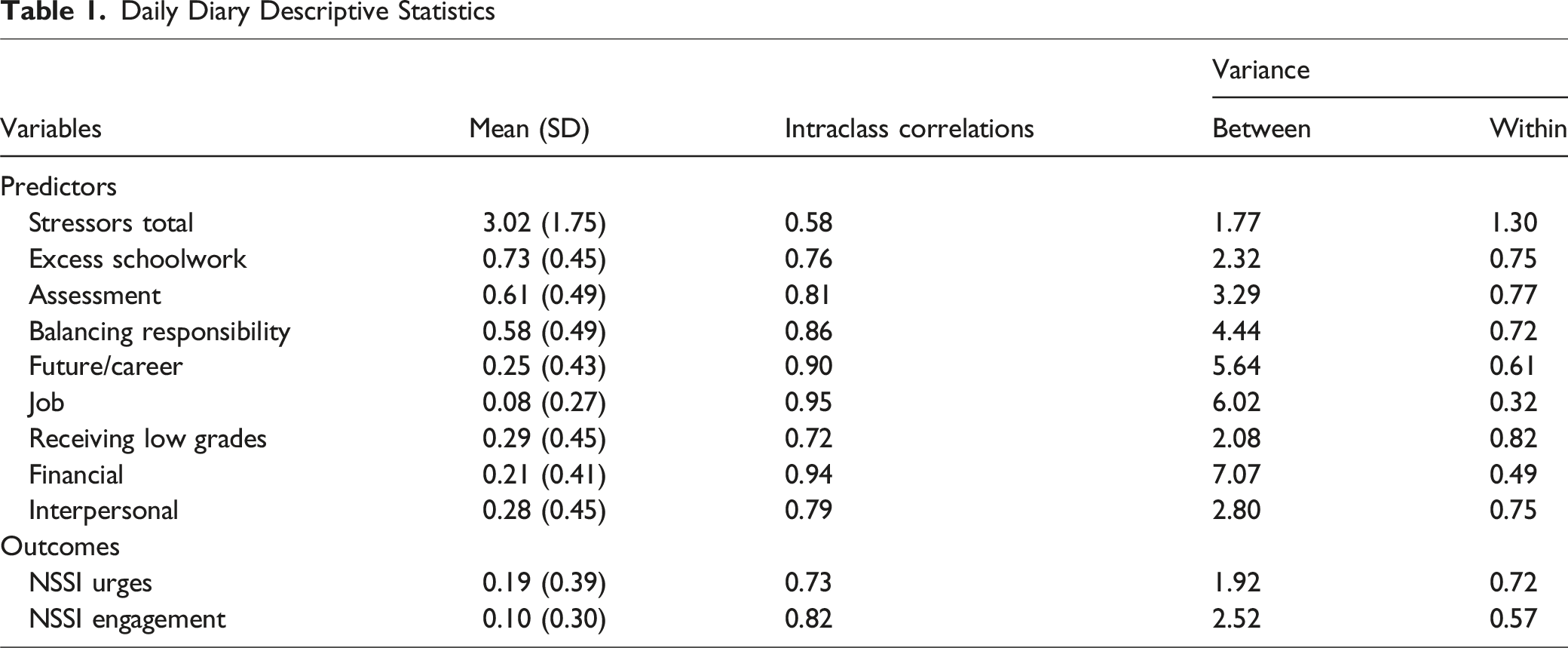
Descriptive analyses were conducted to describe the frequency of stressors and NSSI as they occurred at baseline and over the daily monitoring period. A series of multilevel models were then conducted using Hierarchical Linear Modeling (HLM) 7.0 software to determine whether total daily stressors and individual daily stressors predicted NSSI urges and engagement on the same day and the next day (Raudenbush et al., 2016). The data were treated as a two-level hierarchical structure, with daily assessments nested within participants and gender assessed between participants. In all models, the level 1 predictors (total daily stressors and individual daily stressors) were each separately entered as group-mean centered. This centering approach allowed for participants’ typical level of each predictor to serve as the reference point for estimating relations. For more information on centering binary predictors in multilevel models, please refer to Enders and Tofighi (2007). Both same-day and next-day daily binary NSSI urges, and engagement were entered separately and examined as outcomes predicted by the level 1 variables. As daily stressors (both total and individual), NSSI urges and NSSI engagement were reported by participants for the previous day, all NSSI variables were lagged one day to allow for both same-day and next-day analyses. Models were also randomly varying based on statistically significant error terms during the model building processes (Nezlek, 2012a).
Given that one of the focuses of the present study was on gender differences, a level 2 predictor for gender was included in select models (i.e., models with total daily stressors as the predictor) to investigate gender as a moderator. The gender analysis in this study was restricted to only cisgender men and cisgender women due to the insufficient representation of other gender identities within the sample. As the outcomes were binary (same-day and next-day NSSI urges and NSSI engagement), they were modeled using Bernoulli distribution transformations with a logit link function (Nezlek, 2012a). Recent research shows that simulation studies are the most reliable approach for estimating power in multilevel modeling (Nezlek, 2023). Findings from these studies indicate that gathering almost two weeks of daily diary data from more than 100 participants yields strong power for identifying cross-level interactions (Bolger & Laurenceau, 2013; Nezlek & Mroziński, 2020). With 130 participants in the current study, the sample size was deemed adequate for detecting multilevel effects.
Missing Data
The amount of missing data in the daily survey responses was minimal (≤3.6%). In the analysis, all available responses were included, except when a participant had a missing value for a specific item in a model, in which case their entire data point was excluded from that particular model. Although some participants did not complete all 14 surveys (e.g., completing 13 out of 14), the data were treated as nested within participants, regardless of the number of completed days. Missing days were not considered as missing Level 1 data (Nezlek & Mroziński, 2020). HLM appropriately accounts for missing data by weighting regression coefficients according to the number of observations each participant contributed, ensuring that participants with fewer responses have less influence on the final results (Raudenbush & Bryk, 2002).
Results
Sample Characteristics
In the present sample, 72% of participants identified as cisgender women, 22% identified as cisgender men, and 6% identified as non-binary or unsure. From a multiple-selection checklist, in which participants could choose all ethnicities that applied to them, 38.5% identified as East Asian, 25.4% as White, and 15.4% as South Asian. Additionally, 20.7% of students were represented by Black, Arab/West Asian, Hispanic, Filipino, Southeast Asian, West Indian, and Indigenous ethnicities. Most participants (85%) identified as having a single ethnicity.
Descriptive Statistics
Daily Diary Descriptive Statistics
Primary Analyses
Total Stressors
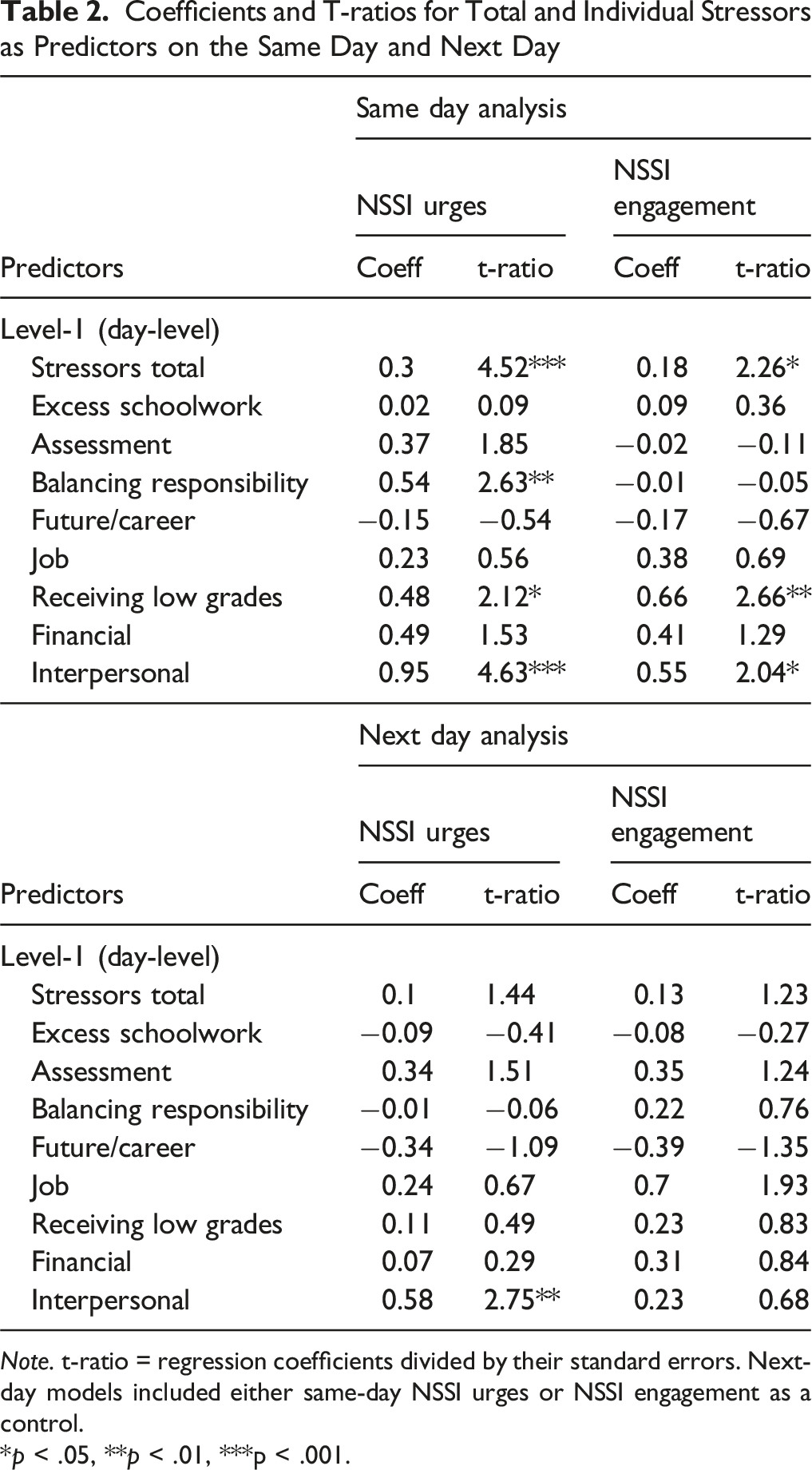
Coefficients and T-ratios for Total and Individual Stressors as Predictors on the Same Day and Next Day
Note. t-ratio = regression coefficients divided by their standard errors. Next-day models included either same-day NSSI urges or NSSI engagement as a control.
*p < .05, **p < .01, ***p < .001.
Gender Analyses
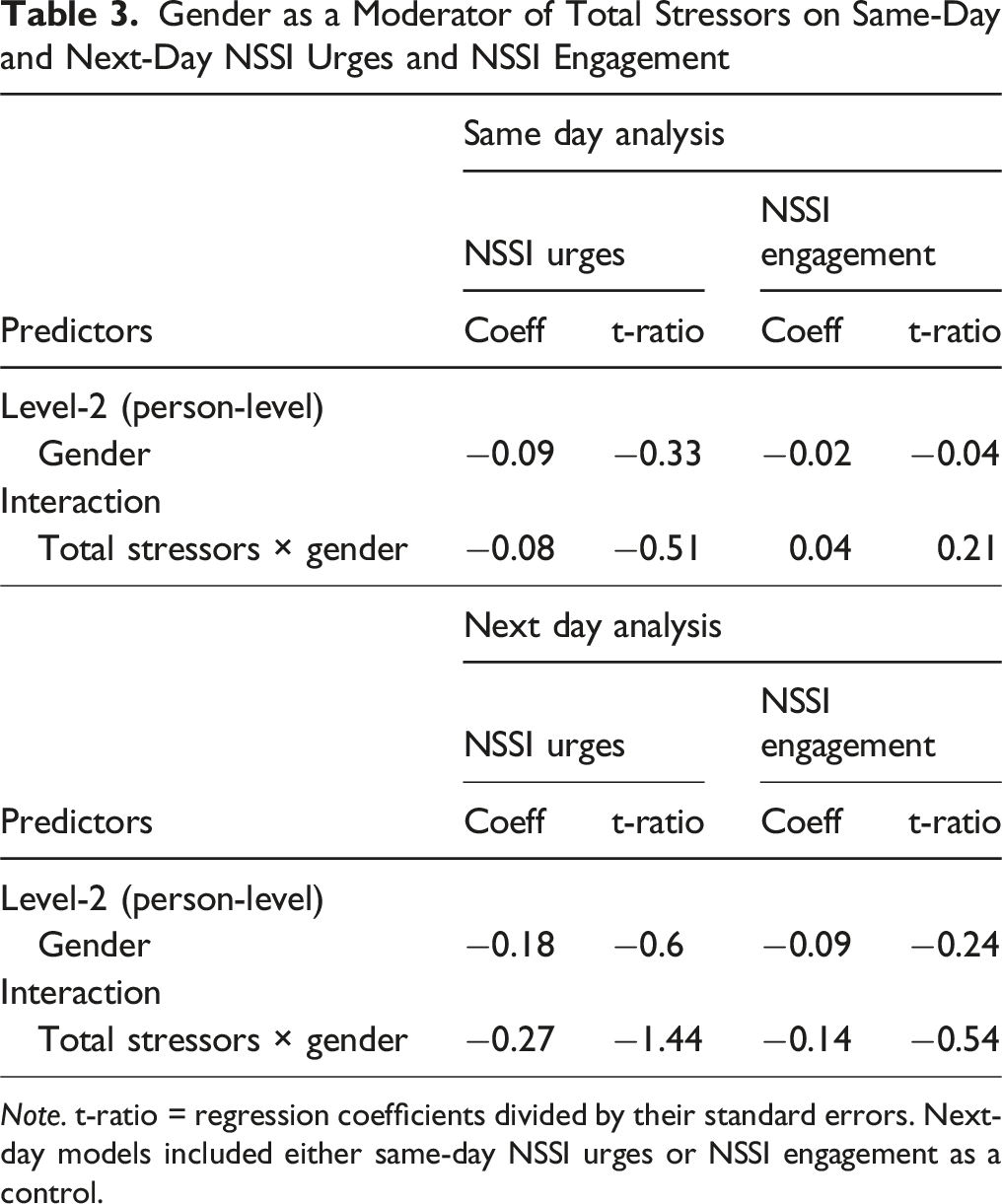
Gender as a Moderator of Total Stressors on Same-Day and Next-Day NSSI Urges and NSSI Engagement
Note. t-ratio = regression coefficients divided by their standard errors. Next-day models included either same-day NSSI urges or NSSI engagement as a control.
Individual Stressors
After evaluating the predictive effects of total stressors, individual stressors were then analyzed to identify which specific stressors most strongly predicted same-day NSSI urges and engagement. The analysis revealed that balancing responsibilities (p = .009, OR = 1.71, CI [1.146, 2.557]), receiving low grades (p = .034, OR = 1.62, CI [1.037, 2.534]), and interpersonal stressors (p < .001, OR = 2.58, CI [1.726, 3.850]) significantly predicted NSSI urges. These results suggest that individuals were more likely to experience urges to engage in NSSI on days when they encountered higher-than-typical levels of these individual stressors. Next, the effects of individual stressors on same-day NSSI engagement were examined. The results showed that receiving low grades (p = .008, OR = 1.93, CI [1.189, 3.126]) and interpersonal stressors (p = .042, OR = 1.73, CI [1.020, 2.931]) significantly predicted NSSI engagement, indicating that individuals were more likely to engage in NSSI on days when they experienced higher than their typical levels of these stressors. The effects of individual stressors on both next-day NSSI urges and NSSI engagement were examined, controlling for same-day NSSI urges and engagement, respectively. Results indicated that only interpersonal stressors significantly predicted next-day NSSI urges when accounting for same-day urges (p = .006, OR = 1.79, CI [1.183, 2.717]). No individual stressors significantly predicted next-day NSSI engagement (see Table 2).
Discussion
Emerging adulthood is a pivotal developmental period, spanning late adolescence to the mid-twenties, characterized by identity exploration, instability, and major life transitions (Arnett et al., 2014). For many, post-secondary education represents a central context where these transitions unfold, often accompanied by heightened stressors and increased vulnerability to mental health challenges such as NSSI (Almeida et al., 2023; Kiekens et al., 2023). Despite this increased vulnerability, research frequently overlooks the specific developmentally and contextually relevant stressors that may contribute to NSSI among emerging adults in post-secondary education. The present study addressed this gap by utilizing daily diary sampling. Results indicated that exposure to stressors was a significant predictor of same-day NSSI urges and engagement. However, no moderation effect of gender was observed. Specific individual stressors driving these associations were also uniquely identified; interpersonal stressors predicted same-day NSSI urges and behaviors, as well as next day NSSI urges. Balancing responsibilities and low grades predicted same day NSSI urges, and low grades also predicted same day NSSI behaviors. These findings can guide post-secondary institutions in customizing their mental health programs to more effectively address the unique needs of their student populations.
The findings of the current study support the diathesis-stress model, which posits that stressors can lead to psychological distress (Colodro-Conde et al., 2018; Zuckerman, 1999). Emerging adults encounter a range of new responsibilities and challenges during their post-secondary education, which may contribute to elevated stressor levels (Arnett, 2016). This period should be recognized as one of increased vulnerability to stress, which may lead to the emergence of mental health challenges such as NSSI, emphasizing the need for campuses to prioritize support during this pivotal time. Previous research suggests that cisgender women, transgender individuals, and non-binary individuals report experiencing more severe stressors and higher levels of psychological distress compared to cisgender men, making them more at risk of NSSI (Hunter et al., 2021; Linden et al., 2022; Lutz et al., 2023). In the present study, no moderation effect of gender was observed. Analyses examining gender differences in overall stressor exposure aggregated across the daily diary period also found no significant differences between cisgender women and cisgender men. However, the disproportionate representation of cisgender women, with fewer cisgender men in the sample, may have limited the power to detect a potential gender moderation effect. Future research should aim for a larger and more balanced sample, including greater representation of cisgender men, transgender individuals, and non-binary individuals, to more comprehensively examine how this association varies across different gender identities.
The identification of specific stressors predicting NSSI among post-secondary students fills critical gaps in understanding which stressors may be most strongly associated with NSSI during this developmentally sensitive period. The occurrence of interpersonal stressors significantly predicted same-day NSSI urges and engagement, as well as next-day urges in the present study. During emerging adulthood, primary interpersonal relationships often shift from family to classmates, peers, and romantic partners (Milevsky et al., 2014). As emerging adults navigate these new social contexts, challenges in forming and maintaining meaningful connections can be particularly distressing, given the importance of social acceptance and peer relationships in shaping one’s emerging adult identity (Galliher & Kerpelman, 2012). Prior research suggests that individuals who engage in NSSI report less frequent contact with their peers and often view their interactions with their peers as less supportive in their daily lives (Turner et al., 2017). These individuals also exhibit higher levels of excessive reassurance-seeking (Turner et al., 2017), greater social rejection (Cheek et al., 2020), and are less likely to seek advice from others or experience peer preference (Cheek et al., 2020; Muehlenkamp et al., 2013). As a result, individuals who experience interpersonal difficulties may be more vulnerable to undergo intense emotional displeasure after negative interpersonal interactions, significantly increasing their likelihood of turning to NSSI as a means of coping (Chu et al., 2017; Kyron et al., 2018). It is also important to highlight that the heightened distress associated with these stressors may have carry-over effects, as interpersonal stressors also predicted next-day urges.
Balancing responsibilities stressors and receiving low grades significantly predicted NSSI urges, with receiving low grades also predicting NSSI engagement on the same day. For emerging adults who engage in NSSI, academic pressures during the transition to post-secondary education may be especially overwhelming. When emerging adults perceive themselves as falling short of academic expectations (e.g., difficulty balancing responsibilities and receiving low grades), it can intensify feelings of failure, heightening emotional distress and subsequently increasing urges to engage in NSSI (Bantjes et al., 2021). Findings from the present study also underscore the necessity of assessing both NSSI urges and behaviors, as balancing responsibilities were associated only with urges, but not predictive of NSSI engagement. This finding is consistent with the ideation-to-action framework, which emphasizes that the development of NSSI urges and the progression from urges to NSSI engagement are distinct processes, each with unique contributing factors (Klonsky & May, 2015). It may be that while difficulties balancing responsibilities are distressing, this type of stressor is often internally generated and may not involve an immediate, tangible failure (Liu & Alloy, 2010). As a result, it may lack the acute emotional intensity or external consequences typically associated with NSSI behavior, making it more likely to elicit urges rather than actual engagement (Taylor et al., 2018). Therefore, understanding the context in which NSSI urges emerge, may have important implications for the prevention of NSSI.
Receiving a low grade emerged as a central predictor of both NSSI urges and behaviors on the same day in the present study. This stressor may amplify feelings of failure, by serving as a tangible reminder of academic underachievement. The experience of failure may be especially salient during emerging adulthood, a life stage where personal competence and success are closely tied to identity development and future goal attainment (Arnett et al., 2014). As emerging adults navigate new roles and settings, such as post-secondary education, questions about one’s competence and potential are common (Nelson & Barry, 2005). In this context, receiving a low grade may be interpreted not just as an academic setback, but as a broader threat to one’s emerging sense of self. Although research on failure during this developmental stage is limited, some evidence suggests that academic failure is associated with declines in well-being, including increased depressive and anxiety symptoms and a greater frequency of negative life events (Shulman et al., 2009).
This tangible confirmation of perceived academic failure may also deepen self-critical thoughts, often characterized by harsh self-blame and self-attacks. Such thoughts are typically linked to feelings of inadequacy, defeat, and anger, which can drive individuals to target themselves in punitive ways, such as through self-injury (Gilbert & Irons, 2008; Sheehy et al., 2019). The association between negative self-views and NSSI is well established in the literature, with evidence indicating that individuals who engage in self-injury often have heightened levels of self-criticism (Xavier et al., 2016) and lower levels of self-esteem/worth (Forrester et al., 2017). During emerging adulthood, when individuals are actively constructing their self-concept and striving toward future aspirations, such failures may also disproportionately impact self-worth. The amplification of self-critical thoughts through academic failures may therefore facilitate the transition from NSSI urges to engagement in NSSI, as emerging adults seek to manage their feelings of emotional distress caused by perceived failure. The present findings further underscore the critical role of academic underperformance in the development and maintenance of NSSI and suggest the need for future research in this area.
Implications
By understanding the specific stressors that emerging adults face on campus, institutions can develop targeted prevention and intervention strategies that address students’ unique experiences and needs. Addressing institutional- and individual-level influences on mental health may offer the greatest potential for providing meaningful support for students (Byrd & McKinney, 2012). For example, targeting and mitigating stressors more broadly on campus may help to promote student mental health and well-being (e.g., a universal approach). While providing support to help students manage their responses to stressors and develop more effective coping strategies for specific stressors may also reduce the risk of NSSI through a more targeted approach.
In the present study, it was found that interpersonal stressors predicted both same-day and next-day NSSI. The post-secondary environment offers distinct opportunities for individuals to connect, build relationships, and enhance their overall experiences as students. Research suggests that campuses that actively promote student participation in community-oriented organizations such as religious clubs, intramural sports, and various social activities, may significantly enhance adaptive interpersonal support networks, which are crucial for effective stressor mitigation (Terrell et al., 2024). Furthermore, research indicates that college campuses that foster a culture of acceptance and enhance the representation of diverse backgrounds, may strengthen students’ sense of belonging in their post-secondary environments (Lisnyj et al., 2021).
Post-secondary institutions should prioritize building culturally responsive, collaborative, and supportive communities that empower students to thrive, while also equipping students with essential coping skills to navigate stressors effectively. Providing students who engage in NSSI with targeted strategies to enhance interpersonal effectiveness, such as skills taught in dialectical behavior therapy, may help reduce the impact of interpersonal stressors on NSSI. Additionally, given that this study examined interpersonal stressors as a single, broad category encompassing various relationship types, future research is warranted to investigate whether the influence of interpersonal stressors on NSSI differs by relationship context (e.g., friendships, romantic relationships, family relationships). Furthermore, it is important to examine whether individuals who engage in NSSI experience these different types of interpersonal stressors with greater frequency or severity compared to those who do not engage in NSSI. The current findings underscore the importance of addressing interpersonal stressors as a salient contributing factor in the prevention and intervention of NSSI.
Findings of the present study also underscore that certain academic stressors may be particularly impactful on NSSI (i.e., difficulty balancing competing demands and low grades). These stressors have the potential to heighten feelings of perceived failure and intensify self-critical thoughts, which are strongly associated with increased NSSI risk (Forrester et al., 2017). Academic stressors during emerging adulthood is uniquely tied to identity formation and future goal attainment, making it a particularly salient (Schwartz et al., 2005). Recent research highlights the added benefit of targeting self-criticism within dialectical behavior therapy, which focuses on addressing self-directed violence as a primary treatment target for NSSI (DeCou et al., 2019; Ramsey et al., 2021). Moreover, interventions designed to help individuals better manage self-critical beliefs or develop self-soothing strategies have shown to be beneficial (Kannan & Levitt, 2013; Werner et al., 2019). Supporting students’ academic skill development, such as strategies for managing competing demands, time management, and effective study practices, may also help mitigate the severity of academic stressors in the post-secondary context, thus reducing NSSI.
Limitations
Despite the strengths of the present study, several limitations warrant consideration. First, the study design does not allow for the establishment of temporal precedence between predictors and outcomes within a single day. Although it is plausible that stressors increase the risk of NSSI, it is also possible that NSSI exacerbates stressors (e.g., through interpersonal conflict), potentially creating a cyclical pattern that contributes to long-term vulnerability (Liu & Spirito, 2019). Second, the sample primarily consisted of East Asian and White students, most of whom identified as cisgender women, which may limit the generalizability of the findings to more diverse post-secondary student samples. These participants were also all enrolled in university; therefore, the findings may not be generalizable to students in other post-secondary programs, such as college or apprenticeship programs. The present sample also included individuals with a prior history of NSSI. This inclusion was necessary to ensure that participants were likely to report NSSI urges and behaviors during the two-week period, but it may limit the generalizability of the findings and not represent all students who engage in NSSI (or start engaging in NSSI later in university). Moreover, findings may be inflated due to the inclusion of a high-risk group. However, selecting participants from a larger study on students’ transition to first-year university may also help to reduce self-selection biases common in daily diary studies on NSSI (Robinson et al., 2023). Third, participants may have encountered other stressors not captured in the current study, such as sleep difficulties, grief, or managing chronic illness (Linden & Stuart, 2020). Fourth, NSSI urges were assessed dichotomously as either present or absent in relation to specific stressors; however, it is possible that urge intensity (the range of an individual’s urge strength), may also be an important factor to consider. Lastly, the present study examined only one demographic characteristic (i.e., gender) as a potential moderator, however, it is possible that other student groups may be at elevated risk.
Future Directions
Building on this work, future research should consider the following directions. First, employing ecological momentary assessment techniques would enhance understanding of the dynamic and rapidly occurring processes between stressors and NSSI, by enabling the monitoring of fluctuations in stressors and NSSI to identify the factor that drives this association. Capturing these interactions over shorter intervals (e.g., multiple assessments per day) is a vital area for future research to effectively support those who self-injure (Rodríguez-Blanco et al., 2018). Moreover, this work could inform the development of ecological momentary interventions (EMIs), which provide real-time support in daily life through mobile or electronic devices (Balaskas et al., 2021; Versluis et al., 2016). EMIs may offer a more accessible and discreet form of intervention when it is needed most (Armey, 2012; Armiento et al., 2014). Second, future research should examine the associations between a broader range of specific stressors and NSSI. It is also important to explore whether gender moderates these associations, as existing evidence suggests that gender differences in perceived stressor severity may vary by stressor type, potentially influencing engagement in NSSI (Linden et al., 2022). Moreover, examining additional demographic characteristics as potential moderators is crucial, as different student groups, such as those defined by ethnic background or international versus domestic student status, may face elevated risks for both stressors and NSSI (Angoff et al., 2021). Third, future research should examine how specific stressors influence NSSI urge intensity, which could be measured using a Likert-type scale. Scaled assessments capture a broader range of responses, allowing for more precise predictions, such as distinguishing mild from intense urges, that are often missing with binary measures. Additionally, scaled data retain more variance, while binary outcomes can lead to information loss and obscure meaningful associations (Furr, 2021). Fourth, given that NSSI is a well-established risk factor for suicidal thoughts and behaviors (Ribeiro et al., 2016), future research may benefit from investigating how the influence of these stressors on NSSI differs from their influence on suicidal thoughts and behaviors. Lastly, future research may wish to examine a mediational model in which stressors predict NSSI behaviors through NSSI urges, given the causal association between urges and behaviors (Turner et al., 2019). However, due to the statistical complexity involved in examining Level 1 mediators, more advanced analytic strategies would be required (Nezlek, 2012b; 2012c).
Conclusion
For emerging adults, the post-secondary years are often marked by significant stressors, which can increase vulnerability to NSSI. Given rising NSSI rates and increasing mental health referrals related to NSSI on post-secondary campuses, understanding the effects of specific stressors on NSSI urges and behaviors in daily life has important implications for developing timely and targeted prevention and intervention strategies tailored to students’ needs. The present study examined the relation between daily stressors and NSSI urges and behaviors, along with the moderating role of gender. Results revealed that the occurrence of total stressors significantly predicted same-day NSSI urges and engagement; however, no moderating effect of gender was observed. Balancing responsibilities was associated with NSSI urges, while low grades and interpersonal stressors predicted both NSSI urges and engagement. Furthermore, interpersonal stressors were associated with next-day NSSI urges. These findings support theoretical perspectives on the role of stressors in mental health challenges and underscore the need for comprehensive assessments of students’ unique experiences to better inform campus mental health initiatives aimed at reducing NSSI.
Supplemental Material
Supplemental Material - Daily Stressors and Nonsuicidal Self-Injury Urges and Behaviors in Post-secondary Students
Supplemental Material for Daily Stressors and Nonsuicidal Self-Injury Urges and Behaviors in Post-secondary Students by Sarah Kuburi, Chloe A. Hamza, Abby L. Goldstein, Nancy L. Heath in Emerging Adulthood.
Footnotes

Funding
The author(s) disclosed receipt of the following financial support for the research, authorship, and/or publication of this article: C. A. H. would like to acknowledge funding support from the Social Sciences and Humanities Research Council (Grant number: 435-2021-0123) and The Ministry of College and Universities Early Researcher Award (ER22-17-173). C. A. H would also like to acknowledge that this work was undertaken, in part, thanks to funding from the Canada Research Chairs Program (CRC-2021-00090). A. L. G would like to acknowledge support from the Canada Research Chairs Program (CRC-2020-00005). The views expressed in this publication are the views of the institution and do not necessarily reflect the views of those providing financial support.
Declaration of Conflicting Interests
The author(s) declared no potential conflicts of interest with respect to the research, authorship, and/or publication of this article.
Transparency and Openness Statement
The raw data, analysis code, and materials used in this study are not openly available, but data can be requested from the second author. No aspects of the study were pre-registered.
Supplemental Material
Supplemental material for this article is available online.
Author Biographies
References
Supplementary Material
Please find the following supplemental material available below.
For Open Access articles published under a Creative Commons License, all supplemental material carries the same license as the article it is associated with.
For non-Open Access articles published, all supplemental material carries a non-exclusive license, and permission requests for re-use of supplemental material or any part of supplemental material shall be sent directly to the copyright owner as specified in the copyright notice associated with the article.
