




Abstract
Stressful experiences are abundant in university and students with a history of nonsuicidal self-injury (NSSI) may be hyper-reactive to stress. While brief mindfulness inductions have been proposed as a buffer against acute stress, whether they function differently in students with a history of NSSI remains in question. This study sought to explore the impact of an online mindfulness induction on (a) two facets of state mindfulness (i.e., mind and body) and (b) state stress, following a stress induction task, in university students with versus without a history of NSSI. Participants were Canadian university students with (n = 82; Mage = 21.30 years, SD = 2.92; 87.8% female) and without (n = 82; Mage = 21.71 years, SD = 3.18; 87.8% female) a history of NSSI, matched on gender, age, and faculty, who completed baseline (T1) measures of state stress and state mindfulness. Participants were randomly assigned to complete a mindfulness induction or an active control task. All participants then underwent a stress induction, and again completed measures of state stress and state mindfulness (T2). Results from three-way mixed ANOVAs revealed that state stress increased from T1 to T2 for all participants, regardless of group or condition. Among those assigned to the control condition, state mindfulness of the body was lower at T2 for participants with a history of NSSI compared to those without such a history. However, participants with a history of NSSI who completed the mindfulness induction reported greater state mindfulness of the body at T2 than students with a history of NSSI who completed an active control task. Findings highlight the unique response of university students with a history of NSSI to a brief mindfulness induction. Implications are discussed in the context of future research and clinical applications.
Stressful experiences are common during the university years, although not all students respond to stress in the same way (e.g., Ewing et al., 2019; Stone et al., 2012). Specifically, students with a history of nonsuicidal self-injury (NSSI), defined as the deliberate destruction of one’s own body tissue without lethal intent (American Psychiatric Association, 2013), may be particularly reactive to stress (e.g., Nock et al., 2008). Mindfulness (the purposeful awareness and nonjudgmental acceptance of present moment experiences; Kabat-Zinn, 2003) has been proposed as a buffer against stress, given the effectiveness of mindfulness practice at improving emotion regulation and distress tolerance (Gratz, 2007; Hindman et al., 2015). However, research examining the effectiveness of mindfulness among individuals with a history of NSSI is largely limited to multi-session programs (Bamber & Schneider, 2016; Shapiro et al., 2011) while mindfulness inductions remain relatively understudied. The present study thus sought to assess the impacts of a brief mindfulness induction on state stress and state mindfulness, following a stress induction, in university students with and without a history of NSSI.
The university years entail numerous stressors which may undermine students’ mental health and academic performance, such as living away from home for the first time, academic pressures and demands, and navigating new social relationships (Arnett, 2000, 2016; Azmitia et al., 2013). Furthermore, university students consistently report frequent use of unhealthy coping behaviors to manage their emotions and stress (Ayalew et al., 2018; Böke et al., 2019). In fact, the trajectories of lifetime prevalence of alcohol use, drug use, NSSI, and risk-taking behaviors peak during the university years (Arnett et al., 2014; Ewing et al., 2019; Stone et al., 2012). NSSI is a particularly significant mental health concern on university campuses (Wester et al., 2018). As many as 15–39% of university students report a history of NSSI, with 6–8% of students reporting engagement within the last year (Cipriano et al., 2017; Swannell et al., 2014; Whitlock et al., 2011). This is alarming given that NSSI is a robust predictor of future suicide attempts (Klonsky et al., 2013; Ribeiro et al., 2016) and is associated with concurrent mental health problems, substance use, and more frequent experiences of negative emotions and stress (Andover et al., 2005; Ewing et al., 2019; Serras et al., 2010; Victor & Klonsky, 2014).
Moreover, the multitude of stressors that university students are faced with (Arnett, 2000, 2016) may lead students with a history of NSSI to experience a heightened susceptibility for re-engaging in this behavior (Ewing et al., 2019; Hamza et al., 2021; Miller et al., 2019). In fact, longitudinal research with university students has shown that stressful experiences are predictive of increased risk of NSSI through emotion dysregulation (Ewing et al., 2019). Similarly, higher-than-usual stress (relative to one’s typical stress level) has been found to be predictive of same-day NSSI engagement (Miller et al., 2019). One of the factors that may influence the relationship between stressful experiences and NSSI is emotion reactivity (Hamza et al., 2021), which refers to the extent to which an individual experiences emotions (a) in response to a variety of stimuli, (b) strongly or intensely, and (c) for a prolonged period of time (Nock et al., 2008). Indeed, individuals with a history of NSSI tend to report higher emotion reactivity when compared to those without such a history (Anderson & Crowther, 2012; Baetens, Claes, Willem, et al., 2011; Nock et al., 2008). Taken together, these findings underscore the importance of exploring effective buffers against stress among university students with a history of NSSI.
A proposed mechanism through which stress may be buffered is through the use of mindfulness (Laurent et al., 2015). Mindfulness may be characterized as a trait or state, whereby dispositional (i.e., trait) mindfulness refers to a person’s general tendency to be mindful (Brown & Ryan, 2003) and state mindfulness refers to the extent to which a person is experiencing mindfulness at any given moment (Tanay & Bernstein, 2013). Furthermore, Tanay and Bernstein (2013) proposed a two-facet model of state mindfulness that incorporates state mindfulness of the mind, as well as state mindfulness of bodily sensations. This model draws on Buddhist tradition and contemporary conceptualizations of mindfulness (Brown & Ryan, 2003) to integrate the qualities of mindfulness as a meta-cognitive state (i.e., the mind) and the events or objects of mindful attention (i.e., the body) into the unified construct of state mindfulness.
State mindfulness may be elicited through mindfulness practice and has been shown to increase dispositional mindfulness over time (Kiken et al., 2015; Treadway & Lazar, 2010). As such, mindfulness-based programs have become increasingly popular within educational settings as a means to support student mental health (Bamber & Schneider, 2016) and have been found to decrease students’ stress and anxiety, as well as improve their emotion regulation, resilience, and self-efficacy (Bai et al., 2020; Chiesa & Serretti, 2009; Hindman et al., 2015; Shapiro et al., 2011; Vidic & Cherup, 2019; Zeidan et al., 2010). Nevertheless, individuals with a history of NSSI report consistently low levels of dispositional mindfulness (Caltabiano & Martin, 2017; Garisch & Wilson, 2015) which have been found to, in turn, predict NSSI engagement (Caltabiano & Martin, 2017; Heath et al., 2016). Accordingly, in the context of Dialectical Behavior Therapy (DBT; M. Linehan, 1993), mindfulness is the most fundamental skill taught in the treatment of NSSI among individuals with borderline personality disorder. Numerous studies have documented the effectiveness of mindfulness practice at decreasing NSSI in the context of DBT (e.g., Linehan et al., 2006; Pasieczny & Connor, 2011).
Notwithstanding the above, studies evaluating the effectiveness of single-session mindfulness inductions are limited. Given that engaging in NSSI most commonly serves as a quick and effective way to alleviate distressing thoughts or emotions that result from stressful experiences (Klonsky & Muehlenkamp, 2007; Miller et al., 2019; Nock, 2009), which are abundant in university, brief mindfulness inductions may have particular utility for these students in moments of heightened distress. However, few studies have examined the effectiveness of mindfulness inductions as buffers against stress and have reported mixed findings (Creswell et al., 2014; Laurent et al., 2015; Miller et al., 2021). For instance, Laurent et al. (2015) found that the effectiveness of a mindfulness induction on physiological stress regulation varied as a function of dispositional mindfulness, whereby participants with low dispositional mindfulness experienced a negative effect of the mindfulness induction on their stress regulation, those with moderate dispositional mindfulness experienced no effect, and those with high dispositional mindfulness experienced a positive effect. Moreover, Creswell et al. (2014) investigated the effects of a three-session (25 minutes per session) mindfulness training and found that it decreased self-reported stress, yet increased physiological stress reactivity. Findings related to the effectiveness of mindfulness inductions thus remain limited and inconclusive, and studies examining their effectiveness among individuals with a history of NSSI are particularly lacking.
To our knowledge, only one study has examined the effectiveness of a brief mindfulness induction as a buffer against stress among university students with a history of NSSI (Argento et al., 2020). Argento et al. (2020) found that a brief mindfulness activity was similarly effective at increasing state mindfulness and decreasing state stress following a stress induction task in university students with and without a history of NSSI. However, as the authors noted, the stress induction employed (i.e., the Stroop task; Stroop, 1935) was ineffective; it was thus proposed that a replication study was needed with an alternative stress induction task. Specifically, it may be worthwhile to explore the use of a stress induction with a social evaluative threat component such as the Montreal Imaging Stress Task (MIST; Dedovic et al., 2005), as this may reflect a more ecologically realistic experience of acute psychosocial stress.
In summary, university students with a history of NSSI may be particularly susceptible to the negative effects of stress in university (Azmitia et al., 2013). While numerous studies have demonstrated the benefits of multi-week mindfulness-based interventions for university students (e.g., Bai et al., 2020; Shapiro et al., 2011; Vidic & Cherup, 2019), only one has demonstrated the preliminary effectiveness of a mindfulness induction as a buffer against stress among this population (Argento et al., 2020). An improved understanding of the effectiveness of brief mindfulness inductions in the face of acute stress, and whether these inductions function differently for university students with and without a history of in NSSI, is therefore needed.
The objectives of the present study were thus to investigate the impact of a brief, online mindfulness induction on (a) two facets of state mindfulness (i.e., mind and body) and (b) state stress, following a stress induction task, in university students with versus without a history of NSSI. The current study replicates the in-person methodology of Argento et al. (2020) however, due to COVID-19 restrictions, data collection and the brief mindfulness induction were conducted over Zoom. Thus, the present study did not evaluate the use of an online mindfulness program per se, which tends to be of much longer duration, although such online interventions are increasingly occurring (e.g., Antonova et al., 2021; Farris et al., 2021). Based on previous literature (e.g., Argento et al., 2020), it was hypothesized that state mindfulness would be higher (H1) and state stress would be lower (H2) across both groups for those who completed a mindfulness induction relative to those who completed an active control task. No hypotheses were made regarding group differences in state stress and state mindfulness, as this was exploratory in the absence of previous conclusive research in this area.
Methods
Participants
A total of 185 Canadian university students participated in the present study. However, given that a randomized controlled design was employed where groups (NSSI/no-NSSI) were matched on age, gender, and faculty, those who could not be adequately matched with others on these variables were omitted from analyses (n = 21). The final sample thus consisted of 164 university students of which half (n = 82) reported a history of NSSI (Mage = 21.30 years, SD = 2.92) and half did not (Mage = 21.71 years, SD = 3.18). Participants were predominantly white (61.0%), Asian (27.4%), or multi-racial (7.9%). They were most commonly from the Faculties of Arts (50.6%), Science (17.7%), and Education (9.2%), majoring in psychology (29.3%), an unspecified major (11.0%), mathematics (4.9%), political science (4.3%), or linguistics (3.1%). Within each group (NSSI/no-NSSI), there were 72 women (87.8%) and 10 men (12.2%); participants reporting non-binary gender (n = 16) were excluded from analyses as they were among those who could not be adequately matched across the two groups.
Due to the small sample of men who had a history of NSSI in the present study (n = 10), interpretation of gender differences in NSSI characteristics is not recommended, although this information is provided for the reader’s interest. The vast majority of women (90%) and men (90%) who had a history of NSSI reported using more than one method. Most self-injured for the first time during adolescence (i.e., 12–17 years old; 69% of women, 40% of men), followed by childhood (i.e., 5–11 years old; 18% of women, 30% of men), and a minority self-injured for the first time during adulthood (10% of women, 20% of men). Among women who indicated that they had a main form of self-injury, the most frequently reported were cutting (44%), self-hitting or banging (19%), and severe scratching (19%). Among men who reported a main form, the most frequently reported were self-hitting or banging (50%), cutting (38%), and burning (13%). Among women, the most highly endorsed functions of NSSI engagement were affect regulation (M = 4.56, SD = 1.45), self-punishment (M = 3.94, SD = 1.81), and marking distress (M = 2.65, SD = 1.93). Among men, the most highly endorsed functions were self-punishment (M = 3.40, SD = 2.12), affect regulation (M = 2.56, SD = 1.51), and marking distress (M = 2.20, SD = 2.44).
Using random assignment and a single-blind method, participants were assigned to one of two conditions (mindfulness induction/active control task) based on their NSSI history (NSSI/no-NSSI). As such, four clusters of participants were created: (1) NSSI and mindfulness induction (n = 41; Mage = 21.10, SD = 3.22; 87.8% female), (2) NSSI and active control task (n = 41; Mage = 21.51, SD = 2.61; 87.8% female), (3) no-NSSI and mindfulness induction (n = 41; Mage = 21.80, SD = 3.49; 87.8% female), and (4) no-NSSI and active control task (n = 41; Mage = 21.61, SD = 2.86; 87.8% female).
Procedure
Participants were a sample of university students recruited from a large, urban, English university in Canada. This study was the second part of a two-part online study on stress and well-being among university students. As noted earlier, participant clusters were matched on gender, age, and faculty, all of which had been reported during the first part of the study. Please refer to Figure 1 for a flow chart of the procedure for this part of the study, as described below. Flow Chart of Time 1 Measures, Experimental Conditions, Stress Induction Task, Time 2 Measures, and Video Watching. SMS: State Mindfulness Scale (Tanay & Bernstein, 2013). PSM-9: Psychological Stress Measure 9 (Lemyre & Tessier, 2003). VAS: Visual Analog Scale (Lesage et al., 2012). MIST: Montreal Imaging Stress Task (Dedovic et al., 2005).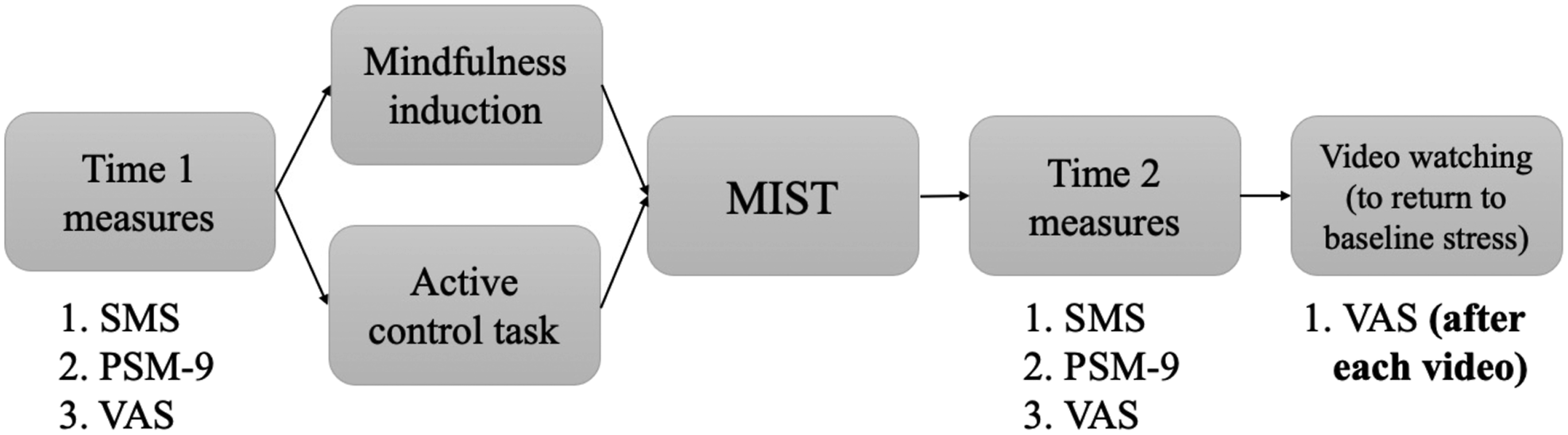
Participants joined a researcher for a meeting hosted on Zoom. At the start of the meeting, the researcher shared a link to an online survey which contained baseline (Time 1) measures of state mindfulness and state stress. Once these measures were completed, participants were provided instructions corresponding to their assigned experimental condition, as outlined below.
Participants assigned to the mindfulness induction condition (n = 82; 50% NSSI) were instructed to listen to an audio recording of a pre-selected, 10-minute guided body scan activity (Mindfulness Meditation, 2018). The body scan is a meditative practice that has been shown to increase state mindfulness, even when practiced for a brief duration (e.g., Mahmood et al., 2016). Moreover, participants assigned to the active control task condition (n = 82; 50% NSSI) were prompted to download a single-page document containing 100 letters, numbers, and symbols, and a grid of 100 boxes. Participants were instructed to place all of the characters in the grid in the order of their choice over the course of 10 minutes. This task has been used in a previous study (Carsley & Heath, 2019) and has been shown not to impact stress or anxiety levels, and was thus deemed an appropriate neutral attention task for the purposes of the present study.
Following the completion of their respective tasks, participants completed the MIST (Dedovic et al., 2005), a derivative of the Trier Mental Challenge Test (Kirschbaum et al., 1993), via remote control of the researcher’s shared screen on Zoom. The MIST consists of a series of computerized mental arithmetic problems, along with a social evaluative threat component, and was completed over the course of six minutes. Social evaluative threat was induced via (1) a performance bar displayed on-screen, which displayed participants’ real-time performance relative to a fictitious “average” that is set to always outperform the participant, and (2) evaluative performance feedback delivered by the researcher at the one-minute, three-minute, and five-minute marks. After the MIST was completed (Time 2), participants once again completed the measures of state stress and state mindfulness that they had completed at Time 1.
Finally, participants were asked to watch pre-selected funny videos until they reported a level of state stress that was less than or equal to their baseline level, as determined by their reported state stress on a visual analog scale (VAS; Lesage et al., 2012) following each video. Participants were then provided with a debrief form and compensated for their participation. This study was approved by the university’s institutional ethics review board.
Measures
History of NSSI Engagement. In order to group participants on the basis of whether or not they had a lifetime history of NSSI, data from a single-item screening question that was included as a measure in the first part of this two-part study was used. The item asked: “Have you ever engaged in self-injury without wanting to die (e.g., self-cutting, self-hitting, burning, bruising, scratching, etc.)?” Response options included “Yes” and “No.”
NSSI Methods, Onset, and Functions. Those who responded “Yes” to the NSSI screening item were prompted to complete subsections of the Inventory of Statements About Self-Injury (ISAS; Klonsky & Glenn, 2009) self-report questionnaire, also during the first part of this two-part study. The ISAS has demonstrated good internal consistency, test-retest reliability, and validity (Glenn & Klonsky, 2011; Klonsky & Glenn, 2009). Only the methods, age of onset, and functions subsections were used in the present study. Participants were first asked to indicate whether they had intentionally engaged in a list of 12 NSSI methods, such as “cutting,” “severe scratching,” and “banging or hitting self.” NSSI age of onset was then assessed with a single open-ended item which asked, “At what age did you first harm yourself?” Finally, a 39-item subsection of the ISAS was used to determine participants’ endorsement of various NSSI functions. Items within this subsection were rated on a 3-point Likert scale (0 = not relevant for me at all to 2 = very relevant for me); 13 functions were then calculated using the sum score of their 3 corresponding items. Scores for each of the 13 functions ranged from 0 to 6, with a higher score indicating a greater endorsement of that function.
State Mindfulness. The State Mindfulness Scale (SMS; Tanay & Bernstein, 2013) was used to assess state mindfulness. This 21-item self-report questionnaire consists of two subscales: state mindfulness of the mind (15 items) and of the body (6 items). The mind subscale includes statements such as, “I was aware of different emotions that arose in me,” while the body subscale includes statements such as, “I clearly physically felt what was going on in my body.” Items were rated on a 5-point Likert scale (1 = not at all to 5 = very well) based on the extent to which the item described the respondent’s experience in the past 5 minutes. A higher sum score on the mind or body subscale indicates greater state mindfulness of the mind or body, respectively. In line with findings from Tanay and Bernstein (2013), the mind and body subscales both yielded high internal consistency in the present study with Cronbach alphas of .92 and .82, respectively.
State Stress. A Visual Analog Scale (VAS; Lesage et al., 2012) was used to assess state stress. The VAS consists of a small, unmarked ruler with anchors labeled as “0 = not stressed at all” and “10 = as bad as it could be.” Respondents are asked to “Indicate how stressed you feel in this moment on the ruler below by dragging the slider.” The scale yields a single subjective stress score from 0 to 10, where a higher VAS score indicates greater state stress. The VAS has demonstrated good inter-rater reliability, validity, and sensitivity in previous studies (e.g., Keitel et al., 2011; Lesage et al., 2011). Nevertheless, its simplicity has been deemed a potential weakness (Lesage et al., 2012) and it was therefore complemented with an additional measure of state stress in the present study, as described below.
The Psychological Stress Measure 9 (PSM-9; Lemyre & Tessier, 2003) was also used to assess state stress. This 9-item self-report questionnaire consists of items such as, “I feel calm,” “I feel rushed; I do not seem to have enough time,” and, “I feel stressed,” rated on an 8-point Likert scale (1 = not at all to 8 = extremely) based on the degree to which each statement has recently applied to the participant. For the purposes of this study, “in this moment” was indicated as the timeframe of interest in order to ensure that participants were indeed reporting their state of stress in-the-moment. A higher sum score on the PSM-9 indicates greater state stress. The PSM-9 yielded high internal consistency in the present study (α = .86).
Data Analysis
All data were analyzed using SPSS version 27. To test the first objective, which was to investigate the impact of a brief mindfulness induction on two facets of state mindfulness (i.e., mind and body) following a stress induction task in university students with versus without a history of NSSI, two three-way mixed ANOVAs (Group X Condition X Time) were conducted. Similarly, to test the second objective, which was to investigate the impact of a brief mindfulness induction on state stress following a stress induction task in university students with versus without a history of NSSI, another two three-way mixed ANOVAs (Group X Condition X Time) were conducted. Pairwise comparisons were performed for all statistically significant simple main effects using a Bonferroni correction for multiple comparisons.
Results
Data Cleaning
Less than 5% of the data were found to be missing within each variable across each of the four participant clusters; it was thus assumed that omitted values were missing completely at random. All missing values were imputed using the Expectation Maximization (EM) method in SPSS. No univariate or multivariate outliers were detected within any of the participant clusters.
Preliminary Analyses
Means and Standard Deviations for State Mindfulness and State Stress for each Group and Condition at Time 1 and Time 2.
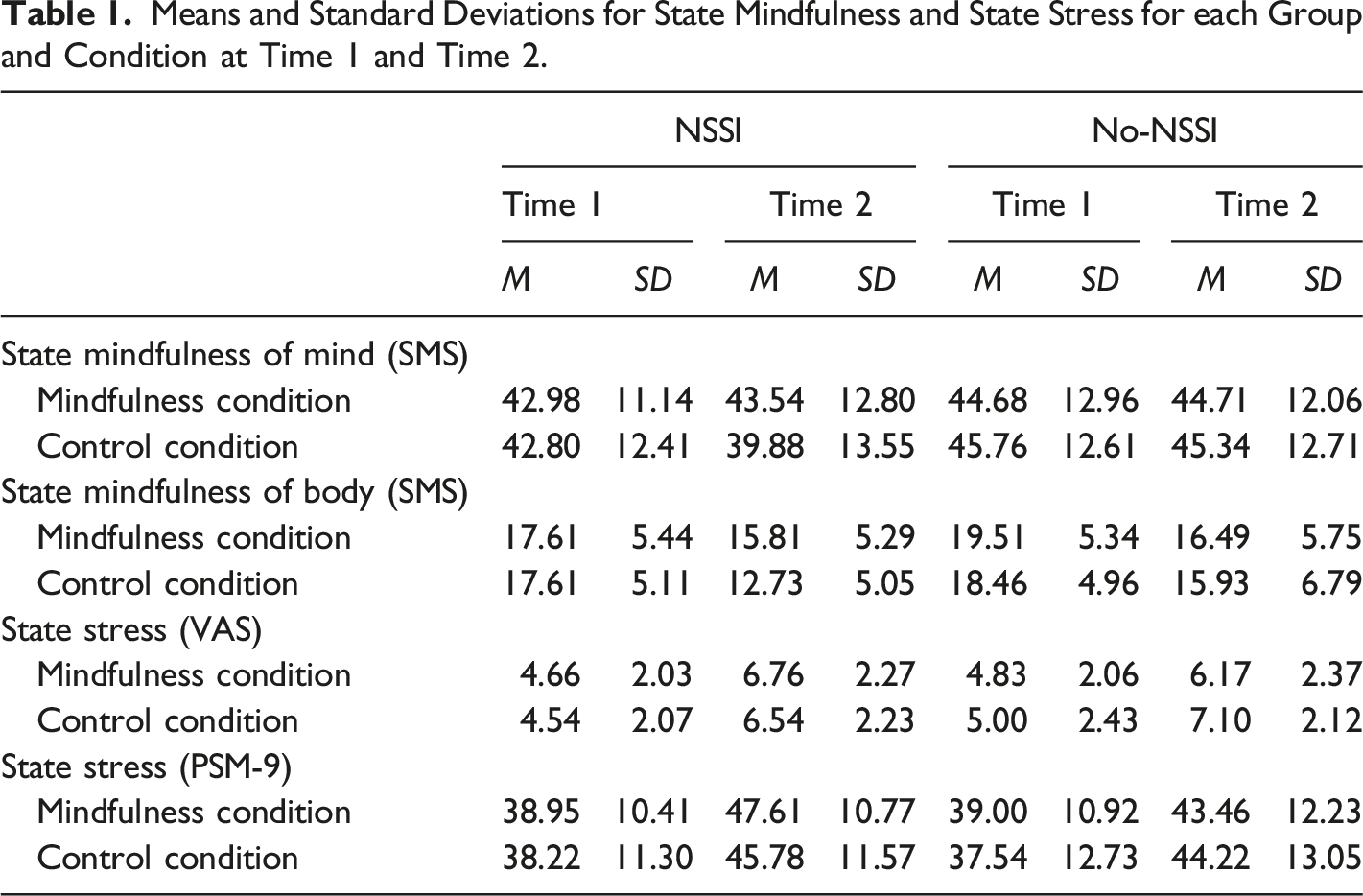
An additional series of one-way ANOVAs was then conducted to determine group equivalency within experimental conditions at Time 1. Within the mindfulness condition, there were no differences across groups (NSSI/no-NSSI) in state mindfulness of mind (F (1, 80) = .409, p = .524), state mindfulness of body (F (1, 80) = 2.550, p = .114), state stress as measured by the VAS (F (1, 80) = .143, p = .707), or state stress as measured by the PSM-9 (F (1, 80) = .000, p = .984). Finally, within the control condition, there were no differences across groups (NSSI/no-NSSI) in state mindfulness of mind (F (1, 80) = 1.141, p = .289), state mindfulness of body (F (1, 80) = .589, p = .445), state stress as measured by the VAS (F (1, 80) = .863, p = .356), or state stress as measured by the PSM-9 (F (1, 80) = .066, p = .798). In sum, given the lack of significant group differences at baseline, it can be assumed that group equivalency was achieved.
Main Analyses
Given that this area of research is still in its infancy, an alpha level of .10 was used to test for significance for all subsequent analyses; results should therefore be interpreted with caution. In alignment with best-practice recommendations for social science research, this decision was based on a consideration of the trade-off between committing a Type I error and a Type II error in the context of the present study (Kim & Choi, 2019; Meyers et al., 2016; Pituch & Stevens, 2016). Specifically, the potential benefits of further exploring or recommending brief mindfulness practices that may be effective were presumed to outweigh any potential risks of falsely rejecting the null hypothesis. The means and standard deviations for all study variables are presented in Table 1.
Differences in State Mindfulness (Mind and Body) Across Groups and Conditions
A three-way mixed ANOVA (Group X Condition X Time) was conducted for state mindfulness of the mind. There was no statistically significant three-way interaction between group, condition, and time, Wilk’s Λ = .997, F (1, 160) = .466, p = .496, ηp2 = .003. There were also no statistically significant two-way interactions between group and time (Wilk’s Λ = .999, F (1, 160) = .196, p = .659, ηp2 = .001) or between condition and time (Wilk’s Λ = .995, F (1, 160) = .773, p = .381, ηp2 = .005), indicating that state mindfulness of the mind did not differ from Time 1 to Time 2 as a result of group membership or experimental condition alone. Finally, there was no statistically significant time or condition effect (p > .10). However, when combining both time points, there was a significant group effect (F (1, 160) = 3.073, p = .081, ηp2 = .019), whereby participants in the NSSI group generally reported lower state mindfulness of the mind than those in the no-NSSI group.
A second three-way mixed ANOVA (Group X Condition X Time) was conducted for state mindfulness of the body. There was a statistically significant three-way interaction between group, condition, and time, Wilk’s Λ = .980, F (1, 160) = 3.338, p = .070, ηp2 = .020. At Time 1, there was no statistically significant simple two-way interaction of group and condition (F (1,160) = .414, p = .521), nor were there statistically significant simple main effects of group (NSSI p = 1.000; no-NSSI p = .364) or condition (mindfulness p = .101; control p = .460). At Time 2, there was no statistically significant simple two-way interaction of group and condition (F (1, 160) = 1.951, p = .164). However, there was a significant simple main effect of condition for those in the NSSI group at Time 2 (F (1, 160) = 5.839, p = .017), but not for those in the no-NSSI group (F (1,160) = .195, p = .660). In addition, there was a significant simple main effect of group at Time 2 for those in the control condition (F (1, 160) = 6.311, p = .013), but not for those in the mindfulness condition (F (1, 160) = .288, p = .592).
Pairwise Comparisons of Mean Levels of State Mindfulness of the Body Within-Groups (NSSI/no-NSSI) and Within-Conditions (Mindfulness/Control) at Time 2.
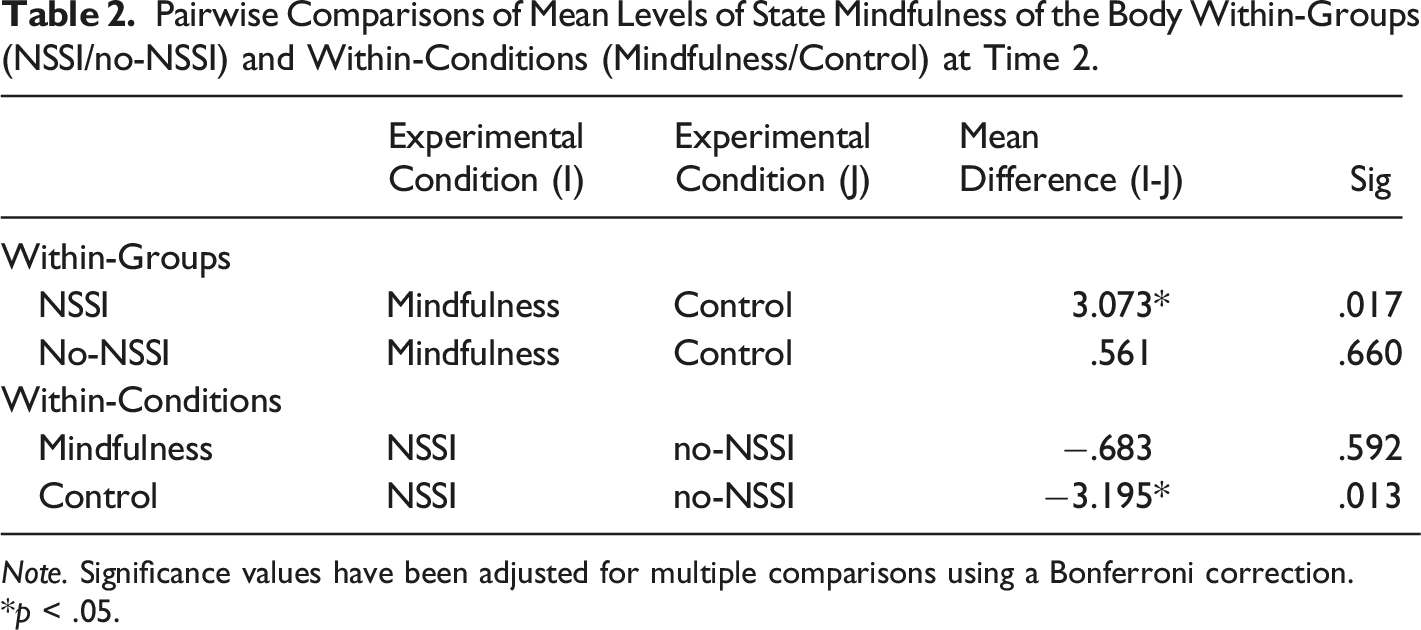
Note. Significance values have been adjusted for multiple comparisons using a Bonferroni correction.
*p < .05.
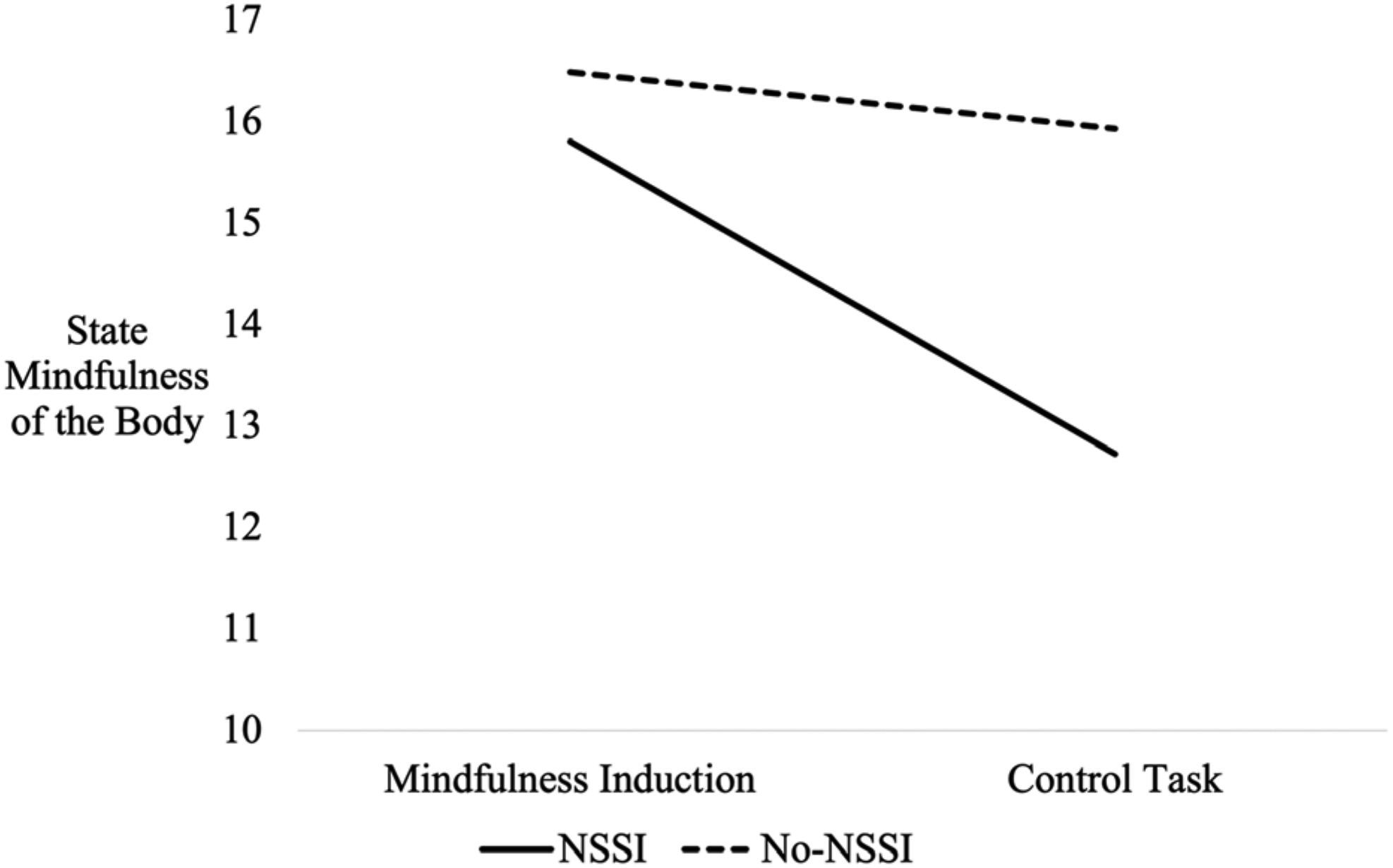
Mean Levels of State Mindfulness of the Body at Time 2 Across Groups (NSSI/No-NSSI) and Conditions (Mindfulness Induction/Active Control Task).
Differences in State Stress (VAS and PSM-9) Across Groups and Conditions
A third three-way mixed ANOVA (Group X Condition X Time) was run for state stress as measured by the VAS. There was no statistically significant three-way interaction between group, condition, and time, Wilk’s Λ = .992, F (1, 160) = 1.209, p = .273, ηp2 = .008. There were also no statistically significant two-way interactions between group and time (Wilk’s Λ = .996, F (1, 160) = .720, p = .398, ηp2 = .004) or between condition and time (Wilk’s Λ = .996, F (1, 160) = .720, p = .398, ηp2 = .004), indicating that state stress, as measured by the VAS, did not differ from Time 1 to Time 2 as a result of group membership or experimental condition alone. Finally, there was no statistically significant condition or group effect (p > .10), however there was a statistically significant time effect (Wilk’s Λ = .629, F (1, 160) = 94.242, p < .001, ηp2 = .371), whereby all participants experienced an increase in state stress from Time 1 to Time 2 regardless of their group or condition.
A final three-way mixed ANOVA (Group X Condition X Time) was run for state stress as measured by the PSM-9; the same pattern of results that emerged from the VAS scores emerged with this measure of state stress as well. Specifically, there was no statistically significant three-way interaction between group, condition, and time, Wilk’s Λ = .994, F (1, 160) = .977, p = 324, ηp2 = 006. There were also no statistically significant two-way interactions between group and time (Wilk’s Λ = .986, F (1, 160) = 2.285, p = .133, ηp2 = .014) or between condition and time (Wilk’s Λ = .999, F (1, 160) = .112, p = .739, ηp2 = .001), indicating that state stress, as measured by the PSM-9, did not differ from Time 1 to Time 2 as a result of group membership or experimental condition alone. Finally, there was no statistically significant condition or group effect (p > .10), however there was a statistically significant time effect (Wilk’s Λ = .706, F (1, 160) = 66.487, p < .001, ηp2 = .294), whereby all participants experienced an increase in state stress from Time 1 to Time 2 regardless of their group or condition.
Discussion
The present study is among the first to employ a single-blind, randomized controlled design with matched groups and a control comparison, to evaluate the effectiveness of a brief mindfulness induction among a sample of university students with and without a history of NSSI. Its main objectives were to investigate the impact of a brief mindfulness induction on (a) two facets of state mindfulness (i.e., mind and body) and (b) state stress, following a stress induction task, in university students with versus without a history of NSSI.
An interesting pattern of results emerged with regards to our first objective, which was to determine the impact of a brief mindfulness induction on two facets of state mindfulness (i.e., of the mind and of the body) following a stress induction, in university students with versus without a history of NSSI. Specifically, participants who underwent the mindfulness induction did not report greater state mindfulness when compared to those who completed the active control task, for either facet of mindfulness, with one exception. That is, participants who reported a history of NSSI and underwent a mindfulness induction reported greater state mindfulness of the body following a stress induction when compared to participants with a history of NSSI who completed an active control task. Thus, while state mindfulness of the mind and of the body did not significantly differ as a function of time or experimental condition for participants without a history of NSSI, the mindfulness induction did have a significant effect-albeit only on state mindfulness of the body-for participants who reported a history of self-injury.
Although state mindfulness of the mind and body were both expected to be greater among participants in the mindfulness induction condition when compared to the active control condition, a potential explanation for why the mindfulness induction had no significant impact on state mindfulness of the mind may pertain to the selected mindfulness induction task. A body scan meditation was selected for the purposes of the present study, and this type of meditation involves voluntarily shifting one’s attention to various parts of the body and noticing what is happening without judgment (Dambrun, 2016). While this form of meditation did demonstrate preliminary effectiveness at inducing state mindfulness in a previous study (Argento et al., 2020), these authors assessed overall state mindfulness, rather than breaking this construct down into two distinct facets. Thus, it may be the case that practicing a body scan meditation has an impact on state mindfulness primarily due to its impact on state mindfulness of the body, whereas it might exert little influence on state mindfulness of the mind, although the present study is the first to document such a distinction. As such, future research investigating a greater variety of mindfulness inductions, and whether they differentially impact state mindfulness of the mind and/or body, is needed to elucidate these findings.
Moreover, the differential impact of the body scan meditation on state mindfulness of the body is a novel finding and highlights the potentially unique response of individuals with a history of NSSI to a brief body scan meditation in the face of an acute stressor. Contrary to previous findings which suggested that university students with and without a history of NSSI respond similarly to a body scan meditation (Argento et al., 2020), the present study’s results suggest that a body scan-based mindfulness induction task may, in fact, function differently for students with and without a history of NSSI.
In line with research findings by Laurent et al. (2015), the present results may be partially explained by participants’ baseline levels of dispositional mindfulness. Laurent et al. (2015) evaluated the effectiveness of a brief mindfulness induction on romantic partners’ physiological stress responses to conflict stress, as moderated by dispositional mindfulness. These authors found no significant differences in stress response profiles by experimental condition; rather, it was only when dispositional mindfulness was taken into account as a moderator that effects emerged. While the present study’s findings are not directly comparable to those of Laurent et al. (2015) given their differences in methodology and assessment, the potential impact of baseline dispositional mindfulness on the effectiveness of brief mindfulness inductions may be worth considering. In fact, research has repeatedly shown that individuals with a history of NSSI tend to report relatively low levels of dispositional mindfulness when compared to individuals without such a history (e.g., Caltabiano & Martin, 2017; Garisch & Wilson, 2015). Thus, it may be the case that baseline dispositional mindfulness was at least partially responsible for the differential impact of the body scan meditation on participants with and without a history of NSSI; nonetheless, future research is needed to further explore this possibility.
In any case, the impact of the mindfulness induction, compared to the control task, on mindful awareness of the body among university students with a history of NSSI is particularly interesting in light of findings related to body regard and its relation to NSSI engagement (e.g., Muehlenkamp, 2012; Muehlenkamp et al., 2013). These research studies have suggested that low body regard, which may present as feelings of disconnect and detachment from bodily experiences, particularly during times of distress, may result in a devaluation of one’s body and thus facilitate the occurrence of NSSI. As such, if a brief body scan meditation is effective at inducing mindful awareness of the body, this may be an important avenue to further explore for fostering increased body regard in individuals with a history of NSSI. However, caution must be taken with such an interpretation, and future research is needed to develop a deeper understanding of whether state mindfulness of the mind and/or body is a positive or potentially aversive experience amongst individuals who have lived experience of self-injury.
The second objective of this study was to determine the impact of a brief mindfulness induction on state stress following a stress induction task, among university students with versus without a history of NSSI. Results revealed that all participants, regardless of their NSSI history, their assigned experimental condition, or the measure of state stress used (i.e., the VAS or the PSM-9), experienced a significant increase in state stress from T1 to T2. As noted earlier, the present study was, in part, a replication of a previous study (Argento et al., 2020) that employed a similar experimental design but used a Stroop task to induce stress (Stroop, 1935), and found that it was not effective at doing so. Thus, the significant increase in state stress from T1 to T2 that was found in the present study provides evidence for the effectiveness of the MIST (Dedovic et al., 2005) among participants with and without a history of NSSI.
Notwithstanding the above, these findings refuted our hypothesis (H2) that state stress at T2 would be lower among participants who underwent a mindfulness induction when compared to those who completed a control task. While the mindfulness induction was expected to buffer against induced stress in accordance with previous studies (Argento et al., 2020; Creswell et al., 2014; Laurent et al., 2015), it is possible that the MIST induced a degree of state stress that could not be buffered by a ten-minute body scan meditation alone. As outlined in the Procedure, an investigator was present on Zoom with each participant as they underwent the stress induction and was privy to their (inevitably poor) performance throughout. This degree of performance monitoring, which is typically not the case when the task is completed in a laboratory setting (Dedovic et al., 2005), may have amplified induced stress to an extent such that the mindfulness induction was not intensive enough to effectively lower the psychological stress response.
Nevertheless, this finding speaks to the importance of developing a regular mindfulness practice in order to lower the stress response over time (Bai et al., 2020; Chiesa & Serretti, 2009; Hindman et al., 2015; Vidic & Cherup, 2019). It is possible that, in the face of an acutely stressful experience, university students who have recently meditated but who do not necessarily have a regular mindfulness practice may not experience the potential buffering effect of a brief mindfulness induction, as indicated by decreased levels of state stress following a stress induction, although they are still be able to retain their state of bodily mindful awareness. This suggests that, if practiced repeatedly, even a 10-minute body scan may be sufficiently effective at inducing state mindfulness and thus increasing levels of dispositional mindfulness over time (Kiken et al., 2015; Treadway & Lazar, 2010). This may, in turn, gradually decrease levels of reactivity to stress (e.g., Bai et al., 2020; Laurent et al., 2015) which would be particularly relevant to those with a history of engaging in NSSI, who consistently report elevated levels of stress reactivity (Anderson & Crowther, 2012; Baetens, Claes, Willem, et al., 2011; Nock et al., 2008).
Limitations and Future Directions
Although this study provides a unique contribution to the literature on NSSI and the effectiveness of brief mindfulness inductions, there are a number of limitations which must be considered. First, as is often the case with NSSI research (see Cipriano et al., 2017 for a review), the present study’s sample was predominantly female. This was the result of a smaller proportion of male students responding to our recruitment efforts, as well as the exclusion of students who reported non-binary gender from our analyses, as there was not a sufficient number of these students to form matched groups. Our sample is therefore not representative of all university students who report lived experience of NSSI, limiting the generalizability of our results. Given preliminary evidence that mindfulness inductions may function differently based on gender (e.g., Laurent et al., 2015), future research should seek to recruit a greater number of male and non-binary participants in order to establish a more comprehensive understanding of the impact of mindfulness inductions among this population.
Furthermore, the study had to be conducted over Zoom due to constraints resulting from the COVID-19 pandemic. Since cameras were turned off for the entirety of the meeting in the interest of preserving participants’ privacy and confidentiality, there was no way of monitoring attention or engagement as participants completed their assigned experimental task (i.e., the mindfulness induction or the active control task). Thus, over the course of the 10 minutes provided to complete their respective task, there was no way of knowing with certainty whether participants were completing the task or whether they experienced distractions (e.g., interacting with household members, checking cellphone, browsing the internet) during that time. While future in-person experiments would allow for increased monitoring and a more controlled environment, future studies that want or need to be conducted virtually should include attention monitoring throughout the assigned activity to ensure participants’ consistent engagement with it. For instance, it may be preferable to keep cameras on, or to have participants complete the active control task on a shared screen so the researcher can monitor their engagement with it.
Another limitation is the omission of an assessment of state mindfulness immediately following the mindfulness induction but prior to the stress induction. It is possible that gains in state mindfulness were experienced immediately following the body scan meditation, but that the impact of the stress induction task washed this effect out. Future research investigating the effectiveness of mindfulness inductions should consider including a third state mindfulness assessment timepoint, between the experimental condition and the stress induction, in order to ascertain whether the mindfulness induction was indeed effective at inducing a state of mindfulness, even if that effect was not sustained following the stress induction.
Finally, prior experience with mindfulness practice was not measured in the present study but should be taken into account in future research, as it may (positively or negatively) bias participants’ response to mindfulness inductions. Moreover, a consideration of comorbid mental health disorders in relation to participants’ response to mindfulness inductions may be informative. Lastly, given that the state stress induced in the present study was largely performance-related (i.e., performance on a demanding arithmetic task), future studies that seek to replicate the present research design should consider measuring and accounting for pre-existing performance-related stress among participants in the analysis and interpretation of results.
Conclusion
NSSI is prevalent on university campuses (e.g., Cipriano et al., 2017; Wester et al., 2018) and students with a history of NSSI may be particularly reactive to the many stressors that accompany the university years (e.g., Anderson & Crowther, 2012; Baetens, Claes, Willem, et al., 2011). While brief mindfulness inductions have been proposed as a potential buffer against acute stress, very few studies have employed sound experimental designs to evaluate the effectiveness of mindfulness inductions; even fewer have examined their efficacy among university students with a history of self-injury. The present study provides a novel contribution to NSSI and mindfulness literature as it is among the first to employ a robust, randomized controlled trial design to evaluate the effectiveness of a brief mindfulness induction among university students with and without a history of NSSI. Although findings are tentative and should therefore be interpreted with caution, they suggest a unique responsiveness of university students with a history of NSSI to a body scan meditation in the face of a stressful experience, particularly in terms of their state mindfulness of the body, suggesting that further examination of brief mindfulness inductions among this population is warranted. Overall, the present study’s results speak to the potential for brief mindfulness inductions to be an important addition to mindfulness-based NSSI prevention and intervention efforts on university campuses.
Footnotes
Declaration of Conflicting Interests
The author(s) declared no potential conflicts of interest with respect to the research, authorship, and/or publication of this article.
Funding
The author(s) disclosed receipt of the following financial support for the research, authorship, and/or publication of this article: This manuscript draws on research supported by the Social Sciences and Humanities Research Council.
