




Abstract
Previous research suggests that individuals who engage in non-suicidal self-injury (NSSI) experience heightened sensitivity to social stressors such as exclusion. Mindfulness practice may buffer social stress among the general population, but whether it functions differently among those who engage in NSSI remains unclear. This experimental study sought to investigate the effects of a mindfulness induction relative to a control task as a buffer against social exclusion among emerging adults with and without a past-year history of NSSI, in terms of state stress and negative and positive affect, over time (baseline, reactivity, recovery). Participants included 172 emerging adults: 82 who reported past-year engagement in NSSI (M age = 22.51, SD = 2.74; 78% women) and 90 who have never engaged in NSSI (M age = 22.57, SD = 2.61; 80% women). All participants completed baseline measures of state stress and affect and were randomly assigned to either a mindfulness induction or active control task. Following completion of these activities, they underwent a social exclusion task (i.e., Cyberball), followed by reactivity measures of state stress and affect. Following a brief delay, participants finally completed recovery measures of state stress and affect. Three 3-way ANCOVAs (Time X Group X Condition) revealed no significant effects of the mindfulness induction on any outcomes at either follow-up time point (p’s > .05), although exploratory supplemental analyses revealed significant decreases in state stress and both positive and negative affect from baseline to reactivity (p’s < .001). Thus, while the mindfulness induction did not differ from a control task in terms of buffering stress and affect in response to social exclusion, participants did report a decrease on outcomes from baseline to post-social exclusion. Implications for future research and practice are discussed.
Introduction
NSSI is defined as the deliberate destruction of one’s own body tissue without suicidal intent and for purposes that are not socially or culturally sanctioned (American Psychiatric Association [APA], 2013; International Society for the Study of Self-Injury, 2024). NSSI has been included in Section III of the Diagnostic and Statistical Manual of Mental Disorders: fifth edition (DSM-5; APA, 2013) as a proposed diagnostic classification, titled Non-Suicidal Self-Injury Disorder (NSSID). A criterion for NSSID includes engagement in NSSI on at least five days within the last 12 months.
Emerging adulthood (ages 18–29 years, Arnett, 2007; Arnett et al., 2014) is a critical period during which elevated rates of NSSI engagement are reported. This developmental period includes various life transitions and increased instability which are often associated with heightened stress (Arnett, 2007; Arnett et al., 2014; Taliaferro & Muehlenkamp, 2015). Indeed, engagement in NSSI during emerging adulthood is associated with increased stressful experiences (Ewing et al., 2019), making emerging adults at an increased risk for using NSSI as a coping strategy. The documented lifetime prevalence rates of NSSI engagement among emerging adults drawn from the community range from 13.4–23.0% (Cipriano et al., 2017; Swannell et al., 2014; Wester et al., 2018). The prevalence rate among emerging adults attending university is also elevated reaching as high as 27–32% (Hamza & Willoughby, 2016; Muehlenkamp et al., 2019). Engagement in NSSI is a source of concern as it increases vulnerability for future suicide ideation and attempts (Hamza & Willoughby, 2016; Kiekens et al., 2018).
Individuals may engage in NSSI for various reasons, including intrapersonal (e.g., regulating emotions) and/or interpersonal ones (e.g., communicating distress; Glenn & Klonsky, 2009; Klonsky, 2007; Klonsky & Glenn, 2009; Taylor et al., 2018). Further, a meta-analysis found that among a pooled sample of studies including adolescents and adults, 66–81% of individuals reported engaging in NSSI for intrapersonal reasons and 33–56% of individuals reported interpersonal reasons (Taylor et al., 2018). It appears that most individuals endorse intrapersonal reasons for engaging in NSSI, while a smaller albeit significant proportion also report interpersonal reasons. Specifically, various social stressors have been identified as risk factors for NSSI engagement. A review by Cawley et al. (2019) found that across 15 studies, experiences of rejection were associated with an increased risk for NSSI behaviours. In addition, an ecological momentary assessment study found that experiences of rejection in daily life uniquely predicted future NSSI urges among emerging adult women with past-year thoughts of NSSI (Victor et al., 2019). Thus, social stressors may pose a significant risk for NSSI urges and engagement.
Prior experimental studies have also documented heightened sensitivity to social stressors such as social exclusion and rejection among individuals who recently engaged in NSSI (e.g., Groschwitz et al., 2016; Latina et al., 2023; Perini et al., 2019). For example, in a sample of adolescents, Latina et al. (2023) found that those with a past-year history of NSSI experienced increased negative affect following laboratory-induced social exclusion, whereas a control group with no history of NSSI showed no change, suggesting that adolescents with a past-year history of NSSI may be more sensitive to social exclusion than those without such a history. Moreover, Perini et al. (2019) examined the differential interpretations of social stimuli using an experimental paradigm among adolescents who recently engaged in NSSI (i.e., in the last 6 months) compared to those with no history of NSSI. The results showed that adolescents who engaged in NSSI perceived greater rejection and distress in response to social stimuli than the control group, revealing a negative bias in in how they interpret evaluative social feedback. The authors suggested that these findings support Nock and Prinstein’s (2004) Five Function Model of NSSI, in which interpersonal stress is believed to increase negative affect and therefore promote NSSI as an emotion regulation strategy (Perini et al., 2019).
In a study by Groschwitz et al. (2016), Cyberball (i.e., an experimental paradigm of social exclusion; Williams et al., 2000) was used to study the effects of social exclusion on neural processing among adolescents with a past-year history of NSSI. The findings revealed divergent neural processing of social exclusion between adolescents with and without a past-year history of NSSI. Specifically, adolescents with a past-year history of NSSI demonstrated greater activation in the medial and ventrolateral prefrontal cortices than did individuals with no history of NSSI engagement. These brain regions have been implicated in the processing of social exclusion and negative experiences (DeWall et al., 2012; Domsalla et al., 2014; Eisenberger et al., 2003; Lieberman et al., 2007), suggesting a unique sensitivity to social stress and unpleasant social interactions among individuals with a past-year history of NSSI (Groschwitz et al., 2016).
Schatten et al. (2015) also used the Cyberball social exclusion paradigm, but among emerging adults with and without a lifetime history of NSSI (i.e., engaged in NSSI at least once in their life). Unexpectedly, the two groups reported similar levels of distress in response to the task. The authors attributed this result to the instrument used to measure distress (i.e., Subjective Units of Distress Scale) not being robust enough to detect differences in negative affect between the groups. Similarly, Robinson et al. (2023) found that women with and without past-year engagement in NSSI reported similar increases in emotional reactivity to the Cyberball social exclusion task. The authors argued that contrary to prominent theoretical models of NSSI (e.g., Chapman et al., 2006; Hasking et al., 2017; Nock, 2010), individuals with a past-year history of NSSI engagement do not report a greater sensitivity or amplified emotional response to social exclusion. Therefore, additional research is needed to ascertain whether emerging adults who engage in NSSI respond uniquely to social exclusion and, if so, what might buffer such a response.
Mindfulness (i.e., the active process of paying attention to the present moment on purpose and with nonjudgmental acceptance; Kabat-Zinn, 1994) has been shown to be a protective factor for social stress (e.g., social exclusion). Three studies to date have experimentally examined the role of mindfulness in buffering the effects of perceived social exclusion using Cyberball. Specifically, Martelli et al. (2018) found that emerging adults exhibiting higher dispositional mindfulness (i.e., naturally occurring characteristic or predisposition to be mindful in daily life; Baer et al., 2006; Brown & Ryan, 2003) experienced less distress in response to Cyberball, suggesting more effective coping with social exclusion and rejection. Similarly, Clear et al. (2021) demonstrated that dispositional mindfulness mitigated the negative impact of social exclusion from Cyberball on feelings of friendliness, and that participants higher in dispositional mindfulness experienced greater recovery in their mood following Cyberball. Both studies imply that higher dispositional mindfulness may be a protective factor for the effects of a social stressor, such as social exclusion. Despite these promising findings, emerging adults with a history of NSSI tend to report relatively low levels of dispositional mindfulness compared to those without such a history (e.g., Caltabiano & Martin, 2017; Heath et al., 2016; Petrovic et al., 2024). However, research suggests that dispositional mindfulness can be developed. For instance, mindfulness practice has been shown to induce a state of mindfulness (i.e., extent to which an individual is experiencing mindfulness at a given moment; Tanay & Bernstein, 2013), and repeated increases in state mindfulness are believed to lead to increased dispositional mindfulness over time (Bishop et al., 2004; Kiken et al., 2015; Lau et al., 2006).
To our knowledge, only one previous study explored the potentially protective effects of a mindfulness induction (i.e., a single brief mindfulness practice of a few minutes; Creswell, 2017) on social exclusion using the Cyberball paradigm. Molet et al. (2013) randomly assigned emerging adults to complete either a 12-min (a) mindfulness induction that instructed individuals to direct their attention and awareness to the breath or (b) control task (i.e., unfocused attention task in which participants were asked to let their mind wander), followed by the Cyberball paradigm. No differences in mood were reported immediately in response to Cyberball between those who underwent the mindfulness induction compared to a control task. However, those who completed the mindfulness induction showed greater recovery in their mood from social exclusion following a three-minute delay. The authors argued that a mindfulness induction may not buffer the immediate emotional reaction to social stressors but may instead allow faster recovery, as it encourages individuals to focus on the present moment (at which point social exclusion has ended).
Although the putative protective effects of mindfulness inductions on social exclusion have yet to be examined among individuals who engage in NSSI, there is accumulating evidence to support the positive effects of mindfulness inductions among this population more generally. For instance, Argento et al. (2020) examined the effects of a mindfulness induction (i.e., a 10-min guided body scan meditation) relative to a control task, followed by a cognitive stress induction task (i.e., Stroop Task; Stroop, 1935), among university students with and without a lifetime history of NSSI engagement. Results revealed that the mindfulness induction was effective at decreasing state stress and increasing state mindfulness similarly for students with and without a lifetime history of NSSI. This study was the first to demonstrate that even a very brief mindfulness activity can decrease stress and evoke a state of mindfulness among individuals with a lifetime history of NSSI similarly to those without a history of NSSI. Subsequently, Petrovic et al. (2022) found that the same type of mindfulness induction (i.e., a body scan meditation) increased state mindfulness of the body more so for individuals with a lifetime history of NSSI compared to those without such a history. The authors concluded that this type of mindfulness induction may function differently between individuals with and without a lifetime history of NSSI. Nevertheless, the effects of mindfulness inductions in the context of social stress among individuals who engage in NSSI remains to be studied.
In summary, research that has largely relied on data collected from adolescents indicates that youth engaging in NSSI appear to be more vulnerable and sensitive to social stressors and suggests that NSSI may serve as a coping strategy in response to difficult interpersonal circumstances (e.g., Groschwitz et al., 2016; Latina et al., 2023; Perini et al., 2019; Victor et al., 2019). Theoretical models (e.g., Chapman et al., 2006; Hasking et al., 2017; Nock, 2010) suggest that emerging adults who engage in NSSI may exhibit heightened emotional sensitivity to social stressors, and mindfulness may promote effective emotion regulation and improved coping with stressful interpersonal situations, as well as stress more generally (e.g., Bai et al., 2020; Clear et al., 2021; Khoury et al., 2015; Martelli et al., 2018). Accordingly, there is a need to further examine the effects of mindfulness inductions in the context of social stressors (e.g., social exclusion) among emerging adults who engage in NSSI, which remained to be investigated, and may inform the use of mindfulness to support social functioning among this population.
This study therefore assessed the effects of a mindfulness induction on responses to the Cyberball social exclusion paradigm (in terms of state stress [
Methods
Participants
Participants were emerging adults recruited in 2023 from various online and social media platforms (e.g., Facebook) including, but not limited to, those associated with English universities in Montréal, Canada. Participants were also recruited through email listservs associated with the host university and through flyers posted around campus. Participants were eligible if they were between the ages of 18–29 years and either self-reported having engaged in NSSI on at least five separate occasions in the past 12 months or self-reported having no history of NSSI (never engaged in the behaviour). Participants who reported a lifetime history of NSSI but did not report engagement in the past year (15.55% of those initially recruited) were not invited to take part in the study.
A total of 193 emerging adults (18–29 years of age) were invited to complete the present study. Participants from each group (NSSI/no-NSSI) were randomly assigned to a condition (mindfulness induction/control task), based on self-reported gender identity. Due to technological issues, some participants (n = 11) were unable to complete the study in its entirety and were therefore excluded from the analyses. Given this attrition, 8 participants were randomly selected to be excluded from the analyses post-data collection, to preserve equal gender distributions across the conditions within the respective groups. Additionally, a small number of participants reported having experienced an aversive response to the mindfulness induction (n = 1) and the active control task (n = 1) and selected to end the study during these tasks. Therefore, these participants (n = 2) were not included in the final sample and analyses. Thus, the final sample (N = 172) consisted of 82 individuals that reported past-year engagement in NSSI (M age = 22.51, SD = 2.74; 78% women) and 90 that reported no history of NSSI (M age = 22.57, SD = 2.61; 80% women).
Participant Demographic Information for Both Groups (NSSI, no-NSSI) and Study Conditions (Mindfulness Induction, Control Task)
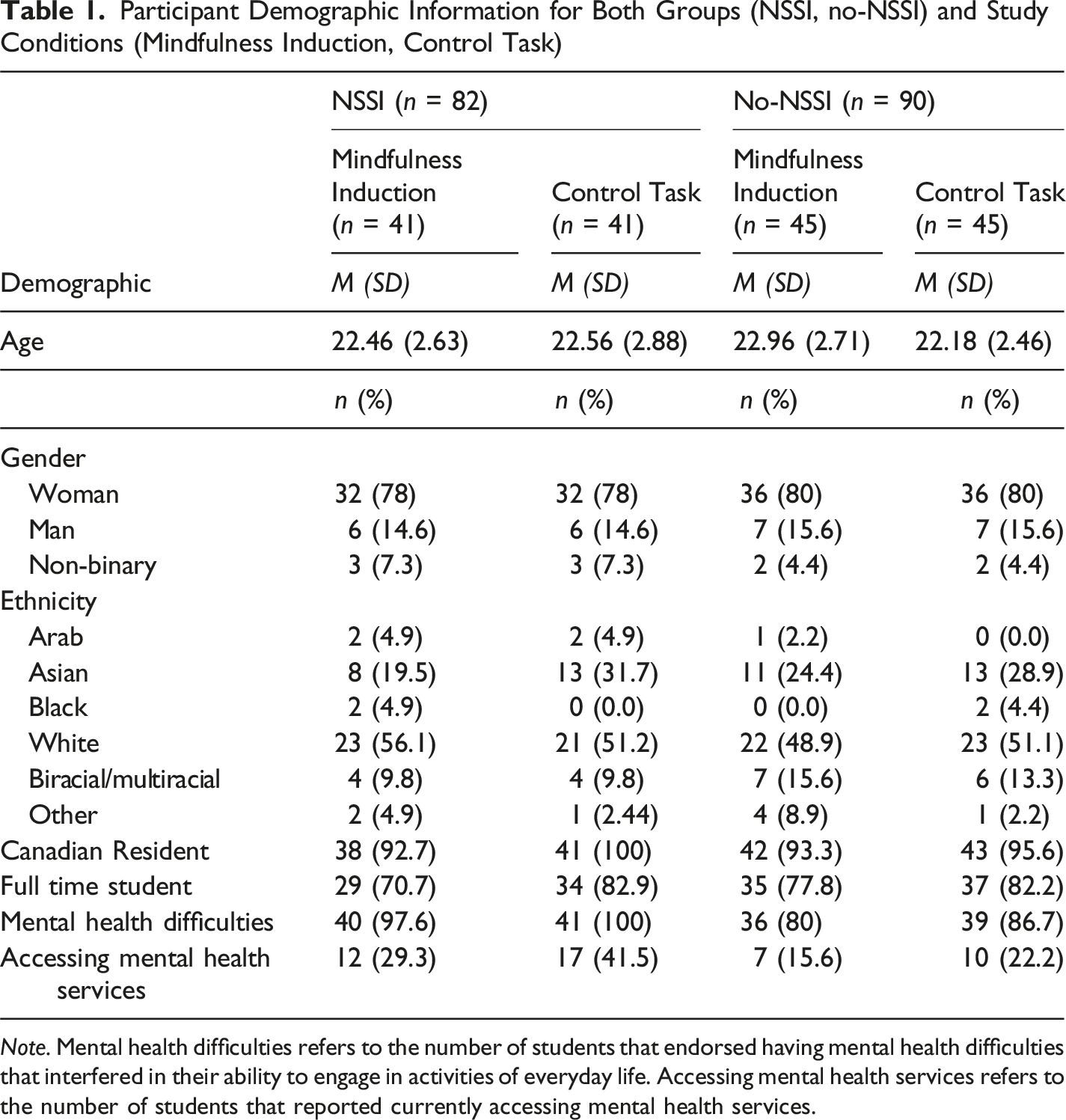
Note. Mental health difficulties refers to the number of students that endorsed having mental health difficulties that interfered in their ability to engage in activities of everyday life. Accessing mental health services refers to the number of students that reported currently accessing mental health services.
Measures
Screening Measure
A screening questionnaire was used to confirm eligibility to participate and included questions on age, gender, ethnicity, and NSSI history. To assess NSSI history, participants responded to the researcher-developed question, “Have you ever engaged in self-injury without wanting to die (e.g., self-cutting, self-hitting, burning, bruising, scratching, etc.)?” with either Yes or No. Participants who responded No were included in the no-NSSI group. Participants that responded Yes to this item were then asked, “Have you engaged in self-injury without wanting to die on at least 5 separate days in the past 12 months?”, with response options of Yes or No.
Individuals who responded No to this item (i.e., have a history of NSSI, but no engagement in the past 12 months) were deemed ineligible to participate in the study (i.e., did not complete additional measures and were entered in a raffle as compensation for participation in the screener measure). Participants that responded Yes to this item were included in the NSSI group; only these participants were asked to complete the Non-Suicidal Self-Injury Disorder Scale (NSSIDS; Victor et al., 2017) and Section 1 of the Inventory of Statements about Self-Injury (ISAS; Klonsky & Glenn, 2009), as described below.
NSSI Characteristics
NSSI History and Functions
The NSSIDS (Victor et al., 2017) is a 16-item self-report questionnaire assessing NSSID as per the proposed diagnostic criteria included in the DSM-5 (APA, 2013). While participants completed the entire NSSIDS, for the purposes of the present study, only an item pertaining to Criteria A (i.e., recency and frequency of engagement) and B (i.e., functions of NSSI) are reported on. One item from criterion A of NSSID was used, which asked participants “In the last year, on how many separate days have you engaged in any of these behaviors intentionally (i.e., on purpose) and without suicidal intent (i.e., not for suicidal reasons)?”. The three items that assess Criterion B of NSSID were also used, which ask participants to report whether they engage in NSSI (1) for relief from negative feelings, (2) to resolve interpersonal difficulties, and/or (3) to induce positive feelings, on a 7-point scale from never (1) to always (7). A score of 4 or more on each individual item indicates that the response meets the clinical threshold for that item. The full scale has demonstrated high internal consistency (Cronbach’s α = .76 to .88), as well as good construct and convergent validity (Victor et al., 2017).
NSSI Methods
Section 1 of the ISAS (Klonsky & Glenn, 2009) is a self-report assessment used to measure lifetime frequency of engagement in 12 different methods of NSSI (e.g., biting, burning, carving, cutting, interfering with wound healing, sticking self with needles, pinching, pulling hair, rubbing skin against rough surfaces, severe scratching). For the purposes of the present study, the measure was adapted to assess participants’ frequency of engagement in the various methods of NSSI within the past year, rather than over their lifetime. The full scale of ISAS has demonstrated excellent internal consistency (α = .84) and concurrent validity, and adequate test-retest reliability (Glenn & Klonsky, 2011; Klonsky & Glenn, 2009).
Primary Outcomes
State stress was measured using the Psychological Stress Measure 9 (PSM-9; Lemyre & Tessier, 2003), where participants rated 9 statements (e.g., “I feel calm,” “I feel stressed”) on an 8-point scale (1 = not at all to 8 = extremely); the timeframe was adapted to assess stress “in this moment.” The PSM-9 has demonstrated good psychometric properties (Lemyre & Tessier, 2003) and showed adequate internal consistency in this study at baseline (α = .87), reactivity (α = .82), and recovery (α = .87).
State affect was measured using the Positive and Negative Affect Schedule (PANAS; Watson et al., 1988), where participants rated 20 items (e.g., “interested,” “upset”) on a 5-point Likert scale (1 = very slightly or not at all to 5 = extremely); the timeframe used was “in the present moment.” The PANAS has demonstrated excellent psychometric properties (Watson et al., 1988) and showed excellent internal consistency for positive affect at baseline (α = .92), reactivity (α = .90), and recovery (α = .93) in the present study. Internal consistency was also excellent for negative affect at baseline (α = .92), reactivity (α = .91), and recovery (α = .92).
Manipulation Checks
Cyberball Appraisal
A reflective questionnaire designed to examine appraisals of Cyberball (Williams, 2009) was administered to assess how the Cyberball task was perceived. Only the 3-item “manipulation check” subsection of this instrument was used. Participants were asked to indicate the degree to which they felt included, excluded, and ignored during the Cyberball paradigm on a 5-point scale (1 = not at all to 5 = extremely).
Mindfulness and Control Task Appraisal
Researcher-developed questions were administered to explore participants’ experience of the mindfulness induction or control task. For the mindfulness induction appraisal, an open-ended item was utilized asking participants to explain how they experienced the activity. For the control task appraisal, a close-ended item asked participants to indicate how they experienced the activity by selecting one of the following response options: (1) soothing/relaxing, (2) neutral, (3) stressful, or (4) other. This control task appraisal question was added after the start of data collection. As a result, it was only presented to 70 out of the 86 participants who were assigned to the control condition.
Procedure
The university research ethics board (REB) approved all study procedures prior to data collection (REB # 22-10-055). The present study’s procedures are an extension of those used by Argento et al. (2020), Petrovic et al. (2022), and Molet et al. (2013), although adapted to be conducted online. Refer to Figure 1 for a flowchart of the study’s procedures. Participants who expressed interest in participating were first sent a screening survey hosted on the online platform Qualtrics to assess their eligibility to take part in the study. This survey included the study consent form where participants were prompted to their informed consent, followed by the screening and NSSI characteristics questionnaires (i.e., demographic questions, NSSI screener questions, NSSIDS, ISAS). Participants who completed the screening survey were compensated with entry in a raffle for a chance to win a cash prize of $10 CAD, regardless of their eligibility status. Eligible participants were randomly assigned to either the mindfulness induction or the active control task and were subsequently invited to participate in the experimental study by signing up for a time slot. Participants were informed that the study must be completed during the timeslot as it had to be simultaneously completed by two other participants, although this was fictitious. The reason for this deception was to enhance the social paradigm of Cyberball, given the online adaptation of the present study. At the time of their selected timeslot, participants were sent a link to the experimental study that was conducted entirely through Qualtrics. Participants first completed baseline measures of state stress and state affect, followed by their assigned experimental task. To minimize the potential for harm, at the start of the experimental tasks (mindfulness induction/control task and Cyberball) participants were told that they may end the study at any time by clicking on an item embedded within the survey. By doing so, participants would be presented with various grounding techniques, consistent with best practice mindfulness instruction guidelines to eliminate potential harm (Treleaven & Britton, 2018), as well as gain access to mental health resources and receive the debriefing information at that time. Flow Chart of Baseline Measures, Experimental Conditions, Cyberball Social Exclusion Task, Reactivity Measures, Delay, and Recovery Measures. PSM-9: Psychological Stress Measure 9 (Lemyre & Tessier, 2003). PANAS: Positive and Negative Affect Schedule (Watson et al., 1988)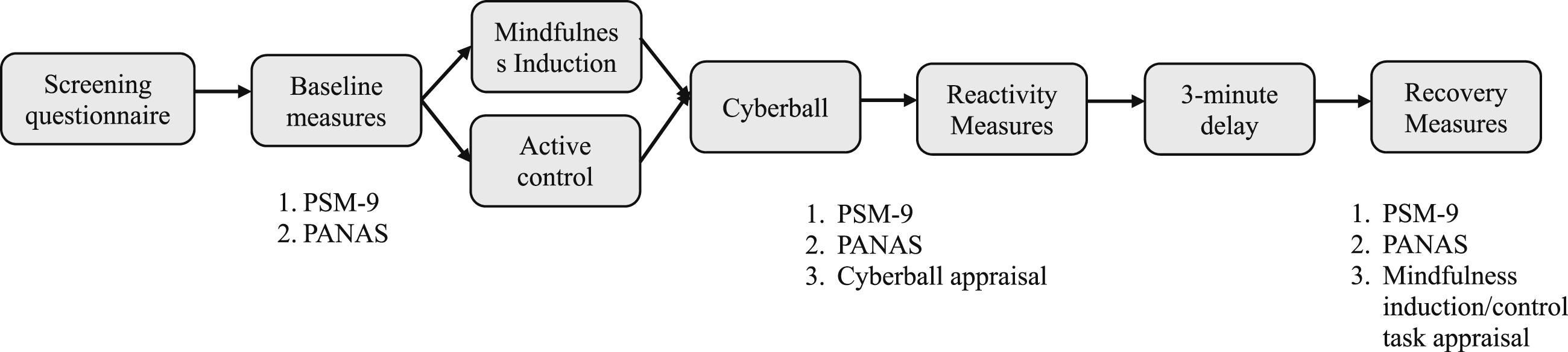
Mindfulness Induction
Participation in the mindfulness induction entailed undergoing a 10-min guided body scan. This included asking participants to sit comfortably and listen to a recording instructing them to shift their awareness to different body parts with nonjudgmental acceptance. The purpose of this task was to induce a state of mindfulness and has demonstrated to do so in individuals with and without a history of NSSI and with no prior mindfulness training (e.g., Argento et al., 2020; Petrovic et al., 2022; Snippe et al., 2017).
Control Task
Participants who were assigned to complete the active control task were presented with a screen containing 100 letters, numbers, and symbols, and an empty grid. Participants were instructed to drag and drop each of the characters into the grid in any order over the course of approximately 10 minutes. This activity is an adapted online version of an activity that has demonstrated to be a neutral control task by not inducing a state of mindfulness (e.g., Argento et al., 2020; Carsley & Heath, 2019; Petrovic et al., 2022).
Cyberball
Following their assigned experimental task, all participants underwent Cyberball, a well-established and widely used experimental paradigm of social exclusion (Williams et al., 2000). Cyberball is a simulated ball tossing game developed to manipulate social exclusion in research. Given the present study did not occur in the laboratory, but rather online, the instructions of the Cyberball game were adapted. Before beginning the Cyberball game, participants were informed that the current study was interested in understanding group dynamics among strangers and were encouraged to be conscious of how the group dynamics were unfolding over the course of the game. Thereafter, participants were presented with a loading GIF for 1 minute during which time they were told that they were waiting for other players to join the game. This was an adaptation of Robinson et al. (2023)’s Cyberball procedures. In actuality, participants played a simulated ball tossing game with two fictitious characters, for approximately 4 minutes. During this time, the fictitious players tossed the ball between each other and excluded the participant by tossing the ball to them less frequently throughout the game. Specifically, out of a total of 60 passes, the ball was passed to the participant for six of those passes (10% pass rate), which were dispersed throughout the game. A meta-analysis found that across 120 studies using Cyberball as a social experimental paradigm, a large effect for ostracism was found (Hartgerink et al., 2015).
Immediately following their completion of Cyberball, participants completed the same baseline measures a second time (i.e., reactivity measures) with the addition of the Cyberball manipulation check questions. Participants then underwent a 3-min delay during which they were asked to remain seated and wait while the other players from the ball tossing game also completed the questionnaires. This delay served as a recovery phase and has demonstrated to be sufficient time to produce significant decreases in distress following Cyberball (e.g., Clear et al., 2021; Molet et al., 2013). After this brief passage of time, participants completed the same baseline measures for a third time (i.e., recovery measures), with the addition of either the appraisal of mindfulness or control task questions, respective of participants’ assigned condition.
Following the completion of the recovery measures, participants received debriefing information and were provided with a list of community and mental health resources. The debriefing included information on the objectives of the study and an explanation for the necessity of deception, including the nature of the ball-tossing game. All participants were compensated $20 via e-transfer for their participation.
Data Analytic Plan
Preliminary Analyses
All data were analyzed using SPSS version 30. First, as part of the Cyberball manipulation check, a two-way multivariate analysis of variance (MANOVA) was conducted to determine whether participants differed in their perception of Cyberball in terms of feeling included, excluded, and ignored, as a function of group (NSSI/no-NSSI) and condition (mindfulness induction/control task).
Second, to explore participants’ appraisals of the tasks they were assigned to, participants’ responses on the mindfulness and control task appraisal questions were analyzed. For the mindfulness induction appraisal, individual responses on this question were coded and subsequently organized into broad categories. Then, two chi-square tests of independence were conducted to determine whether there were significant differences in the proportion of the no-NSSI and NSSI groups’ experience of the mindfulness and the control task. Of note, all assumptions of a chi-square test of independence were met except for the assumption of cell count greater than 5. Specifically, on questions exploring participants’ experience of the mindfulness induction and control task, cell counts for the response codes “uncomfortable/unpleasant” and “soothing/calming” were less than 5. Thus, the analyses were conducted by excluding these response categories.
Main Analyses: Effect of the Mindfulness Induction on State Stress (Objective 1) and Affect (Objective 2)
A series of three-way (Group × Condition × Time) analyses of covariance (ANCOVA) were conducted to compare the effect of the mindfulness induction across groups (NSSI, no-NSSI), conditions (mindfulness induction, control task), and measurement timepoint (reactivity, recovery) for each primary outcome, with baseline scores as the covariate. Specifically, separate ANCOVAs were conducted for state stress, negative affect, and positive affect. Pairwise comparisons were performed for all statistically significant simple main effects.
Results
Data Cleaning
Less than 5% of the data were found to be missing within each variable across each of the four participant clusters; thus, it was assumed that the omitted values were missing completely at random. The exception was on the mindfulness appraisal question, which 13.33% (n = 6) of the no-NSSI group and 21.95% (n = 9) of the NSSI group did not respond to. All missing values for the primary outcomes were imputed using the Expectation Maximization method (Dempster et al., 1977) in SPSS, such that missing values on a given measure were imputed using scores on the other items of that measure. This was done separately for each of the four participant clusters. Three univariate outliers (+/− 3 SD) were identified, two of which were in the no-NSSI-C group and one within the no-NSSI-MF group. These outliers were winsorised within each group (NSSI/no-NSSI) separately in order to maximize prediction accuracy, following the recommendations of Tabachnick and Fidell (2001). No multivariate outliers were detected. An examination of variable skewness (∣3∣) and kurtosis (∣8∣) revealed the following violations of normality: negative affect was positively skewed at each time point for the no-NSSI-C group, at recovery for the no-NSSI-MF group, and at reactivity for the NSSI-MF group. Given the robust nature of ANOVAs to such violations (Black et al., 2010; Blanca et al., 2017; Blanca et al., 2023; Islam & Abbas, 2022; Schmider et al., 2010), the analyses were carried out as planned without transforming the data to maintain its integrity.
Preliminary Analyses
NSSI Characteristics
Given the small number of participants with a past-year history of NSSI who identified as men or non-binary in the present sample, gender differences in NSSI characteristics were not examined. The mean age of NSSI onset was 14.78 years (SD = 3.58) with a range of 3 to 25 years of age. Most self-injured for the first time during adolescence (i.e., 12–17 years of age; 67.95%), followed by emerging adulthood (i.e., 18–29 years of age; 19.23%) and childhood (i.e., 3–11 years of age; 12.82%). The vast majority of participants with a past-year history of NSSI reported engaging in more than one method in the past year (82.93%), with a mean of 4.49 methods (SD = 3.06). Among participants who reported having a main form of NSSI (n = 80), the most frequently reported were cutting (45%) and self-hitting/banging (33.8%). Most participants (81.71%) endorsed engaging in NSSI to obtain relief from negative feelings or thoughts in addition to other reasons. A small proportion (18.30%) reported engaging in NSSI solely for this reason. Moreover, 63.41% endorsed engaging in NSSI to cope with interpersonal problems, along with other reasons. Some participants (11.00%) only endorsed this reason for engagement. Finally, 43.90% endorsed engaging in NSSI to create a positive feeling, with 3.70% only endorsing this reason.
Cyberball Manipulation Check
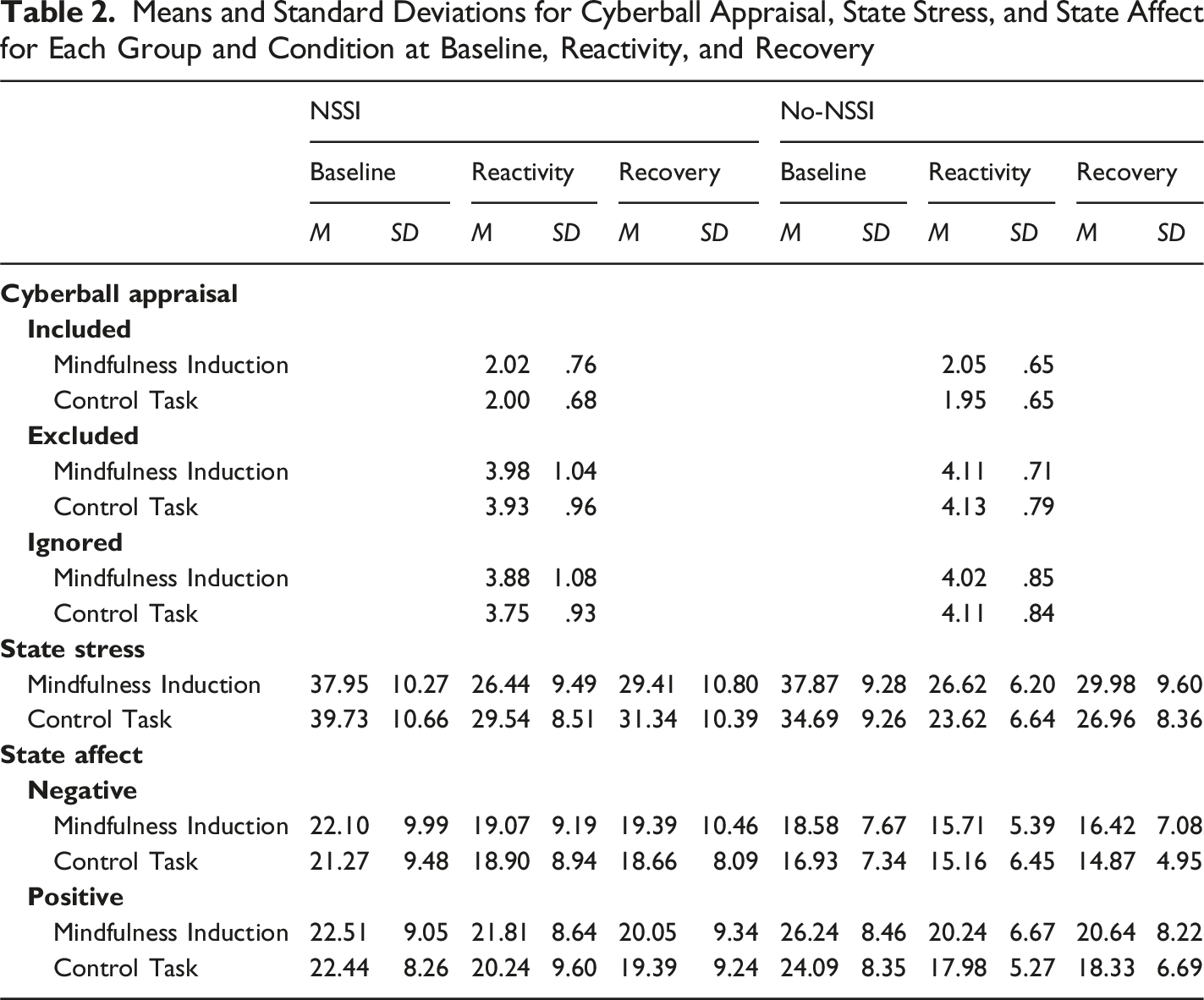
Means and Standard Deviations for Cyberball Appraisal, State Stress, and State Affect for Each Group and Condition at Baseline, Reactivity, and Recovery
Mindfulness Induction and Control Task Appraisals
Participants’ responses about how the mindfulness induction personally affected them were grouped into three categories, namely “soothing/calming,” “distracted,” and “unpleasant/uncomfortable.” Within the no-NSSI group, 43.59% reported that the mindfulness induction was “soothing/calming” and 53.13% of participants in the NSSI group reported this. Next, 25.64% of the no-NSSI and 21.88% of the NSSI group reported becoming distracted or had difficulty sustaining their attention during the mindfulness induction. Lastly, a minority (5.13%) of participants in the no-NSSI group reported their experience during the mindfulness induction to be unpleasant/uncomfortable, while no participants in the NSSI group reported experiences that fell within this category. A chi-square test of independence revealed that the proportion of the no-NSSI and NSSI groups’ experience of the mindfulness induction was comparable, χ2 (1) = 0.35, p = .552. The results suggest that emerging adults with and without past-year engagement in NSSI did not differ in their appraisals of the mindfulness induction.
Regarding participants’ appraisals of the control task, 55.9% of the no-NSSI group and 47.2% of the NSSI group found it to be “neutral.” Next, 41.2% of the no-NSSI and 36.1% of the NSSI group found the control task “stressful/frustrating.” Lastly, 2.9% of the no-NSSI group reported finding it “soothing/calming,” while 16.7% of the NSSI group reported this. A chi-square test of independence revealed that the proportion of the no-NSSI and NSSI groups’ experience of the control task was comparable, χ2 (1) = 0.01, p = .942. Similar to the results for the mindfulness induction, these results suggest that the no-NSSI and NSSI group did not differ in their appraisals of the active control task.
Main Analyses: Effect of the Mindfulness Induction on State Stress (Objective 1)
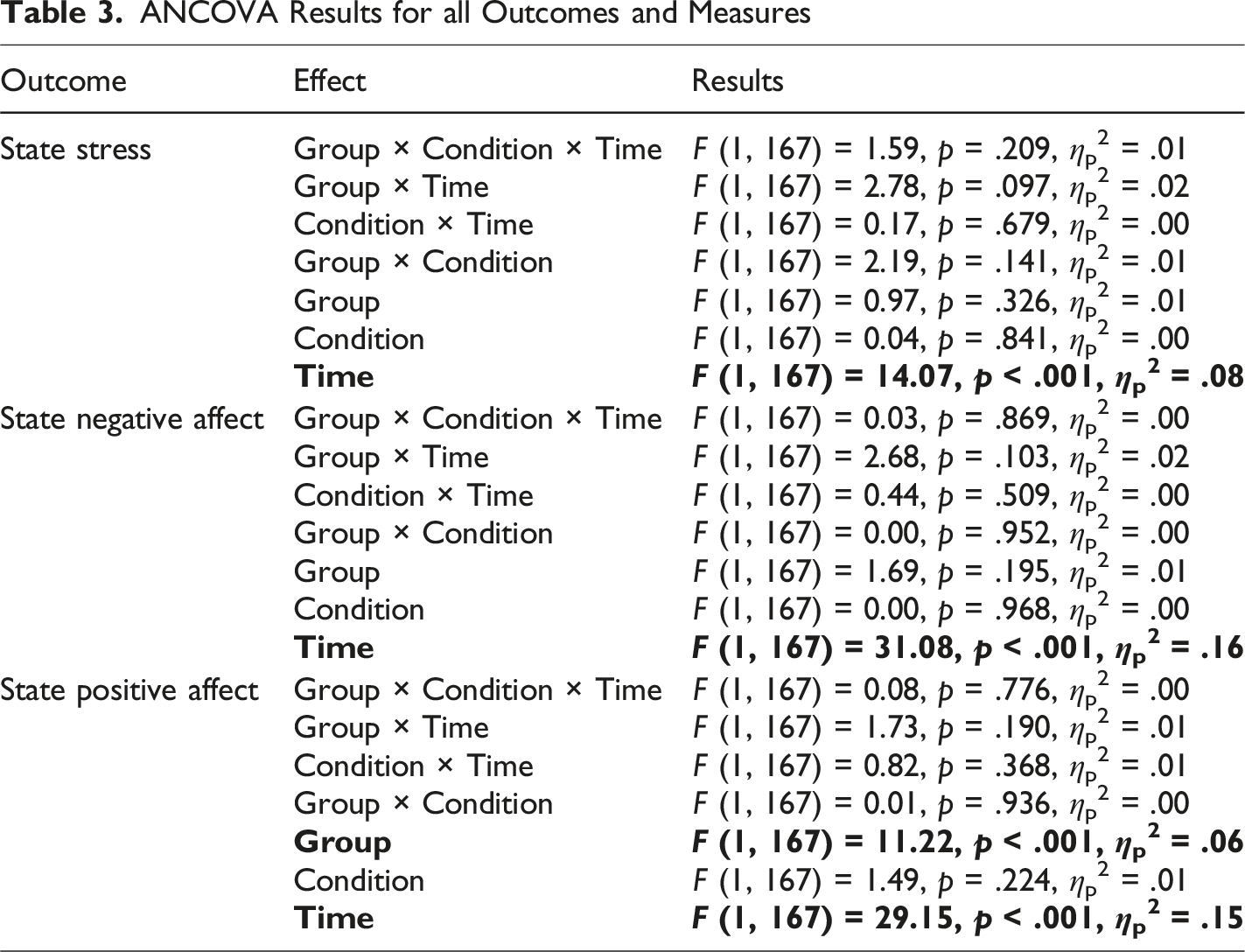
ANCOVA Results for all Outcomes and Measures
Main Analyses: Effect of the Mindfulness Induction on State Affect (Objective 2)
For the primary outcomes of state negative and positive affect there were no significant interaction effects or main effects of condition (p’s > .05). There was only a significant main effect of time for both state negative or positive affect (p’s < .001), although all follow-up pairwise comparisons were non-significant (p’s > .05). For state positive affect only, a significant main effect of group also emerged (p < .001), such that the NSSI group reported significantly higher state positive affect than the no-NSSI group. Overall, H2a and H3b were refuted as the effect of the mindfulness induction relative to the control task on the Cyberball paradigm did not differ as a function of group and condition for state negative or positive affect.
Supplemental Analyses
Although time effects from baseline to reactivity could not be detected by the ANCOVAs, inspection of the means for the primary outcomes suggested the presence of notable decreases in state stress, and negative and positive affect from baseline to reactivity. To explore this trend further, three separate paired samples t-tests were conducted to determine whether this change over time was statistically significant. Given that group or condition effects were seldom found in the main analyses, these were not included as independent variables. Results revealed a statistically significant decrease of 9.87 (SD = 11.14) in state stress, t (171) = 11.61, p < .001, d = .89 (representing a large effect), a 2.50 (SD = 7.49) decrease in negative affect, t (171) = 4.38, p < .001, d = .33 (representing a small effect), and a 3.86 (SD = 7.88) decrease in positive affect, t (171) = 6.43, p < .001, d = .49 (representing a medium effect), from baseline to reactivity (i.e., immediately post-Cyberball).
Discussion
The present study was the first to experimentally evaluate the effects of a brief mindfulness induction at mitigating the effects of Cyberball, a social exclusion task, among emerging adults with and without a past-year history of NSSI. The main objectives were to investigate the effects of the mindfulness induction relative to an active control task on state stress and affect, following Cyberball, over time and between the groups (NSSI/no-NSSI). Based on the means of the Cyberball manipulation checks, participants appeared to feel excluded and ignored during Cyberball, suggesting that ostracism was induced, which is consistent with previous research which has demonstrated overall large effects of ostracism induced by the Cyberball paradigm (e.g., Hartgerink et al., 2015). However, contrary to what was hypothesized, differential effects of the mindfulness induction relative to the control task on state stress and affect were not found, such that the mindfulness induction did not uniquely alter the effects of Cyberball. This is surprising given that participants appraised these tasks differently. Specifically, almost half of the participants reported experiencing a soothing or calming effect from the mindfulness induction, while a minority reported an unpleasant experience. The reverse pattern was found for the control task in which a small proportion of participants experienced the activity as soothing or calming, and many perceived it as unpleasant.
Therefore, despite the mindfulness induction and control task being appraised differently, the condition effect was non-significant. This may be suggesting a common element between these tasks, such that they functioned similarly, negating any significant effects of the mindfulness induction from being produced. Perhaps the control task functioned as an attention control task, by instructing participants to drag symbols from the lefthand side of their screen into a box on the righthand side, in any order, over a period of time. Notably, attentional control (i.e., the ability to sustain attention on a chosen object) is believed to also be a means of emotion regulation when individuals engage in tasks that require focused attention on non-emotive stimuli (e.g., distraction tasks; Gross, 2001; Holzel et al., 2011). Mindfulness practice includes a similar element of focused attention (e.g., a focus on the breath or a particular body party) albeit with an attitude of nonjudgmental acceptance, which also promotes emotion regulation (Gross & Thompson, 2007). In fact, a meta-analysis found that when comparing the effects of mindfulness inductions to distraction tasks, both enhanced emotion regulation similarly (Leyland et al., 2019). This suggests that the control task used in the present study may have functioned as a distraction and attention control task, in turn providing emotion regulation benefits, as is also expected with the mindfulness induction. Therefore, the practice of attention control that occurred during these two tasks may have mattered more than how pleasant the tasks were perceived to be, in terms of their acute effects on stress and affect.
Additionally, this points to the need to compare mindfulness inductions to control tasks that do not encourage attentional control. Unlike previous studies that utilized similar active control tasks (e.g., Argento et al., 2020; Carsley & Heath, 2019; Petrovic et al., 2022), this adapted “drag-and-drop” symbol sorting activity used in the present study may not have functioned as a neutral control task. More research is needed to elucidate the specificity of the effects of the mindfulness induction by utilizing a different control task that does not instruct participants to sustain their attention on a particular task. Petrovic et al. (2025) recently observed similar findings whereby an online active control task (i.e., a similar symbol sorting task to the one used in the present study), was compared to a mindfulness induction (i.e., a 10-min sitting meditation) and failed to find significantly different pre-post changes in state stress. However, when the effectiveness of mindfulness inductions has been examined relative to passive control tasks (i.e., unfocused attention tasks, mind wandering), significant results have been obtained. For example, Keng and Tan (2018) found that participating in a 10-min mindfulness induction resulted in quicker rates of recovery in negative affect following a social rejection task, relative to a 10-min passive control condition. Therefore, future research may consider using passive control tasks which may be more appropriate control tasks to study the effects of mindfulness inductions, by not encouraging similar attentional demands to those involved in mindfulness practice, which are believed to be a mechanism involved in its emotion regulation benefits.
This study was also interested in exploring whether the mindfulness induction would function differently to buffer the effects of social exclusion between the groups (NSSI/no-NSSI). Results suggest that participants’ responses to the mindfulness induction (and control task) did not differ as a function of NSSI history. This finding is particularly interesting given that previous research has documented that individuals with a lifetime history of NSSI engagement report greater levels of stress (Kiekens et al., 2015) and emotion dysregulation (Wolff et al., 2019) relative to those without a history of NSSI. Furthermore, NSSI behaviours are understood as a method of regulating or avoiding emotional pain and negative affect (Klonsky, 2007; Wupperman et al., 2013), and it has been suggested that individuals who engage in NSSI may have greater difficulty practicing mindfulness as it teaches nonjudgmental acceptance of present moment emotions, thoughts, and feelings (Rees et al., 2015; Schmelefske et al., 2020). However, similar to Argento et al. (2020), the current study did not find evidence of this. Therefore, while individuals who engage in NSSI may have unique emotion regulation challenges, they did not respond differently to a brief mindfulness induction prior to a social exclusion task relative to those without such a history. Additionally, as presented earlier, the literature is mixed on whether emerging adults who engage in NSSI are more vulnerable and respond differently to social stressors than their non-self-injuring peers (e.g., Groschwitz et al., 2016; Latina et al., 2023; Perini et al., 2019; Robinson et al., 2023; Schatten et al., 2015). The results of the present study support recent findings (e.g., Robinson et al., 2023) that emerging adults with a past-year history of NSSI do not demonstrate a different pattern of response relative to their peers with no such history to the Cyberball social exclusion paradigm.
Notably, the supplemental analyses revealed decreases in state stress and affect from baseline to reactivity (i.e., immediately post-Cyberball) for all participants. As mentioned earlier, attentional control may have been a common element among both these tasks, that contributed to the observed decrease in state stress from baseline to reactivity. Meanwhile, the pattern of results for state affect (i.e., decreases in both positive and negative affect from baseline to reactivity) appears to follow a trend supported by previous research. For instance, dispositional mindfulness predicts a decrease in negative affect but not an increase in positive affect (e.g., Glück & Maercker, 2011; Jose & Geiserman, 2024). Experimentally, Menezes and Bizarro (2015) found that mindfulness training (i.e., five consecutive days of participation in a mindfulness program including 15 to 20-min meditative daily practices) led to decreases in negative affect but no improvements in positive affect, and better performance on a concentrated attention task compared to a waitlist control group. The authors speculate that attention regulation is a skill developed through mindfulness training which aids in avoiding the engagement of mental resources in negative stimuli. This suggests that mindfulness training and attention control tasks such as those used in the present study may have emotion regulation benefits in terms of negative affect and stress, but not necessarily for positive affect. If this is the case, it is then comprehensible that positive affect did not just remain unchanged, but rather decreased in response to a task that was intended to elicit unpleasant experiences through social exclusion.
Alternatively, the unexpected results may be attributed to methodological factors. First, anticipatory stress could have been induced within the present study simply because participants were informed that they would be interacting with other individuals online when signing up for a timeslot to participate. Once Cyberball was completed, there may have been relief leading to a decrease in stress and affect. However, when looking at participants baseline scores on the PSM-9 and PANAS, they were comparable to those observed in previous studies of mental health outcomes, as well as experimental research among adults (e.g., Gloster et al., 2020; Petrovic et al., 2022, 2025), suggesting that participants did not begin the study with higher-than-expected levels of stress and affect. Therefore, another possible explanation may be that simultaneous decreases in positive and negative affect in response to social exclusion occurred as part of a process of emotional analgesia (i.e., numbing; Baumeister et al., 2009; DeWall & Baumeister, 2006), such that reductions in both these states indicate a shift towards more neutral mood in response to social exclusion. However, few studies (e.g., Bass et al., 2014) have found this pattern of responding to Cyberball and more research would be needed to support this theory. The present study had participants undergo activities believed to aid in regulating emotional responses to social exclusion, which is the more likely explanation for the observed results at this time.
Limitations
While this study provides new contributions to the literature on the use of brief attentional control tasks for coping with social exclusion in emerging adults with and without a past-year history of NSSI, there are various limitations that must be considered. First, the sample lacked diversity in terms of gender and ethnicity, as it was predominantly composed of white women pursuing university studies. This is a consistent issue in NSSI research (for a review see Cipriano et al., 2017) and limits the generalizability of the findings as our sample was not representative of all emerging adults who report a history of NSSI. The lack of gender diversity did not allow us to investigate the potential influence of gender differences that may exist in relation to the current findings. Second, the study did not include a social inclusion condition that is often used in Cyberball research as a control condition. This would have allowed us to decipher the unique effects of the social exclusion task compared to social inclusion. Third, given that Cyberball is an experimental paradigm used to induce feelings of ostracism, the ecological validity of results may be limited as it lacks the naturalistic interactions between individuals (Parsons, 2015). Fourth, after much consideration, to ensure the effect of the mindfulness induction was sustained until the social exclusion task, we did not measure state mindfulness. This is because we wanted to minimize the time between the mindfulness induction and the social exclusion task. However, the omission of a state mindfulness measurement following the mindfulness induction could arguably be a limitation, as we cannot confirm the mindfulness induction resulted in a state of mindfulness. Lastly, a stronger effect may have been observed if a Loving-Kindness meditation (i.e., practice of cultivating unconditional kindness and compassion towards the self and others, Salzberg, 1995) was used for the induction, which is posited to have a targeted impact on social wellbeing and activating the self-soothing system (e.g., Don et al., 2021; Don et al., 2022; Hofmann et al., 2011; Kirschner et al., 2019). However, a body scan meditation was used given its effectiveness in inducing a state of mindfulness among a similar sample of emerging adults within previous research (e.g., Argento et al., 2020; Petrovic et al., 2022). It would be interesting for future research to compare the effects of different mindfulness practices on social exclusion.
Conclusion
Overall, the results of the present study suggest that a mindfulness induction and an active attention control task may function similarly to buffer responses to Cyberball among emerging adults with and without a past-year history of NSSI. This suggests a larger issue with using active attention control tasks in being able to conclusively identify the unique benefits of mindfulness inductions in research. Future research is needed with control conditions that do not encourage focused attention, to isolate the effects of mindfulness inductions on social exclusion. Despite this, the results provide preliminary evidence that tasks that encourage focused attention may have benefits in coping with social exclusion for both emerging adults with and without a past-year history of NSSI in terms of stress and negative affect. Further, this research did not find evidence that these groups differed in their emotional responding to these tasks. While more research is needed, this study further supports the use of mindfulness practice for emerging adults with and without a history of NSSI, which is a widely accessible strategy and can be simple to implement in various settings and contexts. Future research is encouraged to continue investigating the potential benefits of mindfulness practice on social functioning among emerging adults with unique emotion regulation challenges.
Footnotes

Funding
The authors disclosed receipt of the following financial support for the research, authorship, and/or publication of this article: This study is supported by Social Sciences and Humanities Research Council of Canada and Fonds de Recherche du Québec-Société et Culture-Équipe de Recherche Interuniversitaire sur la Prévention du Suicide Chez les Jeunes (https://doi.org/10.69777/311140).
Declaration of Conflicting Interests
The authors declared no potential conflicts of interest with respect to the research, authorship, and/or publication of this article.
Data Availability Statement
Participants of this study did not agree for their data to be shared publicly. Supporting data is therefore not available.