



Abstract
This research investigates the relation between climate anxiety, threat perceptions for future generations, and childbearing motivations in childless emerging adults. Using a sample of 1211 Swiss college students aged 18–25, the study explores if threat perceptions mediate the relationship between climate anxiety and childbearing motivations. Results from structural equation modeling (SEM) indicated that climate anxiety significantly predicted greater perceptions of threat, which in turn related to less positive childbearing motivations and more negative childbearing motivations. Specifically, the relationship between climate anxiety and childbearing motivations was partly to fully explained by threat perceptions, suggesting that worries about the future environment could be an important factor in emerging adults’ complex reproductive considerations. No gender moderation was found. These findings underscore the need for policy interventions that provide psychological support and targeted educational resources to assist young adults in navigating the complex interplay between climate anxiety, threat perceptions, and their decisions regarding childbearing.
Introduction
Climate and biodiversity crises are arguably one of the most important issues facing humanity at the beginning of the 21st century (Watts et al., 2018; World Economic Forum, 2023). The world has already experienced 1.1°C of warming compared to pre-industrial levels, and we can expect further increases of 1.5°C to 3.5°C by the end of the century, depending on the scale and speed of action taken to mitigate the effects of climate change (IPCC, 2022). The stakes of achieving the 1.5°C to 2°C targets associated with the 2015 Paris Agreement are of particular concern to youth, who will have to deal with and manage climate change-related future risks and uncertainties (Ojala, 2023). In fact, the consequences of climate change, loss of biodiversity, and increasing instability of the earth systems will have a much greater impact on the young generations during their lifetime than on the older generations (Thiery et al., 2021; UNICEF, 2021). For example, Thiery and colleagues (2021) found that younger generations (aged zero to 40 in 2020) are likely to face greater exposure to a range of unprecedented extreme weather events, including droughts, flooding, heat waves, wildfires, and crop failures, compared to older generations (aged 55 or older in 2020). This indicates that intergenerational inequalities exist in the impacts of climate change, with younger generations facing a greater burden of climate-related challenges.
According to Burke et al. (2018), the impact of climate change on youth extend beyond direct effects such as the consequences of extreme weather events. Climate change is also seen as an “impending global threat” (referring to its long-term indirect effects) (Burke et al., 2018, p. 35). Given the potential direct and indirect impacts of climate change on younger generations, it is understandable that young people around the world are experiencing increased anxiety because of climate change (APA, 2018; Sanson et al., 2019; Sarrasin et al., 2022). A recent large study of 10,000 young individuals aged 16 to 25 years across ten countries showed that 59% of participants were “very” or “extremely worried” about climate change (Hickman et al., 2021). Furthermore, over half of the participants reported experiencing negative emotions such as sadness, fear, anxiety, anger, helplessness, hopelessness, and guilt. These emotions were found to have a negative impact on young adults’ daily lives, with 45% reporting such effects (e.g., on eating, sleeping, concentrating, having fun, etc.). Additionally, 56% of the participants believed that humanity is doomed. These findings highlight the significant impact of climate change on the attitudes and outlook of young adults, including regarding their future reproductive aspirations.
Several studies suggested that young people’s negative emotions related to climate change have a significant impact on their childbearing motivations (e.g., Davis et al., 2019; Helm et al., 2021), with for example 39% expressing reluctance to do have children in the current context (Hickman et al., 2021). For these reasons, the current study explores climate anxiety among childless emerging adults, focusing on two key areas: their perceptions of the environmental threats facing children today and in the future, and their motivations towards having or not having children. These childbearing motivations are defined, following Miller (1994; Miller et al., 2004), as their latent tendency to respond favorably or unfavorably to the idea of having children and taking on their care. More specifically, it is plausible to expect that climate anxiety may be related to childbearing motivation via threat perceptions, but data is still scarce. Therefore, we aimed to examine whether climate anxiety is associated with young adults’ childbearing motivations, and to test whether perceptions of threat for children’s current and future environment play a mediating role in this association.
Climate Anxiety and Childbearing Motivations
Despite increased media coverage and expert attention, the concept of “climate anxiety” still lacks a clear and consistent definition in the literature, which has led to a variety of definitions and related terminology (e.g., “ecological grief”, “solastalgia”, “eco-anxiety”) making it difficult to fully understand and address the issue (for a detailed review, see Boluda-Verdú et al., 2022; Coffey et al., 2021; Ojala et al., 2021). However, despite the diversity in terminology, these concepts converge on a pivotal theme: a negative emotional response marked by concern, worry and fear rooted in shared experience of the threats of global climate change and ongoing environmental deterioration (Boluda-Verdú et al., 2022; Martin et al., 2022). For the purpose of this study, climate anxiety is defined, following Clayton and Karazsia (2020), as an emotional response that includes cognitive-emotional impacts - such as crying, worrying about, or having nightmares related to climate change - and functional impairments that disrupt daily life activities, for example, difficulties in working, concentrating, or socializing (Clayton & Karazsia, 2020; Heeren et al., 2023). Although climate anxiety may be considered a normal stress response to an abnormal and challenging condition, and may lead to adaptive behavioral and cognitive responses (e.g., pro-environmental behaviors, a sense of environmental identity; Bamberg et al., 2018), it may also result in deleterious effects on psychological health and maladaptive emotional responses, including increased generalized anxiety or depression (Clayton, 2020; Whitmarsh et al., 2022).
Recently, youths’ hesitation to have children, which has long-term implications, has received increasing media attention in western countries (e.g., Fleming, 2018; Iribarnegaray, 2020; Makooi, 2021; Rambal, 2016). In 2018 already, according to a US-national representative survey conducted by Morning Consult for the New York Times, 33% of respondents indicated that climate change influenced their decision to have fewer children compared to their ideal number, and 11% stated that climate change played a role in their choice not to have children at all (Miller, 2018). Two years later, a 2020 poll found 15% of 18-to34-year-old Americans without children considered climate change a “major reason” for not having children, while 21% cited it as a one reason (Morning Consult, 2020). According to Schneider-Mayerson and Leong (2020), this eco-reproductive hesitation may be frequent in countries that share similar socioeconomic and cultural characteristics with the USA, including numerous OECD nations. A substantial body of literature from different disciplines (e.g., demography, sociology, gender studies) has explored the factors that affect individuals’ childbearing motivation (e.g., level of education and employment, family policies such as childcare provisions, religion, gender role attitude, age; for a review, see Hashemzadeh et al., 2021). However, to date, research exploring the relationships between concerns about climate change and childbearing motivations remains relatively scarce, especially outside Western contexts and OECD nations (e.g., North America, Europe) (Dillarstone et al., 2023; Schneider-Mayerson & Leong, 2020).
Of course, childbearing motivations is affected by a wide range of biological, social, cultural and economic factors (i.e., opportunities vs. constraints) (Iacovou & Tavares, 2011; Parker & Alexander, 2004). Yet little research has explicitly examined whether and why climate anxiety is related to childbearing motivations. A positive relationship between environmental and pollution-related health concerns and anti-reproductive attitudes as well as lower fertility intention was shown in two samples of Canadian university students (Arnocky et al., 2012; Davis et al., 2019). More recently, in a qualitative study, Helm et al. (2021) found that environmentally conscious young adults in the USA and New Zealand expressed twofold concerns regarding the impact of having children. On the one hand, they were worried about the issue of overpopulation and its potential contribution to excessive consumption (Helm et al., 2021). In this case, young adults forgo having children to minimize their ecological impact, which can be considered the ultimate (i.e., most efficient) pro-environmental behavior (Nakkerud, 2021). On the other hand, they were also concerned and disheartened about the very challenging circumstances that future generations might face due to the existential threats posed by climate change (Helm et al., 2021). These findings are consistent with the results of a qualitative and quantitative survey conducted by Schneider-Mayerson and Leong (2020) on 607 US-Americans (aged 27–45) indicating that 96.5% of the participants expressed profound levels of concern, ranging from “very” to “extremely” concerned about the welfare of their present, anticipated, or hypothetical children in a world impacted by climate change. In comparison with the parents of the sample, undecided individuals (i.e., not decided whether or not to have children in the future), those planning to have children (i.e., nonparents planning to have children in the future), as well as younger respondents, reported being more concerned about the climate impact their children will experience (Schneider-Mayerson & Leong, 2020). It is even more striking that in open-ended questions, some parents (7.3%) confessed regretting having given birth, primarily driven by feelings of hopelessness and despair regarding climate change (Schneider-Mayerson & Leong, 2020). Recently, Dillarstone et al. (2023) conducted a systematic review of thirteen studies to explore the relationship between climate change concerns and reproductive decision-making. Their findings indicate that, in the majority of reviewed studies (12 out of 13 studies), apprehensions about climate change were typically linked to less favorable attitudes towards reproduction and/or a diminished intention to have children (Dillarstone et al., 2023). However, weaker evidence from four studies suggested climate change concerns may be associated with increased reproductive intention for some in specific contexts (Dillarstone et al., 2023). For example, Schneider-Mayerson (2022) suggested that some individuals, particularly those with left-leaning views on climate issues, consider the impact of their reproductive choices on the political and environmental landscape, viewing childbearing as a strategic action to potentially foster future environmentalists. Thus, to date, there is some evidence suggesting that climate change concerns may have an impact on people’s childbearing motivations and that young people in particular are taking climate change into account in their reproductive decision-making. However, in previous research, climate change concern has often been employed as a broad construct to encapsulate a general awareness and worry about environmental issues (e.g., humanity’s role in affecting the natural environment; Dunlap et al., 2000). Although crucial for capturing general public feeling about environmental degradation, this approach may overlook specific effects of how people psychologically deal – emotionally and functionally – with the threats of global climate change and ongoing environmental deterioration. Our study is the first, to our knowledge, to directly examine the relation between climate anxiety and positive (e.g., personal achievement, family continuity) as well as negative (e.g., couple stress, economical constraints) childbearing motivations in emerging adults, addressing a significant gap in the literature.
The Role of Threat Perceptions About Children’s Future Environment
Consistent with common intuition, extensive evidence in the literature indicates that people’s perceptions of societal (in)security affect their fertility preferences (e.g., Atiqul Haq, 2023; Cain, 1983; Yule, 1906). For example, a literature review conducted by Sobotka et al. (2011) indicates how a rise in the unemployment rate and work uncertainty, usually associated with the deterioration in economic circumstances, can discourage people from starting a family. Although not directly associated with childbearing motivations, Grolnick and colleagues (2002) had also shown that when parents perceive economic or societal indicators of scarcity of resources, harsh environment, or instability, they may feel that their children’s future well-being may be at risk. Based on this reasoning, we expect that individuals may be inclined to give up parenthood in the event of a contextual threat that they imagine would induce harsh living conditions or instability.
Focusing more specifically on the threats caused by climate change, the thematic synthesis of qualitative findings realized by Dillarstone and colleagues (2023) on reproductive decision-making in the context of climate change concerns revealed four main themes: (a) the uncertainty of an unborn child’s future due to climate change effects, (b) the ecological impact of reproduction on overpopulation and overconsumption, (c) the challenge of meeting family subsistence needs (observed in African contexts; e.g., Rosen et al., 2021) in environments affected by climate variability, and (d) the tensions between societal norms and individual beliefs about having children. These themes highlight the complex interplay between environmental concerns, societal pressures, and personal values in shaping individuals’ reproductive choices. Regarding more specifically environmental concerns, Schneider-Mayerson and Leong (2020) notably emphasized that the quality of life of future generations in a forthcoming era characterized by environmental crises is a key factor when considering reproductive considerations. Indeed, for the respondents, the prospect of their children’s future in a climate-changed world weighed more heavily on their minds than the environmental impact of procreation itself (Schneider-Mayerson & Leong, 2020). Recent studies in China and Canada highlight the apprehension among young adults about the climate-related challenges their future offspring may face, reinforcing the global relevance of environmental factors in reproductive choices (Fu et al., 2023; Smith et al., 2023). These concerns regarding children being affected by climate change are inherently linked to the expectations of what lies ahead (i.e., future) (Fu et al., 2023; Vignoli et al., 2020). As such, it is therefore essential to consider threat perceptions about the future of children to gain insight into the relationship between climate anxiety and childbearing motivations. This aligns with the insights from Vignoli and colleagues (2020), who suggested that perceptions about the future (e.g., negative and/or uncertain expectations for the future children due to climate change) may lower childbearing motivations. Thus, we expect that climate anxiety can lead to a bleak vision of the future, in which it would be undesirable or immoral to have children, hence affecting young adults’ childbearing motivations (Rackin et al., 2023). This hypothesis hasn’t been empirically tested quantitatively, as far as we know, making our study a first step in this direction.
The Current Study
Childbearing motivation develops in the course of individual development, beginning in early childhood and continuing throughout adolescence into emerging adulthood (e.g., Bachrach & Morgan, 2013; Miller, 1992, 1994). Emerging adulthood is a developmental period typically ranging from the late teens through the twenties (with a particular emphasis on the ages 18 to 25), and it is characterized by identity exploration, self-focus, and feelings of possibility (Arnett, 2014). During this time, individuals frequently explore various paths their lives might take, including future family and reproductive trajectories (Chwastek & Mynarska, 2024; Mynarska & Rytel, 2023). However, surprinsingly, little is known about the factors associated with childbearing motivations at this stage of development. Research also suggests that emerging adults are especially prone to climate anxiety and pessimism related to climate change, more so than children or those in middle and late adulthood (Clayton & Karazsia, 2020; Ojala, 2023).
Building on the existing literature, the current study aimed thus to examine the associations between climate anxiety, threat perceptions about future environment and childbearing motivations among emerging adults. Although existing research supports the idea that climate anxiety and perception of contextual threats may be related to childbearing motivations, past research did not examine whether the relation between climate anxiety and motivation to have (or have not) children is accounted for by youths’ perception of threats to future generation. To address this gap, a model was tested to examine direct and indirect relationships between climate anxiety, threat perceptions about future environment and positive and negative childbearing motivations. More specifically, we expected that higher levels of climate anxiety would be positively associated with threat perceptions about future environment, which in turn would relate respectively negatively and positively with positive and negative childbearing motivations (cf. Figure 1). Conceptual model depicting the hypothesized mediational associations.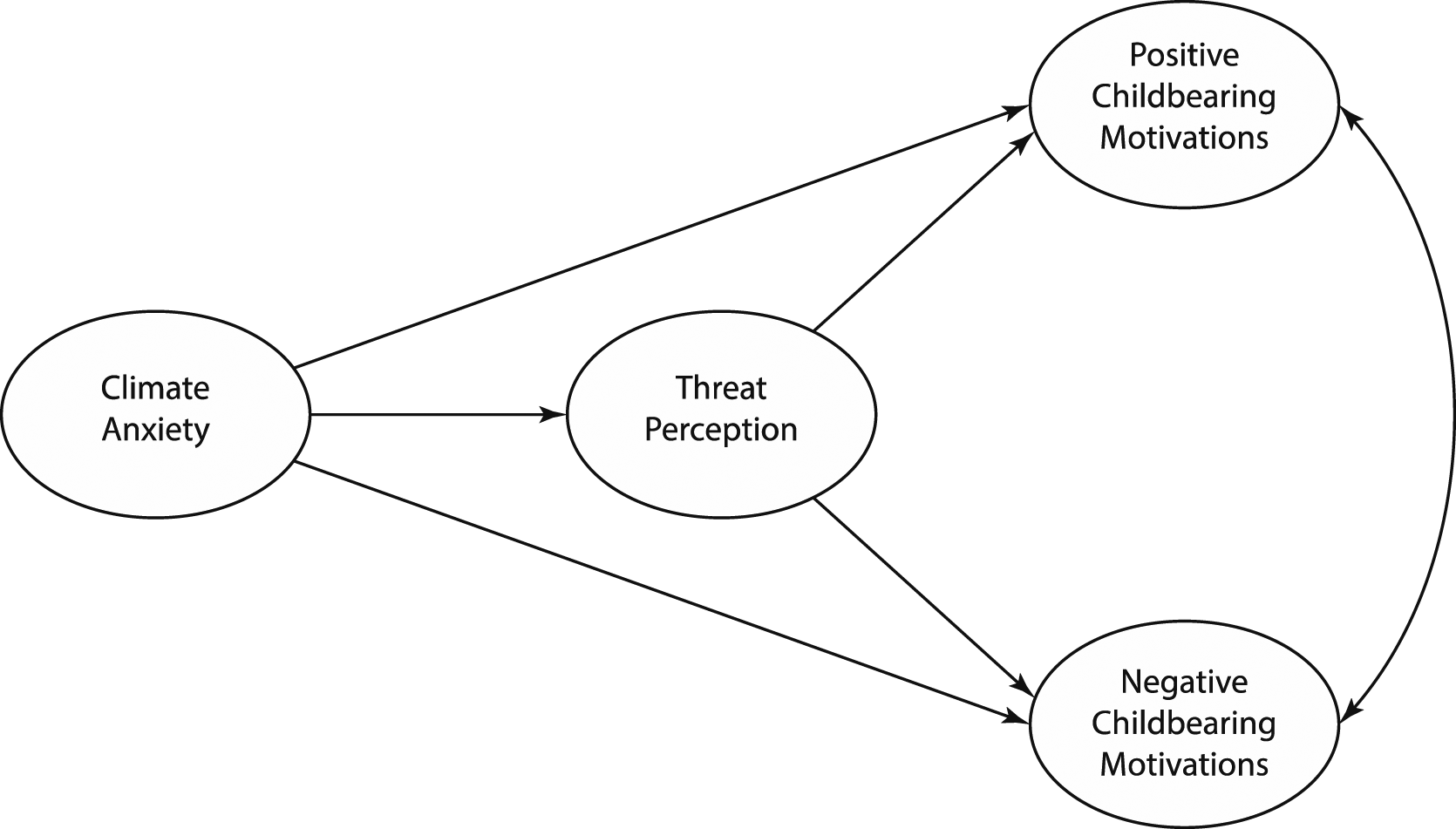
Method
Procedure
With the consent of the Executive Board of the University, we conducted an online survey among all undergraduate (Bachelor) and graduate (Master) students. The online survey was designed using LimeSurvey, and the survey link was disseminated by email to the entire student population in December 2021. Completion of the survey took an estimated 30 min in duration. A reminder message was sent 2 months later. Data was thus collected between 14th of December 2021 and 28th of February 2022. All respondents were provided with a participant information sheet (as the first page of the online survey) and informed consent was obtained from all participants at the beginning of the survey. Participation was completely anonymous and voluntary. Participants could withdraw from participation during the survey or skip questions throughout. At the end of the survey, participants had also the opportunity to take part in a lottery to receive a gift voucher worth 30 Swiss francs. Ethical approval to conduct the study was obtained from the University of Lausanne Research Ethics Committee (C_SSP_112021_00010).
Participants
After exclusion of participants older than 25 and/or parents, the study sample consisted of 1211 childless students aged 18 to 25 years (M = 21.90, SD = 1.84), the majority of whom were women (79.2%) and Swiss citizens (85.9%). Among them, 30.2% were Freshmen/women (i.e., first-year Bachelor students), 42.8% are sophomores or juniors (i.e., 2nd or 3rd years Bachelor students), and 27% are seniors (i.e., Master students). In terms of living arrangements, the majority of the sample (49.7%) reported living with parents, while 27% were living in a shared flat with roommates, 13.6% living alone and 7.1% were living with a partner in a shared household (i.e., cohabiting).
Measures
Participants completed French versions of a set of questionnaires, which were either available or translated following the recommendations of the International Test Commission (Hambleton, 2001).
Climate Anxiety
Participants’ climate anxiety was assessed using the Climate Change Anxiety Scale (CCAS) (Clayton & Karazsia, 2020). The measure consists of 13 items, with eight items measuring cognitive-emotional impairment (e.g., “I find myself crying because of climate change”) and five items measuring functional impairment (e.g., “My concerns about climate change make it hard for me to have fun with my family or friend”). Items were rated on a Likert-type scale, ranging from 1 (Never) to 5 (Almost always) and the average of the thirteen items was used, with higher scores indicating more climate anxiety. In this study, Cronbach’s alpha and McDonald omega were respectively 0.90 and 0.92, which is comparable to previous studies (Mouguiama-Daouda et al., 2022).
Threat Perceptions
We assessed participants’ threat perceptions in children’s current and future environment using 10 items of the World Out There questionnaire (WOT; Gurland & Grolnick, 2005). This scale was originally developed to assess parents’ perceptions of threat in their children’s current and future environment in terms of worry about the future (4 items), scarcity (3 items), and instability (3 items) (e.g., “It makes me nervous to think about all the dangers kids are exposed to today”, “Kids today face an unpredictable future” and “There can be prosperity 1 min and poverty the next”). Items were rated on a Likert scale, ranging from 1 (Strongly disagree) to 5 (Strongly agree). Higher scores represent greater perceived threat. Cronbach’s alphas and McDonald’s omegas were respectively 0.80 and 0.85, in line with what was observed in the original version (Gurland & Grolnick, 2005).
Childbearing Motivations
We assessed participants’ childbearing motivations with the 47-items Childbearing Motivations Scale (CMS; Guedes et al., 2015), which consists of two parts: a positive Childbearing Motivations Subscale (Positive-CMS; 26 items) and a negative Childbearing Motivations Subscale (Negative-CMS; 21 items). Items of the Positive-CMS include, among others, socioeconomic aspects, personal fulfilment, and continuity (e.g., “Being socially valued”, “Giving a meaning to my life”, “Ensuring my familial lineage”). On the other hand, items of the Negative-CMS include, among others, childrearing burden and immaturity, financial problems and economic constraints, and marital stress (e.g., “Feeling unprepared to assume the mother’s or father’s role”, “Facing financial sacrifices”, “Changing our routines as a couple”). Items were rated on a Likert-type scale, ranging from 1 (Not at all) to 5 (Completely). Higher scores on the Positive and Negative Childbearing Motivations subscales reflect participants’ heightened regard for this specific set of reasons, both in favor of (i.e., positive motivations) and against (i.e., negative motivations) becoming parent. Cronbach’s alphas and McDonald omegas were respectively 0.94 and 0.92 for Positive-CMS and 0.95 and 0.94 for Negative-CMS, in line with what was observed in the original version (Guedes et al., 2015).
Statistical Analysis
All statistical analyses were performed in the R environment (R Development Core Team, 2022). First, we tested the common method biases and compared participants with and without complete data using Little’s (1988) Missing Completely at Random test (MCAR) indicating that data were missing completely at random, χ2(3578) = 2637.25, p = 1.00. Then, the preliminary analyses involved descriptive statistics (M, SD) and correlations. As previous research has shown that women were generally more worried about climate change and that motherhood is still essential to gendered expectations for women (Ekholm, 2020; Ridgeway & Correll, 2004), we tested gender differences (i.e., women vs. men) on the variables of interest. The latter was done through a MANOVA, with gender as a between-subject independent variable, and climate anxiety, threat perceptions, and childbearing motivations as dependent variables. Next, the hypothesized model and mediation effects were examined through structural equation modeling using Full Information Maximum Likelihood estimation (FIML; Enders & Bandalos, 2001) combined with MLR, a maximum likelihood estimation with robust (Huber-White) standard errors and a scaled test statistic that is (asymptotically) equal to the Yuan-Bentler test statistic (Yuan & Bentler, 2000).
After conducting confirmatory factor analyses (CFAs) to check whether the study constructs were satisfactorily measured by the indicators, we created latent variables to account for measurement errors. We formed parcels of indicators for positive and negative childbearing motivations using a planned disaggregation strategy (Hall et al., 1999; Little et al., 2002). The use of parceling has been associated with various advantages, such as, among others, an improved communality, a greater reliability, and a remedy of non-normal data and increased model fit (Meade & Kroustalis, 2005). From the measurement model, we performed several successive structural equation models and evaluated their respective model fit indices. We used several indices, including the chi-square to df ratio (χ2/df), the comparative fit index (CFI), the root mean square error of approximation (RMSEA) and its associated confidence interval, and the standardized root mean square residual (SRMR). Values are generally regarded as indicative of a good fit when χ2/df is lower than 5.0, CFI greater than 0.95, RMSEA is under 0.06, and SRMR is under 0.08 (Hu & Bentler, 1999; Kline, 2016). Model comparison for measurement invariance was based on the Satorra-Bentler scaled chi-square difference (Δχ2; Satorra & Bentler, 2001, delta CFI (ΔCFI), and delta RMSEA (ΔRMSEA). Because Δχ2 depends greatly on sample size (especially with N > 500), additional use of ΔCFI and ΔRMSEA is recommended with change in CFI and RMSEA respectively lower than .01 and .015 as indicative of measurement invariance (Cheung & Rensvold, 2002). Furthermore, to address the examination of structural parameters’ invariance across groups, our analysis prioritizes the use of delta chi-square statistics (Δχ2) following Little’s (2013) recommendations.
Results
Preliminary Analyses
Descriptive Statistics (Means, Standard Deviations) of the Study Variables and Comparisons Between Women and Men.
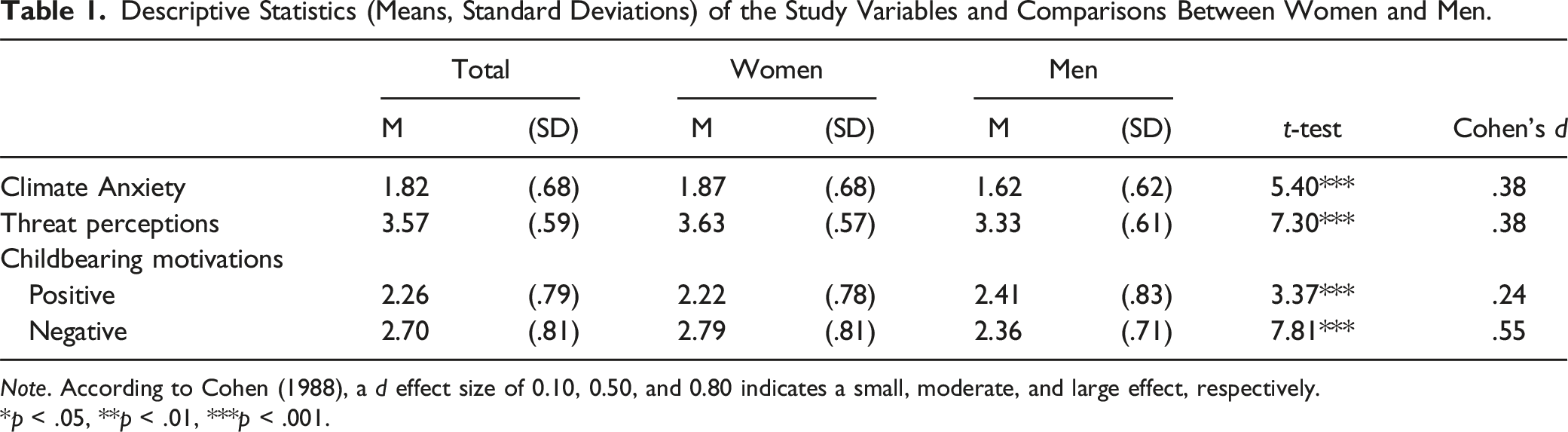
Note. According to Cohen (1988), a d effect size of 0.10, 0.50, and 0.80 indicates a small, moderate, and large effect, respectively.
*p < .05, **p < .01, ***p < .001.
Correlations Among Study Variables.
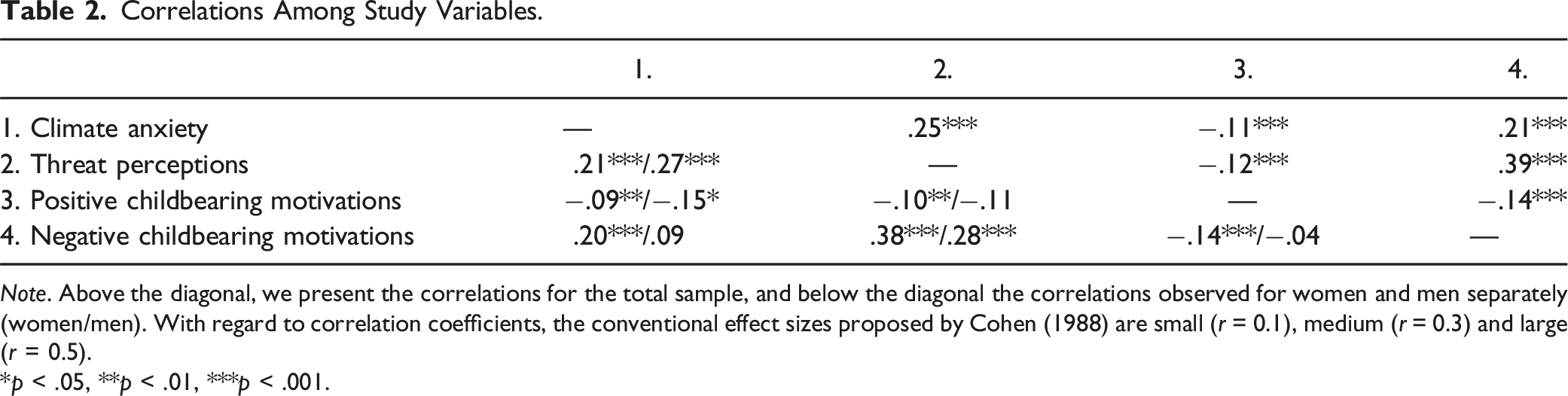
Note. Above the diagonal, we present the correlations for the total sample, and below the diagonal the correlations observed for women and men separately (women/men). With regard to correlation coefficients, the conventional effect sizes proposed by Cohen (1988) are small (r = 0.1), medium (r = 0.3) and large (r = 0.5).
*p < .05, **p < .01, ***p < .001.
Mediation Model
First, we estimated the measurement model. We created four parcels for positive childbearing motivations as well as for negative childbearing motivations. The fit indices of the measurement model were excellent for CFI (.97) and SRMR (.038), but they were above the recommended cut-off for χ 2 /df (7.13) and RMSEA (.071). For this reason, we modified the initial model by incorporating covariance adjustments based on modifications indices. More specifically, the errors of three parcels of positive childbearing motivations, three subscales of threat perceptions and two parcels of negative childbearing motivations were allowed to correlate. These modifications resulted in a revised measurement model that better fitted the data (Δχ2(5) = 146.39, p < .001), yielding an overall good fit (χ 2 (55) = 260.67, χ 2 /df = 4.74, CFI = .98, RMSEA = .056 [90% CI: .050–.063] and SRMR = .032), with factor loadings ranging from 0.55 to 0.95, p < .001.
Next, we tested our hypothesized mediation model where climate anxiety was indirectly associated with positive and negative childbearing motivations, via threat perceptions. The mediation model (see Figure 2) showed good fit to the observed data (χ
2
(55) = 260.67, χ
2
/df = 4.74, CFI = .98, RMSEA = .056 [90% CI: .050–.063] and SRMR = .032) and indicated that climate anxiety is associated with stronger threat perceptions (b = .25, SE = .04, p < .001). Threat perceptions, in turn predicted, lower positive childbearing motivations (b = −.22, SE = .08, p = .004) and higher negative childbearing motivations (b = .89, SE = .11, p < .001). Moreover, climate anxiety was directly and negatively related to positive childbearing motivations (b = −.11, SE = .05, p = .017), but not statistically significantly to negative childbearing motivations (b = .08, SE = .05, p = .117). The mediation effects can be assessed by calculating the indirect effects, which are determined by multiplying the relevant path coefficients in the model (MacKinnon et al., 2002). The indirect effects of threat perceptions in the relation between climate anxiety and respectively positive (Unstandardized indirect effect: ab = -.06, p = .044) and negative childbearing motivations (Unstandardized indirect effect: ab = 0.22, p < .001) were statistically significant. In other words, the association between climate anxiety and positive and negative childbearing motivations was respectively partially and fully explained by threat perceptions. Structural model depicting the relation between climate anxiety, threat perception and childbearing motivations for the total sample. Note. The parameter estimates are unstandardized coefficients. Standardized coefficients are given in parentheses. Dotted lines indicate the paths that were not statistically significant at p = 0.05, N = 1211. *p < .05, **p < .01, ***p < .001.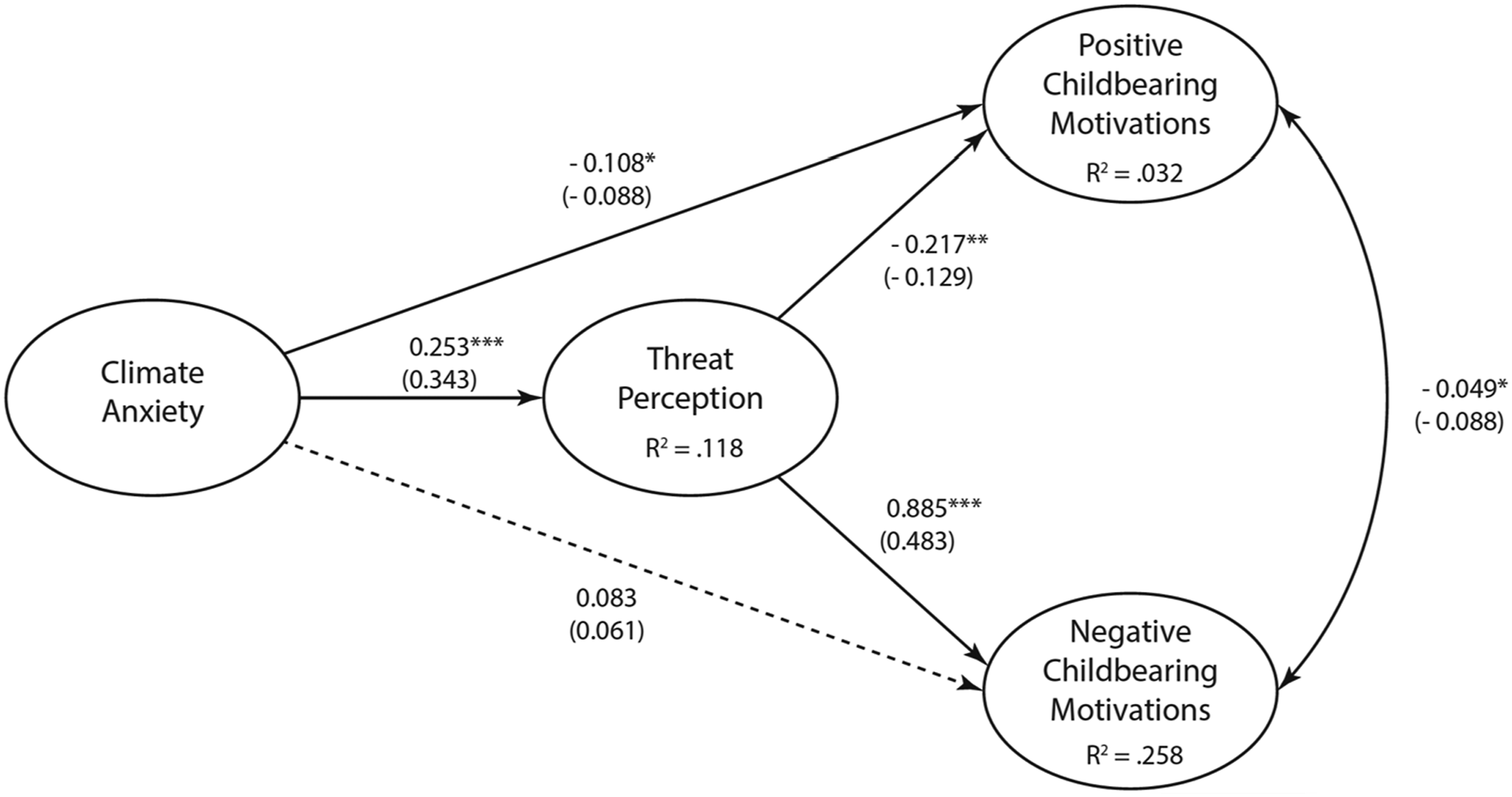
In a final set of analyses, where we examined whether gender moderated the relations observed in the previously decribed model, the mediation model was respecified as a multigroup model. First, we divided the data into two subsamples according to the moderating variable (women vs. men) and conducted a measurement invariance test. This involved comparing a constrained model, where factor loadings were held equal for women and men, with an unconstrained model that allowed these loadings to vary. Both models yielded a good fit to the data (Constrained model: χ 2 (118) = 356.50, χ 2 /df = 3.02, CFI = .98, RMSEA = .058 [90% CI: .051–.065] and SRMR = .037; Unconstrained model: χ 2 (110) = 322.02, χ 2 /df = 2.93, CFI = .98, RMSEA = .056 [90% CI: .049–.064] and SRMR = .033) and comparison indicated a statistically significant chi-square difference between constrained and unconstrained models (Δχ2(8) = 33.75, p < .001), but ΔCFI and ΔRMSEA were largely below recommended cutoff (ΔCFI = .003, ΔRMSEA = .002) suggesting evidence of measurement invariance across gender. As a next step, we tested structural equivalence and compared a mediation model with constrained structural paths or coefficients (i.e., set to be equal for women and men) to an unconstrained model. The baseline model with all paramaters freely estimated showed a good fit to the data (χ 2 (118) = 356.50, χ 2 /df = 3.02, CFI = .98, RMSEA = .058 [90% CI: .051–.065] and SRMR = .037). A similar model with path coefficient constrained to equality across gender did not evidence a statistically significant decrement in the model fit (Δχ2(5) = 7.64, p = .18), suggesting that the coefficients linking climate anxiety, threat perceptions and positive as well as negative childbearing motivations were similar for women and men.
Discussion
In Western industrialized countries, adult interest in parenthood is declining, with many delaying or reconsidering childbearing, which is associated to declining fertility rates and generational shifts (Neal & Neal, 2022; Schmidt et al., 2012). Recently, an increasing number of young people factor climate change into their reproductive decisions, swayed by arguments that fewer children can significantly lower one’s carbon footprint and help mitigate the climate catastrophe (Schneider-Mayerson & Leong, 2020; Wynes & Nicholas, 2017). This perspective, frequently echoed in media, suggests a growing concern over the future impacts of climate change on offspring rather than the mere carbon implications of procreation (Krähenbühl, 2022; Rackin et al., 2023). Addressing a gap in literature, this study explores the connection between climate anxiety and childbearing motivations among emerging adults, while also investigating the potential role of threat perceptions about the future environment.
Using a SEM framework, we tested direct effects of climate anxiety on childbearing motivations, as well as their indirect effects via threat perceptions. Results indicated that threat perceptions fully accounted for the link to negative childbearing motivations and partially for positive childbearing motivations, without any indication that gender moderated these associations. We found evidence for a negative and direct relation between climate anxiety and positive childbearing motivations, whereas no direct relation was found between climate anxiety and negative childbearing motivations. In addition, there was evidence for indirect effects of climate anxiety on both positive and negative childbearing motivations through threat perceptions for both women and men. Globally, these findings are consistent with the idea that young adults who experience climate anxiety are more likely to perceive greater threats to the future well-being of their children, which, in turn, influences their motivations regarding parenthood. One one hand, these results aligns with previous findings that people’s perceptions of societal insecurity and risks such as uncertain job market, economic crisis, extreme weather events, affect their childbearing preferences (e.g., Atiqul Haq, 2023; Cain, 1983; Sobotka et al., 2011). Moreover, they add a nuanced understanding to this paradigm by suggesting that climate anxiety indirectly influences childbearing motivations through altered perceptions of threats. On the other hand, our results align more specifically with the idea that concerns over future well-being and experiences of potential children is central to understand childbearing motivations (Schneider-Mayerson & Leong, 2020; Smith et al., 2023). Recently, Krähenbühl’s (2022) anthropological work has also highlighted the central role of uncertainty, and in particular the possibility of an uninhabitable world, in the discourses of people regarding interrogations about parenthood.
Interestingly, while climate anxiety was directly related to less positive childbearing motivations, its association with negative childbearing motivations was entirely indirect, operating through threat perceptions (i.e., worry about the future, scarcity, and instability). More specifically, our findings highlight that the indirect effects of threat perceptions on the relationship between climate anxiety are stronger for negative childbearing (full mediation) motivations than for positive ones (partial mediation). This distinction implies that while concerns about climate change might reduce positive motivation to have children, the explicit reasons against childbearing (e.g., fear for the child’s future well-being in a climate-compromised world) are consolidated by the threat they perceive for the future environment. Such findings resonate with Helm et al.’s (2021) observations where environmentally conscious young adults expressed both concerns about the ecological impact of overpopulation and the prospective challenge faced by future generations due to climate change. Therefore, it appears that climate anxiety predominatly affect negative motivations to have children through the lens of perceived threats, while positive motivations are somewhat insulated from these perceptions. This is also consistent with the literature highlighting the societal and psychological contexts of parenthood and childlessness, with the former seen as critical for a fulfilling life and linked to generativity and mental well-being (Erikson, 1968; McAdams, 2001), and the latter often facing stigmatization, particularly among women, despite its growing prevalence (Hansen, 2012; Maftei et al., 2023; Morell, 2000).
Although our results did not show any different mediation patterns for men and women, we did find evidence that women, compared to men, reported higher levels of climate anxiety, threat perceptions and negative childbearing motivations, and lower levels of positive childbearing motivations. Consistent with existing literature, our study further confirms the “gender gap” in environmental concern, with women exhibiting higher levels of environmental attitudes, and related anxieties, suggesting a pronounced gendered response to environmental challenges (Berry & Peel, 2015; Echavarren, 2023; Verplanken et al., 2020). These differences may be rooted in societal norms and expectations, where motherhood is often regarded as a significant aspect of the female identity and is conceived as central to a happy life for women (Facchin et al., 2019; Hansen, 2012; Morell, 2000; Ridgeway & Correll, 2004). In addition, in a traditional society like Switzerland with a historically strong sense of gender roles and patriarchal values (Matysiak & Węziak-Białowolska, 2016; SECO, 2022), women are still considered as the central caregiving and educational figure, with primary responsibilities for childcare (Bailey, 1999). As a result, women might be more aware and sensitive to the uncertain and hard-to-grasp risks of climate change and to the environmental threats, that could impact their potential offspring’s well-being. This is also somewhat in line with the results of Ekholm (2020) indicating that a greater level of concern about climate change was observed among parents, especially among women, compared to nonparents. Finally, regarding childbearing motivations, our results are in line with previous literature suggesting that social and individual expectations regarding parenthood differ based on gender (Rehel, 2014). For example, previous studies have shown that women, in particular, face significant challenges in reconciling work and motherhood (Matysiak & Węziak-Białowolska, 2016; Mynarska & Rytel, 2020; Park, 2005). These challenges often include issues like workplace inflexibility and societal expectations, which tend to limit their employment prospects and career advancements. In the Swiss context, recent data have shown that parenthood is widely perceived as an obstacle to a successful career (i.e., parenthood would be associated with negative repercussions on their professional career, Zimmermann & LeGoff, 2020) for childless young women in tertiary education, whereas this is not the case for their male counterparts (OFS, 2019). Thus, gender cultural norms and societal expectations might elucidate why women in our sample of university students exhibit higher negative childbearing motivations and lower positive ones compared to men.
Despite the methodological strengths of this study (e.g., sample size), its societal relevance, and its original contribution, there is a number of limitations that could be addressed in future research. First, data were cross-sectional and consequently we were only able to test within-time associations between variables. We acknowledge that we cannot draw any conclusions regarding reciprocal causation or bidirectionality between climate anxiety, threat perceptions, and/or childbearing motivations. Hence, confirming our conclusions via longitudinal or experimental data is distinctly required and would lend credibility to the findings. Second, our sample is composed only of emerging adults in tertiary education, in a context that for the moment is relatively unaffected by the consequences of climate change directly. It would be thus important in future studies to examine childless young people in working careers and in contexts more directly exposed to the effects of climate change (see for example, Atiqul Haq, 2023, for a study on the impact of extreme weather events in Bangladesh). Third, it would have been interesting to directly evaluate the desire to have children (i.e., childbearing desire; Miller, 2011), which is known to be associated with childbearing motivations (Mynarska & Rytel, 2023). Fourth, while our study emphasizes the “worry” for future generations as a contributing factor to childbearing motivations, it may overlook that caring and guiding for the next generation may also be positive and powerful factors to become a parent (Jia et al., 2015; Shrum et al., 2023). Indeed, the desire to preserve the environment for future children underpins efforts toward sustainability, posing the question of why striving for a sustainable future without children. This is reflected in the paradox highlighted by Spinhirny and Wallenhorst (2023), questioning the contradiction of building for future generations while debating the necessity of birthing them. Future studies should further explore these positive dimensions, including how the decision to raise children can potentially amplify awareness and action towards mitigating climate change (Shrum et al., 2023). Finally, we did not take into account a number of factors influencing childbearing motivations (e.g., economic circumstances, job in-security) that could play a role as well, especially for understanding young adults’ threat perceptions (Iacovou & Tavares, 2011; Parker & Alexander, 2004). Further research could include socio-demographic and contextual factors to investigate their potential impact on threat perceptions and childbearing motivations.
Notwithstanding these limitations, the present study underscores the implications of climate change and associated worries on reproductive aspirations of emerging adults, suggesting the potential onset of an eco-reproductive sobriety phenomenon in emerging adulthood. In this respect, media portrayals often suggest that individuals can combat climate change by giving up having children thereby reducing their “carbon footprint” (e.g., Carrington, 2017), a concept popularized by BP oil company to shift focus from fossil fuel industry responsibility to individual responsability (Rackin et al., 2023; Supran & Oreskes, 2021). However, our results suggest that the issue of having or not having children is not simply connected to “carbon legacies”, but relates to concerns about the future of the children, highlighting more specifically the importance of the threat perceptions in the relationships between climate anxiety and childbearing motivations. This is in line with recent results of Holmes and colleagues (2023) suggesting that many individuals are ambivalent, struggling to balance the idea of parenthood with their fears for their children’s futures. For example, one of the participant’s testimonies in Holmes’ study (2023, p. 364) described her internal conflict in the following way, “[t]he images I have of nurturing my child clash with those of a catastrophic future, making them difficult to reconcile.” This brings into focus the topic of the responsibilities of future parents towards younger generations and their potential descendants in a context of climate change. Lately, Gaziulusoy (2020, p. 7) stated that “parents need to be cared for in order to become parents who care for their children in times of climate change”. In this respect, it would be interesting to promote interventions that enable individuals to reflect on their childbearing motivations. For example, by instilling hope and demonstrating how parents can influence the behavior of their children in a pro-environmental direction, empower them, and consequently contribute to a more sustainable and just future. We can hypothesize that such interventions might have the effect of reducing the perceptions of threats to their future children.
As climate change is regarded as the biggest macrosystemic threat for humanity of the twenty-first century (Sanson & Burke, 2020), understanding its impact on personal and societal decisions becomes increasingly crucial. Our study is helping to advance our understanding of the complex factors influencing childbearing motivations among youth, particularly under the looming shadow of climate change. In line with the recent conclusion of Smith and colleagues (2023), our findings suggest that family planning and contraceptive guidance for young people should recognize the potential impact of climate change on childbearing motivations. Further research is also essential to delve into the reasons why some individuals adjust their reproductive intentions in response to climate change, while others do not, highlighting the need for person-centered research approaches. Understanding these varied reasons could be crucial for crafting effective sexual and reproductive public policies.
Supplemental Material
Supplemental Material - “Bringing Children in a Burning World?” The Role of Climate Anxiety and Threat Perceptions in Childbearing Motivations of Emerging Adults in Switzerland
Supplemental Material for “Bringing Children in a Burning World?” The Role of Climate Anxiety and Threat Perceptions in Childbearing Motivations of Emerging Adults in Switzerland in Grégoire Zimmermann, Joëlle Darwiche, Nadine Messerli-Bürgy, Stijn Van Petegem, Bénédicte Mouton, Gaëlle Venard, and Jean-Philippe Antonietti in Emerging Adulthood
Supplemental Material
Supplemental Material - “Bringing Children in a Burning World?” The Role of Climate Anxiety and Threat Perceptions in Childbearing Motivations of Emerging Adults in Switzerland
Supplemental Material for “Bringing Children in a Burning World?” The Role of Climate Anxiety and Threat Perceptions in Childbearing Motivations of Emerging Adults in Switzerland in Grégoire Zimmermann, Joëlle Darwiche, Nadine Messerli-Bürgy, Stijn Van Petegem, Bénédicte Mouton, Gaëlle Venard, and Jean-Philippe Antonietti in Emerging Adulthood
Footnotes
Author’s Note
The authors would like to thank all students who kindly accepted to participate in the study and the Master students who helped with data collection. We also extend our appreciation to the Executive Board of the University of Lausanne and in particular to its General Secretary, Mr. Marc de Perrot for their support in conducting the study. Finally, we express our gratitude to Ravoire for offering an inspiring writing context, and Prarayer for a breath of fresh air during the revision work. The authors have no conflicts of interest to disclose and no relevant financial or non-financial interests to declare.
Declaration of Conflicting Interests
The author(s) declared no potential conflicts of interest with respect to the research, authorship, and/or publication of this article.
Funding
The author(s) received no financial support for the research, authorship, and/or publication of this article.
Transparency and Openness Statement
The raw data, analysis syntax, and materials supporting the findings of this study are not yet publicly available as it is part of an ongoing research project. However, they can be obtained upon reasonable request to the corresponding author subject to certain conditions and approvals. It is planned that the data will be deposited in the SWISSUbase repository within a reasonable timeframe.

Supplemental Material
Supplemental material for this article is available online.
Author Biographies
References
Supplementary Material
Please find the following supplemental material available below.
For Open Access articles published under a Creative Commons License, all supplemental material carries the same license as the article it is associated with.
For non-Open Access articles published, all supplemental material carries a non-exclusive license, and permission requests for re-use of supplemental material or any part of supplemental material shall be sent directly to the copyright owner as specified in the copyright notice associated with the article.
