



Abstract
This study aimed to explore perceptions and experiences of parental identity development, with a specific focus on how the developmental dynamics of emerging adulthood intersect with processes of commitment, exploration and reconsideration of the parental role. Twenty-four South-African emerging adult parents were interviewed. Thematic analysis revealed that the intersection of the transitions towards parenthood and adulthood culminates in a nuanced expression of parental roles in relation to the themes of possibility, instability, in-betweenness, self-focus and identity exploration. Heterogeneity was seen in the expression of mixed emotions of hope and excitement about parenthood together with insecurity and struggles in the attempt to balance multiple roles, especially when facing challenges related to the South-African context. Participants prioritised responsibility and commitment to the parental role, facilitated by the support from parents, extended families and cultural norms. This research presents first steps towards a qualitative inquiry into the three-dimensional conceptualisation of parental identity formation.
Keywords
Becoming a parent is a life-changing process that includes both growth-promoting and challenging experiences. Although the transition to parenthood can induce positive changes (Don et al., 2021; Taubman-Ben-Ari, 2012), it has been shown that parents experience a great deal of anxiety and worry when they embark on this role, which sometimes results in long-term difficulties in adapting to parenthood (Keizer et al., 2010). A factor that facilitates an understanding of the different trajectories of a parent’s development is the sense of parental identity (Delmore-Ko et al., 2000), which is associated with the parent’s quality of life and risk of psychopathology (Piotrowski, 2018). Currently, knowledge of parental identity development is still limited, especially from the perspective of today’s most popular processual models of identity among young parents in the midst of emerging adulthood.
The aim of this qualitative study was to explore and describe the perceptions and experiences of emerging adult parents in South Africa regarding the development of a parental identity. More specifically, the research aimed to explore how the developmental dynamics of the emerging adulthood stage intersect with processes of commitment, exploration and reconsideration of the parental role. In addition, since identity is a dynamic construct embedded in a psycho-social context (Vignoles et al., 2011; Vosylis, 2021), aspects of the South African society were considered. In this research study, the construct of parental identity (i.e. the dynamic, identification with mental representation of oneself as a parent; Delmore-Ko et al., 2000; Fadjukoff et al., 2016) is considered from the perspective of processual, Neo-Eriksonian approaches to identity (Crocetti et al., 2008; Luyckx et al., 2008; Vignoles et al., 2011). This research is informed by the three-dimensional conceptualisation of parental identity formation (Piotrowski, 2018, 2020) based on the Meeus-Crocetti theoretical model of identity development (Crocetti et al., 2008; Meeus, 2011). Considering the experiences of young parents, attention was paid to how typical experiences of emerging adults (e.g. feeling ‘in-between’ and experimenting with different roles; Arnett, 2000) co-occur with the construction of parental identity, an important determinant of functioning in one of the most important social roles of adulthood.
Theoretical Background
The Developmental Trajectories of Emerging Adulthood
Emerging adulthood, the third decade of life, is a stage of life when young people contend with a variety of changes, transitions and opportunities. Arnett (2000, 2014, 2016) captured the essence of being an emerging adult by referring to five pillars, namely, Feelings of In-Betweenness, Instability, Possibility, Self-Focus and Identity Exploration. Emerging adulthood is a time of transition when young people are in the process of becoming. A mixture of semi-autonomy and semi-dependence together with role fluidity and ambiguity results in a feeling of being ‘in-between’ an adolescent and an adult. This time is also known for its instability. Frequent changes and new directions in living arrangements, relationships, education and work result in life structures that are insecure, uncertain and unsettled. Emerging adults see possibility and have an optimistic idealism towards the future. They believe in limitless opportunities, have elevated expectations about life’s options and see their future selves as capable to live the lives they want. Since emerging adults have less responsibility and commitments than older adults, they are allowed self-directed time for self-exploration, development and self-focus to deliberate about what they want to do, where they want to go and with whom they want to be. This results in deepened identity exploration where emerging adults can explore and experiment with different roles and possibilities in the areas of work/school, relationships/love and worldviews/ideological horizons (Arnett, 2000; 2016; Arnett & Mitra, 2020; Nelson, 2021).
Specific contexts such as living in transitional societies or experiencing social challenges will affect the way in which emerging adulthood and the dynamics of this phase are experienced (Landberg et al., 2019) and how the themes of instability and possibility are balanced. For example, the sociocultural context of Africa and South Africa poses unique challenges – political transition, resource constraints and an unstable economic climate might influence the identity exploration and ability of emerging adults to fulfil adult commitments (Alberts & Durrheim, 2018; Du Plessis et al. 2020; Naudé, 2020; Obidoa et al., 2019; Van Lill & Bakker, 2020). Furthermore, a specific life event such as becoming a parent will also affect the way in which emerging adults, for example, focus on their development and explore their identities (Canzi et al., 2021).
Understanding Identity and its Domains
Identity, a relatively stable sense of self (self-definition), consists of a set of firm, long-term commitments made by an individual in various important life contexts and domains (Vignoles et al., 2011). Contemporary, Neo-Eriksonian perspectives on identity acknowledge identity as both a global and a domain-specific construct and propose the incorporation of multiple, interrelated and intersecting identity domains (Crocetti et al., 2013; Schwartz et al., 2013; Syed & McLean, 2016; Vosylis et al., 2017), which may also include interpersonal (romantic relationships, family), social group (gender, ethnicity, race) and highly idiosyncratic (Syed & McLean, 2016) domains. The centrality (personally meaningfulness) of these domains and their salience across contexts and time are fluid. To understand fully the functioning of identity, research studies should thus not only focus on identity as a global construct but should also recognise the importance of specific domains. The present study focussed on the understanding of the relatively unexplored domain of parental identity whose specificity against other identity domains has been demonstrated (Piotrowski, 2021a).
Identity Development Processes, Reconsidered
Identity development is considered a key developmental process throughout the life course (Fadjukoff et al., 2016; Kroger, 2007). In contemporary process-orientated models, the complexity of identity exploration and commitment is unpacked as a chain of reciprocal and dynamic interactions between explorations, commitments, re-evaluations and re-commitments. For example, in the dual cycle model, Luyckx et al. (2008) explain how identity commitments are formed, evaluated and maintained through five specific identity processes, namely, 1) Exploration in Breadth, 2) Commitment Making, 3) Ruminative Exploration, 4) Exploration in Depth and 5) Identification with Commitments. Similarly, in the Meeus-Crocetti model (Crocetti et al., 2008; Meeus, 2011), identity commitments are explored in two ways: 1) in-depth exploration – a process of conscious monitoring of commitments that results in identity maintenance; and 2) reconsideration of commitments – deciding whether present commitments need to be changed.
Conceptualising the Parental Identity Domain
When an individual becomes a parent, this new role is incorporated into his/her sense of identity (Piotrowski, 2018). The way in which parenthood is experienced and managed has a significant impact on the parent–child relationship and ultimately, on the individual developmental trajectories of parents and their children. Although parenthood can be experienced as a fulfilling endeavour filled with positive experiences (Schrooyen et al., 2021; Taubman-Ben-Ari, 2012), it can also pose many challenges, difficulties and burdens (Matley, 2020; Mikolajczak & Roskam, 2018; Roskam et al., 2017). Parenthood can thus be associated with both growth-promoting and inhibiting experiences and may result in optimal or suboptimal adjustment.
Parental identity can be defined as the dynamic, mental representation of oneself as a parent (Delmore-Ko et al., 2000). It entails being committed to (identifying with) the role of a parent. Various social-psychologically orientated research studies focus on commitment to the parental role – the subjective importance of the parental role to the self compared with other adult roles, for example, worker or spouse (i.e. parental identity salience). Frisén and Wängqvist (2011) and Fadjukoff et al. (2016) propose moving beyond this unidimensional focus on role-commitment and towards a more multidimensional approach that acknowledges the internal dynamics of the development of parental identity. In alignment with the Neo-Eriksonian identity paradigm, they define ‘the identity as a parent’ through the firmness of commitment to the parenting domain and the degree of exploration of parenting issues. They suggest that both the level of commitment and the level of exploration in the parental domain should be taken into account to understand the process of parental identity development fully.
The development of parental identity starts in adolescence, changes significantly after the birth of a child and follows various developmental trajectories that may be informed by demographic factors. These factors include financial aspects and gender, parental characteristics (e.g. personality traits), emotional investments, self-conceptions of the role and vulnerability to ongoing parental strains (Delmore-Ko et al., 2000). Identity development in the parental domain can have a broad influence on parental functioning and behaviour, emotional adjustment and overall physical and mental well-being (Fadjukoff et al., 2016; Perren et al., 2005).
Positioning Parental Identity in the Processual, Neo-Eriksonian Perspective
In this research study, the construct of parental identity was analysed mainly from the perspective of the processual, Neo-Eriksonian approach to identity (Crocetti et al., 2008; Luyckx et al., 2008; Vignoles et al., 2011), which allows for studying identity as a dynamic construct embedded in the psycho-social context. While processual identity studies are one of the most important paradigms in current developmental psychology (Vignoles et al., 2011), studies on parental identity are almost absent within this approach. More recently, however, Piotrowski (2018, 2020) proposed examining parental identity from the perspective of the Meeus-Crocetti identity model (Crocetti et al., 2008; Meeus, 2011), and this approach was used in the present study.
According to this three-dimensional conceptualisation of parental identity formation (Piotrowski, 2018), when an individual becomes a parent, there is a process of greater or lesser identity commitment and identification with the parental role, which manifests itself in the level of satisfaction and self-confidence in performing this role. Identity commitment in the parental domain is usually accompanied and fostered by in-depth exploration, which is an adaptive identity process of reflecting upon commitments made that is expressed in the search for information about the child and about parenting. However, because parenthood can be a demanding and stressful experience (Delmore-Ko et al., 2000; Donath, 2015; Mikolajczak & Roskam, 2018; Roskam et al., 2017), re-consideration of commitment is also a significant process in the development of parental identity and entails looking at alternative options, pondering whether the decision to become a parent was not a mistake, fantasising about life without children and even regret. In Piotrowski’s conceptualisation (Piotrowski, 2018, 2020), this denotes a parental identity crisis.
Previous research on parental identity based on processual models has only been conducted within a quantitative methodology and revealed that particular dimensions of identity are specifically related to parental adaptation. Commitment is positively related to life satisfaction, extraversion, agreeableness and emotional stability. In-depth exploration is also higher among individuals with mature personalities and among parents with an informational identity style (Berzonsky, 1989); this dimension is less related to quality of life, and its main feature is the fostering of commitment. Reconsideration of commitment, in turn, has been shown to be associated with severe difficulties experienced by parents, including higher levels of mental and somatic health problems, parental burnout and maladaptive perfectionism (Meca et al., 2020; Piotrowski, 2021b; Schrooyen et al., 2021).
Limitations of past research on parental identity processes include its focus on questionnaire-based methods of measurement and thus the inability to explore a deeper perspective on perceptions of the process of becoming and being a parent and what shapes levels of commitment, exploration and reconsideration of commitment according to the parents themselves. Transcending these limitations was one of the goals of the present study.
Research Methods
This research study forms part of a larger research study on parental identity that is conducted as a collaborative project between ** and ** [blinded for review]. While the development of parental identity is the main focus of the overarching research project, this particular study aimed to explore this construct specifically among emerging adults and in the South African context.
The research questions were as follows: 1. How do South African emerging adult parents perceive and experience the transition to adulthood and parenthood? 2. How do emerging adult parents a) commit and identify with the parental role, b) conduct in-depth exploration about parenting and c) portray reconsideration of commitment?
A qualitative study, incorporating an explorative and descriptive design (Creswell, 2013; Silverman, 2013), was conducted.
Participants
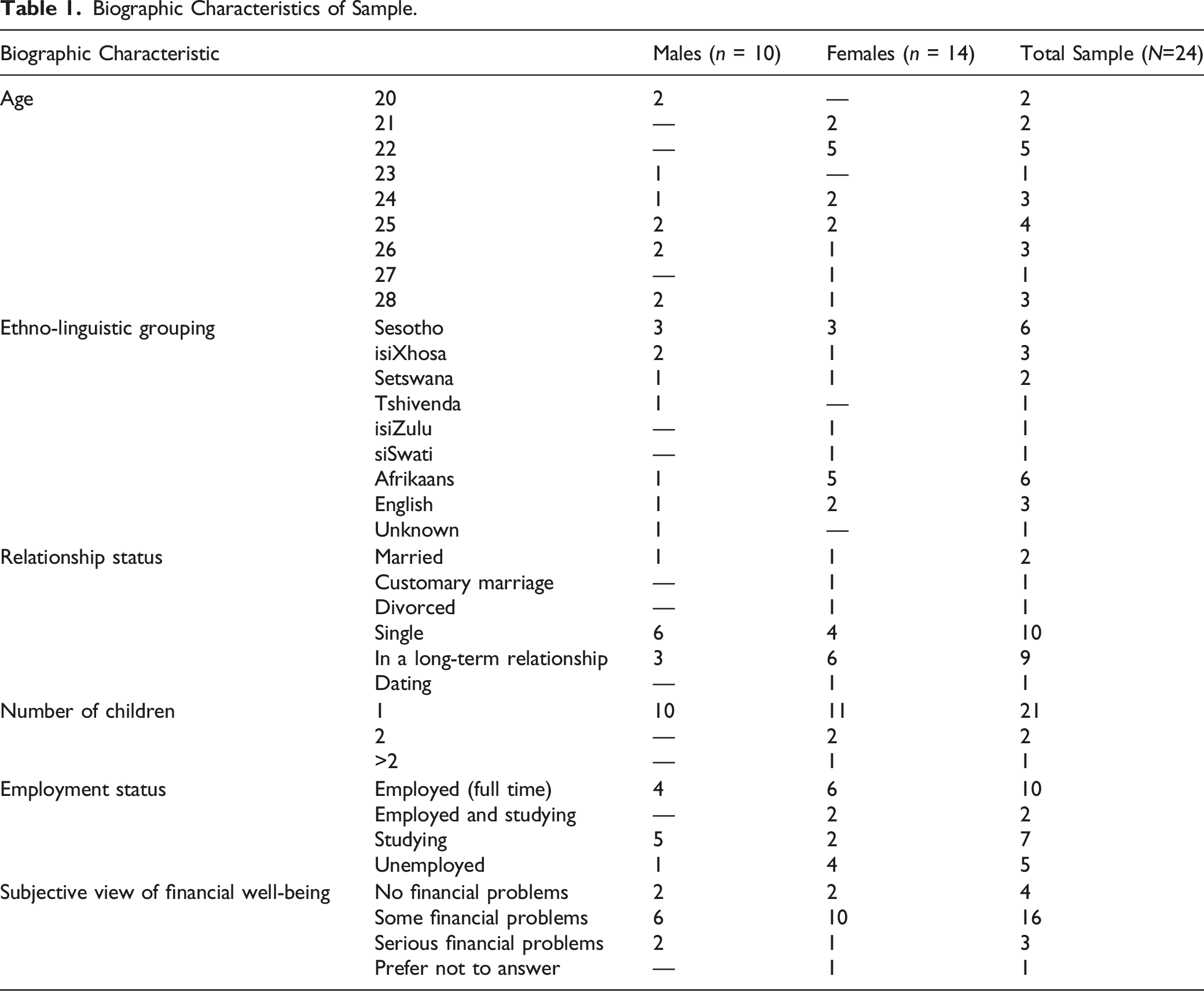
Biographic Characteristics of Sample.
Data Collection
Data collection entailed individual semi-structured interviews (Silverman, 2013) based on the Marcia interview style (Marcia, 1966) that is frequently followed in qualitative studies on identity. Each interview was scheduled at a private location convenient to the participant and lasted approximately 1 hour. Interviews were conducted in English and audio-recorded. The aim of the interviews was to gather qualitative data on the parents’ perspectives and interpretations of their own parenthood and their sense of parental identity. In accordance with the three-dimensional model, the indicators of commitment in the parenting domain were the perception of parenting as a source of positive emotions, the meaning of life, the factor that organises the daily activities of the individual; the manifestations of in-depth exploration were considered the individual’s activity in regard to developing his/her parenting competence, talking about parenting with other people and reflecting on parenting or the child; while reconsideration of commitment was defined as doubts about whether parenting fits the individual, regretting the decision to parent and low identification with the role of a parent.
The semi-structured interviews included questions about a) Expectations and meaning of parenthood, for example, When did you start to consider becoming a parent? What were your expectations of parenthood at that stage? What was your main motivation to have a child? b) Current experiences of parenthood, for example, How does parenthood differ from what you expected? What do you enjoy most about being a parent? What are some of the most significant challenges you have faced while being a parent? If you could go back in time with the knowledge and experience you have today, what would you do differently? c) Current commitment and exploration, for example, Can you describe the type of parent you are? Do you have an opinion about how to rear children? Do you make any effort to develop your parental skills and competencies? d) Associated relationships and forms of support, for example, Who shares your experiences and parenthood with you? Who is mainly responsible for parenting your children and who spends the most time with your child? How do these significant others support you as a parent? and 5) Influence of other people, for example, What factors/issues/people/events have had an effect on your parenting practices and experiences? Did any experiences with your own parents influence the type of parent that you are?
Data Analysis
The audio-recorded interviews were transcribed verbatim, and thereafter analysed by a team of coders. Thematic and content analysis methods were used (Braun & Clarke, 2006; 2019; Saldaña, 2016). A hybrid approach of both inductive and deductive coding and theme development informed the process of analysis (Fereday & Muir-Cochrane, 2006; Saldaña, 2016) regarding the following: a) processes of commitment and identification with the parental role; b) in-depth exploration; and c) reconsideration of commitment in the parental domain as sensitising concepts.
The team of coders (who were also involved in conducting and transcribing the interviews) ensured that they were familiar with the data by reading and re-reading through the transcripts. Thereafter, and based on the research team’s knowledge of the data, a codebook was developed, tested and adapted to ensure consistent coding. Two team members (research assistants) completed the first round of coding. This was followed by a second round of coding by the authors of this manuscript to ensure confirmability. The guidelines for reliable coding of Syed and Nelson (2015) were applied. The criteria of trustworthiness proposed by Denzin and Lincoln (2011) and the standards of rigour suggested by Levitt et al. (2018) were also employed.
Ethical Considerations
The ethical principles of beneficence and non-maleficence guided this study. Ethical clearance was obtained from the relevant institutional ethical committees. The principles of respect and autonomy steered the informed consent process (with voluntary participation and the right to withdraw from the study). Confidentiality, anonymity and privacy of all participants were respected (e.g: interviews were conducted at a private location, pseudonyms were used and all transcripts were anonymised). Psycho-social support was available if participants requested referral.
Results
Themes From the Analysis.
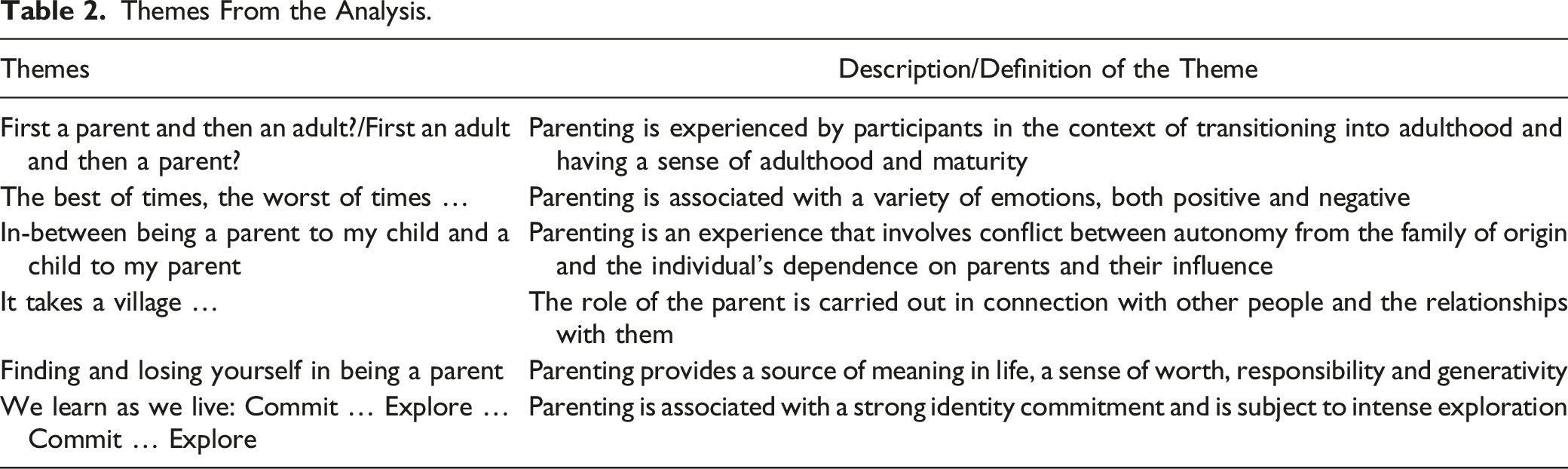
First a Parent and then an Adult?/First an Adult and then a Parent?
Participants expressed various views on the perceived relationship between adulthood and parenthood. Parenthood is seen as a marker of adulthood. Participants perceived the stability of adulthood as the ideal time to become a parent: [Y]ou must be able to give them that stable home, loving, warm home … [Y]ou must have a stable job as well, but your job must not take all of your time; you must still have time for them … [Y]ou must make sure your relationship is healthy with your partner … because if you have children, then it is not about you anymore, it is about them. [F2]
However, for many of the participants, parenthood began before they regarded themselves as adults: I was just enjoying myself and … in the midst of that, I got a child. [M12]
I just lived as things came. But now, I had to plan that tomorrow. [M9]
Being a parent facilitated the acceptance of adulthood and its roles: … busy with the big-people world … made me realise that I am busy with adulthood; I can settle down. Uhmmm … I have a job … I can give them what they need. [F2]
The intersecting transition to parenthood and adulthood posed unique challenges: I had my daughter when I was 20 years old … She was born at the end of my second year [at university] so that was really difficult because no one was mentally where I was. All my other friends were young adults, not even adults. At 20, you are not even an adult … [I]t was such a challenge being caught up in almost two different worlds. Being young and a university student, studying and trying to figure out what, who you want to be as a adult but all of a sudden, now you have to be a parent, and every decision you make, directly or indirectly, has consequences on your life or your child’s life … [S]o that was a really big struggle, finding a balance between those two worlds. Not losing myself … because I am so young and I still have to mature and make those decisions. But … being more responsible or more mature than my friends … [F8]
The Best of Times, the Worst of Times …
Participants described a variety of emotions relating to parenthood. They identified with the joys of parenthood and articulated many experiences of satisfaction, pride and gratitude: [I]t’s a beautiful experience … [M6] A blessing from God … [F22] … a gift that I received with both arms open. [M5]
The participants highlighted the meaning that their children had given to their lives, the value of feeling appreciated and the privilege of having the opportunity to give their children a better life than they had experienced: … a child adds meaning to one’s life … [F11] ]T]o live for something bigger… something better … to see that you put a smile on someone’s face or someone is excited to see you. [F2]
However, many participants were also overwhelmed by the challenges of parenthood. They explained how they experienced difficulties in coping with the demands: Look, there are days when your mind is not with you. Your brain is completely drained … [M]aybe just take a nap or something like that just to, you know, breathe … [M6].
And in dealing with their own emotions: I remember crying my eyes out and was like, ‘Oh my God. Here it is; here we are. I’m a mom. This is a real live thing I’m holding’. [F13]
Many participants were particularly struggling to balance multiple roles: … and go to work and leaving them there and seeing their faces and they can’t understand why mom has to leave. [F2]
In addition, many participants were not prepared for the responsibilities of this role: Yoh, a lot more hands on …[M6]. I’m no longer a free man … [M20]. [Y]ou think it is going to be a walk in the park and then it is a total storm at the end. [M2] They explained that their expectations of parenthood were far removed from reality: [F]rom a distance, it seemed nice … as I am in it right now, I can see that it is difficult … [M20] I think you always expect it to be … easier or much more glamorous than it is, you know. If you see other people … especially like people in the limelight, like influencers or bloggers or … home chefs on TV making meals for their kid’s school—so glamorous. Ah, I am going to make my child, you know, this wonderful lunch box, and they are going to do all this [sic] activities and it is just going to be fun, and we are going to play and do educational games. And then when you have a child, it is like, well okay, real life sets in. … [Y]ou still have hard days as an adult and then your work does not end when you get home because then you are a parent. And then that child needs constant acknowledgement or energy or … time from you, and then it becomes much less glamorous when you are tired or you’re feeling frustrated. But you have to… [F8]
These challenges were mostly due to the instability that marked their lives in general. Many participants were not in stable relationships (12 of the 24 participants were married/in stable relationships, while 12 were single/divorced/dating.; see Table 1), which resulted in having to contend with single parenthood: … I did not have a steady girlfriend. … I was all over the place. [M9] [I]t was a lot harder; there’s a lot of work. I have to always be on point; I can’t slack off because who is going to take care of this kid for me? [F13]
In addition, many participants were without a stable income (only 10 of the 24 participants were employed full time; see Table 1). They were often still engaged in their education (9 of the 24 participants were still studying, either full or part-time; see Table 1) and were without sufficient financial resources (19 of the 24 participants reported that they experience some/serious financial problems; see Table 1): [M]oney that I would use on myself is now used on my daughter… [F22] We were not working. Now that posed a serious challenge because you can give the child all the love in the world but she has to have clothes, food, diapers, milk formula … [M9] All of the above resulted in mixed feelings regarding parenthood: So scared and yet so happy and yet so upset. [F13] Parenthood is fun. It is fun and difficult at the same time … [F22] It was bittersweet. [M9] I was worried. I was stressed. But at the end of it all, it was just very rewarding … to know that there’s a life that you brought to this world … that’s the pinnacle; that’s the peak of the whole experience … [F11]
In-Between a Parent to my Child and a Child to my Parent
The challenges described above exacerbated the participants’ feelings of being in-between. They had to assume the role of parent while still being dependent on their parents for emotional and financial support. The intricacy of the relationships between emerging adult parents and their parents was clear. On the one hand, participants strived towards autonomy (finding their own way in parenting) while on the other hand, they were still deeply entangled in their dependence on their parents.
Some participants respected their parents’ roles in their lives: [G]rowing up, you would see your parent as some sort of … superhero who was able to solve the most difficult things. [M9]
Parenthood taught them to appreciate their own upbringing: I never knew that the struggles they had with me are the ones I am going to face, so now I understand it better … [M20]
The following participants embraced the current involvement of their parents and were comfortable to follow in their parents’ footsteps: [I]t is a privilege … being a parent and having parents as well. [F2]
I put myself as a child in that situation. I think what would I have wanted my mother to have told me to do. [F2]
Other participants strived towards more independence and longed to find their own pathways: I’m not just a parent because the way I was raised … [F13]
Many wanted to break the family cycle that they experienced as negative: [H]is absence shaped my presence… [The] fear was that would I be able to be a good father to my child when I do not know how … I have not experienced what maybe a father figure is like. [M9]
The participants were adamant not to repeat the same mistakes as their parents: I don’t wanna do the same to my children. [F2] [A]ffording my child a soft life—yes, that I would change. [M9] [M]y parents have kept me in a bubble, but I have been hurt. … [M]aybe I should change it … maybe let them see the world and experience the world and the situations that the world can give … that they can see the world isn’t a scary place … [F2]
The participants were also aware of the more contemporary views on parenting and wanted to move away from their parents’ parenting style to adjust to changing circumstances: … there’s no way I can compare. I can’t say it’s better; I can’t say it’s worse. It’s a bit too different to compare. [F13] To raise me 20 years back would be different to how a child would be raised today. I mean then we would eat soft porridge. Now, you would have cereal and things like that. [M9] … better informed than how my parents’ decisions were at that time. So, they did it informally without having any formal education on how a child develops or learns or how spanking or punishment impacts a child. [M9]
It Takes a Village …
In addition to their own parents, participants leaned on friends, colleagues, other parents, teachers and their extended family: [H]ang out together or go out together to a function, there is always that talk of … your children and my children. [F2]
Through these relationships, they found confirmation and guidance: It is always nice to hear you are on the right track. [F2] [F]rom time to time where we shortfall of wisdom, they would chip in there and guide us. [M9] [Y]ou have so much judgement coming from the outside world that if you have that support in your inner circle, that other people’s words don’t affect you. [F8]
Over and above emotional support, participants also received financial support: [I]n terms of monetary value, you know, they play that role to help with clothes. You know, to help with the diapers, help with food and everything. [M9]
The role of the extended family was especially emphasised: Grandma-Friday-days. So every Friday, he goes to his grandma and he visits his grandma. His grandma teaches him the little stuff I can’t teach him. [F7] [H]er uncles are the ones who are picking her up from school and dropping her off, and they spend time with her so she does not feel alone … [M20] She was living with her mother and other family… black family arrangements… you know, the mother lives with her aunt … [M9]
In addition to the support from significant others was the guidance and comfort that the participants found in cultural norms and religion. Participants were motivated to raise their children in a culturally sensitive manner while respecting religious guidelines. For example, one participant [M9] related various cultural idioms that guide his parenting: Tsela e botswa ho ba ka pele (Translated as: You seek advice from people who have walked the road before you); Ntjapedi ha e hlolwe ke sebata (Translated as: Challenges become easier when people are working together to resolve them); and Matlo ho tjha mabapi (Translated as: One’s problems are problems of the other so they ought to help each other).
Finding and Loosing Yourself in Being a Parent
Most participants were confronted with the conflict between determining who they are in life and coping with the responsibilities of being a parent. The search for self by many of the participants was intertwined with their children. In being parents, they found themselves: [T]his is me; this is us … [M6] She is my world. I do not know what I would do without her. [M9] I enjoy spending time with the baby because she’s very lovely. She’s hyper; she’s what I am not. She has a lot of energy in her and she’s bubbly. She spreads love and she has changed me to be someone new … [M20] For some participants, parenthood was an opportunity to revisit their own childhood: As a dad, you can go play in the sand again; you can go play with cars … [M2] Seeing how they look at things and you feel like okay, my point of view should change. Like look through the eye of a child. [F2]
The realisation of responsibility was, however, prominent: Now every decision that I make must be … calculative so that it would not have dire consequences in the near future. You know, to start to plan things more carefully or in advance. [M9] Now it’s time to actually step up and be the parent hey… [N]ow there’s a whole human being I need to look after. [M6] I would rather not have clothes if needs be for my child to be okay … [F22] … waking up every day knowing that I have a family that I have to work hard for and just stay focussed for … [M6]
Most participants embraced the principle of generativity by realising that they are living for someone other than the self: … all about investment … [M20] [F]rom the beginning that he or she opens his or her eyes, you know that everything you do from this moment on is going to have an impact … [F2] [S]he is asked who her father is and she says out my name … it brings joy to me. It is … when she sees me, she sees some sort of security. She sees me as some sort of hope. … [I]t is knowing that even if things would go south, I would have someone who would never throw me in the gutters, who would never give up on me … [M9]
We Learn as we Live: Commit … Explore … Commit … Explore
From all of the above, it is clear that the participants have a strong commitment to their parental identity during the emerging adulthood years. This commitment manifested in positive emotions related to parenting, gaining meaning in life through parenting and highly valuing parenting and the child: Having that love from your own child and giving that love, loving in a way that you have never loved before—Yes! [F11]
Participants realised their own strengths: I’ve learnt so many things; my character has strengthened. So yes, life was easier back then, but I’m a better person now, a stronger person … [F11]
They confirmed certain parenting styles that they have internalised: You know that advert where the Dettol mom, and the mom who is like, ‘No, don’t play in this grass, its dirty. No, don’t do this, you’re going to get sick’. I feel like I’m that mother. [F13] But I feel I am a laid-back parent. Yes, I am easy-going man. [M9]
Participants also identified with the permanence of their commitment: Being a parent is like getting a tattoo. You have to be sure that you want it for the rest of your life because it’s there; it’s there. [F11]
In addition to this commitment, various forms of exploration in the parental identity domain were seen in the sense that parenting was something new and surprising to the emerging adult participants – it evoked feelings of confusion and uncertainty: I think no one is ever really comfortable. It is like ‘fake it till you make it’ basically. Nobody knows what they are actually doing. [M2] [Y]ou can never be too comfortable as a parent because you never know what challenge you would have to face … [M6]
Parenthood served as a source of exploration and search for the self: I do make time for myself in the sense that I don’t lose myself as an individual because … one of the most important things that I want to teach my daughter is being independent and being true to yourself … [I]f I get time for myself, I can also be a better parent for her … [F8]
Participants explained how their parental identity is a continuous process of development: [S]till trying to figure out my place. [F13]
They grew with their children: I learn as she grows because you can never master a child … [F22] [A]ctually, it is hard, but you just learn how to live with it. [F2]
Reconsideration of commitment was less prominent but instances of self-doubt were present: [Y]ou always question yourself, regarding your parent skills. Uhm, will he listen to you one day? Will he be able to do this and that by himself? [M6]
In addition, participants regretted certain mistakes they had made such as the age at which they became parents or the partners with whom they entered into parenthood. However, they learnt from their mistakes: [W]e’ve all had our oopsies and glips and all that, but you can’t learn from something that you haven’t done yet … [M6] Maybe yesterday wasn’t the perfect day. Maybe I got frustrated. Maybe I wasn’t keen on playing with her the whole night or maybe I did get, you know, a little bit short with her. But it is fine ‘cause she still loves me and she will still accept me the next day … [I]t is fine because that love is still there. Then the doubt goes away … [F8]
They also reflected on aspects that they would approach differently in future: [T]here’s quite a few things … I approach it differently the next time. [M6]
However, they did not express regret for parenthood: [M]aybe I shouldn’t have been a mother or maybe things should be different but that is how your life goes … Life goes on and with every obstacle, there’s an opportunity. [F2] When things are too hard I’m like, ‘I can’t do this anymore, I can’t’. But in general, no, I don’t think I’ll ever regret … [F13]
Discussion
The findings of this study denote the complexity of parental identity development through a chain of reciprocal and dynamic interactions between explorations, commitments, re-evaluations and re-commitments (Crocetti et al., 2008; Piotrowski, 2018, 2020). It is clear that becoming a parent is a life-changing process that includes both growth-promoting and challenging experiences (Don et al., 2021; Matley, 2020; Mikolajczak & Roskam, 2018; Roskam et al., 2017; Schrooyen et al., 2021; Taubman-Ben-Ari, 2012) during any developmental stage of life.
Parenthood as a Marker of (Emerging) Adult Identity
Becoming a parent is an important marker of maturity and adulthood for emerging adults. On the one hand, the participants indicated that satisfactorily fulfilling the role of a parent requires prior maturity and responsibility; on the other hand, they indicated that their self-perception shifts towards adulthood with the arrival of a child. At the same time, parenting seems to narrow previous areas of exploration that are losing their importance, and the individual’s perspective shifts from a focus on the self to a focus on responsible role fulfilment. The presence of this theme indicates that emerging adult parents recognise the importance of parenthood. Taking on this role significantly and noticeably affects their sense of identity. This thread in the experience of emerging parents confirms that taking on the role of a parent is often associated with a strong identity commitment in the parental domain, as confirmed by the research of Frisén and Wängqvist (2011) and Fadjukoff et al. (2016), and for many, is a gateway to adult identity (Côté, 1997).
The markers of adulthood and the order of critical life events (Katsiaficas, 2017; Landberg et al., 2019) are disrupted when young people become parents before they consider themselves adults or before they are in stable relationships (Piotrowski, 2020). This culminates in a nuanced expression of a parental role in relation to the themes of possibility, instability, in-betweenness, self-focus and identity exploration (Arnett, 2000, 2016).
Heterogeneity in Feelings of Possibility and Instability During Emerging Adulthood
Many scholars have highlighted the heterogeneity of pathways during the emerging adulthood stage and the importance of acknowledging contextual variations in role transitions and experiences (Nelson, 2021; Vosylis, 2021). The findings of this study confirm this and emphasise how heterogeneity increases when an additional social role transition, namely, becoming a parent during this stage of life, has to be considered.
The themes of possibility and instability, often prominent during emerging adulthood, were witnessed in this research in the mixed emotions of both hope/excitement about parenthood and insecurity/struggles in the balance of multiple roles. Differences were apparent in the participants' emotional experiences associated with parenting. Many of the participants in the study emphasised the positive feelings that came from the role of parent. Positive emotions can be a resource that facilitates adjustment during the transition to parenthood (Don et al., 2021). However, as in previous research (Roskam et al., 2017), participants in this study noted the difficulties, stress and exhaustion that are so common among modern parents. In this context, the resources that parents can use to cope with negative emotions and stress become crucial for the development of parental identity (Schrooyen et al., 2021). If a parent has either social support or the personality traits that are conducive to coping with stress proactively, the burdens of parenting may be a temporary experience; however, the lack of such resources can lead to chronic stress and ultimately parental burnout (Mikolajczak & Roskam, 2018) and the long-term experience of parental identity crisis (Piotrowski, 2021a). These emerging themes may also suggest risk factors that are perceived important by South African parents such as facing single parenting, financial hardship or multiple social roles that may conflict with parenting and disrupt parental identity development. The volatility, fluidity and uncertainty that are typical experiences during emerging adulthood can add to the burden in this context, leading to ambivalent perceptions of parenting.
On Becoming…: Parenthood and Semi-Independence
The feelings of in-betweenness that are often experienced by emerging adults (Arnett, 2000, 2014) were exacerbated by the intricate nature of semi-independence (e.g. needing parents for moral and financial support). Participants had very different perceptions of their parents' influence on their parenting roles. Some described their family of origin as the ‘starting point’ through which they are able to fulfil the role of a parent in a satisfying way, but for others, there was a more ambivalent or even negative perception of how their childhood influenced their current functioning. However, almost all of the study participants stated that the relationship with their parents and how they had been raised influenced the type of parent that they are today. Sometimes, this was done through modelling (especially when this perceived influence was positive) and other times through negation (the type of parent I never want to be), but it seems that for South African parents, the family of origin is an important, perhaps the most important, starting point for exploring their own parental identity. In another South African study, Du Plessis et al. (2020) emphasised the gratitude for family relationships and material support among South African emerging adults.
Processes of Parental Identity Formation—Commitment, Exploration and Reconsideration
The young parents in this study foregrounded manifestations of satisfaction, the high value placed on parenting and the defining of oneself through the lens of being a parent. Although parenting in emerging adulthood can be a source of uncertainty, there is clearly a strong belief that personal identity and social identity shift towards greater maturity with the arrival of a child.
Identity exploration was not only connected to themes of intimacy but also generativity (Erikson, 1968). In addition to this, the Other-Self juxtaposition (with a focus on self-development in combination with a responsibility in parental roles) was an important aspect of emerging adult parents’ developmental trajectory. This finding corresponds with the ‘Generation We’ arguments of Arnett (2013, p. 5) and with research from Jia et al. (2015) who also investigated ties to generative concerns in emerging adulthood. In a South African study, Arndt and Naudé (2020) reported on the youth’s willingness to accept responsibility in the face of adversity. It is this emphasis on responsibility for themselves and others that Katsiaficas (2017) proposes to be the sixth pillar of emerging adulthood, caring for others.
No clear manifestations of an intense and chronic parental identity crisis (i.e. in the form of resentment towards parenting, low identification with the parental role or a sense that parenting ‘does not fit’ with the individual) (Matley, 2020) were observed among the study participants. However, this does not mean that these types of attitudes are not present in the experiences of many parents. As research has shown (Nolsoe, 2021; Piotrowski, 2021b), 7%–13% of parents in Europe and North America regret their decision to parent and see this role as something ‘imposed’ (by peer pressure or social norms) or ‘unwanted’. Interestingly, however, such attitudes are barely visible in qualitative research on parental identity (Fadjukoff et al., 2016; Frisén & Wängqvist, 2011). This may be because parents experiencing an intense parental identity crisis are reluctant to come forward for qualitative parenting research or because it is difficult for parents to disclose fully their greatest fears and difficulties about parenting when in direct contact with an interviewer.
(South) African Parents: Parenthood Embedded in a Psycho-Social Context
The findings of this study also allude to the importance of considering identity and emerging adulthood as dynamic constructs embedded in a psycho-social context (Landberg et al., 2019; Vignoles et al., 2011; Vosylis, 2021). South African emerging adult parents are affected by the challenges of the society in which they live such as high rates of unemployment and poverty (Van Lill & Bakker, 2020). Furthermore, the participants’ parenting styles lean on the principles of African Ubuntu and extended families. In addition to parental support, the results revealed the existence of two other important sources of support from which young parents in South Africa benefit. Firstly, these are social relationships with people other than parents (e.g. friends, extended family) that facilitate coping with daily responsibilities and provide an important source of information on parenting and child-rearing. Other people and their opinions/lifestyles and cultural values provide young parents with material for exploring their own identity as a parent (Fadjukoff et al., 2016), indicating that different viewpoints can be argued. Secondly, cultural and religious norms appear to be an important resource, providing a framework for everyday decisions and signposts in the process of parenting and coping with the demands of parenthood. This corresponds with other research studies from the African continent in which strong ties to sociocultural factors and religion were found in emerging adults from Ghana, Nigeria and South Africa (Du Plessis et al., 2020; Obidoa et al., 2019). The statements of the study participants suggest that these areas are important sources of support for them, stimulating adaptive processes of exploration (Luyckx et al., 2008) and leading to a deepening of the commitments made.
Limitations of the Study and Recommendations for Future Research
This research study provides a snapshot of a relatively small sample of South African parents. While the sample consists of mothers and fathers from diverse ethno-linguistic groupings and varied relationship, employment and financial statuses, the sample is also homogenous in the sense that only biological parents of a small age range (20–28) participated. The current analysis was focussed on general trends in the perceptions and experiences of this group of emerging adult parents (and did not account for nuances in experiences across categories). Future studies could further this research by exploring how experiences of parenthood intersect with variables such as relationship status (single parent vs. cohabiting couple, vs married couple), occupational status and type of parenthood (biological vs. adoptive vs. step-parents). Another limitation is that the in-depth interview was strongly focussed on parental experiences, leaving out such important issues in emerging adulthood as education, career and the quality of the romantic relationship. In future research, it would be valuable to emphasise these themes more strongly in order to assess their relationship to the sense of parental identity
Implications for Practice/Scholarship and Conclusion
This research presents the first steps towards a qualitative inquiry into the three-dimensional conceptualisation of parental identity formation. The research makes a contribution to a field of study in which limited knowledge and research are available. While many studies focus on emerging adults in education, at the workplace and in romantic relationships, few studies focus on emerging adult parents. Processual identity models (Crocetti et al., 2008; Luyckx et al., 2008) comprise one of the most important paradigms in current developmental psychology. However, such studies on parental identity development are limited. While recent studies suggest that parental identity may be an important predictor of quality of life and parenting styles during middle adulthood (Fadjukoff et al., 2016), very little is known about how parental identity develops, changes and influences the well-being and functioning of emerging adult parents. A multidimensional, dynamic approach to parental identity during emerging and early adulthood is thus needed. Furthermore, this research study illustrates the well-being of South African emerging adult parents as they negotiate their identities in a transitional society. The findings of this study can inform psychologists, social workers, counsellors and mentors on how to support emerging adult parents to transform the challenges of parenthood into growth-promoting experiences.
Footnotes
Declaration of Conflicting Interests
The author(s) declared no potential conflicts of interest with respect to the research, authorship, and/or publication of this article.
Funding
The author(s) disclosed receipt of the following financial support for the research, authorship, and/or publication of this article: The work of Konrad Piotrowski was funded by the National Science Centre in Poland, grant no. 2020/04/X/HS6/0028.
Ethical Approval
Project Ethical Clearance No: UFS-HSD2020/0075/2707
Open Practice
The raw data, analysis code and materials used in this study are not openly available but are available from the corresponding author upon request.
