




Abstract
Eco-anxiety is a multidimensional construct that includes emotional, behavioral and cognitive manifestations related to potential environmental calamities. There is a need to adapt and validate measures that evaluate eco-anxiety into Portuguese using a multi-trait approach. This study examined the psychometric properties of the Hogg Eco-Anxiety Scale (HEAS) in adult Portuguese speakers (18–83 years old). Data were collected on the Portuguese adaptation of the HEAS, environmental identity and psychological symptoms, and sociodemographic data. The construct validity of the HEAS was subsequently examined through exploratory and confirmatory factor analysis. The factorial structure of the original scale was the best explanation of the sample data. The scale showed good internal consistency and presented measurement invariance for both sex and age groups. The global score of the HEAS and the dimensions of emotional and behavioral symptoms were moderately associated with clinical symptoms. Females and younger participants presented higher levels of eco-anxiety apart from rumination symptoms. The results suggest the suitability of the HEAS as a valid measure to evaluate the different signs of eco-anxiety among adult Portuguese native speakers.
Introduction
One of the most pressing global health threats of the 21st Century is the global environmental crisis (World Health Organization, 2023). The subtle and progressive climate change also impacts individuals’ mental health, both in people directly affected by environmental threats and indirectly through people’s perceptions about climate change (Clayton, 2020; Clayton & Karazsia, 2020). These mental health consequences are varied, including feelings of loss, hopelessness, distress, grief, anger, behavioral problems, and psychopathology (Coffey et al., 2021). Eco-anxiety was a concept introduced to capture the diverse experiences of distress triggered by environmental crises (Albrecht, 2011; Hickman, 2020; Pihkala, 2020). It comprises both climate change anxiety which comprises the psychological reactions to anthropogenic climate change, such as global warming, rise of sea levels and extreme natural disasters (Clayton, 2020; Clayton & Karazsia, 2020; Pihkala, 2020), but also apprehension regarding potential environmental calamities related or not to climate change, such as elimination of ecosystems and deforestation) (Hogg et al., 2021; Passmore et al., 2023).
Although eco-anxiety primarily involves the experience of anxiety as a key symptom (Kurth & Pihkala, 2022), it does not manifest as a disorder in most cases (Albrecht, 2011; Clayton, 2020; Clayton & Karazsia, 2020; Pritchard et al., 2020). Eco-anxiety involves both emotional and rational responses to environmental problems related to climate change, and uncertainty and unpredictability associated with impending environmental crises (Clayton, 2020; Pihkala, 2020).
The experience of eco-anxiety ranges on a continuum, from mild and non-debilitating manifestations to severe psychological distress (Cunsolo & Landman 2017; Hajek & König, 2023; Lutz et al., 2023; Passmore et al.,2023; Pihkala, 2020; Soutar & Wand, 2022). Moreover, considering the predictability of worsening environmental threats, it is foreseen that maladaptive manifestations of eco-anxiety will increase (e.g., Albrecht, 2011; Clayton & Karazsia, 2020; Cunsolo et al., 2020; Passmore et al., 2022; Pihkala, 2020). Thus, the development of measures to determine the levels of individuals’ eco-anxiety and their correlates is crucial (Hogg et al., 2021).
There are only a few measures for assessing eco-anxiety. These measures mostly address negative emotions related to climate change and/or other environmental problems (Helm et al., 2018). The multidimensional nature of eco-anxiety has been observed in previous empirical studies (Clayton & Karazsia, 2020; Coffey et al., 2021). Eco-anxiety manifestations also include cognitive impairments (e.g., obsessive thinking, rumination), behavioral and physical symptoms (e.g., loss of appetite, insomnia), and future-oriented apprehension on climate changes and its consequences (Clayton, 2020; Clayton & Karazsia, 2020; Coffey et al., 2021; Dockett, 2019; Hickman, 2020; Passmore et al., 2022; Pihkala, 2020; Soutar & Wand, 2022).
The Hogg Eco-Anxiety Scale
The Hogg Eco-Anxiety Scale (HEAS; Hogg et al., 2021) was developed to cover the multidimensional construct of eco-anxiety. It is a validated measure that assesses the psychological manifestations associated with environmental crisis. The authors retrieved a four-factor 13-item final solution: the first factor covers feelings of anxiety assessed by four items, accounting for 50.06% of the variance; the second factor covers ruminative thoughts about negative environmental events which are assessed by three items, accounting for 20.09% of the variance; the third factor covers behavioral symptoms of eco-anxiety (e.g., sleeping problems, difficulties in working and/or studying) which is assessed by three items, accounting for 6.33% of the variance; the fourth factor covers feelings of anxiety about one’s personal impact on the planet which are assessed by three items, accounting for 5.67% of the variance. The internal consistency of the four factors was excellent: affective symptoms (0.92), rumination (0.90), behavioral symptoms (0.86), and anxiety about personal impact (0.88).
In a subsequent study, Hogg et al. (2023) analyzed the psychometric properties of the HEAS in an Australian sample. Using Confirmatory Factor Analysis (CFA), they found support for the four-factor structure and good internal consistency of the four dimensions. It was also observed that the factor structure, factor loadings and item means were consistent across age (group of participants aged 18–36 years old vs group of participants aged 37–82) and gender (male and females; Hogg et al., 2023).
The HEAS has been recently adapted to different languages. In one study that adapted the HEAS to Turkish, Uzun et al. (2022) found that both a three-factor structure (combining the “rumination” and “emotional symptoms” sub-dimensions) and a four-factor structure in the original form showed appropriate construct validity. The authors observed that the “rumination” sub-dimension had a low variance contribution because it was intertwined with the “emotional symptoms” sub-dimension (Uzun et al., 2022)
The scale has been recently validated in young Portuguese adults (aged 18–25 years) recruited from higher education institutions. The authors found that the original four-factor structure of the scale is an appropriate psychometric instrument to assess eco-anxiety in Portuguese youth (Sampaio et al., 2023). Specifically, it was observed that the original factor structure of the HEAS had good fit of the observed data and there were strong factor loadings, indicating strong correlations of the items with the factors underlying the construct. It was also found that the scale showed strict invariance between men and women. We were unaware of this work during our project implementation phase as well as data collection and analysis period, which occurred prior to the publication of the study.
A key limitation of the previous study lies in the use of a restricted sample, composed exclusively of young adults. Furthermore, it is our understanding that the version of the scale employed appears to be specifically designed for this age group, which may constrain the generalizability of the findings to broader populations. The version of the scale also appears to be primarily designed for young adults born in Portugal with Portuguese ancestry, without taking into account the increasing multicultural diversity (in particular, Brazilians and Angolans) of the Portuguese population in recent years. This may raise concerns regarding the scale’s cultural sensitivity and its applicability to individuals from different ethnic or cultural backgrounds living in Portugal.
We provide two examples of differences in item wording between the version used in the present study and the version developed by Sampaio et al. (2023), highlighting potential variations in interpretation and applicability. The translation of item 1 (“Feeling nervous, anxious or on edge”) diverged between the two versions. Sampaio et al. translated it as “Sentir-se nervosa(a), ansioso(a) ou no limite,” whereas in our version, it was rendered as “Sentir-se nervoso ou ansioso ou esgotado.” The expression “no limite” represents a relatively recent linguistic development in contemporary Portuguese, predominantly employed by young adults. In contrast, the term “esgotado” tends to be more frequently employed by older populations. Another instance of this can be observed in item 3 (“Worrying too much”, which was translated differently by Sampaio et al. (“Preocupar-se demasiado”) and by our research team (“Preocupar-se demais”). While the term “demasiado” is more commonly used in European Portuguese, “demais” tends to be more frequently employed in other varieties of Portuguese, such as Brazilian Portuguese.
Association between eco-anxiety and psychosocial variables
The association between eco-anxiety and different measures of psychological health has been mixed. Some studies have found that eco-anxiety was positively and weakly to moderately correlated with symptoms of anxiety, depression, and general psychological distress (Feather & Williams, 2022; Helm et al., 2018; Hogg et al., 2021; Schwartz et al., 2023; Stanley et al., 2021; Stewart, 2021). Taken together, these results suggest that people who present stronger manifestations of eco-anxiety are more prone to manifest worse psychological functioning. Meanwhile, these results may also reveal convergent validity between different measures of eco-anxiety, namely HEAS, and other measures of psychological distress (Clayton & Karazsia, 2020; Hogg et al., 2021).
Regarding differences on levels of eco-anxiety between sexes, it was found higher severity of both eco-anxiety symptoms and personal impact anxiety in females compared to males, but no difference in the other two dimensions between both sexes was observed. The analysis of the association between age and eco-anxiety revealed that the former had a positive and weak correlation with the rumination factor and a negative and weak correlation with the anxiety about the personal impact factor, but it was not correlated with the other two subscales of the HEAS (Hogg et al., 2023).
The present study
The HEAS is a validated measure that covers the different dimensions of eco-anxiety. Considering the psychological effects of environmental crises and potential environmental calamities worldwide, the existence of validated measures of eco-anxiety is needed to properly assess the psychological impact of these dimensions on individuals. Since it is a recent theoretical construct, it is also important to assess its construct validity using a Multi-Trait/Multi-Method approach (Ferketich et al., 1991; Shen, 2017), which we are currently undertaking as part of a larger ongoing project, of which this paper is a component. In the present study, we assessed convergent and divergent validity of the Eco-anxiety scale in a Multi-Trait approach using also the Brief Symptom Inventory (BSI), and the Revised Environmental Identity scale. The HEAS has already been adapted and validated for young Portuguese adults in the age range of 18 to 25. As mentioned above, we were unaware of this other work during our project planning and data collection and analysis, which took place before the publication of this of this prior study.
Meanwhile, this study was conducted with the aim of adapting and validating this measure, taking into account the current multicultural context of Portuguese-speaking individuals living in Portugal—namely Brazilians and Angolans—according to the most recent Census conducted in Portugal. This procedure is highly valuable if we consider that Portuguese is currently the official language of ten countries around the world and is spoken in 18 countries, being the seventh most spoken language in the world today (around 230 million speakers). Furthermore, the relationship with clinical symptoms and a psychological construct related to nature, the environment, and climate (environmental identity) was analyzed. The development of a validated instrument to assess the multiple dimensions of eco-anxiety in adult Portuguese speakers is highly necessary. Fulfilling this objective will make it possible in the future to gather information on the psychological impact of climate change on this population.
Methodology
Participants
Sample comprised 565 native Portuguese speakers living in Portugal but included also participants of other nationalities besides Portuguese, such as Angolan, Brazilian, Mozambican. All participants were 18 years old or older, with a mean age around 37 years old (M = 37.08, SD = 16.35, age range: 18–83 years old). Participants were asked to indicate their biological sex (male or female) and their gender identity (e.g., male, female, non-binary, or prefer not to say). This approach allowed for the collection of both binary and non-binary gender identities, ensuring inclusivity and respect for participants’ self-identification. The distribution of participants according to their biological sex showed a higher proportion of female participants compared to male participants. Most participants identified with the gender corresponding to their biological sex; however, three female participants and one male participant described themselves as non-binary. Only participants who have been living in Portugal for the last 5 years were recruited for this study. Most of the participants were born in Portugal. The inclusion of non- native Portuguese speakers aimed to obtain an approximate distribution of the nationalities observed in the last Census conducted in Portugal. Around half of the study participants were single, with a significant proportion having 12 years of education and only 2% having 6 years of education. Approximately half of the participants were employed, and three quarters of the sample belonged to the medium socioeconomic status (Table 1).
Sample Demographic Characteristics.

The estimation of sample size for Confirmatory Factor Analysis by Root Mean Squared Error of Approximation (RMSEA) was conducted. This procedure was performed with an expected RMSEA of 0.05, 13 items loading on four factors, a significance level of 0.05, and a sample size power of 95%, which resulted in an estimated sample size of 348 participants (Kim, 2005).
Procedure
This study was conducted with the main purpose of collecting information on psychological responses to climate change among native Portuguese-speakers. The institutional review board (IRB) of the xxx reviewed and approved the study protocol. According to the guidelines of the International Test Commission, the questionnaire was first translated into Portuguese (Hernández et al., 2020). Two independent translators, blind to the objectives of the study, translated the scale into Portuguese. One of the translators was Portuguese, while the other translator was Angolan, but had Portuguese as her native language. Both translators were proficient in English and Portuguese, with academic training and research experience in psychometric methods, and had extensive knowledge of the field of environmental psychology.
After independent translation by each translator, the two translations were compared. A high level of consensus was observed between the two translations (Cohen’s kappa = .93). The small differences between the two translations were discussed by a panel composed of the two translators and members of the research team who were also familiar with the socio-cultural context of Portuguese-speaking countries. Some modifications were made to some items to obtain a better adaptation to the cultural context and a consensual version of the translation of the scale was obtained.
A pilot study was carried out on a sample with sociodemographic characteristics similar to the target population. This group included 27 participants ranging in age from 18 to 73 years old, 18 females and nine males, and also included participants from different nationalities: two Angolans, two Brazilians, two Mozambicans, and 19 Portuguese individuals. The aim of the pilot study was to identify and address potential difficulties in the comprehension and wording of the items, ensuring clarity and cultural appropriateness for the target population. No issues were identified by participants regarding the items; therefore, no changes were made to the scale.
Data was collected using a convenience sampling technique in which participants were directly invited to participate in this study. Social networks (Facebook, Instagram, LinkedIn, and WhatsApp) and mailing lists were used for recruiting the study participants. Only participants who were native Portuguese speakers and aged 18 or older were invited to participate in the study. All participants completed an informed consent form before answering the questions of the scales. The informed consent contained detailed information about the objectives of the study and the research protocol in accordance with the Declaration of Helsinki’s guidelines of the World Medical Association. All participants took part in the study on a voluntary basis and no voluntary reward was offered.
Data was collected through self-report measures which were entered into an online platform using JotForm. The research protocol included questions related to psychological manifestations associated with environmental crisis, environmental identity, psychological symptoms, and sociodemographic variables. Filling in the questionnaire took about twenty minutes.
Measures
The Eco-Anxiety Scale (HEAS; Hogg et al., 2021) is a self-report measure which evaluates the levels of eco-anxiety in the last two weeks. It includes 13 items on which participants rate the extent to which each symptom has concerned them, being answered on a Likert-type scale as follows: not at all (0), several of the days (1), over half the days (2), nearly every day (3), every day (4). There is no reverse scoring in the scale. The items are divided into four dimensions: emotional symptoms (“Feeling nervous, anxious or on edge”), rumination (“Unable to stop thinking about future climate change and other global environmental problems”), behavioral symptoms (“Difficulty sleeping”), and anxiety about personal impact (“Feeling anxious about the impact of your personal behaviors on the earth”). The total score of the HEAS scale was calculated by adding up all the items that comprise the scale. The mean scores for each of the scales were also calculated. The presence of higher levels of eco-anxiety is indicated by higher levels on the overall scale and in each of the dimensions.
The Revised Environmental Identity scale (Revised EID; Clayton et al., 2021; Ferrajão et al., 2024) is a self-report measure that was used to evaluate individual’s environmental identity. The scale comprises 14 items which are answered on a Likert-type scale ranging from not at all (1) to true of me (7). The seven-point response scale includes midpoint of neither true nor untrue (4). This measure evaluates a single dimension of environmental identity (“I think of myself as a part of nature, not separate from it”). The total score of the scale was calculated by adding up all the items on the scale, with higher scores indicating a stronger environmental identity.
The Brief Symptom Inventory (BSI; Canavarro, 1999; Derogatis & Melisaratos, 1983) is a self-report measure that assesses individual’s general psychiatric distress. The scale is comprised of 53 items which evaluate nine clinical scales and three global indices of psychological disturbance. Participants were asked to rate the extent to which each of the symptoms has bothered them in the last week, using a five-point Likert scale as follows: not at all (0), a little bit (1), moderately (2), quite a lot (3), and extremely (4). The score for each dimension is calculated by adding up the items that compose each sub-scale. In this study, only anxiety, depression and somatization symptoms were included in the data analysis, given the research evidence of their association with eco-anxiety Clayton, 2018).
Some sociodemographic data was also collected, including information on sex, gender, age, civil status, education, and socioeconomic status of the study participants.
Data analytic strategy
Data analysis was performed using the IBM SPSS Statistics for Windows (version 29) and AMOS 29 package programs. An exploratory factor analysis (EFA) was conducted on the original version of the scale (including the 13 items) to retest the construct validity of the HEAS in which the principal component analysis method was adopted. Next, a confirmatory factor analysis (CFA) was performed to test the suitability of the factor solution retrieved from the EFA. The model with the best fit was selected using the following criteria: (a) a non-significant χ2 testt; (b) comparative fit index (CFI), normed fit index (NFI), and Tucker Lewis Index (TLI) higher than 0.95; (c) root mean square error of approximation (RMSEA) and standardized root mean square residual (SRMR) ranging from 0.00 to 0.08. Considering that the χ2 test is sensitive to sample size, the ratio of χ2 to degrees of freedom was also computed. A satisfactory model fit is achieved when the values of this fit index range from 1 to 5 (Kline, 2011). Cronbach’s alpha value was also examined to test the internal consistency of scales.
The test of bi-variate relationships between the dimensions of the HEAS with the measures of environmental identity, and anxiety, depression, and somatization symptoms were examined by conducting multiple Pearson correlation analyses. In this procedure, it is expected that the association with interrelated constructs should be stronger than with unrelated constructs (Schellingerhout et al., 2022). The mean scores on the global scale and dimensions of the HEAS were compared between women and men using a t-test with a Bonferroni correction. The effect size was evaluated though the Cohen’s d statistic. According to Cohen’s criteria, a d value around 0.2 is considered a small effect, a d value around 0.5 is considered a medium-sized effect, and a d value of 0.8 or higher is considered a large effect (Henson, 2006).
Results
Validity and reliability—Full sample
The hidden (unobserved) structure behind the data set was first examined by conducting an EFA. In this way, the validity characteristic of the data set collected with the measurement tool was also examined. To test the applicability of EFA, we assured that the correlation coefficients between the items did not present multicollinearity. To test the adequacy of the sample, the equality of the correlation matrix between the Kaiser–Meyer–Olkin criterion and the observed variables to the unit matrix was assessed by analyzing the Bartlett’s test of sphericity. It was observed that the data were suitable for factor analysis given that the KMO criterion was 0.90 and the Bartlett’s sphericity test was at a significant level (p < .001, df = 78, χ2 = 3900.32).
EFA was conducted using a principal component analysis method. The Kaiser–Guttman criterion, percentage of variance explained, and the slope trend test were analyzed to determine the appropriate number of factors. A three-factor solution was selected based on the Kaiser–Guttman criterion. Meanwhile, the analysis of the remaining criteria indicated that a four-factor solution could also be selected. The three-factor solution explained 67.11% of the total variance in the population. The first factor, labeled as Rumination symptoms, explained 47.05% of the variance; the second factor, labeled as Emotional and behavioral symptoms, explained 12.33% of the variance; the third factor, labeled as Anxiety about personal impact, explained 7.73% of the variance. This solution provided acceptable construct validity, but the items of the subdimensions of emotional symptoms and behavioral symptoms in the original scale, loaded on a single factor (Table 2).
Item Coefficients of the Three and Four-Factor Structure of the Scale.

To select between the three-factor solution retrieved in the EFA and the original four-factor scale structure of the HEAS, it was conducted a second EFA in which we tested a fixed number of four factors. The analysis showed that the 13 items loaded under four factors, explaining 74.06% of the variance in the population (Factor 1 – Emotional symptoms: 47.05% of the variance; Factor 2 – Behavioral symptoms: 12.33% of the variance; Factor 3 – Anxiety about personal impact: 7.73% of the variance; Factor 4 – Rumination symptoms: 6.95% of the variance). It was also observed that the original item structure of the scale was well-maintained (Figure 1 and Table 2).
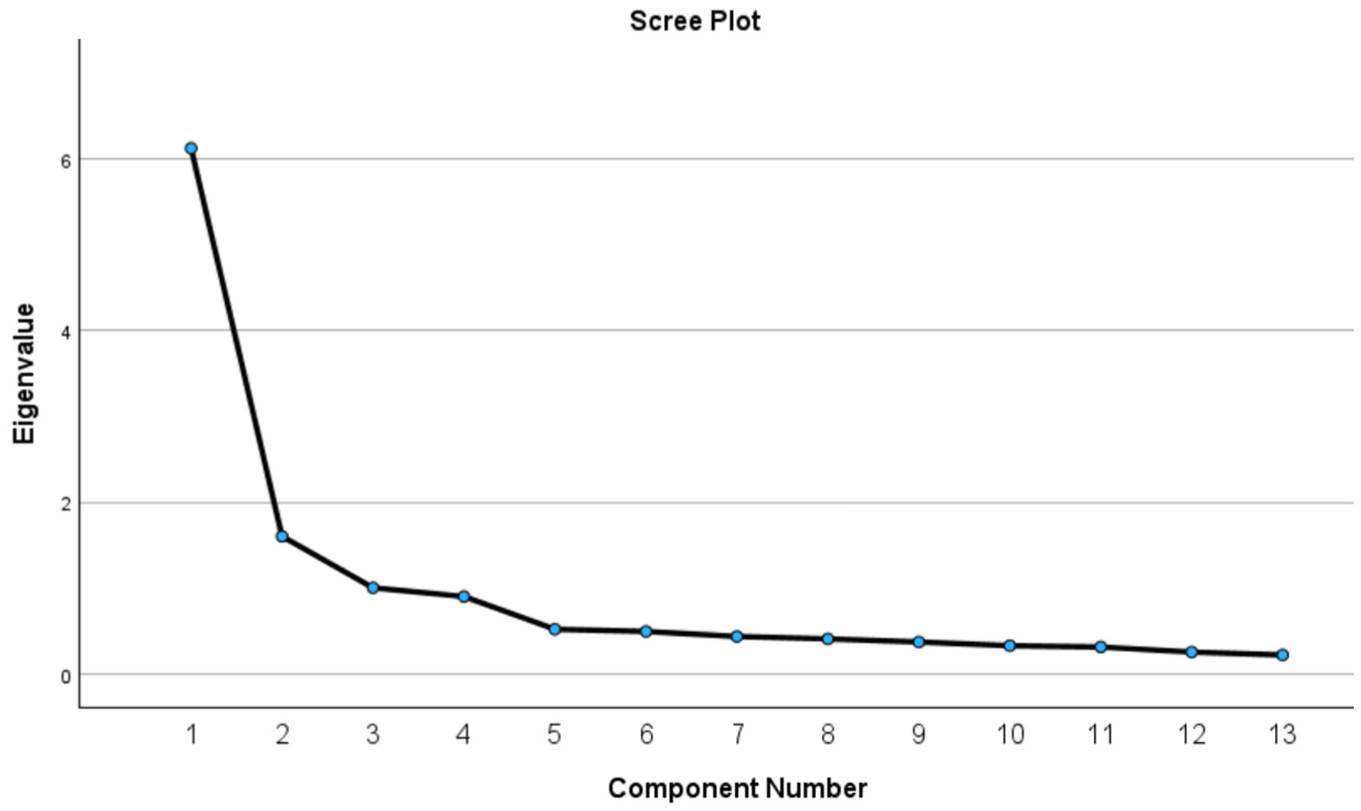
The eigenvalue graph.
Following, a CFA was conducted in which the two solutions – three and four-factor – were analyzed. In both models, the factors of the HEAS were measured as latent (unobserved) variables, and the items of the scale were measured as manifest variables which loaded onto a single factor following the construct validity of the scale. The results indicated that the four-factor solution provided a better fit for the model. Specifically, the three-factor solution showed a poor model fit (χ2 (62) = 329.01, p < .01; ratio of χ2 to degrees of freedom = 5.31; NFI = 0.92; CFI = 0.93; TLI = 0.91; RMSEA = 0.09; SMSR = 0.06). On the other hand, a good fit of the four-factor solution model was observed (χ2 (61) = 220.35, p < .01; ratio of χ2 to degrees of freedom = 3.61; NFI = 0.95; CFI = 0.96; TLI = 0.95; RMSEA = 0.06; SMSR = 0.04) which indicates a compatibility between the observed and the targeted model (Table 3).
Regression Coefficients Between Scale Items and Subscales for the Four-Factor Solution.
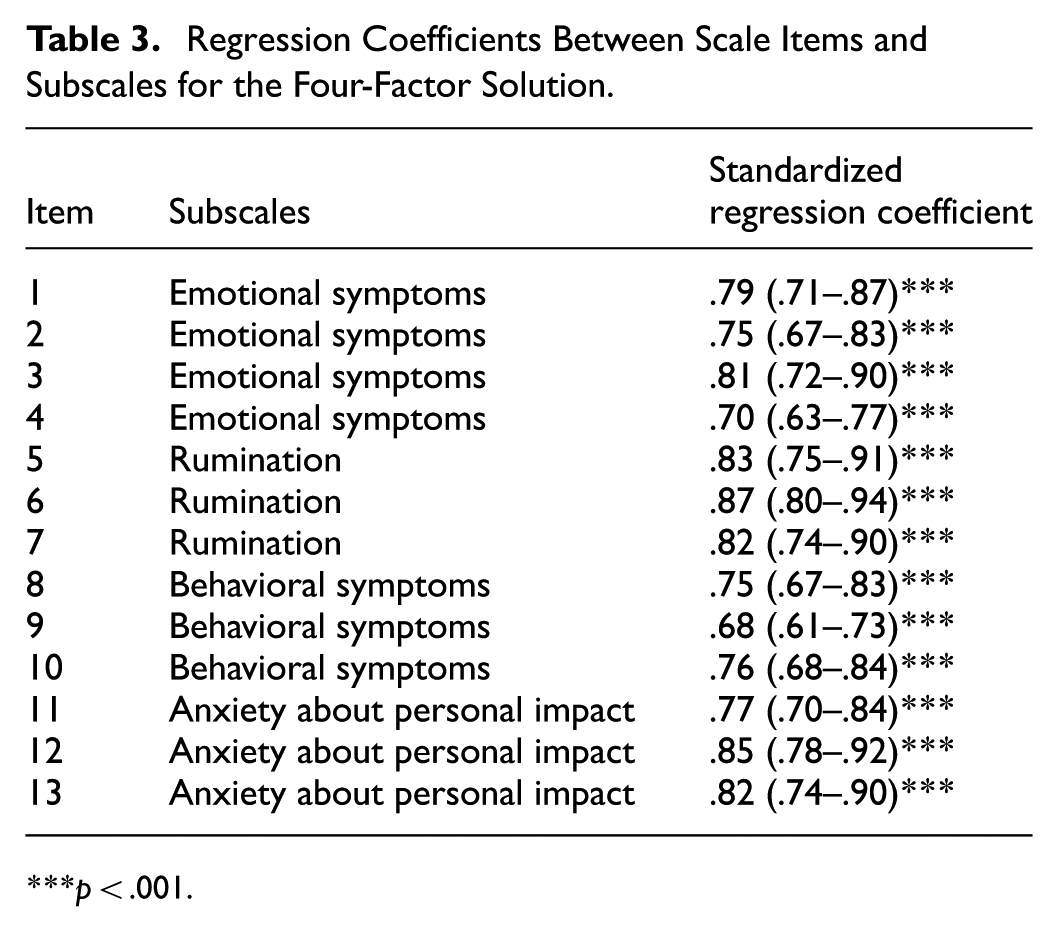
p < .001.
Cronbach’s alpha (.91) indicated that the internal consistency of the global scale was good. Cronbach’s alpha of Emotional Symptoms (.84), Behavioral Symptoms (0.77), Rumination (0.88), and Anxiety About Personal Impact (0.85) indicated that the internal consistencies of the four factors were acceptable to good (Figure 2).

Confirmatory factor analysis of the four-factor structure.
Validity and reliability—Female and male groups
A CFA of the four-factor solution was conducted on the group of female participants. This factor solution provided a good model fit (χ2 (61) = 157.43, p < .01; ratio of χ2 to degrees of freedom = 2.58; NFI = 0.93; CFI = 0.96; TLI = 0.95; RMSEA = 0.06; SMSR = 0.05). A similar procedure was carried out on the group of male participants, and it was also found that the four-factor solution provided an acceptable model fit (χ2 (61) = 149.18, p < .01; ratio of χ2 to degrees of freedom = 2.45; NFI = 0.91; CFI = 0.94; TLI = 0.93; RMSEA = 0.08; SMSR = 0.05) indicating a compatibility between the observed and the targeted model.
Next, the measurement invariance analysis was conducted by ensuring configural, measurement weight, structural covariance, and measurement error invariance of the measurement model for sex groups (Byrne, 2016). The test of configural invariance for the four-factor solution provided good model fit: (χ2 (122) = 306.68, p < .01; ratio of χ2 to degrees of freedom = 2.51; NFI = 0.93; CFI = 0.95; TLI = 0.94; RMSEA = 0.05; SMSR = 0.06). That is, in this unconstrained measurement model, the factor structure for the two populations based on sex was found to be similar.
As can be observed in Table 4, according to the unconstrained model, the changes in CFI in the models obtained by constraining, in sequence, measurement weights, structural covariances and error variances, were less than 0.01. Hence, the measurement model has ensured configural, measurement and structural invariance based on sex.
Measurement and Structural Invariance Results by Sex.

Note. Unconstrained Model: All the parameters are predicted freely.
Measurement Weights Model: All Factor loadings are constrained (equated).
Structural Covariances Model: All Factor loadings + factor variances and covariances are constrained (equated).
Measurement Errors Model: All Factor loadings + factor variances + factor covariances + error variances are constrained (equated).
Validity and reliability—Age groups
Following the procedure carried out by Hogg et al. (2023), we performed a CFA on two sub-samples according to their age: one group included participants aged between 18 and 36 years old, and the other group included participants aged 37 or older. The groups were divided using the same cut-off point adopted by Hogg et al (2023) in the original HEAS validation study.
In the group of participants aged between 18 and 36 years, the four-factor solution provided an acceptable model fit (χ2 (61) = 183.59, p < .01; ratio of χ2 to degrees of freedom = 3.01; NFI = 0.93; CFI = 0.95; TLI = 0.94; RMSEA = 0.08; SMSR = 0.05) suggesting a compatibility between the observed and the targeted model. In the group of participants aged 37 years old or older, the four-factor solution showed an acceptable model fit (χ2 (61) = 143.82, p < .01; ratio of χ2 to degrees of freedom = 2.36; NFI = 0.93; CFI = 0.95; TLI = 0.95; RMSEA = 0.07; SMSR = 0.05) indicating a compatibility between the observed and the targeted model.
It was then examined measurement invariance by ensuring configural, measurement weight, structural covariance, and measurement error invariance of the measurement model for age groups. An acceptable model fit was observed in the analysis of configural invariance for the four-factor solution: (χ2 (122) = 327.41, p < .01; ratio of χ2 to degrees of freedom = 2.68; NFI = 0.92; CFI = 0.95; TLI = 0.93; RMSEA = 0.05; SMSR = 0.07). The unconstrained measurement model, the factor structure for the two populations based on age was found to be similar.
As can be seen in Table 5, according to the unconstrained model, the changes in CFI in the models obtained by constraining, in sequence, measurement weights, structural covariances and error variances, were less than 0.01. Hence, the measurement model has ensured configural, measurement and structural invariance based on age groups.
Measurement and Structural Invariance Results by Age Groups.

Note. Unconstrained Model: All the parameters are predicted freely.
Measurement Weights Model: All Factor loadings are constrained (equated).
Structural Covariances Model: All Factor loadings + factor variances and covariances are constrained (equated).
Measurement Errors Model: All Factor loadings + factor variances + factor covariances + error variances are constrained (equated).
Association with related variables
The associations between the global score, emotional and rumination symptoms, and the anxiety about personal impact with the environmental identity were weak and positive. The correlations between behavioral symptoms with the environmental identity variable were non-significant. The correlations between the global score, emotional and behavioral symptoms, and anxiety about personal impact with depression, anxiety, and somatization symptoms were moderate and positive. The correlations between the rumination symptoms with depression, anxiety, and somatization symptoms were weak and positive (Table 6).
Association of Eco-anxiety Factors with Related Variables.
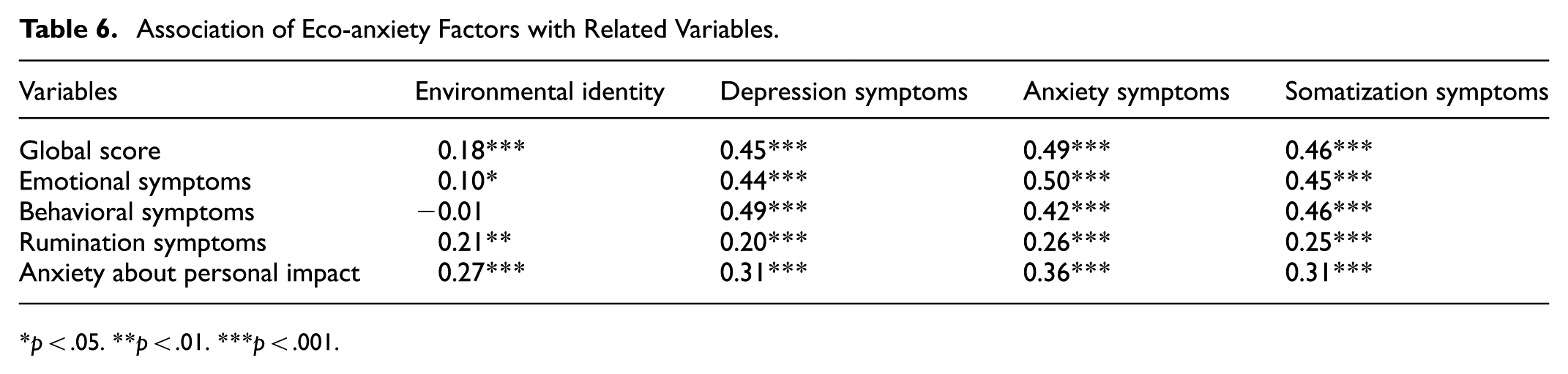
p < .05. **p < .01. ***p < .001.
Comparison of groups on eco-anxiety
The comparison of the mean scores for the total scale and the dimensions of the scale revealed that there were statistically significant differences between both sexes, apart from rumination symptoms. Female participants had higher means in all these variables. The results indicated a medium-sized effect because the Cohen’s d values were around 0.5 (Table 7).
Means, Standard Deviations, Confidence Intervals, and Mean Differences Between Females and Males on Eco-anxiety Dimensions.

p < .01. ***p < .001.
The correlations of age with eco-anxiety global score (r[566] = −.10, p < .05), emotional symptoms (r[566] = −.15, p < .001), and behavioral symptoms (r[566] = −.15, p < .001) were weak and negative. The correlations of age with rumination symptoms (r[566] = .03, p = .42) and anxiety about personal impact (r[566] = −.03, p = .43) were non-significant. Regarding comparisons of the means between the age groups, statistically significant differences were found between participants aged between 18 and 36 years old and the group of older participants on all variables apart from rumination symptoms. The group with younger participants had higher mean scores compared to the other group. Cohen’s d values were around 0.5 which indicated that the difference between both groups had a medium-sized effect (Table 8).
Means, Standard Deviations, Confidence Intervals, and Mean Differences Between Participants Aged Between 18 and 36 Years Old and Participants Aged 37 or Older on Eco-anxiety Dimensions.

p < .001.
Discussion
This study examined the validity and reliability of the HEAS to adapt the measure for adult native Portuguese speakers. The relevance of this study stems from the need to develop validated measures able to measure the different dimensions covered by eco-anxiety. In this respect, the HEAS appears to be the first validated measure that covers the multiple dimensions of eco-anxiety, namely negative emotions, cognitive impairments, behavioral and physical symptoms, and future-oriented apprehension related to environmental crises and potential environmental calamities (Hogg et al., 2021, 2023; Uzun et al., 2022).
This study aimed to replicate and extend prior findings on the factorial structure of the measure under investigation, including the EFA reported by Hogg et al. (2021) and Uzun et al. (2022). Through the use of comparable methodological approaches, our results provide a robust basis for cross-study comparisons. As previously mentioned, the HEAS has already been adapted and validated for Portuguese young adults (Sampaio et al., 2023). However, adaptation and validity testing of the scale in Portuguese older adults, and not only in young adults, is highly relevant. A significant limitation of the aforementioned study lies in its highly selective sample, particularly with respect to age and gender. By contrast, the present study employed a more inclusive sampling approach, albeit still constrained by the use of a convenience sample.
The current findings support the establishment of eco-anxiety as a multi-dimensional construct (Coffey et al., 2021; Hogg et al., 2021) among adult Portuguese native speakers. The current findings suggest that eco-anxiety encompasses a multitude of psychological responses to the environmental consequences of climate change that are not restricted to manifestations of anxiety (Clayton, 2020; Passmore et al., 2023). The manifestations of eco-anxiety, as measured by the HEAS, may also include ruminative thoughts about past and potential environmental events resulting from climate change, sleep problems, anhedonia, work performance issues, and anxiety and guilt for engaging in environmentally damaging behaviors or failure to be actively involved in environmentally protective behaviors (Coffey et al., 2021; Hickman, 2020; Passmore et al., 2022).
Although EFA retrieved a three-factor solution as found in a study among a Turkish sample (Uzun et al., 2022), the CFA revealed that this factorial solution had a poor model fit in our sample. It was found that only the four-factor solution showed suitable construct validity. The CFA showed that the four-factor solution provided a good fit for the model in the full sample and both sex and age groups. As found in prior research, only the four-factor solution showed a good, or at least acceptable, model fit for both men and women, and younger and older participants (Hogg et al., 2023). Likewise, measurement invariance was achieved for the four-factor solution for both sex and age groups. The construct validity of the scale was confirmed, and the original 13 items were retained. Additionally, the internal consistency of the scale was found to be good. These results indicate the suitability of the HEAS in its original form as a measure to evaluate the multidimensional nature of eco-anxiety among Portuguese native speakers.
Notably, the model demonstrated slightly superior fit indices within the older adult sample compared to the younger cohort, suggesting that the scale may perform particularly well in assessing eco-anxiety among older individuals. This nuance, although marginal, highlights the importance of developing and validating psychometric tools that are sensitive to age-related differences in psychological response to climate change. Given the increasing aging of populations globally, a version of the scale that is more finely attuned to older adults not only enhances its validity but also addresses a critical gap in environmental psychology by providing a measure sensitive to the psychological responses of older individuals to the environmental crisis (Clayton et al., 2015; Gifford & Nilsson, 2014). These findings therefore underscore the need to further explore and refine age-adapted versions of such measures in future studies.
Meanwhile, it was found that the emotional symptoms dimension explained almost 50% of the variance in the population. The remaining dimensions had a low variance contribution, in particular the dimensions related to anxiety about personal impact and rumination. It seems that anxiety and fear related to current and impending environmental crises are the core manifestations captured by the HEAS among Portuguese native speakers (Hajek & König, 2023; Pihkala, 2020). Despite this fact, there seems to be some evidence that eco-anxiety also encompasses cognitive and behavioral manifestations, and anxiety or guilt regarding the personal impact of one’s own behavior on environmental consequences and/or the failure of behavior to prevent potential environmental disasters (Clayton, 2020; Pritchard et al., 2020).
The analysis of the correlations of eco-anxiety with related variables indicated that both emotional and behavioral symptoms of eco-anxiety had positive and moderate associations with negative mental health outcomes (depression, anxiety, and somatization symptoms) and weak and non-significant, respectively, associations with the environmental identity scale. As observed in previous research, the moderate correlations of the emotional and behavioral symptoms of eco-anxiety with clinical symptom scales suggest some overlap between those two dimensions of eco-dimensions with general psychological distress, although indicating that they are distinct psychological manifestations from those psychological disorders (Hogg et al., 2021). Nevertheless, the lack of association with environmental identity may indicate that these two dimensions of eco-anxiety are indicators of a rupture in the links with nature that could account for mental health problems related to the environmental crisis such as hopelessness and loss (Coffey et al., 2021) or even an extreme state of eco-paralysis (Albrecht, 2011). Future studies should examine this topic in samples from other countries
In addition, as found by Hogg et al. (2021), the dimensions of rumination and anxiety about one’s personal impact on environmental crisis had weak to moderate associations with clinical symptoms and weak associations with environmental identity. It seems that both dimensions of eco-anxiety may not be primarily manifestations of psychological distress (Clayton & Karazsia, 2020; Pritchard et al., 2020), but rather a rational and emotional response related to individuals’ connection to the natural world and engagement in environmental protection behaviors to prevent potential environmental disasters (Coffey et al., 2021; Passmore et al., 2022).
Finally, mean differences on the levels of eco-anxiety between sexes indicated that females reported higher levels in all dimensions of eco-anxiety compared to males, apart from the rumination dimension in which no significant mean differences were found between both sexes. In accordance with previous literature, these results indicate Portuguese female speakers generally experience more intense emotional, behavioral and anxiety responses related to the global environmental crisis and their personal responsibility for potentially harmful behaviors to the environment (Hogg et al., 2023; Mallett. 2012).
Unlike prior research, age was weakly associated with lower global levels of eco-anxiety, and emotional and behavioral symptoms, but it was not associated with rumination and anxiety about the personal impact. The comparison between younger and older participants indicated that the former, except for rumination symptoms, had higher levels of eco-anxiety overall. It is likely that greater awareness of impacts of climate change and potential threats among Portuguese younger people makes them more vulnerable to psychological distress related to environmental damage (Gislason et al., 2021; Martin et al., 2021).
Overall, the current findings indicate the usefulness of the HEAS as a measure to evaluate the multidimensional nature of eco-anxiety among adult Portuguese speakers (Clayton & Karazsia, 2020; Coffey et al., 2021; Sampaio et al., 2023). This measure seems to be able to capture the different displays of eco-anxiety that have been identified in the literature, namely negative emotions and anxiety, cognitive impairments, behavioral and physical symptoms, and anxiety about one’s personal impact on climate changes and environmental consequences (Soutar & Wand, 2022). This study also seems to contribute to providing some insights into possible psychological responses that are indicators of mental health problems related to the environmental crisis, as well as indicating manifestations of eco-anxiety that could constitute adaptive responses and that could have an influence on environmentally protective behaviors.
Limitations
Some limitations should be considered when interpreting the results. First, a convenient sample was recruited, which does not permit generalization the current findings. Probabilistic and representative samples should be used in future studies. Second, most participants were females. Future studies should have an equivalent proportion of participants in terms of sex and gender. Third, there was a low proportion of participants over 65 years of age in this sample. Considering that there is evidence that older people experience less eco-anxiety, future studies should increase the number of participants in this age group. Fourth, given the limited representation of participants from Brazilian, Angolan, and related cultural backgrounds, no definitive conclusions can be drawn for these groups, highlighting the need for further intercultural validation studies. Fifth, a further limitation of this study is the use of both EFA and CFA on the same dataset. Although this approach has been employed in previous studies, it is methodologically suboptimal, as it may result in overfitting and undermine the validity of the model confirmation process. Ideally, EFA and CFA should be performed on independent samples to allow for more robust validation of the factor structure. Sixth, the direct experience of environmental threats was not evaluated. Bearing in mind that individuals directly confronted with an environmental crisis show higher levels of eco-anxiety, future studies should analyze this variable.
Conclusions
Notwithstanding these limitations, the results of this study provide support for the use of the HEAS as an appropriate and valid scale for assessing the manifestations of eco-anxiety in adult Portuguese speakers. This is particularly relevant given that Portuguese is spoken by approximately 230 million speakers on different continents. The adaptation of this scale will make it possible to carry out studies of the psychological consequences associated with climate change on a large number of individuals. As a result of the examination of the psychometric properties of the HEAS, it can be recognized as a valid measure for assessing the psychological impact associated with environmental crises and potential environmental crises in Portuguese-speaking individuals. This study also provides further support for the multidimensional nature of eco-anxiety, including anxiety and emotional symptoms, cognitive impairments, behavioral and physical symptoms, but also personal concerns about the individual impact on environmental crises. Although this study adds further evidence to the validity of the HEAS, further studies should be carried out in other populations, particularly those directly exposed to the effects of climate change.
Supplemental Material
sj-docx-1-sgo-10.1177_21582440251388161 – Supplemental material for Adaptation of the eco-anxiety scale to adult Portuguese native speakers: a validity and reliability study
Supplemental material, sj-docx-1-sgo-10.1177_21582440251388161 for Adaptation of the eco-anxiety scale to adult Portuguese native speakers: a validity and reliability study by Paulo Ferrajão, Nuno Torres and Amadeu Quelhas Martins in SAGE Open
Footnotes

Funding
The authors disclosed receipt of the following financial support for the research, authorship, and/or publication of this article: This work was funded by National Funds by FCT-Foundation for Science and Technology under the following project UID/04045: Research Center in Sports Sciences, Health Sciences, and Human Development.
Declaration of Conflicting Interests
The authors declared no potential conflicts of interest with respect to the research, authorship, and/or publication of this article.
Data Availability Statement
The data underlying this study are available upon request to the first author.
Supplemental Material
Supplemental material for this article is available online.
References
Supplementary Material
Please find the following supplemental material available below.
For Open Access articles published under a Creative Commons License, all supplemental material carries the same license as the article it is associated with.
For non-Open Access articles published, all supplemental material carries a non-exclusive license, and permission requests for re-use of supplemental material or any part of supplemental material shall be sent directly to the copyright owner as specified in the copyright notice associated with the article.
