



Abstract
While validation of positive youth development (PYD) measures has increased considerably of late, validation of the Five C’s of PYD among emerging adults in non-WEIRD countries remains limited. The main objective of this study was to examine the factor structure, measurement invariance, and criterion-related validity of the Five C’s model of PYD through the use of the Positive Youth Development Inventory (PYDI). Data were collected from 436 university students in Malaysia, with a mean age of 21.19 (SD = 1.19). The findings supported a modified bifactor model of the PYDI, which demonstrated strong measurement invariance across gender and race, but not across age categories. Connection showed the strongest latent factor correlations with the other four C’s. Criterion-related validity was supported through its association with psychological hardiness. The findings demonstrate adequate psychometric properties and cultural applicability of a modified bifactor model of the Five C’s model of PYD among emerging adults in Malaysia.
Keywords
Introduction
Positive youth development (PYD) broadly refers to the role that developmental experiences play in providing optimal preparation for the attainment of adult potential and well-being (Catalano et al., 2019). PYD is grounded in the assumption that all young people have internal and external assets that can be leveraged to promote positive adjustment and personal growth (Ciocanel et al., 2017). PYD programs promote the acquisition of competencies that enhance adjustment and functioning, thereby reducing the likelihood of engaging in high-risk behaviors. Research on PYD has proliferated in the last two decades, both within the United States (Lerner et al., 2015) and internationally (Koller & Verma, 2017), with major international organizations such as UNICEF, USAID, and the World Bank expressing interest. Much of this work has focused on the Five C’s of PYD: competence, confidence, connection, character, and caring. These five global outcomes are considered universally desirable and are exhibited when young people’s personal strengths align with the resources and opportunities available in their environments (Lerner et al., 2015). The Five C’s model has widespread use among researchers and practitioners and has received extensive empirical and theoretical support (Geldhof et al., 2020; Lerner et al., 2015).
The Five C’s model has been widely applied in international PYD program contexts, leading to the development and validation of several measures of its practice. To ensure that these measures retain consistent meanings across diverse cultures, countries, and languages, researchers have conducted numerous studies to test for measurement invariance (e.g., Bowers et al., 2010; Buenconsejo et al., 2022; Conway et al., 2015; Dvorsky et al., 2019; Holsen et al., 2017; Yang & McGinley, 2021). Establishing invariance is crucial for making meaningful statistical comparisons across different groups (Geldhof et al., 2020; Schmitt & Kuljanin, 2008). Previous studies have explored the invariance of PYD measures across time, gender, race/ethnicity, age, and geographic location. However, despite increased global interest in PYD measurement, significant gaps remain. Few studies have investigated invariance among ethnically diverse non-WEIRD (Western, educated, industrialized, rich, and democratic) countries. Among those that have, most attempts to establish invariance have targeted adolescent populations, with limited research on emerging adults (e.g., Buenconsejo et al., 2022). This gap is significant for non-WEIRD countries, where socially constructed definitions of youth often extend beyond adolescence to emerging adulthood. Therefore, this study sought to test for measurement invariance across gender, age, and race of a widely used measure of the Five C’s model of PYD among a sample of Malaysian emerging adults.
The Five C’s of PYD Among Emerging Adults
Among the different paradigms of PYD, the Five C’s model has received more empirical support than any other model (Arnold & Silliman, 2017; Burkhard et al., 2020; Heck & Subramaniam, 2009). The components of the Five C’s model include competence, or actions in domain specific areas including academic, social, health, and career settings; confidence, having a global sense of self-worth and self-efficacy; connection, positive relationships formed with family, peers, community members and institutions that include mutually beneficial interactions; character, which includes integrity, respect for societal and cultural norms, a sense of right and wrong, and standards for correct behavior; and caring, reflected in a sense of sympathy and empathy for others (Lerner, 2009; Lerner et al., 2005).
Studies linking the Five C’s to positive and negative behavioral outcomes have focused more closely on adolescent populations (Gomez-Baya et al., 2021; Manrique-Millones et al., 2021). This line of inquiry has been influenced by the socially constructed definition of youth in the United States. For example, the flagship national PYD program, 4-H, focuses its programs on youth between 8 and 18 years old. However, PYD among emerging adults, defined as those between the ages of 18 and 29 (Arnett, 2010; Arnett, 2014), has received more attention from scholars of late. This may reflect the growing interest in PYD in countries where ‘youth’ is socially constructed beyond adolescence. For example, the United Nations defines youth as those between the ages of 15 to 24 (United Nations, 1981), the Commonwealth, 15 to 29 (The Commonwealth, 2023), and the African Union, ages 15 to 35 (African Union, 2006). These global definitions align more closely with programs aimed at the development of positive outcomes and practical skills for older adolescents and emerging adults.
In line with these broader definitions of youth found globally, several recent studies have devoted attention to the Five C’s model among emerging adults in majority-world contexts. Emerging adulthood is an important transitional phase that extends beyond adolescence and has been shown to represent a period of concentrated change in individuals, their contexts, and their relationships (Arnett, 2000; Dvorsky et al., 2019). Given the different developmental tasks required by emerging adults compared with adolescents, it is important to determine whether the Five C’s model is sufficient for capturing thriving among emerging adults, especially those from non-WEIRD backgrounds (Dvorsky et al., 2019). While studies on the Five C’s among emerging adults globally are scant compared to those among adolescents, recent findings have indicated that emerging adults manifesting the Five Cs are more likely to show negative associations with psychological complaints. In their study of Peruvian college students, Manrique-Millones et al. (2021) found negative associations between competence, confidence, character, and connection and depressive symptoms. Meanwhile, another recent study among Romanian emerging adults attending university found the Five C’s to be related to several aspects of well-being including hope, general well-being, and social well-being (Ferrer-Wreder et al., 2021).
Measurement Invariance of the Five C’s Model Among Emerging Adults in Non-WEIRD Countries
The contextualized nature of human development dictates that a survey measure can represent different phenomena to individuals from diverse backgrounds. Therefore, invariance testing is necessary to ensure that a measure designed in one culture retains similar meanings across other cultures, countries, demographic groups, and languages (Geldhof et al., 2020). While the Five C’s model of PYD originated in the United States, recent attempts to study invariance have been made in regions such as Latin and South America (Geldhof et al., 2020; Manrique-Millones et al., 2021), Western and Eastern Europe (Dimitrova et al., 2021a; Pivec, 2021), Africa (Fernandes et al., 2021; Kabir & Wiium, 2021), and Asia (Ang, 2009; Buenconsejo et al., 2022; Dimitrova et al., 2021b; Li et al., 2021; Yang & McGinley, 2021). Within this growing body of knowledge, invariance testing of the Five C’s model has been examined by country context (Dimitrova et al., 2021b; Fernandes et al., 2021; Geldhof et al., 2020), gender (Ang, 2009; Buenconsejo et al., 2022; Conway et al., 2015; Dimitrova et al., 2021a), geographic location (Wen et al., 2022), race/ethnicity (Su & Johnson, 2022), socioeconomic status (Buenconsejo et al., 2022), and school type (Buenconsejo et al., 2022).
There is a growing interest in measurement invariance of the Five C’s model in non-WEIRD countries, many of which share significant cultural and demographic disparities with the United States. These studies explore whether the model operates similarly in diverse cultural contexts and across different demographic groups. In their study among 1296 seventh-grade students in China, Wen et al. (2022) found strong metric and scalar invariance across both gender and geographic location. Not all studies among non-WEIRD samples have indicated universal support for the invariance of the Five C’s model, however. In the Philippines, Buenconsejo et al. (2022) reported varying levels of measurement invariance across gender, SES, and school type among 1116 high school students during the COVID-19 pandemic. Furthermore, in their study comparing adolescent samples from Belize and the United States, Geldhof et al. (2020) also found limited construct comparability between the samples from the U.S. and Belize. Although overall patterns of item-construct associations were similar across samples, Geldhof et al.’s findings suggest that items within specific C’s of the model may take on particularly different meanings between the two cultures. More research is needed, therefore, on PYD measurement invariance in countries characterized by indigenous ethnic and cultural diversity.
Although some recent international studies have examined the Five Cs model in groups of late adolescents (Conway et al., 2015) and upper secondary school students (Holsen et al., 2017), few known studies have examined the factorial validity and invariance of the Five C’s model among emerging adults in non-WEIRD countries. It is possible that the original measurement structure of the Five Cs model of PYD is unique for emerging adults because the developmental context of early adulthood is characterized by rapid changes in the social context (Arnett, 2016), particularly for those in college settings. However, cultural differences must also be considered. Using past studies exploring the Five C’s among adolescent populations as a guide, researchers have reported that unique subscales, such as confidence and connection, may be interpreted differently in American and non-WEIRD cultures. This is because family, neighborhood, school, and peer connections, as well as self-worth and self-identity, i.e., confidence, are represented differently cross-culturally (Geldhof et al., 2020). According to Buenconsejo et al. (2022), in many non-WEIRD countries, psychological constructs are developed and tested among samples with individualistic values, which may not reflect the experiences of non-WEIRD youth and societies with relatively stronger collectivist values. Thus, further research is needed to extend findings for the PYD Five Cs model in emerging adulthood in non-WEIRD countries and to examine the factor structures and invariance to determine whether this model is beneficial for emerging adults outside a U.S. context.
Study Context: PYD Among Emerging Adults in Malaysia
Malaysia is a multi-ethnic, upper middle-income country in the Western Pacific Region of Southeast Asia, with 32 million people (Department of Statistics Malaysia, 2021). The youth population of Malaysia, defined as those between 15 and 30 years of age, represents 30.5% or 9.9 million of the total Malaysian population. Given the significant proportion of young people in Malaysia, youth development for emerging adults remains a top priority on the country’s national development agenda (Economic Planning Unit, 2021). In addition to the central role that community-based youth associations play in promoting PYD among emerging adults (Krauss et al., 2015), Malaysian universities also maintain a strong focus on co-curricular programming that aims to cultivate critical competencies and life skills. These programs strive to foster positive developmental outcomes, including innovative problem-solving ability, critical thinking, lifelong learning, ethical leadership, and effective communication. Students are encouraged to assume significant roles in leadership, decision-making, and critical thinking throughout the implementation of campus- and community-based projects and programs (Nouri et al., 2022).
Despite the strong policy and programming focus on positive youth development (PYD) among emerging adults in Malaysia, previous research on the Five C’s model remains limited. The Malaysian National Youth Policy (Ministry of Youth and Sports Malaysia, 2015) includes a localized version of the Five C’s model of PYD (known as the Eight C’s) as a guide for programming in the country. Despite this strong PYD-guided policy emphasis, few empirical studies have investigated the invariance of PYD measures among emerging adults in Malaysia. In an earlier related study, Ang (2009) explored the factor structure of the Five C’s model of PYD among 1470 adolescents (aged 13–14). The author discovered that the measurement structure that corresponded to the Five C’s showed a significantly better fit to the data than a unidimensional or two-level factor structure. This five-factor measurement model was invariant across genders. In another recent study, Abdul Kadir et al. (2021) investigated a Seven C’s model of PYD (Caring, Character, Confidence, Competence, Connection, Contribution, Creativity) and found significant factor validity among a sample of 400 university students in Malaysia. However, the study did not perform invariance testing. With the growing interest in PYD practices and research in Malaysia, it is critical to conduct more empirical studies to ensure that existing measures accurately reflect the local culture and context.
The Current Study
Several previous studies have examined PYD invariance using adapted versions of Geldhof et al.’s brief Five C measure (2014). Nonetheless, testing invariance of the Five C’s across different measures helps to examine the salience of the conceptual model, rather than any particular instrument alone. The current study further adds to this body of knowledge by examining the full version of Arnold et al.’s (2012a) Positive Youth Development Inventory (PYDI). The PYDI measure was used to collect data from emerging adults in Malaysia to analyze its factor structure; measurement invariance (configural, metric, scalar, and strict) across gender, race (Malay and other), and age (18–21 and 22–25); and criterion-related validity via its link to psychological hardiness. The PYDI and hardiness measures were selected as part of a larger study of campus-based PYD programs among Malaysian college students (Nouri et al., 2022). As one of several measures of the Five C’s model, the PYDI was chosen because it of its intentional development as an outcome measure for youth development programs (Truskauskaitė-Kunevičienė et al., 2020). Hardiness encompasses three intersecting dispositions: commitment, challenge, and control. It has gained substantial popularity in studies involving youth from disadvantaged and under-resourced backgrounds due to its association with problem-solving and coping in challenging social contexts (Nouri et al., 2022). Although there are limited studies directly examining the relationship between hardiness and positive youth development (PYD), evidence suggests that hardiness plays a role in stress management (Vidrine et al., 2013), the development of problem-solving skills (Abdollahi et al., 2018), resiliency (Kermani & Mahani, 2015), mental health and behavioral adjustment (Cumberland-Li et al., 2004; Huey & Weisz, 1997), and overall well-being (Rizvi, 2016). Individuals with higher levels of hardiness have also been associated with greater levels of happiness, life satisfaction, and better mental and physical health (Abdollahi et al., 2015).
Although several validation studies have examined the measurement invariance of the Five C’s among emerging adults across gender, few have investigated its invariance across race and age, and no known studies have examined these demographic categories in non-WEIRD countries. Without evidence of measurement invariance, comparisons of emerging adults’ PYD across these demographic subgroups may not be methodologically sound. Previous studies identifying gendered (Conway et al., 2015; Pivec, 2021; Tomé et al., 2021; Årdal et al., 2018), racial (Lerner et al., 2005; Williams & Deutsch, 2016), and age-related (Conway et al., 2015; Tomé et al., 2021) differences in PYD highlight the need for rigorous evidence of PYD scales' measurement invariance. Despite previous documentation of psychosocial differences (Irfan et al., 2021; Kalok et al., 2020; Pang et al., 2021; Talwar et al., 2013) among emerging adults in Malaysia based on gender, race, and age, no studies have yet examined the invariance of the Five C’s among this population.
Methods
Participants and Procedures
The study consisted of 436 undergraduate students from all four public universities in Selangor state. Selangor was selected due to its high population and diverse racial composition, providing an opportunity for generalizing the findings to a broader context (Department of Statistics Malaysia, 2021). The age range of the study participants was 18–25 years old, with a mean age of 21.19 (SD = 1.19). The majority of participants self-identified as female, comprising 65.6% (n = 286; 34.4% male, n = 150) of the total participants. In terms of race, a majority self-identified as Malay (57.3%; n = 250), while the remaining participants identified as Chinese (25.9%; n = 113), Indian (9.2%; n = 40), or other races (7.6%; n = 33). In accordance with previous studies conducted with Malaysian young people, the “other” category is commonly employed to encompass the numerous smaller ethnic groups predominantly originating from East Malaysia.
To conduct invariance testing by age, the participants were divided into two groups. The first, representing early emerging adults, included participants aged between 18 and 21 (n = 239). The second group encompassed participants aged between 22 and 25 (n = 197). While no known studies have previously tested differences by age within the category of emerging adulthood, we chose to do so in light of cultural considerations. Previous research has indicated significant developmental changes during the transition period from late adolescence to emerging adulthood, particularly among first-year college students who experience vital developmental tasks such as leaving home, achieving financial independence, establishing new relationships, and adjusting to college life (Dvorsky et al., 2019; Schulenberg et al., 2004). Furthermore, in Malaysia, there is less uniformity in age among first-year university students, as students take a variety of different post-secondary pathways to get to bachelor’s degree programs (Ministry of Education Malaysia, 2020). Given the variability in age and life experience of the target population, we sought to explore whether this translated to greater variance in PYD by age. In regard to sample size adequacy of the two age groups, previous studies examining age differences have typically employed substantial sample sizes (Davis et al., 1990; Hultsch et al., 1991). However, it is important to note that studies with smaller sample sizes have also observed age effects in repetition priming (Abbenhuis et al., 1990; Howard, 1988).
Data were collected during May and June 2019. We employed a multistage, cluster random sampling method to collect the data. Access to each university was facilitated by the respective Student Affairs divisions at each university. Following selection of the four public universities, we used random number generator software to select 125 students from each university. Criteria for inclusion in the study were that students had to be enrolled as first-year, full-time undergraduate students and enrolled in one of the university’s compulsory co-curricular programs (i.e., community service, sports, and leadership). Questionnaires were distributed by hand at each university and took between 20 to 30 minutes to complete. Of the total number of questionnaires collected, 36 (7.2%) were incomplete giving an overall response rate of 92.8%. Another 28 (5.6%) were removed from the analysis due to outlier values.
The survey measures were originally developed in English and translated to Malay. To translate the measures and ensure that the items were culturally appropriate for the study sample, items were initially translated and back translated. Final verification of all items was carried out by two members of the research team, both PhD-level researchers fluent in English and Malay. During the translation of the survey measures, the team gave due consideration to the culture and age of the target group. All items were presented in both Malay and English. After agreement was reached on wording, a pilot test was conducted with 50 undergraduate students. Cronbach’s alpha scores for all measures on the pilot test ranged between .72 and .96. No further modifications were made.
The ethics committee of Universiti Putra Malaysia approved the study (UPM/TNCPI/RMC/1.4.18.2). Permission was also acquired from each of the participating universities to conduct the research among undergraduate students. Instructors were verbally informed about the distribution of questionnaire packages to students, and the aim of the research was explained to all respondents. The students were informed that participation in the study was entirely voluntary and anonymous, and that they could opt-out at any time. The respondents provided written informed consent to participate in the study. Tokens in the form of cash vouchers at local restaurants were provided to the study participants for their participation in the study.
Measures
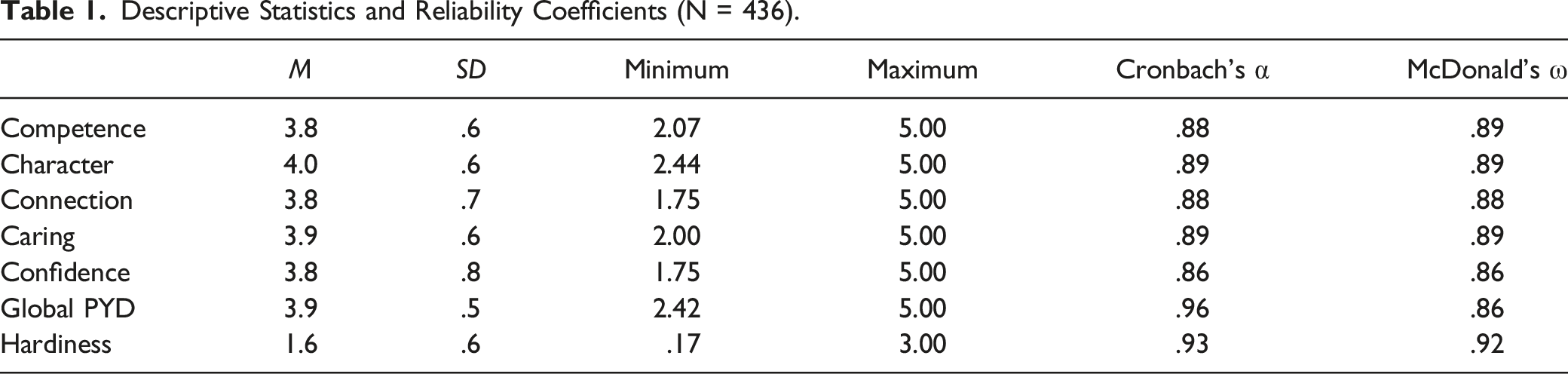
Descriptive Statistics and Reliability Coefficients (N = 436).
The Personal Views Survey (Maddi et al., 2006) was used to measure psychological hardiness. It consists of 18 items, both favorably and negatively phrased, that assess three components of Hardiness: control, commitment, and challenge. The authors advised against isolating the hardiness components of commitment, control, and challenge for assessment purposes. As a result, the total of the three scores was used. Sample items include, “By working hard, you can always achieve your goal,” “I really look forward to my work,” and “I like a lot of variety in my work.” Items were measured on a 4-point scale ranging from 0 (Not at All True) to 3 (Very True). Previous studies incorporating the Personal Views Survey have shown that it has satisfactory reliability and validity among Malaysian undergraduate students (Abdollahi et al., 2015). Studies have also shown an acceptable level of internal consistency (test–retest coefficient) of the measure for overall hardiness (Cronbach’s α - .80 to .88; Abdollahi et al., 2018).
Analytic Strategy
Preliminary analysis and missing data were computed using the Statistical Package for the Social Sciences (SPSS) (version 27). Missing data for all items was <2% and was addressed using the regression imputation method. In addition to Cronbach’s alpha to measure bivariate correlations, we tested for McDonald’s omega using the Hayes and Coutts macro (Hayes & Coutts, 2020). Critics of Cronbach’s alpha assert that the sample coefficient alpha can only provide a reliable estimate of consistency if all the items are equally related to the underlying construct, known as tau-equivalence. However, this assumption is rarely met in practice (Deng & Chan, 2017).
Confirmatory factor analysis (CFA) and measurement invariance tests were conducted using AMOS (version 27). Psychometric sensitivity was evaluated for skewness and kurtosis and was deemed appropriate (Kline, 2011). The average variance extracted (AVE) was analyzed to assess discriminant validity of the measure (Hair et al., 2017). Pearson’s correlation analysis (r) was used to evaluate convergent and discriminant validity. Furthermore, the average variance extracted (AVE) was used to test convergent validity. A value of ≥.5 for the AVE was considered adequate (Hair et al., 2010). CFA using a maximum likelihood estimator (ML) was performed for factor validity. Chi-square (χ2) test and goodness-of-fit indices were simultaneously analyzed (GFI, CFI, TLI ≥.90, acceptable, ≥.95, good; RMSEA ≤.06, good, ≤.08, acceptable; Hair et al., 2010). The improvement of model fit was based on Modification Indexes (MI N 11; p ≤ .001) by adding sequentially correlational measurement errors for the residuals with higher MI values. The chi-square difference test and AIC index were used to select the best fitting model, with smaller values suggesting superior and more stable models for the population under consideration (Kline, 2016). Regarding the local adjustment of the model, all standardized factor loadings should be significant (p = .05) and equal or greater than .50.
Subsequently, multigroup CFA was performed to further assess the measurement invariance (configural, metric, scalar, and residual invariance) of the Five C’s model across gender, race, and age, respectively. To determine criterion-related validity, we computed the Global PYD and Five C correlations with hardiness. Since full measurement invariance could not be definitively confirmed, we tested for partial invariance by examining the constrained model guided by the modification indices. Equality constraints on mis-specified items were gradually released in descending order. In accordance with the concept of partial measurement invariance, it is crucial to establish equality in at least two loadings or intercepts between groups (Bryne et al., 1989).
Preliminary Data Analysis
We examined the assumptions of multivariate normality and linearity and determined that all items exhibited acceptable values of skewness and kurtosis (Sk < │3│ and Ku <│8│–│10│; Kline, 2005), ranging from −.177 to .567 for skewness and between −.179 and .246 for kurtosis. To check for multivariate outliers, we used the Mahalanobis Distance statistic (D2). Despite some cases having D2 values indicating possible outliers, we retained them in the analysis as removing them had no influence on the results, and omitting such cases could reduce the variability of the factor. To investigate the measurement model, we used confirmatory factor analysis (CFA), which is typically the first step in SEM for evaluating model fit, convergent validity, and construct reliability (CR).
Results
Descriptive Statistics and Reliability Analysis
As seen in Table 1, Character indicated the highest mean score of the Five C’s, while Competence was the lowest. Cronbach’s alpha values for Global PYD and its subscales ranged from .861 to .955, indicating high internal consistency. McDonald’s omega values indicated similar values, all above .8.
Confirmatory Factor Analysis
Initial and Modified Confirmatory Factor Analysis on the Measure of PYD Using Robust Maximum Likelihood Estimation.

Standardized Factor Loadings, Standard Errors, and Latent Factor Correlations.
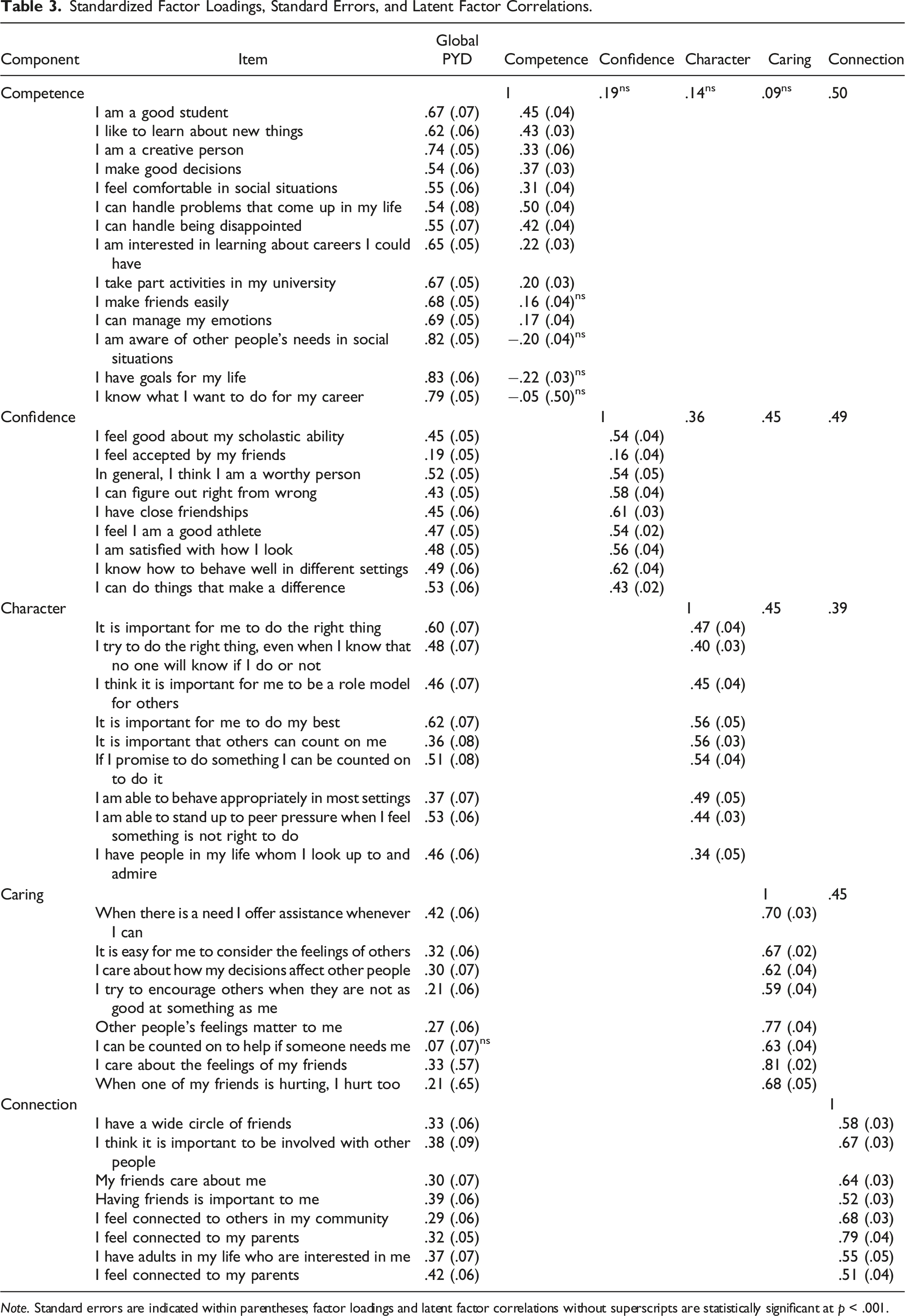
Note. Standard errors are indicated within parentheses; factor loadings and latent factor correlations without superscripts are statistically significant at p < .001.
Multi-Group Confirmatory Factor Analyses
Multigroup Confirmatory Factor Analyses Across Gender, Age, and Race.
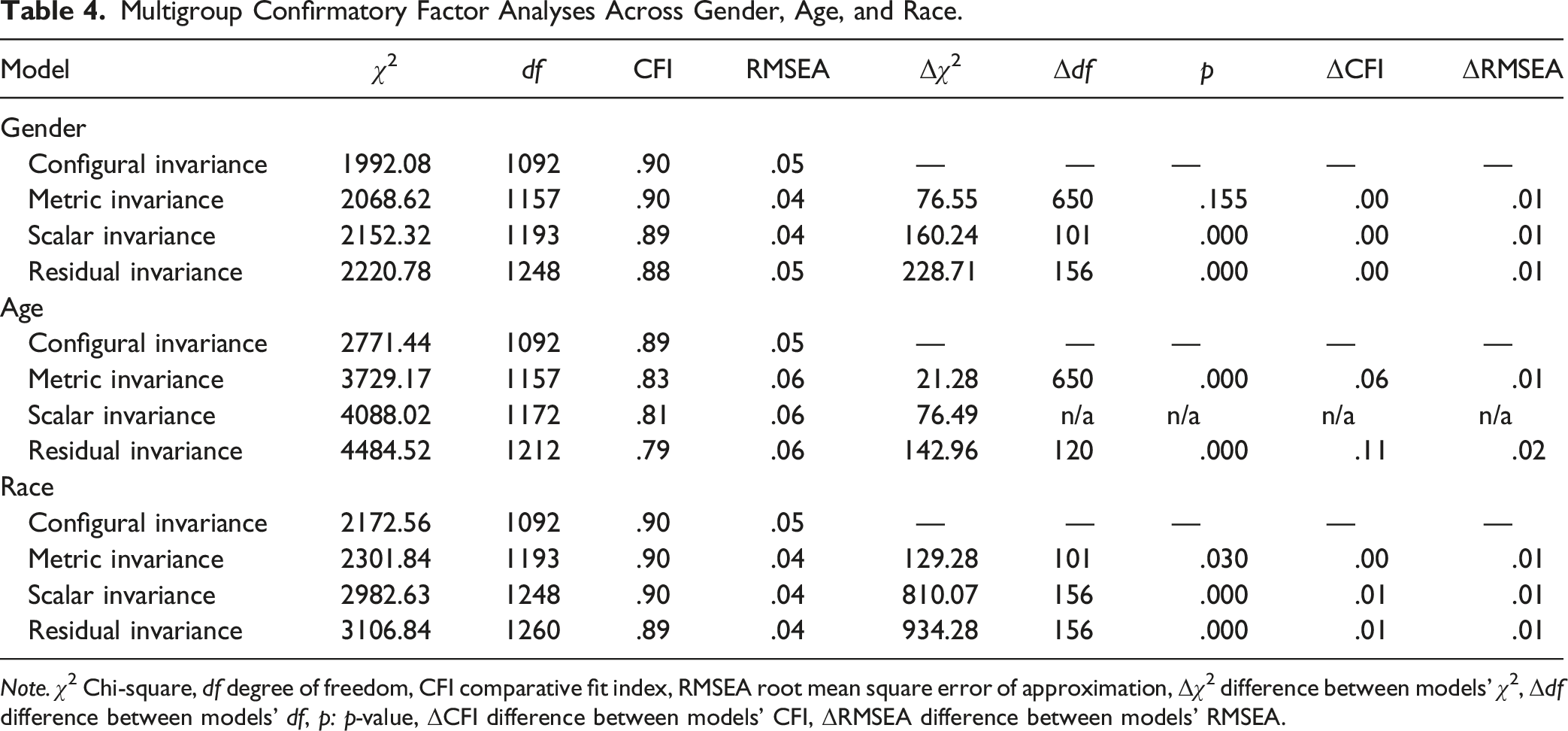
Note. χ2 Chi-square, df degree of freedom, CFI comparative fit index, RMSEA root mean square error of approximation, Δχ2 difference between models’ χ2, Δdf difference between models’ df, p: p-value, ΔCFI difference between models’ CFI, ΔRMSEA difference between models’ RMSEA.
We tested strong factorial invariance (scalar invariance) by examining indicator intercept equality across gender and race. Although the scalar invariance model was not significant (p < .05) for both groups, the ΔCFI and ΔRMSEA values for gender and race were below the thresholds of .01 and .015, respectively. This suggests that the intercepts of each item were invariant across gender and race. The findings for residual invariance mirrored those for scalar invariance. Although the Δχ2 for all three models was not significant (p < .05), the ΔCFI and ΔRMSEA values for gender and race were below the thresholds of .01 and .015. However, the ΔCFI for age was above the threshold (ΔCFI = .105), indicating a lack of residual invariance. In summary, the findings indicate robust measurement invariance for the Five C’s model across gender and race, but no measurement invariance was detected with respect to age.
Bivariate Correlations and Criterion-Related Validity
Bivariate Correlations of PYD and Hardiness.
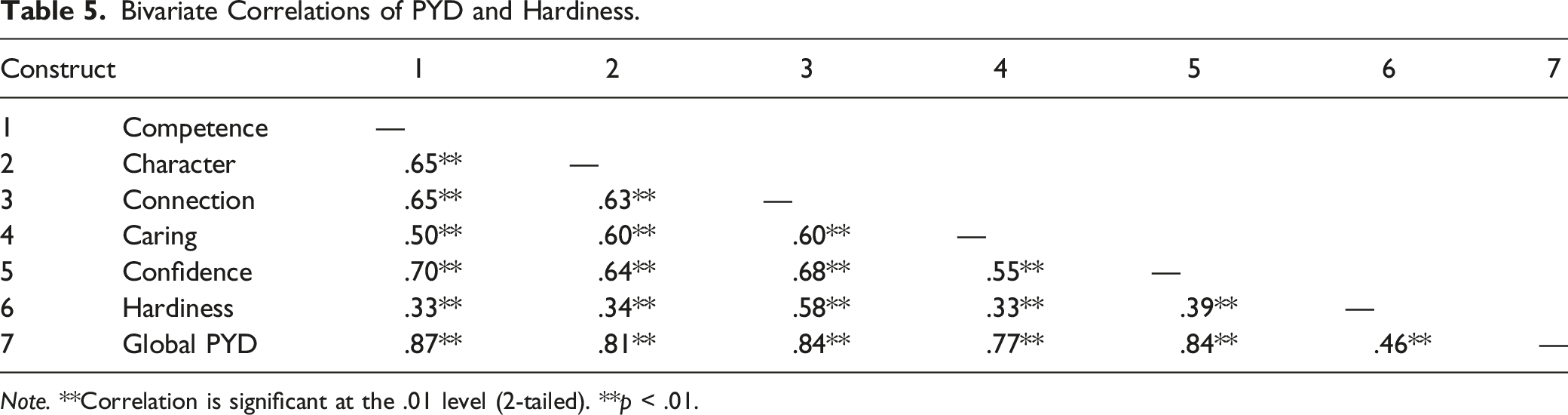
Note. **Correlation is significant at the .01 level (2-tailed). **p < .01.
Discussion
Growing global interest in positive youth development research and practice has necessitated culturally relevant and psychometrically-sound survey measures. This has further extended current interest in PYD beyond adolescent populations and into emerging adulthood, leading to a growing demand for psychometrically sound measures of PYD models for emerging adults outside of the United States. The current study aimed to contribute to this body of work by exploring the factorial validity and measurement invariance of the Five C’s model among emerging adults in a non-WEIRD country context. Data were collected from university students in Malaysia using the PYDI measure (Arnold et al., 2012a) to analyze its factor structure and measurement invariance (configural, metric, scalar, and strict) across gender, race, and age.
Confirmatory Factor Analysis
The factorial validity of the Five C’s was consistent with several previous studies supporting the efficacy of the bifactor model (Buenconsejo et al., 2022; Dvorsky et al., 2019; Holsen et al., 2017; Yang & McGinley, 2021). Several previous studies supporting the bifactor model were based on Geldhof et al.’s short or very short PYD scales (Geldhof et al., 2014). The current study is the first known attempt to explore the factorial validity of the PYDI outside of the United States with emerging adults, as previous studies were primarily conducted with adolescent samples. Despite differences in the measures used, our findings further support the bifactor conceptual configuration of the Five C’s. Similar to Buenconsejo et al. (2022), we also found that some items on the original PYDI did not significantly load onto their respective Cs. Of the C’s, four of the original 14 Competence items failed to significantly load, even though they loaded on the Global PYD construct. Of the four items, two items pertained to social competence (“I make friends easily”; “I am aware of other people’s needs in social situations”), and the other two represented career competence (“I have goals for my life,” “I know what I want to do for my career”). These results suggest that establishing meaningful relationships with peers, being attuned to the needs of others in social situations, and having a strong sense of one’s future career goals and direction may be better explained by the general PYD construct instead of a specific C such as competence. Buenconsejo et al. (2022) also found that items related to peer connectedness did not load on the Competence subscale but did load on the Global PYD construct. Given that the Philippines and Malaysia share certain socio-cultural similarities such as strong collectivist values, these results may be culturally related (Isa & Abdullah, 2019). Ease in forming new friendships may have more to do with pre-existing group dynamics than individual agency, particularly in a highly collectivist culture like Malaysia where group -- particularly ethnic group -- considerations are prioritized (Joseph, 2006; Krauss et al., 2022). For example, Malaysian youth may feel a sense of obligation to befriend others who share similar social and cultural backgrounds, interests, or dispositions. This can inhibit their desire to go out of their way to form new friendships with other students who come from different language or ethnic backgrounds, which is common in Malaysian universities (Tamam & Krauss, 2017). The two career competence-related items that did not load on the Competence subscale but did load onto Global PYD may further reflect the complex nature of career-related competence among Malaysian emerging adults. For example, past studies on career indecision among Malaysian college students indicate that gender, academic achievement, vocational identity, and occupational information all predicted career indecision among a similar sample of public university students (Abu Talib & Aun, 2009). Thus, for Malaysian emerging adults, career-related decisions, while still PYD-oriented, may not solely be influenced by one’s sense of competence but by other factors.
The analysis of latent factor correlations indicated moderate and positive correlations between the Five C subscales, except for Competence, which was found to have a significant correlation only with Connection. Similar to studies by Buenconsejo et al. (2022) and Ang (2009), our findings highlighted the relatively robust associations between Connection and the two efficacy-related C’s, Competence and Confidence. Again, the results may reflect significant socio-cultural values. In highly collectivist societies such as Malaysia, having strong connections to others can reinforce collectivist social norms and expectations, including the importance of group welfare over individual interests and the importance of living a more cohesive lifestyle (Lai et al., 2013). Strong connections with others may also indicate higher social capital, resulting in the acquisition of vital resources such as skills and knowledge that can enhance young people’s personal, academic, and social competence (Valenzuela, 2005). For college students, strong connections with others can also boost their sense of personal and academic confidence (Hope et al., 2013; Li et al., 2018). It is also worth noting that in general, studies have found that collectivist cultural values, such as those found in many non-WEIRD countries, are associated with higher levels of connectedness to others (Pelham et al., 2022). Therefore, youth from non-WEIRD countries characterized by a strong emphasis on collectivism, and who have been socialized in a cultural context that prioritizes collective values, are likely to have a greater perceived sense of Connection. This sense of Connection might have a stronger correlation with the other C's than what has been previously observed in studies conducted in WEIRD countries. The complexity of studying cultural values in relation to PYD practice necessitates more in-depth inquiry.
Multi-Group Confirmatory Factor Analyses
Although the Five C’s model exhibited strong measurement invariance across gender and race, it did not exhibit invariance by age. PYD invariance across gender aligns with related studies on emerging adults in WEIRD countries (Dimitrova et al., 2021a; Dvorsky et al., 2019; Gomez-Baya et al., 2021). We further found measurement invariance across different racial groups, suggesting no differences in the Five C’s model across the different races in Malaysia. While few studies have tested PYD invariance by race among emerging adults, the finding coincides with Su and Johnson’s (2022) recent study who reported good fit of the bifactor structure of a revised version of Geldhof et al.’s (2014) PYD-VSF scale across students from White, Black, Asian, Latino/a, and other ethnicities. Prior research has demonstrated significant differences in academic and psychosocial functioning among Malaysian emerging adults (Saadat & Sultana, 2023; Subon et al., 2020; Tamam, 2013; Wan Chik et al., 2012). Therefore, these findings are meaningful as they allow for comparisons of PYD in Malaysia across gender and race.
Our study sample consisted of individuals aged 18 to 25, which corresponds to the conventional definition of emerging adulthood (i.e., Arnett, 2000; Arnett & Mitra, 2020). However, it is worth noting that alternative viewpoints propose that emerging adulthood extends until the age of 29 (Arnett, 2014). While our study focused on the narrower age range, this decision was made considering the practical considerations and cultural context that supports the age range of 18 to 25. Nonetheless, it is important to acknowledge the broader age range suggested by some scholars and the potential implications it may have for a comprehensive understanding of emerging adulthood. Despite this limitation, the current study represents the first known investigation of invariance in an emerging adult sample using the Five C’s model outside the U.S. Prior studies on the Five C’s model included limited exploration on age invariance, with only one prior study reporting invariance between early and late adolescents (Conway et al., 2015).
The results of the current study suggest meaningful differences in positive youth development (PYD) during emerging adulthood, which could reflect the developmental differences across the early and later years of undergraduate study. While some studies have investigated positive youth development outcomes among college students in Malaysia (Abdul Kadir & Mohd, 2021; Mohamad et al., 2014; Nouri et al., 2022), few studies specifically compare developmental differences between older and younger college students. It is essential to further examine the differences in developmental outcomes during emerging adulthood, particularly in college students who experience unique developmental tasks related to their academic and social life.
Criterion-Related Validity
All dimensions of the PYDI were positively correlated with the criterion-related measure of Hardiness, with Connection showing the strongest association. Hardiness among college students has been positively associated with academic achievement (Meng & Jia, 2023), perceived stress, positive and negative affect, and life satisfaction (Acharya & Sethi, 2020; Hasel et al., 2011), mental health (Sadeghi & Einaky, 2020), and emotional intelligence (Hasanvand et al., 2014). Hardiness is a personality factor or mindset that contributes to resilience under stress (Eschleman et al., 2010; Stein & Bartone, 2020). Other factors like connection to others can also influence resilience (Kobasa et al., 1985). Thus, for college students in collectivist cultures like Malaysia, Hardiness and Connection are likely to work in a supportive fashion; Hardiness being the “inside the person” contributor to resilient responding (Bartone et al., 2016), while social connections provide external supports to coping. In a qualitative study of youth and adults in the U.S., Cless (2017) found that hardiness was developed through learned positive coping and social connections with others.
Limitations and Future Directions
Limitations of the current study include a relatively small sample size for a validation study, criterion-related validity that is restricted to a single outcome measure, and the use of cross-sectional, self-reported data for a sample limited to college-going emerging adults. These limitations suggest that the findings of the current study may not be generalizable to the broader population of emerging adults in Malaysia or different outcome measures. Furthermore, the uneven gender distribution, with 286 females and 150 males, warrants consideration as a limitation that may affect generalizability and statistical power, emphasizing the importance of larger and more balanced samples in future research.
The study was conducted among public universities in the most populated and racially diverse state in Malaysia, Selangor, which provided the best opportunity for generalizing the study findings (Department of Statistics Malaysia, 2021). The cross-sectional research design precludes inferences across time; therefore, future longitudinal studies are recommended to examine changes in the Five C’s of PYD over time. Further, a reliance on self-reported measures of PYD and Hardiness has its inherent limitations (e.g., social desirability bias), so future studies should consider including informant rating scales that include data from peers, co-workers, or family members of emerging adults. Lastly, the full version of the PYDI examined in the study is quite long and less practical for use by practitioners. Other shorter measures of the Five C’s, such as Geldhof et al.’s short and very short PYD measures (2014), as well as the short version of the PYDI (Arnold et al., 2012b; Arnett et al., 2014; Widaman & Reise, 1997) might be more user-friendly for evaluators. Nonetheless, validation of the PYDI further contributes to the conceptual validity of the Five C’s model. The measure’s comprehensiveness and detail are also useful for those interested in in-depth investigations of PYD in practice. Lastly, although the measures employed in the study were pre-tested to ensure that all items translated clearly, the ways in which the Five C’s are understood and measured may differ across cultures, with self-report measures potentially being influenced by cultural norms around self-disclosure.
Conclusion
The current study extends our understanding of the validity of the Five C’s model of Positive Youth Development (PYD) across emerging adults in a diverse setting outside the United States. While other Asian countries such as China (Li et al., 2021), Taiwan (Yang & McGinley, 2021), and the Philippines (Buenconsejo et al., 2022) have also investigated the Five C’s model, Malaysia is unique for its cultural and racial diversity. Prior research emphasizes the need to ensure invariance of measures across culturally diverse populations. As PYD continues to expand globally, within-country diversity will become of increasing interest to researchers. Malaysia is an excellent example of such a society, where its national identity is heavily rooted in race, culture, religion, and language diversity. Hence, it is critical to ensure invariance of PYD measures across different genders, racial and cultural groups, and age categories in such countries.
This study further contributes to the PYD literature by demonstrating the fit of a modified version of the bifactor model of the Five C’s model among Malaysian emerging adults, with evidence of measurement invariance across gender and race, but not age. Additionally, criterion-related validity was supported by exploring correlations of the Five C’s and Global PYD scale with psychological hardiness. Controlling for the Global PYD construct, Connection with family members, peers, teachers, and community exhibited the strongest latent factor correlations with the other C’s. The study concludes that the PYD measures used in the current study showed adequate psychometric properties and cultural applicability of the Five C’s model among emerging adults in Malaysia.
Supplemental Material
Supplemental Material - Factor Structure Validation and Measurement Invariance Testing of the Five C’s Model of Positive Youth Development among Emerging Adults in Malaysia
Supplemental Material for Factor Structure Validation and Measurement Invariance Testing of the Five C’s Model of Positive Youth Development among Emerging Adults in Malaysia by Zeinab Zaremohzzabieh, Steven Krauss, and Katayoun Mehdinezhad Nouri in Emerging Adulthood
Footnotes
Declaration of Conflicting Interests
The author(s) declared no potential conflicts of interest with respect to the research, authorship, and/or publication of this article.
Funding
The author(s) disclosed receipt of the following financial support for the research, authorship, and/or publication of this article: This research was funded by Universiti Putra Malaysia’s Putra Grant scheme (Vote # 9596800).

Supplemental Material
Supplemental material for this article is available online.
Author Biographies
References
Supplementary Material
Please find the following supplemental material available below.
For Open Access articles published under a Creative Commons License, all supplemental material carries the same license as the article it is associated with.
For non-Open Access articles published, all supplemental material carries a non-exclusive license, and permission requests for re-use of supplemental material or any part of supplemental material shall be sent directly to the copyright owner as specified in the copyright notice associated with the article.
