



Abstract
During the COVID-19 outbreak, there emerged on social media an active cohort of sport celebrities, promoting through their messages virus-prevention behaviors. The study tested how people’s intentions to adopt COVID-19 prevention practices were affected by their perceived credibility of sport celebrities, perceived social distance of sport celebrities, and identification with sport celebrities. The study also tested how the message’s power style moderated those relations. The researchers selected four sport celebrities who were active on social media and applied powerful and powerless linguistic styles in developing their social media messages. College students (N = 284) were randomly exposed to one of eight stimuli and asked the questions in the self-administered online survey. The perceived credibility positively affected COVID-19 prevention intentions regardless of the message’s power style. The perceived social distance was effective for intentions only in the powerless message. Identification with sport celebrities was effective regardless of the message’s power style, with the powerless message being more effective than the powerful one. The study provides a theoretical perspective on how people utilize sport celebrities’ characteristics as peripheral cues during health information processing. Also, the study offers practical implications for leveraging social media and sports celebrities to promote virus prevention.
Keywords
In March 2020, shortly after many people learned that COVID-19 began spreading worldwide and were confused regarding its prevention, Stephen Curry, a professional basketball player, co-hosted a live show on Instagram with Dr. Anthony Fauci regarding COVID-19. Nearly 50,000 people watched the show live (Medina, 2020). Various media outlets announced relevant news and comments, causing the event to circulate quickly and disseminate the pandemic prevention information. This case shows that sport celebrities’ popularity can effectively capture public attention, even in a global health crisis.
The current study defines sport celebrities as high-profile athletes who use their fame to advocate for social issues. Sport celebrities are a prominent cohort on social media, with countless individuals around the world following them, including many young people, particularly Gen-Zers (Beaupré et al., 2020). Sport celebrities’ widespread use of social media is largely attributed to its ability to allow users to create and exchange content with others, facilitating two-way communication. Sport celebrities’ influential presence on social media platforms has made them significant contributors to public discourse on a variety of topics, including health-related issues.
Several studies have suggested that on communication platforms, sport celebrities’ distinctive traits are effective at advocating for medical and health issues (Hayes, 2020, Leng & Phua, 2020, Sharpe et al., 2020). This effect is due to the public’s tendency to view successful athletes as role models for healthy living, as their athleticism implies an absence of medical issues (Grunseit et al., 2012). Additionally, people’s general perception of successful athletes is related to desirable body shape and physiological strengths, making them more likely to be seen as credible sources of health information. During the COVID-19 pandemic, some sport celebrities generated pandemic-related health messages on their social media accounts, promoting COVID-19 prevention practices. They were believed to be altruistic and oriented toward collective health benefits without commercial interests; as a result, their social media posts were spread quite rapidly.
Despite sport celebrities’ effectiveness as communication platforms, their influences on particular agendas beyond sports have been controversial (Emmers-Sommer & Terán, 2020). Sport celebrities do not possess expertise and credibility on the given issues; nonetheless, people process the message’s information according to the celebrities’ stardom. How people process health information is also impacted by sport celebrities’ social membership-based characteristics, such as social distance and identification. That is, if they perceive a celebrity to be socially close, they are more likely to accept his or her health message (Centeno & Wang, 2020). A substantial number of sport studies have found that the primary factor making people support a viewpoint is their tendency to identify with their favorite team or athlete (David et al., 2002, Kwak & Pradhan, 2020). Therefore, people’s identification with sport celebrities is another potential determinant of accepting the celebrities’ health messages on social media.
Several communication studies have suggested that in persuasive communication, a role is played by the power style of a message, that is, how a speaker projects their power—powerlessly or powerfully (Areni & Sparks, 2005, Blankenship & Holtgraves, 2005, Emmers-Sommer & Terán, 2020, Gibbons et al., 1991). The former style is characterized by such linguistic features as hedges, tag questions, and hesitations. Such a speaker projects him or herself as less authoritative, informal, and friendly. The latter style is of course devoid of these features but also adopts objective and direct data. Such a speaker projects him or herself as formal and authoritative. Several studies comparing the two power styles across different contexts have found that a powerless message is often more effective than a powerful message in terms of persuasion (Durik et al., 2008, Fandrich & Beck, 2012). Along the same lines, researchers have found that medical and health information conveyed through a powerless and more informal message is more acceptable than information conveyed through a powerful message (Fandrich & Beck, 2012). These findings highlight the effectiveness of sport celebrities in promoting health information, considering the powerless and informal language that is commonly used in their social media messages.
The current study adopts the Elaboration Likelihood Model (ELM) to specify people’s different information elaboration routes according to people’s effort and motivation (Cacioppo & Petty, 1984). When exposed to health information that appears on sport celebrities’ social media, people trying to process it take a peripheral route so as to exert less effort and pay less attention (Emmers-Sommer & Terán, 2020). A peripheral route’s information elaboration is affected not by a message’s information (as is the case with a central route), but by its contextual cues, exemplified by the current study’s sport celebrities’ credibility, social distance, identification, and the power style of the message.
While the global COVID-19 pandemic gave rise to much distress, we observed the increasing influence of sport celebrities as a communication channel. This did provide an opportunity to examine sport celebrities’ social media communication in regard to their contextual cues and power style. Therefore, the current study examines the degree to which sport celebrities’ perceived credibility, social distance, and identification affect people’s intentions to adopt COVID-19 prevention health behaviors. Also, the current study identifies the moderating effect of a message’s power style on the relations between people’s perceived characteristics of sport celebrities and their behavioral intentions.
Literature Review and Hypotheses Development
Elaboration Likelihood Model
Developed by Petty and Cacioppo (1984), the Elaboration Likelihood Model (ELM) is a persuasion communication theory that describes the extent of individuals’ elaboration to process information and cues for attitude and behavior change. The theory conceptualizes two routes through which message recipients process a message’s information. First, when message recipients are highly motivated to process and think the message is highly relevant, they are likely to carefully deconstruct and evaluate its information. This greater elaboration occurs via a central route. In this way, message recipients take time to comprehend, in its entirety, the message’s argument and content. On the other hand, when message recipients have low motivation and less ability to process the information, their message elaboration is low. Elaboration at a low level takes a peripheral route. That is, a person focuses on the information’s irrelevant factors, such as a speaker’s credibility, language style, or visual and aural cues.
The ELM views the message’s persuasion as a degree along an elaboration continuum, focusing not on whether persuasion occurs but on the mechanism of persuasion. Given this, the ELM attributes various characteristics to the message’s persuasion, enabling scholars to seize on the effect of diverse characteristics on the different degrees of persuasion. When information is presented in text without any visual cues, for example, it is known that the only thing that matters for persuasion is the information’s quality (Areni & Sparks, 2005). After all, to process information that appears in text only calls for a high level of elaboration that demands recipients to exert focused cognitive effort. However, when a figure presents a message on visual displays, recipients explore a range of contextual factors about the message and apply their associations to elaborate on the message’s information. As a result, the cognitive effort required to elaborate the information is lower.
Social media’s unique characteristic of enabling two-way communication makes it imperative for sport celebrities to create the message. When recipients are exposed to the message of sport celebrities, their focus on the information is diverted by the celebrities’ attributes, the platform’s visual elements, and even the language style used in the message. Fu and Chen (2012) have suggested that social media is an effective tool for an emotional appeal that works through the recipients’ peripheral route. Therefore, sport celebrities’ social media message allows recipients to execute less message elaboration and more reliance on contextual features, which should occur on a peripheral route.
Several studies have suggested that the central or peripheral route of message elaboration may be applied depending on the context of social media (Teng et al., 2014, Zha et al., 2018). While social media’s contextual cues are related to the peripheral route, message recipients might be likely to engage in elaboration via the central route when processing different information interactively on social media. Therefore, more systematic approaches should be made to fully understand how message recipients elaborate the information through dual-route processing (Teng et al., 2014).
Health Behaviors
People’s intentions to adopt COVID-19 prevention behaviors reflect their health behaviors (Abu-Akel et al., 2021, Ajen, 1991). Nonetheless, due to the COVID-19 pandemic’s novelty, people with limited information had to rely on a surge of numerous health messages on social media for their virus-prevention intentions (Beaupré et al., 2020). More seriously, they could not critically process the message because they had little control over the information’s reliability and verification. Therefore, it is worth knowing how sport celebrities’ peripheral cues affect people’s health behavior intention in exposure to the COVID-19 prevention information on sport celebrities’ social media.
Peripheral Cues
According to the ELM, message recipients’ various attributes are applied to elaborate the information when the information appears on visual displays, such as social media platforms. As a result, message recipients’ cognitive attention diverts from sport celebrities’ social media messages, and they utilize the message’s contextual cues, such as the celebrities’ various characteristics.
Credibility
A message sender’s credibility is the perceived believability regarding the sender at a particular time (Erdem & Swait, 2004). Credibility mainly consists of trustworthiness and expertise. Trustworthiness concerns how honest and believable a message sender is about the information they convey, indicating the degree to which a message recipient considers the message’s information unbiased and honest. In addition, expertise is how a message sender is perceived to be reliable and valid about the message’s information, concerning a message sender’s knowledge and experience.
It is known that individuals perceived to be highly credible—say, surgeons, scientists, lawyers, or professors—are more effective in persuading others (Abu-Akel et al., 2021). However, regarding health information, several studies have found that celebrities are more credible than medical experts (Emmers-Sommer & Terán, 2020, Hoffman & Tan, 2015). This misperception is called the halo effect, in which people’s overall impression of a celebrity influences their judgment of the celebrity’s behaviors and subjective opinions (Leuthesser et al., 1995). For example, when people see their favorable celebrities delivering a COVID-19 health message, they retrieve explicit positive memories regarding the celebrities, and such feeling is transferred to people’s elaboration on the message conveyed by the celebrities. As a result, people adopt the message’s information despite not verifying it.
Therefore, despite the need for more expertise on the issue, it is crucial that we know how people’s perceived credibility of sport celebrities determines their information assessment and behavioral changes. The study’s first hypothesis is generated.
Social Distance
The term social distance is not to be confused with social distancing, a term used during the COVID-19 pandemic to mean the actual physical distance between individuals. Long before COVID-19, Liberman and colleagues (2007) defined social distance as people’s perceived distinction between the self and others based on similarity, familiarity, and social membership. People’s perceived social distance from others is anchored to a discrete social object, such as family, friend, neighbor, or colleague, as the baseline of their feeling of social intimacy. The perceived short distance between the self and the object helps reduce discrepancy regarding the social object and consider the object as part of the same social group. Therefore, people’s perceived social distance decreases when they feel more intimacy and relation to the object.
The closer social distance becomes, the more one’s judgments and perceptions of others become convergent. In this dynamic, the object’s power position and communication style play a role in determining the social distance. For example, several studies have found that high-power individuals are perceived as socially distanced, resulting in less effective communication outcomes (Centeno & Wang, 2020). Similarly, social figures who adopt a powerful language style are also perceived as socially distant and less persuasive in delivering their message.
Due to their intimate knowledge of and access to information about sport celebrities, fans can feel lower social distance from those sports celebrities. Therefore, people’s mental representation of intimacy with sport celebrities regardless of their social membership and categorization affects how people process the health information promoted on the celebrities’ social media platforms. To test this, the study develops the second hypothesis.
Identification
Professional athletes are often a target of attachment that people connect with and orient towards. Based on social identity theory (Tajfel, 1982), a person’s identification with an athlete refers to one’s tendency to identify oneself with the athlete (Heere & Katz, 2014).
Sport celebrities convert their positive images and reputations into brand power on social media, endorsing particular products and services or promoting social issues. However, their popularity on social media is not always due to their athletic achievements. Instead, such initiatives are possible due to people’s tendency to orient themselves toward sport celebrities, that is, to identify with them. Several sport studies have found that people’s identification with an athlete significantly influences their support for the athlete regarding cognitive, affective, and behavioral dimensions (Chung et al., 2019, Heere & Katz, 2014).
According to Jang et al. (2020), sport consumers’ supportive behaviors toward athletes differed based on the message type used by athletes to promote their charitable activities. In this dynamic, the level of identification that sport consumers had with the athletes played a role in how they responded to the messages. Additionally, Brown and de Matviuk (2010) discovered that people’s identification with a sport celebrity negatively affected their health initiatives, particularly when the celebrity was involved in a drug scandal. Despite the supportive behavior being incompatible with public health, people’s identification with their favorite athlete led them to support the athlete.
In this vein, the degree to which people identify with sport celebrities should be a factor in specifying how people process the health information proffered by sport celebrities on social media, suggesting the study’s third hypothesis.
Message Power Style
In a peripheral route, the message’s linguistic style affects how the information is decoded to bring behavioral and attitude changes (Areni & Sparks, 2005, Gibbons et al., 1991). Given this, we review two message styles—powerless and powerful.
A powerless message is often considered more causal or informal and includes several linguistic features, such as hedges (e.g., “sort of,” “maybe,” and “seems”), tag questions (e.g., “isn’t it?”), and hesitations (e.g., “you know” and “I mean”). This message style conveys to its readers a lack of power, control, and certainty, potentially giving rise to a more negative attitude toward the message’s information (Durik et al., 2008). However, it does not challenge the information’s soundness and only concerns the message sender’s characteristics (Gibbons et al., 1991). Given this, a powerless message may, in certain circumstances, be beneficial. For example, if message recipients consider the sender highly credible, tag questions may cause recipients to rely more on the sender’s characteristics and to prepare for more affirmative responses. In this case, tag questions are not a sign of uncertainty but affirmativeness. Also, experts use hedges to mitigate their absolute statements or make their interpretations more accurate.
A powerful message is a more formal message that does not include any of the linguistic features associated with a powerless style (Areni & Sparks, 2005, Gibbons et al., 1991). Its style is generally fluent, direct, and objective; thus, a powerful message seeks to incorporate data-oriented and objective language. In this way, the message senders position themselves as more authoritative and high ranking on a particular issue.
Lastly, the current study aims to test how sport celebrities’ social media message’s power style controlled the relations suggested above. The study’s last hypothesis is the following.
All designed hypotheses are described in Figure 1. Research Model.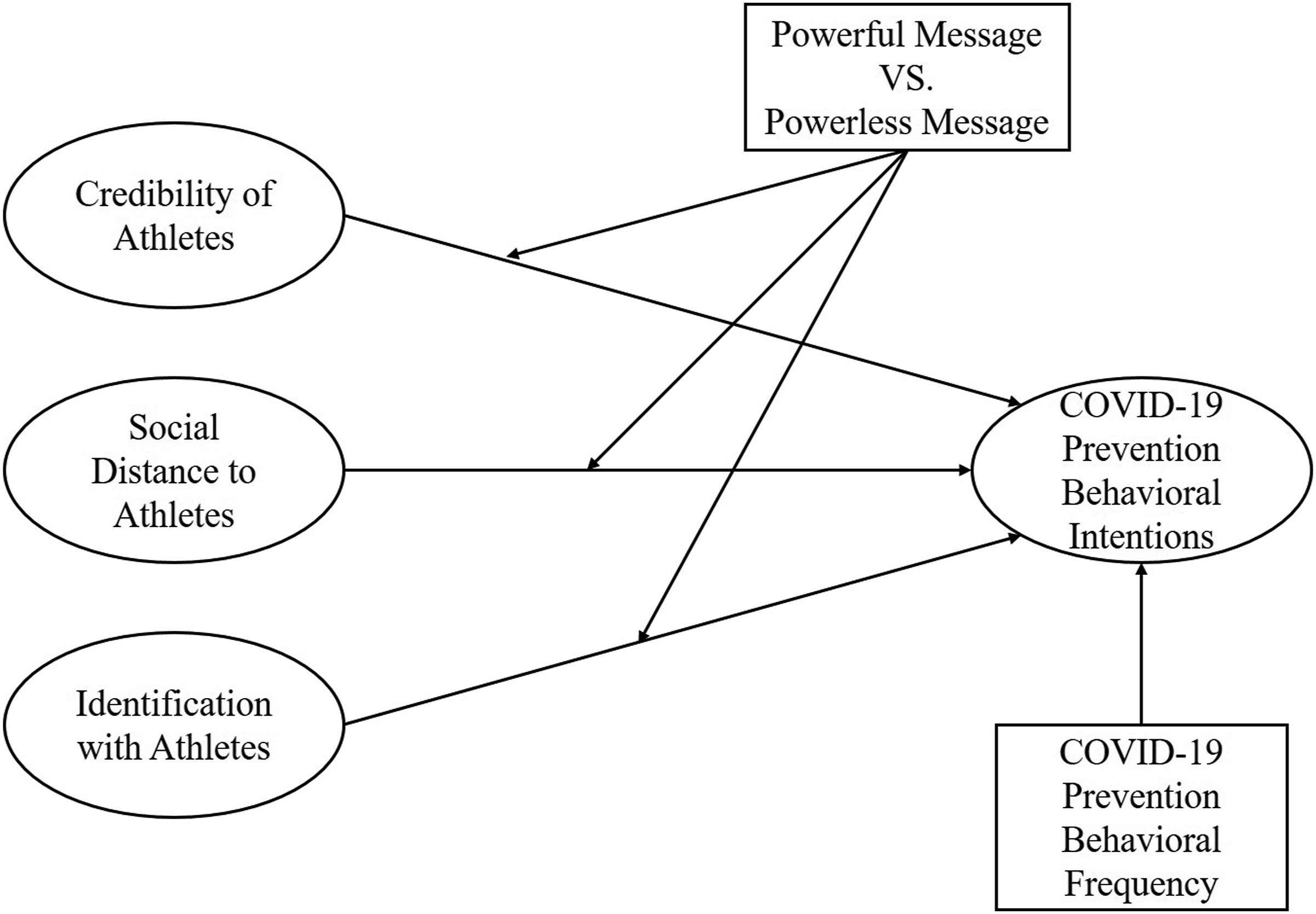
Methods
Samples and Data Collection
According to Dimock (2019), Gen-Zers (born between 1997 and 2012) spend more time on social media and are less engaged in traditional news sources than their older generational counterparts. It has also been reported that since the outbreak of COVID-19 Gen-Zers’ social media consumption has increased by 70% (Burch et al., 2021). Therefore, the present study aims to collect data from Generation Z college students, a primary group of social media users. However, it is important to note that college students are a specific group with relatively homogeneous traits compared to other representative samples (Hanel & Vione, 2016). While the present study’s college students share the characteristics of being Gen-Zers who use social media, they may not fully represent the broader Gen-Z population.
The researchers created self-administered questionnaires on an online survey platform. Also, they developed the study’s stimuli and placed them at the beginning of the survey to arouse respondents’ cognitive processing. The survey platform enabled the stimuli’s random distribution per respondent and the survey link including a stimulus and questionnaires.
The researchers mainly recruited their program’s students and distributed the online survey link to the students. The data collection occurred in the first two weeks of April 2020, when the COVID-19 pandemic worsened, and most universities converted their courses into a remote learning format. This novel circumstance made the researchers employ a convenient sampling technique. Also, the current study could have seized on the impact of sport celebrities on spreading health prevention messages on social media, particularly during the early stage of the pandemic when people were grappling with the veracity of COVID-19 information. However, because this study was cross-sectional, it was unable to capture changes in people’s perceived effectiveness of sport celebrities as the severity of the pandemic deepened.
There were no pre-conditions to participate in the survey except for being aged between 18 and 25. Participating in the survey were students at three American public universities. Two universities were in the Midwest and one in the Southeast. The average time for survey completion was approximately 5 minutes. The final samples were 284 college students—173 males (60.9%) and 111 females (39.1%). Their average age was 22.7 years old. Regarding social media usage, 25% (n = 71) of the samples engaged with social media for one and a half hours daily. The following groups were 2 hours (21.8%, n = 62) and more than two and a half hours (18.7%, n = 53). Considering the substantial time of the samples’ daily social media usage, the samples well represent Gen-Zers’ social media engagement.
Stimuli Development
For their experiments, several studies have created a mimicked Instagram frame (Guizzo et al., 2021, Vries et al., 2018). As its stimulus, this study also did the same, given the platform’s popularity among Gen-Zers and sports celebrities. Of the participants, 189 reported using Instagram actively, while 138 reported actively using Facebook. Twitter users represented the largest group (n = 249), but due to the platform’s brevity, it was not suitable for the study’s purposes. What made Instagram an ideal choice for the study was its focus on visual content rather than text (Guizzo et al., 2021).
In creating the mimicked Instagram post, each celebrity’s race, gender, and sport type were considered to evenly offset any possible effects of survey respondents’ implicit biases toward the celebrities’ particular characteristics. As a result, the researchers picked four sport celebrities, all with significant followings on Instagram. The celebrities were LeBron James (African American male in a team sport with 138 million followers on Instagram as of December 2022), Michael Phelps (Caucasian male in an individual sport, 3.4 million), Alex Morgan (Caucasian female in a team sport, 9.7 million), and Serena Williams (African American female in an individual sport, 16 million).
The researchers developed a powerless and powerful message that included the celebrities’ views on COVID-19 and their comments to encourage the adoption of COVID-19 prevention behaviors. A powerless message was made by implementing three speech marks—hedges, tag questions, and hesitation. This was achieved by using the following words and phrases: “well,” “seem,” “I am not certain if I am in a position to say this,” “that sounds insane,” and “If I understood correctly,” as well as tag questions such as “doesn’t it?” and “Don’t you agree with me?” The second type was a powerful message, which did not include any of these powerless linguistic features. Instead, it emphasized objective data, statistics, and quotes from experts. To convey a more authoritative tone, the message implemented such phrases as “predict that between 100,000 and 200,000 Americans” and “at least 20 seconds,” and words like “reaffirm” and “should.”
Eight mimicked posts (two power styles by four celebrities) were created on Instagram’s frame template, which was intended to evoke survey respondents’ reactions as if they had read that sport celebrity’s actual Instagram post. Some stimuli are shown in Appendix.
Manipulation Check
One of eight stimuli was randomly assigned to a survey respondent. As a result, 29 (10.2%) respondents were exposed to LeBron James’s powerful message, while 38 (13.4%) were to his powerless one. Forty (14.1%) respondents were exposed to Michael Phelp’s powerful message, while 31 (10.9%) were to his powerless one. Thirty-four (12.0%) respondents were exposed to Serena Williams’s powerful message, while 41 (14.4%) were to her powerless one. Lastly, 37 (13.0%) were exposed to Alex Morgan’s powerful message, while 34 (12.0%) were to her powerless one.
To check the stimuli’s manipulation, the researchers included two questions on a 7-point, Likert-type scale ranging from 1 (not at all) to 7 (very much). One question measured the degree to which respondents perceived the assigned post as data-driven (M = 4.79, SD = 1.38). The other question measured the degree to which respondents perceived the assigned post’s celebrity as impersonal (M = 3.93, SD = 1.67). The researchers conducted an independent T-test to compare the powerless messages with the powerful messages on the average score of the questions. The score of the powerful message should be statistically higher than that of the powerless message if the message’s manipulation was properly loaded. As expected, the powerful message (M = 5.14, n = 140) was higher than the powerless one (M = 4.67, n = 144) on the score, t(282) = 3.77, p < .001.
Measures
Three items measured respondents’ perceived experience, knowledge, and qualification of sport celebrities regarding the degree to which they perceived the credibility of sport celebrities talking about COVID-19 (Emmers-Sommer & Terán, 2020). Three items measured the degree to which respondents perceived the social distance of sport celebrities by considering social proximity and closeness to sport celebrities as family, friends, and neighbors (Centeno & Wang, 2020). As for respondents’ identification with sport celebrities, three items measured respondents’ association with sport celebrities, supportive behaviors for sport celebrities, and overall identification with sport celebrities (Chung et al., 2019). Three items assessed respondents’ behavioral intentions to adopt COVID-19 prevention behaviors, such as washing hands, avoiding touching objects, and maintaining social distancing. Lastly, three items examined respondents’ frequency of practicing COVID-19 prevention behaviors on the same items as the behavioral intentions. To verify the adopted items’ validity, the researchers conducted an exploratory factor analysis with the items, resulting in a 77.68% total variance across four factors. The rotated component matrix suggested all items were loaded onto credibility, social distance, identification, and health behaviors as initially designed.
Items’ Description, Descriptive Statistics, and Reliabilities.
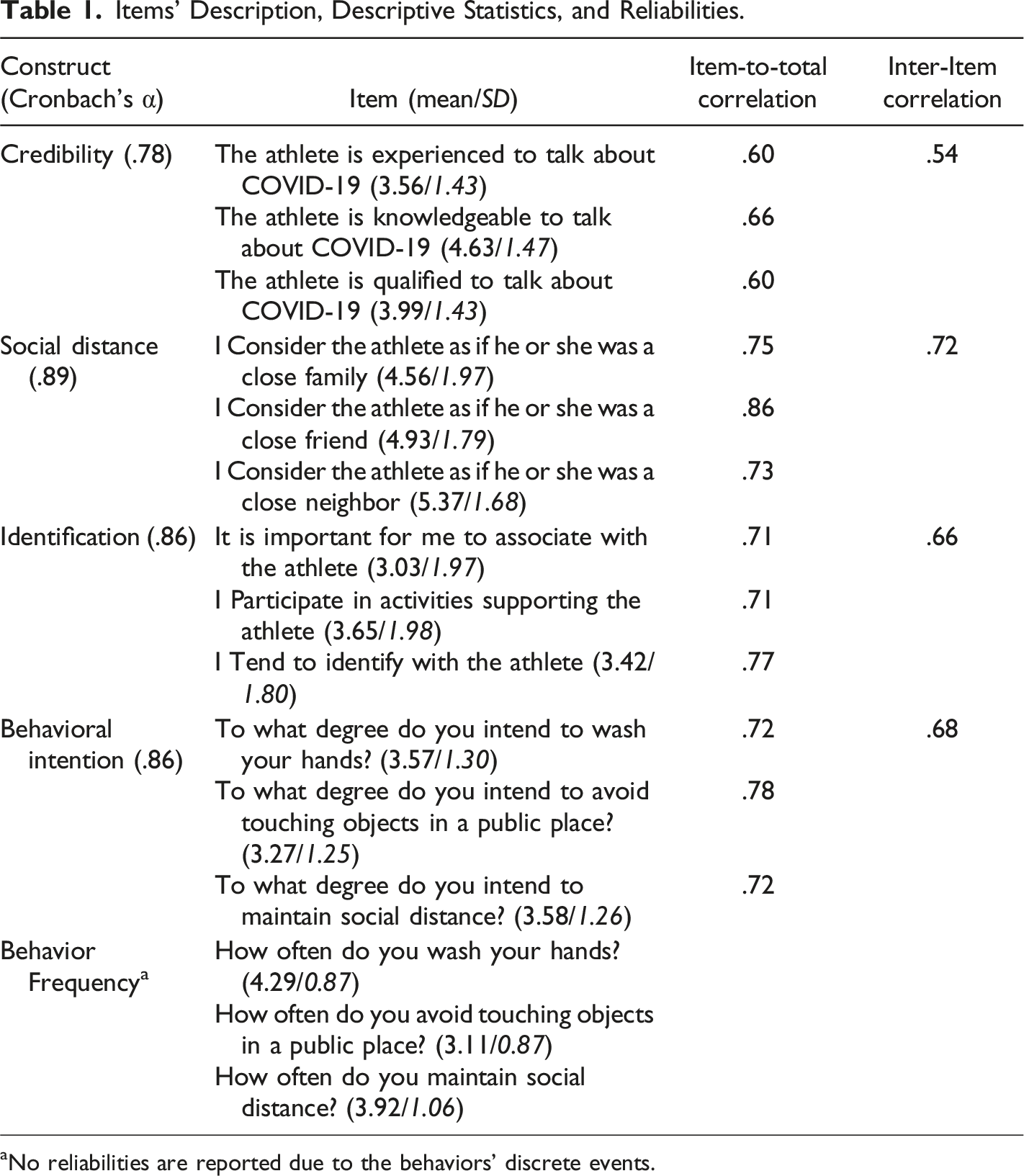
aNo reliabilities are reported due to the behaviors’ discrete events.
Exploratory Factor Analysis Results.
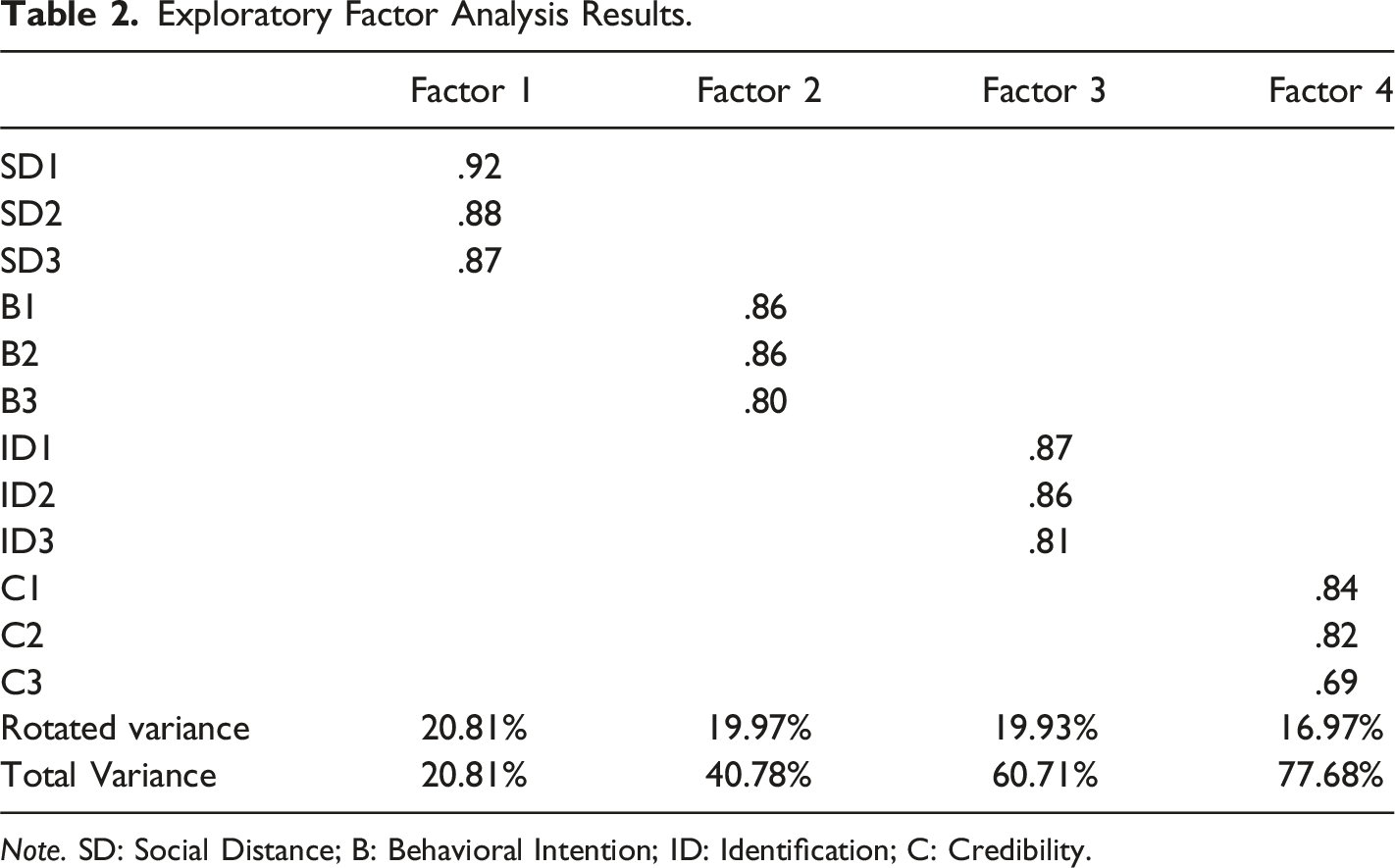
Note. SD: Social Distance; B: Behavioral Intention; ID: Identification; C: Credibility.
Data Analysis
The current study aimed to test the causal effects of the perceived credibility of sport celebrities, perceived social distance of sport celebrities, and identification with sport celebrities on the intentions of Gen-Zers to adopt COVID-19 prevention behaviors while controlling COVID-19 prevention behavior frequencies. The study also aimed to identify a moderating effect of the message’s power styles on those relations (see Figure 1). For these aims, structural equation modeling was deemed appropriate for analysis.
To check the validities and reliabilities of all proposed constructs, the researchers first conducted a confirmatory factor analysis. Comprehensive model testing was then followed to find the magnitudes and significance of the designed paths. Lastly, a moderating effect of the message’s power style was checked concerning critical ratio value differences and their corresponding Z values.
Results
Confirmatory Factor Analysis
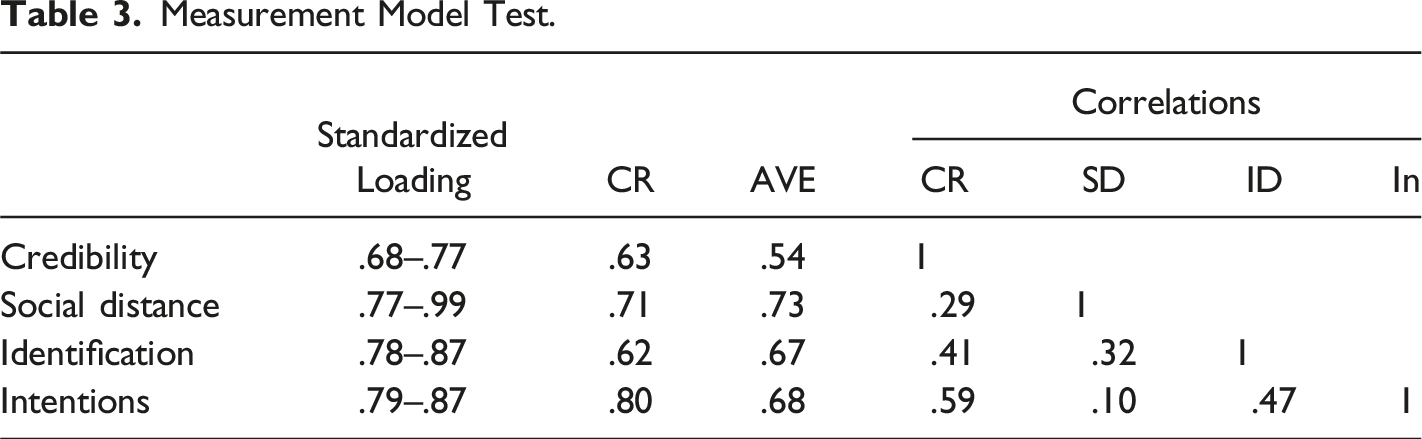
A few absolute fit indices (χ2 = 93.67, df = 48, Normed χ2 = 1.95, p < .001, RMSEA = .06) indicated the model’s fit for the population. Also, a few indices (CFI = .97, IFI = .96, NFI = .95) suggested the model’s incremental fit (Hu & Bentler, 1999, Schreiber et al., 2006).
Three indicators supported the construct’s convergent validity (Fornell & Larcker, 1981). First, the construct’s average variance extracted (AVE) ranged from .54 to .73. Second, the construct’s composite reliability ranged from .62 to .80. Third, all the standardized loadings of each construct ranged from .68 to .99.
Measurement Model Test.
Structural Model Test
The test resulted in χ2 of 180.83 with 118 degrees of freedom (p < .001). The structural model’s fit was found to be acceptable (TLI = .95, CFI = .96, IFI = .96, RMSEA = .04; Schreiber et al., 2006).
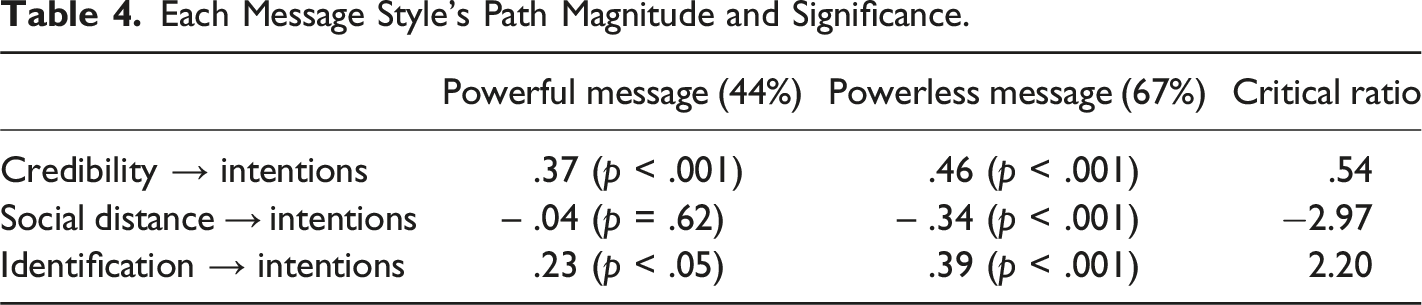
In the powerful message, the effects of the perceived credibility, perceived social distance, and identification on the intentions were .37 (γ1-1, p = .001), −.04 (γ1-2, p = .62), and .23 (γ1-3, p < .05), respectively. These constructs explained 44% of the variance of the intentions, while the behavioral frequency’s controlling effect was .42 (p < .001). College students’ perceived credibility and identification positively impacted their intentions to adopt COVID-19 prevention practices conveyed via the powerful message on sport celebrities’ social media.
In the powerless message, the perceived credibility had a .46 impact on the intentions (γ2-1, p < .001). The effect of perceived social distance on the intentions was −.34 (γ2-2, p < .001). The identification’s effect on the intentions was .39 (γ2-3, p < .001). These constructs explained 67% of the variance of the intentions, considering the frequency’s controlling effect of .51 (p < .001). College students’ perceived credibility, social distance, and identification impacted their intentions to adopt COVID-19 prevention practices conveyed via the powerless message on sport celebrities’ social media.
Each Message Style’s Path Magnitude and Significance.
Discussion
Based on the ELM (Petty & Cacioppo, 1984), the current study tested how college students’ intentions to adopt COVID-19 prevention behaviors were affected by their perceived credibility of sport celebrities (H-1), perceived social distance of sport celebrities (H-2), and identification with sport celebrities (H-3). For this, the study created a sport celebrity’s social media post and randomly exposed it to study participants. Also, the study tested moderating effects of a message’s power style on the relations above (H-4-1/2/3). As for the power style, the study applied powerful and powerless styles.
The study found that college students’ perceived credibility of sports celebrities positively affected their intentions to adopt COVID-19 prevention behaviors that were promoted in sport celebrities’ social media (H-1 accepted). Those positive effects were significant regardless of the message’s power style, suggesting such styles did not impact the relationship (H-4-1 rejected). While college students should have no reason to consider sport celebrities to possess expertise in COVID-19, the magnitudes of credibility on the intentions were substantial.
Sport celebrities’ credibility in areas other than their sport and athletic aspects may be explained by the halo effect (Leuthesser et al., 1995). Sport celebrities’ images as being successful dominate people’s perceptions of them, leading people to think of celebrities as skillful and knowledgeable in health. Also, sport celebrities are often viewed as trendsetters who adopt new practices in their nutrition and exercise routines. With that in mind, it is possible that people overrate sport celebrities’ credibility on health issues. Therefore, the current study’s finding suggests that sport celebrities were capable of playing an impactful role on health behaviors during the global COVID-19 pandemic. While sport celebrities’ halo effect has been found in numerous studies (Brown & de Matviuk, 2010, 2010), the current study finds that that influence carries over even in a global health crisis.
Health professionals often deliver medical and health information objectively and neutrally. Nonetheless, several studies have suggested that medical experts’ powerful message style is ineffective for persuasion, despite perceptions of them as being highly credible in health matters (Blankenship & Craig, 2007, Durik et al., 2008, Fandrich & Beck, 2012). Those studies found that health information would be more effectively accepted when health professionals use a powerless style message. In the current study, sport celebrities’ higher perceived credibility when adopting the powerless message style is consistent with those results.
How to elaborate information on social media should also be considered for the powerless message’s persuasive power. When individuals were exposed to sport celebrities’ social media, the participants likely processed the stimuli not via the central route but via the peripheral route. Such exposure required them to execute less effort and ability to process the information (Areni & Sparks, 2005). In this context, what matters for information elaboration are situational cues. Due to powerless linguistic features, sport celebrities’ genuineness and authenticity should have played a role in strengthening their credibility.
The current study found that college students’ social distance from sport celebrities negatively affected their intentions to adopt COVID-19 prevention behaviors (H-2 accepted). This negative directionality is conceptually compatible with previous studies that examined how the perceived social distance affected communication’s information processing (Centeno & Wang, 2020; David et al., 2002). The social distance relates to how message senders position their social status and power. When people see a sport celebrity as socially proximal, their judgment and perceptions about themselves and the celebrity converge. Finally, people find similarities between themselves and the celebrity and accept the celebrity as a member of the same group. This dynamic suggests that socially distant celebrities can be less persuasive.
High-power individuals are the experts who adopt a powerful message to deliver knowledge and objective information. Low-power individuals often use informal and powerless messages. In this regard, the object’s perceived social distance and power style are substantially related (Centeno & Wang, 2020). For example, health professionals can be easily considered socially distant and powerful with sufficient health information and knowledge, compared to sport celebrities who are more socially proximal due to their familiarity and being powerless with a lack of health information. In the current study, the perceived social distance’s specific effect differed according to the message’s power style (H-4-2 accepted). Therefore, this moderating effect suggests that sport celebrities’ social media would be an effective platform for delivering health messages.
Identification is one’s tendency to identify oneself with the athlete (Heere & Katz, 2014). This tendency is very influential in explaining various sport behaviors, so a substantial number of studies have suggested multiple aspects of how one’s identification with athletes determines their psychological and behavioral characteristics in supporting the athlete (Chung et al., 2019, Kwak & Pradhan, 2020). The current study finds that, whether the message was powerful or powerless, college students’ identification positively impacted behavioral intentions (H-3 accepted). The magnitude’s difference was statistically significant; therefore, the message’s power style had a moderating effect (H-4-3 accepted).
The identification’s effects are baselined on the impact of college students’ social distance on behavioral intentions because social distance and identification commonly concern social membership (Tajfel, 1982). Similar to the difference in the social distance’s effect between the powerful and powerless message, participants’ identification with sport celebrities was much higher for their behavioral intentions in the powerless message than in the powerful message. People who are highly identified with sport celebrities should possess information and knowledge regarding the celebrities and experience some level of perceived connection to that celebrity. Of course, people tend to follow the celebrities’ message when their social status positions like family or friends. In this vein, it makes sense that participants’ identification generated more impact on the intentions when processing the information that appeared on the powerless message.
Practical Implications
The current study’s results suggest that sport celebrities could be a powerful agent to fill the disconnect between reliable health information and misguided and fake news regarding pandemic prevention. Given this, the current study provides some practical implications.
First, health agencies should recognize the significant potential of sport celebrities’ social media platforms in communicating with young people and their communities. Sport celebrities serve as powerful role models, especially for younger generations like Gen-Zers. As a result, sport celebrities’ social media presence can play a crucial role in shaping the young’s behaviors and attitudes. As role models, sport celebrities’ actions and statements on social media should align with their moral standing. Therefore, health agencies must be aware of how sport celebrities are perceived by the public when targeting young people through social media. Young people are likely to be skeptical of sport celebrities’ motivations if they appear to be primarily driven by commercial self-interest. In addition, if sport celebrities are ever embroiled in performance-enhancing drug scandals, their messages on social media become less effective.
Second, health agencies can collaborate with sport celebrities through social media to disseminate accurate and evidence-based health information. The partnership between Stephen Curry and Anthony Fauci, as showcased on Instagram, is a great example of such collaboration. However, there is a challenge in balancing the sport celebrities’ popular image with the credibility of health experts. To overcome this challenge, health agencies can leverage the two-way communication of social media to interact more with sport celebrities’ followers. This would facilitate a smoother transition between the celebrities’ image and the dissemination of more accurate health information.
Lastly, the agencies should consider the message’s nuance and tones in conjunction with the images of sport celebrities. As found in the study, the young generation processed sport celebrities’ health messages via the attributes of the celebrities as well as visual features of the social media platform. This finding highlights the importance of visual displays in social media messages, as they are just as critical as the message’s content and language style.
Limitations and Future Studies
It should be noted that when the current study’s data was collected might have affected study participants’ responses. This claim becomes appealing in light of how people’s perceptions of the pandemic changed after the virus outbreak in 2020. In a longitudinal study conducted by Wise et al., (2020), the researchers examined how people’s risk perceptions and protective behaviors related to COVID-19 changed, as the pandemic unfolded and progressed. The study found that the temporal factor of the pandemic significantly influenced people’s perceptions and health behaviors related to the pandemic. Therefore, future studies should consider the pandemic’s temporal factor regarding how people’s views of the sport celebrities’ health message might change as the pandemic’s severity also changes.
Also, the current study’s mimicked Instagram post lacked participants’ interaction opportunities with other social media users and possibly other sport celebrities. Also lacking were others’ replies, which could affect social media users’ behavioral intentions. Therefore, future studies might consider group dynamics in which social media users interact with one another and develop their attitudes toward celebrities and behavioral intentions through that social interaction.
Hosman (1989) argued that linguistic power style does not accurately represent the range of differences in how a message’s power is perceived. This discrepancy arises because a message’s power style is not simply categorized as either powerful or powerless but is instead perceived along a continuum. This poses a challenge when manipulating powerful and powerless messages in a study. Additionally, sport celebrities are public figures who are often perceived as friendly and attractive. This could create difficulty for the study’s message readers to square a celebrity’s favorable image with their powerful language style. To address this, the current study developed a powerful message that lacked powerless linguistic features and incorporated data-driven and objective information. This approach permitted sport celebrities’ powerful messages to emphasize straightforward communication. For future studies, it would be valuable to consider how sport celebrities’ perceived images and their language style are compatible in developing social media stimuli.
Based on the ELM, the current study investigated the influence of various peripheral cues on how sport celebrities’ COVID-19 prevention messages are processed on social media. Although the primary focus of the study is on the role of the peripheral route, it is crucial to acknowledge the central route’s potential, during information processing, to come into play. This claim is further strengthened by the convergence of social media and traditional media platforms in formats and displays. Recent studies have proposed that social media users may activate dual routes, depending on the platform’s distinctive features (Teng et al., 2014, Zha et al., 2018). This suggestion implies that message recipients might have relied on their central route while processing the COVID-19 prevention messages in this study. It is worth noting, however, that the current study was designed with the assumption that message recipients would predominantly use their peripheral route to process the information appearing on sport celebrities’ social media. Future research should take into account the characteristics of emerging media platforms and how message recipients process information accordingly.
Conclusion
The current study employed the ELM to test how college students processed health information when exposed to sport celebrities’ social media messages. The study also tested the moderating effect of the message’s power style. First, despite sport celebrities’ lack of knowledge and expertise in health, college students’ perceived credibility of the celebrities affected their intentions to adopt COVID-19 prevention behaviors regardless of the message’s power style. This result appears to affirm sport celebrities’ impactful role in promoting public health on social media, especially for young audiences. Second, sport celebrities’ perceived social distance was effective for the intentions only when their messages included a powerless language style. This finding carries implications for how sport celebrities’ social proximity and power status should be positioned for persuasion on their social media. Lastly, identification with sport celebrities was much more vital for the intentions in the powerless message than in the powerful message. This result also suggests who should be targeted and how to communicate in promoting health information on sport celebrities’ social media. Health agencies should consider the influence of sport celebrities and social media’s public accessibility to organize future health campaigns.
Footnotes
Declaration of Conflicting Interests
The author(s) declared no potential conflicts of interest with respect to the research, authorship, and/or publication of this article.
Funding
The author(s) received no financial support for the research, authorship, and/or publication of this article.

Appendix