




Abstract
Background
Access to preventive healthcare improves health outcomes and reduces risk of chronic disease. Annual examinations were integrated into an underutilized clinic at the University of Utah to improve access to preventive care.
Methods:
Nurse practitioners conducted these examinations, which included history, physical examination, age-based screenings, and immunizations. The service was part of a wellness program offering health premium discounts for participants. With employee permission, visit documentation was shared with primary care providers (PCPs) or used to help establish a PCP. Human
Results:
In 2023, 373 examinations were performed, including 719 preventive services and screenings, with 143 referrals for specialty and primary care. Patient satisfaction remained high throughout implementation.
Conclusion/Application to Practice:
This initiative effectively increased access to preventive care for employees, demonstrating the feasibility of offering annual examinations in worksite clinics. The program addresses common barriers to preventive care such as long wait times, PCP shortages, and travel time to appointments.
Keywords
Background
Preventive health care can help decrease the risk of chronic disease and death, reduce health care costs, and improve health outcomes (Ganguli et al., 2019). As of January 2024, the United States Preventive Task Force (USPSTF) includes 58 recommendations for health screenings in adults (Swenson & Ebell, 2016). Recommendations include receiving age-based health screenings and immunizations, which are both widely supported as cost-effective and successful for reducing risk (Ratushnyak et al., 2019). Despite evidence supporting the importance of receiving preventive care, a growing body of evidence suggests that barriers such as long wait times and access to health insurance prevent people from utilizing preventive care (Simon et al., 2017). As of 2020, only 5.3% of United States adults aged 35 years or older had received all recommended preventive health screenings, a decrease from 8.5% in 2015 (Borsky et al., 2018; Reed, 2024). Compounding the problem, the number of primary care providers (PCPs) in the United States decreased 13%, from 265.3 to 232.0 providers per 100,000 population, between 2022 and 2023, making it more difficult for individuals to seek primary care services (United Health Foundation, 2024). In Utah (where this project was implemented), there were 184.3 PCPs per 100,000 population in 2023, well below the national average (United Health Foundation, 2024). In Salt Lake City, Utah, at the center of the University of Utah campus, an employee health clinic exists to provide urgent and occupational health care, free of charge, to University of Utah employees. The purpose of this project was to develop a plan and implement a strategy to increase access to preventive care for the University of Utah employee population.
Project Plan
Many gaps in preventive care can be assessed and addressed during an annual examination. In the United States, 73.2% of American adults have had an annual examination in the last year. As a comparison, in Utah, only 69% of adults have had an examination in the past 12 months (Utah Department of Health and Human Services, 2022). This means that nearly a third of Utahns are not reliably accessing preventive services.
These examinations are typically administered by PCPs, which can include physicians, nurse practitioners (NPs), or physician assistants. In Utah, where Advanced Practice Registered Nurses enjoy full practice authority (Professional Licensing Amendments, Utah Code, 2023), nurses are uniquely positioned to address these glaring gaps in care.
Our program was planned and implemented as a collaboration between the University of Utah Human Resources (UHR) and the University of Utah College of Nursing (CON). The goal of the program was to expand services at an existing on-site occupational health clinic, RedMed Employee Health Clinic, to improve access to wellness examinations. This was done by allowing the clinic to offer preventive care in the form of employee annual examinations (EAEs). By offering EAEs, the goal was to reduce health care costs, improve outcomes, and maintain employee productivity by keeping employees onsite while receiving care.
RedMed Employee Health Clinic is an NP-led clinic located in the center of the university campus. The clinic originally opened in 2016 to provide care to workers who had experienced a workplace injury (University of Utah Health, 2016). Over the years, services were added to include occupational health testing, such as blood tests to monitor for exposure to toxins, occupational hearing tests, as well as services not related to occupational health such as contraceptive care, and urgent care assessment and treatment. While an Occupational Medicine physician serves as the Medical Director and as a clinical resource, RedMed is administered and staffed by College of Nursing staff and faculty, including NPs. The clinic is funded through UHR as a benefit to employees and is set up to offer care at no cost to all employees (University of Utah, 2023).
In 2022, discussions between the RedMed lead clinician, HR staff, the medical director, and the Associate Dean for Practice at the College of Nursing began about the best way to utilize the clinic and its resources to better serve employees. At that time, UHR staff had received informal feedback from employees that their participation in wellness activities, such as EAEs, was limited by long waits to establish with ambulatory primary care offices, scheduling delays for employees with already established PCPs, and inconvenient PCP office locations requiring travel time and time off work. Furthermore, in August of 2023, our clinic manager made phone calls to primary care clinics that are part of the University Health network and found the average wait time to establish with a PCP within this network was about 10 weeks. UHR sought to provide additional options for employees to receive EAEs and appropriate preventive care. These examinations are encouraged by the employer-sponsored health plan and are part of a program called WellU, to encourage health maintenance/management of employees. University employees who complete WellU activities, including an EAE, receive a discount on insurance premiums of up to $40 per month (University of Utah, 2024).
Project Implementation
In 2022, pre-intervention, the clinic was staffed with three Family NPs (1.0 FTE) and one clinic manager (1.0 FTE) who was also trained as a medical assistant. The clinic is only open to employees of the University of Utah. Employees are defined as any individual earning a paycheck from the University. The clinical team partnered with UHR to develop a process by which employees could schedule EAEs and complete the wellness activity in a significantly shorter time than with a typical primary care office. The lead RedMed clinician reviewed evidence-based guidelines for age-based preventive screenings and standards of practice for annual examinations, and engaged with leaders from the University of Utah Department of Family and Preventive Medicine and the College of Nursing Associate Dean of Practice and Community Collaboration to ensure EAE practices were consistent. The RedMed clinic manager arranged for the procurement of additional clinic supplies for specimen collection and a wider immunization offering. RedMed NPs incorporated EAEs into the workflow by offering a limited number of daily appointment times and bringing in an additional NP provider (0.20 FTE) at times of heavy demand. EAEs included a history and physical examination, mental health and substance-use screenings, and age appropriate USPTF-recommended preventive screenings. These included blood work and imaging and any specialty care referrals deemed appropriate by the provider. Vaccines were reviewed with employees and offered in compliance with the Centers for Disease Control and Prevention recommendations. With the employee’s permission, results of the physical examination were forwarded to the employees PCP, if a relationship already existed. If no PCP was identified, employees were assisted in establishing contact. Finally, the RedMed clinic manager compiled a monthly report for UHR with employee ID numbers and date of service, so that those employees could earn their “check mark” for WellU activity completion.
Once a system was established and all relevant stakeholders, including UHR Director of Benefits, the College of Nursing Associate Dean for Practice, and University Department of Family and Preventive Medicine leaders, had agreed on which services the clinic would provide related to the EAEs, the clinic opened its schedule for appointments in January 2023. Newly added preventive offerings were advertised to the University community in a variety of ways including social media, health sciences email newsletter, and new employee orientations. RedMed NPs also encouraged word-of-mouth spread for each employee who presented for any visit type to come to the clinic or to share the information with their co-workers. The University health plan imposed a July 1 deadline to complete all EAEs for the employee’s participation in the wellness program to be validated. As this date approached, demand for EAEs increased and an additional NP was added one day per week for the purpose of providing more EAE appointment slots.
After the July 1 deadline, EAEs continued at an average of two per day. It is expected that the demand will rise again each spring and early summer as the deadline approaches.
Results
In the first year of the new program, 686 EAEs were performed (Figure 1). These EAEs included 38 cervical cancer screenings (Papanicolaou tests), 184 Hemoglobin A1C tests, 229 sexually transmitted infection screenings (for human immunodeficiency virus, syphilis, chlamydia and gonorrhea, and hepatitis C), 193 lipid screenings, 20 referrals for breast mammography, and 22 referrals for colonoscopies. In addition to screenings, 143 referrals for primary or specialty care were generated across the health system, with the 5 most common referrals for care with primary care services, physical therapy, dermatology, obstetrics and gynecology, and psychiatry. RedMed NPs were able to refer to a psychiatric-mental health NP within the College of Nursing’s provider network, providing patients with quicker access to specialty mental health care than through traditional routes of referral. RedMed has been able to provide same week and, in some cases, same-day appointments for these EAEs, and employees can return to work in just over 1 hour. Employee survey data obtained in the first quarter of FY24 reported that 91.4% of survey respondents gave this clinic the highest rating for likelihood to recommend the clinic to friends and family. Similarly, 85.2% of patient survey respondents gave the highest rating for appointment availability.
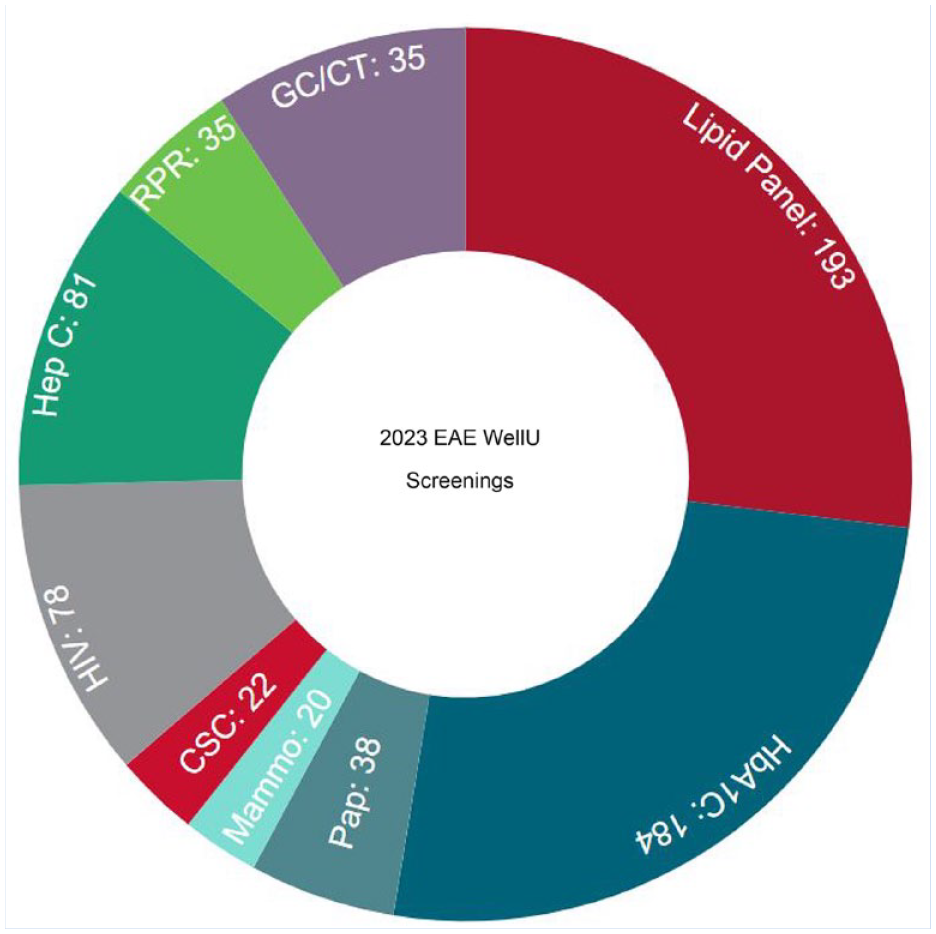
2023 Employee Annual Examinations Health Screenings: HIV= Human Immunodeficiency Virus, Hep C = Hepatitis C Virus, RPR = rapid plasma regain (for syphilis screening), GC/CT = Gonorrhea and Chlamydia, HbA1c = hemoglobin A1c (diabetes screening), Pap = Papanicolaou, Mammo = mammogram (breast cancer screening), CSC = colorectal cancer screening with colonoscopy
An additional consequence of implementing EAEs into the occupational health clinic was that clinic utilization increased from 23.8% in 2022 to 51% in 2023. Clinic utilization was defined by the number of minutes a provider engaged face to face with a patient out of total operating hours. In 2021, the clinic had a total of 933 visits. These numbers increased to a total of 1,639 visits in 2022. After the implementation of EAEs in 2023, visit counts continued to increase for a total of 2,120 visits in 2023. The raw visit counts demonstrate an increase in utilization. Figure 2 shows the increase in provider utilization from 2022 to 2023.
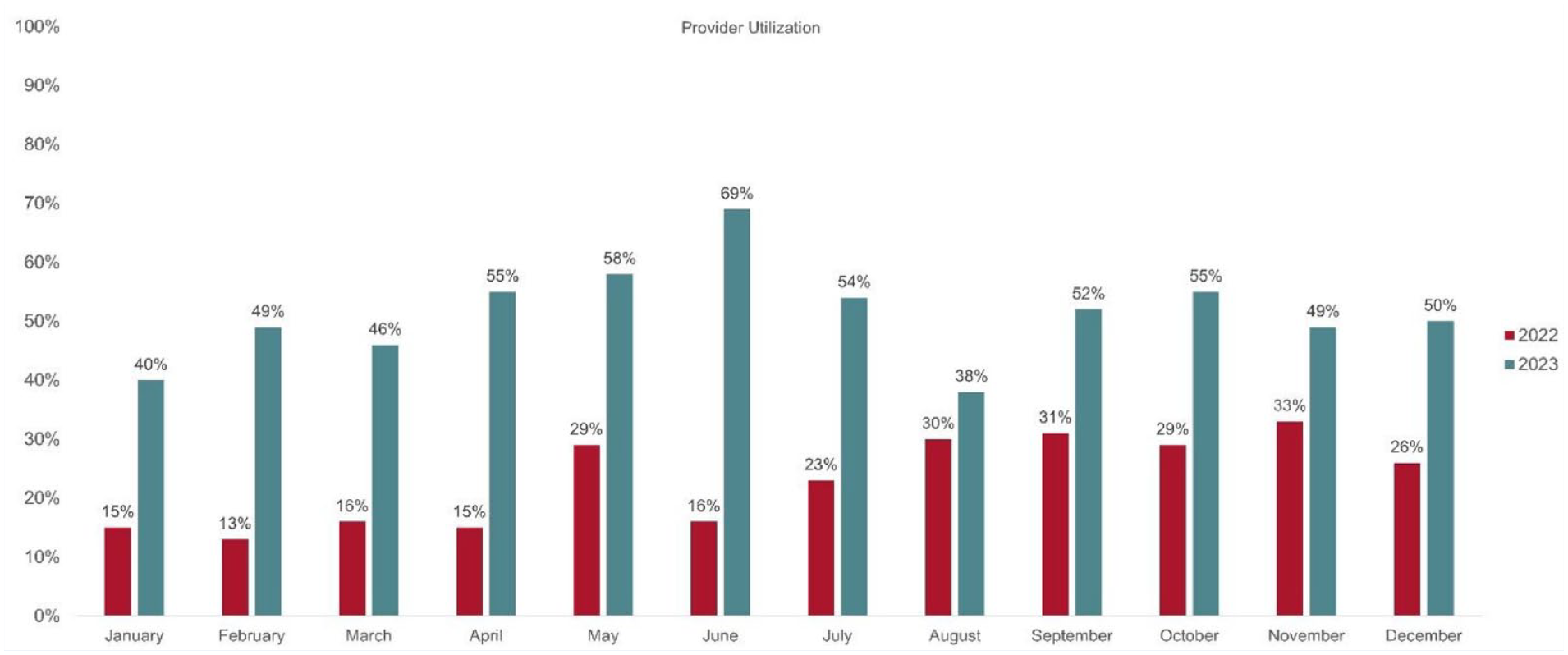
Change in Provider Utilization by Month, 2022 to 2023
Discussion
RedMed Employee Health Clinic successfully added EAEs to other employee services offered for the calendar year 2023. The program has brought value to the University community by providing an additional option to receive timely and convenient preventive care. While the goal of the program was to increase clinic utilization and improve availability, wait times, and ease of use for employees, clinic services demand increased substantially. As a result, the clinic was able to expand other services as well. The office identified a need for and procured an autoclave for sterilization of instruments to begin providing long-term reversible contraceptive devices, including subdermal and intrauterine devices. This service began approximately halfway through the year and a total of 37 contraceptive procedures were completed in 2023. Occupational hearing tests through Shoebox, quantitative mask-fitting services via PortaCount, fluoride treatment application in EAEs, and kinesiology taping of orthopedic injuries were also provided. As more employees came to the clinic, more needs were identified, and overall utilization of the clinic increased. The increase in clinic utilization led to a permanent increase of the NP FTE from 1.0 to 1.2 to meet the needs of the employees seen at this clinic. Within 6 months of expanding NP staff time, the clinic was also able to hire another 1.0 FTE medical assistant as the needs of the employee population and awareness of the clinic continued to grow.
One ongoing challenge was the rate of no-show visits for EAEs which was 12.44% in 2023. In the past, the majority of patients were seen as walk-in appointments, so the no-show rate was 0.5%. Since the increase in utilization when many appointments are scheduled in advance, the no-show rate increased. Currently, there is no penalty for no-showing to this clinic.
Another limitation was space and provider time; RedMed Employee Health Clinic is limited to two examination rooms, without a separate laboratory space, and generally staffs a single provider at a time. This limits the number of employees who can be seen in a day within the clinic. While there is access to additional providers who are available to work in the clinic as needed, until additional space is procured, it is not reasonable to add any more providers to the clinic. The goal is to expand clinic space providing the opportunity to serve more employees for a variety of occupational and preventive health care needs.
As this clinic expansion is a work in progress, it may be appropriate to perform a needs assessment to determine which new services are most needed or wanted by both employees and stakeholders. This could include adding a Psychiatric/Mental Health NP and counseling options or expanding health promotion offerings such as, obesity management or smoking cessation programs, primary care for employees, and expanding care and services for dependents as well.
Applications to Professional Practice
Preventive care, including health screenings and immunizations, are an important part of maintaining the health of any employee population. Access to this type of care is limited by several systems-based barriers, including long wait times and a shortage of primary care providers. Existing on-site occupational health clinics are ideal settings to implement preventive care practices for employee populations. These clinics provide care and treatment to employees at or in very close proximity to their place of employment, are commonly available, and decrease time away from work. Utilizing existing on-site occupational health clinics can be an effective strategy for increasing access to preventive care and reducing healthcare costs, while promoting the health and wellbeing of employees.
Footnotes
Acknowledgements
The authors wish to acknowledge Leslie Bienen of C3 Science Communication for editorial services.
Conflict of Interest
The author(s) declared no potential conflicts of interest with respect to the research, authorship, and/or publication of this article.
Funding
The author(s) disclosed receipt of the following financial support for the research, authorship, and/or publication of this article: Information reported in this publication was supported by the University of Utah College of Nursing. The content is solely the responsibility of the authors and does not necessarily represent the official views of the University of Utah.
Ethics Statement
Project is a health care improvement project and therefore exempt from IRB approval.
