




Abstract
This article, the second in a two-part series, reviews and examines the components of clinical nutrition. In Part 2, the authors discuss nutritional components of fats, proteins, vitamins, minerals, and water. A resource guide is provided for the occupational health nurse to assist in the implementation of employee education in the area of healthy nutrition. The intent of the articles is to acquaint and inform the occupational health nurse on the current guidelines for healthy eating so she or he can better appraise their employee population, thus creating a healthier workforce. The information provided is not all-inclusive on the topics discussed but it provides a foundation for a better understanding of the requirements for healthy eating.
Keywords
This article is the second part of a two-part series. Both articles comprehensively review nutritional components and provide occupational health nurses with information needed to implement workplace programs which promote healthy lifestyles. Part 1 reviewed the recommendations and guidelines for nutritional health as well as discussed, the macronutrient carbohydrate (Toothaker & Chikotas, 2018). Part 2 discusses macronutrients (fat and protein), micronutrients (vitamins and minerals), and provide informational and educational resources that can be utilized by the occupational health nurse in assessing and educating workers about healthy eating.
Macronutrients
Fats
There are many uses to the macronutrient fat (lipids). We fry in it because it transfers heat to rapidly cook food, it creates the creaminess we all enjoy in things like ice cream and cream soups, and improves flavor while adding juiciness. Because it is insoluble in water, it is often used in foods such as salad dressing to provide a unique texture and flavor.
Fat is comprised of three classes of dietary lipids: triglycerides, phospholipids, and cholesterol. These fats are further broken down and classified as saturated and unsaturated fats. The degree of saturation depends on the amount of fatty acids contained within the fat, which assist in the breakdown and absorption of the fat into the bloodstream.
Saturated fats tend to be solid at room temperature. They are saturated with hydrogen molecules due to having no double bond between molecules. They are found mainly in animal products such as fatty red meats, cheese, butter, whole milk, ice cream, pastries, and cookies. Saturated fat, also known as the “bad fat,” can increase low density lipid (LDL) cholesterol levels which increases the risk of coronary heart disease (American Heart Association, 2018).
Unsaturated fats are usually liquid at room temperature due to double bonds which break up the chain of hydrogen molecules and create gaps, making them unsaturated. They are divided into either monounsaturated or polyunsaturated fats. Fats which are monounsaturated tend to be liquid at room temperature but will solidify if cooled in the refrigerator and are the predominant fat found in olives, olive oil, canola oil, peanut oil, avocado, cashews, almonds, and most other nuts. They are commonly known as the “good fats” because when they are eaten in place of saturated fats, they lower LDL cholesterol and raise high density lipids (HDL) cholesterol.
Polyunsaturated fats are liquid at room temperature but stay liquid even below room temperature and are the predominant fats found in fish, corn oil, soybean oil, and safflower oil (American Heart Association, 2017). Because polyunsaturated fats are more susceptible to spoiling food manufacturers may hydrogenate the fat to prolong shelf life. When the fat is partially hydrogenated synthetic trans fats (partially hydrogenated oils) are formed (American Heart Association, 2017). Trans fats are predominantly found in margarine, nondairy creamer, fried foods, pie crusts, ready-made frosting, crackers, and potato chips. Saturated and trans fats are commonly known as “bad fats” because they both raise blood cholesterol and LDL levels and the risk of coronary heart disease (American Heart Association, 2017).
Phospholipids are naturally produced in the human body and are commonly found in foods containing lecithin, which is a component of bile produced by the liver that aids in digestion. Lecithin is found in foods containing egg yolks, wheat germ, soy, milk, and lightly cooked meats. Some vegetable oils and fatty foods also contain phospholipids. The main functions of phospholipids in the body are to provide cell structure and transport fat-soluble substances across cell membranes (Dudek, 2018).
Cholesterol although listed as a fat is considered a sterol. High levels of cholesterol are found in egg yolk, dairy fats, meats, and poultry. Cholesterol is needed to form an integral part of the cell membrane. It is particularly important in the cellular structure of the central nervous system, brain, and an important component of the myelin sheath providing insulation to the nerves. It cannot be utilized for energy as it cannot be broken down within the body. Our livers produce anywhere from 1 to 2 grams of cholesterol per day (Dudek, 2018).
Recommended Intake of Fat
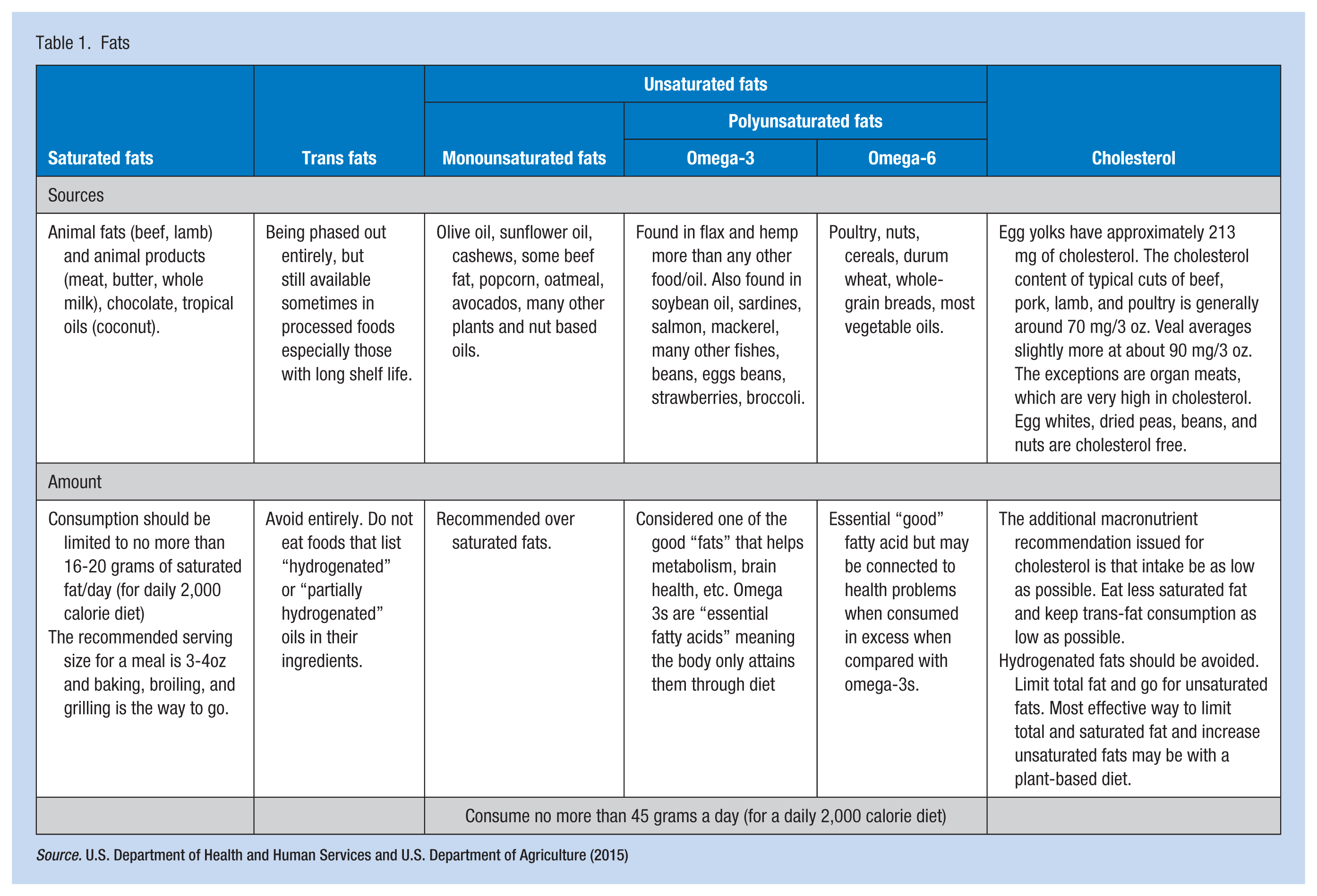
The American Dietary Guidelines (U.S. Department of Health and Human Services & U.S. Department of Agriculture, 2015) recommend that the intake of saturated fats should be limited to less than 10% of calories per day by replacing them with unsaturated fats and while keeping total dietary fats within the age-appropriate range. Individuals 2 years of age and older therefore have no dietary requirement for saturated fats. See Table 1 for types of fats, sources of fats, and dietary reference intake of fats.
Fats
Proteins
Proteins are a component of every living cell and play many critical roles in the body. They do most of the work in cells and are required for the structure, function, and regulation of the body’s tissues and organs (National Institute of Health, 2018). There are 21 amino acids, the basic building blocks of protein, and nine of these are considered essential. As essential proteins cannot be made by the body they must be consumed through food. The main sources of essential proteins come from meat, poultry, seafood, milk, cheese, eggs, and soybeans. These essential proteins are considered complete proteins, as they contain all nine essential amino acids that are needed and have a high biologic value which supports tissue growth and repair (Tessari, Lante, & Mosca, 2016).
There are 12 amino acids which are produced by the body and are considered nonessential and incomplete proteins as they do not contain all of the essential amino acids. The main sources of nonessential proteins typically come from plants such as grains, nuts, fruits, legumes, and vegetables (Tessari et al., 2016).
Recommended Intake of Protein
The recommended daily allowance of protein for healthy adults is 0.8 g/kg. The Dietary Guidelines for Americans (U.S. Department of Health and Human Services & U.S. Department of Agriculture, 2015) recommend that on average women should consume 46g/day and men should consume 56 g/day. The Acceptable Macronutrient Distribution Range for protein in adults is 10% to 35% of total calories.
High protein foods often come packaged with unhealthy fats and hidden salt. For example, a six-ounce broiled-bone steak is a great source of protein—about 41 grams. But, it also delivers about 17 grams of saturated fat (USDA National Nutrient Database, 2015). For someone who eats a 2,000 calorie per day diet, that’s more than 60% of the recommended daily intake for saturated fat.
In comparison six-ounces of wild salmon has about 34 grams of protein and is naturally low in sodium and contains only 1.7 grams of saturated fat (USDA National Nutrient Database, 2015). Salmon and other fatty fish are also excellent sources of omega-3 fats, a type of fat that is especially good for the heart. Alternatively, a cup of cooked lentils provides about 18 grams of protein and 15 grams of fiber, and it has virtually no saturated fat or sodium (USDA National Nutrient Database, 2015).
Water
Water is considered one of the macronutrients and is the single largest constituent of the human body, averaging 60% of total body weight. Water aids digestion, absorption, transport of nutrients, and oxygen throughout the body, and excretion of toxins. The occupational health nurse needs to be cognizant that the average adult loses approximately 1,750 to 3,000 ml of water daily (Gropper & Smith, 2013). There are two types of water loss: sensible and insensible water loss. Sensible water loss is measureable loss coming from urine, stool, and so on. Insensible water loss is not measurable and occurs during respirations and through the skin, so moments of excessive sweating can increase the total amount of loss. The importance of managing water loss lies in preventing dehydration. Signs of dehydration include poor skin turgor, low blood pressure, concentrated urine, and dry mucous membranes (Bailey, Sands, & Franch, 2014).
The body produces a small amount of water through the catabolism of carbohydrates, fats, and proteins, otherwise water is essential and must be consumed. Men need an adequate intake of water of 3.7 L/day and women need 2.7 L/day. To clear the body of toxins the average adult needs to secrete 500ml of urine a day. Daily outputs range from 1500 to 2000 ml per day (Dudek, 2018).
Micronutrients
Vitamins
The first vitamin, thiamine, was discovered in 1913 known as the “vital amine” necessary to prevent the deficiency disease beriberi. Today, 13 vitamins are identified as “essential” for human nutrition (Combet & Buckton, 2015). The quantities needed are micrograms or milligrams aligning with micronutrients and essential to one’s diet. With a few exceptions (vitamin A, D, and niacin), the body cannot make vitamins. Therefore, it is crucial that occupational health nurses educate workers on the quantities and sources of these essential vitamins, which are needed for numerous functions in the human body.
The absorption rate of natural and synthetic vitamins at times differs secondary to different chemical forms of the same vitamins (Lutz, Mazur, & Litch, 2015), however, the body cannot differentiate between natural and synthetic vitamins. Vitamins found in food are susceptible to destruction and subsequent loss of function and value. Destruction of vitamins occur mostly with heat, water, and oxidation. Oxidation is the natural chemical process of substances combining with oxygen, hence, the longer fruits and or vegetables are exposed to temperature and light the less nutrients and value they will have (Ioannou & Ghoul, 2013).
Classification of Vitamins
Vitamins are categorized due to distinctive characteristics in their solubility in either fat or water. This property helps to classify vitamins and aids in the storage and processing of foods that contain vitamins. Fat-soluble vitamins are A, E, D, and K, while water-soluble vitamins are B, 1, 2, 3, 6, and 12, folate, and C.
The occupational nurse needs to differentiate between the different vitamins and their value to assist workers in choosing healthy foods rich in vitamins to maintain good health. Lutz et al. (2015) denote that vitamins are “similar to keys in a lock, all the notches in a key have to fit the lock, or the key will not turn” (p. 97).
Fat-Soluble Vitamins
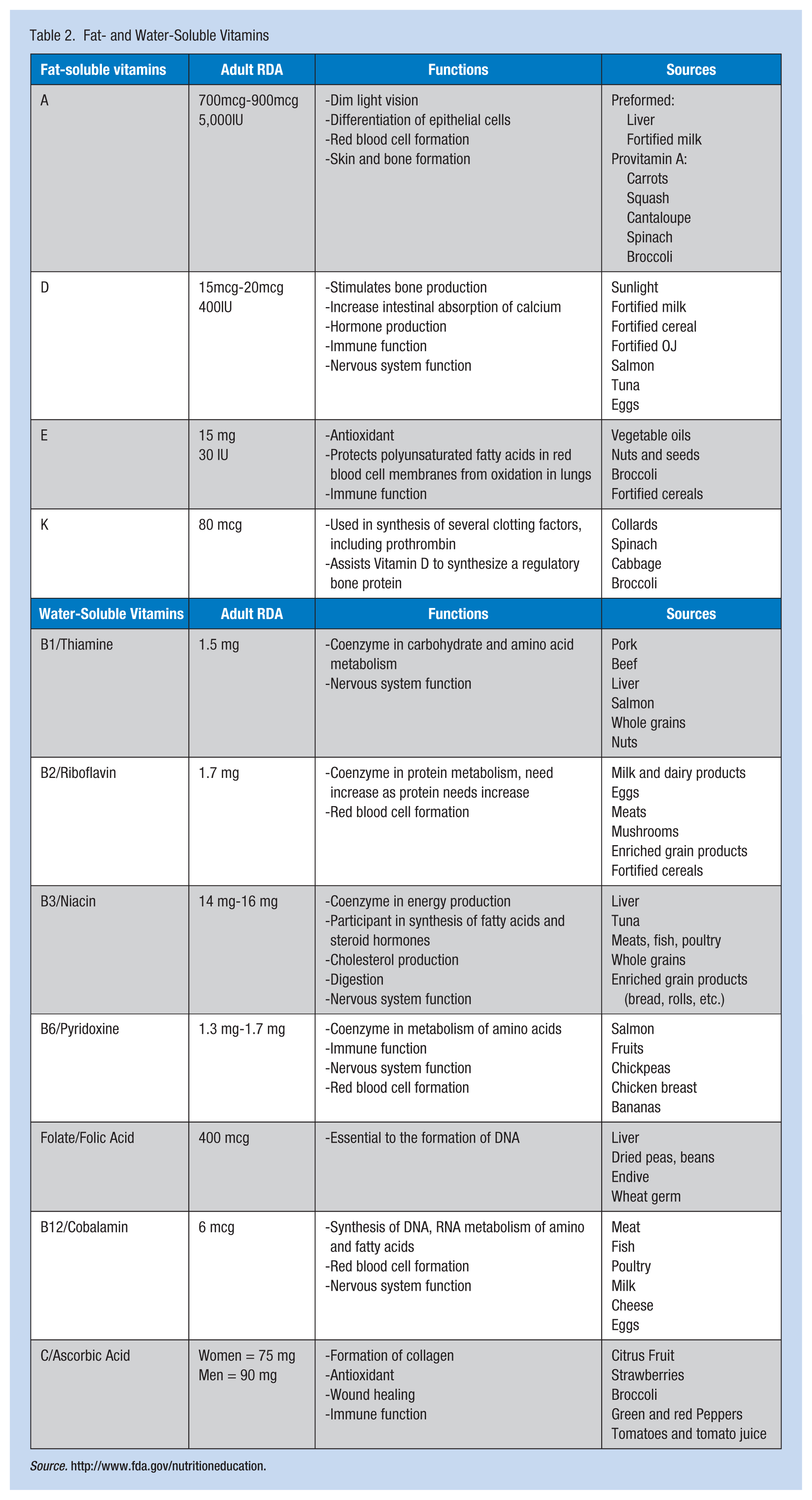
Fat-soluble vitamins are absorbed through the intestine and can be stored in the body for varying lengths of time. Toxicity of certain vitamins such as A and D can occur. There are two types of Vitamin A one of which the body performs conversion on. The two forms are: preformed vitamin A (retinol) and provitamin A (beta-carotene). Provitamin A (beta-carotene) converts to vitamin A (retional) when reserves are low and it is then stored as Vitamin A (retional) (Kono & Arai, 2015). For a listing of fat-soluble vitamins and their recommended daily allowance (RDA) and sources, please see Table 2.
Fat- and Water-Soluble Vitamins
Water-Soluble Vitamins
Vitamins that dissolve in water are known as water-soluble vitamins. These vitamins when compared with fat-soluble vitamins are not stored in the body but rather the body absorbs what is needed and excretes the excess in urination. Therefore, the body needs a continuous supply of water-soluble vitamins through a steady daily intake. Water-soluble vitamins are found in fruit, vegetables, and grains, and can be destroyed by heat, lost in water used for cooking, or by excessive exposure to air. For a listing of water-soluble vitamins and their RDA and sources please see Table 2.
Minerals
Minerals are inorganic elements that originate from the earth’s crust. Plants absorb minerals through their roots and animals also eat plants, so some minerals are obtained indirectly by consuming foods originating from animal sources. Therefore, minerals are found in dairy products, meats, fish, fruits, vegetables, and nuts. They are mainly absorbed in the small intestines and then utilized as needed for the numerous functions they assist with in the body. Some of the functions of minerals include assisting with acid-base balance, fluid balance, nerve cell transmission, structural support (bones, etc.), and hormone activity. They assist to regulate bodily functions without providing energy.
Major minerals are present in the body in amounts greater than 5g and are needed in larger amounts. Major minerals include calcium, phosphorus, magnesium, sulfur, sodium, potassium, and chloride. Trace minerals (less than 5g) are needed in smaller amounts and include iron, iodine, zinc, selenium, cooper, manganese, fluoride, chromium, cobalt, and molybdenum. Both of these mineral groups are essential for life (U.S. National Library of Medicine, 2015).
Minerals stay better preserved than vitamins and are mainly lost in the cooking process of boiling, not due to the heat but of leaching that occurs into the boiling water. Therefore, steaming is the best way to preserve the essential minerals.
Trace minerals are difficult to measure and only four trace minerals have a RDA amount. The four assigned amounts are iron, iodine, fluoride, and zinc, while selenium, chromium, copper, manganese, cobalt, and molybdenum are defined by the label “trace.” See Table 3 for the recommended daily allowances, the function, and sources of major and trace minerals.
Vitamins

The Daily Values are the amounts of nutrients recommended per day for Americans 4 years of age or older.
Nutritional Supplements
Unlike drugs, nutritional supplements are not permitted to be marketed for the purpose of treating, diagnosing, preventing, or curing diseases. That means supplements should not make disease claims, such as “lowers high cholesterol” or “treats heart disease.” Also, dietary supplements are not reviewed by the government before they are marketed, but the Food and Drug Administration (FDA) has the responsibility to take action against any unsafe dietary supplement product that reaches the market. If the FDA can prove that the claim on a marketed dietary supplement are false and misleading, they can take action against the producer of the supplement (U.S. FDA, 2017). Employees should be taught that the price of the supplement is not a way to gauge its effectiveness and that supplements should not be used to replace nutrient complete meals, which are needed for a healthful diet.
Resources
Resources exist to aid the occupational health nurse in educating their employees on healthy eating and nutrients. Table 4 displays resources and associated web-links for quick resources on dietary guidelines, healthy eating, and dietary reference indexes. The resources provide user-friendly websites with health information for individuals and families.
Nutritional Resource Guide for the Occupational Health Nurses
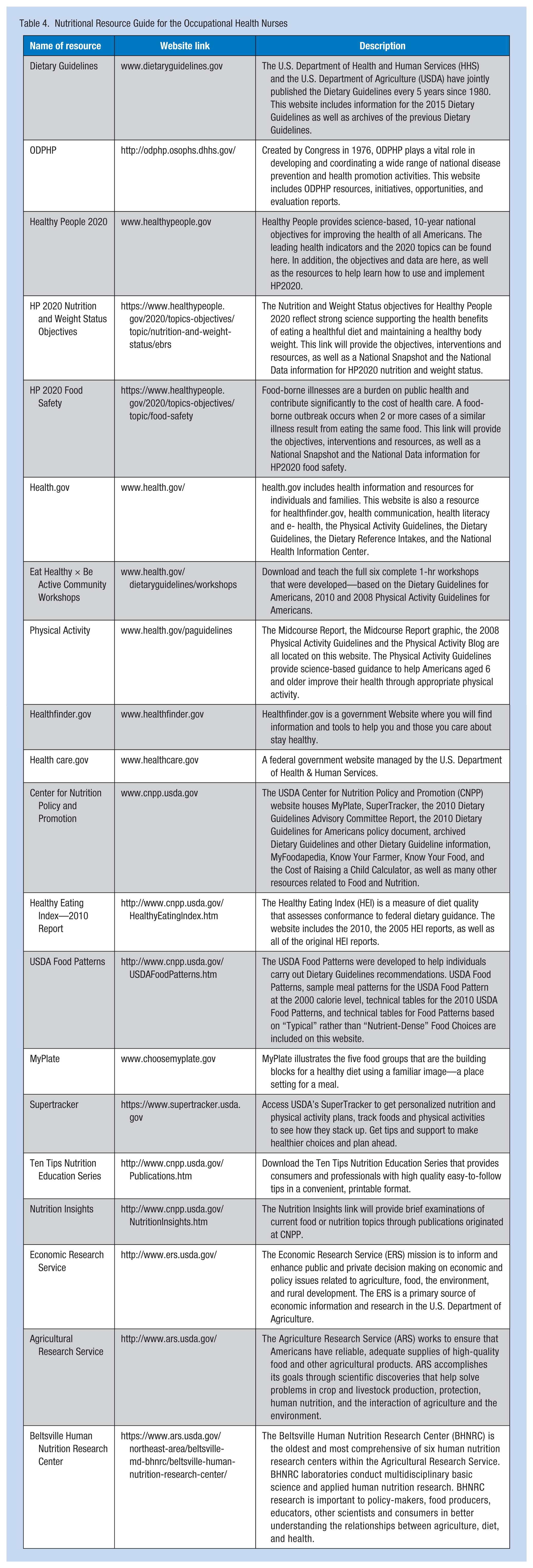
Occupational health nurses can aid their employees with wellness in nutrition by supplying their workers with websites and online resources for quick reliable access. The table exemplifies a wide range of resources that can play a vital role in aiding workers to lead a more nutritious lifestyle.
Summary
This article, the second in a two-part series, reviewed the recommendations and guidelines for both macronutrients (carbohydrates, proteins, and fats) and micronutrients (vitamins and minerals). Educational resources are provided in Part 2 to assist the occupational health nurse in educating their employees.
Footnotes
Declaration of Conflicting Interests
The author(s) declared no potential conflicts of interest with respect to the research, authorship, and/or publication of this article.
Funding
The author(s) received no financial support for the research, authorship, and/or publication of this article.