



Abstract
Background: The training of farmers in pesticide safety is of prime importance for reducing pesticide use and exposure through the implementation of sustainable management practices. This study aimed to assess the impact of compulsory training on the knowledge and perceptions of cereal farmers, with the help of a safety climate scale. Method: We approached cereal farmers throughout France during compulsory training and certification procedures for pesticide-related activities. Trainees were asked to complete a safety climate questionnaire at the start and end of the course. In total, 733 cereal farm managers or workers completed the questionnaire at the start of the study, 131 of whom declined to complete the questionnaire at the end of the training session, leaving 602 subjects available for pre-training/post-training comparisons. Statistical analyses were based on paired t-tests and mixed models for repeated measures. Findings: The mean safety climate score increased from 82.37 to 88.22 after the training course (7.1 %, p < .001) in both univariate and multivariate analyses. Mean increases were also found for each of its seven dimensions (p < .001), ranging from 2.8% for “rules and best practices” to 12.4% for “communication and feedback.” Few covariate-by-time interactions were found to be significant. Conclusion/Application to Practice: This study demonstrates that pesticide training is highly effective in increasing safety climate perception among cereal farmers and provides hints for improving the design of educational programs. Promoting the development and facilitation of lifelong learning with continuously updated training programs should be a top priority for minimizing pesticide exposure.
Background
France was the ninth largest producer of cereals worldwide in 2021 (World Bank, 2024). Not only is France the leading cereal producer in Europe, but it is also the leading user of pesticides (Eurostat, 2024; Food and Agriculture Organization Statistics [FAOSTAT], 2024). Cereals occupy around half the arable land in France (around 10 million hectares), and account for the largest proportion of pesticide use, in terms of monetary value (67.4%; Butault et al., 2011).
Cereal farmers use a wide range of chemicals, including insecticides, herbicides, fumigants, seed dressings, and rodent poisons (Crisan, 2019). Workers involved in the preparation, transportation, loading, and application of pesticides are at the highest risk of exposure to these chemicals through splashing, spills, or leakage or from the dust generated by pesticides in solid form (Damalas & Koutroubas, 2016). However, in addition to those working directly with pesticides, field workers, residents, and bystanders may be exposed to the chemicals concerned and the potential hazards associated with them via drift when pesticides from a neighboring field or farm are carried on the wind (Calliera & L’Astorina, 2018; European Food Safety Authority, 2022).
Cereal farmers can use several strategies to decrease pesticide exposure in farm workers and the general population. Activities such as the implementation of preventive measures, improved safety training, and notifying field workers and nearby residents in advance about spraying are important steps toward the reduction of pesticide exposure (Damalas & Koutroubas, 2017). All these actions are elements of the general safety culture, which embodies the value placed on safety and the extent to which people take personal responsibility for safety within an organization (Ratilainen et al., 2016). The prevailing safety culture therefore appears to be of prime importance for reducing pesticide use and exposure through the implementation of sustainable management practices.
Under Directive 2009/128/EC of the European Parliament and Council on the sustainable use of pesticides (European Parliament and the Council, 2009), France has drawn up a national action plan for implementing the range of actions set out in the Directive, including the training of users, advisors and distributors of pesticides. The use and purchase of phytosanitary products requires possession of an individual certificate commonly known as “Certiphyto.” This certificate is awarded after mandatory training, as part of the certification scheme in place, which includes requirements and procedures for the awarding, renewal, and withdrawal of certificates. This training program is designed to ensure that farmers acquire sufficient knowledge to adopt good practices for sustainable agriculture. For example, the training program covers hazards and risks associated with pesticides, integrated pest management strategies, and techniques.
Evaluations of training effectiveness can help agricultural authorities and instructors to design more effective training components. However, there have been surprisingly few intervention studies to evaluate the efficacy of training designed to improve agricultural workers’ knowledge, behavior, and perceptions to reduce the risk of pesticide exposure. Afshari et al. (2021) selected and reviewed 31 studies. They found that educational interventions effectively improved the knowledge and attitudes of the participants but were less effective in changing behavior and, thus, the risk of exposure to toxic pesticides. Ayaz et al. (2022) subsequently performed a meta-analysis of 38 studies and showed that educational interventions had a major effect on the knowledge of agricultural workers, a moderate effect on their behavior, and a minor effect on risk perception. However, all the studies considered in these two reviews were performed outside Europe. In northern Greece, Damalas and Koutroubas (2017) found that most trained farmers had greater knowledge of pesticide use, stronger beliefs in pesticide hazard control, and better safety behavior than non-trained farmers. Cevik et al. (2023) recently observed that the training of Turkish farmers in the safe use of pesticides encouraged them to develop positive behavioral changes. Rattanawitoon et al. (2023) found a significant improvement in knowledge, attitudes, practices, and beliefs about chemical pesticide exposure among female farmworkers in Thailand after a pesticide training program.
The goal of this study was, therefore, to assess the impact of compulsory safety training in a European country (France) on the knowledge and perceptions of cereal farmers concerning pesticide use, with the help of a safety climate scale.
Methods
Study Population
Under Directive 2009/128/EC of the European Parliament and Council on the sustainable use of pesticides (European Parliament and the Council, 2009), France requires farmers to obtain and hold an individual certificate (Certiphyto), for the purchase and application of pesticides. Chapter II of the Directive establishes rules and principles for the training of professionals, while Annex 1 outlines the training subjects. Certiphyto training is consistently improved with the knowledge acquired from recent research in the field (French Ministry of Agriculture, Agrifood and Forestry, 2013).
We approached farmers during their mandatory Certiphyto training to request their participation in this study. The training courses are conducted by occupational health and safety practitioners and agronomists. Certiphyto certificates are initially awarded for 5 years following the completion of a 2-day training program. The training course covers diverse aspects including the legislation in force concerning pesticide use, the hazards and risks of pesticide use, risk management measures to protect humans and the environment, integrated pest management strategies and techniques, the assessment of occupational and environmental risks at farm level, and the management of equipment and working practices to decrease exposure to pesticides. After 5 years, farmers must attend a 1-day refresher course to update their knowledge and to address any issues they may have. Furthermore, Certiphyto training is specifically designed for two different sets of participants—decision-makers and operators—to ensure more appropriate pesticide use. The study population considered here consisted of cereal farm managers and workers attending either the initial Certiphyto training course or a refresher course.
Safety Climate Scale
The safety climate is used as a measurable proxy for the prevailing safety culture (Huang et al., 2013). This approach is more widely used in industry than in agriculture. Alongside numerous authors, whose definition of safety climate hinges on the shared perception of security concerns (Luo, 2020), we also viewed safety climate as the combination of shared perceptions among workers regarding procedures, practices, attitudes, and behaviors pertaining to occupational safety (Fargnoli & Lombardi, 2020).
We used a safety climate scale that was specifically designed and validated for the agricultural industry (Grimbuhler et al., 2023; Grimbuhler & Viel, 2019). The reliability (Cronbach’s alpha of 0.81) and construct validity of this scale have been shown to be good (Grimbuhler & Viel, 2019). This scale focuses on individuals’ perceptions regarding pesticide use, safety, and regulations. The psychometric model has seven dimensions (management commitment, communication and feedback, rules and best practices, knowledge, safety compliance, safety participation, teamwork climate), evaluated via 20 items (Table 1). Each of the 20 items were rated on a 5-point Likert-type scale. The corresponding scores were then summed to calculate a global score ranging from 20 to 100. Higher scores indicate a better safety climate.
Safety Climate Scale for the Agricultural Sector
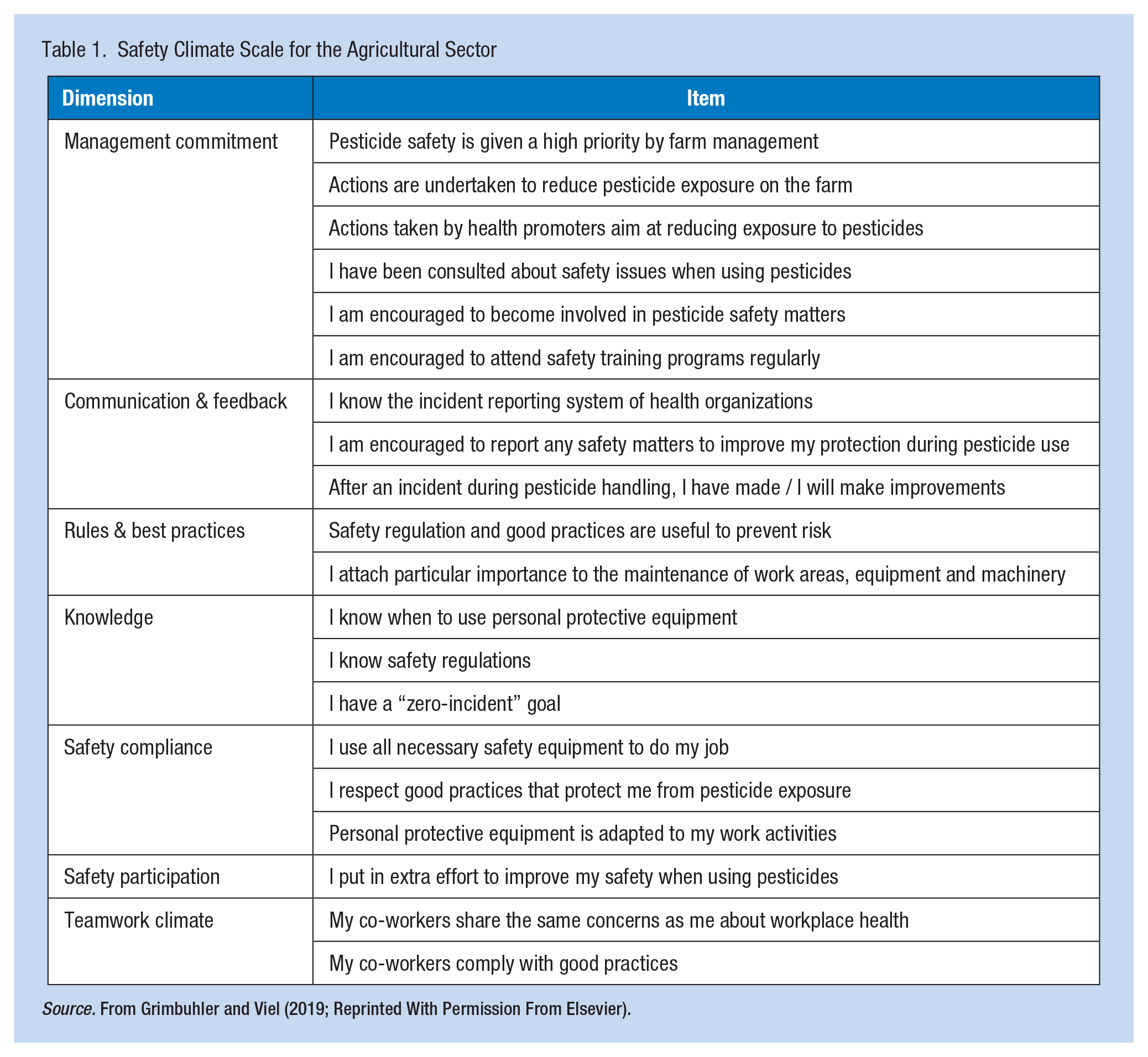
Source. From Grimbuhler and Viel (2019; Reprinted With Permission From Elsevier).
Data Collection
Trainers from 125 Certiphyto sessions, organized between March 2021 and April 2023 throughout France, agreed to allocate some of the training time to the completion of the survey. In total, 1,411 trainees gave informed consent to participate in this study and completed a standardized two-section self-administered questionnaire, excluding health data. The first section of the questionnaire concerned the characteristics of the farmers, with the collection of demographic and occupational data. The second section of the questionnaire was devoted to the safety climate scale. The questionnaire was completed anonymously, for academic purposes, during the compulsory training and certification procedure. As such, no ethics committee approval was required according to the European Union regulations in force (European Parliament and the Council, 2016).
Participants were asked to complete the questionnaire twice: at the start (D0) and end (D1 for 1-day refresher courses or D2 for 2-day initial courses) of the training session. We considered this course to be an intervention that would likely lead to a change in scores, as the safety climate is known to vary over time and in different circumstances (Luo, 2020). Therefore, we assumed that the safety climate scores would increase from the beginning to the end of the course. This is because the course attendees’ perceptions of safety-related policies, procedures, and practices (represented by the different dimensions of the safety climate scale) could become more accurate due to the training content and group dynamics (Damalas & Koutroubas, 2017). In other words, our research hypothesis was that after receiving the training, participants’ improved knowledge and skills could lead to increased awareness of occupational safety issues related to pesticide use.
Certiphyto training courses are organized for all farmers coming into contact with pesticides, not just cereal farmers. We therefore considered only the participants in these courses who had declared cereal farming activities. In total, 733 cereal farm managers or workers completed the safety climate questionnaire on D0. At the end of the course, 131 of these individuals declined to complete the questionnaire a second time. The final analysis therefore included 602 subjects with paired responses for whom pre-training/post-training comparisons were possible.
Statistical Analyses
For comparisons of the mean scores obtained before and after training (n = 602), we initially used a univariate approach based on paired t tests. Cohen’s d for paired samples was used to describe the standardized mean difference and assess the magnitude of the intervention (Lakens, 2013). We then tested the differences in safety climate score with a mixed model for repeated measures (MMRM) including terms for risk factors, time (D0 and D1/D2), and risk factor × time interactions (Cnaan et al., 1997). Covariate × Time interactions (p < .20) identified in univariate analyses were included in multivariate MMRMs. We performed sensitivity analyses for each subscore to guide the further development and implementation of more effective interventions.
P values <.05 were considered statistically significant, and all tests were two-tailed. Statistical analyses were performed with the base and mmrm packages of R software.
Results
Survey Participants
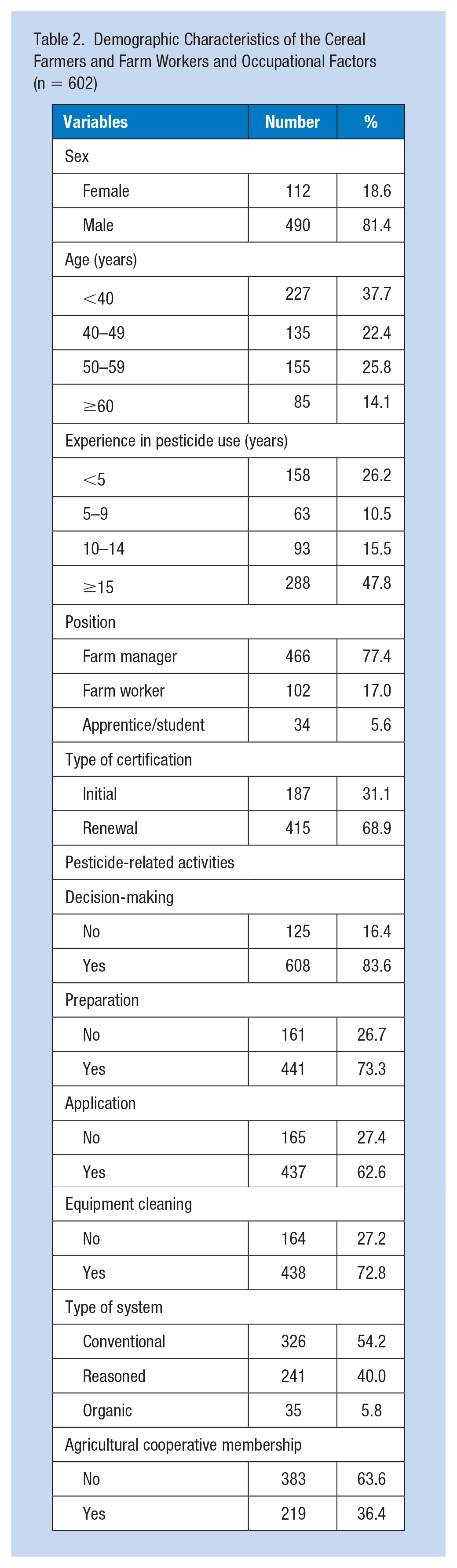
Demographic and occupational data for the 602 cereal farm managers and workers participating in the safety climate survey are reported in Table 2. Most of the respondents were male, less than 50 years old, had more than 10 years of experience in pesticide use, were involved in all pesticide-related activities, worked on conventional farms, and were not members of an agricultural cooperative.
Demographic Characteristics of the Cereal Farmers and Farm Workers and Occupational Factors (n = 602)
Safety Climate Scores
The mean safety climate score for cereal farm managers and workers was 82.37 (standard deviation [SD]: 9.29) at baseline. It increased significantly to 88.22 (SD: 9.48) after the Certiphyto course (7.1%, p < .001) (Table 3). A similar pattern was observed for each of the seven dimensions (p < .001), with increases ranging from 2.8% for “rules and best practices” and 6.2% for “management commitment” to 7.4% for “knowledge” and 12.4% for “communication and feedback..” The Cohen’s d value was 0.73 for the global score indicating a rather large effect size, while the values for the subscores ranged from 0.23 to 0.72.
Sensitivity to Change in Safety Climate Scores in Response to Certiphyto Training (n=602)
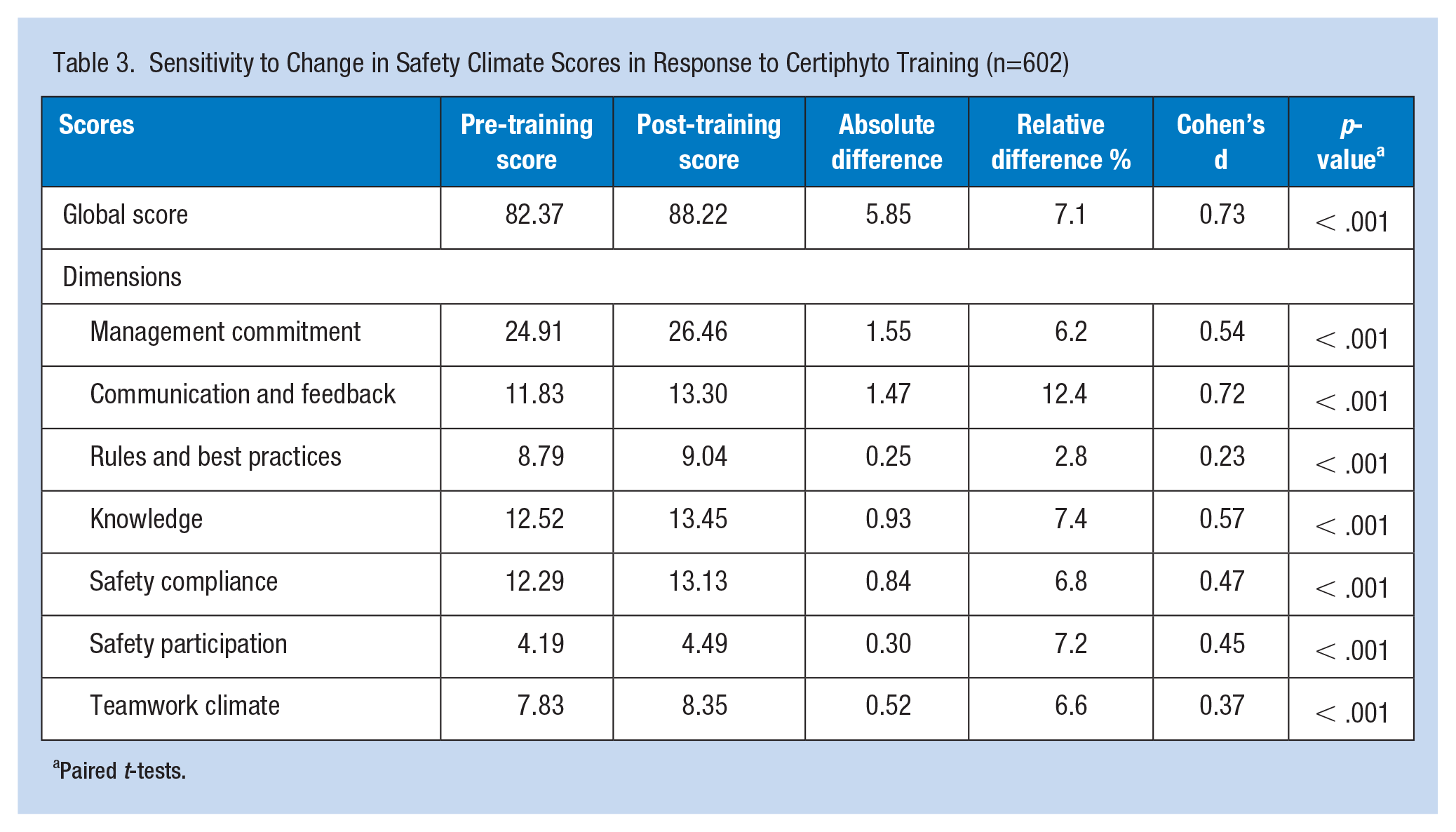
Paired t-tests.
Adjustment for covariate-by-time interactions identified in univariate analyses did not alter the statistical significance of score changes (Table 4). Sex was a significant factor for the global score (p < .05), the communication and feedback dimension (p < .05), and the knowledge dimension (p < .001) with smaller increases in score noted for male participants. Age was a significant factor for the communication and feedback dimension (p < .01) with smaller increases in score noted for older participants. Type of certification (initial or refresher course) was significant for the rules and best practices dimension (p < .05) and the knowledge dimension (p < .01) with smaller increases in score noted for participants in refresher courses. Decision-making was significant for the safety compliance dimension (p < .01) with larger increases in score for individuals involved in decision-making.
Results of a Mixed Model for Repeated Measures Comparing Pre- and Post-Training Safety Climate Scores (n = 602)
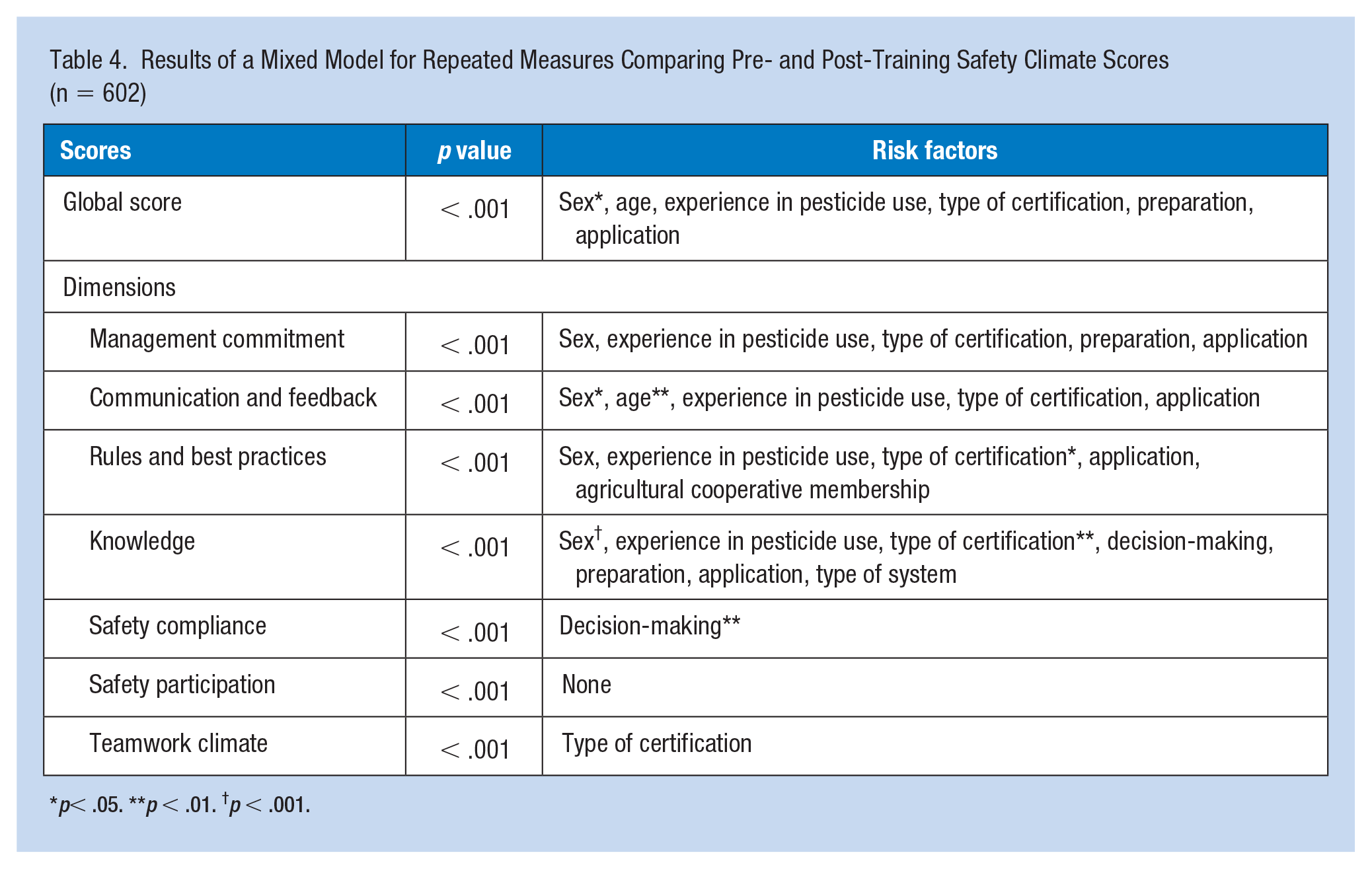
*p< .05. **p < .01. † p < .001.
Discussion
Results from this study show that Certiphyto training effectively increases safety climate among cereal farmers and farm workers, providing additional evidence for the utility of training for improving pesticide knowledge (Afshari et al., 2021; Ayaz et al., 2022), and safety behavior (Damalas & Koutroubas, 2017) in farmers.
This study has several strengths. First, the participants varied considerably in terms of age, pesticide-related activities, experience in pesticide use, and the nature of the farm. This diversity should ensure that the safety climate estimates obtained are representative and generalizable. Second, a pre/post-intervention design was used (D0 and D1/D2), making it possible to discern training effects as the individual risk factors remained constant. Third, the large study population (n = 602) and the major impact of the intervention studied (the Certiphyto training course) led to significant differences between mean scores.
However, this study was also subject to several limitations. First, this approach is dependent on participants giving sincere and honest responses but we did not validate the responses obtained through comparison with field observations. We hoped that the voluntary nature of participation, anonymity, and confidentiality would encourage the participants to respond honestly. Second, this study considered only a few of the factors potentially associated with safety climate change. Nevertheless, given the effect size of the intervention, residual confounding is unlikely to account for the differences observed. Third, the training course was short (only 2 days maximum), so only short-term effects could be detected. It is unclear what the long-term effect of the intervention would be, as the impact of training on health indicators in the medium or long term could not be disentangled from other factors that contribute to reducing pesticide exposure, such as agricultural regulations, access to more advanced machinery, or the introduction of safer pesticides.
We found evidence of increases in the safety climate score and each of its subscores after the completion of the Certiphyto training course. It makes perfect sense that a short educational session cannot change the work environment, which is primarily shaped by facilities, equipment, procedures, and policies. Similarly, a change in behaviors cannot be expected in such a short timeframe. However, our findings demonstrate that a training session has the potential to change individual perceptions of the work environment by imparting new knowledge and skills. The increases in scores were unexpectedly large (7.1% for the global score), yielding highly significant results. Not surprisingly, the largest increases were observed in the dimensions of “knowledge” and “communication and feedback,” which were consistent with causal inference as these topics represented the core of the training program. Increases in safety climate scores were generally unaffected by demographic or occupational characteristics. Specifically, there was no significant association found between any score difference and the participant’s position in cereal farming activities (Table 4). This finding contrasts with the differences in safety climate perception between hierarchical groups (workers, supervisors, and upper managers) in the restaurant (Huang et al., 2012) and construction (Marín et al., 2019) industries. The lack of significance in our study may be partly explained by the unique features of the agricultural sector. Autonomy is highly valued in farming and is not necessarily tied to actual ownership of land or the farm business (Stock & Forney, 2014). Cereal farms have a relatively flat organizational structure, as managers are directly involved in day-to-day operations. In addition, the dispersion of cereal fields across the landscape requires on-the-ground, site-specific decisions to be made in real-time, blurring the distinction between the roles of managers and operators.
The signs of the few significant covariate-by-time interactions were in the expected direction. First, two other European studies (Cecchini et al., 2018; Damalas et al., 2019) have already shown that older agricultural workers have a negative attitude toward health and safety in the workplace (represented in this study by the communication and feedback dimension). Second, most trained farmers (represented in this study by those attending a certification refresher course) display safer behavior in pesticide use (Damalas & Koutroubas, 2017). The margin for improvement was therefore smaller for these individuals and scores in two dimensions (rules and practices and knowledge) were found to increase less after the intervention for this group. Third, farmers involved in decision-making regarding pesticide use and, therefore, probably concerned about the well-being of their coworkers, benefited more from the training and exhibited a larger increase in the safety compliance dimension. Conversely, the influence of the sex of the participant was unexpected with smaller increases noted for global score, communication and feedback, and knowledge scores in men compared with women. The receptiveness of workers to the principles of prevention and safety in agriculture depends on various factors including personal values, education, age, experience, and specific workplace context. We therefore believe that caution is required when generalizing about any particular gender group and that the gender issue in European agricultural practices should be investigated further.
During the external validation of the safety climate scale, a comparison was also conducted before and after a “Certiphyto” training attended by vineyard professionals (Grimbuhler et al., 2023). Overall, there were similar increases in mean scores, although some variations in the few covariate × time interactions were observed in type of production system, agricultural cooperative membership, type of certification, and experience in pesticide use. This consistency reinforces the relevance and generalizability of the safety climate scale as a proxy measure for safety culture in the agricultural sector.
Implications for Occupational Health Practice
The reduction of pesticide exposure in agricultural activities remains a major challenge. This study demonstrates that the training provided to cereal farmers and farm workers enhances their perception of a safe climate, although smaller increases are observed in some subscores for male farmers, older farmers and those not involved in pesticide use decision-making. Occupational health and safety practitioners can apply these findings in practice by promoting the development and facilitation of lifelong learning and providing tailored educational and awareness programs for specific subgroups of cereal farmers. This approach is expected to result in more effective practices and safety measures in the future.
Applying Research to Occupational Health Practice
The training of farmers in pesticide safety is of the utmost importance for reducing pesticide use and exposure through the implementation of sustainable management practices. However, there have been limited intervention studies to demonstrate the relevance and efficacy of such training. Results from this study show that pesticide training effectively improves safety climate perception among cereal farmers and farm workers. This study provides additional evidence for the importance of pesticide safety training, which should be a top priority for minimizing pesticide exposure and optimizing the efficiency of preventive actions among cereal farmers.
Footnotes
Acknowledgements
The authors would like to thank Elisabeth Marcotullio and Marc Delanoë for providing valuable advice.
Author Contributions
Sonia Grimbuhler: Conceptualization, Supervision, Investigation, Writing—Original Draft; Théo Werlen: Investigation, Data Curation, Software, Writing—Review & Editing; Jean-François Viel: Conceptualization, Methodology, Software, Formal Analysis, Funding Acquisition, Project Administration, Writing—Original Draft.
Conflict of Interest
The author(s) declared no potential conflicts of interest with respect to the research, authorship, and/or publication of this article.
Funding
The author(s) disclosed receipt of the following financial support for the research, authorship, and/or publication of this article: The project was supported by the French Central Agricultural Mutual Insurance Fund (CCMSA). The funder had no role in the design or conduct of this study, the analysis or interpretation of the data, or the preparation of this manuscript.
Ethics Statement
This study was performed in line with the principles of the Declaration of Helsinki. Informed consent was obtained from all individual participants included in the study. They completed a safety climate questionnaire anonymously, without providing any health data. This was done for academic purposes during a compulsory training and certification procedure. Therefore, according to the French regulations in force at the time of the study, no ethics committee approval was required.
