




Abstract
Farmers in developing countries use harmful pesticides while taking few or no protective measures. There is limited evidence on factors affecting their safety measures. The objective of this study was to identify the underlying factors influencing farmers’ protective behaviors (PBs) and use of personal protective equipment (PPE) during the exposure to pesticides. From April to August 2017, a descriptive study was conducted in Twiserkan County in western Iran among 474 farmers from 104 villages. A questionnaire was developed to measure demographic characteristics and factors suggested in integrated agent-centered (IAC) framework. The questionnaire was validated in terms of content validity through expert reviews and tested for reliability in a group of farmers. Data were collected by face-to-face interviews with farmers. Physiological arousal (β = .154, p < .05), intention (β = .345, p < .05), habit (β = .188, p < .05), and contextual factors (β = .101, p < .05) had a significant and positive impact on farmers engaging in pesticide PBs. Among the assessed factors, only physiological arousal (β = .122, p < .05) and habit (β = .646, p < .05) were found to have a significant and positive effect on the use of PPE, but the intention (β = –.039, p > .05) and contextual factors (β = –.009, p > .05) had no significant relation with the use of PPE. The results of this study identified determinants of farmers’ safety measures. Our results suggest that the IAC framework could serve as a guide to developing a more effective intervention for safety measures of Iranian farmers.
Introduction
Pesticides are considered an essential part of modern agriculture, playing a key role in crop production to control harmful insects, weeds, and pathogenic organisms (Damalas, 2009; Jallow, Awadh, Albaho, Devi, & Thomas, 2017a). The unprotected use of pesticides can cause severe threats to human health and the environment, making it a very important public health concern (Damalas & Eleftherohorinos, 2011; Saeed et al., 2017). Concerns about adverse health effects of pesticides, particularly in the developing nations, have been decreased by adopting protective behaviors (PBs) and personal protective equipment (PPE) (Hashemi, Rostami, Hashemi, & Damalas, 2012; Khan & Damalas, 2015). The Food and Agriculture Organization (FAO), the World Health Organization (WHO), and various non-government organizations focusing on low and middle-income countries have emphasized improving PBs and personal protection equipment for farmers in pesticide use (Fan et al., 2015). Studies indicate that PPE and behaviors are effective in reducing farmers’ exposure to pesticides (Damalas & Hashemi, 2010). Despite indications of efficacy, it has been shown that protective measures are not frequently used (Damalas & Hashemi, 2010).
Using PPE and engaging in safe behaviors depend on a variety of factors such as farmers’ knowledge of pesticide hazards and correct use of practices (Jallow et al., 2017b), farmers’ beliefs and perceptions about the risks of pesticide exposure (Hashemi et al., 2012), perceived and actual barriers for the adoption of safety behaviors and use of PPE by farmers (Blanco-Munoz & Lacasana, 2011; Damalas & Hashemi, 2010), and social influences (Wang, Deng, & Ma, 2017).
Identifying the various effective factors in using protective measures during pesticide exposure by farmers is necessary to provide insight into the underlying motives which drive farmers’ safe pesticide behaviors (Wang et al., 2017). These factors have seldom been investigated in a comprehensive study (Hashemi et al., 2012). There are a number of studies that have focused on the influences of farmers’ individual characteristics and governmental regulations (e.g.,Wang et al., 2017; Zhang & Li, 2016); however, studies assessing the role of a wide range of factors based on a specific framework are limited. Feola and Binder (2009, 2010b) suggested that because of complexity and the multi-level nature of the agricultural system, an integrated and dynamic approach should be applied to research in this field. Having a specific framework could improve our understanding of farmers’ behavior within the context of the agricultural system where they work (Feola & Binder, 2009). In this study, we used the integrated agent-centered (IAC) framework to understand factors and paths by which these factors may influence the adoption of the protective measures by farmers.
The IAC Framework
The IAC framework is based on studies by Feola and Binder (2010b) which combines the Giddens’s (1984) Structuration Theory (ST) and the Theory of Interpersonal Behavior (TIB) (Triandis, 1980). In the framework, each farmer’s action (use of PPE and PBs) can be explained based on personal internal factors, such as intention, habit (past behavior), physiological arousal (fear and risk perception), and external contextual factors (knowledge, perceived barriers, and facilitators). The intention itself is determined by consequent expectations (health and social outcome expectations and the expected value of consequences), social norms, and affect (Feola & Binder, 2009, 2010b).
To the best of our knowledge, the interaction between the components of the IAC framework have been applied in only a few studies (Feola & Binder, 2010a, 2010c), and there have been no studies that included Iranian farmers. Thus, the objective of the study was to identify the underlying influencing factors on farmers’ PBs and their use of PPE during the use of pesticides.
Method
Research Design and Sampling
From April to August 2017, a descriptive correlational study was conducted in Twiserkan (Toyserkan) County, located in the Hamadan province in west Iran. This county has an appropriate climate for the extensive cultivation of crops. These products include wheat, barley, garlic, almonds, peach, plum, apple, and especially walnuts as its main commodities. Farmers work on their farms during the week, and pesticide use in this region is highly varied (Agriculture Organization of Hamadan Province, 2017).
A stratified sampling procedure was followed to select the participants in 104 villages of Twiserkan County. At first, we obtained a list of eligible farmers residing in each village from corresponding health houses, and we conducted simple random sampling to select participants within each village. Farmers were included if they resided in one of these villages and conducted pesticide spraying during their jobs. The sample size was calculated based on 95% confidence level and a precision of 9%. Assuming the values derived from Gaber and Abdel-Latif (2012) study, a total sample of 474 was necessary.
Data Collection
We collected data in collaboration with health providers of health houses (known as Behvarz in Iran) from all 104 villages of Twiserkan County. At the time of the study, 54 of the 104 villages had health houses, while the remaining 50 villages traveled to these other villages to receive their care. Data were collected through face-to-face interviews with selected farmers, using a questionnaire. Interviews were conducted in a private room of the health houses and interview time was scheduled based on participants’ convenience. The questionnaire was developed based on a review of the literature (Burton, 2004; Feola & Binder, 2009, 2010b; Price & Leviston, 2014; Senger, Borges, & Machado, 2017).
We measured the PBs and use of PPE 4 weeks after measuring the IAC constructs (i.e., knowledge, perceived barriers, facilitators, social norms, social outcome expectations, health outcome expectations, expected value of consequences, affect, physiological arousal, habit, and intention) and demographic data through a self-reported questionnaire. The rationale for this approach was that while we expected that the constructs of the IAC would predict the farmers’ PBs, measuring behaviors cross-sectionally meant that we were providing measures of past or current behavior rather than future behavior. Past behavior accounts for the unique variance in predicting the future behavior (Conner & Armitage, 1998).
We collected data on key factors influencing the use of PPE and adoption of PBs during pesticides exposure by farmers based on the IAC framework. The survey consisted of questions about demographic and baseline variables and IAC framework constructs including knowledge about protective measures (five items), perceived barriers to adopt protective measures (10 items), facilitators to adopt protective measures (three items), social norms to adopt protective measures (nine items), social outcome expectations to adopt protective measures (three items), health outcome expectations to adopt protective measures (three items), expected value of consequences to adopt protective measures (six items), affect to adopt protective measures (two items), physiological arousal to adopt protective measures (four items), habit to adopt protective measures (20 items), intention to adopt protective measures (four items), PBs for reducing exposure to pesticides (12 items), and use of PPE for reducing exposure to pesticides (eight items).
Validity and Reliability
The first draft of the questionnaire was developed using items as presented in the literature and based on the experiences of researchers. Then to assess content validity, the questionnaire was reviewed by a panel of experts consisting of nine specialists in occupational health and health education and promotion. The content validity ratio (CVR) was calculated through experts’ opinion, and based on Lawshe’s (1975) table, items with the score of 0.78 or more remained in the questionnaire. Content validity index (CVI) was calculated by researchers using a 4-point scale assessed by Waltz and Bausell (1981). The score of 0.79 was considered as the least suitable CVI. The face validity of the questionnaire was examined by interviewing 10 farmers so that the questions were read for them, and we assessed the farmers ability to understand the complexity level of questions that were assessed. The dimensionality of the questionnaire was determined by performing an exploratory factor analysis (EFA). EFA was performed for half of the sample (n = 200). Factors were extracted by the most likelihood method and by the rotation method (varimax). To distinguish the best structure, the eigenvalue greater than 1 and factor loading equivalent or greater than 0.4 were applied (Sharma, 1995). Accordingly, 21 items were removed from the scale.
To approximate the test–retest reliability, the interclass correlation coefficient (ICC) was used (Nunnally & Bernstein, 1994). Test–retest reliability was evaluated by conducting a pilot study on 30 sprayer farmers using convenience sampling in the rural area of Twiserkan County. The questionnaire was re-administered to the same sprayer farmers 2 weeks after the first. The ICCs for test–retest reliability was above .87 for all scales (rating from .87 to .99). The validity and reliability stage suggested minor changes to the questionnaire before finalization.
Data Analysis
A number of statistical tests were performed to examine the reliability of the measures using IBM© SPSS© Statistics version 24 (e.g., t test and ANOVA, differences between the means were analyzed using the Tukey test) and structural equation modeling (SEM) technique with a partial least squares (Smart PLS 2.0) approach. We replaced missing values with values imputed from the observed data. PLS model study comprised of two stages. A measurement model was assessed in the first stage and involved the development of a test measurement model to validate the study model. Also, after the model was found to meet the criteria for the measurement model, the structural models were examined. Figure 1 shows the conceptual framework used in the study.
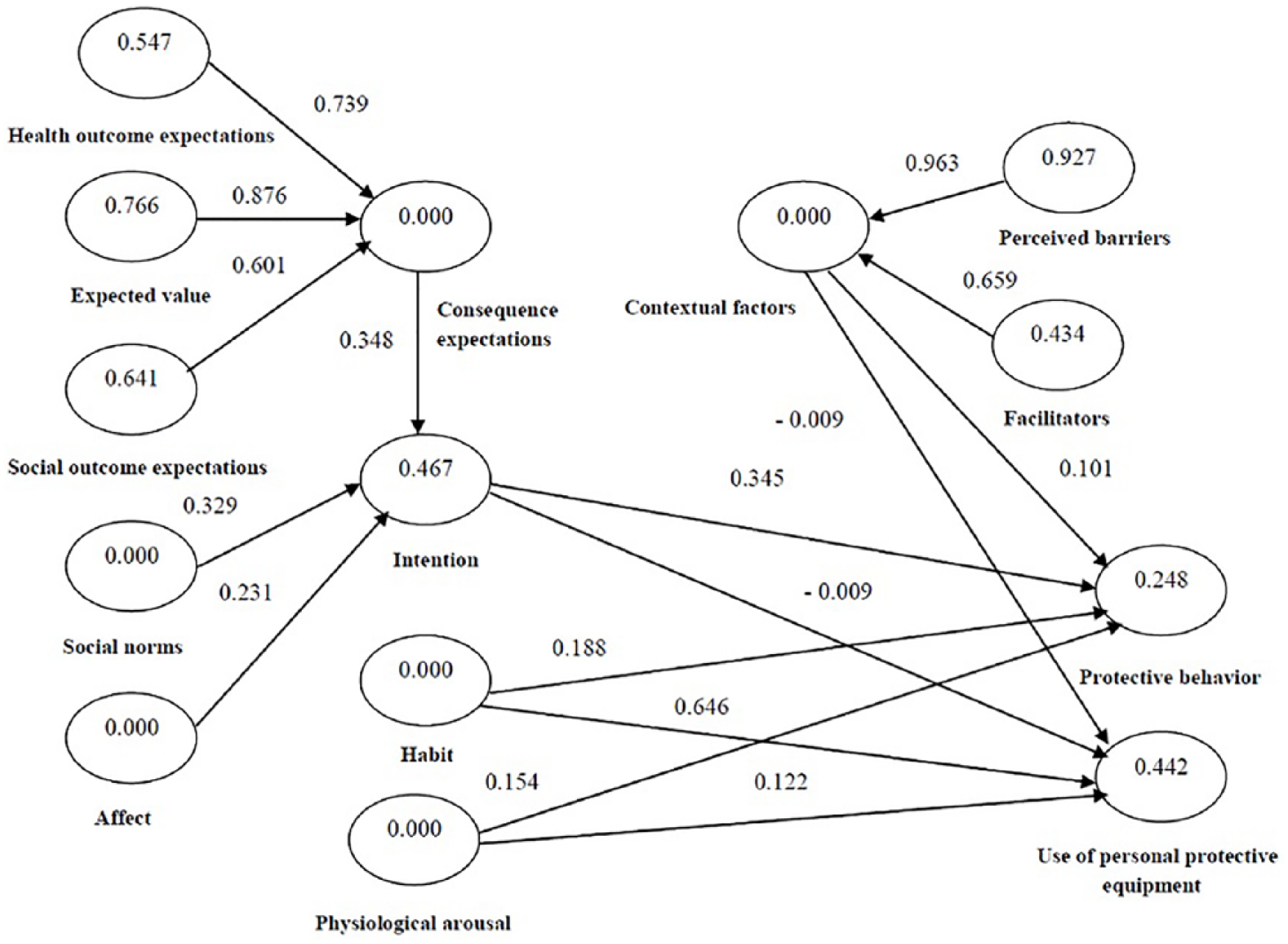
Structural model in the prediction of path coefficients.
The design of the measurement model involved the development of a test measurement model to validate the research model. To assess the properties of the measurement model, we conducted the confirmatory factor analysis to review homogeneity (factor loading and t value; Chin, 2010; Hair, Ringle, & Sarstedt, 2011), reliability (composite reliability and Cronbach’s alpha; Hair et al., 2011), convergent validity (average variance extracted [AVE]; Henseler, Ringle, & Sinkovics, 2009), and discriminant validity (square roots of the AVEs more than their corresponding correlation coefficients; Fornell & Larcker, 1981) of the latent variable indicators.
Ethical Approval
Informed consent was obtained from the farmers after the aim of the study was described to them. This study was approved by the Ethical Committee of Hamadan University of Medical Sciences (No.: IR.UMSHA.REC.1395.509).
Results
There were no missing values except for the PB and use of PPE in five participants. Participants were predominantly male (98.5%) and married (89.4%) with an average age of 48.15 years (Table 1). About half (49.8%) of the participants were illiterate or educated at primary school level. The majority of farmers (85.6%) were the owner of farm land and 57% of them had more than 10 years of experience in farming.
Demographic Characteristics of the Participating Farmers (n = 474)
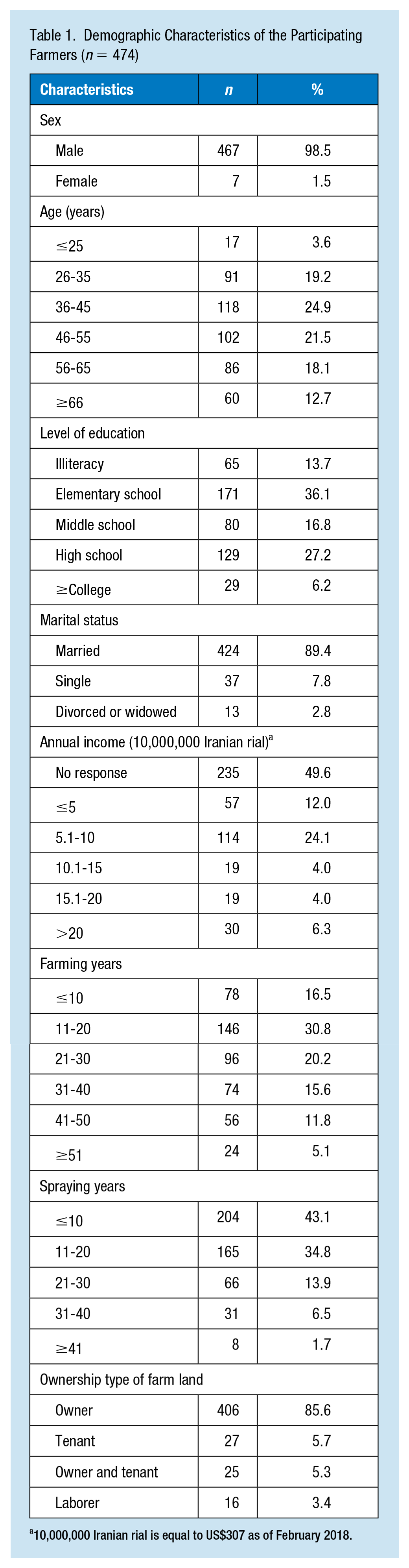
10,000,000 Iranian rial is equal to US$307 as of February 2018.
Farmers’ most frequent PBs were as follows: avoiding smoking while spraying (81.2%), avoiding drinking and eating while spraying (72.3%), careful and safe storage of pesticides (67.6%), changing clothes or showering after applying pesticides (66.7%), use of the scarf to cover mouth and nose when spraying (57.6%), avoiding contacting hands with the eyes and mouth during spraying (47.5%), storing work clothes separately after replacement (54%), and washing hands well with soap and water after spraying (57.4%) (data not shown). The use of PPE was inadequate among 46.9% of the farmers who reported that they never used masks, 43.3% never used gloves, 18.3% never used thick and long pants, 20.3% never used thick or long-sleeved shirts, 32.5% never used long rubber boots, 59.7% never used protective glasses, and 22.6% never used gloves when mixing and loading pesticides. A total of 27.3% sometimes cover their head. There were no significant differences between the two outcome variables (i.e., PBs and use of PPE) and demographic characteristics of participants (p > .05).
In this study, the factor loading measurements of ≥0.6 and t value more than ±1.96 were accepted. The Cronbach’s alpha value was .71 and above, and composite reliability score was ≥.80 for each construct. Also, the results of the AVE test prove that the scores constructs were ≥0.51. Therefore, knowledge, two items of perceived barriers, 10 items of habit, and four items of PB were removed from the initial model to improve the model fit. Finally, after the model was found to meet the criteria for the measurement model, the structural models were tested (Table 2).
The Validity and Reliability of the IAC Framework Scales
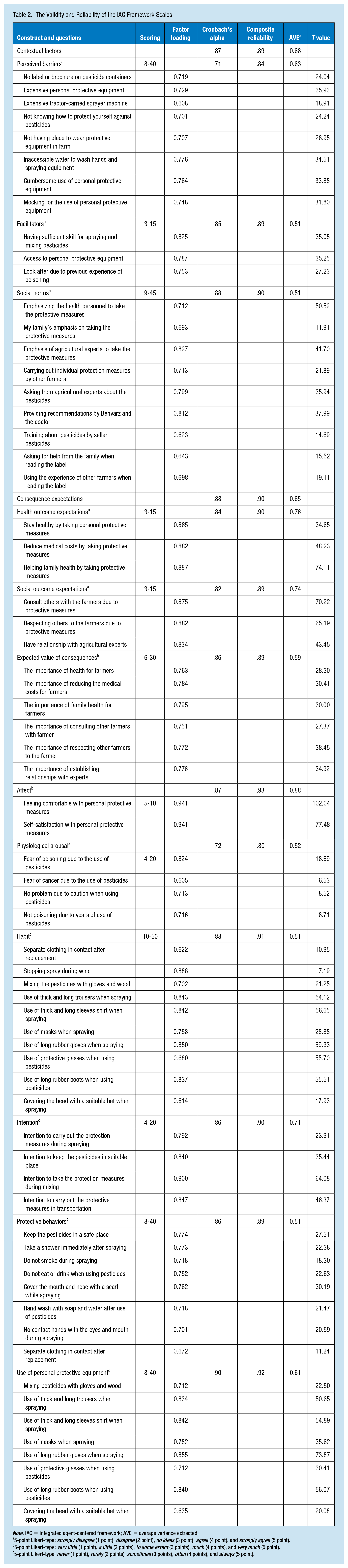
Note. IAC = integrated agent-centered framework; AVE = average variance extracted.
5-point Likert-type: strongly disagree (1 point), disagree (2 point), no ideas (3 point), agree (4 point), and strongly agree (5 point).
5-point Likert-type: very little (1 point), a little (2 points), to some extent (3 points), much (4 points), and very much (5 point).
5-point Likert-type: never (1 point), rarely (2 points), sometimes (3 points), often (4 points), and always (5 point).
We tested all dominos and paths suggested by IAC. The path coefficients to predict intention, PBs, and use of PPE are presented in Figure 1. The expectations (β = 0.348, p < .05), social norms (β = 0.329, p < .05), and affect (β = 0.231, p < .05) had a positive effect on intention to adopt protective measures. The coefficient of determination (R2) for intention was 46.7% indicating that the expectations, social norms, and affect constructs could explain 46.7% of the variability in participants’ intention. According to paths suggested by IAC, physiological arousal (β = 0.154, p < .05), intention (β = 0.345, p < .05), habit (β = 0.188, p < .05), and contextual factors (β = 0.101, p < .05) had a positive impact on PBs, with an explained variance of 24.8%. In regard to the use of PPE, physiological arousal (β = 0.122, p < .05) and habit (β = 0.646, p < .05) were found to have a positive effect on use of PPE, accounting for as much as 44.2% of the variance. However, intention (β = −0.039, p > .05) and contextual factors (β = −0.009, p > .05) did not have a significant effect on the use of PPE.
In this study, the goodness of fit value was obtained as 0.589 indicating an excellent overall fit of the model to the data (Tenenhaus, Vinzi, Chatelin, & Lauro, 2005). Predictive validity (Q2) value for intention, PB and use of PPE was 0.330, 0.125, and 0.263, respectively (Table 3). These values show that the model had the power to predict the changes in intention, PBs, and the use of PPE constructs.
The Result of the Structural Model for Examining Paths in IAC Framework of Contextual Factors and Personal Factors
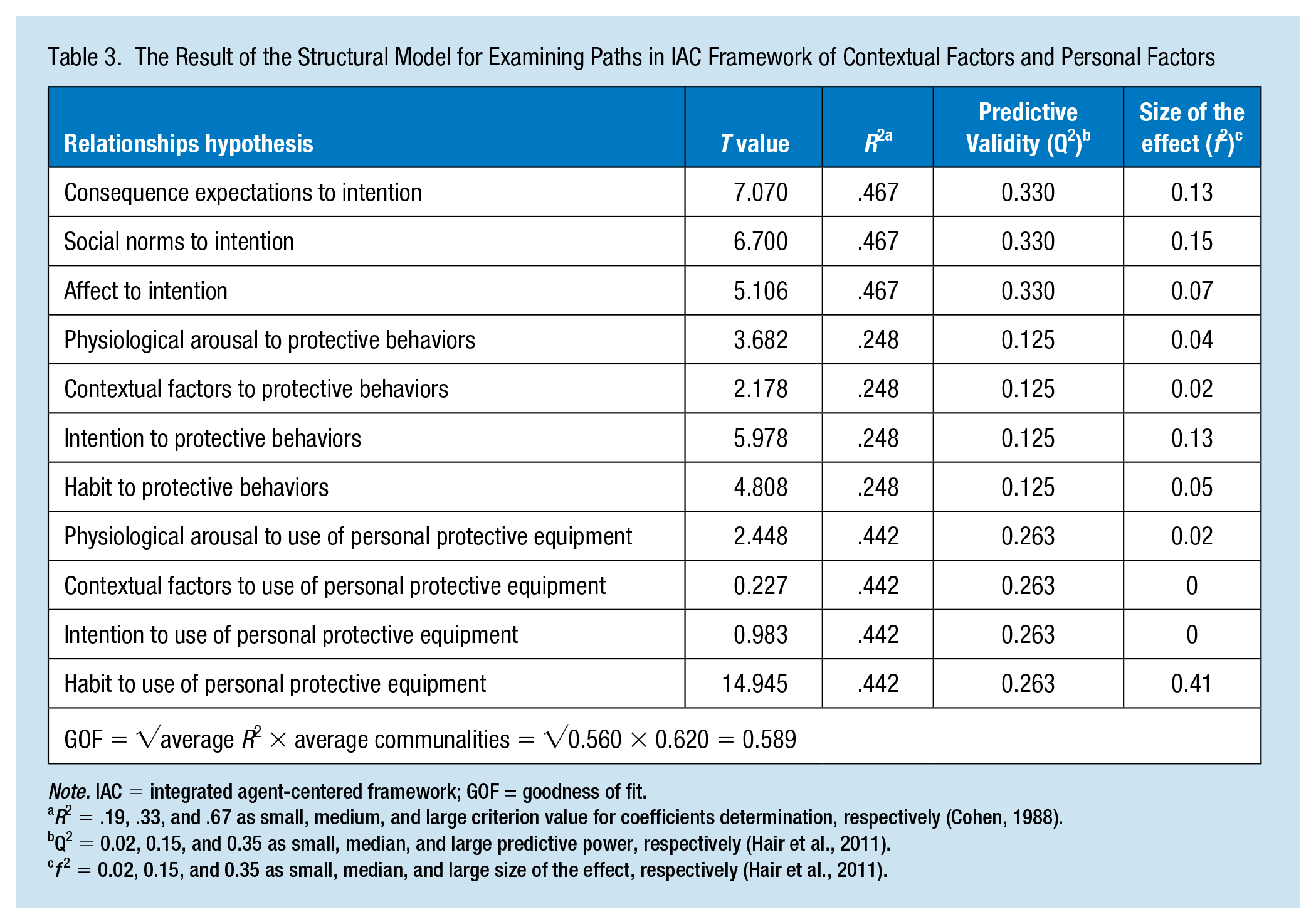
Note. IAC = integrated agent-centered framework; GOF = goodness of fit.
R2 = .19, .33, and .67 as small, medium, and large criterion value for coefficients determination, respectively (Cohen, 1988).
Q2 = 0.02, 0.15, and 0.35 as small, median, and large predictive power, respectively (Hair et al., 2011).
f2 = 0.02, 0.15, and 0.35 as small, median, and large size of the effect, respectively (Hair et al., 2011).
Discussion
This study was developed to enrich our understanding of the effective factors on protective measures among the farmers. Our study is among the few theoretical framework studies investigating farmers’ PBs in developing countries. Our findings showed that farmers adopt PB and PPE poorly, which is consistent with the findings of Fan et al. (2015) and Okoffo, Mensah, and Fosu-Mensah (2016) while proper protective measures and use of personal equipment could decrease the probability of poisoning by 44.3% (Dasgupta, Meisner, Wheeler, Xuyen, & Lam, 2007).
The results show that a significant amount of variance in intention, PBs, and use of PPE was explained by the independent construct model. There is a lack of evidence available toward the role of some surveyed structures in other agricultural health studies. Our study indicated that the consequence expectations had a positive effect on intention. Similar to some other studies (Maddux, Sherer, & Rogers, 1982), the results demonstrated that an increase in outcome expectancies improved the intention to do the behavior. Also, we found that social norms had an impact on intention, which are consistent with the results proposed in previous studies (Le Dang, Li, Nuberg, & Bruwer, 2014; Wang et al., 2017). In addition, the relationship between effect and intention was strongly supported. Regarding effect, the majority of the respondents associated the positive feelings with the protective measures (Feola & Binder, 2010c).
Another finding gained in the current study showed that the intention was associated with PBs during the exposure to pesticides. The intention is “instructions that people give themselves to behave in certain ways” (Triandis, 1980). According to the planned behavior theory, the positive intention is associated with positive behavior because the intention is a predictor of behavior (Ajzen, 1991). Our analyses indicated that an increase in consequence expectations, social norms, and effects was associated with a higher intention to engage in the PB. The obtained results were similar to the findings of the previous study by Sawant et al., 2016.
Contextual factors had a positive effect on PBs. This finding suggests that the farmers with previous knowledge, skill, and protective experience during exposure to pesticides had higher PB. These factors can facilitate PBs which is consistent with a study conducted in China (Xiao et al., 2014). Similar to another study (Walton, Leprevost, Linnan, Sanchez-Birkhead, & Mooney, 2017), farm workers perceived work experience as facilitating PBs. Based on previous studies, some of these most common factors included the resource (or lack thereof; Elmore & Arcury, 2001; Snipes et al., 2009), income (or lack thereof; Wang et al., 2017), dexterity (or lack thereof; Hersi et al., 2015), and (dis)comfort (Elmore & Arcury, 2001; Snipes et al., 2009).
Our findings supported that physiological arousal is effective on the PBs and the use of PPE. Farmers understand the PBs and PPE as a helping factor to avoid getting sick and staying healthy. Also, farmers are well aware of the risks associated with the exposure to pesticides, and they recognize the concern for severe consequences in the psychological, family, social, and relational spheres and in the work environment. Farmers who have experienced health problems from pesticide use showed the heightened concern about the health effects of pesticides and were more likely to use protective equipment (Hashemi et al., 2012; Schenker, Orenstein, & Samuels, 2002).
The habit was positively associated with PBs and use of PPE during exposure to pesticides. The term habit is broadly used to predict and to explain the behavior. Also, a part of the behavior and use of equipment is due to the habits (Lensink et al., 2000). The influence of habits on current behavior is a topic that has involved considerable attention in general (Lensink, Boissy, & Veissier, 2000). A number of studies have confirmed that habit contributes significantly to the prediction of future behavior over and above other constructs (De Vries, Eggers, Lechner, van Osch, & van Stralen, 2014; Verplanken & Melkevik, 2008).
Contextual factors (barriers and facilitators) had no positive impact on the use of the PPE. We considered several factors for measuring the farmers’ barriers including price of equipment and accessibility of protective equipment and the mean score obtained by participants was 30.92 (out of 50). This result indicated that many farmers found it difficult to use the PPE. On the contrary, the mean score obtained from the facilitators was 39.03 (out of 50). As IAC defines the contextual factors as the facilitating conditions, it seems that in this study, these two factors counteract the effects of each other.
The relationship between intention and use of PPE was not strongly supported. According to other studies, intention to use PPE was low (Hasanah, Setiawati, & Apriani, 2016). The majority of the farmers intended to use the equipment during exposure to pesticides. Despite the intention, most farmers did not manage pesticides and did not adhere to the use of PPE. Cost, general lethargy, and the discomfort caused by wearing the protective equipment were the main reasons given for not using such devices (Indra, Bellamy, & Shyamsundar, 2007).
The results of this study should be considered in light of its limitations. First, the results of the research might be affected by self-report bias. Second, this study was conducted in a limited geographic area. However, there are many similarities in farming characteristics between Hamadan province and other areas of Iran. For example, the educational level of farmers and type of agriculture (i.e., horticulture, permaculture, and agriculture) are comparable in Hamadan province with other provinces of Iran (Statistical Center of Iran, 2014). Measuring the variables in two waves may have influenced subjects’ responses to questions in the second wave.
Conclusion
Agriculture has been ranked as one of the most hazardous industries. It is evident that there is a relationship between pesticide exposures and farmers’ health. This study helps to identify the underlying factors influencing pesticide PBs and use of PPE in farmers. The results of this study indicated that the use of these models within agricultural settings is fairly limited. The findings of this study could help community/occupational health care providers to better understand the underlying factors of farmers’ behaviors and to develop intervention programs to modify the health-PBs of farmers.
Footnotes
Author’s Note
This project has been approved by the Research and Technology Deputy of Hamadan University of Medical Sciences.
Declaration of Conflicting Interests
The author(s) declared no potential conflicts of interest with respect to the research, authorship, and/or publication of this article.
Funding
The author(s) disclosed receipt of the following financial support for the research, authorship, and/or publication of this article: This work was supported by Hamadan University of Medical Sciences (reference number: 9511126847).
Author Biographies
Maryam Afshari is a PhD graduate in health education and promotion at the Hamadan University of Medical Sciences. Her master’s and PhD theses focused on safety promotion.
Jalal Poorolajal is a professor of epidemiology at Department of Epidemiology & Biostatistics, School of Public Health in Hamadan University of Medical Sciences, Iran.
Forouzan Rezapur-Shahkolai is an associate professor at the Hamadan University of Medical Sciences, Iran. She has supervised several research projects in the field of health education and promotion with specialization in safety promotion and injury prevention.
Mohammad Javad Assari is an assistant professor of occupational health in the Department of Occupational Health and Occupational Health and Safety Research Center at the Hamadan University of Medical Sciences, Iran.
Akram Karimi-Shahanjarini is an associate professor of health education in the Department of Public Health at the Hamadan University of Medical Sciences, Iran. Her research interest is primarily in the area of the determinants of health behaviors and developing and evaluating intervention approaches. She is also interested in qualitative reviews and knowledge synthesis methods.