




Abstract
Background:
Studies show conflicting evidence on the association of age and occupational injury in agriculture, and few studies have addressed the effect of age on work-related chronic conditions or preventive practices among farmers.
Methods:
We examined the probability of injury, work-related stress, musculoskeletal symptoms (MSS), and preventive practices for MSS as a function of aging using surveillance data of 7,711 farm and ranch operators in the central United States.
Findings:
Segmented regression analyses of men (85% of sample) indicated that the probability of all four outcomes increased up to a certain age and then decreased; the changepoints in years of age being 59.6 for injury, 55.4 for work-related stress, 59.6 for MSS, and 67.9 for MSS preventive practices. Female operators had an increasing trend for stress up to age 29.7, while they showed no changepoints across their age spectrum in the proportion of injury, MSS, and prevention techniques.
Conclusion/Application to Practice:
These findings emphasize the need for preventive efforts particularly among younger and middle-aged farmers and ranchers, and the need to modify work duties to match work abilities at older ages.
Aging affects workers in many ways over their working careers. The median age of employed persons in the United States in 2022 was 42.3 years for all workers and 48.1 years for hired agricultural workers (BLS, 2023). The average age of self-employed farmers has been increasing; it was 57.5 years in 2017, an increase of 1.2 years since the 2012 Ag Census. One-third (33.9%) of the producers in 2017 were 65 years of age or older (USDA NASS, 2021).
While the risk of chronic conditions generally increases with age (Boersma et al., 2020), the association of age and farm-related injury has been inconsistent across studies. A systematic review of risk factors for agricultural injury (Jadhav et al., 2015, 2016) found 29 studies quantifying the association of age and injury in agriculture. It was not possible to calculate pooled risk estimates for different age groups due to differences in categorization of age, but most studies showed elevated odds ratios in age groups between 20 and 60. In contrast, dairy and beef operators younger than 30 and older than 70 were at greater risk of injury than those between 30 and 70 years of age in an Eastern Ontario study (Brison & Pickett, 1991). Farmers younger than 55 years were at greater risk of injury in Iowa (Lewis et al., 1998), while older farmers were at greater risk in Alabama and Mississippi (Lyman et al., 1999) and New South Wales Australia (Walker et al., 2021).
Several recent reports have linked age to stress levels, with younger farmers experiencing higher levels of stress. In Ireland, 57% of 736 farmers reported feeling work-related stress as a result of weather, workload, and finances (Brennan et al., 2022). Stress decreased with advancing age in a nonlinear association (Brennan et al., 2022). Similarly, in 170 U.S. Midwest farmers younger than 38 years, 71% met the criteria for an anxiety diagnosis based on the Generalized Anxiety Disorder-7 (GAD-7) and 53% met criteria for major depressive disorder based on the Patient Health Questionnaire-9 (PHQ-9) (Rudolphi et al., 2020). Finances, time pressures (workload), and economic conditions scored highest among seven stress domains. Young farmers have less access to capital and healthcare, often work off the farm, and are trying to establish themselves and learn the business. Additional stressors ensue in a generational family farm dealing with succession issues.
Injury rates have been associated with work-related stress (Bai et al., 2023; Elkind, 2008). Musculoskeletal disease (MSD) may result from an injury or from chronic physiological stressors. In a study of 8,655 Finnish farmers, high psychological stress scores predicted low-back, neck, and shoulder-related disability pensions in a 10-year follow-up study (Manninen et al., 1997). Stress showed a strong association with musculoskeletal symptoms (MSS) in 4,354 Midwest U.S. agricultural operators (adjusted odds ratio [OR] 5.55, 95%) (Du et al., 2022). Musculoskeletal symptoms were much less prevalent in the 18 to 44 age category (44%) compared to the 45 to 64 year (63%) and 65+ year age category (62%) (Du et al., 2022). In support of these findings using the same 2018 data, age and MSS were the most important factors after gross farm income in a classification tree analysis distinguishing those with work-related stress from those not experiencing stress (Chengane et al., 2021). The results were reproduced in a 2020 survey with 80% accuracy (Chengane et al., 2021), despite changes in farm economics and COVID-19 from 2018 to 2020. However, MSS were not associated with stress in 189 Latino manual labor workers (111 of whom were farmworkers) in North Carolina (Tribble et al., 2016). Overall, what is missing from our understanding is how stress, MSS, and injury risk changes across the agricultural operator’s lifespan. Identifying age periods of elevated risk for high stress, MSS, and injury might provide us with a more complete picture of how these factors are related, and how targeted interventions could be developed for these common conditions.
Engaging in prevention techniques is important to maintaining healthy joints and reducing MSS strains and sprains. Pilates, which focuses on strength and flexibility, has been shown to increase body stability and reduce pain in fruit farmers (Kim et al., 2014). Using good lifting techniques, taking regular work breaks and mechanizing when possible are also important MSS prevention techniques (Fathallah, 2010). In a previous study, regular breaks (OR 1.33), stretching (OR 2.02), exercising (OR 1.31), good lifting techniques (OR 1.61), and mechanizing heavy tasks (OR 1.57) reduced the risk of MSS; however, the temporal relationship of MSS and preventive measures could not be determined (Du et al., 2022). Farmers may be unlikely to use preventive techniques prior to experiencing an injury or MSS. The temporal association between age and MSS prevention techniques is of interest in this study and has not been examined previously.
The purpose of this study was to examine the probability of an injury, MSS, use of techniques to prevent MSS, and work-related stress across the age spectrum of agricultural operators using a segmented regression approach (Pastor & Guallar, 1998). Our specific hypotheses are that the risk of injury changes over a person’s lifetime with injury being more likely in older operators, the pattern of age and MSS is similar to that of age and injury, the use of techniques to reduce MSS would be more likely to be practiced by older operators compared to younger operators, work-related stress would be higher in younger operators compared to older operators; and male and female operators would differ in their patterns of the outcomes explored. We also conducted a sensitivity analysis in males including only principal operators who reported working 75% or more of their work time on the farm.
Methods
The study sample derives from two cross-sectional surveys administered by the Central States Center for Agricultural Safety and Health (CS-CASH) in the spring and summer of 2018 and 2020 in farm and ranch operators in a seven-state region (Iowa, Kansas, Minnesota, Missouri, Nebraska, North Dakota, and South Dakota). In each of the 2 years, the paper-based survey was distributed to a random sample of 2,500 farm and ranch operations in each of the seven states. The Farm and Ranch Health and Safety Survey (FRHSS) consisting of 29 questions was created by CS-CASH and focused on injuries, chronic health outcomes, work-related exposures, and the use of personal protective equipment for up to three main operators working on a farm or ranch. All responses were received by mail and entered into REDCap. The University of Nebraska Medical Center’s Institutional Review Board determined this surveillance research study to be exempt from the Health and Human Services policy for protection of human research subjects in accordance with 45 CFR 46, Subpart A. §46.104 Exempt research (d) Category (2) (No. 452-11-EX).
The sampling frame was provided by Farm Market iD (FMiD) using a stratified random sample of 2,500 farms in each of seven states. FMiD (currently DTN) is a for-profit organization that creates farm databases from the United States Department of Agriculture (USDA) annual surveys, remote sensing data, and other public and private sources. The FMiD database covers 95% of agricultural producers in the United States. Eligibility criteria were farm and ranch operations with an email address and an estimated gross farm income of at least US $5,000. The random sample of 16,826 farm and ranch operations were contacted by letter in May of 2018 with one follow-up request in June and resulted in a response rate of 19% including 3,268 farms and ranches and 4,423 individual operators. Similarly, the initial mailing for the 2020 survey was sent out in March and the follow-up request was mailed out in June. The 2,736 farms that responded represented 3,492 individual farmers and ranchers. Operators 18 years or older were included in the sample.
Measures
The personal and demographic covariates included age measured as a continuous variable and gender (male or female). We asked about the type of operation (farm, ranch, or both), the role of the operator on the farm (Principal operator, Operator 2, Operator 3), percentage of work time spent doing farm or ranch work (100%, 75%–99%, 50%–74%, 25%–49%, 0%–24%), whether the operator spent at least 50% of work time as a farmer/rancher or other occupation (primary occupation).
The injury question asked “How many farm-related injuries occurred to each operator during the past 12 months” with possible responses none, one, two, or three or more. Injury was re-coded as (none = 0 and at least one = 1). The presence of MSS (no = 0, yes = 1) was asked with the question “Did the operator experience pain or discomfort that affected his or her work in any of the following body areas during the past 12 months?.” Those who checked the box “none” were coded as negative for MSS, while any checked box for pain/discomfort was coded as “Yes.” The use of preventive techniques to reduce the risk of MSS was asked with the question “Was the operator using any of the following preventive techniques to maintain his or her musculoskeletal health during the past 12 months?.” The use of any of the listed techniques (regular breaks, stretching, exercising, good lifting techniques, mechanizing tasks) was coded as a 1 and 0 otherwise. Work-related stress (no = 0, yes = 1) was asked using the stem question: “Did the operator experience extended work periods that resulted in any of the following during the past 12 months?,” and respondents were asked to check the box for high stress level if it applied to them. A checked box was coded as 1 and 0 otherwise.
Data Analysis
Descriptive statistics were calculated separately for men and women on type of operation, operator role, percentage of time spent doing farm or ranch work, and primary occupation. Variables believed to be related to age such as injury, MSS, MSS prevention techniques, and work-related stress were compared between males and females using a chi-square test.
We used four separate logistic regression models with outcome variables injury, MSS, MSS prevention techniques, and work-related stress with the single explanatory variable age. We first tested for whether a changepoint was statistically likely in general linear models. A changepoint is a point at which the slope in the segment prior to the point differs from the slope in the segment after the point. For each model, we used the Pseudo Score test to assess for a changepoint in the slope across the values of age (Muggeo, 2016, 2017). The null hypothesis was that the difference in slopes is equal to zero across the 20 points tested; rejecting the null hypothesis indicates the presence of a changepoint. A significant p value means that the algorithm detected a change from positive to negative or from negative to positive in the slope of the regression line. We also used the Davies test to confirm the existence of a changepoint because it is more conservative than the Pseudo Score test because the p value represents an upper bound. The Davies test provides a best guess of the location of the changepoint using the selected number of points examined (Bacon & Watts, 1971; Davies, 1987). Both tests used the general linear model with a logit link as the input for testing for a change in slope. The input for fitting the segmented regression model was the logistic regression model, specifying a logit link function, and providing an initial changepoint estimate from the Davies test as a starting value. The segmented model tests whether the distribution of the data points changes over increasing ages of operators. A grid search is used to identify the changepoint value corresponding to the model with the best fit until an optimal change in slopes is identified (Muggeo, 2003).
We report the slope coefficients (β) and standard errors (SE) for each segment of the regression line before and after the changepoint. We also report the t-statistic, p value, and changepoint with 95% confidence interval for the association represented by the regression line. We standardized the confidence level, alpha (α), to adjust for the large sample sizes of 6,519 in the analysis of males, 1,192 in the analysis of females, and 3,737 in the sensitivity analysis (Good, 1982). Therefore, the level of confidence used in these analyses for determining statistical significance was set at α = .006 for males, α = .014 for females, and α = .008 in the sensitivity analysis. The slope coefficients and SE values were not exponentiated because we were not interested in calculating odds ratios and were more interested in comparing the slope coefficients between segments. The coefficients, presented in the log scale, represent the proportion of operators with the outcome for every one-year increase in age. The fitted logistic regression models were plotted to visualize the changes in the regression line by plotting the proportion of the characteristic for each of the four outcomes. The Segmented package in R (Muggeo, 2008) was used to test for and model changepoints. R version 4.0.3 was used for producing graphs (The R Core Team, 2019). SAS version 9.4 was used for the descriptive statistics.
Finally, we conducted a sensitivity analysis in the sample of men by repeating the above analyses but included only principal operators who worked at least 75% on the farm or ranch to see how the results might change. Working more hours on the operation was hypothesized to increase the risk of injury, MSS, and increase the use of MSS prevention techniques, but might lower the stress levels compared to those not spending most of their time doing farm or ranch work. The purpose of this analysis was to reduce sample heterogeneity and compare the results.
Results
The response rate in 2020 was 16%. An analysis of nonresponse bias in the 2018 sample found no evidence that responders differed from nonresponders on farm, ranch, or demographic characteristics, although responders were more likely to be married (Beseler & Rautiainen, 2021). A total of 7,711 agricultural operators were included in the analysis comprising 6,519 males and 1,192 females after removing 86 operators with missing information on the variables of interest. Males (85% of the sample) had a mean age of 57.9, standard deviation (SD) = 14.8. The women were on average 58.7 (SD = 12.2) years of age. Men were primarily principal farm operators and 70% spent at least 0.75 of their total work time doing farm or ranch work (Table 1). Over 80% of men reported that farming or ranch work was their primary occupation. Women (15% of the sample) were overwhelmingly listed as second farm operators. Slightly fewer than half worked off the farm. A smaller proportion of women reported injuries compared to men (8.4% vs. 13.0%, p < .0001). Women were less likely to report MSS (61.0% vs. 65.1% p = .006) or use prevention techniques to reduce the risk of MSS (79.1% vs. 82.8%, p = .002). Women reported less work-related stress than men (22.9% vs. 26.1%, p = .02).
Characteristics of Male (n = 6,519) and Female (n = 1,192) Farm and Ranch Operators in a Seven-State Region of the Midwestern Region of the United States, 2018 and 2020
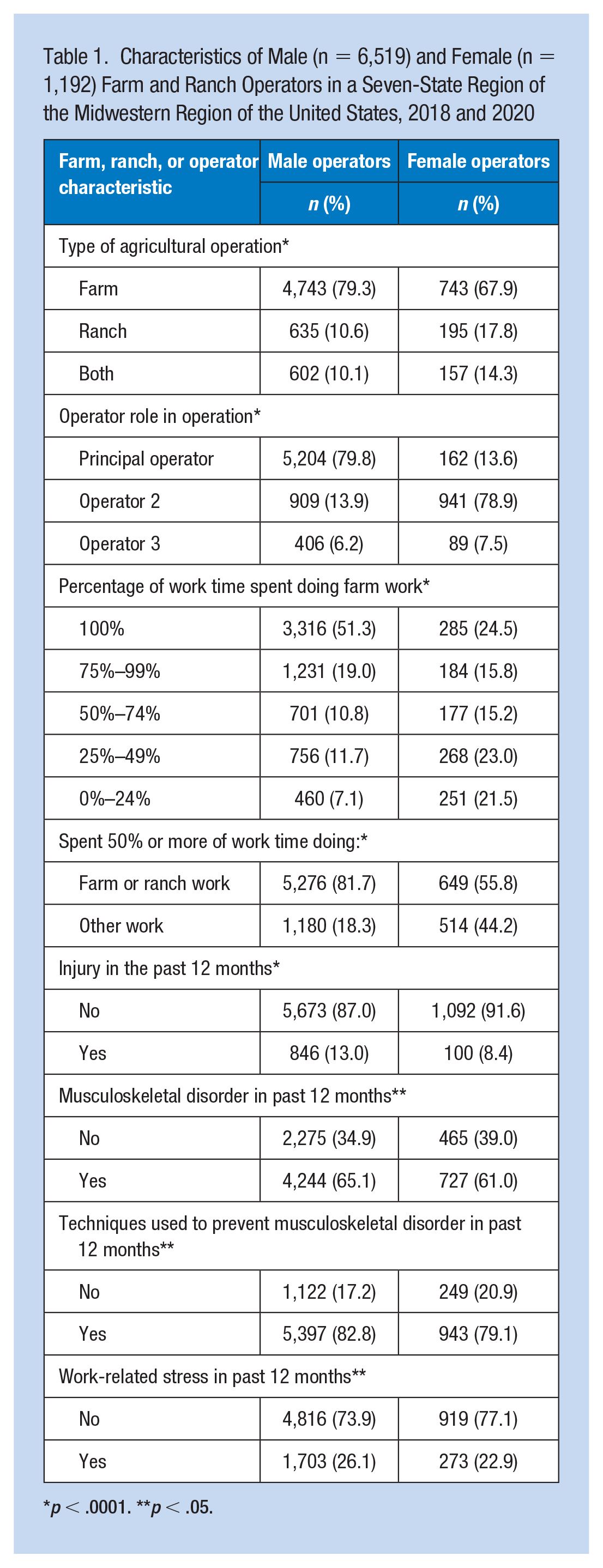
p < .0001. **p < .05.
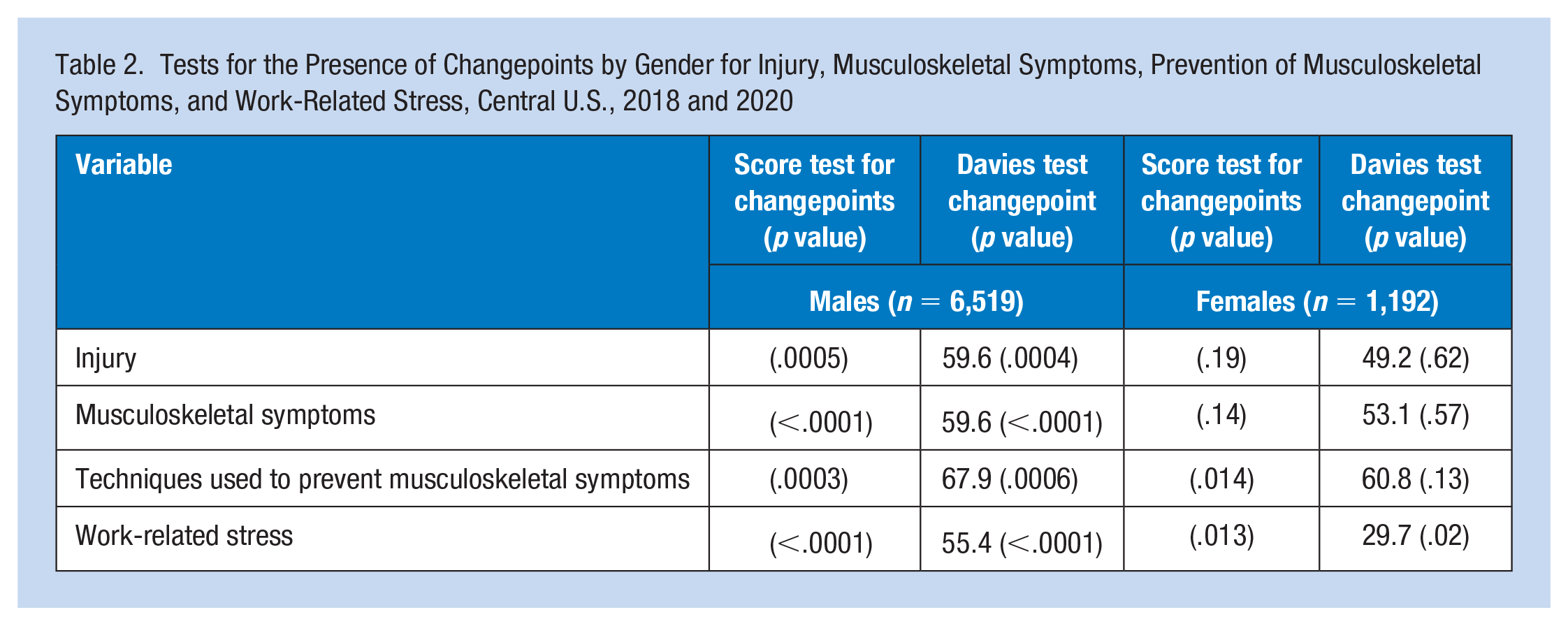
For the segmented regression findings, males, both the Pseudo Score Test and the Davies Test revealed statistically significant changepoints in the regression functions for all four outcomes (all p values < .001) (Table 2). The changepoints crudely estimated by the Davies test were within the confidence interval of those identified by the grid search. The probability of injury, MSS, and work-related stress increased up to a certain age and then decreased (Figure 1). The injury rate was nearly 10% in those 18 years of age and increased to about 15% by 58 years of age, after which the injury rate decreased to nearly 6%. As was expected, MSS showed a similar pattern in relation to age, but the proportion line was shifted upward, ranging from 40% to just over 70%. MSS prevention techniques showed a far different pattern over the age spectrum. The relationship was constant until age 69, but then decreased dramatically with increasing age. The proportion of those exercising MSS prevention ranged from 60% to 85%. The association of age with work-related stress increased monotonically from age 18 to age 57 and then showed a curvilinear decrease. Between 18 and 57 stress was relatively high, ranging from about 27% to 35%. Table 3 shows the variability around the changepoints.
Tests for the Presence of Changepoints by Gender for Injury, Musculoskeletal Symptoms, Prevention of Musculoskeletal Symptoms, and Work-Related Stress, Central U.S., 2018 and 2020
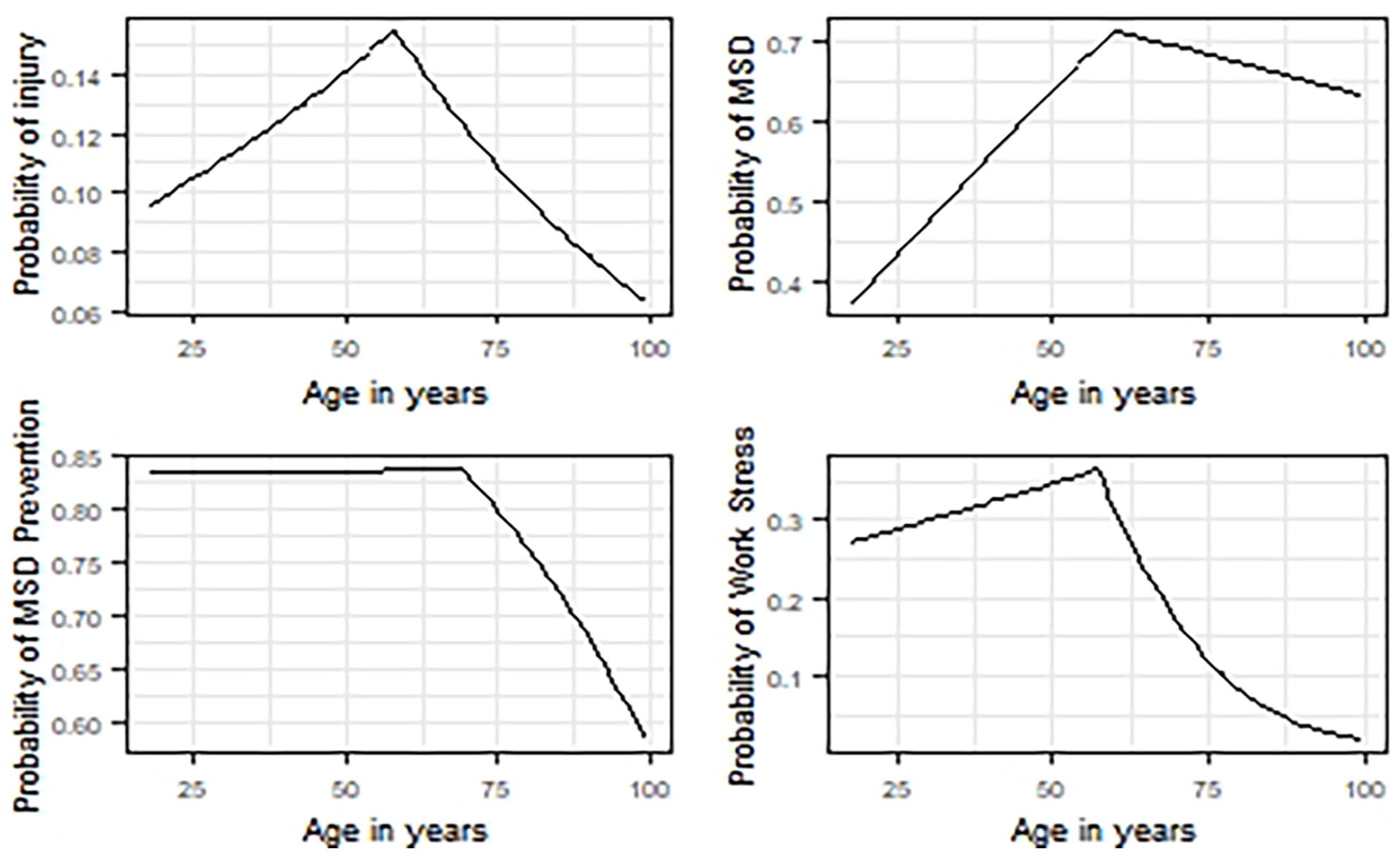
Proportion of 6,519 Operators Reporting a Work-Related Injury, MSS, Using MSS Prevention Techniques, and Work-Related Stress in Relation to Age From a Logistic Regression Changepoint Analysis, 2018 and 2020.
Two-Segment Logistic Regression Model of Estimated Model Parameters With 95% Confidence Interval in All Male Operators and in Principal Operators Working at Least 75% of Full-Time, 2018 and 2020
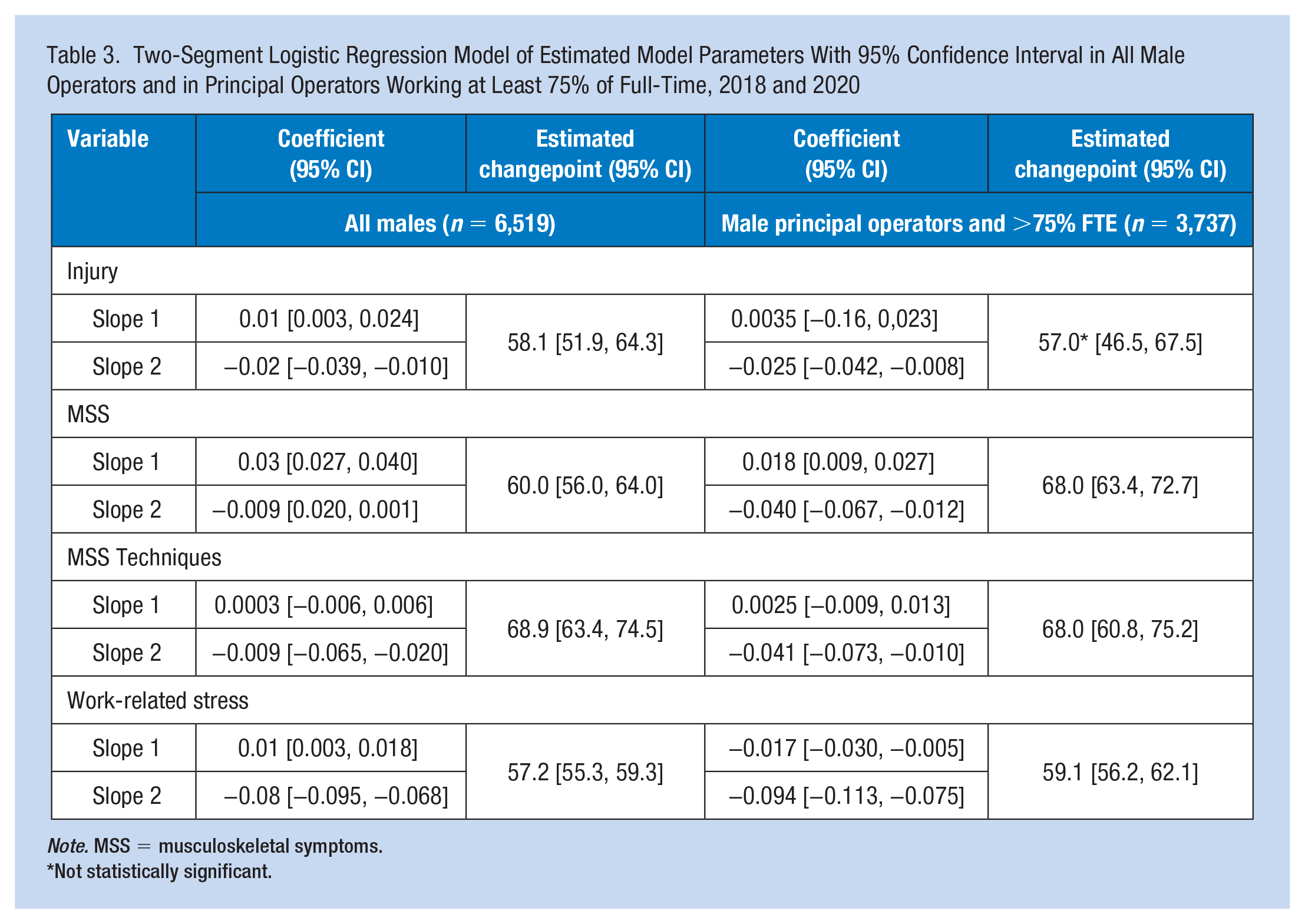
Note. MSS = musculoskeletal symptoms.
Not statistically significant.
In females, only work-related stress showed a significant changepoint in relation to age using a standardized alpha = 0.014. The Davies test and the segmented model estimated the changepoint to be about 30 years of age. The association of age to stress in the first segment was 0.19 (−0.03, 0.40) with high uncertainty in younger women and in the second segment −0.03 (−0.04, −0.02), indicating lower stress levels in older women. Female operators appeared to be experiencing work-related stress differently than their male counterparts. They showed no changes in the slopes across the age spectrum for injury rate, MSS rate, or the use of MSS prevention techniques.
For the sensitivity analysis, male operators who spent three-fourths or more of their work time engaged in farming or ranching, no significant changepoint was identified between age and injury (Pseudo Score test p-value = .15; Davies test p-value = .35). The probability of an injury showed a narrow range of approximately 0.15 to 0.175 until about age 57, but the variability around the estimated, nonsignificant changepoint was wide ranging from 46.5 to 67.5. The results of the segmented models are shown in Table 3 for comparison to the full sample. MSS increased with increasing age up to about 68 then decreased; neither of the confidence intervals contained zero. Techniques to prevent MSS mirrored what was seen in the full sample of male operators. The line was relatively constant then decreased dramatically after 68 years of age (Figure 2). A marginally significant changepoint was identified by the Pseudo Score test for techniques to prevent MSS (p value = .0076), but the Davis test was not significant (p = .01). The slope increased to age 68 then decreased, but only the decreasing slope was statistically significant. Work-related stress was strongly associated with age with p values near 0. Compared to the full sample of operators, the stress curve for the restricted sample showed remarkable differences. The probability of stress decreased slightly until approximately age 59 and then decreased at a faster rate. In the full sample, the stress regression line for segment 1 increased significantly.
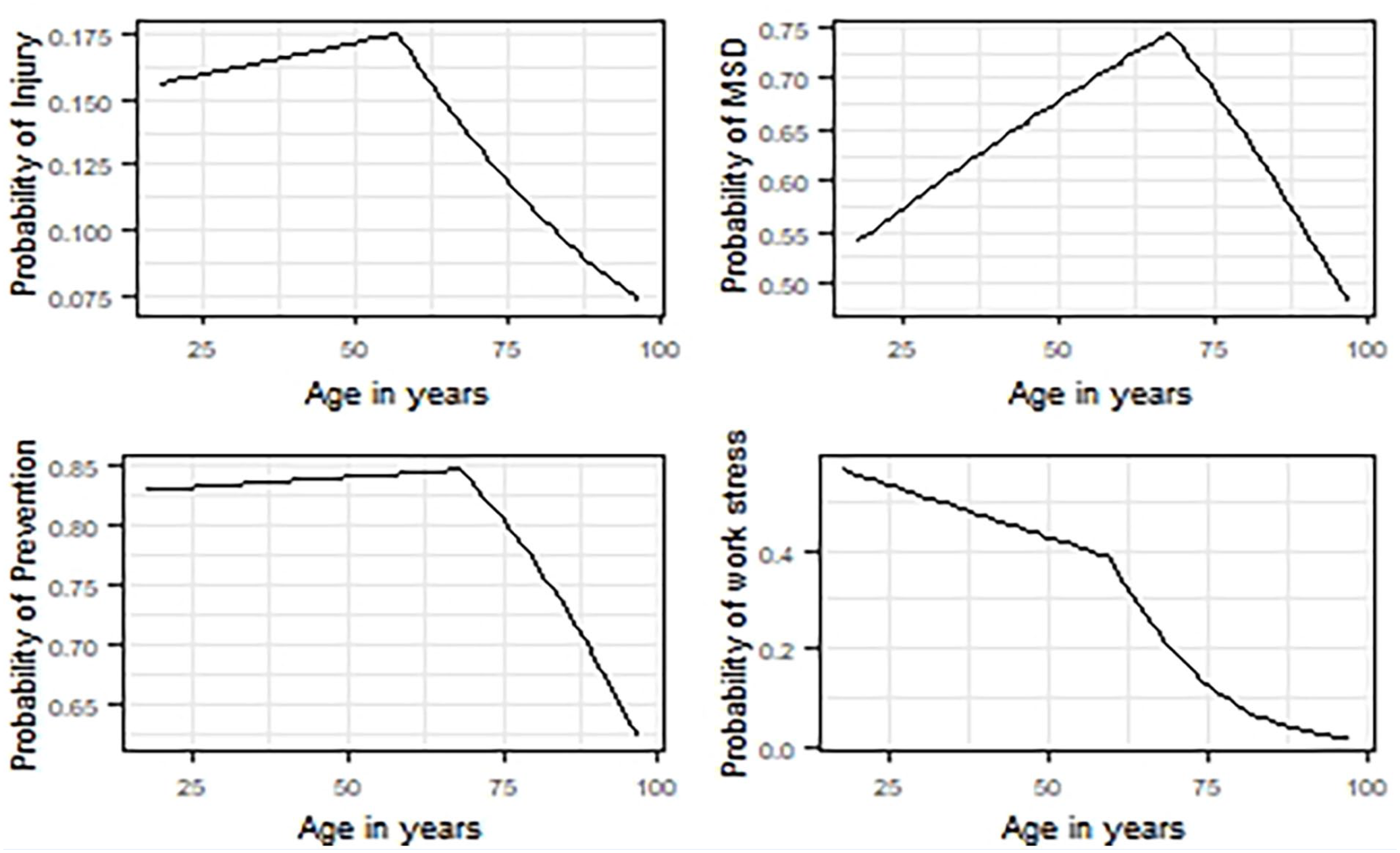
Sensitivity Analysis Results Showing Proportion of 3,737 Operators Who Spend at Least 75% of Their Work Time on the Operation Reporting a Work-Related Injury, MSS, Using MSS Prevention Techniques, and Work-Related Stress in Relation to Age From a Logistic Regression Changepoint Analysis, 2018 and 2020.
Discussion
In this study, we showed that the association of age with injury, musculoskeletal disorders, techniques for preventing musculoskeletal disorders, and work-related stress change over the lifespan in male operators. We identified possible thresholds in these associations, indicating that the risk is not constant across operator ages. Work-related stress changed over the age spectrum in female operators and peaked at a younger age than in males. The smaller sample size in women and only 100 reported injuries resulted in uncertainty around the estimates of the slope and the changepoint in the female injury model. Working a greater number of hours on the operation appeared to reduce the work-related stress in male farmers, while increasing the risk of injury. Injury rates peaked at 58, the current average age of the male operators. In operators working at least 75% of their work time on the operation, injury probabilities were higher than in the sample as a whole and did not show a significant change in the slope; they started high and stayed high, but decreased somewhat with increasing age.
These results indicate that work-related injuries may be high in mid-life compared to younger and older farmers. This result was identified in the previous study by Du et al. (2022). Injury may differ depending on the type of agricultural production. Working with animals may be equally dangerous at any age. Between 52 and 64 years of age, a shift occurred in the probability of an injury (Watts et al., 2013). Time spent working on the farm might seem a reasonable explanation for this finding. Fewer hours are spent working on the operation if younger farmers are not the principal operators on a family farm. In our surveillance data, 49.8% of principal operators worked 75% or more on the farm/ranch but in second and third operators combined only 16% worked more than 75% on the farm/ranch. Younger farmers are more likely to work off the farm (USDA, 2017), although the added time pressure might be expected to increase the risk of injury by increasing stress (Beseler & Stallones, 2020). Older farmers may have greater assistance from family members as they transition to retirement. This is somewhat supported by the fact that the changepoint disappears when the analysis is restricted to those working 75% or more on their operation. It is difficult to tease out the reasons for the peak at 58 years of age, but in those who spend most of the time farming, their risk for injury is not changing direction, although it does appear to decrease over the years.
Our study does not support previous findings that younger and older farmers were at greater at risk of injury than those in their middle years (Brison & Pickett, 1991; Lewis et al., 1998; Lyman et al., 1999; Walker & Lower, 2021). However, if the relationship between age and injury is not linear, and a changepoint exists, then associations will vary by the classification coding used to summarize the age variable. Using a linear model for age will not capture the nonlinearity in the association. The situation is further complicated by how many hours the agricultural operator spends working on the operation.
MSS and injury followed a similar pattern, but MSS were far more prevalent than injury. The changepoints for injury at 58 and MSS at 60 are similar, but there was greater certainty about the MSS changepoint than the injury changepoint. MSS increased dramatically from ages 18 to 60 starting at less than 14% and increasing to greater than 70%. Using techniques to prevent MSS was common in the full sample and in the reduced sample in the sensitivity analysis, although given the increase in MSS with increasing age it does not seem to be adequately mitigating the risk of MSS. However, it is not known whether these operators experienced MSS and then began using prevention techniques to try to reduce the pain and reverse causation is being observed in this study. In contrast to our hypothesis, older farmers were not more likely to exercise MSS prevention techniques than younger farmers. In the sensitivity analysis, this change in the association occurred at age 68, and the confidence interval only slightly overlapped the full sample’s interval. This might suggest that good MSS prevention techniques tend to keep operators better able to work by extending their productive years. These results also suggest that more could be done with agricultural operators to provide instruction in improving ergonomics and biomechanics in the physical labor they do earlier in their agricultural careers.
Over the age spectrum, men and women appear to experience injury, musculoskeletal disorders, and work-related stress differently. The smaller sample size for the women may account for the lack of significant findings and, specifically, the lack of changepoints. Women experienced fewer injuries than men (8.4% vs. 13.0%). Work-related stress was clearly different by gender. The peak at about age 31 with 95% confidence interval 25.7 to 36.3 is younger than the lower bound for males at 55.3 and may reflect the conflict between family pressures and those of the farm or ranch (Gallagher & Delworth, 1993; McCoy et al., 2002; Proctor & Hopkins, 2023).
The advantage of using the changepoint approach to assessing changes in injury risk with age is that it is data-driven. Visualizing how risk might change over age provides insights into how age influences outcomes of interest. The results can be used to inform how age might be categorized to reflect the changing risk over age using a segmented regression approach prior to categorizing the variable. Failing to capture nonlinearity in a relationship can dilute the effect of a predictor or explanatory variable on an outcome and can cause interpretation difficulties when testing for interactions. In the current example, the comparison of MSS and techniques used to prevent MSS were unexpected. Over most of an operator’s work life, prevention techniques were used consistently at high rates, but it does not seem as if the techniques being used are doing much to reduce the steep increase in MSS. This study also confirmed reports from the 1980s and more recent reports that young farmers were experiencing greater stress than older farmers, and that female operators are experiencing these work-related stressors at much younger ages due to the burden of work and family (Gallagher & Delworth, 1993). Mental health programs in rural communities should provide resources for young women in agriculture. These supports could include expanded access to quality child care and education and greater access to healthcare and behavioral health services.
Implications for Occupational Health Nursing Practice or Implications for Occupational Health Practice
Male and female agricultural operators have different patterns of risk for injuries, MSS, work-related stress, and use of MSS prevention techniques over the working lifespan. Women experience work-related stress at much younger ages then men do. Men who spend most of their work time on the operation are at higher risk of injury than those working less. Traumatic injury and MSS tend to follow the same patterns across the age spectrum, but MSS was much more prevalent with no obvious mitigation by techniques designed to reduce the risk of MSS. Healthcare providers working in rural communities may benefit from understanding who is at greater risk of occupational disorders so that they can help their agricultural patients prevent MSS, manage stress, and advise patients about exercises and techniques to reduce their MSS. Asking agricultural operators specifically about their work-related health issues and what prevention methods they are using can raise awareness of the importance of prevention. Being able to express an understanding of the injury risks to patients working in agriculture builds trust between patient and healthcare professional. Building partnerships with community resources such as agricultural extension and referring people for trainings and classes might help with encouraging operators to do more to improve their health. Several states offer continuing education courses (for credit) in agricultural health and safety, and health professionals are encouraged to take advantage of these courses to enhance their ability to provide services to agricultural workers.
Footnotes
Author contributions
C.L.B. conceived of the study research questions, designed the methodology, and drafted and edited the manuscript text. R.H.R. designed the survey used to collect the data, assisted with distributing the survey, assisted with writing and editing of the manuscript.
Declaration of Conflicting Interests
The author(s) declared no potential conflicts of interest with respect to the research, authorship, and/or publication of this article.
Funding
The author(s) disclosed receipt of the following financial support for the research, authorship, and/or publication of this article: This work was supported by the CDC/NIOSH U54 OH010162. NIOSH funds the Central States Center for Agricultural Safety and Health (CS-CASH) which supports the collection of farm safety and health surveillance data. The funder had no involvement in study design, data collection and analysis, decision to publish, or preparation of the manuscript.
Ethics approval and consent to participate
The study was determined to be exempt from human subjects’ research by the University of Nebraska Medical Center’s Institutional Review Board, IRB) No. 452-11-EX by letter dated March 9, 2018.
