




Abstract
Background:
Bedside nurses and nursing students are at increased risk of musculoskeletal injury due to the physicality and complexity of their work. The purpose of this study was to explore the relationship between grip strength and orthopedic injuries or pain among nurses and nursing students.
Methods:
A cross-sectional study of nursing staff and nursing students at a health sciences university was conducted. The survey consisted of work-related demographics, exercise habits, and validated scales. The Nordic Musculoskeletal Questionnaire was used to collect information on musculoskeletal problems. Anthropomorphic measures included height, weight, body mass index (BMI), and grip strength. Logistic regression was performed.
Findings:
Participants with grip strength at or above the national average had significantly lower odds of self-reported orthopedic problems, B = 0.86, OR = 2.35, p =.01, indicating participants with grip strength at or above national average were 135% less likely to report orthopedic problems compared to participants with grip strength below the national average.
Conclusion/Application to Practice:
Healthcare workers in direct patient care who have lower grip strength may be at increased risk for injuries. Nursing staff and students with below average grip strength were more likely to experience orthopedic problems. Increased muscle mass and grip strength are known to effectively reduce the risk of upper extremity injuries. Nurse leaders may benefit from promoting grip strengthening activities among employees to prevent workplace injuries. Further research is needed to understand the biophysiological mechanisms, confirm the findings of this study and evaluate effective interventions.
Background
There are nearly five million nurses in the United States (Smiley et al., 2021) making up a substantial portion of the healthcare workforce. Fifty-four percent of registered nurses (RNs) work in the hospital setting (Smiley et al., 2021). Nurses providing direct patient care at the bedside perform a physically demanding role. The U.S. Bureau of Labor Statistics (BLS) ranked nurses’ injuries and illness as highest among healthcare workers (Dressner & Kissinger, 2018). Previous studies have found that on average, nurses and students are not performing the recommended amount of exercise during their leisure time (Smiley et al., 2021; Pugh et al., 2019). A lack of adequate fitness increases the risk of musculoskeletal injuries among nurses (de la Motte et al., 2017). Nursing students also experience musculoskeletal symptoms, and despite regular exercise many students have poor to average fitness levels, and poor to fair grip strength (Pugh et al., 2019). Bedside nurses and nursing students are at increased risk of musculoskeletal injury due to the physicality and complexity of their work. It is common for nurses to work night shifts or extended shifts, which are known to increase the risk for orthopedic injury (Han et al., 2016; Thompson, 2021). Orthopedic injury is defined as: any injury to the musculoskeletal system. Often, these injuries relating to the bones and joints are a result of an accident or trauma to the body (Beaumont Health, Common Orthopedic Injuries, 2021). Sprains and strains of the back, upper extremity, or multiple areas are the most common injuries among the nursing workforce (U.S. BLS, 2021). The terms orthopedic and musculoskeletal injury refer to the same condition examined by this study.
Throughout the workday, nurse activity can range from relatively low levels of musculoskeletal use when performing activities such as documentation to high levels of musculoskeletal demand when lifting or turning patients (Chappel et al., 2017). Nurses assist patients who have limited function or mobility, with activities of daily living. Nurses also provide physical support alongside patients and reach across bodies to turn, pull, or lift (Younan et al., 2019).
Efforts have been made to reduce injuries among healthcare workers and some progress has been made. OSHA as well as the American Nurses Association (ANA) has campaigned for a safer work environment in hospitals through safe patient handling programs (American Nurses Association [ANA], 2021; Lee et al., 2021). The ANA has published the second edition of Interprofessional National Standards for safe patient handling and mobility signaling continued commitment to preventing injuries in the workplace (2021). While these programs can be effective over time, the national rate of injuries among nurses has remained nearly the same since OSHA’s implementation (US BLS, 2021). Several states have adopted safe patient handling programs which require organizations to invest in assessment, training, and equipment (Lee et al., 2019). While these programs help reduce risks, they were more common in large hospitals compared to small-medium hospitals (Lee et al., 2019). Orthopedic injuries remain common, suggesting a gap in the preparation of nursing students. The use of safe patient handling equipment and technology may not be included in nursing education. These findings suggest there is more to be done to improve the physical well-being of nurses.
Prolonged periods of inactivity are known to increase the risk of musculoskeletal injuries (Lurati, 2018). A multisite study of 410 Canadian nurses found only 23% met the recommended activity requirements (Reed et al., 2018). In a statewide survey of California nurses, 50% reported less than 2.5 hours aerobic activity per week (Nam et al., 2018). These studies suggest a gap between the evidence and practice in terms of physical activity for occupational health safety.
The average grip strength in the U.S. population has decreased dramatically since the 1980s normative data (Vanderbilt, 2017). Grip strength is an effective indicator of present and future health status (Bohannon, 2015, 2019; Carney & Benzeval, 2018; Lee et al., 2021; Leong et al., 2015; Wang et al., 2018). Decreased grip strength reflects lower overall strength and upper limb function, and is associated with increased risk for musculoskeletal injury, cardiac events, and other health problems (Bohannon, 2019). A dynamometer measures grip strength at a low cost. A dynamometer is handheld and can be transported and stored easily.
Approximately 53% of nurses are above the age of 50 and approximately 90% are female (Smiley et al., 2021). Muscle mass and bone density decrease with age and more so in females due to changes in hormones (Lang et al., 2012). On average, females have significantly lower grip strength than males in the same age cohort (Leyk et al., 2007). Therefore, the science suggests that nurses are at elevated risk for injury due to low grip strength, age, and gender.
Given the substantial risk of injuries among nurses and nursing students, exploring the relationship between grip strength and orthopedic injuries may point to interventions to prevent injuries and reduce organizational costs resulting from such injuries. The purpose of this study was to explore the relationship between grip strength and orthopedic injuries or pain among nurses and nursing students.
Methods
We conducted a cross-sectional study with data collection from October 2019 to September 2020. Nurses and nursing students working in unlicensed assistive personnel (UAP) roles were included in the high physical demand group while participants working in administrative positions were included in the low physical demand group. A sample of (N = 271) nursing staff and nursing students at a health sciences university completed a brief survey consisting of nonidentifiable work-related demographics, questions pertaining to exercise habits, and validated scales by paper and pencil method. In addition, the team collected anthropomorphic measures on all participants.
The Nordic Musculoskeletal Questionnaire (NMQ) collects the frequency and locations of musculoskeletal problems (Crawford, 2007). Specifically, low back, neck, shoulder, and general musculoskeletal pain or problems, whether medical attention was sought, and in what timeframe this was self-reported on the NMQ. The tool provides a convenient method of assessing individuals’ own perception of injury rather than relying on a medical diagnosis. The NMQ was first developed several decades ago and has sustained popularity in occupational and applied science (Kuorinka et al., 1987; López-Aragón et al., 2017). NMQ has been adapted and validated across occupations and countries (López-Aragón et al., 2017). The Centers for Disease Control (CDC) has utilized the NMQ to study musculoskeletal risk factors (Wiehagen & Turin, 2004). In a study of Australian nurses and nursing students, Pugh et al. (2015) utilized a modified version of the NMQ to measure fitness level categories.
Anthropomorphic measures included height and weight with body mass index (BMI), which were measured with the same stadiometer and digital scale for all participants. Grip strength was evaluated with Jamar hydraulic dynamometers.
Grip strength was separated into below national average and at or above the national average. Age and BMI were analyzed as scale variables. Exercise intensity was self-reported as low, medium, or high.
G*Power 3.1.9.2 (2009) was used to conduct a priori sample size analysis. For a two-tailed t-test, a sample size of 152 needed as calculated by G-power with a medium effect size (0.3), alpha.05, and power.80. Descriptive analyses were conducted using frequencies for nominal/categorical variables and M with SD for continuous demographic variables. Chi-square and t-tests were used to determine significant differences between subgroups. Bi-variable associations of co-variates with orthopedic problems were conducted using Pearson’s correlations to inform multivariate analyses and model building. For a logistic regression, a sample size of 242 is needed as calculated by G-power with an odds ratio of 1.5, alpha.05, and power.80. Logistic regression was performed to explore the factors (grip strength, age, gender, BMI, physically demanding positions, and exercise intensity) with orthopedic problems among participants.
Results
The sample size (N = 271) consisted of 204 females, 62 males and 5 identified neither male nor female. An average age of 34.66 ± 11.56, ranging from 19 to 68 years of age. The mean BMI was 27.11 ± 5.82 with a minimum 16.10 and a maximum of 52.00. The vast majority, 74.50% (n = 202) of the participants were found to have orthopedic problems, while only 25.50% (n = 69) did not. Participants reported exercise intensity being low for 22.30% (n = 53) medium for 60.90% (n = 145) and high for 16.80% (n = 40). Grip strength measures were below the national average for 66.80% (n = 181) and at or above the national average for 33.20% (n = 90) of participants (see Table 1).
General Characteristics of Study Participants Stratified by Orthopedic Problems Status (N = 271)
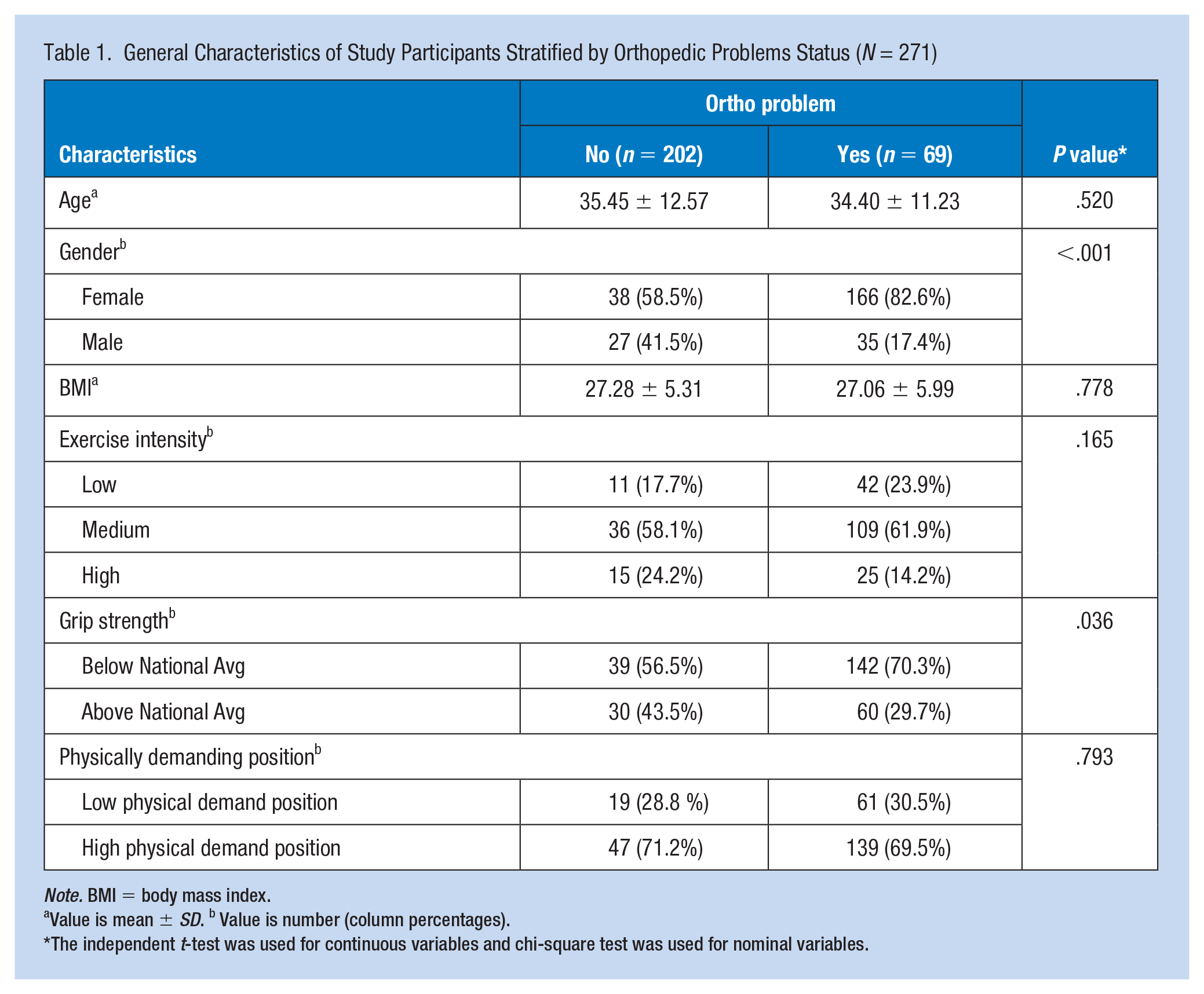
Note. BMI = body mass index.
Value is mean ± SD. b Value is number (column percentages).
The independent t-test was used for continuous variables and chi-square test was used for nominal variables.
Grip strength among participants with and without orthopedic problems significantly differed between genders (p < .001), with more females, 82.60% (n = 166) than males, 17.40% (n = 35) experiencing orthopedic problems. Exercise level significantly differed among participants below versus those meeting grip strength normative values (p = .04). Age and BMI were not significant with p values .21 and .61, respectively. Working in a physically demanding work role was not a significant factor (p = .45).
Multiple logistic regression was conducted to assess the association between grip strength status and self-reported orthopedic problems. For model building purposes, correlations were explored (see Table 2), and significant variables were included in the logistic regression. The multivariable adjusted model shows the participants with grip strength at or above the national average had significantly lower odds of self-reported orthopedic problems, B = 0.86, OR = 2.35, p = .01, indicating participants with grip strength at or above national average were 135% less likely to report orthopedic problems compared to participants with grip strength below the national average (see Table 3).
Correlations Between Study Variables Disaggregated by Orthopedic Problem
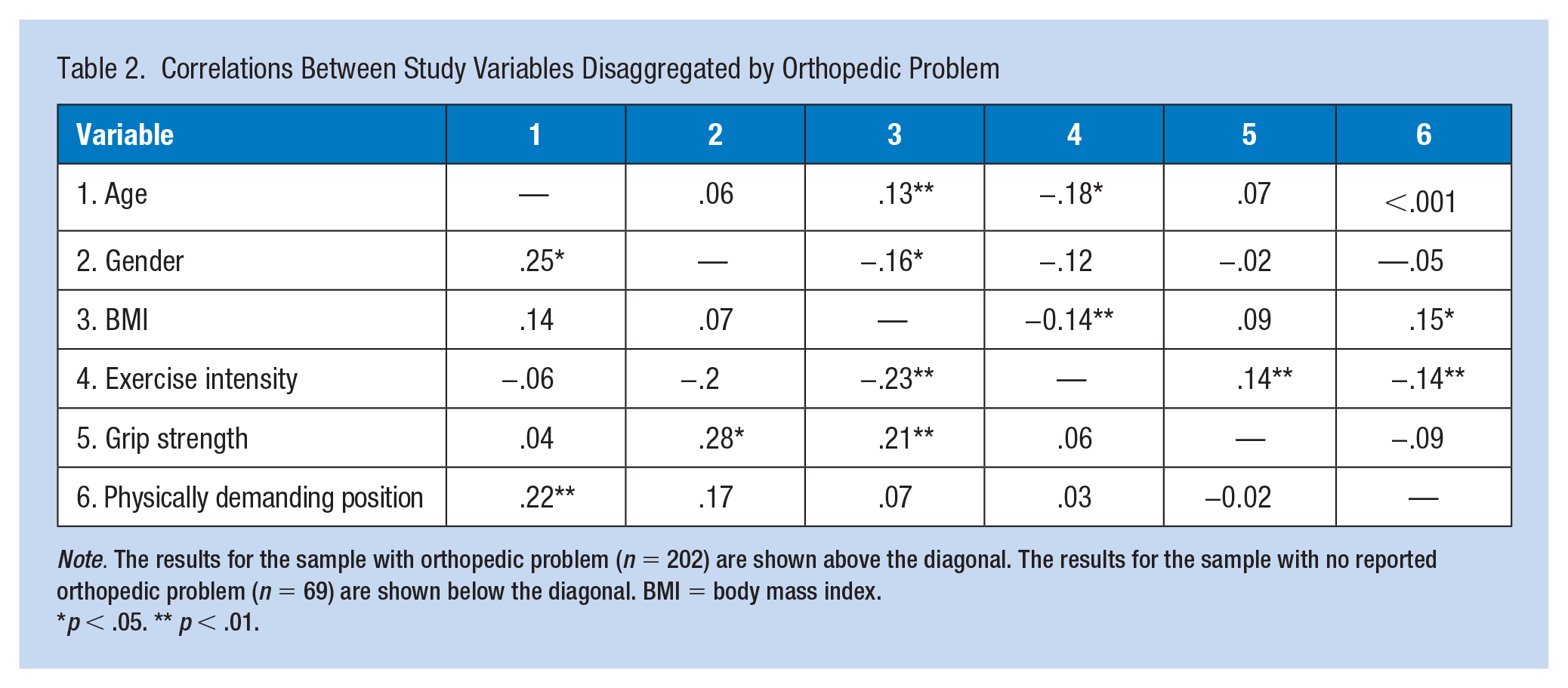
Note. The results for the sample with orthopedic problem (n = 202) are shown above the diagonal. The results for the sample with no reported orthopedic problem (n = 69) are shown below the diagonal. BMI = body mass index.
p < .05. ** p < .01.
Multiple Logistic Regression Analysis of the Relationship Between Grip Strength Status and Self-Reported Orthopedic Problem
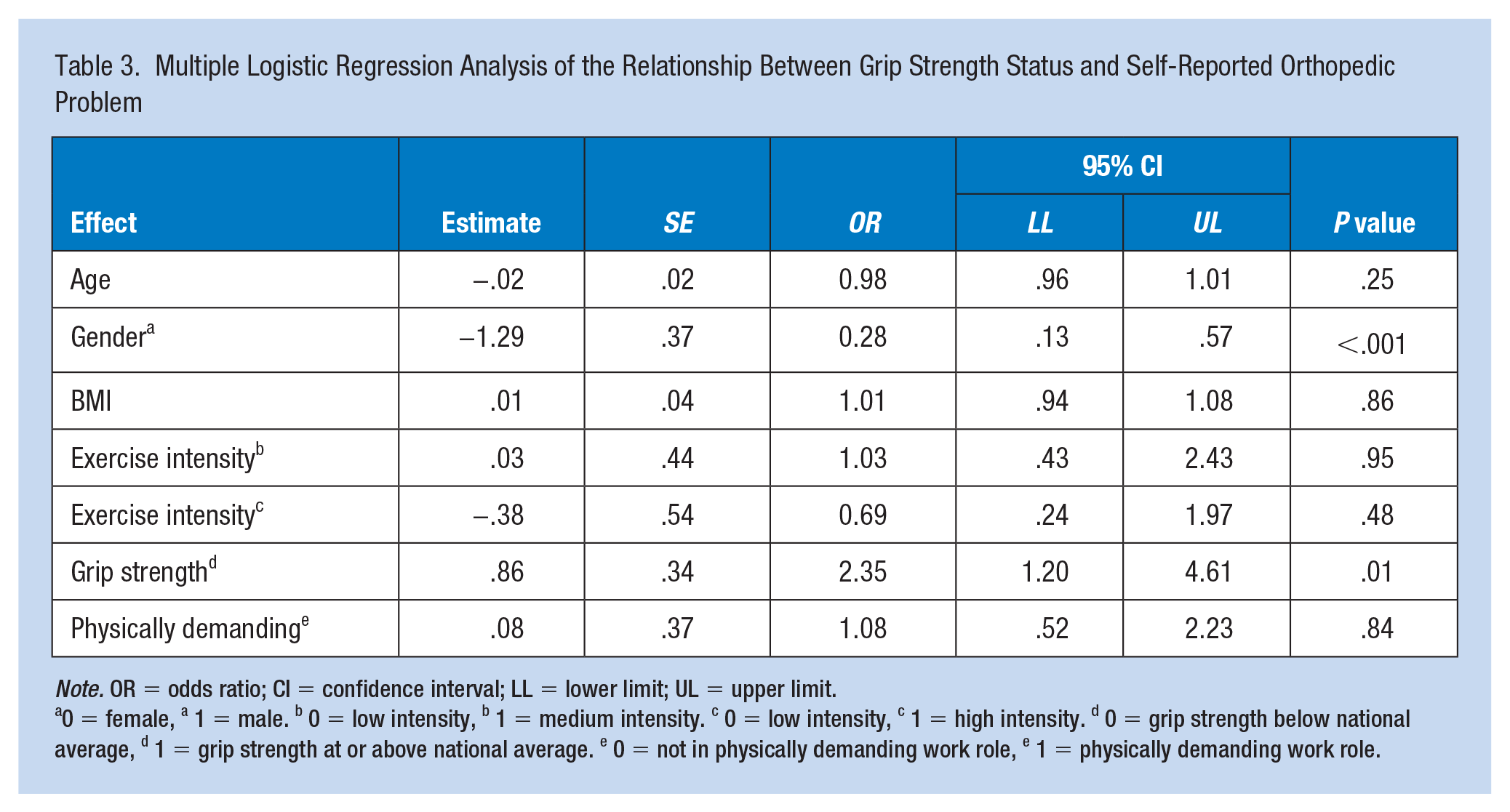
Note. OR = odds ratio; CI = confidence interval; LL = lower limit; UL = upper limit.
0 = female, a 1 = male. b 0 = low intensity, b 1 = medium intensity. c 0 = low intensity, c 1 = high intensity. d 0 = grip strength below national average, d 1 = grip strength at or above national average. e 0 = not in physically demanding work role, e 1 = physically demanding work role.
Discussion
This study sought to add to the current body of knowledge by exploring grip strength, exercise, and physical demand of work position as factors impacting the likelihood of self-reported orthopedic problems among nurses and nursing students. Grip strength, when combined with age, gender, BMI, high demand position, and exercise intensity highlights the risk of orthopedic injury among nurses and students. Our sample was primarily women, reflecting the typical nursing population (Smiley et al., 2021). Compared to the average age of nurses in the nation (Smiley et al., 2021), our sample was younger, reflecting the inclusion of students.
Significantly, more women in our sample suffered orthopedic problems than their male counterparts. Among the women, 82.60% (n = 166) reported orthopedic problems compared to just 17.40% (n = 35) of the males. Furthermore, the findings suggested that medium to high-intensity exercise may be associated with reduced levels of orthopedic injury. Our results confirmed what is known in the current literature while adding exercise intensity as a modifiable factor.
Grip strength was an important health indicator. In our sample, the odds of orthopedic injury were more than doubled among participants with below-average grip strength compared with those who met or exceeded normative grip strength values by age and gender. Collecting grip strength data may be an overlooked opportunity to raise awareness regarding the importance of physical conditioning among nurses. Given these findings, organizations that provide exercise resources to nursing staff may benefit from lower orthopedic problems. While health-promoting benefits may be included in many employers’ benefit packages, a lack of utilization may represent untapped potential for promoting workforce well-being. Nursing leadership could intervene by promoting awareness of grip strength. Nursing staff should be aware of the importance of grip strength to prevent workplace injuries. In the same way re-education about best practice is provided when quality measures are deficient, leaders may improve the health of the nursing workforce by encouraging health promoting activities outside of work. By encouraging employees to maintain above-average grip strength, employers may see a reduction in workplace injuries. Nurses with risk factors should consider increasing physical exercise to reduce the likelihood they will experience orthopedic injuries.
Potential limitations to this study included self-report of orthopedic problems, and levels of exercise intensity. Future studies should include the same factors while using objective measures of exercise intensity such as heart rate monitoring during exercise. A longitudinal study with repeated measures of grip strength and a control group would provide further evidence for factors predicting orthopedic problems and inform interventions.
Conclusion
Orthopedic injuries were more than two times as likely to occur among nursing staff and students with below-average grip strength. Further research is needed to confirm the findings of this study as well as effective interventions. Educating nursing staff and students on the need for adequate fitness and strength may reduce the likelihood of orthopedic problems and musculoskeletal injuries.
Application to Professional Practice
Healthcare workers in patient care are in physically demanding positions. While orthopedic injuries among nurses are relatively high compared to other healthcare providers, the level of strength required is not known. Grip strength is a reliable measure of overall strength that may be combined with ergonomic assessments to determine the level of risk for a nurse to experience orthopedic injuries. Occupational health professionals in healthcare employee health services may best serve nurses and nursing students by promoting physical fitness for overall employee health and, potentially prevent orthopedic injuries.
Footnotes
Conflict of Interest
The author(s) declared no potential conflicts of interest with respect to the research, authorship, and/or publication of this article.
Funding
The author(s) disclosed receipt of the following financial support for the research, authorship, and/or publication of this article: Funding for this study was provided by an intermural grant (# 2190522) from Loma Linda University.
Ethical Approval
This study obtained approval from the Loma Linda University Institutional Research Board.
