




Abstract
Background: A cohesive body of scientific evidence has documented the adverse impacts of occupational stress on worker health and safety and, to a lesser extent, on organizational outcomes. How such adverse impacts may be prevented and/or ameliorated are important to understand, but progress has been limited due to the lack of a robust and comprehensive theoretical model of occupational stress. Methods: Building on a review of existing theoretical models of occupational stress and an ecological framework, a multilevel conceptual model of occupational stress and strain is proposed that identifies various and potentially interacting sources of occupational stressors as well as potential protective factors. Results: The revised ecological model proposed herein embraces a broad conceptualization of outcomes and includes an individual worker, work unit (team) performance as well as organizational level outcomes; for example, resilience/dysfunction. Conclusion/Application to Practice: This model provides occupational health nurses with an improved understanding of occupational and worker health as well as guidance in developing targeted interventions and generating new lines of occupational stress research.
Keywords
Background
Over the past several decades a cohesive body of scientific evidence regarding the impact of occupational stressors on workers’ mental and physical health and well-being has been published. These research findings have documented both the global nature of work stress as well as its contributions to various adverse mental and physical health outcomes (de Jonge et al., 2000; Karasek & Theorell, 1990; Wang et al., 2012) including cardiovascular disease (Karasek et al., 2010) and depressive disorders (LaMontagne et al., 2008). This complex public health problem has been, and remains, challenging to investigate. This has been due, in part, to a lack of a comprehensive and robust theoretical models of work stress that adequately identified the various sources of occupational stressors. None of the prevailing models of workplace stress, including the Person Environment Fit (Karasek & Theorell, 1990) or Effort–Reward Imbalance Model (Siegrist et al., 1990) have considered factors beyond the individual worker or the worksite. None of the prevailing models of occupational stress have considered how community, state-level, federal, or other extra-organizational factors are implicated in enhancing worker stress (Leppin et al., 2014). Nor have any of the existing models identified the potential protective factors that may also operate at various levels nor have they considered the potential roles of non-work moderating variables (Ganster & Perrewé, 2011). These protective or moderating variables may serve to either partially ameliorate or potentially magnify outcomes and thus may mitigate or contribute to adverse worker health impacts. Ideally, such a theoretical model of occupational stress would generate novel research endeavors, guide efforts to design interventions, and provide assistance for health providers, including occupational health nurses. To date, most clinical interventions intended to reduce the adverse effects of stress in the workplace have focused primarily on the individual worker (Grawitch et al., 2015) and/or, to a lesser extent, on their workplace organization(s) (Bambra et al., 2007; Landsbergis et al., 2017). We are proposing herein an ecological approach to this complex and multidimensional public health problem.
Ecological theory is derived from the biological and sociological sciences in their efforts to describe and analyze the complex interrelationships between organisms and their environments (Hawley, 1950). The basic assumptions of ecological theory are that systems are dynamic, interdependent, and work together to create equilibrium or homeostasis; change is constant; and “everything is interconnected to everything else” (McDonald et al., 1999). The ecological model consists of a nested arrangement of successive and more complex hierarchical structures representing layers of influence. Social scientists have long recognized the value of the ecological approach as an aid to the systematic analysis and understanding of complex human behaviors (Ruffing-Rahal, 1998; Stokols, 1996). Salazar and Beaton (2000) originally proposed an ecological model of occupational stress. In their original model, Salazar and Beaton (2000) proposed that relatively more distal and complex hierarchical peri-organizational and extra-organizational layers or levels were presumed and postulated to influence and interact with more proximal layers such as the work organization and immediate worker group or team. One limitation of the original ecological model of occupational stress was the omission of the individual worker level; that is, the dynamic processes related to an individual worker’s appraisal of work stressors and coping. As seen in Figure 1, the proposed revised ecological model of occupational stress adds an individual worker layer at its core, augmenting the context in which worker groups, the work organization as well as peri- and extra-organization layers of influence are embedded. This additional level emphasizes individual worker stress appraisal processes as well as coping strengths and deficiencies that could affect short-term and longer term occupational health and other outcomes. The revised ecological model also differs from the original by considering and including a host of other potential outcomes associated with work stress, in addition to worker health and safety, such as worker performance and organizational level outcomes.
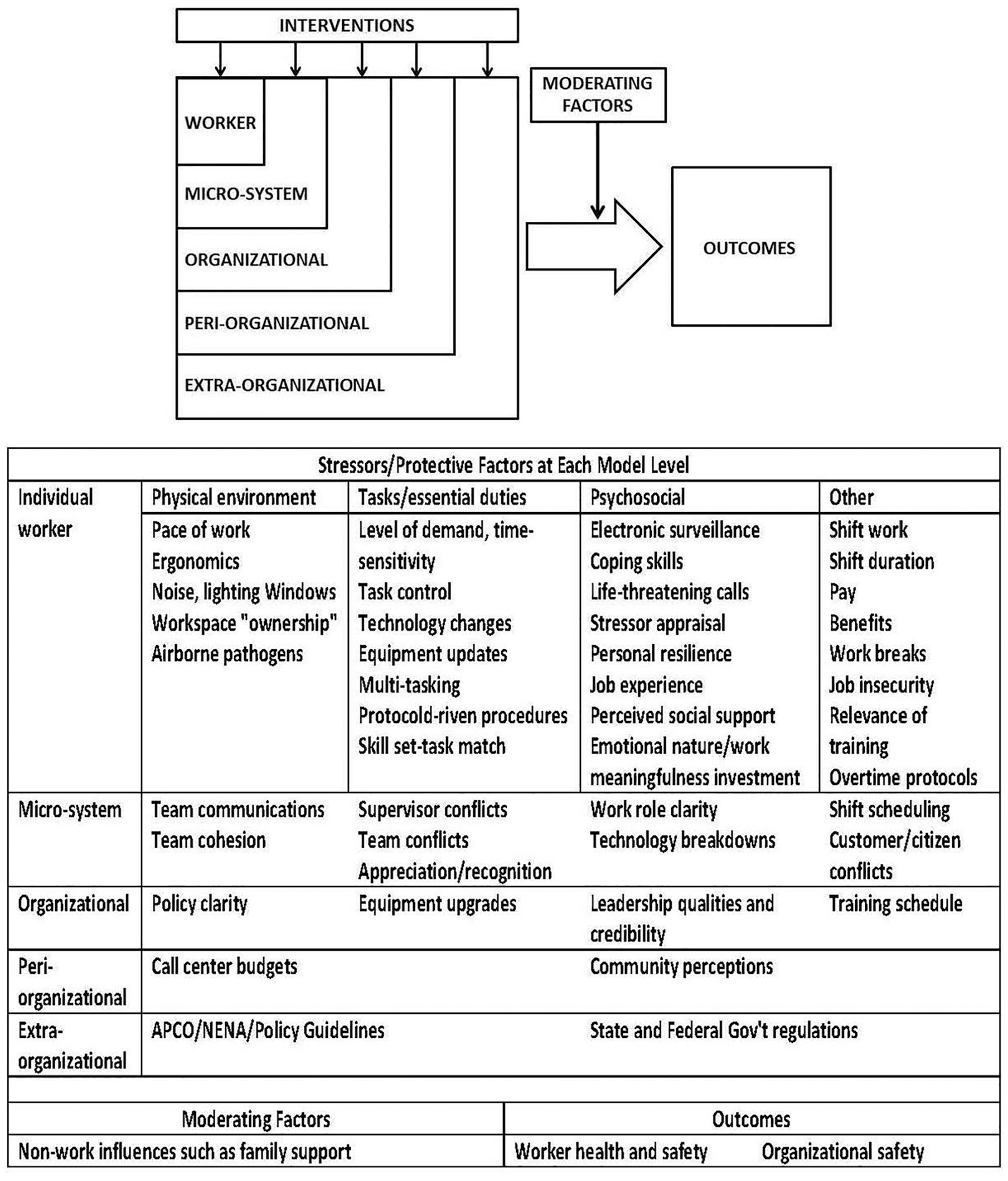
Depicts the main elements of the revised ecological model including the various nested levels, moderating variables and outcomes.
Methods
We conducted a literature review and critique of extant models of occupational stress and strain. Building on a prior ecological model of occupational strain, we generated and revised successive iterations of a revised ecological model of occupational stress. Drawing on the basic tenets of ecological theory, we constructed a revised ecological model of occupational stress. This revised model proposed an additional individual level of analysis and influence. To illustrate the utility of this model we provided a description and analysis of the various levels of using 9-1-1 telecommunicators (TCs) as an occupational case exemplar. The application of this model to TCs and call centers was also informed by interviews with currently employed novice and seasoned TCs, site visits to call centers in a Northwest state as well as guidance and feedback provided by an advisory group which consisted of 11 call center managers, two trainers and two TCs from call centers in Washington State.
TC Roles and Work Environment
TCs (also referred to as 9-1-1 call receivers or police/medical emergency dispatchers) work in a high stress work environment in which they are tasked with responding to emergency calls from citizens in their community, making time urgent decisions and, if needed, dispatching police, fire and/or emergency medical services (EMS) personnel to the scene of an emergency (Adams et al., 2015). TCs are the First of the First Responders tasked with life and death decision making and responsibilities and, in some U.S. communities, TCs are even trained to provide instruction in life-saving cardiopulmonary resuscitation (CPR) techniques (Meischke, Painter, Chavez, et al., 2015). All of the official communications of TCs are subject to monitoring, electronic surveillance and TCs are “. . . directly answerable for every decision they make” (Adams et al., 2015). TCs are also exposed indirectly to the vicarious trauma of “first party calls” from victims, family members, or observers who have just witnessed or are experiencing a crime, serious injury, or medical emergency (Golding et al., 2017). Bedini et al. (2017) recently reported that levels of salivary cortisol, as a biomarker of stress, were elevated in those emergency medical dispatchers who received an incoming call that required an immediate dispatch of a medical aide unit. To maintain their effectiveness, TCs are also required to learn and master new technical skills as emergency call center systems undergo routine system upgrades. More recently in the United States, TCs have been challenged with updating their technical skills in response to entirely new communication technologies (NextGeneration 911 or NG911), such as receiving and responding to text messages from citizens and/or video streaming of potentially of graphic images from incident scenes (National Emergency Number Association [NENA], 2013b).
Few studies have focused on job-related stress, stressors, or mental and physical health outcomes in TCs. However, the available research investigations have reported elevated risks for burnout, compassion fatigue, and secondary traumatic stress linked to TCs’ workplace stress exposures (Golding et al., 2017; Gould, 2009). Similarly, Ramey et al. (2017) found that TCs in a large metropolitan police department (n = 19) self-reported statistically higher levels of stress compared with sample of police officers on most measures employed. In a nationwide investigation of call center TCs (n = 758), Lilly et al. (2016) found that more than 80% of their sample was either overweight or obese (based on BMI) and self-reported an average of 17 physical health complaints. Findings from another call center survey study of TCs (n = 154) documented elevated self-reported symptoms of stress, and an association between TCs’ self-reported stress symptomatology and perceived effort at work, effort–reward imbalance, over commitment to one’s job, and “technostress”(Meischke, Painter, Lilly, et al., 2015). Finally, a study of a large national sample (n = 800) found that approximately 18% to 25% of TCs reported symptoms consistent with a probable diagnosis of posttraumatic stress disorder (PTSD) and 24% of TCs reported symptoms consistent with a probable diagnosis of a major depressive disorder (MDD; Lilly & Allen, 2015). The prevalence(s) of PTSD and MDD reported for TCs were several times greater than those for gender/age-matched community samples (Anders et al., 2011; Hasin et al., 2005). The following sections describe the application of the revised ecological model to the occupational stress of TCs.
Application of the Revised Ecological Model of Occupational Stress to TCs
The individual worker level focuses on the individual employee’s stressors and protective factors. The individual worker may be a line worker who, for example, performs certain tasks or operations and/or provides direct services. The inclusion of the individual TC worker level represents a major revision to the original ecological model. (Text embedded in Figure 1 provides a list of potential stressors and protective factors that are inherent at the level of the individual TC.) This list of stressors enumerated in Figure 1 includes features of the individual TC physical workplace environment such as workstation ergonomics as well as their task-related essential duties and tasks, their time urgent work pace, as well as psychosocial stressors such as work product surveillance as well as other stressors inherent in sedentary, service-oriented occupations (Kim & Choo, 2017; Oh et al., 2017).
This individual TC worker’s appraisal of, and coping with, stress highlights the importance of individual worker appraisal and coping styles or deficiencies that may influence a broad array of outcomes (Regehra et al., 2013). This level also includes the individual TC worker’s perceptions or appraisals of their work environment. For the individual TC, every citizen’s 9-1-1 call is a potential stressor that initiates appraisal and coping processes (Lazarus & Folkman, 1984). The individual TC must first evaluate whether the call is urgent, controllable, or irrelevant (i.e., primary appraisal). If deemed relevant and urgent, the next step involves the individual TC’s secondary appraisal process in which a TC assesses what coping resources might be needed and available (Lazarus & Folkman, 1984). Both the short and long-term coping efforts of the individual TC worker may be mediated by meaning-based coping or coping processes that could induce positive emotions and even positive re-interpretations and posttraumatic growth. The individual TC may also perceive the situation, though stressful, as an opportunity to grow or to acquire new skills needed to advance their career. As detailed in Figure 1, potential protective factors at the individual TC level includes their problem-focused coping styles, internal locus of control, psychological flexibility, higher levels of mindfulness as well as their perceptions of social support (Lilly & Allen, 2015; Meischke, Painter, Lilly, et al., 2015; Regehra et al., 2013; Shakespeare-Finch et al., 2015). These same research investigations have also documented a number of stressors operating at the individual TC worker level including higher levels of technostress and over commitment, emotion-based coping and lack of social support.
The microsystem level of analysis refers to the immediate worker group or team with whom the individual worker interacts or communicates with to accomplish some desired end, goal, or deliverable (Salazar & Beaton, 2000). TCs operate as part of a team that depends on effective communication between the 9-1-1 caller, the TCs’ call receivers and/or dispatchers. (At times, this immediate TC’s work team may also include First Responder field personnel). Figure 1 lists a number of potential TC’s microsystem-level psychosocial stressors, such as conflicts arising between team members, managers, and/or callers/citizens. Physical stressors present at the microsystem level include physical or technological impediments that can hinder clear communications within the call center or in exchanges with field personnel (Bye et al., 2013). Potential protective factors at this team level include effective and competent management (Beaton et al., 2001).
The organization level refers to the structures, policies, procedures as well as the managerial personnel who guide the mission of a public or private sector entity. There are more than 5,000 9-1-1 call centers in the United States (Federal Communications Commission [FCC], 2017). Each 9-1-1 call center organization operates with a certain degree of autonomy in terms of decisions regarding hiring, training, as well as protocols for updating old or implementing new technologies. As listed in Figure 1, occupational stressors operating at the organizational level of the ecological model might include, for example, shift work, lack of recognition and policies (Adams et al., 2015) such as mandatory overtime policies and electronic surveillance and recording of all organization workers’ computer key strokes and audio interactions with the public. Each of these organizational level parameters and protocols could influence individual TCs and TCs’ work teams. For example, poor managerial decision-making or ineffective communication are potentially stressors that could aggravate organizational conflict and/or which could contribute to uncertainty or ambiguity at the organizational level (Atefi et al., 2014). Moreover, stressors at the call center organizational level, such as ineffectual leadership, could lead to increases in stressors at the team level in terms of increased conflicts and adverse outcomes at the individual TC level, in terms of job dissatisfaction. On the contrary, competent, fair, and communicative leaders can enhance job satisfaction and overall call center morale (Beaton et al., 2001).
The peri-organizational level refers to the surrounding community in which a particular work organization is embedded. Figure 1 also lists peri-organizational stressors and protective factors such as budgetary shortfalls or adequate funding, respectively. In theory at least, as no research has been conducted in this arena, call centers that are not adequately funded are often short staffed, contributing to mandatory overtime which can serve as a stressor at the individual TC level but also, consistent with the ecological model, influence outcomes at the organizational as well as work team TCs levels. Based on informal interviews with 911 TCs during site visits, they have often perceived that citizens in the communities they serve did not truly understand the nature of their work (they are perceived as “operators”) and complained that such widespread community misunderstanding can be demoralizing for TCs.
The extra-organizational level refers to the more distal hierarchical state, federal, and even global professionalism trajectories as well as regulatory and/or macroeconomic influences. Call centers and the communities they serve are not immune to stressors caused by factors that can occur at the extra-organizational level. For example, Next Generation 9-1-1 (NG911) is a national initiative underway now for that past several years that requires all wireless carriers and providers of “interconnected” text messaging applications to support bidirectional transmissions between the public and emergency call centers, including short message service (SMS, also known as text messaging) from a cellular phone, email, Skype, or instant messaging (FCC, 2013). This extra-organizational level mandate could potentially serve as a stressor as it requires call centers in the United States to upgrade from analogue to digital communication systems and to also expand their capacity to receive, interact with, and transmit streaming video, photo uploads, and automatic crash notifications. One of the national TC’s professional organizations, the National Emergency Number organization, has expressed its concerns regarding the potential stressful impacts on TCs and TC organizations of these planned technological upgrades and has formulated a host of policy recommendations to potentially counter its adverse effects (NENA, 2013a).
This revised ecological model also includes potential moderating (non-work) factors that could influence outcomes at every level. Such moderating factors could include transient events, enduring situations or other factors that might affect either serve protective roles or aggravate adverse outcomes. These moderating influences are those that can exist or occur outside of the work domain. An individual TC’s family situation, for example marriage, divorce, and/or caregiving demands, might function as a moderating factor in the revised ecological model. Published research with another First Responder occupation has documented that marital status, for example, can influence risk for PTSD in urban professional fire service personnel (Corneil et al., 1999). Such moderating influences, which may serve as risk or protective factors could conceivably affect outcomes, not only at the individual TC level, but also at the level of work team and the organizational level. A variety of other community non-work variables such as neighborhood crime, local unemployment rate, and local disasters could serve as moderating factors and thus influence outcomes in this revised model at one or more levels.
Outcomes in our revised ecological model refer to a multitude of effects or results reflecting the interaction and interplay of the various stressor/protective factors at all of the levels of the ecological model as well as the potential contributions of the moderating variables. This is another manner in which the revised ecological model differs from the original theoretical model; that is, the manner in which “outcomes” are conceptualized. The original ecological model of occupational stress (Salazar & Beaton, 2000) focused exclusively on individual worker’s health/illness outcomes. The revised ecological model incorporates a much broader array of potential outcomes such as work performance in addition to physical, emotional or behavioral symptoms, diseases, and/or resilience (at the individual worker level); work team effectiveness, cohesion, and dysfunction (at the microsystem level); organizational resilience/dysfunction and leadership qualities (at the organizational level); community outcomes; such as resilience in the face of disaster (at the peri-organizational level); and, theoretically at least, certain extra-organizational outcomes which might include, in the case of TCs for example, broader adoption of certain best practice 9-1-1 technical and/or human factors standards.
Discussion
The revised ecological model of occupational stress proposed herein differs from virtually all prevailing models of job stress and health by embracing a broader ecological theoretical framework of occupational stress. The revised ecological model of occupational stress also differs from the Salazar and Beaton (2000) model as it includes an individual appraisal and coping level acknowledging the role of individual employee parameters. The inclusion of the individual worker level to this model is also supported by empirical findings from studies of TCs and other worker groups (Beaton et al., 1999; Lilly et al., 2016; Regehra et al., 2013). This level of the revised ecological model is important to include as appraisal of work-related stressors and coping efforts can also contribute, collectively, to the effectiveness and resilience of work teams and even to the efficacy (or dysfunction) of the entire work organization. The revised ecological model proposed herein also differed from the original in the manner in which it conceptualizes “outcomes.” The revised model proposed herein includes not only the health and safety of workers, but also conceptualized outcomes as multilayered to include, for example, organizational resilience/dysfunction as well as work team factors such as morale. The revised ecological model also viewed individual worker outcomes more broadly to include parameters such as worker performance and job satisfaction.
The research implications of the revised conceptual model of occupational stress are manifold. One augmentation to the original ecological model of occupational stress is the revised model’s inclusion of potentially remedial and preventive interventions—each targeting one or more ecological levels (see Figure 1). The revised ecological model suggests that outcomes, including employee health and safety, arise from a dynamic interaction of stressors and protective factors present at various levels of the model. To date, very little research has examined the potential contributions of peri-organizational and/or extra-organizational stressors or protective factors to outcomes. The revised model of occupational stress would also seem to suggest that multipronged interventions targeting more than one ecological level are likely to be more effective than a stand-alone intervention targeting one level.
This revised ecological model of occupational stress, while more congruent of the realities of the 21st century workplace, is more complex than the prevailing models of job stress including the original ecological model of occupational stress. However, one practical limitation of the revised ecological model is its sheer complexity. This limitation is shared with virtually all other systems models of occupational stress (Sauter et al., 1990). In part, this is because it is difficult to control, hold constant, or even to precisely measure stressors in system models that could be arising from peri- and extra-organizational levels that are embedded within, and represented in the revised ecological model. It also offers occupational health nurses the promise of novel and crosscutting interventions potentially augmenting their approaches to deter and prevent the adverse effects of occupational stressors not only on worker health and safety but also on their work teams and work organizations.
One implication and an important clinical application arising from the revised ecological model is the guidance it provides in terms of interventions. What follows are descriptions of how interventions may be formulated and targeted at one or more levels based on premises of the revised ecological model. Based on a review of the published outcome investigations of worker and workplace interventions, many, if not most, of the interventions suggested by the revised ecological model have not as yet been implemented or tested with TCs.
Individual TC-Level Interventions
Consistent with the stress appraisal and coping level of the ecological model, Lambert et al. (2003) suggested that individual stress reduction interventions for nurses should include coping strategies that focus on re-appraisal of workplace stressors in an effort to foster “hardiness” or employee resilience. More recently, Aikens et al. (2014) documented the benefits of workplace-based mindfulness trainings for corporate administrative personnel. Such individual TC worker level interventions could influence TC’s secondary appraisal of workplace stressors and/or by enhancing an individual TC’s coping capacity and/or by changing a TC’s perceptions of workplace stressors. Changes which can, at least partially, ameliorate the impacts of TC’s workplace stressors leading to potentially beneficial health and safety outcomes.
TC Team, Organizational, Peri- and Extra-Organizational Level Interventions
Interventions at the microsystem level are primarily designed to ensure that the work team environment supports the TC’s duties/tasks, roles, responsibilities, and interpersonal interactions by reducing team-level workplace stressors. While apparently no intervention studies at this level have been conducted with TCs, conflict management/resolution training (Almost et al., 2016) and team-building (Salas et al., 1999) could, for example, improve TCs workgroup interactions and reduce interpersonal conflict. According to a basic premise of ecological model, the potential benefits of such microsystem interventions would not necessarily be confined to that level of the ecological model.
Organizational level interventions, such as manager leadership training, while not yet evaluated in TCs, have been shown to improve outcomes in other First Responder populations (Beaton et al., 2001). Such leadership-focused interventions, could also affect crosscutting outcomes on at least three levels of the ecological model: improved morale (organization level); improved work group performance (microsystem level); and reduced stress and improved job satisfaction (individual TC level). Moreover, while such interventions may be focused at the organizational level, the individual and microsystem levels of the model could also be impacted.
Interventions targeted at the peri-organizational level may be difficult to mount and implement due to a variety of logistical and pragmatic considerations. Compared with other First Responders, TCs are often, but not always, “invisible.” This may be one of the reasons that TC work is not readily understood nor appreciated by the general public or communities they serve. Such peri-organizational community-level misconceptions and lack of appreciation can serve as stressors and be demoralizing for individual TCs, TC work teams, and call center organizations. This suggests a need for a peri-organizational-level intervention that would include community education and outreach to improve community perceptions, dispel myths and misconceptions about TC’s work, and highlight the vital services provided by TCs and their dedication to public safety (South Sound 911, 2017).
In terms of extra-organizational intervention, two national TC associations, the Association of Public-Safety Communications Officials (APCO) and the National Emergency Number Association (NENA; and their state affiliates), provide technical assistance, policy formulation, professional guidance, advocacy, and outreach and training to its members. These organizations have also anticipated the transition to NG911 technology (FCC, 2013) and have promulgated human factors best practice guidelines (APCO, 2010; NENA, 2013a). Such extra-organizational interventions, while untested, could also reduce stress at the call center, work team, and individual TC levels per the ecological model.
Another clinical implication of the revised ecological model also provides guidance to occupational health nurses as well as managers, administrators, and policy makers. Namely, the suggestion that one needs to consider how stressors existing at one level of influence may also influence stress at other levels. Thus, one clinical implication for occupational health nurses is to assess the big picture and to consider the presence and extent of extra-, peri-, and organizational level as well as work team stressors and individual-level employee stressors.
Applications to Professional Practice
A revised ecological model of occupational stress is proposed, designed to highlight the various levels and interacting sources of work stressors as well as potential protective factors. The revised ecological model can serve as a template for occupational health nurses in terms of assessing the causes and buffers of adverse outcomes at the individual employee, work team, organizational, peri-organizational and extra-organizational levels. Based on such assessments and a broader conceptualization of occupational health and safety, the model can also guide the development of targeted interventions at one or multiple levels of influence to improve worker health. In addition, the model describes how interventions designed to improve functioning at one level of the model (e.g. improved worker health) may also enhance functioning at others (e.g. improved team morale and increased organizational productivity). Finally, the revised ecological model of occupational stress provides a framework for generating new lines of occupational stress research.
Footnotes
Conflict of Interest
The author(s) declared no potential conflicts of interest with respect to the research, authorship, and/or publication of this article.
Funding
The author(s) disclosed receipt of the following financial support for the research, authorship, and/or publication of this article: This journal article was supported by Grant Number R01OH010536 (PI: Meischke), funded by the Centers for Disease Control and Prevention. Its contents are solely the responsibility of the authors and do not necessarily represent the official views of the Centers for Disease Control and Prevention.

Author Biographies
Hendrika Meishke, PhD, MPH, is a Professor in the Department of Health Services in the School of Public Health at the University of Washington. Dr. Meishke is a communication scientist who has studied the development, implementation and evaluation of health promotion and/or health communication interventions. Most recently Dr. Meishke’s research has focused on the investigation of occupational health and safety issues relevant to 9-1-1 telecommunicators (stress) and emergency medical service providers.
Randal D. Beaton, PhD, is a Research Professor Emeritus and faculty member in the School of Nursing and the School of Public Health at the University of Washington. Dr. Beaton’s programs of research have focused on the causes and effects of occupational stress in First Responders, including professional firefighters and paramedics, as well as Disaster Psychology.
Michelle Lilly, PhD, is an Associate Professor of Psychology at Northern Illinois University. Dr. Lilly’s research as focused on cognitive and emotional processes that predict post trauma psychopathology. Dr. Lilly’s research has focused on risk factors associated with psychopathology, revictimization and recovery in those populations, such as 9-1-1 telecommunicators, with recurrent exposure to trauma.
Ann Tu, MD, MPH, is a faculty member in the Department of Environmental & Occupational Health Sciences, School of Public Health at the University of Washington. Dr. Tu is also the Outreach/Stakeholder Engagement Director and Clinical Assistant Professor, Department of Medicine (Division of General Internal Medicine), School of Medicine at the University of Washington.
Debra Revere, MLIS, MA, is a Research Scientist and Clinical Assistant Professor in the Department of Health Services in the School of Public Health at the University of Washington. Ms. Revere’s research uses qualitative and mixed-methods to focus on understanding the information and communication needs of public health; evaluation of health information systems (HIS) and knowledge management processes to support evidence-based decision making; and developing approaches through stakeholder engagement to improve HIS and information design technologies in public health and clinical environments.