




Abstract
Background: High job stress is positively associated with reduced quality of life in workers, detrimental effects on worker health, and increased worker absenteeism and lower productivity. Exercise is a proven approach for coping with psychological stress in general. However, relatively few research studies have examined the effects of workplace exercise interventions on job stress reduction. The purpose of this systematic review was to identify associations between workplace exercise interventions and job stress reduction among employees. Methods: A literature search was performed using five databases (i.e., CINAHL, Medline via PubMed, Scopus, PsycINFO, and Embase), and eligible studies were written in English, and were published between January 1990 and October 2018. Studies were included if worker participants were subjected to a workplace exercise intervention, and their job stress was measured before and after the intervention. To assess the quality of these studies, van Tulder’s risk of bias assessment tool was applied. Findings: Eight studies were identified, and six of those (75%) were found to be of relatively good quality. In only two of the studies (25%) was the workplace exercise program associated with a statistically significant reduction in job stress. The study findings suggest that relationships between workplace exercise interventions and job stress reduction have not been sufficiently evaluated in the literature. Conclusion and Application to Practice: Based on the limited data available, future intervention research should focus on randomized controlled trials of interventions incorporating both exercise and multidimensional strategies to reduce job stress.
Introduction
Job stress is a common and growing issue in workplace. In 2015, the American Psychological Association (APA) reported that Americans had higher average stress levels than the year before, and in 2017, about 61% of 3,440 American adults surveyed reported that their work was a substantial source of stress (APA, 2017). Job stress can be defined as a psychological response to either emotional or physical challenges when workers’ capabilities do not match the demands of their jobs (National Institute for Occupational Safety and Health [NIOSH]; 1999). An earlier NIOSH report published in 2004 classified job stress as an “anxiety, stress, and neurotic disorder.” This report stated that as of 2004, such disorders caused more than four times the number of days away from work than all nonfatal injury and illness cases.
High job stress has been correlated with reduced worker quality of life, detrimental effects on worker health such as increased risk of cardiovascular disease and mental disorders (Calogiuri et al., 2016; Freitas, Carneseca, Paiva, & Ribeiro Paiva, 2014; LaMontagne, 2012), increased worker absenteeism (Sallon, Katz-Eisner, Yaffe, & Bdolah-Abram, 2015; Schmidt et al., 2019), and lower productivity (Adaramola, 2012). All these issues have a negative effect on companies’ financial status as well (Adaramola, 2012; Sallon et al., 2015; Schmidt et al., 2019). However, the contributing factors of job stress are difficult to pinpoint, as they can be simultaneously related to multiple unpredictable factors such as interpersonal problems, environmental conditions, and personal issues (Bliese, Edwards, & Sonnentag, 2017).
Exercise is one of the confirmed approaches for coping with psychological stress in general (Kettunen, Vuorimaa, & Vasankari, 2015; Van Rhenen, Blonk, van der Klink, van Dijk, & Schaufeli, 2005). In APA’s 2017 study, more than half (53%) of the adult Americans surveyed stated that they used exercise to cope with their stress. Furthermore, several studies have reported significant positive effects of workplace exercise interventions on the mental health of employees (Calogiuri et al., 2016; Kettunen et al., 2015). In addition, providing an exercise program that reduced worker stress has demonstrated benefits for both individuals and organizations (Stults-KolehMainen & Sinha, 2014; Sun, Buys, & Wang, 2013).
However, relatively few research studies on examining the effects of workplace exercise interventions on job stress have been conducted worldwide (Axén & Follin, 2017; Calogiuri et al., 2016; de Freitas-Swerts, & Robazzi, 2014; Eriksen et al., 2002; Figl-Hertlein, Horsak, Dean, Schöny, & Stamm, 2014; Freitas et al., 2014; Lin, Huang, Shiu, & Yeh, 2015; Sjögren et al., 2006). Furthermore, no known data have been repeatedly collected on a single exercise program over time to confirm its effectiveness, possibly because of limitations in human resources and financial support from companies to actually sponsor the intervention. Consequently, given the lack of information available about workplace exercise interventions’ ability to reduce job stress, the objective of this study was to perform a systematic review to define potential associations between workplace exercise interventions and job stress reduction. Based on the findings, efficient means of developing a successful workplace exercise program were identified.
Methods
Search Strategy
This comprehensive systematic review was guided by the Preferred Reporting Items for Systematic Reviews and Meta-Analyses (PRISMA; 2015) guidelines. From September 18 through October 2, 2018, five databases were searched for relevant literature: the Cumulative Index of Nursing and Allied Health Literature (CINAHL), Medline via Pubmed, Scopus, Psychological Information (PsycINFO), and the Excerpta Medica Database (Embase). To identify literature containing outcomes of interest, the search terms used were “occupational stress OR job stress OR work stress,” “workplace OR job site,” “exercise intervention OR workplace physical activity,” and “occupational health services” either alone or in combination. All possible combinations of search terms were carefully reviewed with a professional librarian and an expert in physical health interventions. The search terms were selected to include studies of worker samples regardless of their occupation, age, or race/ethnicity.
Study Selection
The following inclusion criteria were applied during study selection: (a) primary research was published in English in a professional journal from January 1990 to October 2018; (b) study subjects were subjected to a workplace exercise intervention, and their job stress was measured before and after the intervention for comparison; and (c) in studies with multiple variables, data regarding the effects of a workplace exercise intervention were presented independently from data for other variables such as diet, general exercise, and physical activity. Both descriptive studies and studies of psychological stress that did not specify job stress were excluded from the review.
The search yielded 12 articles in CINAHL; 512 in PubMed; 2,834 in Scopus; 207 in PsycINFO; and 86 in Embase. After removal of duplicate references, 3,373 articles remained. Studies were then screened by title and abstract, and another 3,325 articles were excluded. After applying the inclusion criteria to the remaining 48 articles, 8 articles were retained for detailed review (see Figure 1).
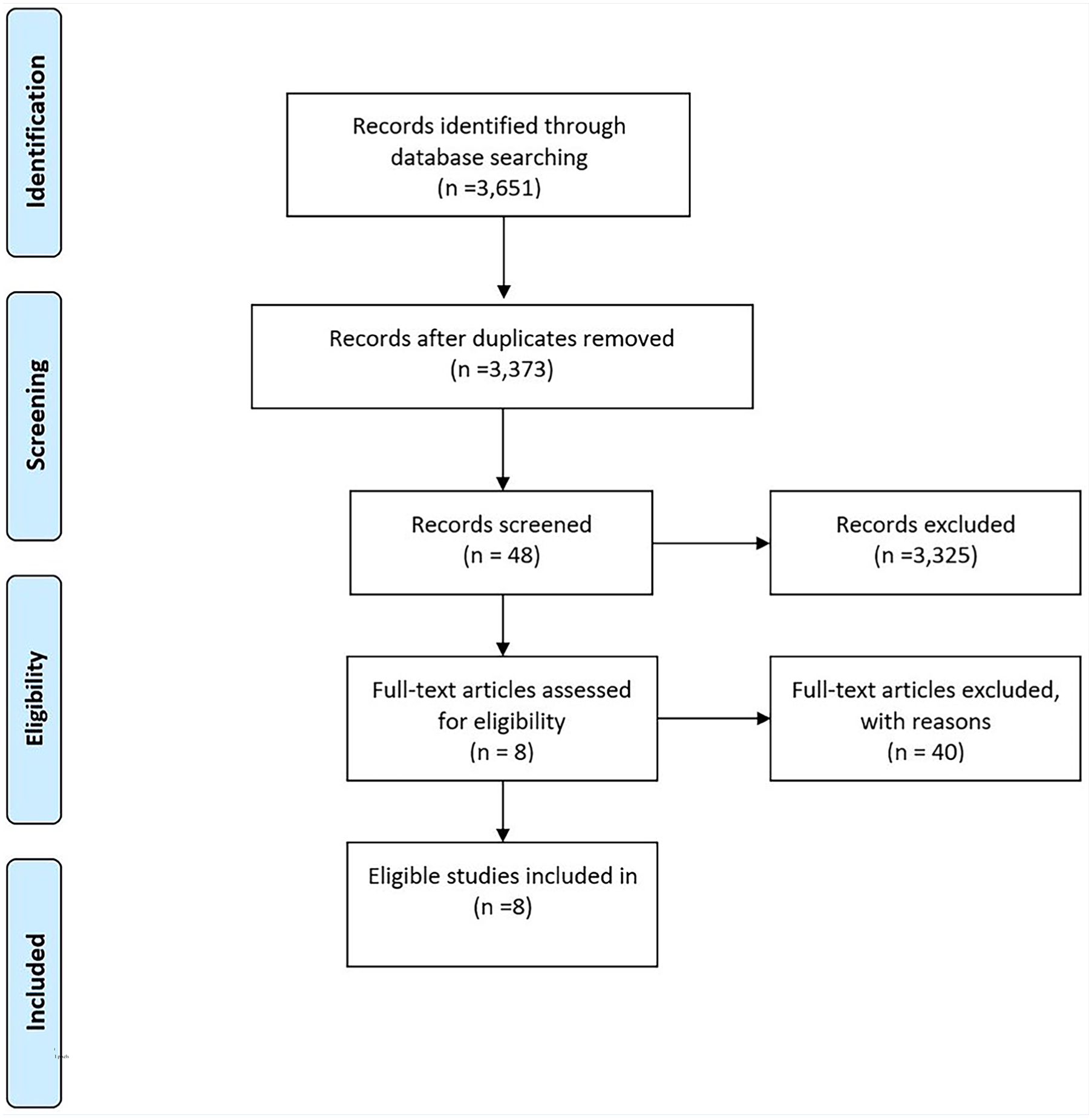
PRISMA flow diagram of study-selection process for systematic review.
Data Extraction and Quality Assessment
Using the Matrix Method (PRISMA, 2015), data extraction was completed using a tabular matrix to record information on a range of study details, including type of exercise intervention and its duration. The major categories of information recorded included study design, sample demographic characteristics, exercise intervention, job stress outcome measures, and main findings. The methodological quality of the eight studies was assessed using van Tulder’s risk of bias assessment tool, which included such bias domains as selection, performance, detection, attrition, and reporting. Although van Tulder recommended use of randomized controlled trials (RCTs) to minimize research bias, the author stated that the tool could be applied to quasi-experimental studies as well as RCTs (Furlan et al., 2015). Notably, 65% of the eight studies reviewed were RCTs and 35% were quasi-experimental studies.
Results
As stated above, of the eight studies reviewed, five were RCTs (Calogiuri et al., 2016; Eriksen et al., 2002; Figl-Hertlein et al., 2014; Lin et al., 2015; Sjögren et al., 2006) and three were quasi-experimental pilot studies (Axén & Follin, 2017; de Freitas-Swerts & Robazzi, 2014; Freitas et al., 2014).
Synthesis of the Studies
The aims of all eight studies were to identify associations between workplace exercise interventions and job stress reduction (Table 1). However, the studies involved participants with varying characteristics as well as different kinds of exercise programs and job stress outcome measurements.
Summary of Studies on Workplace Exercise Interventions and Job Stress Reduction
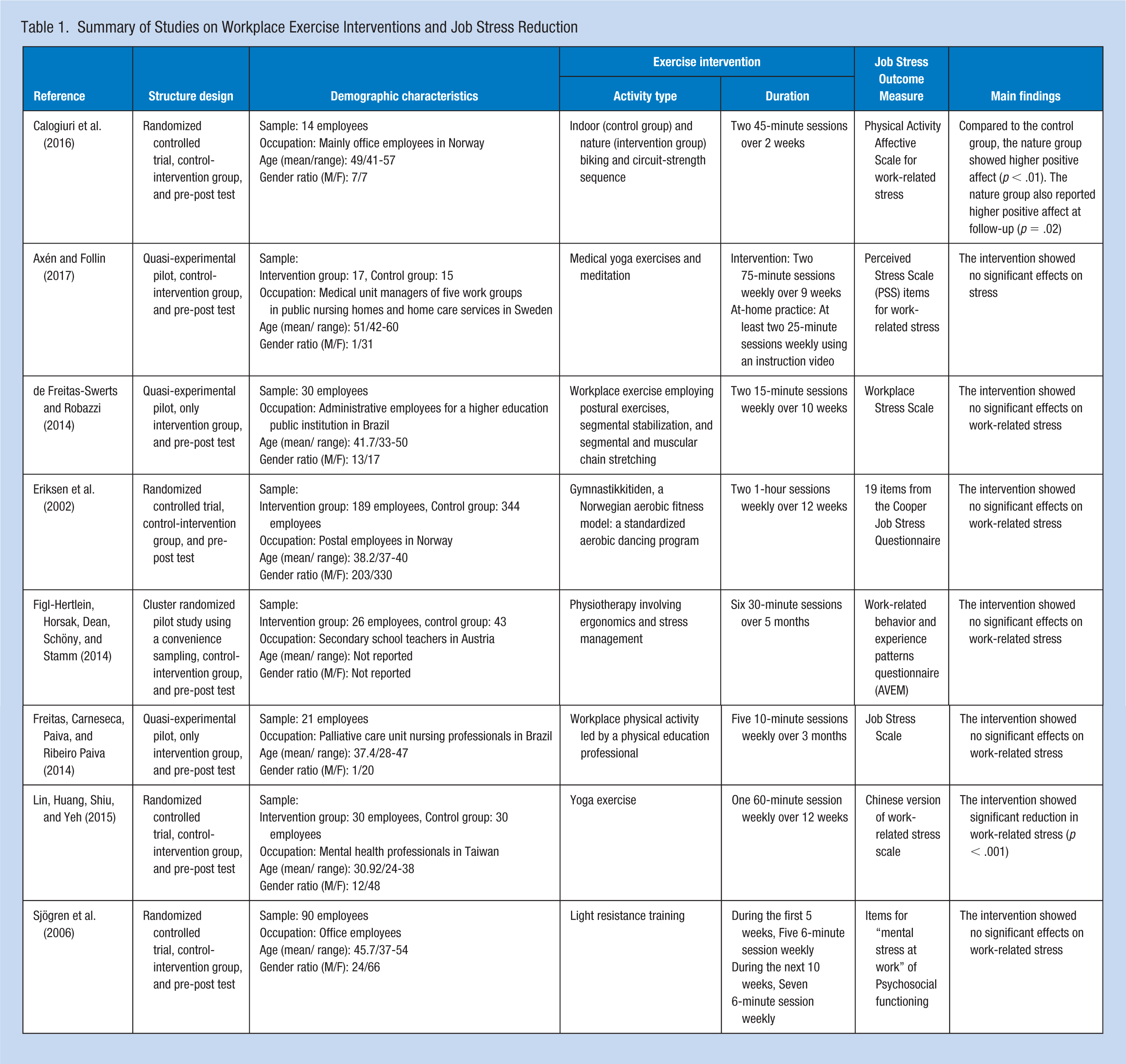
The eight studies included workplace exercise programs conducted in four types of workplace settings. These included office (25%), postal office (12.5%), educational (25%), and medical (37.5%) settings. Sample sizes in the studies ranged from 14 to 533 participants. Characteristics of the study participants varied considerably. For example, participant ages ranged from 24 to 60 years, and mean ages varied from the 30’s (Eriksen et al., 2002; Freitas et al., 2014; Lin et al., 2015) to the 40’s (Calogiuri et al., 2016; de Freitas-Swerts & Robazzi, 2014; Sjögren et al., 2006) to the 50’s (Axén & Follin, 2017), with one study not reporting age information (Figl-Hertlein et al., 2014). In addition, all the studies included both male and female participants, with six having more females than males (Axén & Follin, 2017; de Freitas-Swerts & Robazzi, 2014; Eriksen et al., 2002; Freitas et al., 2014; Lin et al., 2015; Sjögren et al., 2006).
This review revealed that only two of eight workplace exercise programs (Calogiuri et al., 2016; Lin et al., 2015) significantly reduced job stress. In Calogiuri et al.’s (2016) study, an intervention group engaging in outdoor exercise sessions in a natural environment showed significantly lower job stress (p < .001) than a control group performing indoor exercises. In addition, in Lin et al.’s (2015) study, a yoga exercise group showed a significant reduction in work-related stress (p < .001). These two intervention programs are further described in the “Workplace Exercise Interventions” section below.
Of the eight studies reviewed, six were judged to be of good quality based on scores assigned by the two review authors using van Tulder’s criteria. In summary, the two authors independently performed in-depth analyses of each study to identify potential sources of bias and to select the best option (Yes/No/Unsure) for each source on the risk of bias assessment tool. Initially, the two authors’ quality appraisals differed for about 22% of the items across the eight studies (i.e., for 23 of 104 questions). Consequently, the authors conferred to attempt to reconcile these inconsistencies. However, the authors were unable to reach agreement on the appraisals for about 11% of the items (i.e., for 11 of 104 questions). Specifically, the authors differed about whether the various biases were well controlled in the five RCT studies conducted in the workplace, as some bias-related information was only implicitly expressed or not explained in those studies. Accordingly, following van Tulder’s recommendation, the authors attempted to contact the five RCTs’ corresponding authors via e-mail to obtain clarifications; unfortunately, no response was received. Therefore, to resolve the remaining disagreements between the authors, a third reviewer was recruited to make final decisions about the associated quality appraisals. Interestingly, the two studies that showed a positive relationship between exercise workplace interventions and job stress reduction, Calogiuri et al. (2016) and Lin et al. (2015), received the highest and second highest quality appraisal scores, respectively, principally because they most rigorously applied RCT methodologies.
Job Stress-Related Measurement Tools
Four of the eight studies used a scale designed to directly measure job stress (de Freitas-Swerts & Robazzi, 2014; Eriksen et al., 2002; Freitas et al., 2014; Lin et al., 2015). In addition, one study used a general stress scale that included several items for work-related stress (Axén & Follin, 2017), and three studies used scales that measured job stress indirectly (Calogiuri et al., 2016; Figl-Hertlein et al., 2014; Sjögren et al., 2006).
Regarding direct measurement of job stress, Freitas et al. (2014) used the Working Stress Scale (WSS). In addition, Eriksen et al. (2002) used 19 items from the Cooper job stress questionnaire, including eight items for communication, four for leadership, three for workload, and four for relocation. In Freitas et al.’s (2014) study, job stress was assessed using the Job Stress Scale (JSS), which included items addressing psychological demands, control, and social support. Finally, Lin et al. (2015) used the Chinese version of a work-related stress scale that included 50 items addressing work satisfaction, role, career development, interpersonal relationships, and organizational structure. In contrast to those four studies, Axén and Follin (2017) used 14 questions of the Perceived Stress Scale (PSS) that addressed both work-related and private stress. As to scales that measured job stress indirectly, Calogiuri et al. (2016) used the Physical Activity Affective Scale, which included items such as “describe how you feel generally these days” and “describe how you feel generally right now.” Figl-Hertlein et al. (2014) used the work-related behavior and experience patterns questionnaire (AVEM) scale, which included 11 subdimensions such as offensive coping with problems, balance and mental stability, emotional distancing, and satisfaction with work, to evaluate personal experiences of work-related stress. Finally, Sjögren et al. (2006) used psychosocial functioning questions that included items addressing mental stress at work.
Workplace Exercise Interventions
Of the eight studies reviewed, none used a longitudinal approach, and no two studies used the same exercise intervention with the same duration. Thus, it was difficult to definitively evaluate or compare the effectiveness of the eight exercise programs (Table 1). The two studies (Calogiuri et al., 2016; Lin et al., 2015) whose exercise interventions were shown to significantly reduce job stress employed muscle-strength exercise in sessions lasting 45 to 60 minutes. In Calogiuri et al.’s (2016) study, employees performed a bike and circuit-strength sequence in four 45-minute sessions over 2 weeks, and in Lin et al.’s (2015) study, employees engaged in yoga exercise in 12 60-minute sessions over 12 weeks.
Regarding the intervention types examined, six of the studies used physical interventions only (Calogiuri et al., 2016; de Freitas-Swerts & Robazzi, 2014; Eriksen et al., 2002; Freitas et al., 2014; Lin et al., 2015; Sjögren et al., 2006). However, Axén and Follin (2017) employed both physical interventions (including controlled breathing and seated exercise) and a psychological intervention (seated meditation) to reduce job stress. In addition, Figl-Hertlein et al. (2014) employed exercise as a physical intervention and stress management as a psychological intervention.
With respect to the specific activities involved in interventions, Calogiuri et al. (2016), de Freitas-Swerts and Robazzi (2014), and Eriksen et al. (2002) employed aerobic exercise, whereas Axén and Follin (2017) and Lin et al. (2015) used yoga in their interventions. In addition, de Freitas-Swerts and Robazzi (2014), Figl-Hertlein et al. (2014), and Sjögren et al. (2006) intervened with light exercises such as stretching. Freitas et al. (2014) reported no information on the specific type of exercise used in their intervention.
The duration of the intervention sessions varied, with exercise sessions ranging from 5 to 75 minutes. Most of the interventions employed fewer than three sessions weekly (Axén & Follin, 2017; Calogiuri et al., 2016; Lin et al., 2015; de Freitas-Swerts & Robazzi, 2014; Eriksen et al., 2002), and the duration of the overall interventions ranged from 2 weeks to 5 months. The intervention involving the most frequent workplace exercise had 150 sessions (Freitas et al., 2014), and the number of sessions among the eight studies ranged from 4 to 150.
Discussion
This literature review was performed to define potential associations between workplace exercise interventions and job stress reduction. In most of the eight studies reviewed, no statistically significant association was found between the interventions and job stress reduction. Although previous studies have shown statistically significant associations between exercise and reductions in general stress (Hewett, Pumpa, Smith, Fahey, & Cheema, 2018; Zheng et al., 2018), only 25% of the studies reviewed showed a relationship between job stress reduction and a workplace exercise intervention (Calogiuri et al., 2016; Lin et al., 2015).
By definition, job stress is mostly attributable to working conditions, but this does not mean that it is entirely separate from general stress (APA, 2017). APA has conducted annual surveys on stress, mostly in the general population, for more than 10 years, and money and work have consistently been the top two stressors identified. In addition, both individual and situational factors may intensify the effects of job stress (APA, 2017). For example, family issues such as work–family conflicts were shown to increase job stress (Lu et al., 2017). Although Axén and Follin (2017) used the PSS, which can assess both work-related and private stress, the relationship between job stress and private stress was unclear in their study because these types of stress were not measured separately. Therefore, future job stress studies should identify the origin of stress by separately assessing job and personal stress.
In addition, it is difficult to evaluate the continuous effect of workplace exercise interventions on job stress for two central reasons—the small number of exercise intervention studies conducted to date and the lack of longitudinal studies. The findings of this study were based on eight studies reviewed following the Matrix Method (PRISMA, 2015). Bliese et al.’s (2017) review of stress reduction studies pointed out the difficulties of evaluating the validity of exercise interventions because of the relatively small number of studies conducted. Moreover, these authors stated that relatively few intervention studies focusing on job stress reduction had been performed from 1917 to 2017, even though coping with work stress had been extensively considered from a theoretical viewpoint. In addition, a longitudinal study or multiple studies of the same research design would be required to obtain valid outcome measurements for a given exercise intervention. However, none of the studies included in this review employed a longitudinal research design, which reflects a notable research gap in the literature. Moreover, replication studies are also lacking, making researchers skeptical about the extent to which the results found in the literature are reliable and valid.
Although Calogiuri et al.’s (2016) and Lin et al.’s (2015) studies found statistically significant correlations between workplace exercise interventions and job stress reduction, they were not longitudinal studies. By way of comparison, at least two studies have employed longitudinal designs to examine means of coping with general stress within the workplace and thus have achieved reasonable causality in their findings as well as reduced risk of bias (Herr et al., 2018; Rodríguez, Kozusznik, Peiró, & Tordera, 2018). In Rodríguez et al.’s (2018) study of three approaches for coping with stress, an organizational approach was found to be most effective in reducing employee stress within 6 months. In addition, Herr et al.’s (2018) study showed that a continuous intervention for work stress led to prevention of mental health issues, including excessive stress, in employees. In addition, de Vries, van Hooff, Geurts, and Kompier’s (2017) longitudinal study showed that an exercise intervention significantly reduced work-related fatigue and enhanced well-being in employees. Given the demonstrated value of longitudinal studies in obtaining significant findings regarding the relationship between workplace exercise interventions and workers’ mental health, more such studies are needed to evaluate the effectiveness of interventions intended to reduce job stress in particular.
In addition, in the eight studies reviewed, the frequency and duration of the interventions were too varied to meaningfully compare the interventions’ designs. Of the two studies that identified a significant relationship between a workplace exercise intervention and job stress reduction, Calogiuri et al. (2016) and Lin et al. (2015) both examined interventions conducted once per week for less than 6 months. Specifically, Calogiuri et al. (2016) performed their 45-minute sessions for 2 weeks, and Lin et al. (2015) conducted their 60-minute sessions for 3 months. To obtain meaningful health benefits, the Office of Disease Prevention and Health Promotion (ODPHP) has recommended that adults do at least 150 to 300 minutes of moderate-intensity or 75 to 150 minutes of vigorous-intensity aerobic physical activity weekly or should do an equivalent combination of moderate- and vigorous-intensity aerobic activity (ODPHP, 2018). What is more, the aerobic activity should occur throughout the week. However, these criteria may not be suitable for every employee because individual exercise needs are likely to differ due to employees’ varying behaviors outside the workplace. Based on the fact that these and other studies found that exercise sessions lasting 45 to 60 minutes resulted in improved mental health in employees (Calogiuri et al., 2016; de Vries et al., 2017; Lin et al., 2015), it is reasonable to assume that an exercise time of less than 10 minutes would be ineffective. However, the minimum time required for an effective workplace exercise session has not been established (Freitas et al., 2014; Sjögren et al., 2006).
On the whole, the findings of this study have important implications for future research on job stress reduction. First, few studies have examined potential associations between workplace exercise interventions and job stress reduction, and thus there is a clear need for additional research to identify effective interventions for employees. Second, only 25% of the interventions examined in this study had a significant positive effect on job stress reduction among employees. Despite the small number of studies available, this finding argues that approaches other than physical exercise alone should be explored in future research. For example, Huang, Li, Huang, and Tang (2015) found that their mindfulness-based intervention was effective not only for reducing job stress but also for alleviating employees’ perceived stress and fatigue. In addition, in evaluating a conceptually similar intervention, Reingold (2015) stated that a mindfulness-based stress reduction program was successful in reducing employees’ emotional distress. In studying a different, macroscopic approach, Tsutsumi, Nagami, Yoshikawa, Kogi, and Kawakami (2009) found that a participatory intervention in which researchers and employees worked together to identify means of altering the workplace to achieve stress reduction was also effective in reducing employees’ emotional distress. Moreover, in Sun et al.’s (2013) study, a comprehensive Health Promotion Enterprise Program that involved both “improving the quality of organizational care and implementing health promotion activities for employees at the individual level” had a positive effect on reduction of job stress in employees (p. 409). Based on these studies, future intervention research and development efforts should focus on multidimensional strategies. For example, physical exercise could be combined with mindfulness promotion as a strategy for combatting workplace stress. As another example, organizational interventions combining elements of work environment improvement and employee physical exercise could be designed and tested. With research attention to both of these promising areas, more effective approaches for reducing job stress can be identified for implementation in workplaces. In addition, future studies focusing on job stress reduction should apply a particular research design and exercise intervention to different employee populations to expand the generalizability of any significant relationships identified.
Limitations
Some limitations of this study should be acknowledged. First, the quality appraisal scores assigned using van Tulder’s criteria were observed to be relatively low for non-RCT studies, which may be attributable to the fact that van Tulder’s bias domains primarily focus on the RCT research design. When the RCT research design is applied in a clinical setting, both the experimental and control groups tend to be well blinded, and potential biases tend to be well controlled. However, when an RCT is performed in a workplace setting, true randomization is difficult. In addition, the 13 specific sources of bias covered by van Tulder’s criteria were often ambiguously addressed in the eight study articles, resulting in differing quality appraisal interpretations by the two authors. For example, for two of the studies reviewed, the authors disagreed about whether randomization was acceptable or not because the interventions showed a dropout rate of about 50%; van Tulder (Furlan et al., 2015) implied that a 30% dropout rate indicated unacceptable quality (Figl-Hertlein et al., 2014; Freitas et al., 2014). As another example, the item asking “Are other sources of potential bias unlikely?” called for subjective judgments on the parts of the authors that again resulted in differing quality appraisals. For these two reasons in particular, a third reviewer was needed to resolve differing author opinions. Therefore, although use of van Tulder’s criteria generally supported objective evaluation of the eight studies, the risk of bias assessment tool may be more appropriate for studies conducted in clinical settings. Finally, limiting the review to articles published in English may have excluded relevant studies in other languages. Given that the review findings are based on only eight studies, additional reviews of non-English publications might be useful.
As for the eight studies themselves, none gathered qualitative feedback from participating employees, and the six studies that found no significant correlation between workplace exercise interventions and job stress reduction provided no explanation of the deficiencies of their interventions. Both of these factors made it difficult to determine why the interventions studied were or were not effective. Given these issues and the relatively small number of relevant studies available, further research is needed to understand why particular workplace exercise interventions are ineffective and to identify interventions that will meet employees’ job stress reduction needs.
Implications for Occupational Health Nursing Practice
Based on the data available in the eight studies reviewed, as well as exploration of other studies cited herein, the authors recommend that occupational health nurses who plan to implement job stress management interventions include muscle-strengthening exercise lasting 45 to 60 minutes at least once per week. In addition, the authors recommend that occupational health nurses consider using multidimensional approaches combining exercise with, for example, a mindfulness-based intervention or an organizational-level program involving strong employer engagement.
Conclusion
Based on the review findings, the relationships between workplace exercise interventions and job stress reduction have not been sufficiently evaluated in the literature. In addition, the studies reporting significant positive associations between them were unexpectedly small in number, as only two of eight studies reviewed showed such a relationship. Based on the studies included in this review, future research should include RCTs of exercise interventions that incorporate multidimensional strategies to reduce job stress. Specifically, future occupational health nursing studies should investigate the effectiveness of combinations of workplace exercise programs and psychological or organizational-level interventions.
In Summary
The purpose of this study was to identify associations between workplace exercise interventions and job stress reduction.
A systematic review was performed of eight articles meeting inclusion criteria, and only two of the studies (25%) involved a workplace exercise program that achieved a statistically significant reduction in job stress.
Both of those studies were RCTs. One intervention included a strength sequence involving activities such as biking, and the other incorporated yoga exercise with meditation. These studies received the highest and second highest quality appraisal scores based on van Tulder’s criteria.
Results of this systematic review indicate that future practice should focus on RCTs of exercise interventions incorporating a mindfulness-based intervention to maximize the effect of reducing job stress.
Footnotes
Acknowledgements
The authors thank Dr. Shannon N. Zenk of the University of Illinois at Chicago (UIC) for her guidance during the preparation of this article. They also thank Mr. Jon Mann of UIC for his strong editorial contributions to the article and Dr. Patricia Hershberger of UIC for her sound instruction in literature review methodology.
Declaration of Conflicting Interests
The author(s) declared no potential conflicts of interest with respect to the research, authorship, and/or publication of this article.
Funding
The author(s) received no financial support for the research, authorship, and/or publication of this article.

Author Biographies
Sungwon Park, MSN, is a PhD nursing student at the University of Illinois at Chicago. She studies occupational and environmental health nursing with an emphasis on job stress reduction.
Min Kyeong Jang, PhD, is a postdoctoral research associate at both the University of Illinois Cancer Center and the University of Illinois at Chicago.