




Abstract
Motivating employees to increase their physical activity is a health promotion challenge. A Move-A-Thon (MAT) event approach was implemented as an alternative incentive to help workers to optimize their physical activity levels. We implemented a demonstration project in which workers were incentivized for their participation through monetized donations to charity. Their steps were monitored over the 2-week demonstration period. The MAT goal was for participants to achieve a minimum of 3,000 daily steps for 2 weeks, for which they could earn a total donation of up to US$20. Participants walking at least once with up to five different “exercise buddies” could earn up to US$2 more per buddy for donation. Of 10 workers invited, nine enrolled and eight completed participation by logging their monitored steps across an average of 13.75 full MAT participation days. Participants averaged 9,330.8 steps per day—more than triple the lower threshold required for a maximum US$20 charitable donation. The eight participants walked with a total of 21 “exercise buddies.” They were receptive to future MAT events of longer duration. In total, the monetized donation to charity made by those eight participants was US$202. The MAT event participants were successful at promoting physical activity among a small group of workers for 2 weeks. Future worksite health promotion projects with this type of incentive strategy are indicated.
Keywords
Background
The Centers for Disease Control and Prevention (CDC) states “only a few lifestyle choices have as large an impact on your health as physical activity” (CDC, National Center for Chronic Disease Prevention and Health Promotion, Division of Nutrition, Physical Activity, and Obesity, 2018, para. 6). The risk of premature death is 40% higher among those who spend less than 30 minutes per week being physically active than among those who spend more than 7 hours per week being active (CDC, National Center for Chronic Disease Prevention and Health Promotion, Division of Nutrition, Physical Activity, and Obesity, 2018). Mounting evidence suggests uninterrupted sedentary time is especially detrimental to health (Biswas et al., 2015; Schmid, Ricci, & Leitzmann, 2015; Seguin et al., 2014). Motivating individuals to become more active over the long haul, especially those who are not already exercise enthusiasts, is a health promotion challenge. Many worksites currently offer their employees programs designed to motivate physical activity and improve fitness levels. Often, such programs offer financial incentives, and some even incorporate the use of activity trackers, also known as activity monitors or accelerometers. But, the impact of those programs hinges on the organizer’s ability to attract workers to enroll and then participate consistently over time.
There is a relatively small body of research evidence on the effectiveness of incentives in workplace health promotion. Specific conclusions from the literature about the impact of incentives on enrollment and partial versus full retention rates are often difficult to distinguish. The often-used term participation rate has multiple definitions in the literature, some of which do not take into account those who were initially targeted, but not enrolled in the programs. For example, reported participation findings across different types of wellness programs (e.g., lifestyle, etc.) are mixed. Results of a nationally representative survey across various workplace wellness programs (N = 407) demonstrated participation rates for programs with a prevention/intervention focus were not influenced by incentives; the 29% baseline participation rate was statistically significant (p < .05), but the incentive effect of 10% did not reach statistical significance (Huang et al., 2016). The authors did not report participation results by specific incentive type. In another recent national survey of more than 500 randomly selected employers, authors did report participation by workplace wellness program incentive type and noted participation rates of 68% for incentives involving penalties, and 52% for incentives involving valuable rewards (Batorsky, Taylor, Huang, Liu, & Mattke, 2016). A penalty incentive punishes noncompliance by taking away something of presumed value. One such example of a penalty would be requiring employees who do not participate to contribute more of their salary to their health care plans. These investigators also reported that the use of penalty incentives was 1.25 times more common among large employers, and among nongovernment employers with large numbers of women.
Authors of a systematic review of 23 studies that included physical activity workplace programs defined participation level as the proportion who participated among those who were eligible to participate (Robroek, van Lenthe, van Empelen, & Burdorf, 2009). They found participation levels of worksite health promotion programs were typically below 50% with participation means of 33.5% versus 30.7% for incentive versus nonincentive-based interventions, respectively (Robroek et al., 2009). Mitchell et al. (2013) linked workplace program incentives to significant, positive effects on exercise in eight out of 11 studies in their meta-analysis, but rated most studies as “weak” in terms of selection bias from the targeted audience and also noted lack of research directly comparing incentive strategy features, such as whether rewards were certain (e.g., cash reimbursement) versus by chance (i.e., lottery-based reimbursement), dollar versus nondollar incentives, or were for performing the activity versus achieving a specific outcome (e.g., aerobic fitness).
Evidence about incentive-based workplace physical activity promotion programs from randomized trials also remains scarce. In one recent study, investigators compared the success of various financial incentives on workers’ activity levels (Patel et al., 2016). Over a 13-week period, participants were randomly assigned to one of three financial incentives and a control incentive. The three roughly equivalent dollar incentives included a gain incentive (i.e., US$1.40 per day if the goal was reached), a lottery incentive (i.e., eligible to enter a US$5.00 and US$50.00 daily lottery if the goal was reached), and a loss incentive (i.e., an original monthly allotment of US$42 per month was reduced by US$1.40 per day for failing to meet an activity target). The investigators found that only the “loss incentive” showed a statistically significant increase in the number of days employees met the study activity goal of 7,000 steps. Although effective, perhaps because loss-centered incentives literally take something away from individuals, these motivational options may be negatively perceived by some employers and workers. The prospect of taking reimbursement or benefits away from lower wage workers or workers in smaller businesses may be considered controversial. On the other end of the income spectrum, it is unclear whether these modest financial incentives are sufficient to motivate busy sedentary office workers or higher wage earners. Perhaps new alternatives to motivate employees to become more physically fit are needed against the backdrop of large financial investments in workplace fitness programs and the rise of “loss incentives” that penalize noncompliance.
It is suggested here that alternatives to financial reward and penalty incentive strategies explored elsewhere (Mukherjee, Sahay, Pammi, & Srinivasan, 2017; Patel et al., 2016) are needed to attract broader worker segments to engage in regular physical activity, and to augment recruitment and retention in existing workplace physical activity programs. The premise is that certain employees who are not motivated to exercise by modest financial incentives may instead become inspired by a desire to “donate” their physical activity to a cause in a manner similar to that of marathon fund-raiser participants. In other words, the volunteer impulse and energies could be harnessed for the primary purpose of improving the health and well-being of the volunteer. In this article, this drive is termed the “giving motive incentive” (GMI) and it is the central concept of our project. An example of a GMI project involved a large-scale, nonworkplace Fitbit™-sponsored “FitforGood” charity campaign that resulted in more than 25.1 billion steps donated by participants who earned US$1 million in activity donations to the American Heart Association, National Multiple Sclerosis Society, and the American Diabetic Association (Fitbit, 2015).
Overview of the Workplace Move-A-Thon (MAT)
A workplace MAT concept was developed by the authors as a novel approach to promote physical activity among workers. The purpose of our workplace MAT was conceived as a way to incentivize workers to increase their physical activity by enabling them to donate their monetized activity (i.e., steps) to charity. Using this approach, employee volunteers’ monitored steps were recorded, which were then monetized for donation to a charitable fund by event sponsors. A MAT fundraising event, as imagined, is not unlike a traditional “walk-a-thon” fund-raiser, except (a) the primary goal was to improve the physical activity level of the volunteer; (b) by design, it was intended to take place over a prolonged period (e.g., weeks, months); and (c) instead of a physical “finish line,” the goal was a monitored physical activity level milestone (e.g., tracked steps). This benefit approach was envisioned as a strategy to demonstrate and explore the feasibility of applying the GMI approach to motivate physical activity among employees.
Project Methods
Access to recruit a maximum of 10 office staff volunteers to participate in a MAT event demonstration project was requested from a regional eldercare facility. The event was announced in the facility’s newsletter. Also, a representative from the facility distributed MAT project brochures and subsequently identified 10 staff from among those who had expressed a potential interest in taking part. Contact information of those 10 workers was provided to the project lead, who then formally invited them to participate in the MAT. Workers who replied to the project lead’s emailed invitation were scheduled for an initial MAT enrollment appointment. While they were all office workers, they were not specifically selected based on their individual baseline physical fitness levels. Potential MAT participants were informed that their participation was completely voluntary and that they were free to withdraw from the MAT at any time without loss of benefits to which they were otherwise entitled (e.g., donation credit for steps already accrued at the time of their withdrawal).
In preparation for this demonstration project, recruitment materials and instructions were developed and reviewed. Provisions were made for volunteers to be individually enrolled in a private setting. Individual MAT enrollment appointments took place in a private room within the facility. Prior to enrollment, MAT procedures were provided in writing and reviewed with potential participants. The activity donation conversion scale was also explained. Those who achieved at least 3,000 steps per day would earn a “full credit” activity donation of US$20.00 for their selected eldercare facility charity at the end of the 2-week event, with a downward donation proration for those days, if any, in which <3,000 steps were achieved. A relatively low step compensation threshold was selected strategically to engage nonexercisers with lower stamina and to appeal to those who might potentially be intimidated by a higher threshold. The operational assumption was that success at achieving a modest goal might propel enthusiasm for continued participation.
Potential participants were also informed their donation could be increased by US$2.00 per “exercise buddy” for up to five buddies who walked with them. In addition, participants were instructed that a nominal “token of appreciation” (US$5.00) gift card would be given to each participant at the final appointment, together with gift cards for distribution to their exercise buddies. They were also informed that the wrist activity tracker would only be available to them on loan during the MAT period, as opposed to given to them. Use of a loaned activity tracker (i.e., Fitbit Charge 2) was implemented to remove receipt of the activity tracker as a gift as a financial participation incentive. This ensured that the MAT fund-raiser, rather than the activity tracker, would be the primary incentive for demonstration project purposes.
Those who enrolled were provided with the Fitbits and instructions regarding Fitbit use via links to Fitbit videos on charging, pairing, synchronizing, and using the Fitbit application (e.g., app). Enrollees were also instructed to maintain an end-of-day paper log on which Fitbit step readings, sponsor counts, and comments/suggestions were to be recorded. They were also directed to review selected information on the U.S. Department of Health and Human Service’s website regarding exercise safety prior to starting participation.
At the conclusion of the approximately 2-week MAT period, participants returned the logs and Fitbits to the project manager, and were prompted to provide feedback, if desired, on their MAT event experience.
Results
Nine of the 10 office workers invited to participate in the MAT demonstration project volunteered to take part during their private consultation with the project manager. Seven of the nine office workers’ jobs were characterized as being sedentary.
As anticipated, most participants who had not previously used activity trackers required assistance and a short start-up time lag for trouble-shooting regarding their password, pairing, synchronizing, and Fitbit app use and screen questions, and to develop proficiency in related tasks. Activity tracking during the first participation day was nonuniform due to varying MAT start times, and so while participants’ steps were counted for donation purposes, Day 1 steps were excluded from the study tabulations. Two participants had one day of missing data during which activity was not tracked. Eight of the nine participants logged daily tracked steps. Step counts they recorded in their logs were used to calculate the MAT donation. Some (n = 5) also shared steps collected via the Fitbit app, but the app step submission timeframes were not standardized to permit comparison with the log. Tracked step totals were accessed approximately weekly from the ninth participant, but not daily logged information, excluding them from the calculations of average data steps among participants, but not from step donation.
The average number of steps per day was based upon calculations from eight participants for whom daily steps data were logged. Across an average of 13.75 participation days, the mean of participants’ daily steps averaged 9,330.8 steps. Distributions of steps achieved and donated during the event are presented in Figure 1. All eight participants exceeded the 3,000-step threshold during every day of the event, and so all monetized step donations reached the maximum cap of US$20.00. As shown in Figure 1, step donations were fairly consistent across Weeks 1 and 2, and step totals were slightly higher during the weekends. Furthermore, across all participants, more than 5,000 steps were achieved for 89% of the 111 individual worker participation days, and more than 10,000 steps were achieved for 38% of those days. Twenty-one “exercise buddies” also took part (range = 0-5 per participant), and US$2.00 per “buddy” was added to the primary participants’ total contributions. In total, the monetized donation to charity made by the eight full participants was US$202.
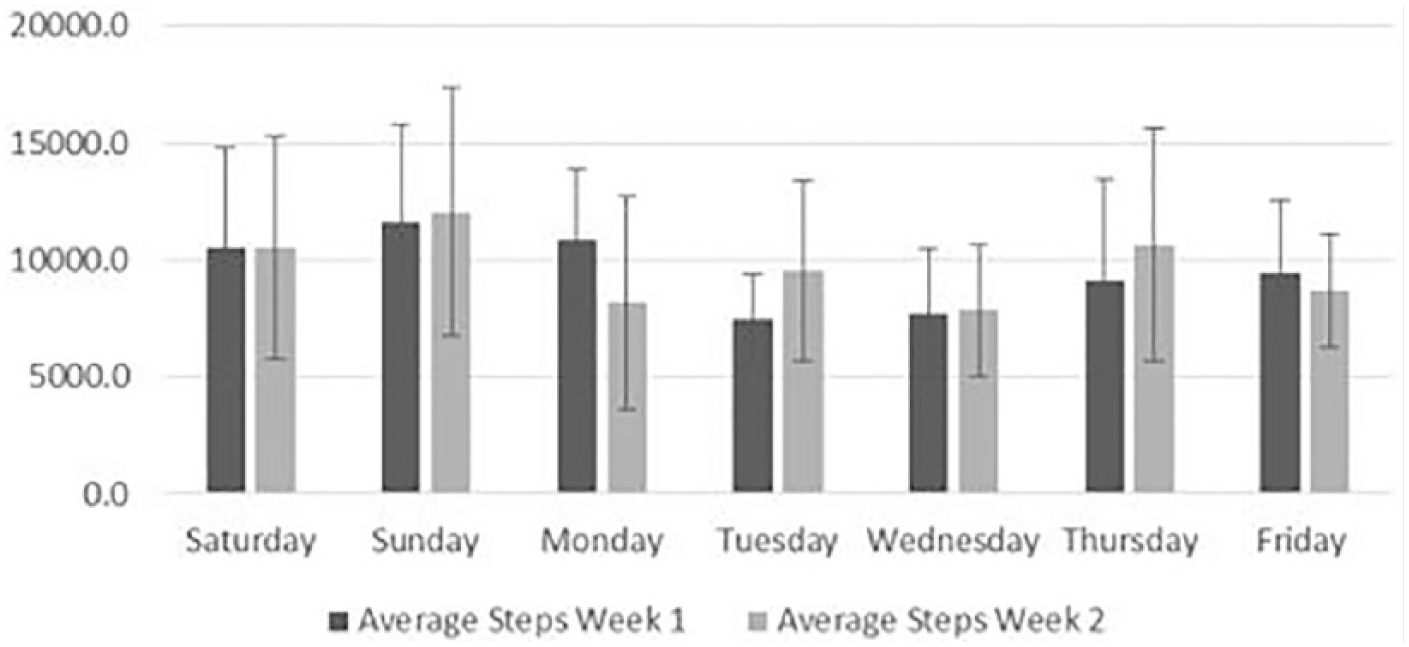
The average number of steps taken by participants in the 2-week Move-A-Thon event by week and weekday.
Seven of eight participants indicated that the option of future MAT events that were of longer duration and repeat MAT events would be well received.
Discussion
The workplace MAT was an idea whose practical potential remained to be vetted prior to this proof of concept demonstration. This MAT demonstration project illustrates a worksite was willing to host a MAT event, workers were willing to enroll, and were indeed willing to donate their physical activity to charity. Their enthusiasm for the MAT event was noted in the form of high participation and sustained level of steps achieved, involvement of their “walking buddies,” and their comments suggesting their receptivity to future MAT events. Another encouraging response was that everyone consistently exceeded the relatively low step count threshold, which was set to earn the maximum donation.
The authors speculate that if a MAT motivates more people to reach even modest Healthy People 2020 activity goals (U.S. Department of Health and Human Services, 2019), it may also produce long-term health benefits. Potentially envisioned individual volunteer gains from future MAT benefits include forming new exercise routines and habits, expansion of workers’ pools of coworkers and friends considered potential “exercise buddies,” and experiencing positive feelings associated with the physical, social, and altruistic aspects of the events. It is suggested that tangible and intangible employee health, engagement, and morale benefits might also accrue to the employer sponsoring the MAT event, reinforcing a workplace culture that favors physical activity, as well as financially benefiting charities receiving funds. The proposed MAT approach, if effective, will provide employers and those in health promotion with a new tool to help workers progress toward optimizing their health in a well-being affirming, nonregressive context. The promise of the MAT approach is that it will prove a “win, win, win” for employees, employers, and recipient charities.
Like some marathon fund-raisers, future MATs are not proposed as a one-time occurrence, but rather as an annual event. Unlike marathons, the authors speculate events could be held across periods of 2 or more months each year, similar to participation periods for certain outdoor sports. It is proposed such events could potentially become sustainable as annual events given sufficient worker, organizational, and financial support.
Other anticipated features of future MATs are portability and scalability in that they likely could be implemented by a small, medium, or large employer on a local, regional, or national scale. The major nonpersonnel-related resource required beyond donation sponsorships is purchase and replacement of lost or damaged activity trackers. Technical support may be required throughout the MAT event, especially to guide participants who are unfamiliar with activity trackers, and to assure standardization of step count records (e.g., activity is logged/tracker is synced at bedtime). Once approved by administration, commitment of a designated coordinator’s and employees’ time to implement the project would also be required.
Potential participant demands, which could occur during MAT implementation, must be considered. It is possible that some employees who take part in future MATs may wish to stipulate that their donations be anonymous. In contrast, some participants may be receptive to recognition in the form of nominal dollar amount gift cards, recognition certificates, or other small awards (e.g., US$5-US$10 tokens of appreciation). Others may have personal or religious objections to certain funds. Two potential accommodations are suggested: (a) employers could poll employees on a panel of selected charities, and select an option to which no employees object; and (b) employees could select from among a panel of recipient charities from which MAT participants could select.
The need to solicit sponsor donations may be viewed as a potential limitation. But many worksites already participate in fund-raising campaigns (e.g., United Way), and so it is possible that a MAT event could be incorporated to leverage engagement and fitness during existing nonprofit fund-raisers. While this demonstration project was self-funded, future worksite or even community event donations could potentially be funded by participant recruitment of their own individual sponsors, crowd-sourcing, employers’ out-right or in-kind donations, external private or corporate donors, or by a combination of these types of donation sponsorships. Raffles to raise money may also be an option to consider in some locales with input from a qualified legal consultant, as raffle laws vary by state.
Additional planning recommendations for any other charitable walk-a-thon or marathon fund-raiser would require prior consultation on Internal Revenue Service and risk management event requirements, and to determine the potential need for event insurance. Although these suggestions may seem burdensome, it is important to note that other exercise programs and financial incentives also carry risks and costs. It seems quite possible that activity programs with loss incentives might be negatively perceived by those who “lose,” with plausibly intangible effects on employee morale. Under the Affordable Care Act, up to 30% of an employee’s health insurance premium coverage has been permitted to be used to incentivize employee engagement in (nontobacco) outcome-based wellness initiatives (Klautzer, Mattke, & Greenberg, 2012), while no cap was placed on participation incentives (Huang et al., 2016). While effective, the use of incentives has been contentious in the United States (Huang et al., 2016). Ethical concerns and litigation arose around the potential for monetary incentives, especially those involving financial loss, to engender coercion, cost shifting, privacy violations, and discrimination (Horwitz, Kelly, & DiNardo, 2013; Huang et al., 2016; Lunze et al., 2013; Robroek, van de Vathorst, Hilhorst, & Burdorf, 2012).
As with other workplace fitness-oriented programs, employees who have preexisting health conditions or disabilities may opt to participate in their employer-hosted MAT event. To broadly accommodate those with a reduced or impaired capacity to exercise, remedies could be incorporated such as designating a baseline proportion of total sponsor financial contributions be made to acknowledge all participants who enroll in the MAT event, without regard to their monitored activity levels. The authors recommend that all MAT participants, including those who may be pregnant or have preexisting health conditions or disabilities, be instructed to “start slow,” not to exceed any activity restrictions recommended by their personal health care provider(s), and to consult their personal health care provider beforehand should they have any questions about activity restrictions or increasing activity levels.
Limitations of the small “proof-of-concept” demonstration project reported here are that there were few participants, and they were highly selected. Because the project size was small and not generalizable, future research is suggested to test its application to larger work groups. There were too few participants to permit sufficient aggregation to describe participant characteristics. Conduction of future MAT pilot and intervention studies in conjunction with workplace MAT events is indicated, not only to establish enrollment and retention rates for this incentive strategy, but also to characterize potential costs and benefits of the MAT among different worker demographic-, job-, health-, and fitness-level subgroups. Such proposed studies could potentially address Goal 1 for extramural research under the Total Worker Health® “Non-Health Cross Sector” of the National Institute for Occupational Safety and Health (NIOSH; 2016) to “Advance and conduct etiologic, surveillance, and intervention research that builds the evidence base for effectively integrating protection from work-related safety and health hazards with promotion of injury and illness prevention efforts to advance worker well-being.” A proposed goal for future investigations would be to provide evidence to inform development of a proposed evidence-based MAT implementation toolkit.
Occupational health nurses must address not only the efficacy of workplace physical activity promotion interventions, but also participation, especially among employees who are the least physically fit. The MAT is a promising new strategy to motivate increased physical activity among employees, potentially including those who are not motivated by traditional incentives. Future studies of this strategy are indicated to characterize the feasibility, acceptability, and effectiveness of the workplace MAT approach, particularly among these target groups.
In Summary
A workplace MAT benefit approach was envisioned by the authors as a strategy to demonstrate and explore the feasibility of applying the “giving motive incentive” (GMI) approach to motivate physical activity among employees. Under this approach, employee volunteers’ monitored steps were logged, and then monetized for donation to a charitable fund by the event sponsor.
Participants engaged in sustained physical activity during the 2-week MAT, accruing daily step counts which were, on average, over 3 times higher than the 3,000-step demonstration target. Most also took part with as many as five “exercise buddy(s)” on at least one occasion.
Based on observations from a small MAT demonstration project, the authors suggest this alternate incentive approach may represent a promising strategy to improve physical activity levels for future use by occupational health nurses and others seeking to motivate improvements in workers’ exercise levels.
Future studies of this strategy are indicated to further vet, test, and inform refinements to the proposed MAT approach prior to broader adoption.
Footnotes
Authors’ Note
The findings and conclusions in this report are those of the authors and do not necessarily represent the views of the National Institute for Occupational Safety and Health.
Declaration of Conflicting Interests
The author(s) declared no potential conflicts of interest with respect to the research, authorship, and/or publication of this article.
Funding
The author(s) disclosed receipt of the following financial support for the research, authorship, and/or publication of this article: Coauthor was supported by the National Institute for Occupational Safety and Health through the University of Cincinnati Education and Research Center (No. T42OH008432). Any mention of company names and/or products does not constitute endorsement by the National Institute for Occupational Safety and Health.
Author Biographies
Susan Reutman is an assistant professor and directs the Occupational Health Nursing Program, University of Cincinnati College of Nursing.
Renee Lewis is a health services leader at a Fortune 500 manufacturing company in the Midwest, and a recent graduate of the University of Cincinnati Occupational Health Nursing’s graduate program.