




Abstract
This study investigated whether Fitbit devices can reduce sedentary behavior among employees in the workplace. Participants were asked to wear Fitbits during 8-hour work shifts, 5 days per week, for 8 weeks. They were instructed to stand at least once every 30 minutes throughout the workday. The goal of the study was to determine whether standing once every 30 minutes was a feasible strategy for reducing sedentary workplace behavior. On average, participants completed 36 of 40 workdays using Fitbits. The number of times participants stood during an 8-hour workday averaged 12 stands per day (maximum 16 stands per day). These results indicate that Fitbit technology is effective for recording and tracking interruptions in sitting time; however, to reduce sitting behavior, alternate approaches are required to motivate larger numbers of workers to participate.
The link between physical activity at work and the physical health of workers was first recognized in the differential rate of heart disease between sedentary drivers of London’s double-decker buses and standing and stair-climbing conductors (Morris, Heady, Raffle, Roberts, & Parks, 1953). Today, in developed countries, research estimates that adult workers spend more than 50% to 66% of their work time sitting and accumulate additional sedentary time in leisure activities and commuting (Chau et al., 2010). Adverse health effects associated with adult workers’ sedentary behavior include more sick leave time, impaired mobility, and less productivity (Aittasalo, Rinne, Pasanen, Kukkonen-Harjula, & Vasankari, 2012). Workplace wellness, an important health initiative (Canadian Centre for Occupational Health and Safety, 2015), focuses on interventions to reduce sedentary behaviors among adult workers.
It is well understood that physical activity and exercise are associated with better physical health and well-being; less than recommended levels of physical activity pose risks to worker health (Bravata et al., 2007; Chau et al., 2010). Sedentary behavior is defined as any awake activity that requires less than or equal to 1.5 metabolic equivalents of task (METS), which is usually associated with sitting (Chau et al., 2010; Sedentary Behaviour Research Network, 2012). Research reports that 55% to 69% of adults’ waking hours are sedentary (Matthews et al., 2008) or, alternatively, the equivalent of 3.2 to 6.8 hours per day (Bennie et al., 2013). Sedentary behavior in adults is associated with the development of several chronic health conditions, including cardiovascular and metabolic diseases associated with elevated triglycerides, resting blood pressure, fasting plasma glucose and low high-density lipoprotein (HDL) cholesterol (Healy et al., 2008).
Positive workplace health outcomes from relatively simple interventions include rapid sit-to-stand postural changes of less than 10 seconds, fewer subjective reports of discomfort, and no impact on work productivity (Karakolis & Callaghan, 2014). Research suggests that postural transitions at least every 30 minutes could decrease health-related risk factors (Ryan, Dall, Granat, & Grant, 2011). The Canadian Centre for Occupational Health and Safety (2015) recommends standing approximately every 30 minutes to minimize the health risks of continuous sitting. Standing is associated with more sympathetic-driven muscle activity and less plasma volume pooling in the lower extremities, which contribute to cardiometabolic health (Healy, Winkler, Owen, Anuradha, & Dunstan, 2015). Self-initiated interruption of sitting time by alternating between sitting and standing results in a 2-hour reduction in time spent seated, less discomfort, improved HDL levels, and better work performance (Alkhajah et al., 2012).
Avoiding static, prolonged postures, and scheduling stretch breaks have been advocated by workplace ergonomic researchers (Canadian Centre for Occupational Health and Safety). Recently, sit-to-stand workstations have decreased sitting time at work but are expensive. Alkhajah et al. (2012) reported that access to adjustable sit-to-stand workstations reduced sitting time by 143 minutes per day in just 1 week. In a second study, sitting was almost exclusively replaced by standing at 3 months after introduction (Alkhajah et al., 2012). In contrast, Wilks, Mortimer, and Nylen (2006) found that only 20% of employees used the sit-to-stand feature of their workstations once a day. However, when similar workers received 1.5 hours of instruction with e-mail reminders to stand sent every 3 days, they stood an average of three times per day (Robertson, Ciriello, & Garabet, 2013). Job rotation can encourage alternating postures while performing usual work tasks (Callaghan, De Carvalho, Gallagher, Karakolis, & Nelson-Wong, 2015). When sit-to-stand devices are used in workplaces, the result can be a 66% reduction in sedentary time and a 54% reduction in upper back and neck pain (Callaghan et al., 2015).
Many organizations do not have the financial resources for sit-to-stand equipment; activity trackers may be an inexpensive alternative. Activity trackers, such as Fitbits which are pedometers with multiple additional features, can be used to record physical activity in free-living conditions (Dontje, De Groot, Lengton, Van Der Schans, & Krijnen, 2015). Pedometers are associated with significant increases in physical activity as well as decreases in body mass index (BMI) and blood pressure (Bravata et al., 2007). Pedometers demand fewer resources than traditional face-to-face approaches to behavior change (Aittasalo et al., 2012), and the self-monitoring aspect of the devices increases self-awareness about activity levels (Prochaska & Norcross, 2001). Evidence suggests that participatory workplace interventions can reduce sitting time (Parry, Straker, Gilson, & Smith, 2013) while maintaining workplace productivity (Callaghan et al., 2015). Therefore, the purpose of this intervention was to use Fitbit devices to self-monitor sitting time in a group of participants working in call centers. Participants were advised to stand at least once every 30 minutes. Adherence was recorded using Fitbit data shared with the research team.
Method
Sample
Participants were full-time call center employees who had access to Fitbit activity trackers or were willing to purchase a Fitbit using their employer-provided Wellness Fund. Recruitment strategies included posters, on-site recruitment booth, and an e-mail sent out by the organization’s occupational health nursing consultant. Participants were ineligible to participate if (a) they had injuries or health conditions that prevented them from standing up from a chair, (b) they did not have access to a Fitbit, or (3) they were nonambulatory.
Explicit consent was obtained when participants voluntarily changed their Fitbit password to their assigned unique participant identification number and completed an online education module about the health risks associated with uninterrupted sitting. Weekly, participants voluntarily shared their data by synching their Fitbit with their online Fitbit account. Upon study completion, e-mails were sent to remind all participants to change their Fitbit password from their unique participant identification number, thereby removing access to their data by the research team.
Instruments
Fitbit One™ wireless activity trackers used in this intervention contain a triaxial accelerometer capable of tracking multiple measures of physical activity with relative error below 1.3% (Takacs et al., 2014). Fitbits have high interdevice reliability and can therefore be used in research requiring comparisons of data from different devices and multiple participants (Dontje et al., 2015).
Procedure
Participants attended a Lunch & Learn Workshop or viewed an online video prior to participation in the study. The aim of this education was to provide evidence-based information regarding sedentary behavior and associated health risks to participants. Participants also completed a short electronic questionnaire prior to participation and were instructed to identify their readiness for behavior change using a Confidence/Conviction matrix. All participants were provided with a suggested specific, measureable, attainable, realistic, and time-based (SMART) goal: “While at work, I will stand up at least once every 30 minutes throughout the day for the next 8 weeks.” Perfect performance was standing up at least 16 times in an 8-hour workday. Only data from the participants’ 8-hour workday were examined.
During the 8-week intervention, participants monitored their sedentary time using the Fitbit smartphone or computer application. Participants could view their own personal physical activity and sedentary profile graph each day, thus enabling them to evaluate their progress in reaching their sedentary behavior goal. Overtime, sick days and vacation time were not considered.
Analysis
Descriptive statistics were calculated using SPSS version 24 and used to describe group mean, standard deviation, and range in data and provide a summary of adherence to Fitbit use.
Results
This study investigated whether Fitbits could be used to reduce the duration of sitting time at the workplace. Fifty-seven employees of call centers initially showed interest in establishing the habit of standing every 30 minutes. After an educational intervention, 22 participants explicitly consented by sharing their Fitbit activity feed with researchers. Of these participants, 77% adopted the suggested SMART goal “While at work, I will stand up at least once every 30 minutes throughout the day for the next 8 weeks.” In addition, 23% of participants extended their SMART goal to include decreasing their sitting time at home and after the 8-week study period (see Table 1 for participant beliefs at baseline). Participants’ ratings of their confidence in their ability to change their sitting behavior and their beliefs about the importance of changing their sitting behavior are displayed in Table 2.
Participant Beliefs at Baseline
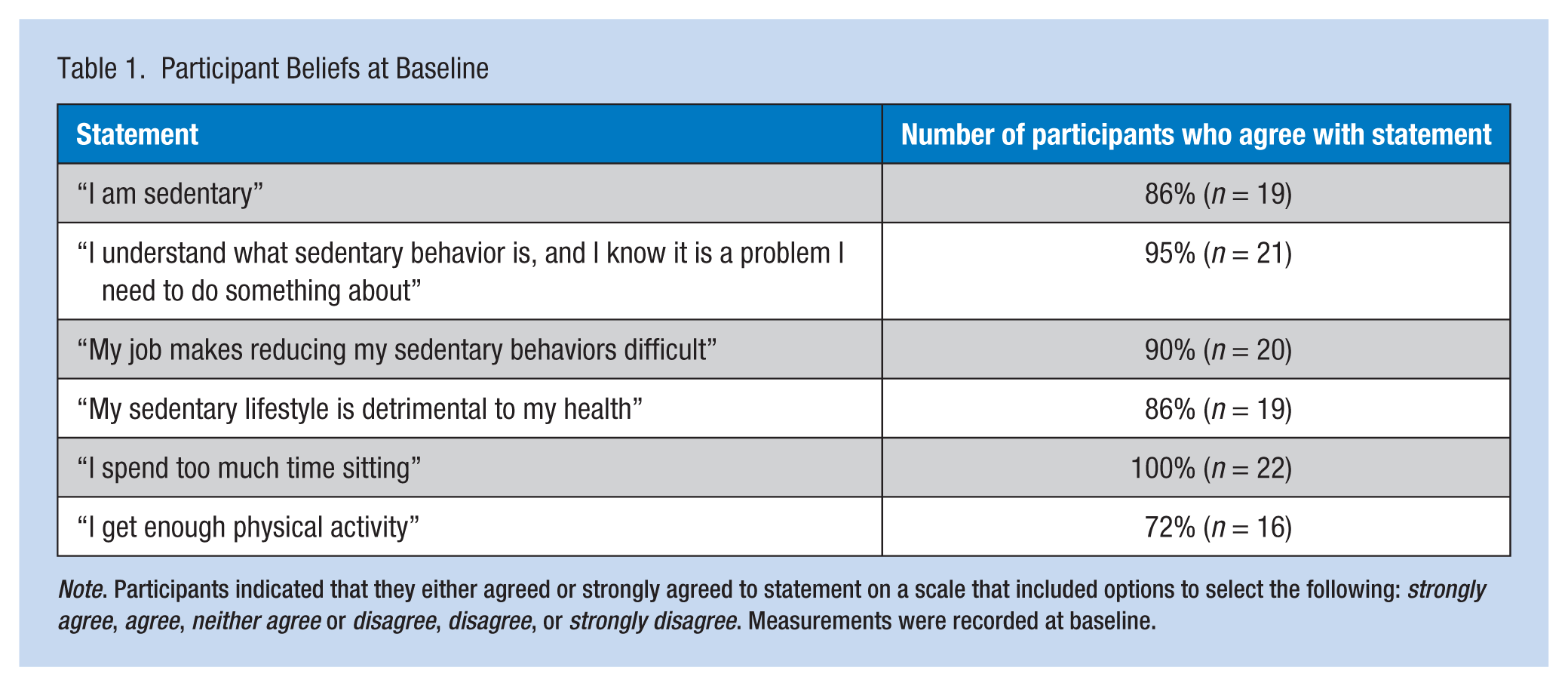
Note. Participants indicated that they either agreed or strongly agreed to statement on a scale that included options to select the following: strongly agree, agree, neither agree or disagree, disagree, or strongly disagree. Measurements were recorded at baseline.
Participants’ Ratings of the Importance of Changing Their Sitting Behaviors and Their Confidence in Their Ability to Change Their Sitting Behaviors at Baseline
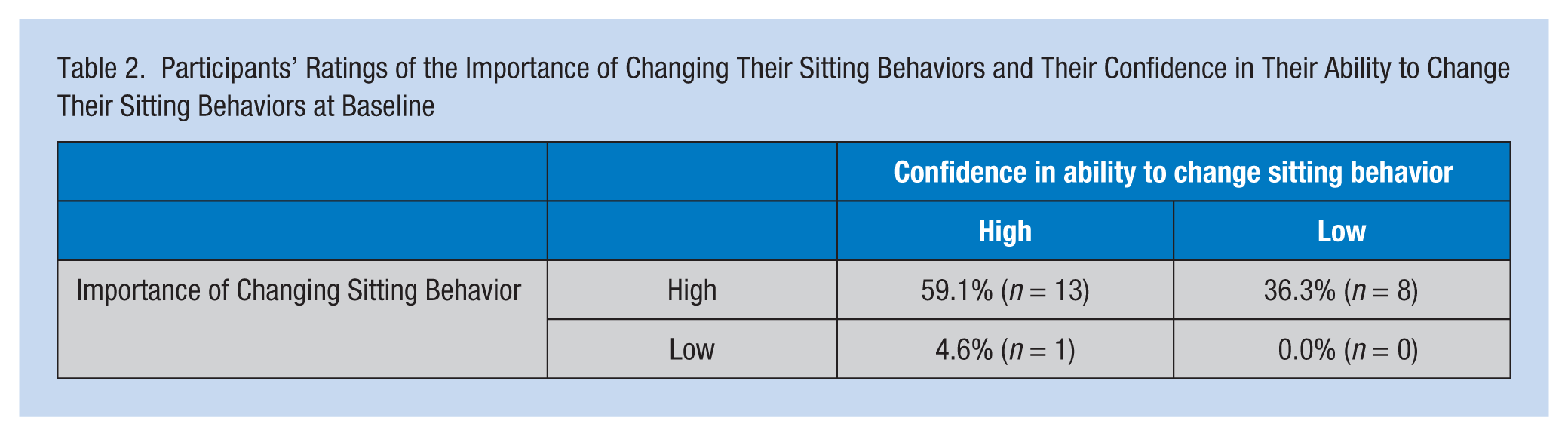
On average, 22 participants completed 36 of 40 possible days of Fitbit use with a range of 8 to 48 days of participation; seven participants completed less than the requested 40 days, three participants completed more than the requested 40 days, and 12 completed exactly 40 days. A participant stopped sharing data with researchers on Days 8, 15, 20, 25, 36, 38, and 39, resulting in only 15 participants completing the full 40 days of the study. Each participant received a daily score that was defined by the number of times per half hour they stood during an 8-hour workday. Scores ranged from 3 stands to 16 stands per day with an average of 12 stands per day of the total possible 16 (Figure 1). These results indicate that although Fitbit interventions are effective in interrupting sedentary behaviors in the workplace and employees are confident in their ability to reduce their sedentary behaviors, resources and strategies are required to capture all initially interested potential participants. To preserve anonymity in the workplace, monitoring nonconsenting participants was not feasible.
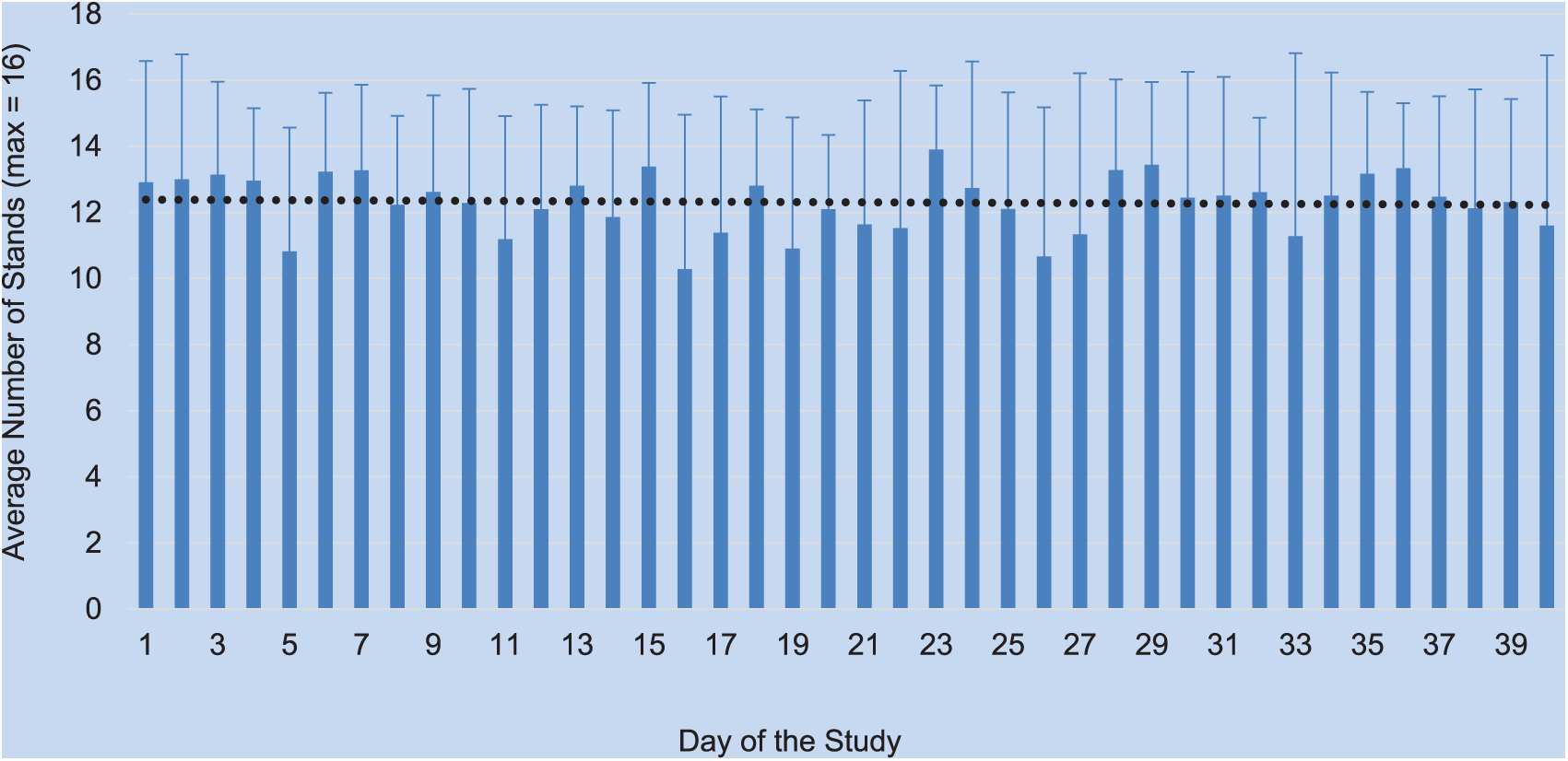
The average number of stands per day across all 22 participants in the study.
Discussion
The purpose of this intervention was to use Fitbit devices to monitor sitting time in a group of participants working in call centers. Participants were asked to wear a Fitbit during their 8-hour workday for an 8-week period; they were also instructed to stand at least once every 30 minutes during the workday. The results of this study indicate that Fitbits are feasible tools for aiding employees to interrupt sitting time during sedentary work. However, due to the descriptive nature of this study, a lack of baseline activity prevents meaningful comparisons of sitting time between pre and post Fitbit intervention.
Limitations
One difficulty in interpreting these findings was that no minimal clinically significant difference exists for the amount of sedentary time that adversely affects health outcomes (Parry et al., 2013). The amount of sitting time that adversely impacts short-term and long-term health outcomes is unclear. However, evidence does support that standing every 30 minutes improves health (Ryan et al., 2011). Future studies should consider baseline measures of physical activity and sedentary time, as well as the frequency of standing throughout the work. Future research should also consider taking longitudinal approaches to musculoskeletal health and well-being in individuals working in sedentary occupations.
Footnotes
Conflict of Interest
The author(s) declared no potential conflicts of interest with respect to the research, authorship, and/or publication of this article.
Funding
The author(s) received no financial support for the research, authorship, and/or publication of this article.
Author Biographies
N. A. Guitar is a PhD student in the combined PhD/MPT program in Physical Therapy at Western University. She is part of Dr. Denise Connelly’s Aging and Mobility Laboratory and is interested in the impact of physical exercise on executive functions. She holds a previous masters degree in behavioral and cognitive neuroscience.
A. MacDougall completed her Bachelor of Science at Western University in 2016.
D. M. Connelly is an associate professor in the School of Physical Therapy at Western University. Her leadership roles include Chair, MPT Program in the School of Physical Therapy and Assistant Dean, Interprofessional Education in the Faculty of Health Sciences. Her research program addresses multiple facets of functional mobility including the influence of aerobic/strength training on mobility, and qualitative research exploring issues related to exercise in the lives of older adults living in the community. She is an Associate Scientist with the Lawson Health Research Institute, and a Faculty Associate of the Canadian Centre for Activity & Aging.
E. Knight holds a PhD from Western University, and contributes her clinical training as both a physiotherapist and exercise physiologist, along with her research training in exercise and rehabilitation sciences. She is a member of the Aging, Rehabilitation and Geriatric Care Research Centre at Lawson Health Research Institute.