




Abstract
A growing body of evidence suggests long work hours adversely affect mental health across a variety of domains. Mental health issues have been found to negatively affect work performance. This finding was highlighted in the aviation industry by the 2015 Germanwings incident in which 150 people died. Further investigation into work hours and their associated factors (e.g., demographic characteristics and experiences of sleep and fatigue in the cockpit) contributing to mental health issues among pilots is warranted. A cross-sectional survey investigating attitudes and experiences of fatigue was developed and distributed to commercial airline pilots. Results found pilots who reported typically spending longer hours on duty per week were twice as likely to report feeling depressed or anxious. Pilots’ experiences of job-related sleep disturbance and fatigue may explain why pilots who typically spend long hours on duty each week are more likely to report feeling depressed or anxious.
The association between mental health and well-being, and work hours is of growing interest and concern with an increasing body of evidence suggesting longer work hours adversely affect mental health across a variety of occupations (Dembe, Erickson, Delbos, & Banks, 2005). Various studies have identified an association between overtime and extended work schedules with increased risk of worker fatigue (Åkerstedt, Fredlund, Gillberg, & Jansson, 2002; Park, Kim, Chung, & Hisanaga, 2001), stress (Maruyama & Morimoto, 1996), and depression (Proctor, White, Robins, Echeverria, & Rocskay, 1996; Shields, 1999). Several meta-analyses such as those by Sparks, Cooper, Fried, and Shirom (1997) and Spurgeon, Harrington, and Cooper (1997) summarized these research findings. The literature suggests that longer work hours are associated with adverse effects on workers’ mental health. Further investigation into work hours and concomitant factors contributing to workers’ mental health is warranted.
Mental health issues, which can be detrimental to quality of life, can also have a negative influence on work performance (Butcher, 2002). Depending on occupation, mental health issues can have serious widespread consequences. The mental health of commercial airline pilots has been found to influence flight performance (Butcher, 2002). Within the aviation industry, the potential incidence of mental health issues among pilots is a serious concern due to operation of multi-million euro airframes and the lives of 500 or more passengers. This loss of life and equipment was recently highlighted on March 24, 2015, when co-pilot Andreas Lubitz, having locked the captain out of the cockpit, crashed Germanwings Flight 9525 into the French Alps killing 150 passengers and crew. Further investigation found that Lubitz had a history of severe depression. This fatal incident is not isolated. On October 31, 1999, 30 minutes after take-off from New York City, an EgyptAir Boeing 767 experienced a rapid descent killing 217 individuals. Inconclusive evidence suggested that the crash was deliberately caused by the relief first officer (Aviation Safety Network, 1999). Furthermore, on December 19, 1997, Silk Air Flight 185 crashed following a rapid descent from cruising altitude on route from Jakarta, Indonesia to Singapore killing 104 on board. In the subsequent incident report, it was suggested that the captain was suffering from “multi-work related difficulties” (Aviation Safety Network, 1997). According to Butcher (2002), mental health issues among pilots have been identified, but the extent, origins, or degree of these problems among active airline pilots is currently unknown because no decisive epidemiological studies on rates of mental disorders have been conducted for this group.
One factor proposed to have a strong impact on mental health, specifically depression, is long work hours (i.e., more than 8 hours; Proctor et al., 1996). Pilots flying for European-based air carriers can fly up to 13 hours per duty day (European Union Air Operations [EU-OPS]-Subpart Q*). Commercial pilots assigned to U.S.-based flights can fly up to 9 hours per duty day based on a two-pilot crew (Federal Aviation Administration [FAA]-14 CFR Part 117**). Pilots flying for U.K.-based carriers are permitted to fly up to 13 hours per duty day (Civil Aviation Authority [CAA-UK]-CAP 371***) while commercial pilots operating Chinese-based flights can spend up to 14 hours on duty per day, although flight time cannot exceed 10 hours (China Civil Aviation Regulations [CCAR]-Section 135****). These flight time limitations implemented by various aviation regulation authorities suggest further evaluation is needed worldwide regarding pilot work hours.
A number of previous studies have investigated the relationship between work hours and health (Proctor et al., 1996; Sparks et al., 1997; van der Hulst, 2003). The mental health of shift workers has also received some attention (Harrington, 2001; Kim et al., 2002). In contrast, research examining quantity of work hours and workers’ mental health is much sparser (Spurgeon et al., 1997). Regardless, existing evidence causes concern about the negative impact of longer work hours on the health and well-being of workers (Harrington, 2001; Spurgeon et al., 1997; van der Hulst, 2003). In a meta-analysis based on 21 studies, Sparks and colleagues (1997) found a small but significant positive correlation between longer work hours and poorer psychological health. Furthermore, qualitative analysis of an additional 12 studies supported these findings (Sparks et al., 1997). Using the results from the Third European Working Conditions Survey, completed by 21,703 workers in face-to-face interviews across the 15 European Union member states in 2000, Boisard, Gollac, Valeyre, and Cartron (2003) found that of those who worked 30 to 35 hours per week, 27% and 19% reported experiencing stress and overall fatigue, respectively, due to work. Whereas, of those employees who worked 45 hours or more per week, 39% and 33% reported experiencing stress and overall fatigue, respectively, due to work. The researchers concluded that the frequency of reported mental health issues was significantly correlated with work time.
Although long work hours appear to be associated with mental health issues, the potential influence of confounding factors (i.e., demographic variables, job demands, work characteristics, and personality) may also play a role in this relationship (Spurgeon et al., 1997; van der Hulst, 2003). Previous research has used the number of hours worked as an indicator of task demands (van der Hulst, 2003). However, such an approach cannot clearly separate the effects of job demands and long work hours. Basic correlations between work hours and health effects provide limited information. According to van der Hulst (2003), failure to control for covariates may contribute to inconclusive findings in investigations of work hours and mental health.
According to the literature, some factors associated with long work hours and depression or anxiety include sleep disruptions, feelings of fatigue, and manifestations of fatigue (e.g., microsleeps; Samel, Wegmann, & Vejvoda, 1997; Sirois, Trutschel, Edwards, Sommer, & Golz, 2009). Until now, no published studies have investigated to what extent self-reported depression or anxiety due to work hours might be explained by sleep disruption and fatigue adjusted for individual pilots’ demographic characteristics. The purpose of the current study was therefore to investigate the differences in self-reported depression or anxiety among European-registered commercial airline pilots, and then to further investigate the extent to which these differences could be explained, initially by individual demographic characteristics (e.g., age, position, employment), and subsequently by their experiences of fatigue in the cockpit, experiences of microsleeps in the cockpit, and sleep disturbance due to work schedule.
Method
This study analyzed data from a cross-sectional survey of European-registered commercial airline pilots conducted between September and November 2012. All participants in the current study flew for airlines all registered to the same European state. A total of 701 commercial airline pilots fully completed the anonymous online survey. Prior to distribution of the survey, ethical approval was granted by Dublin City University Ethical Committee.
Sample
A total of 2,186 European-registered commercial airline pilots’ email addresses were obtained. Pilots were emailed details outlining the purpose of the study and a link to the online survey. Of the distributed surveys, 701 were fully completed, representing a 32% response rate.
Survey Description
The survey was based on three previous unpublished European pilot fatigue surveys conducted by the Norwegian Airline Pilots’ Association (2010), the Danish Airline Pilots’ Association (2011), and the Swedish Airline Pilots’ Association (2011). The 25-minute survey collected data on the following topics: Demographics, Captain’s Discretion, Personal Health, Overall Attitudes and Opinions about Regulations and Associated Bodies, Experiences of Sleep and Fatigue, Errors and Incidents, and Attitudes toward and Experiences of Duty Periods.
Following a review of the literature, analysis of other European pilot fatigue surveys and discussions with experienced European-based commercial airline pilots, a 30-item survey was created using the web-survey development, cloud-based product, SurveyMonkey®. Prior to survey distribution, the acceptability of the survey and question ambiguity were determined by two postgraduate researchers, a university researcher, and two commercial airline pilots with combined flying experience of more than 30 years (Williams, 2003). These individuals were also asked to provide opinions on the overall content of each item as a determination of “face validity.” The questions were then amended accordingly. The revised survey was sent to four professionals (i.e., two commercial airline captains, one university professor, and one university researcher), who had conducted other European pilot fatigue surveys, to ascertain their opinions on instrument layout and content. This process acted as a measure of “content validity”; after analysis, appropriate alterations were implemented. Following this, 10 pilots who currently fly with European-registered airlines were randomly selected and asked to complete the online survey which gathered data about their opinions on the language used, duration, layout, and overall content. Following this process, final changes were made. The 30-item survey included time-bound questions. The current flight time regulations at the time of the survey, under the auspices of the EU-OPS Subpart Q, were effective in July 2008. Therefore, all questions in this survey referred to the period from July 2008 to the day on which the survey was completed, unless otherwise stated (e.g., “in the last 12 months”) from the time of taking the survey.
Outcome Measure
Perceived depression or anxiety was measured by a response to the self-rated depression question “In the past 12 months, have you ever suffered from feelings of being . . . depressed or anxious?” Respondents answered on a 5-point Likert-type scale ranging from no, never; yes, once; yes, now and then/rarely; yes, often; or don’t know/no opinion. These responses to the self-rated depression and anxiety questions were also dichotomized to those reporting not having experienced depression or anxiety in the last 12 months and those reporting having experienced depression or anxiety in the last 12 months by assigning 0 to those reporting either “no” or “don’t know/no opinion”; and 1 to those reporting “yes, once,” “yes, now and then/rarely,” and “yes, often.”
Statistical Analyses
Pearson’s chi-square tests of independence were performed to investigate the association between the number of respondents typically working less than 25 hours on duty, 25 to 30 hours, 31 to 35 hours, 36 to 40 hours, 41 to 45 hours, 46 to 50 hours, and greater than 50 hours per week, and their perceived depression or anxiety. Due to the likely effect of confounding variables (i.e., age, gender, and experiences of sleep disruption and fatigue caused by occupation), binary logistic regression was used to further explore these issues in perceived depression or anxiety. By assigning the dichotomous indicator of “have experienced depression or anxiety” as the response variable, an initial model investigated the unadjusted differences in typical duty hours per week (i.e., less than 25 hours on duty, 25 to 30 hours, 31 to 35 hours, 36 to 40 hours, 41 to 45 hours, 46 to 50 hours, and more than 50 hours per week; Model 1). This model was subsequently adjusted for other demographic factors (i.e., gender, age, position, living situation, contract, and employment) in Model 2, and then finally adjusted by adding sleep and fatigue factors (i.e., experiences of fatigue in the cockpit, experiences of microsleeps in the cockpit, and sleep disturbance due to working schedule) reported as Model 3.
Results
A Pearson’s chi-square test of independence was used to investigate the association between typical duty periods and self-reported depression or anxiety. Findings showed that as number of hours on duty increased, pilots reported a significant increase in depression or anxiety (χ2 = 14.215; p < .05). In response to the Likert-type self-rated depression or anxiety question, the findings suggested that pilots who typically spend 36 to 40 hours on duty per week are more likely to report feeling depressed or anxious relative to any other duty hour periods (Table 1). Due to the likely effect of confounding variables, binary logistic regression was used to further explore self-reported depression or anxiety.
Frequency (%) of Responses to the Likert-Type Self-Rated Depression or Anxiety Question by Typical Hours Spent on Duty per Week
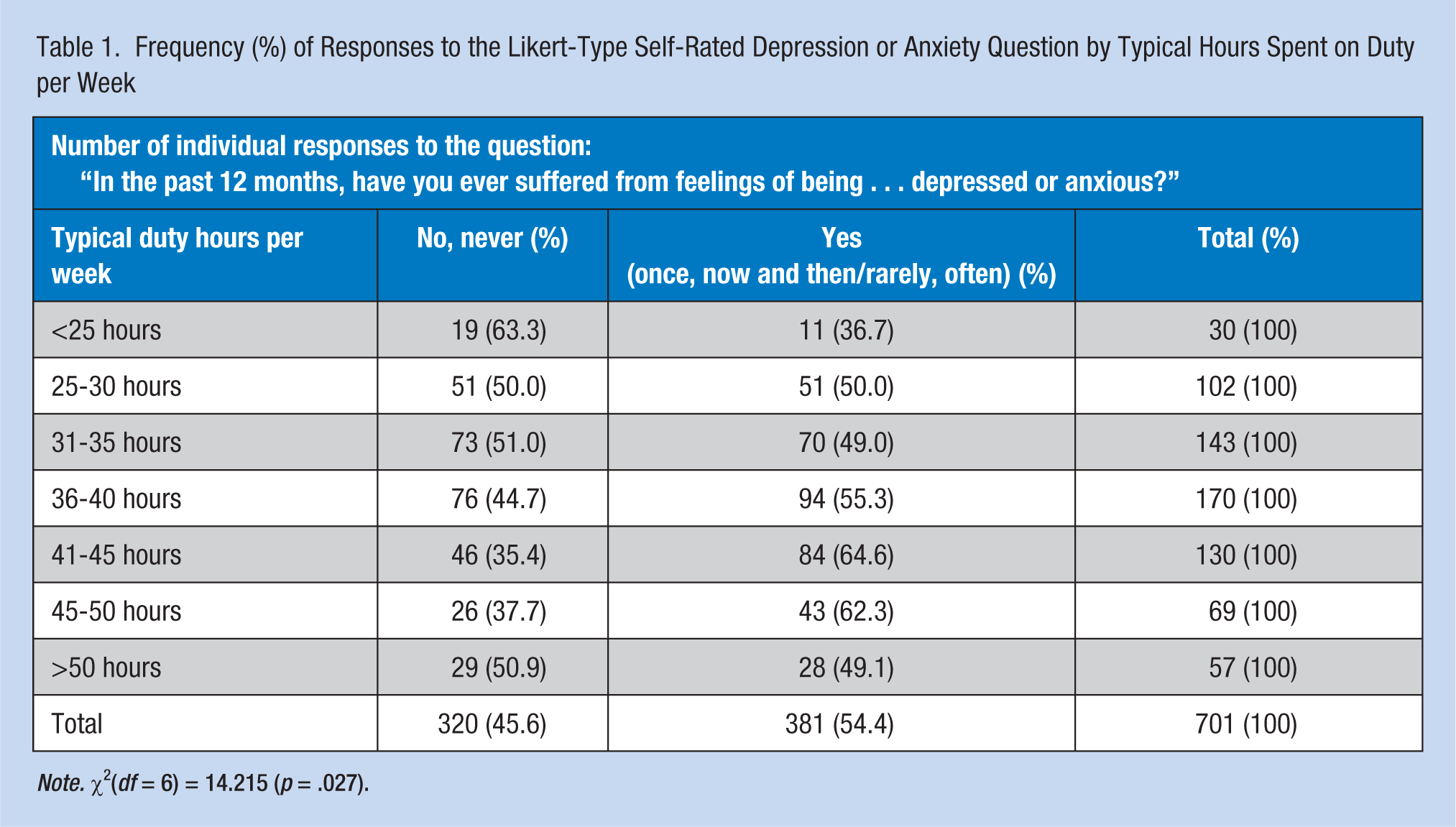
Note. χ2(df = 6) = 14.215 (p = .027).
Factors Associated With Duty Hours Adjusted for Demographics
The unadjusted binary logistic regression analysis (see Table 2, Model 1) identified that pilots working 41 to 45 hours and 45 to 50 hours had a significantly higher probability of reporting feeling depressed or anxious in the last 12 months (odds ratio [OR] = 3.15, 95% confidence interval [CI] = [1.38, 7.19] and OR = 2.85, 95% CI = [1.17, 6.94]) than those who worked less than 41 hours per week. Those who reported typically spending 36 to 40 hours on duty per week approached significance (OR = 2.13, 95% CI = [0.95, 4.76]) compared with those who reported typically spending less than 25 hours on duty per week (baseline level). The resulting analysis identified a strong effect of gender; females were significantly (2.6 times) more likely to report feeling depressed or anxious (OR = 2.61, 95% CI = [1.12, 6.07]) compared with males (baseline group). Furthermore, those aged 46 to 55 years were also found to be significantly (2 times) more likely to report feeling depressed or anxious (OR = 2.15, 95% CI = [1.02, 4.52]) compared with those participants aged less than 25 years in the baseline group.
Differences in Perceived Depression or Anxiety Due to Duty Hours Alone (Model 1), Adjusted for Individual Demographics (Model 2), and Adjusted for Both Individual Demographics and Sleep Disturbance and Fatigue Experiences (Model 3)
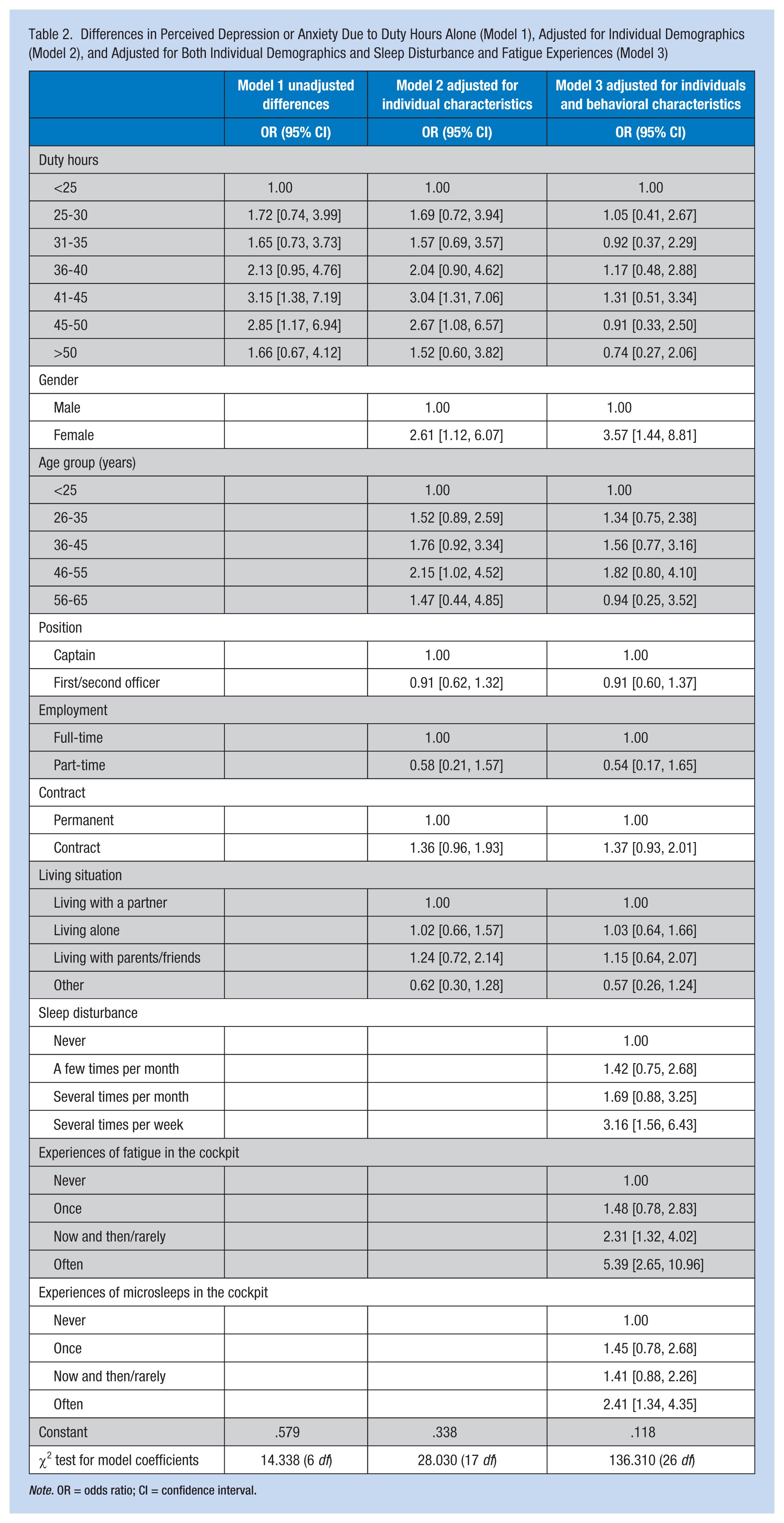
Note. OR = odds ratio; CI = confidence interval.
Factors Associated With Duty Hours, Adjusted for Demographic Characteristics and Experiences in the Cockpit
A third binary logistic regression analysis (Model 3) was completed incorporating experiences of fatigue in the cockpit, experiences of microsleeps in the cockpit and sleep disturbance due to work schedule in addition to those variables included in Model 2. The aim of this analysis was to determine the experiences in the cockpit associated with feelings of depression or anxiety and explain the above demographic differences. When pilots’ experiences of fatigue and sleep disruption due to work were incorporated into the binary logistic regression analysis, the differences in perceived depression or anxiety due to typical hours spent on duty disappeared (see Table 2, Model 3). The resulting analysis identified the effect of fatigue in the cockpit. As frequency of experiences of fatigue in the cockpit increased, participants reported a progressive increase in the likelihood of reporting feeling depressed or anxious. Those pilots who reported rarely feeling too fatigued to be on active duty in the cockpit were more than twice as likely to report feeling depressed or anxious (OR = 2.31, 95% CI = [1.32, 4.02]). Those who reported often feeling too fatigued to be on active duty in the cockpit were more than 5 times as likely to report feeling depressed or anxious (OR = 5.39, 95% CI = [2.65, 10.96]) compared with those who reported never feeling too fatigued to be on active duty in the cockpit (baseline group). Furthermore, those pilots who reported experiencing sleep disturbance due to work several times per week were more than 3 times more likely to report feeling depressed or anxious (OR = 3.16, 95% CI = [1.56, 6.43]) compared with those pilots who reported never experiencing sleep disturbance due to their occupation. Those who reported often experiencing microsleeps in the cockpit were significantly more likely to report feeling depressed or anxious (OR = 2.41, 95% CI = [1.34, 4.35]) relative to those who reported never experiencing microsleeps in the cockpit (baseline group).
Further analysis revealed that when experiences of fatigue and sleep due to work were incorporated into Model 3, the effects of age (46-55 years) disappeared. No age group reported significantly more feelings of depression or anxiety compared with the less than 25 year old baseline group. However, significant differences in gender remained (OR = 3.57, 95% CI = [1.44, 8.81]) with females being more than 3 times more likely to report feeling depressed or anxious than males.
Discussion
Based on the findings of the survey, differences in European-registered commercial airline pilots’ self-reported depression or anxiety were associated with hours spent on duty. Pilots typically spending longer hours on duty were progressively more likely to report feeling depressed or anxious. Pearson’s chi-square test demonstrated that as number of hours on duty increased, self-reported depression or anxiety significantly increased. However, this finding was only significant for pilots working 36 to 40 hours after which the likelihood of reporting depression or anxiety progressively decreased.
These differences in self-reported depression or anxiety were confirmed using binary logistic regression (Model 1). Respondents who typically spend longer hours on duty per week revealed a progressively significantly greater probability of reporting depression or anxiety up to 41 to 45 hours on duty compared with those participants who typically spend less than 25 hours on duty per week. A somewhat similar trend was found by Virtanen and colleagues (2011; Virtanen, Stansfeld, Fuhrer, Ferrie, & Kivimäki, 2012) who studied British public servants for 5.3 to 5.8 years to determine the risks of depressive symptoms and major depressive episodes, respectively. Both studies found that those individuals with long work hours (more than 11 hours per day) showed increased risk of depressive symptoms/major depressive episodes compared with those who worked 7 to 8 hours per day. The results from this study revealed a similar trend, but surprisingly those who reported typically spending more than 50 hours on duty per week, despite being 1.8 times more likely to report feeling depressed or anxious, were not found to significantly differ in their reported feelings of depression or anxiety compared with those who typically spend less than 25 hours on duty per week. Åkerstedt and colleagues (2002) found similar results. They examined the relationship between work, disturbed sleep, and fatigue in an open cohort study with repeated national cross-sectional surveys. Overtime work was not found to result in significant sleep disruption. However, most overtime was found to be voluntary which may thwart adverse sleep effects through selection of those most tolerant of overtime work (Åkerstedt et al., 2002). It is perhaps plausible that the same concept can be applied in this instance in that a positive correlation existed between hours on duty and self-reported feelings of depression or anxiety to a certain point after which those spending long hours on duty (i.e., more than 50 hours per week) may predominately do so on a “voluntary” basis and as such are more acquiescent of their work practices and thus less inclined to report feelings of depression or anxiety.
In the current study, the findings of Model 2 suggest that the differences in self-reported depression or anxiety associated with typical duty hours are not explained by pilots’ demographic characteristics (e.g., position or employment). The binary logistic regression analysis for Model 2 found that differences in the likelihood of reporting feeling depressed or anxious remained constant across differing duty hours of respondents. The recorded difference in self-reported ratings of depression or anxiety were slightly reduced but not fully explained by respondents’ individual demographic characteristics thus suggesting that using these pilot demographic characteristics as potential screening markers to identify pilots most susceptible to developing depression or anxiety is not warranted.
Gender and age were the only demographic characteristics found to significantly influence perceived depression or anxiety in Model 2. Gender had a substantial effect on perceived depression or anxiety for females who were 2.6 times more likely to report feeling depressed or anxious than their male counterparts (OR = 2.61, 95% CI = [1.12, 6.07]). According to Nolen-Hoeksema (2001), from adolescence though adulthood, women are twice as likely to experience depression as men. Furthermore, long work hours may pose a higher risk for depression and anxiety among females because women often have added burdens of extended work hours and domestic chores, an explanation for this finding (Artazcoz, Borrell, & Benach, 2001; Gjerdingen, McGovern, Bekker, Lundberg, & Willemsen, 2001; Lundberg & Hellström, 2002; Matthews & Power, 2002). In addition, Baum, Newman, Weinman, West, and McManus (1997) concluded that in community-based surveys, women are more likely to report psychological distress and depression than men. However, caution is warranted due to the number of respondents (31 females vs. 670 males in total).
Age also had an impact on perceived depression or anxiety; older respondents are progressively more likely to report depression or anxiety (those aged 46-55 years were significantly more likely to report feeling depressed or anxious) with the exception of those workers aged 56 to 65 years who were less likely to report feeling depressed or anxious compared with those workers aged less than 25 years. According to a report conducted by the Health and Safety Executive (HSE) in 2002 in the United Kingdom, older workers are more likely to report work-related stress, depression, and anxiety than younger workers, which may be explained by cumulative exposure to workplace hazards such as inadequate work design and management
When details of respondents’ experiences of job-related sleep disturbance and fatigue were included in the binary logistic regression analysis for Model 3, all of the differences across duty hours for self-reported feelings of depression or anxiety disappeared. Indeed, only female respondents remained significantly more likely to report feeling depressed or anxious than the baseline male group. Significant age-group differences were eradicated and overall differences across age were reduced with the inclusion of job-related sleep disturbances and fatigue in the logistic regression analysis (Model 3). These findings suggest that reducing pilots’ job-related sleep disturbances and experiences of fatigue may influence the effects of aging on pilots’ perceived depression or anxiety.
Insufficient sleep has previously been associated with increased risk of psychiatric disorders (Vandeputte & de Weerd, 2003). Similarly, the present study found that sleep disturbances several times per month or per week, resulting from pilots’ inability to adopt normal sleeping patterns that promote proper rest due to work schedules, nearly doubled and tripled, respectively, the respondents’ probability of reporting depression or anxiety, highlighting the strong association between these two variables. Raggatt (1991) found sleep disturbances among long-distance coach drivers, due most notably from long hours at the wheel (50 hours or more per week), were consistently correlated with stress outcomes and negative health consequences. Furthermore, Raggatt (1991) suggested that fatigue is expressed in a cyclical pattern in which attempts to deal with long hours increases the likelihood of maladaptive coping efforts, resulting in disturbed sleep, fatigue, and eventually stress outcomes.
Pilots’ fatigue in the cockpit was found to significantly influence perceived depression or anxiety. Respondents who reported rarely feeling too tired or fatigued in-flight, and those who reported often feeling too tired or fatigued in-flight and felt they should not be on active duty in the cockpit, were 2.3 and 5.3 times more likely to report feeling depressed or anxious, respectively, compared with those who reported never experiencing feelings of being so tired or fatigued in-flight they felt they should not be on active duty in the cockpit. In addition, those who reported often experiencing a microsleep event or falling asleep while on duty in the cockpit without prior agreement with the other pilot were more than twice as likely to report feeling depressed or anxious compared with those who reported never experiencing a microsleep event or falling asleep while on duty in the cockpit. The findings suggest that pilots who spend longer hours on duty and report more frequent feelings of fatigue and microsleeps in the cockpit are significantly more likely to report feeling depressed or anxious. These findings appear to be in consonance with the literature with increasing duty hours associated with increasing feelings of fatigue (Goode, 2003; O’Hagan, Issartel, Fletcher, & Warrington, 2016). According to Ono, Watanabe, Kaneko, Macsumoto, and Miyako (1991), long flight hours and night-time and early morning work significantly contributed to high levels of fatigue complaints among Japanese flight attendants. Fatigue and microsleep events may cluster such that individuals who are more fatigued are more likely to experience microsleep events (Samel et al., 1997; Sirois et al., 2009). Furthermore, fatigue is regularly found to be positively associated with depression and anxiety in both healthy populations and in shift workers (Belza, 1995; Smith et al., 1999) thus further promoting the sentiments of Raggatt (1991) referred to above.
Several study limitations were identified. First, observations were based on self-report rather than objectively measured sleep and fatigue experiences and ratings of depression or anxiety. Self-report research can be biased by potential misunderstanding of posed questions, social desirability as well as cognitive difficulties associated with recall (Sallis & Saelens, 2000; Stone et al., 2009). Moreover, baseline or clinical levels of depression and anxiety were not pre-determined. Further study would permit researchers to establish a causal relationship between perceived depression or anxiety, duty hours, and experiences of job-related fatigue and sleep disturbance.
Implications of the Research
The findings of this study suggest that differences in self-reported depression or anxiety associated with duty hours are prevalent among European-registered commercial airline pilots with those who spend longer hours on duty being more likely to report depression or anxiety. Demographic factors such as position, employment, contract, or living situation do not appear to explain these differences, therefore, suggesting that using these pilot demographic characteristics as potential screening markers to identify pilots most susceptible to developing depression or anxiety is not supported. However, pilots’ experiences of job-related fatigue and sleep disturbance do explain why pilots who typically spend long hours on duty each week are more likely to report feeling depressed or anxious. These findings warrant further investigation into workers job-related fatigue and sleep disturbance issues due to their influential impact on mental health and work safety, not only within an aviation domain but also among those in medicine and nursing where worker performance has a direct and substantial impact on others.
Conclusion
Differences in self-reported depression or anxiety associated with duty hours were found among European-registered commercial airline pilots. These differences cannot be fully explained by demographic characteristics. Differences in perceived depression or anxiety appear to be explained further by job-related fatigue and sleep disturbance. Due to the detrimental and dangerous influence mental health issues can have on work, flying performance, and thus flight safety, further investigation is essential to determine how to identify, monitor, treat, and reduce factors which may negatively influence mental health. Although this study assessed whether job-related fatigue and sleep disturbances could explain the differences in perceived depression or anxiety associated with duty hours, the study did not explore which of these factors (e.g., scheduling, circadian rhythms, workload) contribute to the relationship among duty hours, depression, and anxiety. Further research into these factors and ways in which to positively target these pilot experiences is needed. Moreover, the development and implementation of objective measures of sleep and fatigue could support and validate this study’s findings.
Applying Research to Practice
Pilots who typically spend longer hours on duty per week are more likely to report depression or anxiety. Demographic characteristics such as position, employment, or living situation do not explain why pilots who spend longer hours on duty are more likely to report feeling depressed or anxious. Pilots who report regular sleep disturbances and fatigue in the cockpit are more likely to report feeling depressed or anxious the longer they are on duty.
* EU-OPS – Subpart Q – a legally, binding minimum set of flight time limitation safety rules aimed at preventing pilot fatigue across Europe
** FAA – 14 CRF Part 117 – flight and duty-time limitations and rest requirements for flightcrew members in the United States
*** CAA-UK – CAP 371 – regulations for flight crews and cabin staff designed to prevent the onset of fatigue for non-European Aviation Safety Agency flight time limitation operations
**** CCAR – Section 135 – a set of operating requirements to attain and maintain a level of safety, in accordance with the People’s Republic of China civil aviation law
Footnotes
Acknowledgements
The authors thank all those who reviewed the survey and provided their constructive feedback as well as all participants who took the time to complete the survey.
Conflict of Interest
The author(s) declared no potential conflicts of interest with respect to the research, authorship, and/or publication of this article.
Funding
The author(s) disclosed receipt of the following financial support for the research, authorship, and/or publication of this article: This work was supported by the Irish Research Council under Grant GOIPG/2013/45.
Author Biographies
Anna Donnla O’Hagan is a PhD student in the School of Health & Human Performance at Dublin City University. She is investigating human factors and performance specializing in pilot fatigue.
Johann Issartel is a lecturer in the School of Health & Human Performance at Dublin City University and director of the Multisensory Motor Learning Lab.
Alan Nevill is a research professor at the University of Wolverhampton. He is presently a visiting professor in sports sciences at Newman University, Birmingham.
Giles Warrington is a senior lecturer in the Department of Physical Education & Sports Science at the University of Limerick. He is also a fellow of the American College of Sports Medicine.