




Abstract
The purpose of this study was to examine the relationships among hiding emotions, psychological well-being, and presenteeism for South Korean interactive service workers. This study is a secondary analysis of data extracted from the 2011 Korean Working Conditions Survey (KWCS), a longitudinal study conducted by the Korea Occupational Safety and Health Agency (KOSHA). For the present analysis, 15,669 workers who interacted with others at work were selected. Based on existing literature, a set of variables was chosen from the KWCS. Psychological well-being was measured using the World Health Organization (WHO)-5 Well-Being Index. The results indicated that frequently hiding feelings is related to presenteeism. Also, among workers who hide emotions at work, an inverse relationship was found between the degree to which these workers hide their feelings and their psychological well-being. Based on these results, the researchers offered practical suggestions to assist interactive service workers adjust to duties that require emotion management.
The service sector has grown rapidly in both developed and developing countries (Dursun, 2014). According to 2013 data, the service sector accounted for approximately 72% of all employment created in the Organisation for Economic Cooperation and Development (OECD; 2015) area. The service sector, sometimes called the tertiary sector, is usually defined as the part of the economy that provides services directly (i.e., face-to-face or voice-to-voice) to the end user or customer, and includes housekeeper, psychotherapist, tax preparer, tour guide, nurse, and teacher. Emotional labor, which requires controlling feelings and expressions at work, is a critical aspect of interactive services (Grandey, 2000; Hochschild, 1983). To meet business goals, employers set specific rules that regulate workers’ emotional displays; employees are expected to control their true emotions and emotional displays according to these rules. Workers in interactive services may be required to amplify positive emotions or hide negative ones (Diefendorff & Richard, 2003).
It is known that emotion management is associated with worker health. According to previous research, the influence of emotion management on worker health can be either positive or negative. The positive influence of emotion management is based on the facial feedback hypothesis, which states that expressing positive emotions during work may put the individual in a better mood (Hennenlotter et al., 2009). On the contrary, emotion management may be harmful to worker health because of the discrepancy between true and displayed emotions (Grandey, 2000; Hochschild, 1983). In previous literature on the relationship between emotion management and worker health, emotion management was associated with musculoskeletal pain (Armon, Melamed, Shirom, & Shapira, 2010), depression (Yoon & Kim, 2013), and absenteeism (Nguyen, Groth, & Johnson, 2013).
However, little research has been published on the effects of hiding emotions, as a special form of emotion management. According to previous studies, hiding negative emotions was associated with depersonalization, personal accomplishment (Brotheridge & Grandey, 2002), and job satisfaction (Bono, Foldes, Vinson, & Muros, 2007), having no significant effects on mental health (Burr, Albertsen, Rugulies, & Hannerz, 2010). However, previous studies that addressed this issue paid little attention to the degree of hiding emotions. Therefore, the current study addressed the relationship between the degree of hiding emotions and health consequences, especially psychological well-being and presenteeism, because little research has examined the relationship between hiding emotions and presenteeism. Presenteeism is associated with less productivity at work, the costs of which have been evaluated to exceed those attributable to both health care expenses and sickness absence (Hemp, 2004). Also, psychological well-being was one of the most prominent factors in determining job involvement and absenteeism at workplaces (Baptiste, 2008).
The purpose of this study was to examine the relationship between the degree of hiding emotions and psychological well-being and presenteeism in South Korean interactive service workers. This study posed the following research questions:
Method
Study Design
This study is a secondary analysis of data extracted from the third (2011) Korean Working Conditions Survey (KWCS), a longitudinal study conducted by the Korea Occupational Safety and Health Agency (KOSHA) which used a representative sample of economically active South Koreans, meaning anyone who performed any type of work for at least 1 hour during the previous week for pay or profit. KWCS is a government-approved statistical survey that was conducted in 2006, 2010, and 2011 to investigate the state of working conditions, exposure to risk factors, the nature and contents of changes affecting the workforce, and the quality of work (Occupational Safety and Health Research Institute [OSHRI] & KOSHA, 2012). A previous study showed that the KWCS had superior external validity (rigid sampling procedures) and content validity (reasonable procedure of questionnaire development) and reliability (high matching rate in the test-–retest; Kim, Rhee, Oh, & Park, 2013).
Sample and Data Collection Procedures
KWCS was distributed to workers older than age 15 living in 16 cities or provinces in South Korea. The sample was selected from the 2005 population and housing census. First, census districts were chosen using the probability proportional-to-size systematic sampling method, based on the number of households in each district. Then, households were selected randomly from each selected census district. From each selected household, individuals who fit the pre-set conditions (i.e., employees or the self-employed older than age 15) were chosen to be interviewed. The goal was to schedule a face-to-face interview with 50,000 individuals, but due to the sampling outcomes, the total number of participants in the 2011 KWCS was 50,032. The surveys were conducted by Gallup, Korea’s trained surveyors, for approximately 3 months from June to August, 2011. The participants were classified as employers, self-employed workers, paid workers, unpaid family workers, or others. Among them, the current study used the data from only paid workers who dealt directly with individuals other than their colleagues at their workplaces (e.g., customers, passengers, pupils, patients). Workers in occupations where the focus of the job is on “interacting with other people” are generally seen as the main performers of emotion management (Mann, 2004). Paid workers are defined as individuals who have contact with other paid workers, individuals, households, or companies and are compensated for their work. Overall, the sample size of the current study totaled 15,669.
Instruments
From previous research, the effects of hiding emotions on health outcomes were moderated by individual and work-related factors (Grandey, 2000). To meet the purpose of this study, a set of variables was chosen from the KWCS, based on existing literature.
Degree of hiding emotions
The degree of hiding emotions was assessed by asking participants how often they were required to hide their feelings while working. Response options included (1) always, (2) most of the time, (3) sometimes, (4) rarely, and (5) never.
Psychological well-being
Psychological well-being was measured using the WHO-5 Well-Being Index, developed by the World Health Organization (WHO). The WHO-5 Well-Being Index is a short, self-administered questionnaire with five items related to positive moods (e.g., cheerfulness, calm), vitality (e.g., activity, freshness), and general interests. Each of the five items was rated on a 6-point Likert-type scale from 0 (at no time) to 5 (all the time). Scores were summed, ranging from 0 to 25. Scores below 13 indicated poor psychological well-being (WHO Collaborating Center for Mental Health, 1998).
Presenteeism
To evaluate presenteeism, the study surveyed how many days participants worked while sick in the previous 12 months. Presenteeism refers to a phenomenon of workers coming to work, even when they need to rest at home due to illness or injury (Aronsson, Gustafsson, & Dallner, 2000). In this study, participants who reported they had worked while ill at least 1 day in the previous 12 months were classified as suffering from presenteeism.
Individual characteristics
Individual characteristics of the participants included gender, age, education, income, smoking, and alcohol use. Income was measured by asking participants about their net monthly income from their main paid job. Based on a previous study, the current study grouped participants into four categories according to income level: <1 million South Korean Won (KRW), <2 million KRW, <3 million KRW, and ≥ 3 million KRW (Yun et al., 2015). Smoking status was classified as current smoker or current non-smoker. In this study, a current smoker referred to an individual who had smoked on at least 1 day in the previous month. Alcohol use was determined by asking participants how many days they had consumed alcohol in the previous month. In this study, a drinker was defined as an individual who had consumed alcohol on at least 1 day in the previous month.
Work-related characteristics
Employment type, work hours, shift work, autonomy, social support, and job stress were included in the participants’ work-related characteristics. Employment type was classified as either permanent or temporary. In this study, a temporary worker was defined as one who had an employment contract for less than 12 months. Occupations were classified by International Standard Classification of Occupations (ISCO-88). Working hours were assessed using a question “How many hours do you usually work per week in your main paid job?” The answers were grouped into two categories, less than 52 hours and 52 hours or more per week, following the Korean Labor Standards Act that limits extended work hours longer than 52 hours a week (K.-H. Lee et al., 2013). Shift work was assessed via a dichotomous (yes/no) question “Do you work shifts?” Autonomy was measured using three items: ability to change or choose (1) the order of tasks, (2) the speed or rate of work and (3) the method of work. Response options included yes (1) or no (0). The level of autonomy was calculated by summing the scores of the three items, producing scores ranging from 0 to 3. Social support was assessed using two questions regarding support and assistance that workers received from their colleagues and managers. Response options were (1) never, (2) rarely, (3) sometimes, (4) most of the time, and (5) always. The level of stress was assessed by asking participants how often they experienced stress at work. Response options included (1) never, (2) rarely, (3) sometimes, (4) most of the time, and (5) always.
Data Analysis
The current study used the Statistical Package for the Social Sciences (SPSS) version 21 (IBM Corp., Armonk, NY, USA), with the maximum significance level set at .05. The analysis first examined the descriptive statistics for the variables such as unweighted frequencies, weighted proportions, weighted means, and weighted standard deviations. A chi-square test was applied to detect possible differences in psychological well-being and presenteeism according to the degree of hiding emotions. Adjusted odds ratios (AOR) and 95% confidence intervals (CI) were estimated, controlling for age, gender, education, income, smoking, alcohol use, employment type, work hours, shift work, autonomy, social support, and job stress, to confirm the association between the degree of hiding emotions and psychological well-being and between the degree of hiding emotions and presenteeism.
Results
Participant Characteristics
About 54% of the participants were male, and 29% were in their 30s. Of the respondents, 57% reported their highest education as a bachelor’s degree or higher. A majority of the workers reported their net monthly income as less than 2 million KRW. Most of the participants were permanent employees and non-shift workers; 71% of the workers reported work hours less than 52 hours per week. About 28% of the participants were working in service occupations. The proportion of smokers was 31%. In total, 77% said they had consumed alcohol more than once in the previous month. The average level of autonomy was 1.39 (SD = 0.01). The mean level of social support (1 = never to 5 = always) and job stress (1 = never to 5 = always) was 3.47 (SD = 0.01) and 3.00 (SD = 0.01), respectively. Participant characteristics are summarized in Table 1.
Characteristics of Study Participants (N = 15,669)
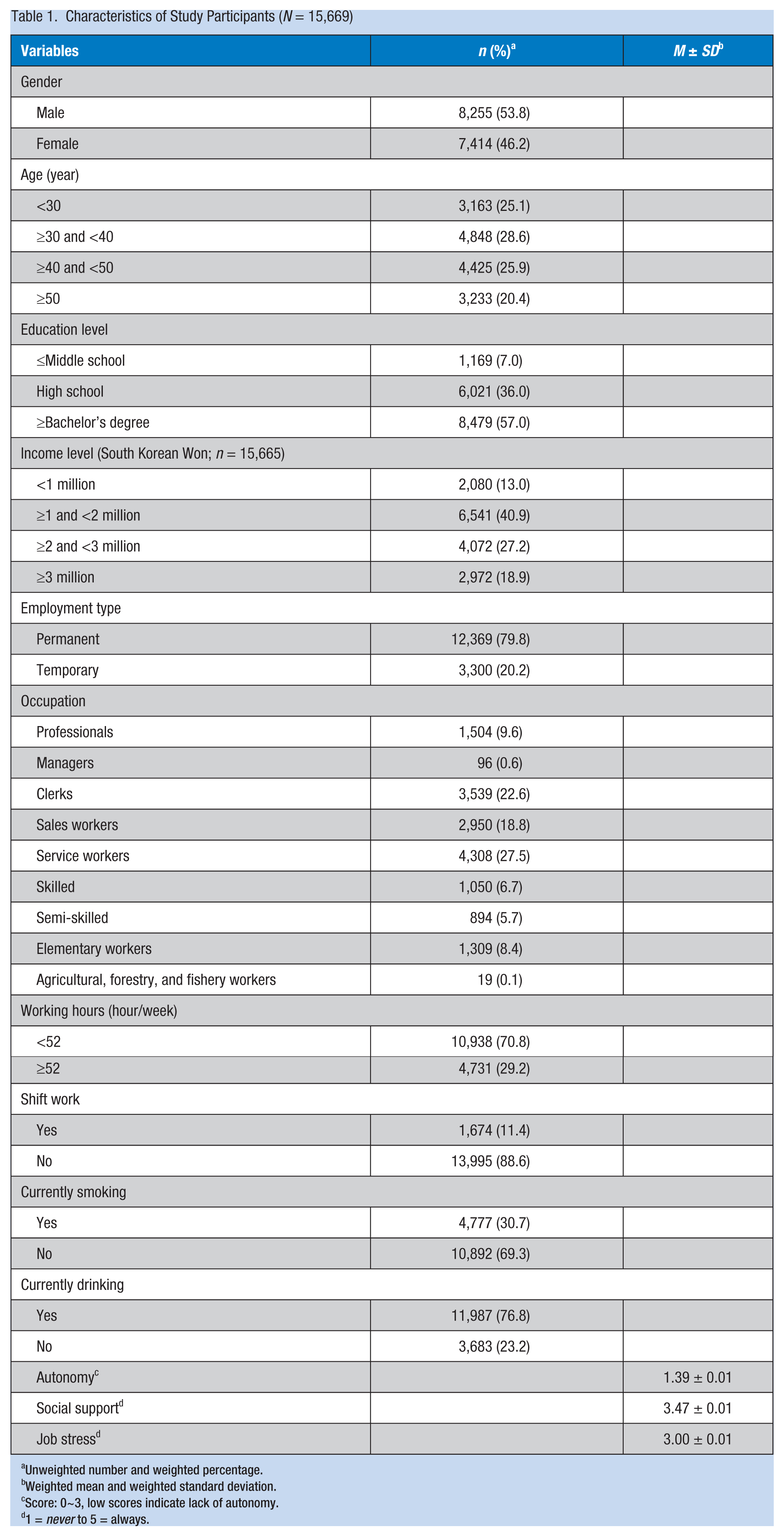
Unweighted number and weighted percentage.
Weighted mean and weighted standard deviation.
Score: 0~3, low scores indicate lack of autonomy.
1 = never to 5 = always.
Differences in psychological well-being and presenteeism by the degree of hiding emotions
Significantly fewer workers who did not hide their feelings experienced poor psychological well-being than workers who hid emotions at work. Also, more workers who were “sometimes” or “rarely” required to hide emotions at work showed poorer psychological well-being than workers who were “most of the time” or “always” required to hide emotions at work.
A total of 21% of participants reported to work while ill at least 1 day during the previous 12 months (i.e., presenteeism). The incidence of presenteeism was significantly lower among workers who did not hide their emotions than among workers who hid their emotions at work. Presenteeism was found most frequently among workers who “always” hid emotions at work (see Table 2).
Psychological Well-Being and Presenteeism Depending on the Degree of Hiding Emotions—Unit: n (%)
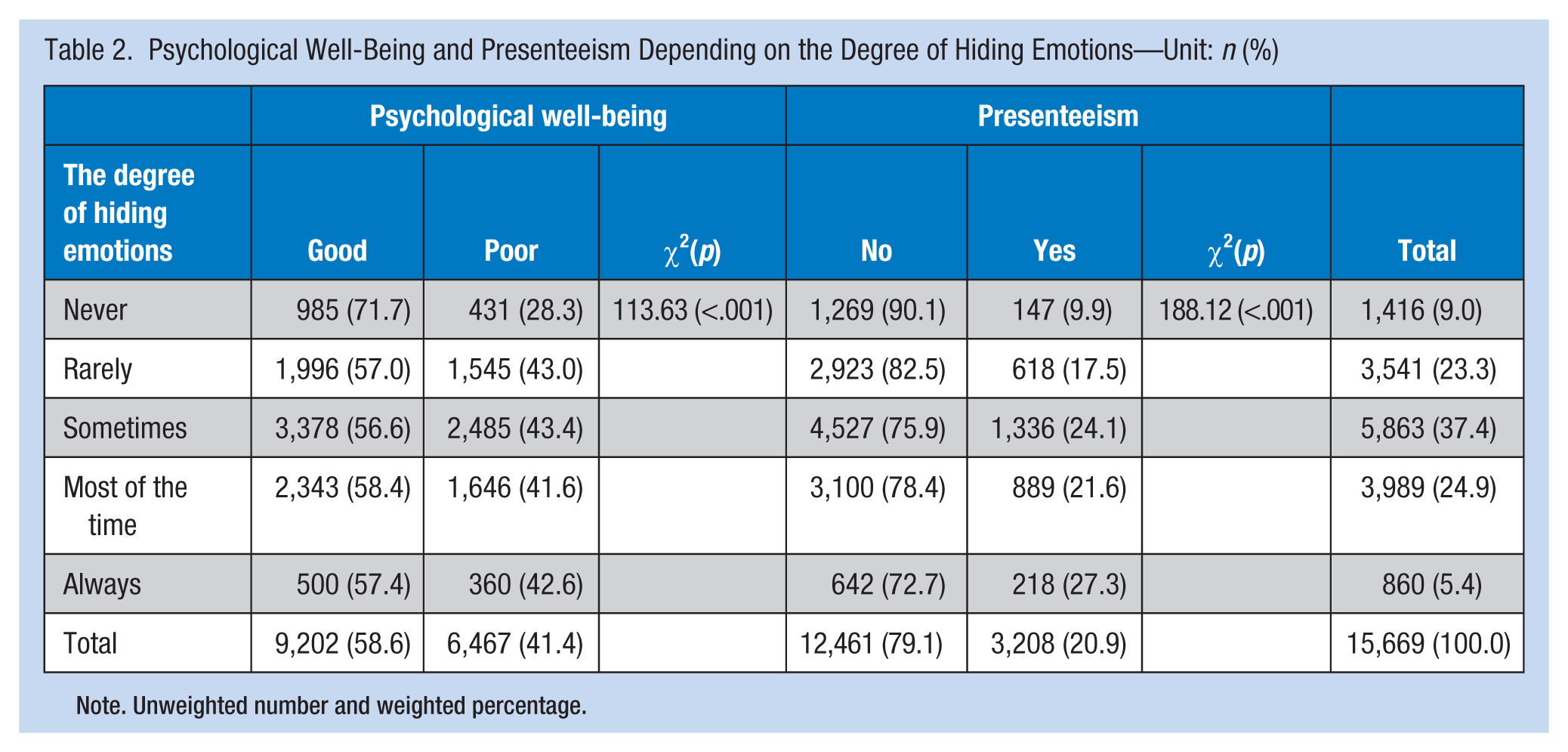
Note. Unweighted number and weighted percentage.
The association between psychological well-being, presenteeism, and the degree of hiding emotion
Compared with workers who “never” hid emotions at work, workers who “rarely” (AOR = 1.74, 95% CI = [1.45, 2.08]), “sometimes” (AOR = 1.65, 95% CI = [1.38, 1.98]), “most of the time” (AOR = 1.64, 95% CI = [1.35, 1.99]), or “always” (AOR = 1.53, 95% CI = [1.19, 1.98]) hid their emotions were more likely to experience poor psychological well-being after controlling for covariates. Also, looking only at workers who hid emotions at work, the degree of hiding emotions was in inverse proportion to those workers’ psychological well-being. That is, workers who most frequently hid their feelings showed the lowest risk of mental unhealthiness.
Workers who “always” hid emotions at work were almost 2.3 times (AOR = 2.27, 95% CI = [1.66, 3.12]) more likely to experience presenteeism than workers who “never” hid emotions at work. Among all the workers who hid emotions at work, those who “rarely” hid emotions showed the lowest AOR (AOR = 1.69, 95% CI = [1.32, 2.17]; see Table 3).
Results From a Multiple Logistic Regression Analysis
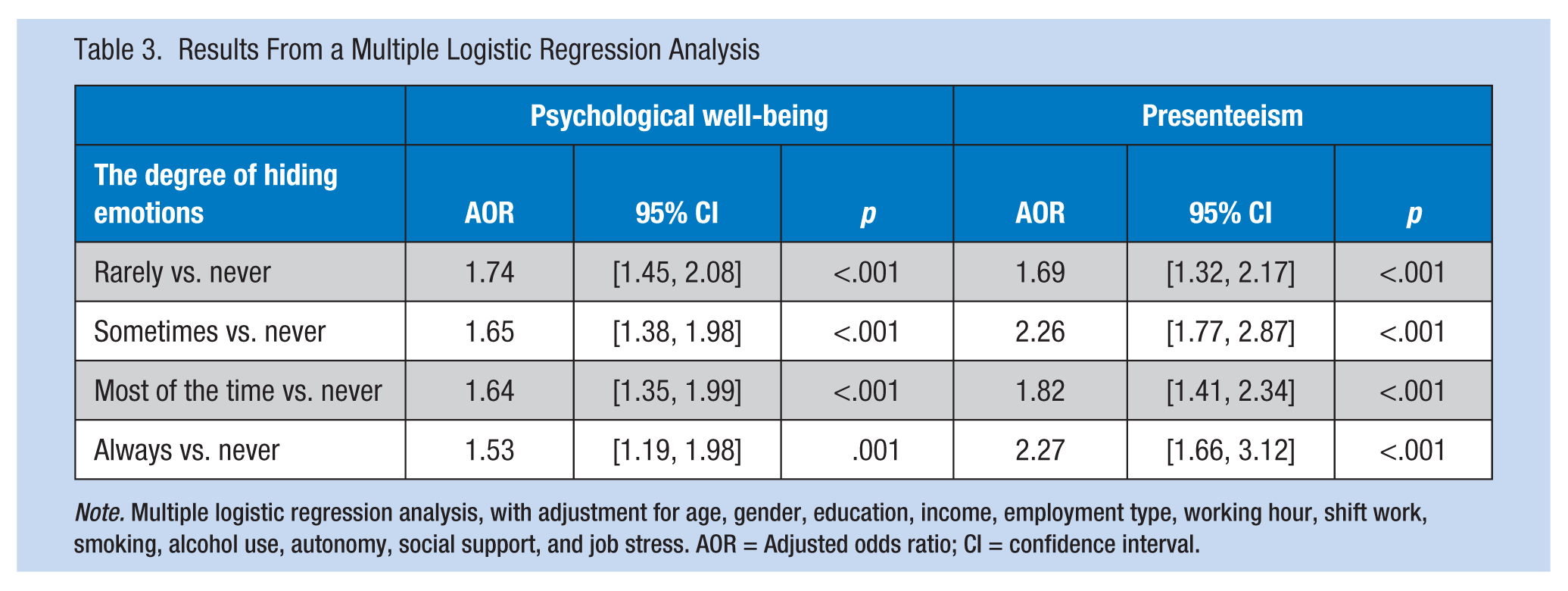
Note. Multiple logistic regression analysis, with adjustment for age, gender, education, income, employment type, working hour, shift work, smoking, alcohol use, autonomy, social support, and job stress. AOR = Adjusted odds ratio; CI = confidence interval.
Discussion
The results of this study show that asking workers to hide their feelings could lead to poor psychological well-being. The association between emotional demands and psychological health has been frequently examined in previous studies. Hiding negative emotions could increase stress (Bono et al., 2007). Also, excessive emotional labor may lead to depression in the long run (Zapf, 2002). However, the effects of hiding emotions could be related to job autonomy and co-worker support (Naqvi, 2013; Zapf, 2002). The results of this current study, exploring the relationship between hiding emotions and psychological well-being, after adjusting for variables that could influence the consequences of hiding emotions (e.g., autonomy, social support, job stress), showed that hiding emotions could result in poor psychological well-being.
This study found when the degree of hiding emotions increased among workers who did hide emotions at work, the AOR of poor psychological well-being decreased. In other words, workers who less often hid emotions may be more likely to experience poor psychological well-being. However, the findings of the current study are not consistent with previous research. Several previous studies reported that more frequent emotional labor led to greater negative consequences such as emotional exhaustion and depressive symptoms (Choi & Kim, 2015; B. Lee, 2009). However, the degree to which workers hid emotions was inversely related to the prevalence of poor psychological well-being, which can be explained by interactive service workers adjusting to the stress caused by emotional labor. It may be more difficult for workers who have less frequent interactions with customers to adapt to those interactions. Thus, they may report or experience poor psychological well-being more than workers who interact with customers more frequently.
In this study, hiding emotions was found to increase presenteeism. This finding is consistent with the findings of Eurofound (2012) that the need to hide emotions was associated with presenteeism. This finding may be because asking workers to hide their feelings enhances their propensity to work even on days they are sick. Namely, it is reasonable to assume that workers who are required to hide emotions at work would strive to meet the request, increasing the probability of them working while ill. Also, this study showed a non-linear exposure–response relationship between the degree of hiding emotions and presenteeism. The impact of emotional labor on health showed high inter-individual variability (Schmidt & Diestel, 2014). Thus, to firmly determine the relationship between the degree of hiding emotions and presenteeism, further research should be done, taking confounding variables into account.
Several limitations of this study should be noted. First, because the study is based on a cross-sectional survey design, the researchers cannot exclude reverse causality between hiding emotions and psychological well-being as well as between hiding emotions and presenteeism. However, as the author stated earlier, a previous study provided a strong theoretical basis for the direction of these relationships (Grandey, 2000). Second, because this study gathered data via self-reported questionnaires, participants may have under- or over-reported their responses. Even though the researchers used reliable and valid instruments to estimate psychological well-being and presenteeism, possible problems regarding the methods and response biases could be present. Third, this study used a secondary dataset and was, therefore, limited to the variables selected by the KWCS. Consequently, other significant variables influencing the effects of hiding emotions were not available for analysis. Indeed, worker’s self-efficacy, job involvement, and self-monitoring abilities could have reduced the negative effects of emotional labor (Sloan, 2014). Despite these noted limitations, this study offers new interpretations about health outcomes according to the degree participants’ hid emotions. Moreover, this study is meaningful because few studies have addressed the relationship between hiding emotions and health outcomes.
Implications for Practice
The results of the current study suggest that hiding emotions has negative effects on both psychological well-being and presenteeism. Frequent hiding of emotions is related to an increased risk of presenteeism. Among workers who were asked to hide emotions, however, those who had more interactions with others showed better psychological well-being than those who engaged in fewer interactions. Occupational health providers and employers in the interactive service sector must understand the association between the degree of hiding emotions and interactive service workers’ health to develop and implement healthy emotion management strategies. Also, these professionals must routinely assess the health of interactive service workers who less frequently hide emotions as well as workers who hide emotions constantly. To assist interactive service workers adjust to duties that demand emotion management, organizations could identify workers’ propensity for emotion management, provide education about healthy emotion management strategies, or monitor their health problems (Hülsheger & Schewe, 2011).
In Summary
Asking workers to hide their feelings could lead to poor psychological well-being.
Hiding emotions was found to increase presenteeism.
Among workers who were asked to hide emotions, workers who hid emotions less may have been more likely to experience impaired psychological well-being, which can be explained by interactive service workers adjusting to the stress caused by emotional labor.
Footnotes
Acknowledgements
I thank the Statistics Team of Occupational Safety and Health Research Institute (OSHRI) for offering the raw-data from the Korean Working Conditions Survey (KWCS).
Author’s Note
The article’s content is solely the responsibility of the author and does not represent the official view of OSHRI.
Conflict of Interest
The author(s) declared no potential conflicts of interest with respect to the research, authorship, and/or publication of this article.
Funding
The author(s) disclosed receipt of the following financial support for the research, authorship, and/or publication of this article: This study was supported by the 2015 Research Fund from the University of Ulsan in South Korea (2015-0463).
Author Biography
Bokim Lee, PhD, MPH, RN, has been a director of the Korean Association of Occupational Health Nurses (KAOHN). She has studied workers’ health promotion and prevention and presented these findings at many regional and national conferences.