




Abstract
Each year, thousands of professionals and practitioners opt to learn more about disability management practices by attending conferences, self-study, and registering for advanced educational courses. Their motivation is to enhance their competencies, advance their careers, and attain or maintain professional certification. However, for their efforts, are they accessing the most effective mode of disability management instruction? This clinical research indicated that the “online delivery” of disability management instruction nets a 5% higher score on the outcome measure than the “in-class delivery” modality.
Keywords
In Canada, disability management is an emerging field. Over recent years, the growth in the number of disability management professionals and practitioners has mushroomed. Each year, thousands of professionals and practitioners opt to learn more about disability management practices by attending conferences, using self-study modules, and registering for advanced educational courses. Their motivation is to enhance their competencies, support career advancement, and attain or maintain professional certification. However, for their efforts, do they maximize their learning for the time expended? In essence, which is the most effective mode of disability management instructional delivery?
The intent of this article is to examine the outcomes of two modes of disability management education, namely, the “in-class delivery” of disability management instruction and the “online delivery” of disability management instruction. Does one mode net better outcomes than the other?
Background
Disability management education is defined as providing the information, concepts, and models to deliver an effective disability management program and, ultimately, an integrated disability management program (Dyck, 2013). This education includes stakeholders developing the requisite skills and judgment to assist ill and injured employees return to work in a safe and timely manner. It also addresses the assessment of disabled employees and their work situations (Dyck, 2013).
The objectives of disability management education are to facilitate the implementation of an integrated disability management program and raise professionals’ or practitioners’ awareness and skills to an acceptable performance standard. Disability management professionals and practitioners, human resources personnel, and occupational health and safety practitioners are responsible for assisting ill and injured employees, and hence, require broad understanding of disability management to meet their business obligations (Dyck, 2013).
Disability management professionals and practitioners enter the field from medical, nursing, social work, and other health care or rehabilitation disciplines as well as from occupational health and safety, human resources, benefits, workers’ compensation, and unions. Disability management preparation and orientation differ by professional or practitioner. Hence, standardized preparation for disability management is not mandated. So how can disability management education best be designed and delivered for learners and employers sponsoring or in receipt of that education?
Current Situation
The University of Calgary and the University of Fredericton offer courses that introduce an interdisciplinary approach to the concept and practices of disability management, addressing the design, implementation, and marketing of an effective integrated disability management program (Dyck, 2015). Students attending these courses are adult learners with a strong interest in occupational health and safety, human resources, and disability management. All participants are either working or between jobs (Dyck, 2015). Many are looking to earn or maintain practice certification, or enhance their current disability management or case management skills. Many students are attracted to these courses because they need to learn how to develop or improve their employers’ current disability management program (Dyck, 2015).
Using the experience gained from teaching these courses at these two universities, the researcher wondered whether classroom or online instruction was most effective in delivering a disability management course.
Evaluation Method
The evaluation question was: Is there a quantifiable difference in student grades between an in-class disability management instructional strategy and an online disability management instructional strategy for an introductory course?
To address this question, the above evaluation plan was used (Figure 1).
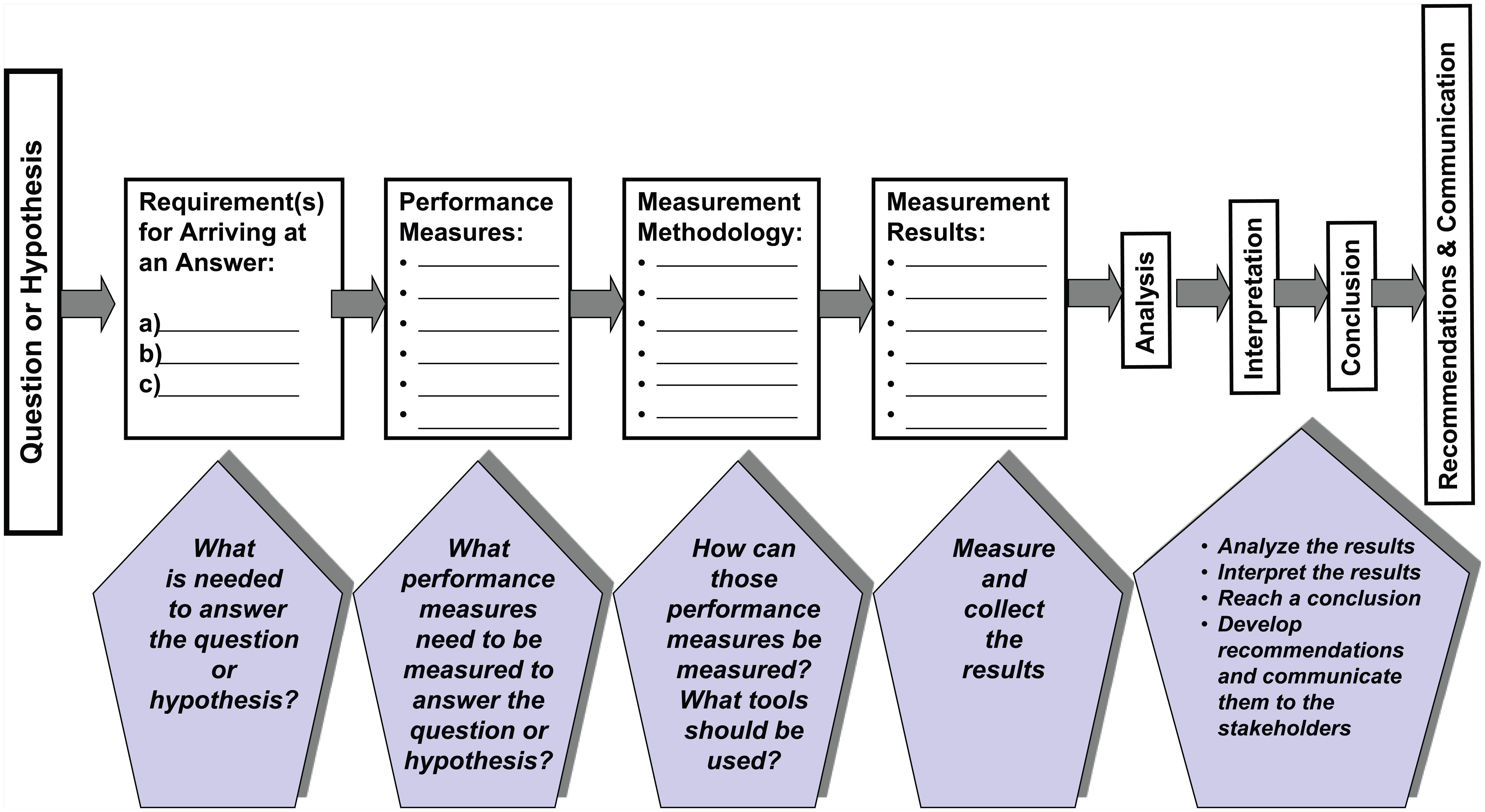
Program Evaluation Model
What Is Needed to Answer This Question?
To answer this question, a comparison of the two instructional delivery modalities was required. An in-class disability management course, offered at the University of Calgary (Business Management Certificate [BMC-309]; University of Calgary, 2015), is a four-day, compressed course that addresses the fundamentals of disability management programs. In comparison, the University of Fredericton offers five online disability management educational courses, also compressed-learning courses, with each running for 8 weeks. For this evaluation, just the introductory course, Introduction to an Integrated Disability Management Program (IDMP 311; University of Fredericton, 2015), was evaluated.
For the past 5 years, these two courses have been taught by the same instructor using the same instructional materials, same textbook, and same examination techniques. The target audiences for these courses were similar: adult learners with work-related motivation for advanced education. These learners came from a variety of educational, cultural, and work backgrounds. The common elements that they shared included demographics (e.g., gender and age) and a keen interest in workplace health and safety.
The University of Calgary course (BMC-309) is offered twice a year and is one of the courses available for the University of Calgary Occupational Health and Safety Certificate, Human Resources Certificate and Professional Management Certificate. Although 4 days in length, the students are expected to prepare for this instructional experience by pre-reading and completing a content-targeted quiz. A combination of lecture, individual exercises, additional readings, and group work is required. Student manuals are used as in-class workbooks. These manuals include all presentation slides, case studies, crossword puzzles, additional references, and assignment details. As for the 3 assignments, the students have 6 weeks to complete and electronically submit them to the instructor. Instructor support is available throughout this time frame.
The University of Fredericton course (IDMP 311) is conducted using weekly, live 90-minute webinar sessions (virtual classes). The course materials are posted online for student use and electronic workbooks are available as an additional resource. The virtual classes are designed to be interactive and involve the use of industry-focused case studies. Students are expected to come to class prepared and ready to work with the instructor to effect a meaningful class experience. Students also respond to weekly discussion questions that are designed to evoke group discussion similar to the discussions that would naturally occur during the in-class experience. The same three assignments are required with the students submitting them electronically to the instructor. Instructor support is available throughout this teaching and learning experience.
Both of these instructional modalities focus on applied learning, with the students demonstrating their ability to apply the concepts taught. Hence, all the course assignments center on learners’ abilities to show they have developed the requisite skills needed to meet the course learning objectives.
Available Performance Measures
To determine whether a difference in the learning outcomes between these two instructional delivery modalities exists, students receive grades for each course. Since 2010, student course grades for both these educational instructional delivery modalities have been tracked by the instructor.
Measurement Method
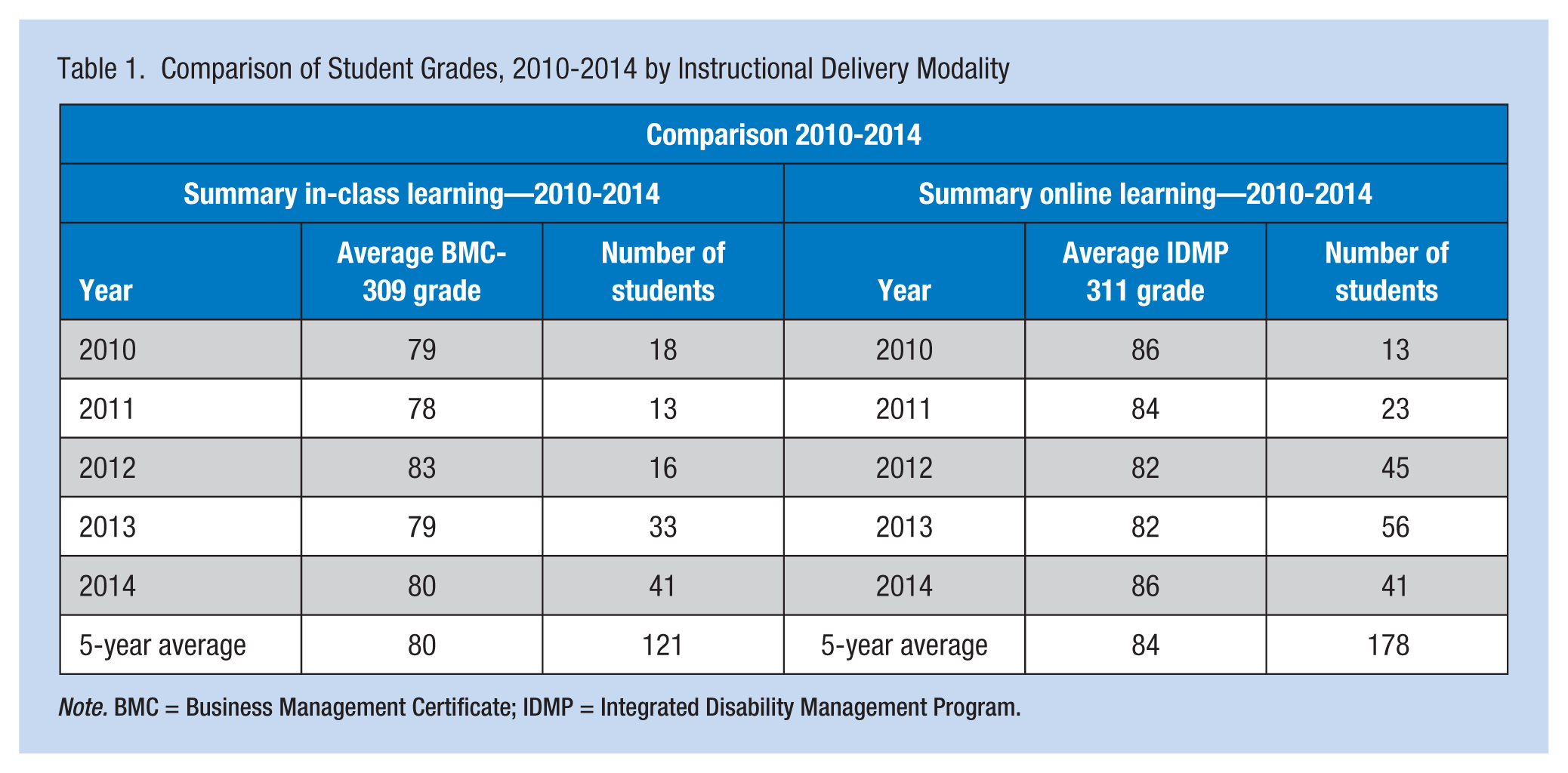
Because the University of Fredericton online course included a participation grade, that element was removed and the actual scores for each assignment were re-weighted to align with the assignment weights used for the in-class course. The grades for each of the 5 years were averaged and subsequently compared by instructional modality (Table 1).
Comparison of Student Grades, 2010-2014 by Instructional Delivery Modality
Note. BMC = Business Management Certificate; IDMP = Integrated Disability Management Program.
Analysis and Interpretation of the Results
Based on these findings, a difference between the two instructional delivery modalities was quantified. The noted difference in the average grades was 4 points, 5% higher for the average score delivered online compared with the score for the content delivered in class.
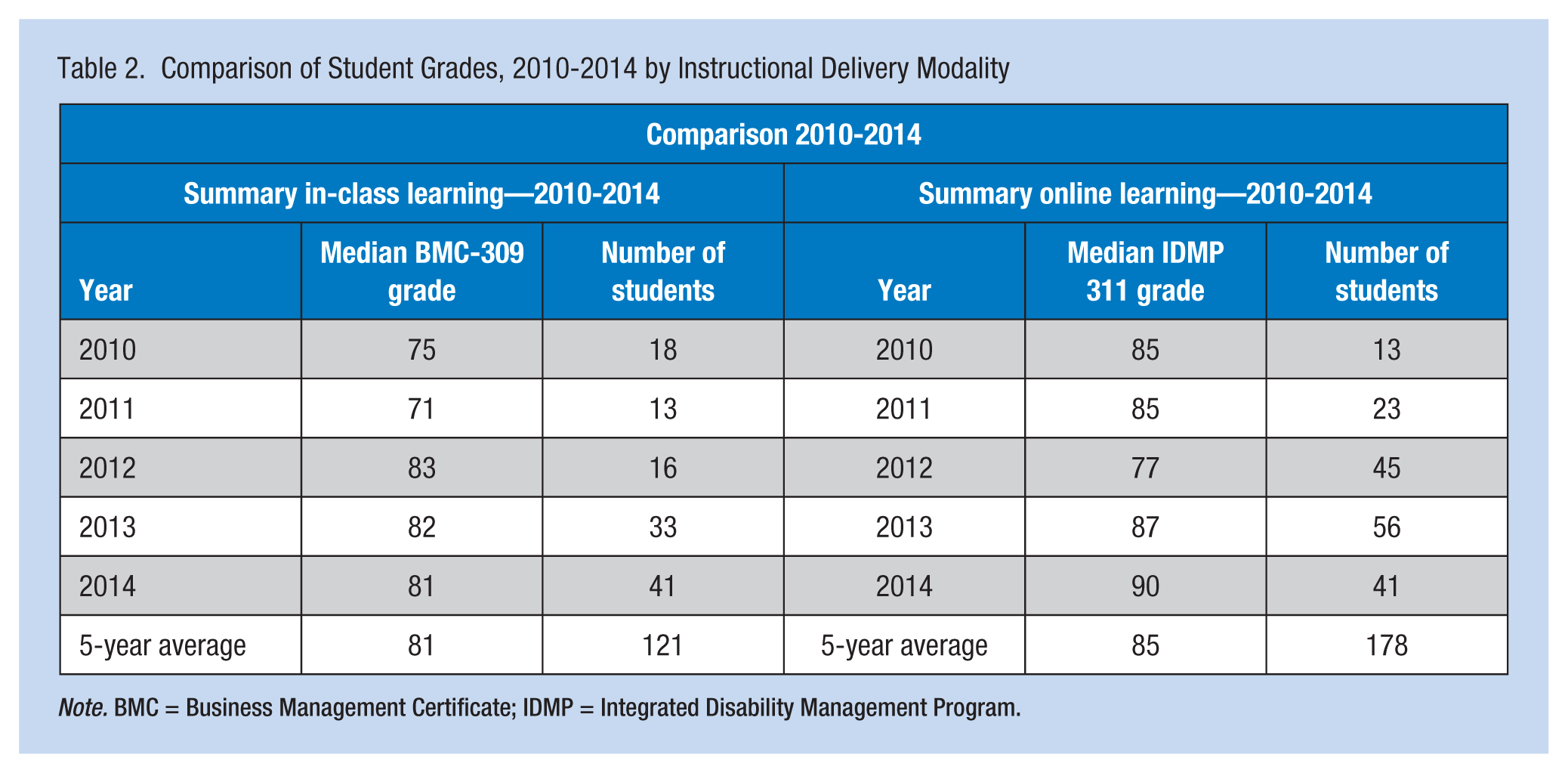
This data set was re-examined using the arithmetic median grades for each delivery mode over the 5 years, and that outcome was compared with the above findings. The noted difference was the same (Table 2).
Comparison of Student Grades, 2010-2014 by Instructional Delivery Modality
Note. BMC = Business Management Certificate; IDMP = Integrated Disability Management Program.
The 4-point spread between the two teaching modalities can be the difference between passing and failing, which in turn can affect a student’s ability to complete a certificate program. Likewise, educators and universities should be aware that in-class courses may require additional resources and support to enhance student learning.
Discussion
This finding was not anticipated: In fact, the general belief was that in-class course outcomes would be superior. So why the noted difference?
First, it is a rare opportunity to compare two instructional delivery modalities that are essentially the same in many aspects over a long period of time. Having said that, exploring any possible differences that may have affected the noted outcomes is important.
The University of Fredericton’s online delivery is 8 weeks in duration, 1.5 weeks longer than the University of Calgary’s in-class course. Having a longer period of time to focus on the course content, integrate the concepts, and apply new skills may have made a difference in the learning outcomes.
A majority of the students in the University of Calgary in-class course take the disability management course to complete the University of Calgary Occupational Health and Safety Certificate, or one of the other related certificates. Hence, fewer have any actual work experience in the field of disability management. This finding is somewhat evident given the student discussions noted during the in-class experience. Most of the participants know each other from previous contact when taking earlier certificate courses together. BMC-30 is just another course on the path to the completion of their certificates. Only two students had pursued more advanced disability management educational courses. In comparison, the majority of the University of Fredericton students took this introductory course enroute to completing the professional diploma in disability management. Many participants had some work experience in disability case management; 61% continued advancing their disability management education. Their focus was on practice learning and improvement. No doubt, this is a major factor affecting the noted outcome results.
As for the adult learning motivational factors, learning to earn a certificate and advance one’s career differs from learning to enhance one’s professional knowledge and skills so as to do one’s job better. In the latter, the learner has greater investment in the learning process and outcomes. Certainly, this is another factor.
Last, the online course at the University of Fredericton costs 30% more than does the in-class course at the University of Calgary. This cost difference may lead to selection bias; the higher priced course may eliminate those students not serious about the course. This selection bias could lead to a student group that is highly motivated to complete the course and do well.
Implications
This research warrants further verification. It is important to recognize that many differences exist between online and in-class learning experiences. Some institutions consider the provision of online education materials to be online learning; others offer asynchronous teaching sessions; others, such as the University of Fredericton, offer virtual classes that provide a synchronous learning experience. It would be worthwhile to repeat this research testing each of these individual instructional approaches.
From the learner’s perspective, knowing the learning outcome differences between in-class and online instructional delivery modalities could be a deciding factor when choosing an advanced educational option.
Conclusion
Based on this clinical research, there is a noted and significant difference between the types of instructional modalities used. Now the new question is, “What should be done about this finding?”
Disability Management Course Learning Objectives
Both of these instructional modalities focus on applied learning, with the students demonstrating their ability to apply the concepts taught. Hence, all the course assignments center on the learners’ ability to meet the course learning objectives, namely to:
Gain an understanding of the concept of disability management and related practices;
Be able to identify the components of an integrated disability management program;
Utilize disability management concepts and tools to analyze case studies;
Gain an appreciation of the various disability insurance plans and how they impact an integrated disability management program;
Develop an ability to use some basic disability management practices such as data management, program evaluation and program communication and marketing;
Research a related element or aspect of disability management;
Develop an appreciation of the impact that disability can have on the worker, employer, and organization;
Understand how to effectively communicate the fundamentals of disability management to stakeholders; and
Gain an appreciation of the ethical and legal aspects associated with disability management.
In Summary
An integrated disability management program is defined in Canada as a planned and coordinated approach to facilitate and manage employee health and productivity. It is a human resources risk management and risk communication approach designed to integrate all organizational and company programs and resources to minimize or reduce the losses and costs associated with employee health-related absence regardless of the nature of the disability. It is aimed at:
assisting ill and injured employees and employees experiencing diminished work capacities;
providing early intervention and support measures;
facilitating a collaborative approach to managing employee disabilities;
restoring the disabled employee’s work and functional capacities to an optimal level;
maximizing the disabled employee’s capabilities;
integrating the organization’s or company’s various employee support and group benefit programs;
measuring program performance and outcomes in human, legal, and business terms;
evaluating the organization’s or company’s various disability management efforts and performance with a focus on continuous improvement; and
attaining a healthy workforce through injury and illness prevention. (Dyck, 2013, p. 12)
Footnotes
Conflict of Interest
The author(s) declared no potential conflicts of interest with respect to the research, authorship, and/or publication of this article.
Funding
The author(s) received no financial support for the research, authorship, and/or publication of this article.
Author Biography
Dianne E. Dyck is a certified occupational health nurse and occupational health and safety specialist who has worked for private and public-funded agencies to develop occupational health, occupational health and safety, disability management, and workplace wellness programs. As an educator, Dianne has developed a number of courses in the fields of disability management, occupational health and safety, and human resources. She also instructs disability management courses.