




Abstract
Social media is a buzzword frequently referred to in marketing materials, general media, and personal conversations. Although many refer to the term social media, some individuals do not understand its meaning or how it affects their daily lives at work and home. Since the expansion of the Internet to web 2.0, multiple platforms of communication occur virtually through various social media. Understanding and learning how to use these platforms are essential to stay connected with friends, family, and colleagues; advance connections to professional organizations; and extend educational opportunities. This article presents basic information for occupational health nurses to improve their understanding of social media and how to communicate virtually using different platforms safely and securely.
Keywords
Social media is a term frequently referred to in marketing materials, general media, and personal conversations. The term refers to various virtual platforms for computers, tablets, smartphones and other devices, and the Internet to communicate or exchange information (McGonigle & Mastrian, 2015; Nelson, Joos, & Wolf, 2013). A virtual platform is an electronic environment or cyber-location where information is viewed and shared. These social media virtual platforms differ depending on how information is shared. Examples include blogs, Facebook, Twitter, and YouTube.
Although many professionals refer to the term social media, some do not understand its meaning or how it affects their daily lives personally and professionally. Since the expansion of the Internet to web 2.0 (i.e., a higher level of functioning on the World Wide Web), these virtual platforms offer individuals the opportunity to choose between multiple blog sites, Twitter accounts, and Facebook users (individual and groups) to exchange information. Learning to use social media is essential to stay connected and share information among friends, family, employees, and professional colleagues. Sharing information on social media sites is referred to as social networking. Social networking provides an opportunity to simultaneously communicate with a variety of individuals in numerous locations. Currently, multiple professional organizations, such as the American Association of Occupational Health Nurses (AAOHN) and the American Nurses Association (ANA), extend educational and informational opportunities using social media platforms. This article presents basic information so occupational health nurses can better understand social media and embrace it as a tool to communicate virtually safely and securely.
Background
The Pew Research Internet Project (2014) conducted a survey that found 74% of adults who use the Internet also use social media sites. The report demonstrated the growth in social media annually. For example, women’s use of social media has increased from 74% in 2013 to 76% in 2014, and men increased their use from 62% in 2013 to 72% in 2014. Over an 8-year period (2005- 2013), the growth in social media use increased 73% among all age groups with individuals ages 18 to 29 increasing by 90%, 30- to 49-year-olds increasing by 78%, and 50- to 64-year-olds increasing by 65% (Pew Research Internet Project, 2014).
A study by Wolf, Anton, and Wenskovitch (2014a) explored nurses’ use of the Internet and social media; they found that 67% of nurses used the Internet to access social media sites for personal use, but only 17% extended their professional services via social media platforms. The authors also confirmed that although nurses are visiting social media sites (e.g., 87% of the respondents visited Facebook, 38% visited YouTube, and 3% used Twitter), they are not using these sites to advance their professional role or the nursing profession. Occupational health nurses must embrace social media professionally, offering information and education to promote healthy behavior and safe workplaces.
Types of Social Media
When exploring how social media can support occupational health nurses’ roles, the first step is to understand the different types of social media available. Next, nurses must consider how they can use these virtual platforms to promote healthy behavior and advance safety at the workplace. Blogs, Twitter, Facebook, YouTube, and LinkedIn are five social media platforms that will be presented, including a brief explanation of how occupational health nurses can use these virtual platforms to support their professional roles.
Blogs
Nelson et al. (2013) defined blogs as “online journals, posts or entries in chronological order that one updates frequently” (p. 253). Blogs, also known as web logs, consist of posted information about a certain topic, with the most recent post appearing first. Blogs can be private, requiring a password or invitation to participate, or they can be public, open to anyone searching the web. Blogs have been used to share health information among a select group of individuals who have similar interests, to post updates regarding activities, or to host journal clubs to discuss research studies. Various terms are associated with blogs, such as a blogger (one who maintains a blog site), blog site (the website in which one actually views and participates in the blog discussion), and blogosphere (describes the collective community of bloggers).
An occupational health nurse may be interested in using a blog to offer educational information or updates regarding health initiatives or changes in safety requirements. By using a blog, one can share information with multiple individuals in a variety of locations. Blogs allow individuals to view the content at a time that is convenient to their personal schedules from their current location, reducing time spent in traveling to classes or seminars. Multiple websites can guide users in creating and maintaining a basic blog free-of-charge. Wordpress.com, accessible at https://wordpress.com, offers free use of their system to create a basic blog using multiple pre-developed templates and support services. A second site to create and maintain a free blog is Blog.com, accessible at http://blog.com, which offers a variety of themes to help the novice blogger get started. From the website, the occupational health nurse can view several different blogs that share ideas or demonstrate how to create professional blogs.
Two existing nurse-driven blogs have been well received by a large group of followers and are excellent examples of professional blogs: http://blog.rtconnections.com/ by Renee Thompson who inspires and connects nurses from a variety of settings and another, http://connect.ons.org/ons-connect-blog, by the Oncology Nursing Society, which supports oncology nurses. As nurses embrace technology to communicate with other nurses and health care professionals, blogs may allow them to share stories, discuss professional issues, and influence current practice (Watson, 2012).
Another virtual platform used to share information is Twitter. Twitter is a form of social media that allows individuals to send “tweets” to a select group of individuals who follow their twitter accounts. A tweet is basically a short message of approximately 140 characters that can be sent to others via cell phone text message, e-mail, or the web. Some refer to Twitter as microblogging because the length of the message is restricted to a certain number of characters. Initially, Twitter allowed one-way messaging; the individual receiving the message could only read the content or forward (retweet) the message to others. More recently, Twitter added a “reply function that allows Twitter to support a discussion group service” (PCMag, n.d., para. 5).
Tweets can be private or public depending on the sender’s preference. Occupational health nurses can set up a twitter account at https://twitter.com/ and search for profiles they wish to follow, such as the AAOHN at https://twitter.com/AAOHN, the American Holistic Nurses Association at https://twitter.com/OfficialAHNA, or Safe Healthy Workers via National Institute of Occupational of Occupational Safety and Health (NIOSH) at https://twitter.com/NIOSH. In addition, occupational health nurses can establish profiles to send their own tweets to others they invite or request to follow their profiles. After creating an account and becoming familiar with tweeting, users can use a hashtag symbol (#) as a prefix to locate a group of discussions about one topic. Finally, Twitter supports businesses and organizations to create and manage a Twitter presence, helping them to connect with or grow an audience (Twitter, 2014).
One of the most popular forms of global social media is Facebook, accessed at https://www.facebook.com. Founded in 2004, Facebook has been the fasted growing social media platform; information, pictures, and videos are shared on this platform continuously. Used by individuals for personal and professional connections, the virtual platform offers a variety of functionalities. For example, individual accounts can be created to (a) share information with friends, (b) create professional and peer support groups (which can be private or public), (c) create marketing advertisements, (d) play virtual games, and (e) find friends or old acquaintances. AAOHN has a group page on Facebook accessed at https://www.facebook.com/AAOHN, where information regarding special events or current trends is shared. One unique functionality of Facebook is the ability to connect status updates between Twitter and Facebook accounts (Tagtmeier, 2010). When users post comments or messages on Facebook, those comments or messages are automatically posted to their Twitter accounts.
Other health professionals have already turned to Facebook to market their services. For example, Riekeman (2013) shared how Facebook has been used to share information regarding spinal health and wellness care; Brosseau et al. (2014) used Facebook to deliver an educational program to clients with osteoarthritis and rheumatoid arthritis. The authors found statistically significant improvements in knowledge acquisition (p < .01) and participants’ use of self-management strategies. It was found that when friends linked a blog post from a podiatry practice to their Facebook pages, a new level of free marketing occurred. New clients presented to their practice identifying the post as the advertisement from which they learned of the podiatry practice (Freels, 2013).
YouTube
Today, other forms of communication are rapidly taking over the Internet. No longer is the written word the main form of communication within social media sites. Pictures, audio, and video recordings are commonly used to communicate with others. Although pictures and recordings can be shared within blogs and Facebook, one social media platform called YouTube only shares audio and video recordings. YouTube, accessed at https://www.youtube.com, allows individuals and organizations to establish “Channels,” which host multiple videos (play lists) under the organization’s name. Organizations (e.g., Institution of Occupational Safety and Health [IOSH] https://www.youtube.com/user/IOSHchannel/featuredandNIOSH; https://www.youtube.com/user/NIOSHSafetyVideos/featured) have turned to YouTube to share videos promoting safety.
Logan (2012) shared how perioperative nurses use YouTube to enhance learning by using video clips to engage learners and promote critical thinking and decision making. Logan outlined how to use videos and embed video clips into PowerPoint presentations uploaded to YouTube. The author offered a list of suggested videos to advance perioperative nursing such as how to prepare an operating room for a patient accessed at https://www.youtube.com/watch?v=OxJMRUHJrJU. YouTube is also a nursing resource for physical assessment videos to maintain current skills.
Social media supports individuals’ need to network with other health care professionals. Occupational health nurses can join one of the fastest growing professional networking sites called LinkedIn (2015), which currently hosts more than 300 million members in 200 countries. Basic membership is free and the social media site can be accessed at https://www.linkedin.com. The professional network offers individuals the opportunity to
market themselves and build relationships with other professionals and professional groups of similar interest,
locate quality talent for hire or employment, and
increase sales through networking.
Occupational health nurses can expand their network of colleagues, follow other professional groups who advance occupational health, and stay abreast of the most current resources and ideas being shared among peers.
Table 1 presents a summary of the five social media sites presented. Each type of social media has its own distinct icon used in marketing and e-mail materials to alert others to the particular social media site. By including the Facebook or Twitter icon, organizations can share a visual image of other forms of communication they use.
Five Social Media Platforms
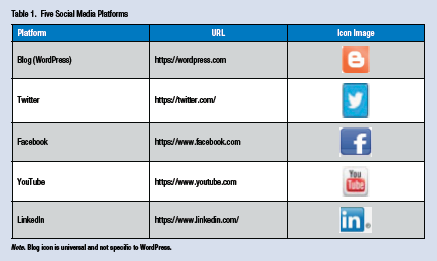
Note. Blog icon is universal and not specific to WordPress.
Discussion
Five types of social media were introduced to help occupational health nurses understand how technology and the Internet can advance their nursing roles. The first step occupational health nurses must take is to separate personal and professional use of social media. Occupational health nurses should use two separate social media accounts to communicate with others. For example, a Facebook account attached to a personal e-mail account is the best way to connect with friends and family to share information regarding non-work-related activities. A second Facebook account using work e-mail connects to colleagues, organizations, or professional groups to discuss various topics related to the nursing profession and occupational health nursing, preventing cross-contamination between personal and professional lives.
Wolf et al. (2014b) shared key recommendations for occupational health nurses to promote health and safety virtually, including understanding the nurse’s legal and ethical responsibilities. Occupational health nurses should discuss the use of social media within their organizations with their employers to gain both administrative and financial support. Organizational policies should guide how and when social media is used to improve communication, enhance training, and promote healthy behaviors.
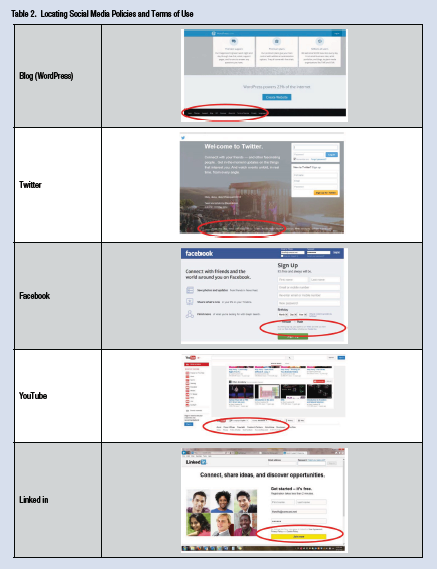
Another key step occupational health nurses must take before using social media is to explore privacy and user agreements for select social media sites. Each social media site displays polices uniquely. Typically, these policies or terms are found at the bottom of the web page in small font size requiring users to scroll and open additional links. For example, Twitter will share “Terms of Service,” which provides copyright policy, license to use their services, and user rights, as well as Twitter’s rights. Twitter also offers a separate “Privacy Policy” that outlines how information is shared, collected, and used as well as policies regarding children. Facebook shares “Terms” regarding rights and responsibilities, safety actions, and how to protect others’ rights. Facebook also offers a “Data Use Policy,” which outlines how user information will be used. Table 2 shares visual images of where to locate polices on each of the five social media sites shared in this article. Finally, occupational health nurses should use the privacy settings each social media site offers to control how information is shared, privately or publicly, and selected information that is viewable by others.
Locating Social Media Policies and Terms of Use
Another resource for occupational health nurses was published by the American Academy of Ambulatory Care Nursing (AAACN; 2012) titled Telehealth Nursing Practice Essentials. These practice essentials offer a variety of topics AAACN considers essential when nurses new to telehealth are expanding services virtually. AAACN defines telehealth as “an umbrella term used to describe the wide range of services delivered across distances by all health-related disciplines” (p. 282). The text offers several recommendations regarding role development, legal issues, communication, and customer service that occupational health nurses may find helpful when considering social media to expand their practices.
Finally, occupational health nurses are cautioned about viewing and interpreting information found on the Internet and social media sites. Unfortunately, information shared on the Internet may be inaccurate. Occupational health nurses must take care in using information in practice before virtual information is validated. Various tools outlined by Wolf, Anton, and Wenskovitch (2014a) can assist occupational health nurses assess the authenticity of websites. The authors outlined nine tools including SPAT (Site, Publisher, Audience and Timeliness) accessed at http://www.spat.pitt.edu, DISCERN accessed at http://www.discern.org.uk/, and the MedlinePlus guide to healthy web surfing accessed at http://www.nlm.nih.gov/medlineplus/healthywebsurfing.html.
Conclusion
Occupational health nurses can be empowered by using social media to extend their roles and level of communication. By embracing innovative technology, such as computers, smartphones, the Internet, and social media platforms, occupational health nurses can reach multiple individuals simultaneously offering information and education to promote healthy behaviors and a safe work environment.
In Summary
Social media provides an opportunity for occupational health nurses to extend their role and services virtually. Virtual communication through use of blogs, Facebook, Twitter, YouTube, and LinkedIn offers a new direction for occupational health providers to further promote and educate employees and their families on health and safety alternatives. Exploration of organization and employee/family interest is the first step in integrating technology into practice. By embracing innovative technology, such as computers, smartphones, the Internet, and social media platforms, occupational health nurses can reach multiple individuals simultaneously offering information and education to promote healthy behaviors and a safe work environment. To meet the demands of the technology future, occupational health nurses must reimage and actively take part in creating a virtual presence that will strengthen their knowledge and understanding of how the internet can be used to their advantage.
Footnotes
Conflict of Interest
The author(s) declared no potential conflicts of interest with respect to the research, authorship, and/or publication of this article.
Funding
The author(s) received no financial support for the research, authorship, and/or publication of this article.
Author Biographies
Debra M. Wolf is Assistant Director of Nursing Programs/Associate Professor of Nursing at Chatham University, Pittsburgh, Pennsylvania, and an Independent Healthcare Informatics Consultant.
Kimberly Olszewski is the Director of Nurse Practitioner Programs and Assistant Professor at Bloomsburg University, and Vice President of Mid State Occupational Health Services Inc. in Lewisburg, Pennsylvania.