




Abstract
This study describes socio-demographic, health, and work factors as well as health and safety perceptions of day laborers who reported work-related health complaints and injuries. The researchers completed a secondary data analysis of 217 interviews conducted in 2009 with day laborers in a large city. The participants reported 83 health complaints or injuries (38%) that had occurred during the prior 12 months, with 57 of these complaints or injuries resulting in lost work time. Pain and soreness of the back were the most prevalent health complaints or injuries; 66% of participants did not report their injuries, 62% reported no health and safety training, 96% reported they needed personal protective equipment (PPE), and 63% were provided with PPE. Latino day laborers reported a high 12-month prevalence of work-related health complaints and injuries. Ongoing policy work is needed to encourage injury reporting by day laborers and the provision of health and safety training and PPE to this group of workers.
Keywords
Day laborers traditionally search for temporary employment by waiting on street corners or in home improvement stores, paint supply stores, city-sponsored centers, and moving facilities. The day laborer population in the United States is predominantly Latino immigrants. In a national survey of 2,660 day laborers in 2005, 59% were found to be born in Mexico, 28% in Central America, and 7% in the United States. Of those surveyed, 75% were also found to be undocumented (Valenzuela, Theodore, Melendez, & Gonzalez, 2006). In a large urban west coast city, this 2009 survey of 217 Latino day laborers found the majority were born in Mexico (55%), in addition to those born in Guatemala (23%), El Salvador (10%), Honduras (8%), Nicaragua (2%), and Costa Rica, Bolivia, or Peru (3%; Nelson, Schmotzer, Burgel, Crothers, & White, 2012).
Day laborers work in non-standard and informal work arrangements that are unconstrained by labor laws, unionization, and other mechanisms that traditionally protect workers from unjust labor practices (de Castro, Voss, Ruppin, Dominguez, & Seixas, 2010; Seixas, Blecker, Camp, & Neitzel, 2008; Rabito et al., 2011; Valenzuela, 1999). The adverse health effects of unstable and transient employment arrangements include high rates of self-reported morbidity among workers (Benach & Muntaner, 2007). Preliminary research by de Castro et al. found that day laborers are at increased risk for high allostatic load, predisposing them to a number of clinical conditions associated with chronic stress.
It is difficult to measure the exact occupational injury rates of day laborers and compare their occupational injury incidence with comparable professions because of the temporary, transient nature of their work. A national survey specifically focused on this population, conducted in 2005 by Valenzuela et al. (2006) found that approximately one in five day laborers had suffered an occupational injury and half of those injured did not seek care. Studies indicate that day laborers have significant exposure to health and safety hazards (Rabito et al., 2011; Seixas et al., 2008; Valenzuela et al., 2006) and resulting high injury rates that have been cited as major concerns for day laborers (Seixas et al., 2008).
These concerns are not unfounded. Day laborers engage in a wide range of work tasks including moving and hauling, painting, construction, and gardening. Focusing on the construction industry in 2000, Hispanic workers were found to comprise almost 16% of the construction workforce in the United States, but accounted for 23.5% of fatal injuries and they were nearly twice as likely as non-Hispanic construction Applying Research to PracticeDay laborers, in this study, had a high 12-month prevalence of self-reported work-related injuries, many of which went unreported.Those with injuries reported poor/fair physical and mental health, higher arthritis and depression diagnoses, fewer rest breaks at work, and working in the prior week in pain.Day laborers work in moving/hauling, painting, and construction, jobs associated with risk for injury, and are provided with limited job safety training and personal protective equipment (PPE). Day laborers in this study overwhelmingly believed that PPE is necessary to do their jobs safely.Occupational health nurses can promote health and safety of day laborers by advocating for contingent worker rights for job safety training and PPE, especially respiratory, hearing and fall protection, and encouraging reporting of all health complaints and injuries.workers to be killed by occupational injuries (Dong & Platner, 2004; relative risk = 1.84, 95% confidence interval [CI] = [1.60, 2.10]). In 2009, when the data used in this analysis were gathered, Hispanic construction workers had the highest incidence of work-related fatalities compared with other ethnic groups in the United States at 3.7 per 100,000 compared with 3.4 and 3.0 for Whites and Blacks, respectively (U.S. Department of Labor, 2011). In a study of 7,000 medical record reviews, Hispanics were found to be 30% more likely to have a health-related condition due to a work-related injury than non-Hispanics after controlling for age, gender, education, and occupation (Dong, Men, & Ringen, 2010).
Researchers have also suggested that day laborers may not receive adequate job training. This lack of training, as well as lack of personal protective equipment (PPE) and exposure to hazardous work environments, may result in day laborers being at increased risk of injury (Valenzuela et al., 2006; Williams, Ochsner, Marshall, Kimmel, & Martino, 2010). When training is available, language or cultural barriers may hinder any potential worker safety benefit (Pransky et al., 2002; Roelofs, Sprague-Martinez, Brunette, & Azaroff, 2011). Regardless of job training, day laborers do engage in self-protective behaviors (e.g., talking to coworkers and supervisors, leaving jobs viewed as especially dangerous, and refusing to work at heights) aimed at protecting themselves and avoiding dangers (Nelson et al., 2012; Williams et al., 2010).
Although studies have shown that Hispanic day laborers are at increased risk for occupational injury, more exploration is needed to understand the type of injuries experienced by this group of day laborers and their health and safety perceptions, specifically related to whether job safety training was provided and the role of PPE in preventing occupational injuries. These data may identify strategies to prevent future occupational injuries among day laborers. In this study, three research questions were asked:
Method
This descriptive, cross-sectional study was conducted from April to August 2009 in a large urban center. Detailed description of the study methods was reported in a previous publication detailing factors contributing to the success of Latino day laborers finding work (Nelson et al., 2012). Using systematic sampling of day labor gathering sites, Latino men were approached and 217 verbally consented to a 1-hour face-to-face interview using a structured interview guide. Interviews were conducted in Spanish or English primarily by bilingual interviewers who were not native Spanish speakers; one interviewer was a native Spanish speaker from Peru. Day laborers signed a written receipt for US$25 in cash to compensate them for their time. This protocol was approved by the University of California San Francisco Committee on Human Research.
To determine health complaints and injuries, day laborers were asked the questions in the “Survey Questions: Health and Safety Perceptions” section. All responses were captured for analysis, which included both symptoms (e.g., fever) and injuries (e.g., falling from a ladder). Acute and chronic injuries were not differentiated. If the day laborers responded with a health complaint or injury, they were asked if they reported it to supervisors, friends, coworkers, or health care providers, and where they sought health care (e.g., clinics or pharmacies); all answers were collated. A health complaint or injury was classified as minor if it did not prevent the day laborer from working; the health complaint or injury was classified as serious if it did prevent the day laborer from working. Six day laborers reported a second health complaint or injury that had occurred in the prior 12 months; three were classified as serious (one worker reported a headache and two reported back pain) and three as minor. These second health complaints or injuries were not included in the study analyses.
The researchers described the types of minor and serious health complaints and injuries experienced by day laborers, including nature of the health complaint or injury, the specific work event, the body part affected, if the health complaint or injury was reported (and if yes, to whom), and the type of care sought.
The second research aim was to describe the socio-demographic (i.e., age, years of education, marital status, country of birth, years in the United States, months in the city, English proficiency), health (i.e., general physical health status, general mental health status, smoking, alcohol use, illicit drug use, ever seen by a physician or nurse for health care in the United States, selected health-related diagnoses, health insurance), and work (i.e., success at finding work as a proxy measure for work-hour exposure, access to breaks at work, and if had worked in pain during the prior week) factors of day laborers who reported health complaints or injuries and compare these factors with workers with no reports of health complaints or injuries. Average success at finding work, as a proxy variable for work hours, was generated by asking day laborers, “Did you work during a season (i.e., fall, winter, spring, summer)?” Day laborers were then asked how many days per week they looked for work and how many days they were successful at being hired. Success in obtaining work was calculated as the number of days worked divided by the number of days looking for work in an average week, averaged over all four seasons, and expressed as a percent (Nelson et al., 2012).
To answer the third research question, the researchers separately explored the associations of three health and safety perceptions and compared the perceptions of those individuals with health complaints or injuries with the perceptions of those individuals with no health complaints or injuries. These health and safety perceptions included whether the day laborers were trained to keep themselves safe, belief by the day laborers that PPE was needed to do the job safely, and the provision of PPE by the employer (“Survey Questions: Health and Safety Perceptions” section). Fourteen different types of work (i.e., construction, painting, moving/hauling, gardening, roofing, drywall, farming, housecleaning, carpentry, car wash, plumbing, electrical work, dishwashing, and cooking) were separately queried. Because day laborers are hired for a wide range of jobs during the workweek and data had not been collected about the jobs associated with injury, three composite variables were created: “Any job safety training?” “Any belief that PPE was needed?” and “Any PPE provision?” were coded as “yes” if a respondent answered “yes” or “sometimes” to any of the three items in any of the 14 jobs. Associations for the three most prevalent jobs (i.e., moving/hauling, painting, and construction) are presented.
Data were correlated using Pearson’s r or Spearman’s rho; chi-square or ANOVA were used to determine significant comparisons between groups. A power analysis was not conducted. Alpha was set at .05 for determining statistical significance. Analyses were conducted using SPSS, version 20.
Results
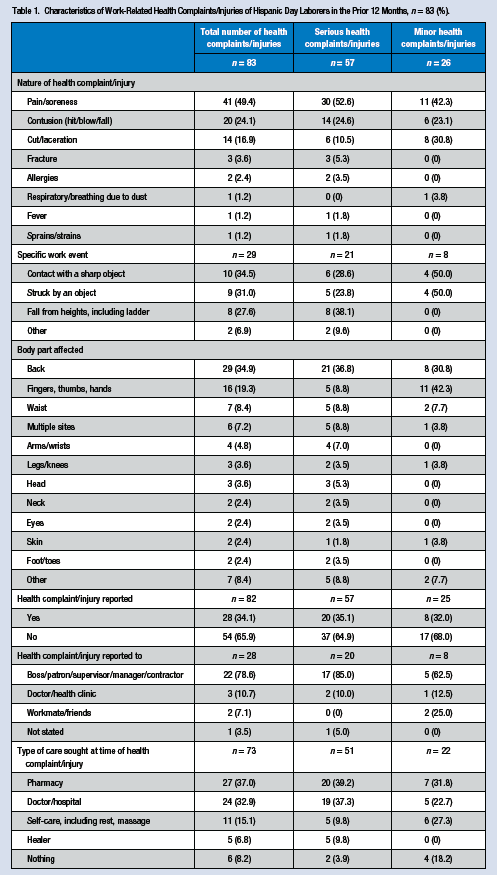
Of 217 day laborers, 83(38%) self-reported health complaints or injuries in the prior 12 months: 57 were serious complaints or injuries (26% of the total sample, 69% of all health complaints/injuries) and 26 (12% of the total sample, 31% of all health complaints/injuries) were minor (see Table 1). The majority were identified as pain or soreness for both serious and minor health complaints and injuries. Cuts and lacerations were more commonly reported in the minor category, with fingers or thumbs and hands as the body parts most affected. The back was the body part most affected by those with serious health complaints or injuries. Of 29 workers who provided additional health complaint or injury details, 8 reported falling from heights; all of these met the definition of a serious health complaint or injury. Sixty-six percent of participants did not report these health complaints or injuries. Of 28 workers who reported health complaints or injuries, the majority informed their bosses or contractors (85% with serious vs. 62% with minor health complaints or injuries). Going to a pharmacy (39% serious vs. 32% minor), going to a physician or hospital (37% serious vs. 23% minor), and/or self-care (10% serious vs. 27% minor) were the reported health care sought (see Table 1).
Characteristics of Work-Related Health Complaints/Injuries of Hispanic Day Laborers in the Prior 12 Months, n = 83 (%).
Socio-Demographic, Health, and Work Factors of Day Laborers
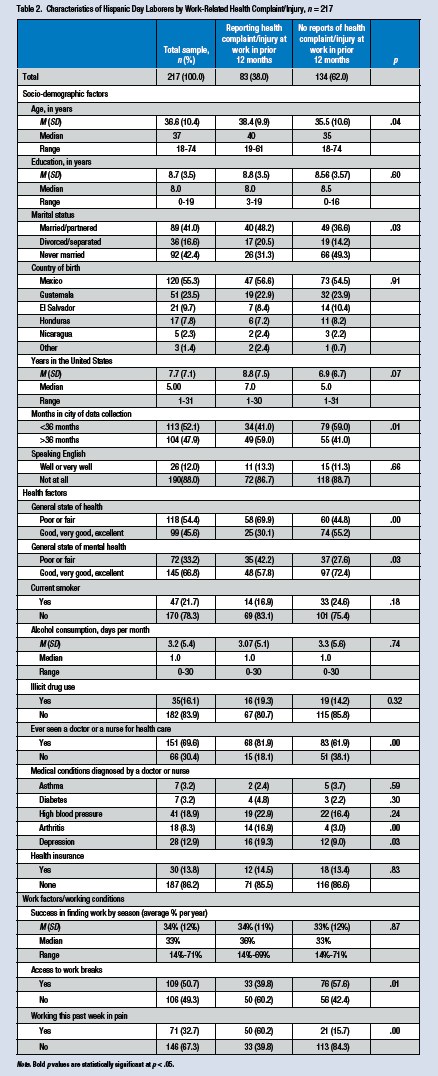
Table 2 summarizes socio-demographic, health, and work characteristics of the sample (Nelson et al., 2012). Participants were on average 37 years old, never married, with 9 years of education, originally from Mexico or Guatemala, and living for 8 years in the United States. Eighty-eight percent did not speak English, and 86% were uninsured for health care. Fifty-four percent reported their physical health as poor or fair, and 33% self-rated their mental health as poor or fair. Twenty-two percent were current smokers and 16% reported using illicit drugs. Seventy percent had seen a physician or nurse for health care in the United States, and this was modestly correlated with current health insurance (Spearman’s ρ = .236, p = .00).
Characteristics of Hispanic Day Laborers by Work-Related Health Complaint/Injury, n = 217
Note. Bold p values are statistically significant at p < .05.
Bivariate analyses of those participants with any health complaint or injury compared with all others are shown in Table 2. Day laborers who had experienced any work-related health complaint or injury in the prior 12 months were significantly older, married or partnered, and more likely to have lived longer (≥36 months) in the city. Those with any health complaint or injury were significantly more likely to report both poor or fair physical and mental health. Arthritis and depression diagnoses were more prevalent in those who reported a health complaint or injury in the prior 12 months. Not surprisingly, those with a health complaint or injury were more likely to have accessed health care compared with those without a health complaint or injury, and were more likely to report working in pain during the past week. Having no access to breaks during work was reported by 60% of participants with a health complaint or injury compared with 42% of participants without a health complaint or injury (p = .01).
Job Safety Training, PPE Beliefs, and the Provision of PPE
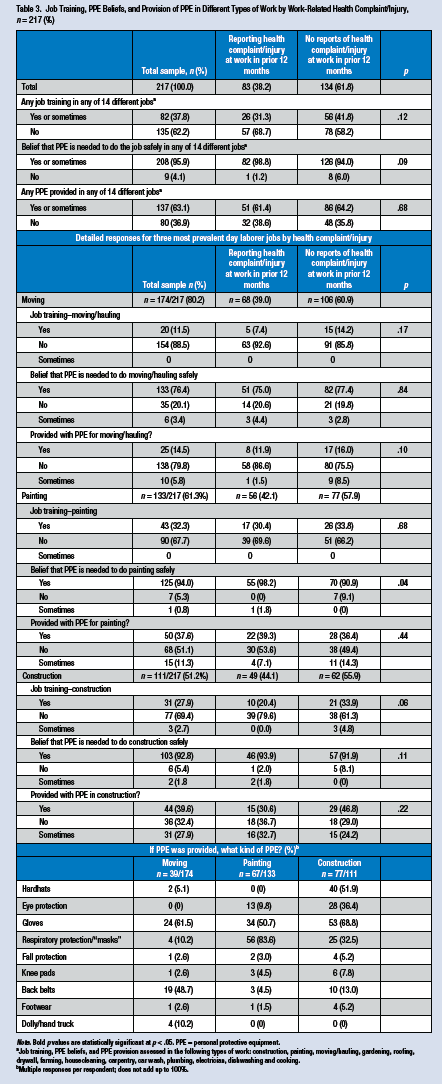
Job safety training, PPE beliefs, and the provision of PPE were assessed in 14 different day laborer jobs, including construction, moving, painting, gardening, roofing, drywall, housecleaning, farm work, carpentry, car wash, plumbing, electrician, cooking, and dishwashing. Moving and hauling was the most common type of work reported by this sample (80.2%) followed by painting (61.3%), construction (51.2%), and gardening (50.2%). Job safety training was significantly correlated with perceiving the need for PPE (Spearman’s ρ = .162, p = .02), and with the provision of PPE (Spearman’s ρ = .418, p = .00). Perceiving the need for PPE was also significantly correlated with the provision of PPE (Spearman’s ρ = .272, p = .00). Table 3 summarizes whether day laborers, in any of the 14 jobs, received job safety training, if they perceived the need for PPE to do their jobs safely, and if PPE had been provided by the employer. These data are detailed in Table 3 for moving, painting, and construction jobs, including the type of PPE provided.
Job Training, PPE Beliefs, and Provision of PPE in Different Types of Work by Work-Related Health Complaint/Injury, n = 217 (%)
Note. Bold p values are statistically significant at p < .05. PPE = personal protective equipment.
Job training, PPE beliefs, and PPE provision assessed in the following types of work: construction, painting, moving/hauling, gardening, roofing, drywall, farming, housecleaning, carpentry, car wash, plumbing, electrician, dishwashing and cooking.
Multiple responses per respondent; does not add up to 100%.
Only 38% of participants reported receiving any job safety training (i.e., answering “yes” or “sometimes” to the job training question in at least one of the 14 jobs); no significant differences in job safety training were found by reported health complaint or injury. Job safety training ranged from a low of 11% in moving/hauling jobs to a high of 71% in cooking jobs. On average, 96% of day laborers perceived the need for PPE to do at least one of the jobs safely. Seventy-seven percent of those who did moving/hauling perceived the need for PPE whereas 97% of those who did roofing stated PPE was needed to work safely. Sixty-three percent of participants reported that at least one type of PPE was provided in at least one of the 14 jobs. The provision of PPE ranged from a low of 14% in moving/hauling jobs to a high of 71% in cooking jobs (e.g., aprons). Most PPE was provided by the employer. The types of PPE varied by type of job and are described in Table 3 for the three most common jobs. Respiratory protection (defined most frequently as a “mask”) was the most prevalent PPE provided in painting jobs, compared with gloves in gardening, construction, and moving. Strikingly, the participants did not mention hearing protection being provided in any of the 14 jobs; only 3% of day laborers who did roofing (n = 31) reported that fall protection (i.e., safety harness) was provided.
Discussion
Work-related health complaint and injury prevalence in this study ranged from a high of 38% for any health complaint or injury in the prior year to 26% for more serious health complaints or injuries, which prevented the day laborer from working. One health complaint or injury per worker was included in this analysis; 6 day laborers reported a second health complaint or injury in the prior year (i.e., 3 were classified as serious and 3 as minor). If the second health complaint had been included, the serious health complaint and injury rate would have increased to 60 of 217 (28%). The health complaint and injury classification used in this study included symptoms associated with the injury (e.g., pain and soreness) and symptoms associated with an occupational illness (i.e., fever and breathing troubles from dust). The researchers honored the day laborers’ perceptions of their symptoms in response to the Spanish word for injuries (“lesiones”). This study’s self-reported 12-month health complaint and injury prevalence is higher than a Seattle-based study of Hispanic day laborers (Seixas et al., 2008) for which first-aid or medical treatment was included in their case definition: 15% of their 180 day laborers reported at least one injury in the prior year (Seixas et al., 2008). The 12-month prevalence in this study is also higher than the 20% injury prevalence of day laborers studied by Valenzuela et al. (2006). Pain was a consistent injury theme in half of all serious reported injuries, with a major concern that 8 had fallen from heights resulting in three fractures. Only 34% of those workers with injuries reported their health complaints and injuries to their supervisors, physicians, or coworkers; underreporting and not seeking treatment has been well-documented among day laborers (Pransky et al., 2002; Seixas et al., 2008).
Those with a higher prevalence of health complaints and injuries were older, married or partnered, and had lived in the city longer. Age was significantly correlated with years in the city, and both factors could signify more years of cumulative exposure. Age was also significantly correlated with married or partnered status. The association between marital status and health complaints and injuries is unclear.
In the current day laborer sample, 13% reported being diagnosed with depression by a physician or nurse; the participants who reported a work-related health complaint or injury had a significantly higher prevalence of depression (19% vs. 9%, p = .03). It was not possible to determine if depression preceded or was in response to work-related health complaints or injuries. Depression diagnoses were not collected by the California Health Interview Survey (CHIS) in 2009; however, in 2005, 4% of Latino men reported serious psychological distress in the prior month, similar to other Californian men (CHIS, 2014). In 2005, 9.4% of Latino men in California reported an arthritis diagnosis (e.g., arthritis, gout, lupus, or fibromyalgia) compared with 14.9% for Californian men of all ethnicities (CHIS, 2014). For this sample, 8% had been told by a physician or nurse that they had arthritis, similar to other Latino men in California; however, the prevalence of arthritis increased to 17% for those men with a health complaint or injury compared with 3% of day laborers without a work-related health complaint or injury in the prior year (p = .00). Whether this finding is due to (a) the cumulative effect of heavy repetitive work that is required for many day laborer jobs (e.g., moving/hauling, construction and painting), (b) the effects of health complaints or injuries, or (c) a precursor to an occupational health complaint or injury is unknown. These health issues could inform future health education and targeted screening opportunities for day laborers.
When examining day laborer work factors, almost 50% of the sample reported not having access to rest breaks; lack of access to rest breaks was significantly higher for those who had experienced a health complaint or injury (60% vs. 42%, p = .01). Growing evidence suggests that the lack of rest breaks during continuous work contributes to accident risk (Tucker, Folkard, & Macdonald, 2003). Furthermore, overall length of rest breaks may prolong an injury-free period, specifically for work-related falls from ladders (Arlinghaus et al., 2012).
This study offers rich data about types of PPE used in 14 different jobs, with detail regarding the three most prevalent jobs. Only 63% of day laborers reported receiving PPE from their employer, contractor, or boss in any of the 14 jobs, despite their overwhelming belief that PPE was necessary to do any 1 of the 14 jobs safely. Several studies confirm that day laborers do not have PPE available to them (Buchanan, Evens, Buckley, & Friedman, 2008; Buchanan, Nickels & Morello, 2005; Contreras & Buchanan, 2012). In contrast, Seixas et al. (2008) found that 74% of day laborers had asked for safety equipment and 86% reported that employers provided PPE. This study did not find any hearing protection provided or used by day laborers. Contreras and Buchanan (2012) provided a duffle bag of nine pieces of PPE equipment to 109 day laborers in Chicago, and 6 to 8 weeks later re-contacted 42 of the participants to evaluate the impact of the PPE provision program. The researchers found that after their intervention, hearing protection was one of the least used PPE because day laborers reported “it was not needed” (p. 163). The use of respiratory protection was also not as high as the researchers had anticipated, finding that after the intervention, 43% of day laborers were using a respirator during construction, 64% used a respirator during demolition, and 53% used a respirator for painting (Contreras & Buchanan, 2012). In this study, of those who worked in construction, only 40% (44/111) were provided with PPE consistently; an additional 28% (31/111) stated they were provided with PPE “sometimes.” Gloves and hard hats were the most prevalent PPE provided followed by eye protection and “masks.” Only 25 of the 77 day laborers who were provided with PPE reported receiving any respiratory protection (i.e., masks) during construction work. In contrast, masks were the most prevalent PPE provided for painting jobs in this study. It is unknown if respirator fit testing with training for mask or respirator use was offered; this question deserves further study.
Thirty-eight percent of the participants in this study reported receiving job safety training for at least 1 of the 14 day laborer jobs. The scope and depth of training was not explored, and it was not known what specific content on occupational health and safety was included. In addition, job safety training may have been provided many years prior to an occupational injury that occurred within the prior 12 months. However, the prevalence of training in this study was similar to Seixas et al. (2008) who found that 40% of day laborers in their Seattle study had received occupational health and safety training. Several other studies have reported a lack of work-related health and safety training for day laborers (Buchanan et al., 2008; Buchanan et al., 2005; Contreras & Buchanan, 2012).
Study Strengths and Limitations
Study strengths included a broad inclusion of symptoms in the health complaint or injury definition with comprehensive data collection about 14 jobs. Potential weaknesses include self-report by day laborers of their health complaints or injuries, which may have contributed to misclassification of cases to either serious or minor categories. The broad definition used limited the researchers’ abilities to compare study results with other study prevalence findings. The type of work at the time of injury was not collected, and these data, if known, could have supported more focused analyses. It is not known what constituted job safety training; the timing of the training in relation to the injury or health complaint is also unknown. Temporal precedence cannot be determined using a cross-sectional study design; day laborers with a work-related health complaint or injury may have inconsistent recall of work breaks; lack of work breaks may either precede or follow a health complaint or injury, or the lack of work breaks may be a proxy variable for other hazardous working conditions not captured in this survey.
Summary
Study results add to the growing body of research documenting the higher prevalence of work-related health complaints or injuries among Latino day laborers working in a large urban center. Those with work-related health complaints or injuries were older, married or partnered, with more years living in the city, reporting poor or fair general physical and mental health, and more likely than those without health complaints or injury to work in pain during the prior workweek without access to work breaks. The majority of health complaints or injuries were unreported: Only 22 health complaints or injuries were reported to a supervisor. Those with work-related health complaints or injuries that occurred within the prior year experienced a higher prevalence of depression and arthritis when compared with their day laborer counterparts without work-related health complaints or injuries in the prior year. Day laborers often work in a wide range of jobs, with very limited job safety training and PPE provision. Day laborers in this study overwhelmingly believed that PPE was necessary to do their jobs safely.
Occupational health nurses have many opportunities to promote the health of and prevent injuries among this group of vulnerable workers at both the individual and system levels. Depending on setting, comprehensive health care, including, for example, smoking cessation and early diagnosis and treatment of depression, could be provided to this high risk population using culturally sensitive outreach and motivational interviewing strategies. Due to underreporting, active case finding for occupational injuries is needed when day laborers access any health care system. To ensure provision of health and safety training and PPE for day laborers at the system level, occupational health nurses can advocate for comprehensive occupational health and safety legal protections for all contingent workers. Reporting health complaints and injuries, in addition to providing rest breaks, deserves further study in this population. In addition to targeted hearing conservation and respiratory protection programs for this high risk group, the risk of falls from heights is a serious hazard facing day laborers, and this phenomenon also deserves further investigation.
Survey Questions: Health and Safety Perceptions
“Qué lesiones sufrió en el año pasado?” (What were your injuries last year?)
“Estas lesiones le han impedido a usted alguna vez poder trabajar?” (Have these injuries impeded your ability to work at any time?)
“Ha sido entrenado para trabajar con medidas de seguridad?” (Have you been trained to keep yourself safe in construction, moving/hauling, etc.?)
“Usted piensa que necesita equipo de protección para trabajar sin peligro?” (Do you feel that protective equipment is necessary to keep you safe in construction, moving/hauling, etc.?)
“Se le ha proporcionado equipo de protección in construction, moving/hauling, etc.?” (Are you provided with protective equipment?)
“Si es asi, que clase de equipo?” (If yes, what kind?)
Footnotes
Conflict of Interest
The author(s) declared no potential conflicts of interest with respect to the research, authorship, and/or publication of this article.
Funding
The author(s) disclosed receipt of the following financial support for the research, authorship, and/or publication of this article: The funding support for the original study was from The University of California Institute for Mexico and the United States (UC MEXUS).
Author Biographies
Barbara J. Burgel is a professor of clinical nursing at the University of California San Francisco (UCSF) School of Nursing, teaching in a NIOSH-funded graduate program in occupational and environmental health nursing. She is a fellow of the American Association of Occupational Health Nurses and the American Academy of Nursing.
Ronald W. Nelson completed his medical degree and MPH at the Tulane University Medical School in New Orleans, LA. At the time of this study, he was a research associate at the UCSF School of Nursing, where he conducted many of the day laborer interviews.
Mary C. White is professor emeritus from the UCSF School of Nursing. She is an epidemiologist and demographer, formerly teaching in the Community Health Nursing program. She was a fellow of the American Academy of Nursing.