




Abstract
Introduction
The argument about whether leadership style affects nurses’ job satisfaction is centered around the impact of different leadership styles on the work environment and the quality of care provided by nurses. Therefore, this review was primarily aimed at assessing the impact of transformational leadership style on the job satisfaction of hospital nurses.
Methods
This is an integrative review conducted according to the Whittemore and Knafl's framework. Comprehensive literature searches were conducted in PubMed, MEDLINE, CINAHL, Web of Science, Research4Life, and APA PsychInfo. In addition, studies were included through hand-searching from different sources of grey literature and a reference list of identified articles. All English articles published between 2012 and 2023 reporting the impact of transformational leadership style on nurses’ job satisfaction were eligible for inclusion.
Results
Seventeen articles were included in the review, of which 16 were cross-sectional studies, while one was mixed. The majority (n = 12) of the studies were conducted in at least two or more healthcare settings, with a total of 5841 nurses. Almost all (n = 16) articles reported the positive influence of transformational leadership on nurses’ job satisfaction. In addition, the transformational leadership style was reported to have a positive impact on nurses’ intentions to stay at work, quality care, and patient outcomes.
Conclusion
By adopting a transformational leadership approach within clinical environments, there is a potential to boost nurses’ job satisfaction.
Introduction
Various nursing leadership styles have a direct or indirect impact on the nursing profession, professionals, and patient outcomes (Sfantou et al., 2017). Each leadership style has its own unique approach and impact on the nursing field. Transformational, transactional, passive/avoidant leadership, servant, situational, authentic, charismatic, and quantum are among the widely implemented leadership styles in the healthcare system (Carrara et al., 2017; Lee et al., 2019).
In hospitals, leadership is seen as a central element of a well-coordinated and integrated provision of care (Sfantou et al., 2017). The structural measures influenced by nurse managers’ leadership styles are believed to be important determinants of nurses’ job satisfaction, morale, productivity, and retention (Asamani et al., 2016; Kiwanuka et al., 2021; Pishgooie et al., 2019). Therefore, the active role and participation of nurses in implementing the best leadership style are crucial to ensuring quality care, advancing the profession, and creating a conducive environment in the health industry.
Transformational leadership has become one of the leadership styles believed to have a positive effect on employee satisfaction, engagement, and performance. It is a theory of leadership where leaders work together in teams to explore a needed paradigm shift and create a vision to realize it with other inspirational members of a group (Kiwanuka et al., 2021; Moon et al., 2019). But also, it is a demanding leadership style that directly correlates to organizational commitment (Al-Yami et al., 2018; Carrara et al., 2017).
Conversely, few evidences did not show the scenario about the positive impact of the transformational leadership style. A cross-sectional study from Iran indicated that there was a positive correlation between transformational leadership and anticipated turnover (Pishgooie et al., 2019). In addition, the adoption of transformational leadership seems way behind in health care settings. A study from Belgium revealed that head nurses and nurse directors were excessively implementing passive-avoidant leadership styles in contrast to transformational leadership styles in nursing homes. Subsequently, all leadership outcomes (extra effort, effectiveness, and satisfaction) were significantly lower among both the head and director of nurses (Poels et al., 2020).
Furthermore, understanding the impact of nurse managers’ leadership styles on job satisfaction may lead to increased retention (Suliman et al., 2020). Subsequently, this can contribute to the overall achievement of a given healthcare organization. Therefore, it is necessary to gather the kinds of literature necessary to develop a holistic and conclusive idea of whether transformational leadership influences nurses’ job satisfaction. As such, this integrative review will provide tangible evidence of the impact of transformational leadership style on the job satisfaction of hospital nurses.
Research Question
Does transformational leadership style affect hospital nurses’ job satisfaction?
Methods
Design
An integrative review approach was used as it allows for findings from diverse methodologies to be applied to clinical practice, and evidence-based practice initiatives (Whittemore & Knafl, 2005).
Search Methods
The initial search for literature was carried out from August to September 2021 and last updated on May 18, 2023. Literature was searched from online databases such as PubMed, MEDLINE, CINAHL, Web of Science, Research4Life, and APA PsychInfo. In addition, articles were identified from the Edinburgh Napier University repository, reference lists of included articles, Google, Google Scholar, and World Health Organization websites. The main search terms used in the databases were “Transformational leadership AND Nurs* AND Job satisfaction.” The advanced searching options available in each online database were executed using the predefined search terms and strategies (Appendix A).
Inclusion/Exclusion Criteria
Inclusion Criteria
All English-language studies that reported the impact of transformational leadership on hospital nurses’ job satisfaction were eligible for the review. To reach an up-to-date conclusion, the authors included articles published between January 1, 2012, and May 18, 2023. The integrative review allows the inclusion of studies with diverse methodologies. Therefore, there were no restrictions for inclusion of studies based on their sample size or design.
Exclusion Criteria
Nonprimary sources such as editorials, opinion pieces, letters, and review papers have been excluded. Also, an article dealing with multidisciplinary professionals was ineligible unless it had a piece of result relevant to the review. Furthermore, the authors excluded inaccessible articles after contacting the corresponding author three times, through email. The final decision on whether to include an article was based on the consensus of the two authors.
Selection of Studies
All database search results were exported to the Mendeley reference manager software version 1.19.4. With the help of the software, duplicate search results were deleted. Next, a two-step selection process was undertaken. In step 1, two independent reviewers (GG, EC) scanned the titles and abstracts of all articles reporting the impact of transformational leadership on nurses’ job satisfaction. And in step 2, full-text articles were screened by the reviewers to determine their eligibility. In the end, fully eligible articles were selected for further analysis (Figure 1). Evaluators’ disagreements were resolved via a third reviewer (HT).

A PRISMA diagram showing the article selection process (Page et al., 2021).
Data Extraction, Analysis, and Synthesis
The integrative review framework developed by Whittemore and Knafl (2005) was used as guidance during data extraction, analysis, and synthesis. Accordingly, the data was extracted using an Excel table. Initially, articles were read at least three times to grasp a comprehensive understanding of their methodologies and findings. Next, the common observations and patterns in each article were identified. Basically, the authors abstracted variables that were relevant to the review question. Consequently, the authors recorded the author, year of publication, country, aim, study setting, design, sample size, and main findings of each article. Finally, the findings were synthesized according to the study characteristics and the aim of the review.
Quality Assessment
The methodological quality of the papers was evaluated using the JBI quality assessment checklists for cross-sectional studies (Appendix B).
Results
Characteristics of the Studies
The literature search generated 1,118 articles, of which 462 were from online databases and the remaining 656 were from other sources. After eliminating duplicates and evaluating titles and abstracts, the number of articles was reduced to 58. Of these, one full-text article was inaccessible after contacting the corresponding author. Subsequently, 57 articles were retrieved and fully reviewed for inclusion. Of these, 40 articles were excluded with reasons, and 17 full studies met the inclusion criteria for the review (Figure 1). These studies were conducted in Saudi Arabia (n = 3), USA (n = 2), Jordan (n = 2), China (n = 1), Malaysia (n = 1), Turkey (n = 1), Pakistan (n = 1), Philippines (n = 1), Canada (n = 1), Italy (n = 1), Slovakia (n = 1), Portugal (n = 1), and Ethiopia (n = 1). The total sample size from these studies was 5841 nurses, ranging from 87 to 1,037, and the majority (n = 12) of the studies were conducted in at least two or more healthcare settings. With regards to study design, 16 were cross-sectional studies, while only one was mixed. Furthermore, a correlation analysis was executed in all articles to show the relationship between transformational leadership style and nurses’ job satisfaction (Table 1).
Characteristics of the Studies Included in the Review.
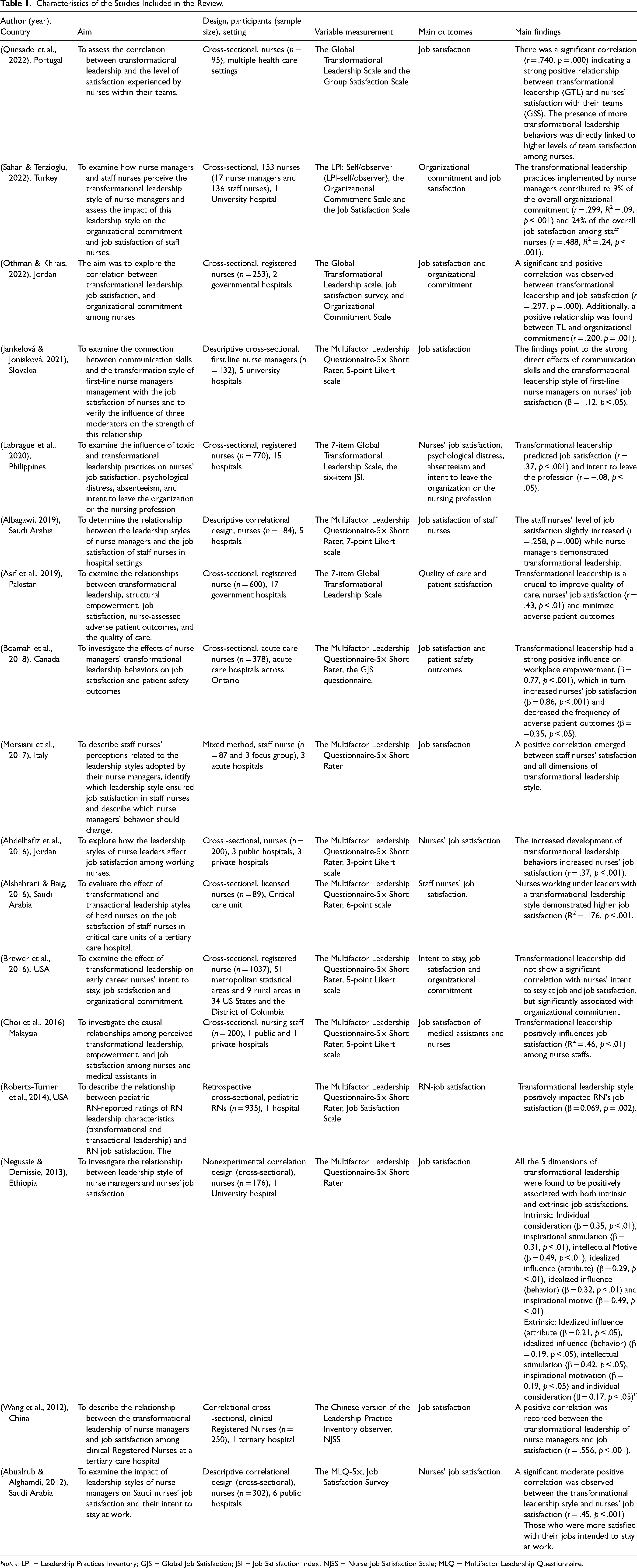
Notes: LPI = Leadership Practices Inventory; GJS = Global Job Satisfaction; JSI = Job Satisfaction Index; NJSS = Nurse Job Satisfaction Scale; MLQ = Multifactor Leadership Questionnaire.
Quality Appraisal of the Review
Two authors (GG, EC) evaluated, by consensus, the methodological quality of articles using the JBI quality assessment tools. The authors included studies with clear eligibility criteria, a detailed description of context, a reliable and valid measure of exposure, and an adequate statistical analysis. Accordingly, articles with scores of 8/8, 7–5/8, and less than 5/8 were labeled as high, moderate, and low quality, respectively. As a result, 13 studies were of high methodological quality because all of these papers received a “yes” rating for all relevant elements of the JBI Quality Assessment Tool (Abdelhafiz et al., 2016; Abualrub & Alghamdi, 2012; Alshahrani & Baig, 2016; Asif et al., 2019; Boamah et al., 2018; Brewer et al., 2016; Choi et al., 2016; Jankelová & Joniaková, 2021; Labrague et al., 2020; Morsiani et al., 2017; Negussie & Demissie, 2013; Othman & Khrais, 2022; Roberts-Turner et al., 2014). And, four studies (Albagawi, 2019; Quesado et al., 2022; Sahan & Terzioglu, 2022; Wang et al., 2012) were of moderate methodological quality due to their limitations in having a standardized objective and, identification and management of confounding factors (Appendix B). No article was excluded based on this data evaluation rating system.
The Impact of Transformational Leadership on Nurses` Satisfaction
Seventeen articles demonstrated the association between transformational leadership style and nurses’ job satisfaction. Of these, 16 articles have reported the positive influence of transformational leadership on job satisfaction of hospital nurses (Abdelhafiz et al., 2016; Abualrub & Alghamdi, 2012; Albagawi, 2019; Alshahrani & Baig, 2016; Asif et al., 2019; Boamah et al., 2018; Choi et al., 2016; Jankelová & Joniaková, 2021; Labrague et al., 2020; Morsiani et al., 2017; Negussie & Demissie, 2013; Othman & Khrais, 2022; Quesado et al., 2022; Roberts-Turner et al., 2014; Sahan & Terzioglu, 2022; Wang et al., 2012). In particular, four studies showed the presence of strong positive correlations between transformational leadership style and, extra effort, effectiveness, and satisfaction (Alshahrani & Baig, 2016; Boamah et al., 2018; Morsiani et al., 2017; Negussie & Demissie, 2013). Furthermore, in two studies, nurses who were working under managers demonstrating transformational leadership showed more job satisfaction and intent to stay at work (Abualrub & Alghamdi, 2012; Roberts-Turner et al., 2014). Relatedly, it has also been reported that a transformational leadership style can enhance job satisfaction and overall organizational commitments of nurses (Othman & Khrais, 2022; Sahan & Terzioglu, 2022). Besides the positive impact that a transformational leadership style had on nurses’ job satisfaction, it also contributed to minimizing the adverse outcomes of patients (Asif et al., 2019).
On the other side, according to a study from the USA, transformational leadership style had no statistically significant impact on the intent to stay and job satisfaction of nurses but was significantly associated with organizational commitment (Brewer et al., 2016).
Discussion
The authors set out to summarize whether a transformational leadership style has an impact on nurses’ job satisfaction. The authors found seventeen articles that demonstrated the relationship between transformational leadership style and nurses’ job satisfaction in health care settings.
In this review, almost all the studies confirmed that transformational leadership has a positive correlation with nurses’ job satisfaction. Furthermore, the studies have also reported that a transformational leadership style can enhance nurses’ intentions to stay at work, quality care, and patient outcomes. Likewise, in a related review, a transformational leadership style has had a positive correlation with work or professional satisfaction and the reduction of medication errors in the intensive care unit. More importantly, the authors also reported that a transformational leadership style indirectly influences job satisfaction by creating a motivating and cohesive work environment (Kiwanuka et al., 2021).
Despite the fact that a transformational leadership style correlates with better job satisfaction, existing evidence shows that it is rarely demonstrated by nurse managers in health care settings (Morsiani et al., 2017). This might be due to the leadership style preferences of managers and hospitals. In addition, the adoption of a transformational leadership style requires individuals with considerate and exemplary characteristics and a resourceful environment. In contrast, some other types of leadership styles can still be more effective than transformational leadership styles, especially in high-pressure work environments where a hard leadership style is required for successful task accomplishment and job satisfaction, such as in emergency and critical care departments. In such settings, according to the article published by Abdelhafiz et al. (2016), transactional leadership style is believed to have a better impact on the job satisfaction of nurses’ than transformational leadership. In this case, it is understandable that the character of the transactional leadership style allows a manager to focus on taking corrective actions against staff nurses and subordinates who show poor work conduct. Therefore, in such circumstances, transactional leadership can be a better option than transformational leadership to increase task achievement, build teamwork, and increase overall nurses’ job satisfaction.
The results of this review also revealed that nursing leaders, who exhibit transformational behavior have a great role in decreasing staff turnover, which may also indirectly imply the existence of nurses’ job satisfaction as a mediating factor (Abdelhafiz et al., 2016; Abualrub & Alghamdi, 2012). Transformational nurse leaders can recognize and foresee the necessities of their staff nurses by establishing a good relationship and making significant efforts to fulfill their needs to encourage a sense of empowerment and autonomy that can subsequently result in job satisfaction (Asif et al., 2019). Also, related studies have inferred the contribution of transformational leadership style in decreasing nurses’ turnover (Magbity et al., 2020; Pishgooie et al., 2019). Overall, the transformational leadership style contributes to higher levels of job satisfaction, which, in turn, can enhance nurses’ overall well-being and performance in their roles.
Limitations
The search for literature was limited to articles published between 2010 and 2023. Furthermore, studies published in languages other than English or those not indexed in commonly used databases may be missed. These limitations can affect the interpretation and reporting of findings.
Implications for Practice
Choosing the best leadership style could be one of the modifiable factors that a healthcare organization can do to create a conducive working environment and promote quality care (Phillips et al., 2021). In this regard, the findings of this study have highlighted the importance of a transformational leadership style in promoting hospital nurses’ job satisfaction. This study can also be used as input to plan and develop future nursing leadership quality improvement initiatives in a healthcare organization. Furthermore, it contributes to the growing body of literature on nursing leadership development and training. Overall, the present review promotes the implementation of transformational leadership style in hospitals and provides a theoretical grounding for future researchers in nursing management and leadership.
Conclusion
Overall, the transformational leadership style has a positive impact on nurses’ job satisfaction. Therefore, it is recommended that healthcare settings adapt a transformational leadership style for better staff job satisfaction.
Supplemental Material
sj-docx-1-son-10.1177_23779608231197428 - Supplemental material for The Impact of Transformational Leadership Style on Nurses’ Job Satisfaction: An Integrative Review
Supplemental material, sj-docx-1-son-10.1177_23779608231197428 for The Impact of Transformational Leadership Style on Nurses’ Job Satisfaction: An Integrative Review by Gdiom Gebreheat, Hirut Teame and Emilia I Costa in SAGE Open Nursing
Supplemental Material
sj-docx-2-son-10.1177_23779608231197428 - Supplemental material for The Impact of Transformational Leadership Style on Nurses’ Job Satisfaction: An Integrative Review
Supplemental material, sj-docx-2-son-10.1177_23779608231197428 for The Impact of Transformational Leadership Style on Nurses’ Job Satisfaction: An Integrative Review by Gdiom Gebreheat, Hirut Teame and Emilia I Costa in SAGE Open Nursing
Footnotes
Acknowledgements
The authors thank the library assistants of the University of Algarve and Edinburgh Napier University.
Availability of Data
All data and materials used for this work are submitted with the manuscript.
Declaration of Conflicting Interests
The authors declared no potential conflicts of interest with respect to the research, authorship, and/or publication of this article.
Funding
The authors received no financial support for the research, authorship, and/or publication of this article.

Supplemental Material
Supplemental material for this article is available online.
References
Supplementary Material
Please find the following supplemental material available below.
For Open Access articles published under a Creative Commons License, all supplemental material carries the same license as the article it is associated with.
For non-Open Access articles published, all supplemental material carries a non-exclusive license, and permission requests for re-use of supplemental material or any part of supplemental material shall be sent directly to the copyright owner as specified in the copyright notice associated with the article.
