



Abstract
Occupational health nursing focuses on promotion and restoration of health, prevention of illness and injury, protection from work-related and environmental hazards, and corporate profitability. Quality education about the relationship between work and health is critical for nurses’ success regardless of work setting, and is consistent with Healthy People 2020 goals, but is lacking or limited in some programs. This report introduces an innovative occupational health nursing curriculum for students enrolled in baccalaureate nursing programs. The process of designing and pilot testing this novel curriculum, its alignment with nursing competencies, and its format and learning activities are described. Preparing professional nurses to understand the role of the occupational health nurse and the relationship between work and health is an essential curricular consideration for contemporary nursing education.
Keywords
Care of populations in the home, school, work site and community is basic to community and public health nursing (American Nurses Association [ANA], 2010). Occupational health nurses deliver health and safety programs and services to workers. This specialty practice area focuses on promotion and restoration of health, prevention of illness and injury, protection from work-related and environmental hazards, and corporate profitability (American Association of Occupational Health Nurses [AAOHN], 2007). A recent study by the National Institute for Occupational Safety and Health (NIOSH) predicted a shortage of occupational health nurses to serve the nation’s workforce (McAdams, Kerwin, Olivo, & Goksel, 2011). Quality education for prospective occupational health nurses is critical for their success and a healthy workforce, and is consistent with Healthy People 2020 goals (U.S. Department of Health and Human Services, 2010).
Although a component of baccalaureate nursing education ideally includes introductory didactic and practicum learning experiences for emerging nurse generalists in this specialty (American Association of Colleges of Nursing, 2008), published reports indicate that fewer than half of undergraduate nursing education programs include occupational health nursing in their curricula (Callen et al., 2009). Furthermore, a paucity of recent studies have examined how the health and wellness of the workforce are addressed in baccalaureate curricula. Contemporary faculty report that they are unaware of occupational health nursing roles and occupational health nurses’ contributions to maintaining a safe and healthy workforce as well as a lack of qualified faculty to teach this content (Occupational Health Nursing Task Force, 2010).
These factors indicate a need for specially prepared nurses to meet the health needs of workers. However, the current nursing education system is poorly prepared to introduce emerging nurses to the specialty of occupational health nursing. Nursing programs need didactic and clinical learning opportunities for baccalaureate nursing students. The purpose of this project was to develop and pilot curricular materials to introduce undergraduate nursing students to occupational health nursing.
Method
Curricular resources were developed for use in baccalaureate nursing programs, including learning objectives, learning resources, and learning activities suitable for various class formats and evaluation (test) items. The curriculum was reviewed and tested by a convenience sample of nurse educators.
This multi-phase study included a variety of methods, including initial testing, expert panel review, and one-group pre-test/post-test. The project was reviewed and approved with exempt status by the first author’s university institutional review board.
Development of Curricular Materials
A draft lesson was developed to provide an overview of occupational health nursing for baccalaureate nursing students enrolled in a public/community health nursing course. The curriculum structure included a lesson overview, student guide, student pre-test, student pre-class learning activity, instructor classroom/seminar guide, and student post-test. A variety of teaching−learning strategies, including independent reading, viewing a screencast, and interactive small group learning activities, were included. Learning activities were designed to be flexible and meet the varying time allocations for occupational health nursing in each curriculum, using resources readily available to nurse educators such as computer-enhanced classrooms and web-based learning management systems (e.g., Blackboard, Desire to Learn). The 15-minute screencast included a series of computer-generated slides, outlines of key points in the audio lecture, and use of color and illustrations (e.g., photos, figures), with audio narration. The screencast also included brief biographic narratives of actual occupational health nurses in a variety of practice settings, including industry, government, and research. All curricular materials were adaptable for use in a variety of teaching−learning situations, such as large and small size classes, and face-to-face and online instruction. Materials were designed to be highly accessible to students using contemporary distance learning technologies (e.g., pdf, mp4) while minimizing file size.
Learning activities were organized into pre-class, in-class, and post-class activities. Suggested pre-class learning activities included (a) readings about occupational health nursing from students’ community/public health nursing textbook, (b) readings of selected journal articles, (c) review of the screencast with audio, and (d) thought questions. Readings were selected to introduce students to a variety of resources for occupational health nurses (e.g., OSHA and NIOSH websites) and the broad scope of the subspecialty, as well as stimulate interest in the subspecialty via topics relevant to younger nurses (e.g., job safety of teen workers, breastfeeding at the workplace).
Suggested in-class learning activities included viewing a virtual manufacturing plant tour, processing pre-class learning activities, and interactive activities focused on practical application of pre-class learning. Discussion questions were included in the instructor resources. Sample discussion questions included, “How would you describe the population of workers at the plant? As the nurse at this plant, what methods would you use to assess this population? How would the demographics of workers influence your nursing care?” The teaching materials were initially tested by one author (M.C.M.) with groups of baccalaureate nursing students, and subsequently refined.
Alignment With Selected Nursing Competencies
The curriculum was examined in relation to selected standard nursing competencies, including the Quad Council of Public Health Nursing Competencies (Cravetz, Krothe, Reyes, & Swider, 2011), American Nurses Association Public Health Nursing (ANA PHN) Scope and Standards of Practice (ANA, 2007), and AAOHN Competencies in Occupational and Environmental Health Nursing (AAOHN, 2007). A summary of the alignment with selected nursing competencies is displayed in Table 1.
Relevance of Curriculum to Selected Nursing Competencies
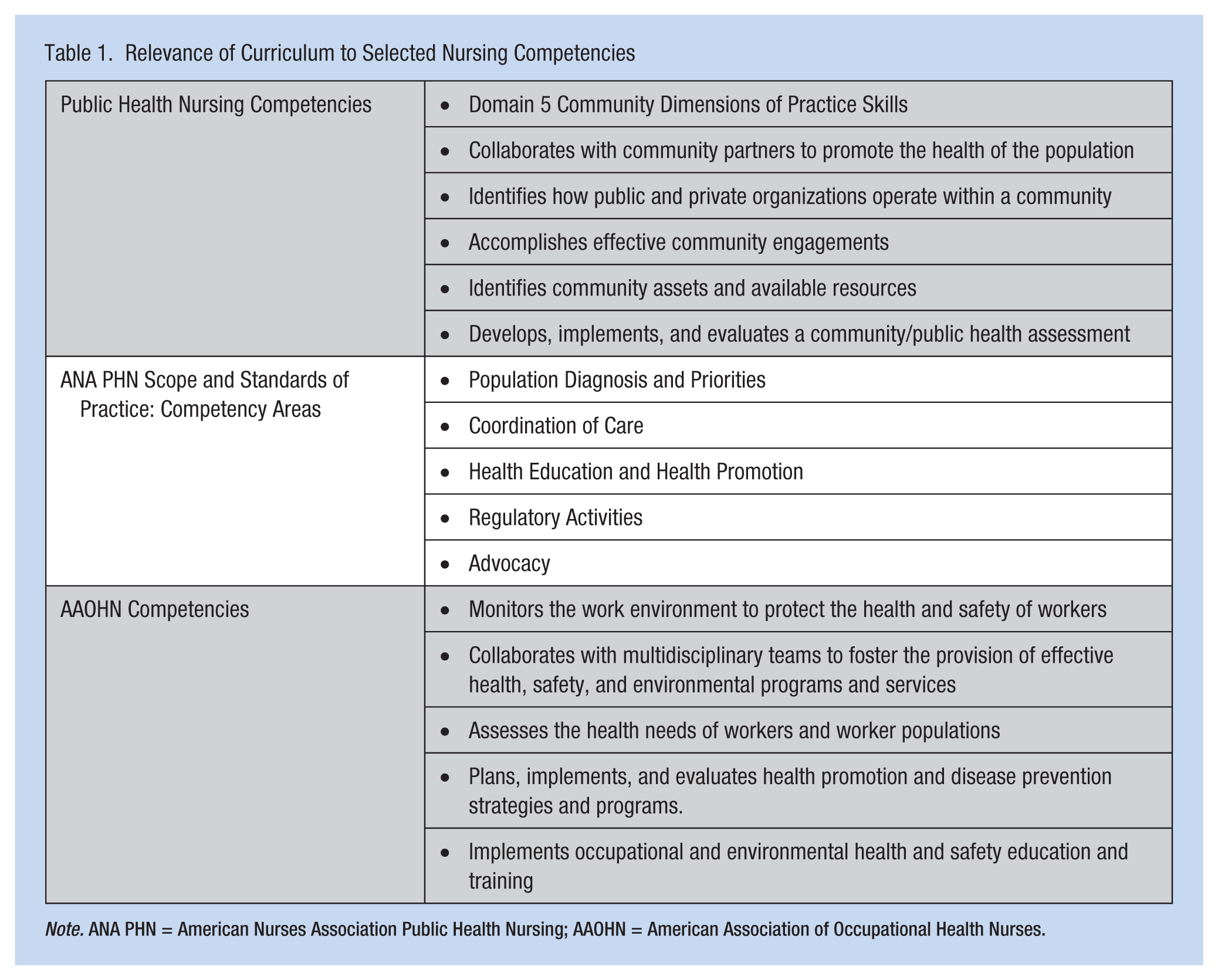
Note. ANA PHN = American Nurses Association Public Health Nursing; AAOHN = American Association of Occupational Health Nurses.
Expert Panel Review and Curriculum Revision
A panel of five experts, including occupational health nurse educators and clinicians, was recruited to critique the revised curriculum. A review tool focused on systematic examination of curricular objectives, teaching/learning methods, and evaluation methods was used. Feedback from the expert panel review led to further curricular revisions.
Curriculum Beta Testing
A one-group pre-test/post-test design was used to evaluate the curriculum materials. Using email list serves and contacts through professional organizations, project organizers (M.C.M., P.B.) recruited, screened, selected, and trained a convenience sample of faculty to serve as reviewers and beta testers.
A digital folder was distributed to participating nurse educators. The folder included several files: faculty guide, curricular materials, student pre- and post-tests, and faculty and student satisfaction surveys. The faculty guide included information necessary to plan the lesson and was organized using the Association for Community Health Nursing Educators (2014) Innovative Teaching Strategies format. The faculty guide included learning objectives in behavioral terms, suggested learning strategies (e.g., informal lecture content outline, readings, small group activities), time allotments, bibliography, and list of suggested learning materials.
Instruments and Measures
Knowledge test
A knowledge test was developed by the authors for use in the study. The test consisted of 10 multiple-choice items based on the content included in the lesson plan provided. A sample item stem from the test was, “Which of the following measures would the occupational health nurse use as an outcome measure of the occupational health and safety program?”
Student satisfaction survey
A satisfaction survey, 11 items rated on a 5-point Likert-type scale (highest rating/superior to unsatisfactory/unacceptable), was developed for students participating in the study. A sample item from this instrument was, “Overall, this was an excellent lesson.” The instrument also included two additional items that invited students to provide qualitative responses (e.g., “The most important thing I learned in this lesson was [please describe]”).
Faculty satisfaction survey
A faculty satisfaction survey was also included in the faculty file. The 14-item instrument invited educators to evaluate the lesson using a 5-point Likert-type scale (highest rating/superior to unsatisfactory/unacceptable). A sample item from the faculty instrument was, “The content and methods are appropriate for the specified level of learner.”
Procedures
Faculty reviewers were solicited from a national organization of public/community health educators. The study author (M.C.M.) provided a digital folder containing the instructor resources (i.e., instructor guide, screencast, pre-/post-tests, instructor and student satisfaction surveys) via email to faculty members who expressed interest in the study. The study author and prospective participant−faculty met by phone to discuss the study procedures and answer any questions. Instructors selected learning activities from the resources and assigned pre-class, in-class, and post-class activities to be accomplished in face-to-face or distance formats, according to course design. Faculty members provided unique student identification codes on pre-tests and post-tests for later analyses. The faculty and student satisfaction survey forms were available for anonymous completion online, or in hard copy format, to be mailed to the study team. Faculty members notified the study author (M.C.M.) when the online evaluations were complete or mailed hard copies to the author.
Analysis
Quantitative satisfaction survey items were analyzed using descriptive techniques; qualitative items were analyzed using content analysis.
Results
Digital folders were distributed to 14 nursing faculty; 5 nursing faculty responsible for teaching baccalaureate-level public/community health nursing courses reviewed the materials and responded with comments about the materials, and an additional 2 nursing faculty implemented the curriculum with 53 students. Faculty represented a variety of educational institutions (i.e., private, public, small, research-based).
Student and faculty feedback was positive overall, with students most positive about the material deepening their interest in occupational health nursing and quality of the learning materials (e.g., readings, websites). Faculty expressed a high level of interest in this unique resource and their intent to include it in their future course planning.
Discussion
Specially prepared nurses are needed to meet the health needs of workers, but the nursing education system is poorly prepared to introduce emerging nurses to the subspecialty of occupational health nursing. A didactic curriculum was developed and pilot tested for use in undergraduate nursing education programs.
On evaluation, the curricular materials were well received by both students and faculty from a variety of educational institutions, demonstrating acceptability and feasibility of the curriculum for broader use in baccalaureate nursing education. Responses were overwhelmingly favorable, with several instructors requesting supplementation of didactic materials with clinical learning materials.
Based on these favorable reviews, project developers plan to explore future opportunities for dissemination of the curricular materials to a wide audience of baccalaureate nurse educators. The group also plans to develop procedures for periodic review and update of the materials. In addition, the group will continue its work by developing supplementary materials to support clinical learning activities.
The resources described are appropriate and feasible for use in baccalaureate nursing education programs, and ready for expanded dissemination to nurse educators. These materials are expected to enhance undergraduate nursing education, and improve access to and quality of nurses’ education in this subspecialty. These changes are expected to improve occupational health nursing education in baccalaureate programs, increase interest in occupational health nursing as a career option, and improve nurses’ functional ability to promote the health of the nation’s workforce.
Implications for Practice
Inclusion of occupational health nursing content in basic nursing education is of interest to both nurse educators and clinicians. Although only a small minority of nurses will ever be employed as occupational health nurses, nearly all nurses in clinical practice provide care for adult, child, and aged workers, and former workers. In addition, many nurses will interact with clients and members of the occupational health team (e.g., occupational physicians, industrial hygienists, safety specialists) concerning care of healthy, sick, or injured workers. Nurses in all settings will be better prepared to support the occupational health team and promote the health of the nation’s workforce when they are well informed about the role of occupational health nurses.
Occupational health nurses in clinical practice can promote inclusion of this subspecialty content in baccalaureate nursing education programs. Practicing occupational health nurses are a valuable resource to nursing faculty, who may benefit from their consultation about curriculum development, their utility as guest faculty in nursing courses, and them acting as clinical preceptors for undergraduate and graduate nursing students.
Footnotes
Acknowledgements
The authors wish to thank the expert panel, faculty, and students who served in the testing of the curriculum.
Authors’ Note
The views expressed do not necessarily reflect the official policies of the Department of Health and Human Services, nor does mention of trade names, commercial practices, or organizations imply endorsement by the U.S. Government.
Conflict of Interest
The author(s) declared no potential conflicts of interest with respect to the research, authorship, and/or publication of this article.
Funding
The author(s) disclosed receipt of the following financial support for the research, authorship, and/or publication of this article: Funding for this publication was made possible (in part) by the training grant T42 OH008845 from the National Institute for Occupational Safety and Health, Centers for Disease Control and Prevention.
Author Biographies
Marjorie C. McCullagh is Associate Professor of Nursing and Director of the Occupational Health Nursing Program at the University of Michigan School of Nursing.
Peggy Berry is a doctoral candidate at the University of Cincinnati, a NIOSH Education and Research trainee, and American Nurses Foundation Scholar.