




Abstract
Background
Accounting professionals experience a stressful working environment with previous studies demonstrating a high prevalence of burnout. Meditation-based interventions have a potential role in decreasing burnout and improving satisfaction with life. However, the benefits of Heartfulness meditation intervention have not been demonstrated among accounting professionals.
Objective
To evaluate the effects of an 8-week Heartfulness Meditation program on burnout and satisfaction with life in chartered accountants.
Methods
The study was a prospective cohort analysis comparing burnout and satisfaction with life outcomes among accounting professionals who either self-selected to participate in the Heartfulness Meditation Program (intervention group) or with no particular intervention (control group). Maslach Burnout Inventory (MBI) and Satisfaction with Life Scale (SWLS) scores were collected at baseline and at the end of the study period.
Results
Two hundred and six participants completed the study. Participants in the intervention group (n = 107) experienced statistically significant improvement in MBI emotional exhaustion from 2.17 to 1.75 (P = .00) and overall MBI score decreased from 2.99 to 2.83 (P = .020). Participants in the control group (n = 99) experienced statistically significant improvement for emotional exhaustion only, from 1.82 to 1.52 (P = .009). Further, participants in the intervention group demonstrated statistically significant improvement with SWLS from 4.90 to 5.17 (P = .005). While participants in the intervention group experienced higher levels of decline (19.55%) compared to the control group (16.41%) for emotional exhaustion, it was not statistically significant.
Conclusion
The current study is one of the first attempts of a Heartfulness meditation intervention to reduce burnout and improve satisfaction with life among accounting professionals. Both the intervention group and the control group showed an improvement of emotional exhaustion. The statistically significant improvements observed in the overall MBI and SWLS outcomes in the intervention group suggest an online Heartfulness meditation program could serve as a potential tool for reducing burnout and improving satisfaction among accounting professionals.
Introduction
Employee burnout is a global concern. The global burden of burnout is reflected through reduced productivity, absenteeism, and increased compensation costs in excess of $300 billion annually. 1 Burnout is a psychological syndrome characterized by emotional exhaustion, feelings of cynicism and reduced personal accomplishment at the workplace. 2 It is composed of three dimensions, namely—exhaustion, cynicism, and lack of professional efficacy. Particularly, exhaustion refers to feelings of stress and chronic fatigue resulting from excessive work demands. Depersonalization or cynicism, refers to an apathetic or a detached attitude towards work in general and the people with whom one works, leading to the loss of interest in work. Lack of professional efficacy refers to reduced feelings of efficiency, success attainment, and accomplishment both in one’s job and the organization. 3 While the first article on burnout dates back to 1974 by Herbert Freudenberger—a clinical psychologist investigating physical signs and behavioral indicators of staff burnout, 4 research on workplace related burnout has grown tremendously since then with more than thousand journal articles on different aspects on burnout published every year in recent times with majority reporting high prevalence rates. 5
Thus, with burnout becoming increasingly common, it is important to incorporate evidence-based, self-care strategies at the workplace to improve workplace environments. Moreover, there is rich evidence of burnout to be strongly correlated with satisfaction with life.6,7 Higher levels of burnout lead to lower levels of satisfaction with life resulting in strain on personal well-being with poor sleep quality, emotional and physical exhaustion, and family conflicts. 6
While burnout can be found in any profession, high rates of burnout are found among accounting professionals—with women reporting higher levels of reduced personal accomplishment and men reporting higher levels of depersonalization. 8 In recent years, work-life balance surpassed compensation as the most important job satisfaction factor among American Institute of Certified Public Accountants (AICPA) members. 9 Despite the continued significance of this issue within the accounting profession (AICPA 2011), 10 there is limited research examining self-care interventions that could be administered outside of traditional clinical settings to manage burnout and satisfaction with life within the employer space. The most common interventions explored within this population were offering work flexibility to employees 11 and programs to improve healthy lifestyle including workplace mindfulness practice, seminars on nutrition, exercise, and mitigating work conflict among others.12-14 Specifically, comprehensive mindfulness programs within accounting firms reported medium to large effect size on measures of perceived wellness and stress. In contrast, brief interventions reported a small effect size.15-18 Further, studies inferred large effect sizes of mindfulness practices for job burnout and medium effect sizes for job performance and creativity.19-21 Thus, while limited literature persists, the strength of evidence is favorable for meditative practices among accounting professionals.
A growing body of literature on different forms of meditative practices have shown to effectively decrease exhaustion, fatigue, burnout, anxiety, depression, loneliness and physical illnesses.22-27 Additionally, meditation has also shown to be beneficial in improving emotional intelligence, leadership skills, ability to focus, developing higher levels of self-actualization, and performing under stress making these forms of self-care interventions as a potential means for enhancing overall workplace wellness.28,29
Despite growing concern of burnout among accounting professionals there has been limited research to date exploring various self-care interventions to manage burnout outside of traditional clinical settings. Notably, most of the literature examining self-care interventions for burnout is limited to healthcare settings for physicians, nurses, and medical students alike or mindfulness practices within accounting professionals.22,24 It is therefore valuable to explore the benefits of different forms of meditative practices for burnout and satisfaction with life among accountant professionals.
The Construct of Heartfulness Meditation
Heartfulness meditation system is based on Raja Yoga, a form of mind-body practice first described in the classic text, Yoga Sutras, which is widely acknowledged as the authoritative text on yoga. 30 Based on the principles of Yoga Sutras, many different yogic disciplines have been developed, with each discipline having its own method of enhancing total well-being. 31 One such technique is the Heartfulness Meditation. It is a simple heart-based meditation system aimed at attaining a balanced state of mind. The practice is typically offered through certified Heartfulness meditation trainers and comprises of a morning session focusing on relaxation and meditation, an evening rejuvenation session that involves removal of emotional impressions of the day and a session at night for a deeper connection with oneself involving a short meditation session prior to sleep. 25 This form of meditation has been evaluated in various settings of healthcare, schools, and corporate wellness globally and have shown to improve physical health, psychological health, burnout, sleep quality, stress and loneliness.32-35 We hypothesized that engaging in an 8-week Heartfulness meditation program would result in decreasing burnout and improving satisfaction with life among accounting professionals.
Materials and Methods
Participants
The study was an 8-week, prospective cohort analysis from May 30, 2021, through July 25, 2021, comparing burnout and satisfaction with life outcomes among accounting professionals who either self-selected to participate in the Heartfulness meditation program (intervention group) or no particular intervention (control group). The study was approved by the ethics review board at the Institute of Chartered Accountants of India and registered with the International Standard Randomized Controlled Trial Number registry (study ID ISRCTN59921622).
Participants were recruited through multiple channels, including but not limited to newsletters, internal emails circulated by ICAI and word of mouth. Additionally, one introductory webinar was hosted by ICAI wherein the Principal Investigator of the study shared the study concept and potential risk and benefits to participation. The webinar was attended by over ∼1100 members of ICAI. All recruiting materials included a direct online link for participants to review the study concept in detail, offer voluntary consent to participation and self-register to either of the study groups based on personal preference. While any adult ≥18 years, member of ICAI, was eligible to participate, individuals with active suicidal ideation, current or past diagnoses of manic-depressive disorders, post-traumatic stress disorder, psychotic disorders or any other psychiatric conditions requiring treatment were excluded from the study. Ultimately, 472 participants registered for the study with 206 participants completing the program by providing pre-post assessments. Given that prior literature depicted high attrition rates for virtual meditation-based interventions,
35
we recruited more than the required sample size to balance the number of participants in the intervention and control group. This adaptive recruitment strategy resulted in 107 participants in the intervention group and 99 participants in the control group of the study. A flowchart for enrollment is presented in Figure 1. CONSORT flow chart.
Intervention
Given that study was conducted during fluctuating COVID 19 rates in India, all components of the study were completely virtual for convenience. Participants registering for the study received an email from the research coordinator with instructions to study enrolment and onboarding depending on the selected study group: Heartfulness meditation group and control group
Heartfulness meditation group
Participants in this group were invited to participate in an online meditation program, offered by the Heartfulness Institute. The intervention comprised of two main components:
A. Weekly live online session (60 minutes):
The weekly live online session consisted of 30 minutes of didactic components such as presentation of one of the modules of meditation, 20 minutes of guided meditation session followed by 10 minutes of question-and-answer session. The live online session included a presentation of one of the modules of meditation, conducted by a certified Heartfulness meditation instructor, on a weekly basis for 8 weeks. The sessions consisted of a practical guided meditation where participants were requested to sit comfortably and gently focus their attention, with eyes closed on the source of light within the heart. Rather than trying to visualize this, participants were asked to simply tune in to their hearts and be open to any experience that they may have. If their mind wandered, participants were advised to gently redirect towards the heart. The modules also included workplace specific topics such as health and well-being, focus, peak performance among others covered throughout the study duration.
Each week, the research coordinator circulated a reminder email to all participants in the intervention group with a zoom video conference link to join the live online meditation session, along with preparation materials such as PowerPoint presentation deck used for the didactic session and personal journaling specific to the corresponding module for the weekly session. Personal journaling was a voluntary component of the program, and the records were not collated at the end of the program. Participants did not incur any costs associated with the meditation program and did not receive any incentives for study participation.
B. Daily Practice (35 minutes):
Participants were provided with materials such as guided audio clips to independently follow Heartfulness core practices (meditation, rejuvenation, and bed-time relaxation and meditation) for 35 minutes every day in the following schedule for the 8 weeks intervention: a. 15 minutes Heartfulness meditation in the morning b. 15 minutes Heartfulness rejuvenation in the evening c. 15 minutes Heartfulness bed-time relaxation and meditation before sleeping
Control Group
Participants in the control group did not receive any meditation program related instructions. The group was requested to complete the same baseline assessments as the intervention group and were instructed to carry on with their usual daily life routine. At the end of 8 weeks, the questionnaire set was repeated for pre-post score comparisons.
Data Collection
All participants completed questionnaires on demographics, Maslach’s Burnout Inventory (MBI), Satisfaction with Life Scale (SWLS) and engagement (Self-reported meditation log) at baseline and end of study period at 8 weeks.
Maslach’s burnout inventory
The MBI general survey was designed for use with occupational groups other than human services and education, including those working in jobs such as customer service, maintenance, manufacturing, management, and many other professions. It is a proprietary survey of Mind Garden validated by multiple research studies for more than 35 years since its initial publication. The MBI is a well-validated measure designed to assess the three primary dimensions of burnout at the workplace: emotional exhaustion, cynicism, and professional efficiency. Each of these dimensions was assigned a numerical score.36,37 Rated on a 7-point Likert scale, the survey consisted of 16 statements of job-related feelings with “0” representing never and “6” representing feelings experienced daily.
Satisfaction with life scale
The SWLS is a validated five statement survey providing an overall judgement of life to measure the concept of life satisfaction.38,39 The five statements of the SWLS were answered using a 7-point Likert scale, where 1 = strongly disagree and 7 = strongly agree. Scores between 5 and 9 indicate respondents to be extremely dissatisfied with life, scores of 20 indicate neutral stance and scores between 31 and 35 indicate extreme satisfaction with life.
Engagement
Two channels were utilized to record engagement: While the Zoom video conference allowed for auto-recording of attendance for the weekly live meditation practice, a self-reported meditation log was administered every week by the research assistant to maintain records of participation in daily practice.
Statistical Analysis
Descriptive statistics was used to assess participant demographics and clinical characteristics. Independent t-test was used to analyze the differences between intervention group and control group at baseline. Normality was checked through Kolmogorov-Smirnov and Shapiro-Wilk tests prior to implementing an appropriate statistical analysis. Changes in MBI scores and SWLS scores between the intervention group and control group were analyzed by paired-sample t-test, α < .05 were considered statistically significant. While repeated measures of ANOVA might be considered as an appropriate statistical test for the analysis, assumptions required to utilize the test (specifically, the sphericity assumption) was not met, resulting in t-test to be used to compare pre-post results between the intervention and control groups. Additionally, linear regression analysis was performed between intervention group and control group for the results that showed improvement in both the groups. Statistics were calculated using SPSSv.24 (IBM, Armonk, NY)
Results
Baseline Characteristics.

Mean MBI and SWLS Score Changes at Baseline (Pre-Test Mean) and at the End of Study Period (Post-Test Mean)*.
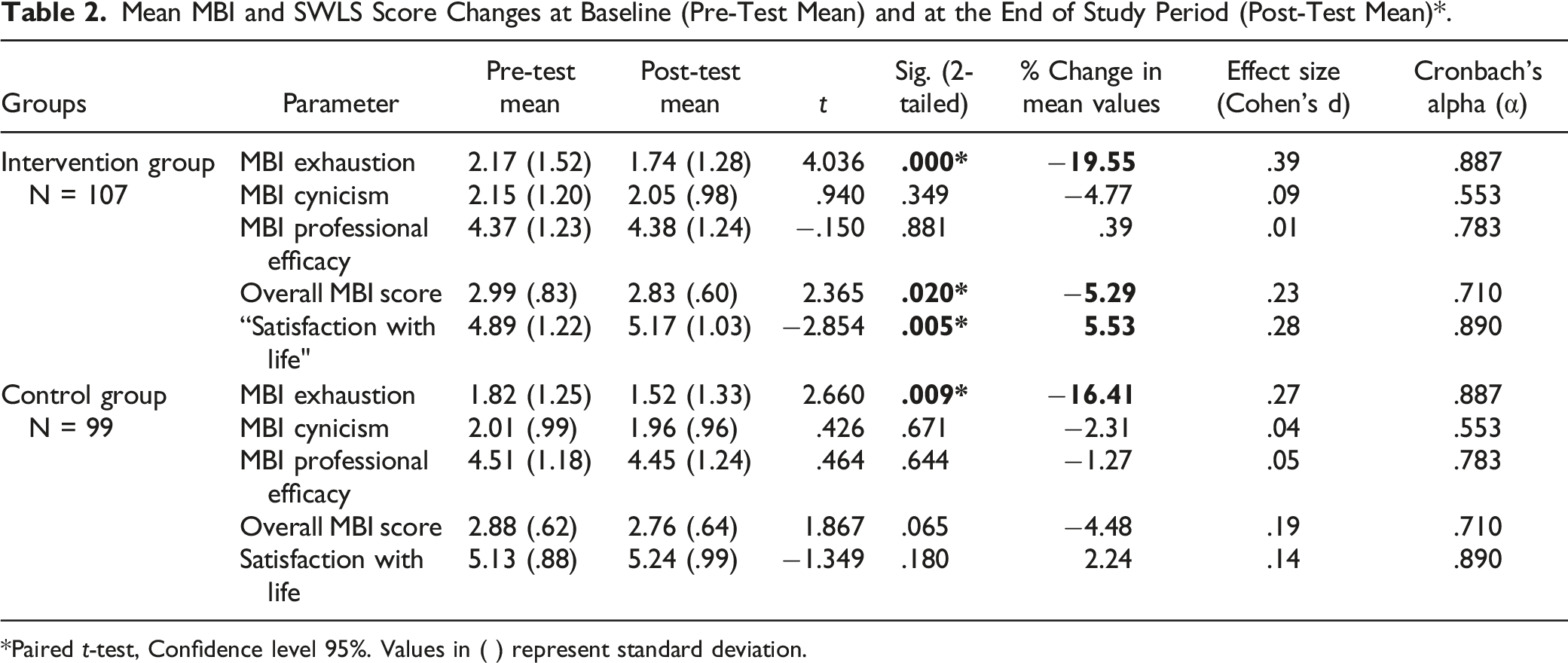
*Paired t-test, Confidence level 95%. Values in ( ) represent standard deviation.
MBI Burnout Results
At week 8, participants in the Heartfulness meditation program group experienced a statistically significant decrease in mean MBI emotional exhaustion and overall MBI scores. Their emotional exhaustion scores decreased from 2.17 to 1.75 (P = .00) and overall MBI score decreased from 2.99 to 2.83 (P =.020). In comparison, participants in the control group experienced statistically significant improvement for emotional exhaustion only from 1.82 to 1.52 (P = .009). Although there were differences between effect sizes for emotional exhaustion between the control group (.27) and intervention group (.39), the regression analysis did not reveal a statistically significant change between the groups (P = .190). The MBI subscales of cynicism and professional efficiency did not depict statistically significant changes in the intervention group. None of the other changes in the MBI measures in the control group were statistically significant (Table 2).
Satisfaction With Life Results
At week 8, participants in the Heartfulness meditation program group demonstrated statistically significant improvement with satisfaction of life score from 4.90 to 5.17 (P = .005). In comparison, the control group experienced improvements in satisfaction of life score from 5.13 to 5.25, albeit not statistically significant (Table 2).
Additionally, percentage change in post––test mean values was estimated for parameters that showed significant change with paired sample t-test (Figure 2). Although decline in MBI emotional exhaustion level was statistically significant for both intervention group and control group, participants in the Heartfulness meditation program group experienced higher levels of decline (19.55%) compared to the control group (16.41%). MBI Cynicism level declined for both groups, however, none was statistically significant. MBI professional efficacy increased for the intervention group by .39% while it declined for the control group by 1.27%. Both measures were not statistically significant. Overall MBI score depicted a decline for both groups. The decline was higher and statistically significant for the intervention group (5.29%) as compared to the control group (4.48%) which was not statistically significant. Further, the improvement of SWLS was higher and statistically significant for the intervention group (5.51%) as compared to the control group (2.3%) which was not statistically significant. Percentage change in mean values for parameters that showed statistically significant change with paired sample t-test.
Engagement
Daily Heartfulness Meditation Practice.

Discussion
The current study is one of the first studies to explore the benefit of Heartfulness meditation among accounting professionals. The findings aim to create awareness of burnout and satisfaction with life among accounting professionals and inform wellness leaders to address this issue using self-care interventions. While there are research studies demonstrating prevalence of burnout among accounting professionals,7,8 there is limited evidence of self-care interventions to improve burnout and satisfaction with life within this population. Employees were willing to engage in a meditation program aimed at reducing burnout and improving satisfaction with life. Moreover, participants in the intervention group experienced a statistically significant decrease in mean emotional exhaustion and overall MBI scores demonstrating favorable results to the Heartfulness meditation program as a feasible intervention to mitigate burnout. However, emotional exhaustion also showed a decrease in the control group and was not statistically different from the intervention group. Authors speculate that incidence of COVID 19 in India during the study period could have played a role in the decrease of emotional exhaustion seen in the control group. Specifically, the number of new cases in the preceding two months of the study period ie, April and May 2021 were 16, 004 ,773. In contrast, over the two months of the study period ie, June and July, the number of new cases were 3, 347 ,701 and mostly had plateaued. 40 This may be one of the reasons for an improvement in emotional exhaustion in the control group. Further, the intervention was beneficial to improve satisfaction with life. Findings from the study concurred with previous literature on internet-based meditation interventions.41,42 A meta-analysis study on online mindfulness programs showed a small but significant beneficial impact on mental health ranging between .29 and .32. 43 Further, another meta-analysis study on the effect of meditation based intervention on burnout reported a small effect size between .26 and .39. 44 The current study depicts an effect size of .2 for overall MBI score, .4 for MBI exhaustion and .3 for satisfaction with life among others adding to the limited body of literature supporting meditation-based intervention to be a potential means to manage burnout and well-being for accounting professionals.
The study demonstrated an attrition rate of 56%. This high attrition rate corresponds with previous experiences from online meditation-based interventions typically presenting an attrition of 42-60%.35,45 An RCT assessing the effect of an 8-week online mindfulness based stress reduction program for healthcare professionals presented an attrition of study of 50%, 46 another study on 8 week meditation program for stress reduction reported a completion rate of 41%. 47 Notably, while online meditation interventions have consistently shown higher attrition rates, the current study implemented virtual delivery for convenience during the COVID 19 pandemic. Nevertheless, even with high attrition rates, studies inferred effectiveness of the interventions among participants who utilized it as prescribed. Further research is needed to explore reasons for high attrition rates, especially for online-based meditation interventions.
There are study limitations to note: First, lack of randomization to either of the study groups is an important limitation of the study prone to confounding. Further, the fluctuations in the prevalence rate of COVID 19 in India throughout the study period might have played a part in changes to burnout and satisfaction with life score. Second, there could have been personal life factors of participants that played a role in the changes noticed. We speculate this because of the statistically significant changes seen in MBI emotional exhaustion of the control group. Second, the study did not restrict participants with prior or current experience with meditation practices which could have impacted the changes recorded in both intervention and control groups. The authors recommend future research to exclude participants with prior experience in meditation practices. Third, the impact of didactic components in the intervention vs the meditative aspects were not independently evaluated. The differences between the groups including participants who completed the study, those who did not, those that were highly engaged were not measured. Fourth, qualitative feedback from participants at the end of the program were not obtained which might have provided information on the upsides and downsides of the intervention. Fifth, long-term data about the sustained improvement to burnout and satisfaction with life beyond the study period is lacking. Lastly the study did not include an exploratory analysis. We have included this as a scope for future research.
Conclusion
The current study is one of the first attempts of a Heartfulness meditation intervention to reduce burnout and improve satisfaction with life among accounting professionals. The statistically significant improvements observed in the overall MBI and SWLS outcomes suggest an online Heartfulness meditation program could serve as a potential tool in reducing burnout and improving satisfaction among accounting professionals. Further larger randomized controlled studies would be recommended.
Footnotes
Acknowledgments
Authors gratefully acknowledge the support of The Institute of Chartered Accountants of India with funding, recruitment, and implementation of study. Authors particularly thank CA N. Jambusaria, President, ICAI; Mr. Debashish Mitra, Vice President ICAI; CA Anuj Goyal, Chairman of Research Committee, ICAI, Dr. Amit Agarwal, secretary of research committee, ICAI and CA Suresh Prabhu, India's Sherpa to G7. Authors express their gratitude to Kamlesh D. Patel, M. Pharm, global Heartfulness guide for his advisory role for the study. Authors wish to extend thanks to Mr. Stanislas Lajugie, Ms. Pallavi Rao, CA Vaibhav Goel, CA Raj Kumar Sharda, Dr. Krishnamurthy Jayanna and Dr. Snehal Deshpande for their immense support with study completion.
Declaration of Conflicting Interests
The author(s) declared no potential conflicts of interest with respect to the research, authorship, and/or publication of this article.
Funding
The author(s) disclosed receipt of the following financial support for the research, authorship, and/or publication of this article: This work was supported by the Institute of Chartered Accountants of India.
