



Abstract
Background
Levels of stress and burnout continue to rise amongst healthcare workers. In addition to systemic and institution-level changes to healthcare practice environments, well-being interventions, resources, and support to assist healthcare providers are necessary. Meditation practices like Heart Rhythm Meditation (HRM) may provide benefits to healthcare workers, but healthcare worker experiences with HRM are not well understood.
Objective
To explore healthcare worker experiences with HRM using a journey mapping approach.
Methods
An exploratory cross-sectional online survey was administered between May and July of 2020 to a purposeful sample of 25 healthcare workers currently practicing HRM. Surveys consisted of 5 open-ended and 36 multiple-choice items mapped to five journey mapping domains: Discover, Search, Assess, Decide, Assist. Descriptive statistics for survey items were generated in addition to a visual representation of a Persona and associated journey map for HRM. Content analysis was performed on open-ended responses using a general inductive approach to code responses and identify representative quotes.
Results
Twenty surveys were completed for a response rate of 80%. The majority of respondents identified as women (n = 14). From the journey mapping output, the overall emotional experience score was an 8.2/10, suggesting respondents had positive experiences with HRM. Open-ended comments suggest that HRM provides important benefits to the personal and professional lives of healthcare workers. A small number of participants reported challenges like feeling difficult emotions during HRM practice.
Conclusion
Mapping the healthcare worker journey with HRM identified generally positive experiences with personal and professional benefits. While experiences were largely positive, HRM elicited difficult emotions from some individuals, suggesting that appropriate resources and support are required when considering HRM and other meditation forms.
Burnout is a psychological syndrome emerging as a prolonged response to chronic stressors experienced in one’s work environment which have not been successfully managed.1,2 Burnout is characterized by three dimensions: physical and emotional exhaustion, increased mental distance from one’s job, and reduced professional efficacy. 3 High levels of stress and burnout are prevalent among healthcare workers, with existing studies indicating that approximately 50% of clinicians (physicians, nurses, pharmacists, and other professionals) report feeling burned out. 4
A large body of research has emphasized and evaluated self-care activities as potential coping-strategies for burnout, with considerable focus on mindfulness, meditation, and meditative practices.5-9 Meditation, as defined by the National Institutes of Health Center on Complementary and Alternative Medicine, is “a mind and body practice that has a long history of use for increasing calmness and physical relaxation, improving psychological balance, coping with illness and enhancing overall health and well-being.” 10 Meditation has been shown to have a number of benefits, including improvements in perceived stress and burnout.11-19 Further, mindfulness meditation may have positive effects on patient safety, with studies demonstrating a reduction in preventable errors.12,20-23 While numerous studies have focused on mindfulness and loving-kindness meditation practices, exploring additional forms of meditation practice used by health care workers like Heart Rhythm Meditation (HRM) may provide new insights.
Heart Rhythm Meditation (HRM) is a form of meditation that coordinates the fundamental rhythms of the heartbeat and breath, with the basic steps of HRM include sitting upright, concentrating on breathing full slow breaths, and observing ones heartbeat or pulse by using a finger on an artery or feeling the heartbeat through proprioception and counting heartbeats and pulse. Once the heartbeat is identified, the heartbeat and counting are used to balance breathing, making inhalation and exhalation equal in length with the intent of slowing down both the heartbeat and breathe. While empirical evidence of HRM benefits are limited, heart and breath-related meditative practice have the potential to promote conscious breathing, improve heart rate variability (HRV) and vagal tone, which are correlated with improvements in brain function, self-regulation, performance, health, and well-being.16,24-27 Pharmacists, pharmacy students, and a myriad of additional healthcare workers have reported engaging in, and benefiting from meditative practices, including HRM. Despite the increase in meditation amongst this population, the experiences of healthcare providers discovering, establishing, and maintaining a meditative practice are not well understood. 6 One way to understand these experiences is through the processes of journey mapping.
Journey mapping is a research methodology focused on the user experience and is typically employed to better understand consumer behavior, preferences, and experiences with products or services.28,29 Journey mapping enables visualization of the overall experience of an individual from their perspective, including feelings, motivations, and attitudes, as they move through various interactions or “touch points.”
30
For the present evaluation, we focus on the journey of healthcare workers who have engaged in and developed a HRM practice. By using research methods purposefully focused on gaining empathy for the individual experience and collecting data on the entirety of the experience, journey mapping has the potential to convey deeper and more nuanced insights than other evaluation techniques. These insights may subsequently be used to identify potential targets to develop and implement formal resources and programs designed to support healthcare workers’ well
Methods
This exploratory study was conducted between May and July 2020. A purposeful convenience sample of 25 healthcare workers with HRM experience were recruited to complete online, journey map surveys. The sample was comprised of pharmacists, certified pharmacy technicians, physicians, registered nurses (RNs), certified registered nurse practitioners (CRNPs), opticians, therapists, chaplains, and dentists and were identified by a study author (LW) as having experience with HRM.
The study author (LW) who identified participants is a Medication Safety and Compliance Specialist trained in HRM and is a Certified HRM Instructor who currently offers virtual drop-in meditation sessions at their institution. While some individuals identified to complete the journey map surveys had participated in the drop-in meditation sessions, others were recruited from outside the institution who had familiarity with the study author providing HRM sessions and had experience with HRM outside of and/or in addition to the drop-in sessions. While some study participants had participated in HRM instruction provided at the institution, the anonymous nature of the survey prevented those individuals from being identified. The drop-in meditation sessions consisted of weekly classes, taught by a certified HRM teacher (LW), where the fundamental steps of HRM were practiced, any questions or difficulties surrounding HRM were resolved, and individuals were prepared for an established regular HRM practice moving forward. The study was reviewed by the Institutional Review Board and received an exempt status.
Survey questions were informed by standardized items within the online journey mapping platform (Journimap, Iowa City, IA) and were adapted for HRM. The journey mapping survey consisted of 5 open-ended and 36 multiple choice items, collecting data from five journey domains: Discover, Search, Assess, Decide, and Assist. These domains were identified from existing human-centered design research, focused on collecting information related to multiple phases which provide a holistic reflection and visualization of an individual experience.30,31 Additionally, the journey mapping survey was informed by remote ethnography principles. 32 Ethnography is a methodological tool that “gets close” to a particular group and/or sub-group to uncover cultural phenomena, offering exploratory researchers an opportunity to uncover their social realities.33,34 Ultimately, the journey mapping survey was specifically designed to collect and visualize the dynamic experience of healthcare workers currently practicing HRM and to uncover specific components of the experience related to the practice.
The online journey mapping platform maps multiple-choice survey response items to each experiential domain (Discover, Search, Assess, Decide, Assist) and uses an algorithm to produce a visual journey map which is an aggregate representation of all respondents’ experience with HRM, titled: Persona, Empathy, and Current Journey. The Persona outputs can be described as an avatar representing an aggregate of all responses, providing generalized characteristics of the survey group based on median responses. The Empathy outputs are a visual depiction of four emotion domains: Think & Feel, Hear & See, Pain, Gains, which are common experiential domains within journey mapping work.28,29,35 While these domains within the Empathy output are specific to the journey mapping platform, they were designed to capture emotions experienced throughout the process of discovering and practicing HRM while facilitating empathetic understanding of the participant experience. The Think & Feel and Hear & See domains reflected participant emotions surrounding discovery and practice of HRM. The Pain and Gains domains captured participant emotions reflecting general difficulties and positive outcomes or benefits associated with HRM experience. The domain outputs were informed by the 35-items of the journey map survey and were generated by median scores for items in each of the five decision-making domains. The Empathy output also procured an overall emotional experience score, quantifying the overall experience based on the range of emotions felt in learning HRM. Scores may range in values from 0 to 10, with larger values associated with better or more positive experiences. The Current Journey outputs provide a visual depiction of the HRM process, progression through the five journey map domains. The Current Journey outputs mapped Good and Bad Experiences within the healthcare worker’s experience with HRM.
Descriptive statistics for survey items were generated in addition to a visual representation of journey mapping results. Content analysis was performed by two authors using a general inductive and manifest analysis approach to categorize open-ended responses and identify areas of salience and divergence.36,37 The manifest analysis approach to content analysis focuses on what the informants actually say and is well-suited to descriptively assess participants experience with HRM. 38 To encourage quality in qualitative research and to triangulate findings, initial open codes were assigned to open-ended response text by two study authors (LTM and MJW). The two study authors then met to group open-ended responses which reflected similar concepts, identifying similarities and differences in HRM experience and discussing the interpretation of responses. The two study authors developed a narrative which reflected the experiences of healthcare workers practicing HRM, which was reviewed by a third study author who was a certified HRM instructor and was providing drop-in HRM sessions (LW). Finally, all study authors met to discuss journey map results and identified themes.
Results
Quantitative Journey Map Survey Responses
In total, 20 surveys were completed for a response rate of 80%. Of the received responses, 70% identified as women (14) with 85% (17) of respondents identifying as white. The most frequent response categories for education level and annual household income were “Advanced Graduate Work or PhD” and “Over $100,000,” respectively. The journey map Persona output (Appendix 1) provides an avatar representing the mean age and most frequent responses from the sample.
Descriptive Statistics for Journey Map Items. a
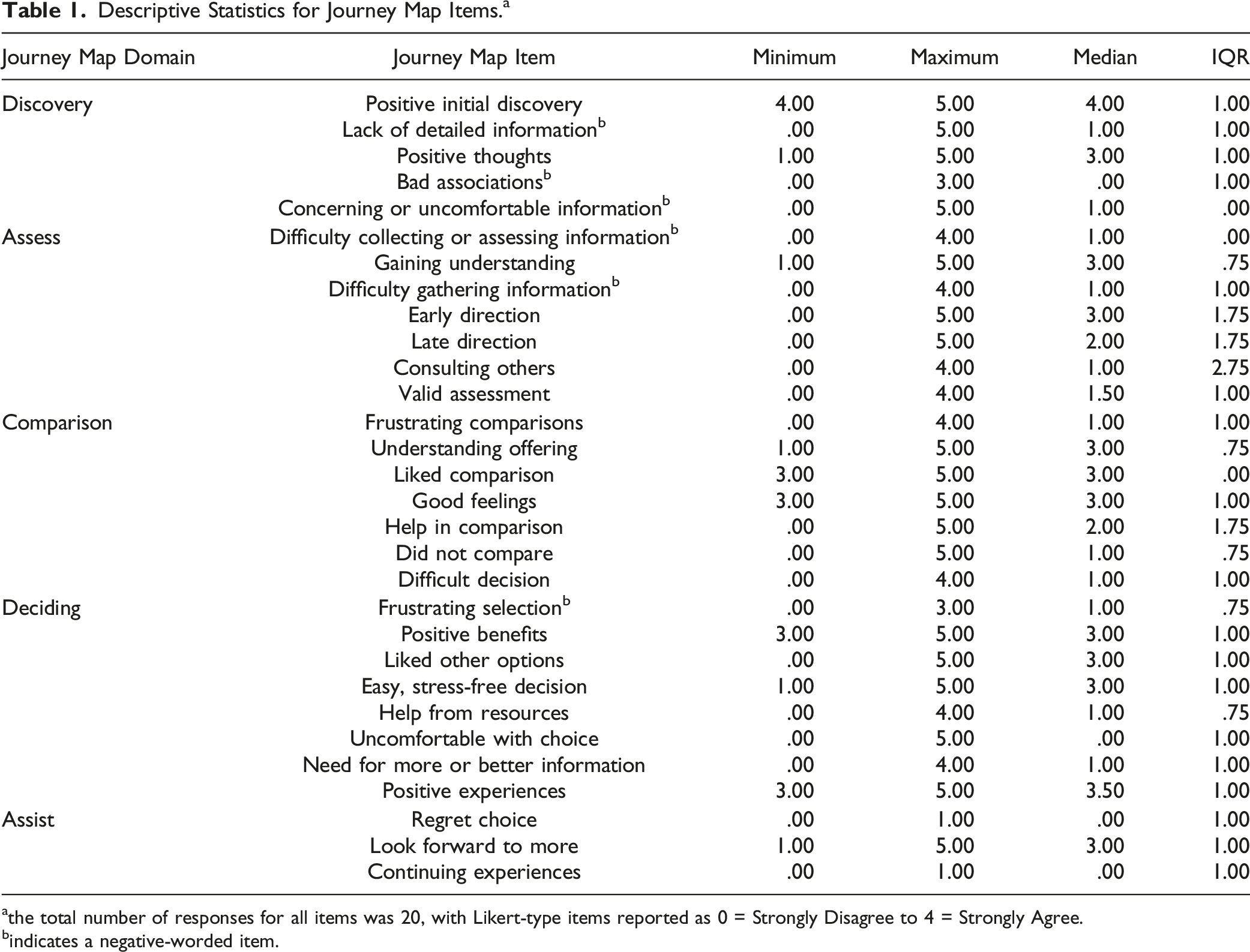
athe total number of responses for all items was 20, with Likert-type items reported as 0 = Strongly Disagree to 4 = Strongly Agree.
bindicates a negative-worded item.
From the Current Journey output, healthcare workers appeared to have the most difficult time in the Search and Decide journey map domains. The Current Journey output is included in Figure 1. Current journey output: Healthcare workers experience with HRM.
Qualitative Journey Map Open-Ended Responses
The process of discovering and engaging with HRM. Healthcare (HC) respondents were referred to HRM through different processes including personal invitations from colleagues and friends, or from an advertisement by the health system or health system wellness programming. Individuals had a wide range of HRM practice experience, which varied from 3.5 to 20 years. Additional quotations and their associated domain can be found in Table 2.
Through a physician at work that had attended the school. About 5 years ago. [HC9]
From a friend. 20 Years ago. [HC4]
Easy decision, I trusted the person who told me about it. [HC14]
Journey Mapping Domains and Quotes.
a
a(+) and (−) denote positive and negative comments within the healthcare provider HRM journey as determined during the coding process.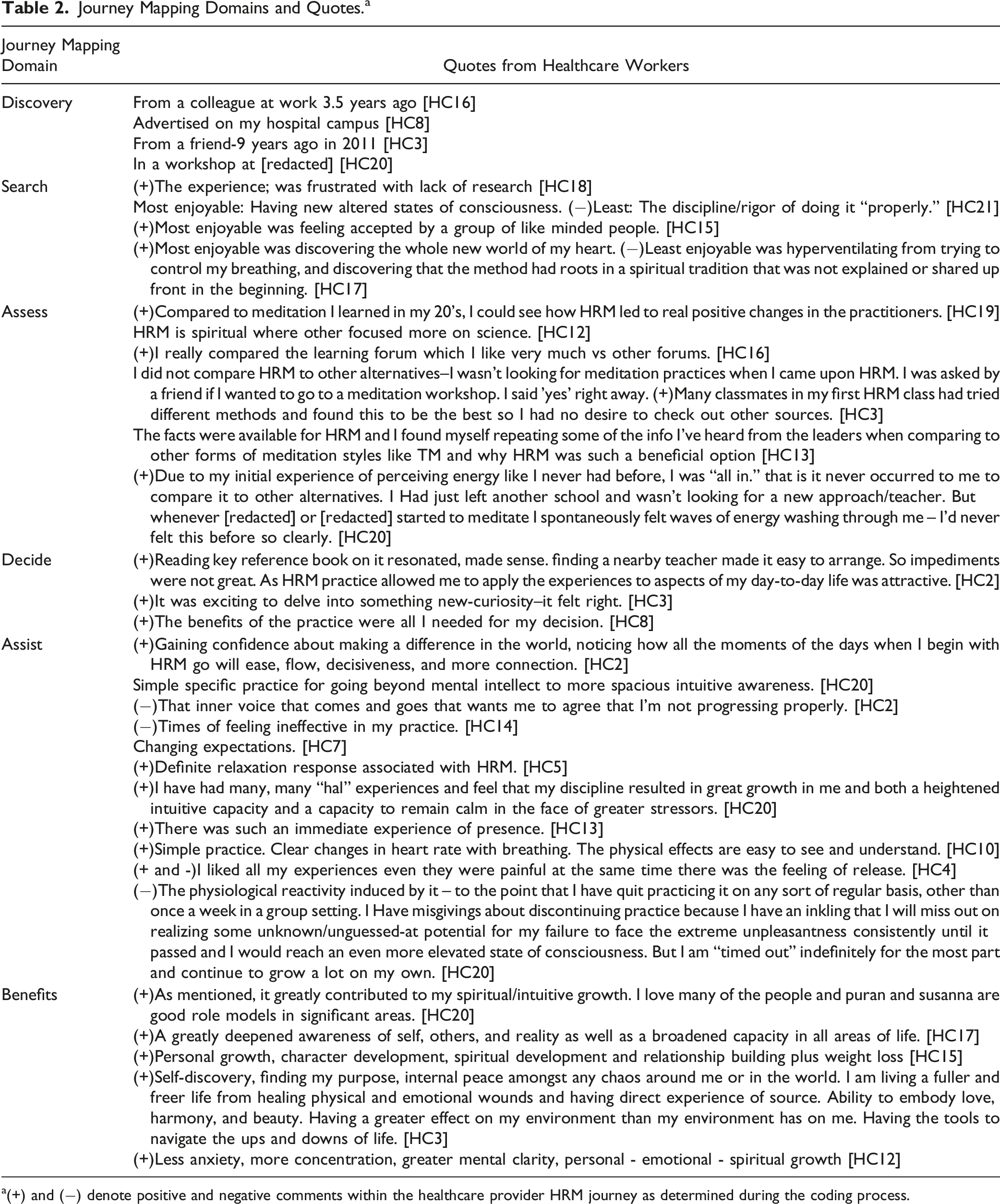
Respondents varied in their process for initially evaluating and discerning their engagement with HRM. Some found the premise for HRM intuitive and that it “felt right” [HC4] and appreciated the physiological basis for HRM. Others, however, wanted more explicit research supporting the HRM practice.
It was new and exciting form of meditation and based on science seemed to make sense. [HC9]
There is not any research in referenced journals about HRM. [HC16]
There are some materials in the teaching [session], but when it comes to more detailed or scientific-based information, it was difficult to get or find. [HC6]
Some participants had experience with other forms of mindfulness-oriented meditation and preferred HRM because of the flexibility, openness, and spiritual but not religious nature of the approach.
HRM helped me focus more than mindfulness. [HC9]
Most enjoyable was connecting my breath with my heartbeat--this felt like I was home. [HC3]
At first, it felt almost like work since I was used to just doing mindful meditating. But once I worked up to it… the benefits of breathing really seemed to have more benefits than mindfulness. [HC11]
Positive Experiences with HRM practice. Most individuals appreciated that HRM was practiced as a group with trained instructors guiding the weekly session. Many found community with their fellow meditators and instructors.
I loved the small group sharing. [HC8]
Feeling accepted by a group of like-minded people. [HC10]
Most enjoyable was the connection to the teachers and students. [HC4]
Many of the healthcare workers also reported benefits to individual growth which they attributed to their HRM practice including improving awareness, gaining confidence, being present, improving relationships, and better engaging with patients and the world.
Daily regular practice that benefited my well-being. [HC11]
Yes. improve relationship capacity and manner, self-trust, regulation of physical health. [HC2]
Deep and vivid experience of my emotions; clarity to negotiate higher salary; ability to authentically connect with and serve my patients. [HC14]
My benefits were strengthening my nervous system, getting self-worth, decision making got easier, there came more clarity into my thoughts and feelings, less fear for everything that is needed to do, more joy, better relationships. [HC4]
Negative Experiences With HRM Practice
While not a common sentiment, a small number reported challenges and frustration with HRM practice, especially early on as they were gaining experience. Some were initially hard on themselves for not doing HRM properly and comparing themselves to the experiences and abilities of others. Additionally, some individuals noted that it was difficult to establish a daily practice. Lastly, a few respondents shared they had experienced difficulty breathing and uncomfortable emotions, especially when practicing HRM on their own.
Least enjoyable was comparing myself to others in my meditation class that knew more and had deeper experiences than myself. [HC3]
Least enjoyable was to find a daily rhythm and establish a daily practice. Further to go to the deepest emotions as anger, fear, guilt, and breath through it. [HC4]
Initially I felt very incompetent. I went through a period of 4 months where I was drenched in sweat by the end of every 20 min. session -- it was most unpleasant, but I persisted…,[HC20]
The ONLY time I can count on it being pleasant is in a group setting. It is still extremely unpleasant at times -- a kind of nameless anxiety comes over me that I can barely stand. [HC20]
That inner voice that comes and goes that… I’m not progressing properly. [HC2]
Trying to control breathing, it felt unnatural and caused hyperventilation. [HC17]
Discussion
Overall, the healthcare worker journey with HRM was positive, with an aggregate emotional experience score of 8.2 without salient pain points. Some participants, however, expressed strong emotional reactions at different points in the process and expressed multiple difficulties in their HRM practice. There was variation in how healthcare workers gained an understanding of HRM and making the decision to continue an HRM practice. Other key findings were the importance of group practice and the personal and professional benefits to HRM.
Respondents shared a range of positive sentiments in their open-ended comments including the benefits of the practice on individual growth, self-management, and their ability to engage with patients. This provides some support that meditation practices such as HRM may be especially beneficial in the study population, as the majority of participants had completed advanced graduate work and were practicing clinicians, a population is especially susceptible to burnout.39,40 In the existing literature, institutions supporting meditation and mindfulness-based interventions while providing guided meditation and training resources appears to provide individual benefit.8,9,41,42 More specifically, a study on the effects of “Heartfulness Meditation,” a heart-based meditation practice, found that a 12-week program resulted in significant improvements in professional burnout and emotional wellness in residents, faculty physicians, and nurses at a large community teaching hospital. 5
Additionally, the group nature of HRM sessions that some individuals participated in appeared to provide considerable benefit and may be a key attribute to initial and sustained practice. A recent study by Hanley et al suggests that group meditation may be especially beneficial in producing states of mindfulness and improving feelings of social connectivity compared to a solitary meditation practice. 43 Other interventions commonly offered in group-settings, such as Yoga, have shown positive effects on healthcare worker stress and burnout. 44 Further, social support appears to mediate the effect of burnout in health-professionals, providing additional support that group-based interventions facilitating social support and connectedness may improve healthcare worker well-being. 1 A recent study by Halimi et. al. identified that peer and organizational support, and resilience-fostering programs, supported professional resilience in early career pharmacists. 45 As such, additional research is needed to explore and understand the moderating effects of group-based interventions, such as meditation, on participate experience and outcomes associated with interventions designed to improve healthcare worker well-being.
In addition to the reported benefits of HRM, qualitative responses suggested several challenges which may be useful to incorporate into the development of HRM programs, specifically related to developing a sustainable practice and the need for support. A number of participants reported difficulties establishing a daily practice and experienced negative thoughts, emotions, and physical responses to HRM. Studies have highlighted that negative emotions amongst healthcare workers with the initiation of meditative practice are not uncommon. 46 Further, long practices, emerging negative thoughts, and becoming self-critical were factors identified as key barriers to healthcare workers engaging in a self-help mindfulness-based intervention. 47 When considering the development and provision of meditation interventions, education and interpersonal support may help to improve the initial and sustained practice of meditation and facilitate the development and provision of meditation self-care activities. 48
Recommendations for Health Systems and Healthcare Workers
This exploratory study found generally positive experiences for HRM both in the areas of personal and professional growth, but also for community building when people meditate as a group. Health system investment in well-being programs and initiatives like group meditation sessions may help build connectedness and resiliency while potentially mitigating burnout. When encouraging healthcare workers to participate in self-care activities, organizations and institutions may benefit from considering how to support employees to engage in these activities, providing the necessary time and support to have positive experiences, outcomes, and develop sustainable meditation practices. In the instance of healthcare workers HRM practice, providing dedicated work time and access to licensed meditation instructors and other mental-health professionals may contribute to promoting meditation as a self-care activity.
While HRM and other meditation practices may be a potentially beneficial self-care activity promoting well-being and helping individuals cope with burnout, meditation is not a substitute for structural changes and organizational support for employees at a system level to address burnout and employee well-being.48,49 Additional workplace and organizational level changes are likely needed to prevent burnout and support employee well-being, in addition to the development and provision of evidence-based strategies to promote the health, development, and well-being of healthcare workers. 2
Limitations
The study should be considered exploratory, as a small, purposeful sample of healthcare workers were surveyed who already were enrolled in the HRM program. Further, the sample consisted of predominately women and individuals who had completed advanced graduate work, which may limit transferability of findings to other groups. Additionally, many individuals have established long-term HRM practices, and their experiences may differ from individuals with more recent familiarity with HRM. As journey mapping is designed to explore and understand individual experience, no control group (eg those who did not use HRM) was included in the study. Participants who initiated HRM practice but have been unable to sustain practice likely have different journeys and experiences. The survey also may be subject to recall bias as some participants made the decision to practice HRM years before completing the survey, with varying durations of practice, practice setting, and current practice having the potential to impact perceptions and experiences with HRM.
Conclusions
Overall, healthcare workers practicing HRM had generally positive experiences and reported a number of benefits from their meditative practice, including an increased connection with patients and colleagues. Care should be exercised in administering these programs as a small fraction of individuals reported difficult emotions and discomfort in their early experiences with HRM. Most healthcare workers practicing HRM persisted in their HRM practice, even when experiencing difficult emotions and perceived long-term benefits.
Footnotes
Declaration of Conflicting Interests
The author(s) declared the following potential conflicts of interest with respect to the research, authorship, and/or publication of this article: JC is the founder and CEO of Journimap, Iowa City, IA.
Funding
The author(s) received no financial support for the research, authorship, and/or publication of this article.

Persona output from journey map,depicting a general summary persona based on demographics and characteristics of all respondents.
Empathy output from journey map,depicting the experienced emotions and overall emotion score.