




Abstract
Introduction
Anthroposophic medicine is a form of integrative medicine that originated in Europe but is not well known in the US. It is comprehensive and heterogenous in scope and remains provocative and controversial in many academic circles. Assessment of the nature and potential contribution of anthroposophic medicine to whole person care and global health seems appropriate.
Methods
Because of the heterogenous and multifaceted character of anthroposophic medicine, a narrative review format was chosen. A Health Technology Assessment of anthroposophic medicine in 2006 was reviewed and used as a starting point. A Medline search from 2006 to July 2020 was performed using various search terms and restricted to English. Books, articles, reviews and websites were assessed for clinical relevance and interest to the general reader. Abstracts of German language articles were reviewed when available. Reference lists of articles and the author’s personal references were also consulted.
Results
The literature on anthroposophic medicine is vast, providing new ways of thinking, a holistic view of the world, and many integrating concepts useful in medicine. In the last ∼20 years there has been a growing research base and implementation of many anthroposophical concepts in the integrated care of patients. Books and articles relevant to describing the foundations, scientific status, safety, effectiveness and criticisms of anthroposophic medicine are discussed.
Discussion
An objective and comprehensive analysis of anthroposophic medicine finds it provocative, stimulating and potentially fruitful as an integrative system for whole person care, including under-recognized life processes and psychospiritual aspects of human beings. It has a legitimate, new type of scientific status as well as documented safety and effectiveness in some areas of its multimodal approach. Criticisms and controversies of anthroposophic medicine are often a result of lack of familiarity with its methods and approach and/or come from historically fixed ideas of what constitutes legitimate science.
Introduction
Anthroposophic medicine, founded in 1920 by Rudolf Steiner, Ph.D., with Ita Wegman, M.D., and other physicians, was conceived from the beginning as an integrative, multimodal and individualized approach to healthcare of patients, where physicians, pharmacists, nurses and various therapists work together to expand–not replace–conventional medical approaches. It was formulated and developed after requests from physicians (and later other therapists and as well as patients) to have a more complete and holistic view of the human being and broader and safer approaches to treat illnesses. After the peak of 19th century materialism, some physicians felt that the official paradigm of science and medicine was ignoring the whole patient and was never really fully addressed beyond the necessary material, physical aspects. At that time medical treatment was quite limited and with many adverse effects from which patients suffered. Anthroposophic medicine was therefore was developed as a response to the deeply felt need by these physicians and patients to have their full human stature, as fourfold beings, consisting of physical, functional-biological, psychological-autonomic, and spiritual aspects, acknowledged and treated concretely. These four major factors of a human life operate in health and illness in obvious and not so obvious ways and are specifically addressed in anthroposophic medicine.
Background: What is Anthroposophic Medicine?
In brief, anthroposophic medicine has several components. It takes the knowledge and insights from Rudolf Steiner’s anthroposophy (“consciousness and knowledge of the human being”) and applies the developed fourfold view mentioned above in a rigorous way to human health and illness. Deeper knowledge and insights into nature and its processes can then be used to make corresponding natural remedies and other therapeutic interventions for various corresponding illnesses or functional pathophysiology. Illness, whether functional or pathological, is seen fundamentally as an imbalance or abnormal functioning between the fourfold factors in an ill person’s organism that must be corrected and brought into functional harmony, and reverse, as much as is possible, the pathological diseased states. Symptoms are seen as an attempt by the human organism that often–but not always—inadequately or inappropriately deal with the underlying pathology. Therefore, symptoms are not usually suppressed (unless the patient’s life or an organ is in danger) and are instead appropriately guided with natural, conscientiously-prescribed remedies, or other modalities, to overcome the illness and regain balanced health. Depending on medical necessity, this may also include judicious use of conventional drugs and interventions. True health in anthroposophic medicine is seen as a balanced and dynamic state which is in accordance with the healthy fourfold functioning of the human being within three major functioning organic systems that are interactively and dynamically working throughout the human organism. These major functioning systems, both physiological and morphological, form another aspect of the human constitution and include the nerve-sense system, the rhythmic system and the metabolic-limb system, as these are differentially expressed throughout the human being. While illnesses certainly are treated in anthroposophic medicine, there is usually an attempt to at the same time support the patient’s own healing capacities (salutogenesis) in the context of their fourfold factors and threefold organic functioning systems.
When delving into anthroposophic medicine, it becomes clear that another major component involves an extensive reformulation of one’s thinking, and also of the prevalent scientific views pertaining to what constitutes a human being. This includes understanding and evaluating the determinative biological, functional, psychological-autonomic, and spiritual levels in health and illness. This reformulation and revisioning also applies to surrounding nature, and ultimately to the wider universe.
Another major component of anthroposophic medicine is the emphasis on the physician being a healing therapeutic force, to help the patient’s own healing capacities, alongside use of medical remedies, advice on modifiable lifestyle factors and use of important non-medication treatment modalities. Much can be gained in a recovery towards health when the patient has trust and confidence in their physician, who displays an appropriate mixture of caring, struggle, expertise, confidence and circumspection. Thus, anthroposophic medicine places a heavy emphasis on the personal and professional development of the physician. To truly practice anthroposophic medicine, the physician is invited to embark on a conscious, meditative, moral and cognitive path of self-knowledge and self-transformation to develop a strong therapeutic will and become an ever more effective “remedy” (therapeutic agent) for the patient. Patients can sense a difference between this intense, empathic will to heal, and the often quick and routine approach that can be frequently employed in conventional medicine. With this sense experienced by patients, they are stimulated to embark on the various and necessary aspects of their path to healing. Complementary to the spiritual and moral development of the physician in anthroposophic medicine, is then the recognition of the patient as an autonomous agent with dignity and self-responsibility, along with their need for professional guidance in stimulating their organism’s self-healing potential.
Through the past one hundred years, anthroposophic medicine has developed into a sophisticated and complex form of integrative medicine. It originated in Europe but has now expanded to many countries around the world, including the US.
Using the epistemological (conceptual analysis of what is knowledge)1–4 and philosophical,5–8 scientific,9–12 Goethean scholarship results,13–15 and the spiritual insights and methods of anthroposophy,4,16–27 anthroposophic medicine has thereby developed a very complex and encompassing view of the human being in health and illness. It acknowledges and works with the integrated, real and dynamic workings of physical, functional-biological, psychological-autonomic, and spiritual factors and processes in the human organism (also referred to as “members” of the integrated human entity).
It greatly expands the reductionist, truncated and physical-chemical view and understanding of the human being by biomedicine and natural science. Anthroposophic medicine is not at all contrary to their legitimate conceptions and established results in their own realms. However, it strives to continually expand the therapeutic options in medicine and therapy by including a more conscious use of many modalities including, healthy organic nutrition,28–31 various types of natural medicines and especially uniquely anthroposophic medicines,32 eurythmy therapy (imaginative, mindful movements),33--35 therapeutic anthroposophic nursing procedures, 36,37 therapeutic rhythmical massage,38 various artistic modalities in creative speech formation and therapy,39--43 music therapy, clay modeling, painting therapy, therapeutic drawing and color therapy. (Information on these are all found under the umbrella organization, AHA, Anthroposophic Health Association.) 44 The Anthroposophic Pharmaceutical Codex, APC, 45 gives a comprehensive and authoritative list of the therapeutic substances in anthroposophic medicine, their description, origin, constitution, and quality standards for manufacturing, for both homeopathic and anthroposophic medical products. Table 1 gives more information on what are anthroposophic medicines. Further helpful, reliable and introductory sources on anthroposophic medicine are also available45--54 (see Supplementary Materials, S1).
Anthroposophic Medical Products.

For more information see references 32, 49, 78–81.
Over the last few decades, anthroposophic medicine has developed and matured to the point that there is now a research base with comprehensive technology assessment reports,55,56 a website with a collection of the latest research, 57 standardized training courses around the world 58 with international credentialing criteria, 59 and major English language textbooks and other works in family medicine, 60 internal medicine, 61 pediatrics,62–64 and functional morphology. 54 Other works exist in German. In addition, since 1995, anthroposophic medicine has established itself in six European academic university settings, including the Universities of Bern, Switzerland, Berlin (Charité), Witten/Herdecke, Freiburg, and Alfter (Alanus University of Applied Science) in Germany, and Leiden in the Netherlands. There are 2 chairs (Witten/Herdecke and Berlin) and four professorships explicitly dedicated to anthroposophic medicine (Witten/Herdecke, Bern and Leiden) or anthroposophic medical education (Witten/Herdecke), and five professorships dealing with specific research projects on anthroposophic treatment modalities (Witten/Herdecke, Freiburg and Alfter), and likewise, at least 20 Ph.D. researchers at these and other universities (Peter Heusser, M.D., personal communication).
Epistemological Basis and Conception of Anthroposophic Medicine
Significantly, a comprehensive publication, Anthroposophy and Science: An Introduction by Professor Peter Heusser, M.D., from Witten/Herdecke University, Germany, appeared in 2016. 65 This important and updated English version of his original work in the German language presents a detailed scientific explanation of the view of the human being underlying anthroposophy and anthroposophic medicine. It also provides a conceptual basis for integrative medicine, critically evaluating the various fields of natural science as well as the philosophy of mind that impact medicine. A careful reading of this comprehensive work can provide a modern, philosophically and scientifically sound, holistic understanding of what it means be a human being. The resultant analysis, synthesis and outlook is potentially capable of overcoming the reductionistic, molecular-material, and one-sided naturalism of modern science and medicine. Not only can science and its results be reformulated to be more comprehensive and inclusive of non-sensory-based processes, it can also be expanded to include refreshingly new ways to actually participate in legitimate scientific research.5,9–12,22 Goethe originally introduced a non-reductionist, scientific method involving both intense observation and conscious participation in natural phenomena developing over time.1,9,66 This type of phenomenological approach has more recently been advocated by other researchers.67–69 Steiner elucidated a firm methodological basis to Goethe’s method and work, and expanded his approach to nature to include non-sensible, yet perceptible phenomena through an enhanced training of our normal cognitive ability.1,3,4,17,23 Legitimate and reliable science does not have to be solely limited to physical experimentation and quantification, as is usually assumed by many philosophers of science and practicing scientists. A Goethean approach to science has also led to some productive results.68–73
Many people, both patients and non-patients, suffer biologically, psychologically and spiritually from the common, restricted, dogmatic and monoparadigmatic ideology that science and biomedicine offer and practice (the exclusivity of scientific materialism, scientific naturalism or scientism). 74 There is a truly trenchant criticism of the ideology or world view of scientific materialism and reductionsim1,3,65,74,75 that is demanding to be taken to heart by the medical profession. While the advances in science and medicine since the 19th century are epoch-making and frequently valuable, many can experience, directly or indirectly, the drawbacks, one-sidedness and adverse effects of modern medicine; hence, the rise in interest and use of integrative medicine and other medical systems by patients to more fully address their suffering. Many physicians recognize this need; this is borne out by a movement to address the one-sided conventional approach with the establishment of academic integrative medicine clinics and research centers in many US medical schools (as well as in many European centers). The National Center for Complementary and Integrative Health at the National Institutes of Health (NIH) and the Academic Consortium for Integrative Medicine and Health both exist as a response to meeting the needs of patients and to the need for more systematic research.
The Academic Consortium’s definition of integrative medicine and health is “integrative medicine and health reaffirms the importance of the relationship between practitioner and patient, focuses on the whole person, is informed by evidence, and makes use of all appropriate therapeutic and lifestyle approaches, healthcare professionals and disciplines to achieve optimal health and healing.” 76 The anthroposophic medical approach has been pioneering this paradigm for 100 years. As result, patients who have experienced anthroposophic medicine report higher satisfaction compared to conventional patients. 77
Anthroposophic medicine may be considered unique as an integrative medical system in that it offers a consistent, coherent, rigorous, fully human, and a century-long integrative philosophy and scientific approach. This discipline informs the medical and functional diagnosis of illness, the promotion of more vibrant health (salutogenesis), and the formulation, production and proper use of medicines and other therapeutic modalities. All anthroposophic physicians must be fully trained and licensed in conventional medicine. Additional certified training is necessary “to expand the art of healing by spiritual knowledge of the human being” 23 before becoming an anthroposophic physician. This expansion and training aims to provide a concerted effort to philosophically, scientifically and conscientiously reformulate one’s “scientific” education, and to apprehend the insights of anthroposophy and anthroposophic medicine.23,54,60–64 Students are introduced to a rigorous meditative path of cognition-insight,4,16–21 potentially leading to real and concrete spiritual knowledge as lived experience. Appropriate post-graduate training, usually with accountable certification, are also currently offered for many paramedical, healing professions such as nursing, therapeutic rhythmical massage, eurythmy therapy, arts therapy, psychotherapy, creative speech formation, as well as in anthroposophic pharmacy. Trainings in other modalities, informed by anthroposophy, may also be envisaged.
While anthroposophic medicine is ambitious in it attempts to be as comprehensive an integrative medical system as possible, it certainly needs and bases itself on the knowledge and advances of conventional medicine. It was never conceived to be an “alternative” or “completely independent” medical system ignoring the hard-won advances over the centuries in science and medicine. 23 Some of its historical roots also lie in the European context of homeopathy, naturopathy, alchemy and western herbal medicine.23,25,78–81 However, it is clear that the insights and methods of anthroposophic medicine provide many new approaches to the use of older natural remedies, also providing many original and unique remedies and modalities for treatment61,62 (Table 1). Thus, anthroposophic medicine provides a foundation for a comprehensive and rational and scientific system (including conventional medicine) for diagnosis and therapy. 32,54,60--62,65,78--81 It also has the potential to help integrate the various fields in integrative medicine into a firm, scientific and fully human foundation. 65
Pillars of Anthroposophic Medicine
As previously noted, anthroposophic medical physicians are conventionally trained in academic medical institutions. They therefore see conventional medicines as potential contributors to attaining health and make judicious use of them as needed. In addition, anthroposophic medical practice also employs many complementary and alternative modalities if they have theoretical, practical, or supportive research evidence base that informs their clinical and anthroposophical use to help make a relevant contribution to a person’s health and development. In some circles, the use of homeopathy (or potentized substances), naturopathy, alchemy, as well as herbalism is controversial at best and deemed “unscientific” or “irrational” and “unproven” by skeptics and critics, especially in some dogmatic, scientific and materialist circles. However, an unbiased review of the medical, nutritional and herbal literature shows beyond a doubt that plant substances, homeopathically potentized remedies and nutritional supplements have health-promoting and disease-modulating biological effects.82--85 As in any medical system, they certainly have to be used rationally and not in a haphazard way (which the training in anthroposophic medicine provides). Homeopathy has its own extensive literature documenting its effectiveness and safety in at least some conditions85--96 (see Supplement S2).
There are similarities and overlap between the medical systems of homeopathy and anthroposophic medicine. 45,60--62,64,78 However, there are important differences. Homeopathy uses, almost exclusively, the oral and topical routes, while anthroposophic medicine uses all the established routes of administration as is done in conventional medicine (Table 1). Homeopathy often uses much higher potencies (“dilutions”) while anthroposophic medicine sticks to lower potencies, usually 30X or less. The therapeutic principle of homeopathy, the law of similars (“like cures like”), is recognized in anthroposophic medicine, but it also recognizes 6 other therapeutic principles 61 (see Table 2). Lastly, anthroposophic remedies originate from the anthroposophic knowledge of the human being and nature’s processes, while homeopathy relies on empiric “provings” of substances in healthy volunteers.
How Anthroposophic Medicines Work: Therapeutic Principles.

Adapted from Girke M, Internal Medicine: Foundations and therapeutic concepts of Anthroposophic Medicine, 2016. 61
Perhaps much of this reality may irritate inveterate scientific materialists or other critics with their own vested interests–often provoking irrational derision. However, the positive clinical science in these areas simply cannot be denied.
Organic, specifically biodynamic food97 and nutritional science are also an important part of anthroposophic medicine. Current research documents the health benefits of organic, minimally processed food which is largely free from all types of biocides, petrochemicals and heavy metals when compared to conventionally grown food.98--100 Given current agricultural, military and business practices of using and then disposing of thousands of potentially dangerous petrochemicals into the environment, it isn’t surprising that the FDA has recently found disturbing amounts of dangerous petrochemical toxins in food such as perfluoroalkyl and polyfluoroalkyl substances (PFAS).101,102 Also, perfluorinated compounds in food have also been associated with a reduced vaccine humoral immune response (lower clinically protective antibody levels) in exposed children.103 This is another documentation of the health-harming effects of environmental toxins.
There is a wealth of literature on the negative, toxic effects of conventionally grown food104--107 and the health benefits of organic food.108 Ideally, using biodynamic food would be part of an anthroposophic medical practice because of its organic farming methods (largely free of environmental toxins and contaminants) and its superior effects on soil quality.109,110 However, at this time, its availability is limited to certain regions in the United States, often operating in the context of Community Supported Agriculture (CSA) systems. Current nutritional and biomedical research also point to the importance of food quality as well as the use of some supplements in maintaining and promoting health.111,112 Recent research out of France from a large, prospective cohort study (NutriNet-Santé) has shown the detrimental effect of commonly-eaten, ultra-processed food on increased overall morality, risk of cancer, type 2 diabetes mellitus and cardiovascular disease.113--115
For many centuries, alchemy has been largely misunderstood, undervalued and ridiculed by scientists, the lay public, and physicians. However, its invaluable proto-scientific contributions have been well documented. 116 Western alchemy has contributed historically to an understanding of chemistry and pharmaceutical processes for natural substances. In anthroposophic medicine, a transformed and more scientific, alchemical and threefold Paracelsian thinking is being applied to understanding nature, its relationship to the human being, functional pathophysiology, medical diagnosis, and treatment.23,36,54,60--62 Pharmaceutical processes employed in anthroposophic medical pharmacy use renewed and more modern insight into alchemical processes in the manufacture of natural anthroposophic remedies. This approach is in a manner that is compatible with scientific consciousness and understanding and not shrouded in mysticism or arcane terminology. 45,78,80,81,117
Potential Contribution of Anthroposophic Medicine to Conventional Medical Care
Anthroposophic medicine is a comprehensive and integrative medical system that can complement conventional medicine in many fields. There are currently, for example, five specified major “care areas” that show its particular promise and relevance in contributing to current medical practice. These five care areas already have had considerable development in anthroposophic medicine.118 Specifically, these care areas are: 1. Pregnancy, birth and early childhood as well as developmental disorders and their related disabilities. 2. The treatment of fever and febrile infections (especially respiratory illnesses, otitis media and urinary tract infections). In view of the current crisis with antibiotic resistance, anthroposophic medicine has a long tradition of treating the vast majority of these types of infections with much reduced use of antibiotics and antipyretics,119--121 including even some cases of hospitalized pneumonia (both viral and bacterial), with good clinical outcome.122 3. Mental health treatment, such as sleep disturbances, common forms of anxiety and depression, post-traumatic stress disorders, involving only minimal and judicious use of psychotropic medications. 4. Oncology, including adjuvant treatment with Viscum album L. (European white berry mistletoe) in various pharmaceutical preparations, along with other conventional and complementary oncologic services. 5. Palliative medicine, pain therapy and management, and the accompaniment of dying patients, including the provision of psychospiritual care. Within anthroposophic clinical contexts, the need for opioid medications clinically appears to be reduced.
In summary, anthroposophic medicine can offer supporting treatments and therapies alongside conventional medicine, especially but not only in the above fields which are so challenging for practitioners with current limited tools (pharmaceutical drugs, short appointments, and limited availability of effective psychotherapy). Its spiritual and integrative insights, as well as its differentiated vocabulary and enhanced theoretical constructs, offer tools to address the desired but unmet biophysical, functional, psychological, and spiritual needs of the human being, both in sickness and in health. 65,123 The preferences, perspectives and motivations of patients, especially those with chronic diseases, and the limited offering of conventional options, have been major drivers for the advancement of integrative medicine and anthroposophic medicine in the US.
Scientific Basis of Anthroposophic Medicine
Given its roots in the spiritual science of anthroposophy, the question can be asked as to whether anthroposophic medicine is in fact, genuinely scientifically based or rather the mere construct of an eccentric philosophical system and a reversion to pre-scientific belief systems. In other words, does anthroposophic medicine have a genuine scientific basis or is it a mere non-science or a pseudoscience?
The previously mentioned book, Anthroposophy and Science: An Introduction, 65 clearly delineates the scientific character and basis of anthroposophic medicine and anthroposophical spiritual science. The author points out that through rigorous self-observation in the act of thinking and then subsequent conceptual analysis of the experience, one can come to the conclusion that the access to full reality is not simply derived only from the external world by perceptions or impressions through the sense organs or their instrumental extensions. Only when the act of perceiving is brought together with the corresponding, inherent concept in the act of cognition (the act of knowing) is the full reality apprehended. This epistemology (theory of knowledge) is called objective ontological idealism (also known as universal realism, empirical ontological idealism, or simply, objective idealism, as Steiner termed it 2 ) In other words, ideas and concepts are a real and an objective part of full reality.
Panel 1. The objective idealism of Rudolf Steiner
Ideas and concepts are a real and an inherent part of the full reality that we can come to know through cognition; they are not arbitrary, subjective inventions of the mind. They have real, ontological status; that is, concepts and ideas corresponding to the perceptions we receive are inherent and objective constituents of reality, but we experience them within the mind.
As well as outer sense perceptions there are also inner perceptions derived from embodiment or the psyche (e.g. pain, thoughts, desires, feelings, etc.); both may become objects of our perceptions. Without the corresponding concept or complex of concepts, a world of only observed perceptions, whether inner and outer, would be completely unintelligible and appear as an entangled jumble of meaningless and unassociated flow of perceptions.
It becomes clear that linking concepts to perception forms a necessary part of accessing reality. Without validating the pre-existence of concepts and their associated ideas, that we can apprehend, there really is no possibility of obtaining any knowledge of anything whatsoever. More importantly, it would invalidate the very aims and existence of any true science. In other words, science would not be possible. This achievement in observation, insight and conceptual analysis, was developed by Rudolf Steiner and described in detail in The Philosophy of Freedom 3 and further elaborated by Heusser. 65
In science, medicine, and research in general, the fundamental scientific methodology consists in uniting inner or outer observations with their associated concepts in order to grasp the underlying lawful connections in an act of judgement or discernment. This universal process of cognition accompanied through an act of judgment constitutes the real fundamental scientific method. The careful, systematic application of these lawful connections to a field of study constitutes real science. While this type of application of our conscious cognitive process in the scientific method requires extensive training and effort, it doesn’t have to be characterized exclusively as consisting of experimentation, hypothesis generation, mathematical quantification, statistics, atomistic or molecular thinking, etc. To insist, as some do, that science must involve experimentation, quantification, deductive and inductive reasoning, reductionism, and only employ the current methods of natural scientists, and that all else must be speculation or worse, is a historically and culturally determined and uncritical view of current convention. As a general rule, most physicians and scientists haven’t had the time and exposure to critically look at the epistemological and metaphysical foundations (“first principles”) of science. 124,125
Steiner and Goethe’s methodology offer empirical and rational accounts of the emergent, systemic and higher-order properties of biological life functions and psychospiritual levels of human functioning in health and disease. While the methods of current natural science (analysis, reductionism and mechanisms) directed at the physical-chemical and molecular levels are legitimate, necessary and valuable, the emergent and higher order properties in the human organism cannot be grasped this way. Without additional, empirical and rational higher-order concepts the human being simply can’t be fully understood—and patients sense this when they are subjected to many conventional medical practices and attitudes.
The schematic Table 3 below may be helpful to see how anthroposophic physicians and scientists view the human being and nature. In this simplified table, each of the 4 hierarchical levels or realms of nature and the human being have interactions, influences and coordinated responses with a level above or below (see double-headed arrows). The three higher levels have emergent properties that cannot be predicted nor explained by a lower level. 65 In addition, the higher levels have a determinative and organizing effect on the lower ones. The recent results of science in physics, chemistry, biology, genetics, psychology, neuroscience, consciousness studies, and philosophy of mind all point to higher, more complex and emergent laws that determine the expression of lower levels. It requires intense study and practice for this to be fully recognized. This is all discussed in detail in Heusser’s book, Anthroposophy and Science. 65
The Anthroposophical View of Nature and the Human Being.
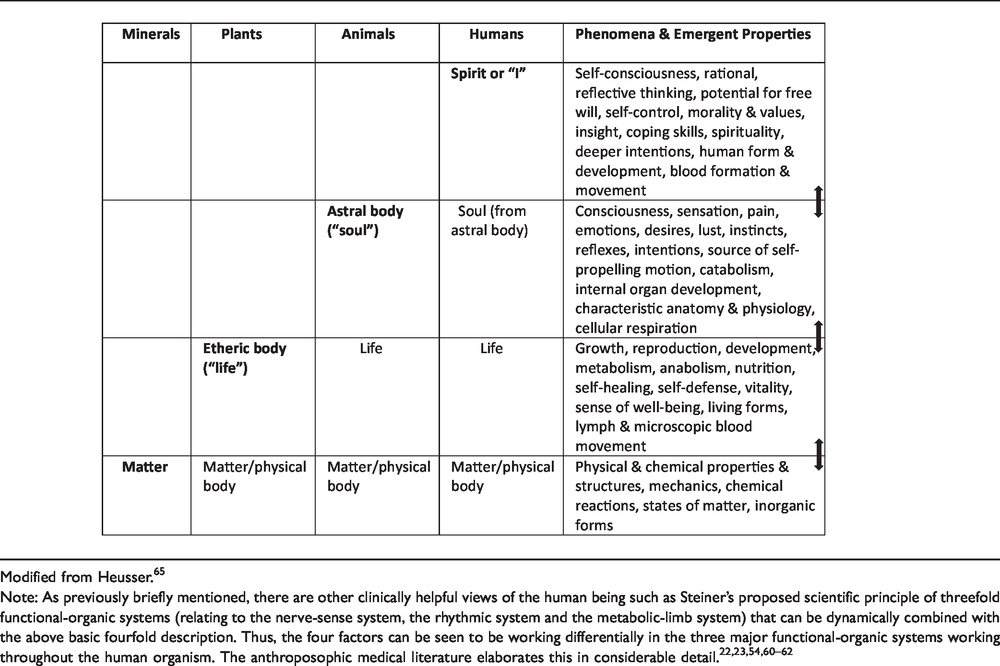

Modified from Heusser. 65
Note: As previously briefly mentioned, there are other clinically helpful views of the human being such as Steiner’s proposed scientific principle of threefold functional-organic systems (relating to the nerve-sense system, the rhythmic system and the metabolic-limb system) that can be dynamically combined with the above basic fourfold description. Thus, the four factors can be seen to be working differentially in the three major functional-organic systems working throughout the human organism. The anthroposophic medical literature elaborates this in considerable detail.22,23,54,60–62
Table 3 has technical terms introduced by Rudolf Steiner such as etheric body, astral body, and “I”. They have specific and somewhat unique meanings in anthroposophy and anthroposophic medicine that are much broader than the corresponding terms, “life”, “soul” and “spirit”. These technical terms include, beyond the common terms, broader supra-sensible aspects as well as organic and unconscious aspects working in human anatomy, physiology, biochemistry and pathophysiology.18,23,24,54,60--62 Looking at characteristic published medical literature,35,41,46,50,54,60?64,81 it becomes clear that anthroposophic medicine is not just a conglomeration of the various complementary approaches, but an original and integrative, multimodal and individualized way to address the full, integrated, fourfold human composition.
Although the current scientific approaches are often helpful and necessary when employed in scientific endeavors in both the natural and social sciences today, they are not, however, a necessary prerequisite to do science. Furthermore, the repeated dogmatic criticisms by scientific materialists in conventional medicine against nonconventional aspects of integrative medicine threaten to stifle free development of legitimate scientific inquiry and the progress and validation of various schools of integrative medicine, including anthroposophic medicine. The human biopsychospiritual organism is very complex, and no one isolated medical paradigm can possibly have the complete answer when addressing the complex needs of sick human beings. What seems to be needed is pluralistic array of evidence-informed and safe medical approaches to more fully meet the suffering patient; not a restricted and materialistic monoparadigm of biomedicine (excluding other medical systems) that may indeed serve some specific needs but whose overreliance has led to many of our current problems of microbial antibiotic resistance, expensive pharmaceuticals with significant adverse effects, and pollution of the water supply and environment by current medical-pharmaceutical practices. The current exponential costs of modern biomedicine are also not sustainable by any socio-economic system and this needs to be fully recognized (and addressed).
Criteria to Discern What Truly is a Science
In 2018 an important paper published in Complementary Therapies in Medicine by Baars et al., addresses, from another point of view, the scientific status of anthroposophic medicine. 126 They assessed the scientific status of anthroposophic medicine based on the demarcation criteria proposed by contemporary philosophy of science. Looking at eight publications, they combined all the various proposed criteria to demarcate (“set boundaries to”) true science from non-science (i.e., definitely having no significant scientific attributes) and pseudoscience (i.e., superficially appearing as a science), as well as to characterize true science in medicine. Eleven criteria were culled and condensed from the relevant literature and ordered in logical sequence. See Table 4 for the list of the succinct eleven criteria from the authors’ paper.
Criteria for the Demarcation of Science and Non-Science, Based on Contemporary Philosophy of Science.

From Baars et al.126 Used with permission.
Baars et al. go into detail to show how anthroposophic medicine meets all these criteria and thus has scientific status and validity. Also, Heusser’s book, Anthroposophy and Science, 65 can complement and elaborate what is in the Baars et al. article. Their considered conclusion doesn’t mean that anthroposophic medicine and anthroposophy aren’t controversial for many conventionally trained physicians and scientists. However, looking at the historical development of natural science may provide insights into the basis of the controversy.
Modern science had much of its historical beginnings from the natural Western philosophy of the 16th and 17th centuries especially from the work of René Descartes, Galileo Galilei, Francis Bacon, Isaac Newton, Robert Boyle, and John Locke.124,125 These natural philosophers (early scientists) and mathematicians defined and developed the naturalistic epistemological stage as well as the mathematical, atomistic, and skeptical foundations for natural science and its methodology. The decision and claim were made that in order for natural science to progress and be more objective, it needed to focus on primary, measurable, and quantitative qualities, such as number, mass, velocity, temperature, extension, etc. of the sense-perceptible world (scientific naturalism), and ignore secondary qualities like color, sound, taste, smell, cold, warmth, etc. produced as “subjective” sensations in human observers. Later, this same approach was applied to the human being. Thus, mind, consciousness, emotions, feelings, pain, etc. were viewed as only complex neurochemical and neurophysiological (physical) phenomena that produces or causes the qualities of consciousness. This historical, philosophical and scientific decision has advanced the endeavors and fruitfulness of natural science up to this day. However, Goethe9,66–73 and Steiner1,3,4,10,11,16,18,22–27 demonstrate, for example, that there are other ways to engage in legitimate and rigorous scientific work that involve secondary sensory qualities and also supra-sensible phenomena (like consciousness and mind); those that are immediately accessible to our consciousness, and those that require considerable enhancement of our latent capacities through systematic, mental meditative exercises.17,19–21,23
To experience and learn to see in a new, scientific and phenomenological way, some works can be particularly helpful. This would include Steiner’s work on the epistemology (how do we come to truly know?), the experience and observation of pure thinking, and the experience of conscious freedom, titled The Philosophy of Freedom, 3 as well as some of his many books on meditation.17,19,21 To experience the Goethean way of seeing the world and its fruitful approach, as well as understanding the distinction and relationship between Goethean science and Steiner’s anthroposophy, several sources are recommended.9,14,67–70
Summary of Scientific Basis of Anthroposophic Medicine
In summary, three perspectives and arguments have been provided to demonstrate the scientific basis of anthroposophic medicine. First, the philosophical-epistemological argument considers that the foundation of a true science and its scientific method consists of two parts. The first part is the careful and systematic application of a universal cognitive process, whereby the intense and structured observations are combined with associated concepts, corrected, if necessary, and then repeated in various contexts. The second part is that, with repeated observations and concept building, there has to be an act of judgment to discover the underlying and reliable relationships and laws. Of course, sophisticated, quantitative methods may also be of immense help; they are an essential component in a scientific endeavor when studying the quantitative aspect of relationships and laws. However, they are not necessarily essential with respect to observed qualities in human beings and nature. Therefore, a more objective scientific approach to qualities–even subjective states when coupled with strict attention to outer and inner perceptions–(as developed by Goethe and Steiner) is equally justified and necessary. This type of science has a legitimate, necessary and independent right to scientific activity alongside the usually preferred quantitative ones.
Second, Goethean science is an example of a new type of science that allows us to perceive sensory phenomena in new ways and come to fruitful results. Anthroposophy and anthroposophic medicine have intensified and expanded the Goethean approach to involve spiritual phenomena and forces that are acting in the workings of the perceived sensible world.
Third, looking at the eleven criteria that contemporary philosophy of science has developed as to what distinguishes (demarcates) a science from pseudoscience and non-science, a more objective consideration shows that anthroposophic medicine meets all the criteria for a true science (however early it may be in its current stage of development).
Safety of Anthroposophic Medicines
Historical evidence, long clinical experience, and good clinical research attest to the safety of both homeopathic and anthroposophic medicinal products (remedies), despite their differences. Because of the therapeutic, non-classical use of homeopathic remedies with anthroposophic medical practice, the safety of the former also speaks to some extent to the safety of the latter.93?96,127?130 Potentized remedies are usually recognized as extremely safe based on their method of serial dilutions and proper mixing. Many anthroposophic medicines and all homeopathic ones are considered “potentized,” despite their dilute concentrations. Further information about homeopathic effectiveness and safety research is available (see Supplement S2).
There is high-quality research on the safety of anthroposophic medicine (which includes herbal tinctures and potentized products) published in comprehensive Health Technology Assessment Reports and in peer-reviewed medical journals. 55?57,131?135 This comprehensive literature assessment strongly supports the historical and clinical experience of anthroposophic practitioners.
Recent research by Hamre HJ, et al documents the very rare occurrence of adverse “drug” reactions in anthroposophic medicine.131 This was a large, prospective, multicenter, observational pharmacovigilance study on anthroposophic medical practice over 10 years with a mean follow-up of 27 months. Adverse “drug” reactions (ADRs) were monitored in 44,662 patients with 311,731 anthroposophic medicinal prescriptions of 1722 different medicinal products, including anthroposophic mistletoe. Overall, ADRs of any intensity (WHO standard criteria) occurred in 0.071% of anthroposophic medicinal prescriptions (rare) and in 0.502% of patients receiving anthroposophic remedies without a prescription (self-use of over-the-counter remedies; ADRs were usually mild and transient). Serious ADRs were extremely rare (0.0003%).
Compared to the known frequency of ADRs from prescriptions and non-prescription pharmaceutical drugs, anthroposophic remedies are extremely safe and with very much less documented serious ADRs. This large, prospective study, documenting adverse reactions in anthroposophic medicine, is in accord with current clinical experience.
Special preparations of anthroposophic European white berry mistletoe (Viscum album L.) have name recognition in Europe and are used in adjuvant cancer therapy. These preparations of mistletoe (with various trade names) have been systematically studied for safety. Using the Network Oncology database, a conjoint clinical registry of German hospitals and outpatient practitioners specialized in anthroposophic medicine and mistletoe treatment, two published studies in 2014 demonstrate the safety of intravenous132 and subcutaneous133 anthroposophic mistletoe. All the ADRs for intravenous anthroposophic mistletoe were mild to moderate (total 4.6% of patients) with no serious ADRs. Use of subcutaneous anthroposophic mistletoe resulted in ADRs in 14.7% of patients, with most ADRs being mild to moderate (95.9%) and severe in 4.2%. There were no serious or life-threatening reactions. All ADR classifications are based on published WHO criteria. A systematic and comprehensive review in 2011 of the safety of higher dosages of Viscum album L. came to a similar conclusion regarding the published safety of anthroposophic mistletoe.134 Another retrospective cohort study using the German Network Oncology registry of 1361 patients also documented expected, mild-moderate ADRs with higher doses of one preparation of anthroposophic mistletoe.135 All this published data on safety corresponds to the long clinical experience of knowledgeable anthroposophic mistletoe use.
There are isolated, rare and largely uncritical published case reports claiming a variety of serious ADRs from mistletoe such as cardiac arrest, coma, death, delirium, hallucinations, skin necrosis, hepatotoxicity, pancreatic hemorrhage, seizures, sarcoidosis, renal failure, allergic reactions and anaphylaxis. Some of these have also been mentioned in editorials and reviews of mistletoe.136?140 A careful review of the primary literature of these cases demonstrate a very biased and uncritical reporting.55,134 Many cases involved mixed formulations that may or may not have had mistletoe as one ingredient. Most cases did not involve anthroposophic mistletoe, but instead involved other formulations containing some components of Viscum album L., or did not have supervision by a knowledgeable physician, or involved toxicity studies in animals. Anthroposophic mistletoe does have well known and expected immunologic effects such as fever, flu-like symptoms, local inflammatory reactions, pruritus at the injection site, or other mild non-specific symptoms. Anaphylactic reactions, angioedema/urticaria and allergic and pseudo-allergic reactions have been very rarely reported.134,141
The Anthroposophic Medicine Outcomes Study (AMOS),119 an observational cohort study of 1,631 German adult and children outpatients treated for a variety of common, chronic conditions in a real-world context also demonstrated a low incidence of mild to modest and transient adverse reactions. A detailed safety analysis confirmed adverse reactions to anthroposophic remedies were 3% of users, 2% of remedies used, 3% in eurythmy therapy, 1% in art therapy and 5% in rhythmical massage.
Furthermore, there have been recent publications in the fields of obstetrics and pediatrics that also document the safety and clinical effective use of anthroposophic medicines, with both oral and intravenous routes of administration.120,121,142?146
In contrast, many review articles on adverse drugs reactions from FDA-approved prescription medications (most of these are from common drugs like antibiotics, non-steroidal anti-inflammatory medications, and antidepressants) estimate about 8% incidence in the general outpatient population and account for 3–10% hospital admissions (more serious reactions).147?149 Antibiotic -associated diarrhea is quite common; between 5–39% of patients experience it.150 Other common and disturbing side effects from antibiotics include childhood obesity when used before age 2 years,151 allergic reactions,152 and increase in risk of IBS (irritable bowel syndrome).153 In addition, one study revealed about 46% of emergency department visits in children are for ADRs154 and up to 1 in 12 concurrent pediatric users of prescription medications are at risk for a potentially major drug-drug interactions.155 All these authors recognize the large public health and medical problem this causes in terms of patient safety and medical cost. The use of anthroposophic medicine in an anthroposophic practice has been shown to markedly reduce antibiotic use and is a core care area where anthroposophic medical experience has something to contribute to worldwide problems in public health and medicine.118--122
Despite the relatively high level of adverse pharmaceutical drug reactions in conventional medicine, they have a legitimate place in a truly comprehensive medical approach and anthroposophic medical physicians use them judiciously when indicated.
Safety of Non-Oral and Non-Topical Routes for Anthroposophic Medicines
There is a general consensus in the medical profession and in the US Food and Drug Administration (FDA) that non-oral and non-topically applied skin medications (such as injections, intravenous infusions, and ophthalmic eye drops) have a higher risk of ADRs in vulnerable populations, such as the elderly, infants and children, and pregnant women. While this seems generally true for pharmaceutical medications, based on clinical experience and current pharmacologic knowledge base, this is not evidence based with respect to anthroposophic medicines.
There is a recognized high demand and a genuine need by patients, physicians and other prescribers for non-oral and non-topical routes of administration of anthroposophic medicines. These routes of administration are an important part of the approach in anthroposophic medicine and have been employed in clinical use for 100 years with an excellent safety record.119?121,131?135,142?146,156 They are used by physicians in appropriate clinical circumstances in pediatrics, in pregnant women and in the elderly.
These routes are often employed for a variety of legitimate clinical reasons with appropriate precautions and adhering to standards for sterility and purity. The reasons for their use include: more rapid effect; better, more enhanced effect; higher bioavailability (avoids the first pass effect in the gastrointestinal tract and liver); easier use in some clinical situations; administration is possible at a precise location; combination with other therapies or medication is made possible; better treatment compliance; and in some cases, the oral and topical route is simply not possible.157
As noted earlier regarding safety, anthroposophic mistletoe is an important, sterile, botanical anthroposophic medical product used almost exclusively as parenteral injections (subcutaneous, locally injected into the tumor or intravenous) for cancer therapy. Its oral use is less effective.
In marked contrast to conventional, pharmaceutical, chemotherapeutic preparations with their known serious adverse drug reactions (both oral and intravenous routes), there is considerable research to document the safety of anthroposophic intravenous and subcutaneous mistletoe preparations.132?134 All anthroposophic remedies and medical products are procured and manufactured under strict standards.45,117 Another example of a safe, well-tolerated and effective anthroposophic intravenous preparation is the widely-used, potentized combination of Bryophyllum 5X/Conchae 7X. This preparation is used instead of conventional tocolytic agents to effectively and safely arrest preterm labor.142?145
Effectiveness of Anthroposophic Medicine–Overview
Without governmental or much institutional support, there is a body of research that supports the cost effectiveness of anthroposophic medicine.55,56,119 The research base of anthroposophic medicine (using both non-medicinal modalities as well as herbal and potentized remedies) is modest, but still growing. The comprehensive health technology assessment report on anthroposophic medicine and its update55,56 together evaluated a total of 265 clinical trials with 38 randomized clinical trials (RCTs). The authors’ assessment was that the trials were of varying design and quality, with many having major limitations. Nevertheless, most studies did demonstrate good clinical outcomes, with few side effects, high patient satisfaction and likely lower costs. The authors noted that even the prospective, observational trials and RCTs of better quality still tended to show positive results. 56 Further quality research was urged.
The AMOS study on German outpatients previously mentioned, did sophisticated analyses to assess the contribution of the anthroposophic treatment to the patients’ overall experience of improvement.119 In sensitivity analyses combined with bias suppression, the researchers found that a maximum of 37% of the improvement seen in patients could be explained by other factors such as natural recovery, regression to the mean, adjunctive therapies, and non-response bias. The conclusion was that the multimodal treatments in anthroposophic medicine have real effects for patients in regaining their health.
Since the 2011 health technology assessment update report, there have been further RCTs and systematic reviews on various aspects of anthroposophic medicine, including reference to ongoing trials. 57 As examples of currently published studies, a well-designed RCT in 2013 demonstrated highly significant increased survival in patients with advanced pancreatic cancer that failed initial conventional chemotherapy158 and also demonstrated in 2014 significant clinical benefits in many quality of life parameters including weight gain and decreased fatigue (very unusual in therapy for advanced pancreatic cancer).159 As previously mentioned, a comparative, cross-sectional field study comparing primary care anthroposophic medicine to conventional medicine demonstrated that anthroposophic medical patients had a higher satisfaction with their physicians and the approach to their problems. 77
Eurythmy therapy is an imaginative and mindful movement modality frequently used in anthroposophic medicine. Consequently, its clinical effects have also been studied. There has been a 2015 systematic review (of non-RCTs) on the potential benefits of add-on therapeutic eurythmy160 that confirmed the positive conclusion of a 2008 systematic review.161 A 2017 three-armed pragmatic trial with a multimodal treatment arm that included therapeutic eurythmy, showed that this multimodal treatment was superior to standard aerobic training in reducing cancer-related fatigue in breast cancer survivors.162 Another three-armed RCT of the clinical comparative effectiveness of yoga, eurythmy therapy and physical therapy for chronic low back pain has recently been completed and its published results are pending.163
Of course, there is much other published literature on anthroposophic medicine that also include several modern, rigorously-documented case reports (using published CARE guidelines) and real-world observational studies pointing to its effectiveness.57,135,164
Prospective Observational Studies in Support of Anthroposophic Medicine and its Related Therapeutic Recommendations
Several prospective observational studies on anthroposophic medical practices document the very low use of antibiotics and can likely contribute to an effective approach to reduce antibiotic use more generally and reduce the problem of antibiotic resistance (selection bias cannot be completely ruled out).119?121,165,166
Furthermore, epidemiological studies on children living an anthroposophic lifestyle with natural childbirth, breast feeding, organic food, fermented foods, Steiner education (Waldorf Schools), selective vaccinations, exposure to largely benign febrile childhood illnesses, limited or no antipyretics, and very limited antibiotic exposure, leads to less atopy (allergies),167,168 to altered and more diverse (likely beneficial) intestinal flora,169 and to less stress indicators like lower salivary cortisol levels.170?172 The large, careful, cross-sectional, multinational PARSIFAL study with analytical methods to exclude disease-related modification from early atopic illness exposure, also has shown that measles infection, but not measles vaccination, is associated with less allergic disease.173 The exclusion of children within the first year of life with wheezing illness or eczema helps strengthen the cross-sectional study’s results because the timing of MMR vaccination and measles infection is usually after the first year (in the US and Europe); the effects of either measles or measles vaccination can then be assessed. Finally, the prospective ALADDIN birth cohort studies with 490 children have documented that an anthroposophic lifestyle is associated with less food sensitization in early childhood174 and that it is also associated with less parent-reported food hypersensitivity, recurrent wheeze and IgE sensitization.175 Admittedly, there have been conflicting other studies with some negative findings, but these last two studies are of better quality than most.
Regarding the health effects of attending a Waldorf/Steiner school, an exploratory, multicenter, cross-sectional study comparing Steiner school graduates and a control group, indicated improved health outcomes as adults with small decrease in osteoarthritis and allergic rhinitis and less symptom burden from back pain, insomnia, joint pain, GI symptoms and imbalance,176 as well as easier adjustment to demands of higher education.177 While these results are admittedly preliminary and quite modest, they nevertheless point to the spiritual, health-promoting effects of education that takes the child’s development into account in the way that Steiner envisioned.63,178?181 When looking at all of Steiner’s statements and indications for Waldorf education, it becomes clear that there appears to be an untapped potential to improve the effectiveness and health-promoting effects of Waldorf education.178,181
Review of Anthroposophic Mistletoe for Cancer
Anthroposophic mistletoe treatment for cancer is considered controversial and debated in many oncology circles. Over the years there have been both positive and negative systematic or meta-analytic reviews of both non-anthroposophic mistletoe extract formulations and specifically anthroposophic mistletoe therapy for cancer. A 2019 systematic review (published in two parts) of published RCTs from 1995 to October 2017 of mistletoe therapy in cancer by Jutta Huebner and colleagues came to a negative conclusion about mistletoe’s potential effect on survival, safety, quality of life and toxicity of conventional cancer treatment.182,183 The authors cited many flaws or weaknesses of the studies (including both anthroposophically-prepared mistletoe and standardized extracts), as well as many potential sources of bias that could have contributed to the positive results of some reported RCTs.
However, a detailed look at the authors’ assessment about potential biases in some of the positive RCTs as well as at their the text of the article reveals their negative bias towards anthroposophic medicine in general, towards RCTs of anthroposophic mistletoe specifically, and flaws in their risk of bias assessment that negatively impacted their assessment of the quality of the RCTs.182,183 Huebner and colleagues stated that “most studies did not show any effect of mistletoe on survival” and also stated that most of the reviewed RCTs were small (with risk of bias for positive results). Their negative assessment doesn’t seem justified when 5 of the 14 RCTs did show a positive and significant effect on overall survival and another 6 of the 14 RCTs demonstrated a favorable trend.184 A meta-analysis and systematic review seems indicated to increase the power of separate and varied controlled trials to detect a real difference in survival and quality of life. As one response, a recent rigorous, quantitative and comprehensive systematic review and meta-analysis of global quality of life outcome in cancer patients treated with mistletoe detected a robust, medium-sized and clinically relevant improvement (pooled standardized mean difference, d = 0.61, 95% CI 0.41–0.81, p < 0.00001).185
In addition, a reply to criticisms of the well-designed and well-executed RCT on anthroposophic mistletoe therapy for advanced pancreatic cancer by Tröger, et al was published.186 Huebner and colleagues also state that the safety of mistletoe therapy in cancer is not established.182 However a much more widely scoped and comprehensive systematic review (69 human clinical trials and 49 animal experiments) by Kienle, et al comes to an opposite conclusion and states that even higher dosages of mistletoe are safe, without immunosuppression or significant adverse reactions.134
Going any further into the vast literature on mistletoe therapy for cancer and the attendant details of the studies does not seem fruitful and is beyond the scope of this narrative review. Readers interested in further details can consult the relevant references mentioned, as well as other reviews.187,188 Besides the recent meta-analysis and systematic review on quality of life,185 there have been more recent, encouraging publications focusing on safety and efficacy,189?191 and two positive meta-analyses and systematic reviews of controlled trials of fermented mistletoe (Iscador®) for overall survival in cancer patients.192,193
Some further general observations can made regarding research into anthroposophic medicine and it’s mistletoe preparations. Without public or large pharmaceutical firm funding, large RCTs of mistletoe in cancer are difficult (e.g., trouble with recruitment where many western patients refuse to be randomized into a placebo group, lack of funding, etc.) and are very expensive to do. Hence, many mistletoe RTCs are small and there has been more focus on larger, prospective observational studies or controlled and rigorous retrospective studies (called “retrolective” studies) that can still give valuable and reasonably reliable information.
Most current systematic reviews and meta-analyses are limited by focusing too exclusively on randomized clinical trials, most often only focusing on the methodologic and reporting quality of the trials and ignoring the critical component of the clinical protocol and dosing regimens used. For example, many of the negative RCTs on anthroposophic mistletoe employed low doses or slow dose titrations in their trials or used an inappropriate host tree. Even the positive RCTs currently published only have used moderate doses. Most researchers do not seem to be very familiar with proper (presumably more successful) and safe clinical protocols with individualized treatment of mistletoe used in current clinical practice. Lastly, most reviews of mistletoe oncologic treatment lump together all mistletoe products and only rarely focus only on anthroposophic mistletoe. The limitations of the “gold standard” RCT have been recognized for years,194,195 although most researchers and proponents of RCTs seem to be either unaware or discount their importance.
Despite the critics’ correct assessment of some of the weakness in the clinical trial data (especially high risk of bias from inability to blind the treatment185) one can conclude that even the best trials, with a proper clinical protocol, show a positive effect of mistletoe therapy in cancer for overall survival and quality of life. Further high-quality clinical trial data—of various designs– are still necessary, and there are at least four well-designed, moderate-sized and registered phase III RCTs on anthroposophic medical cancer treatment (1 on eurythmy therapy and 3 on mistletoe) finishing their recruitment phase (Gunver Kienle, M.D., personal communication and Matthes et al.184).
Common Misconceptions about Anthroposophic Medicine
The following are common critiques and misconceptions about anthroposophic medicine.
Anthroposophic medicine and anthroposophy aren’t really anything like a science (as we conceive of and experience today), and instead are based on “occult notions,” “mystical ideas,” fantastic notions and connections, religious ideas from Eastern religions and gnostic Christianity, reversion to Druidism, or ideas of “spiritualism” and therefore are “antiscience” and “quackery,” respectively.
This is a frequent pattern of the criticism of anthroposophy and anthroposophic medicine, especially by those who appear to be unfamiliar with any systematic assessment that would be required before an unbiased judgment can be made.
Anthroposophy and anthroposophic medicine are complex, inevitably provocative, and varied with many components and aspects. An unprepared reading of anthroposophical works will likely lead to a distorted impression and, when prejudiced, to a superficial, disparaging assessment. There are a few basic works that one must carefully read and assimilate before tackling other written or orally transmitted material that was not revised by Steiner. These basic works will provide the epistemological, philosophical and spiritual-scientific basis, as well as the appropriate technical terms for anthroposophy. These works would include, at the very least, A Theory of Knowledge Implicit in Goethe’s World Conception, 1 The Philosophy of Freedom, 3 The Psychological Foundations of Anthroposophy: It’s Standpoint in Relation to the Theory of Knowledge, 4 Theosophy, 16 How to Know Higher Worlds, 17 An Outline of Occult Science, 18 and additionally for physicians, Fundamentals of Therapy: An Extension of the Art of Healing through Spiritual Scientific Knowledge, 23 and Rohen’s Functional Morphology: The Dynamic Wholeness of the Human Organism. 54 In addition, Heusser’s important and explanatory work, Anthroposophy and Science: An Introduction, 65 and Landman-Reiner’s two-part article, Complementing Reductionism: Goethean Science,68,69 provide important and rigorous elaborations on the relationship between anthroposophical spiritual science, Goethean science and the natural and social sciences. More clinical references and textbooks can then be appreciated and understood.60–62
The fields of medicine and science, as well anthroposophy and anthroposophic medicine, are all inherently complex and require years of study and training to competently understand them. What distinguishes anthroposophy and anthroposophic medicine from the other fields is the essential necessity of learning to think in non-habitual ways and work one’s way to a new view and understanding of the human being and the world.
Furthermore, many critics seem to have a limited notion of what spiritual knowledge and a spiritual path means in the modern, anthroposophical context. It certainly does not mean some type of religion or adhering to a set of religious views. It means an acknowledgement that there are forces or elements at work in humans and nature that are beyond our current natural scientific methods and technology. We can experience these elements directly in ourselves by self-observation and also infer or deduce them from a more open way of perceiving nature as noted in Table 3 above. Having a spiritual life that can inform the practice of medicine means distinguishing the essential from the non-essential, paying attention to the inner life, embarking on a path of self-observation and self-development, practicing meditation, and cultivating various moral virtues that improve one’s overall character.17,21 These characteristics of anthroposophic medicine are surely something to be welcomed within medical practice.
2. Anthroposophic medicine appears to depart from fundamental (naturalistic, materialistic and mechanical) principles of physiology and biology. Examples include the view that the heart does not pump blood through the whole extensive circulation, but instead the blood propels itself; and also, the view that the working brain does not directly cause consciousness.
The Heart and Circulation
As demonstrated in the above view of the human being (Table 3), anthroposophic medicine does significantly depart from the current core tenets of cardiovascular physiology and popular opinion that views the heart as a pressure-propulsion pump which must push the blood through a system of vessels. However, there are important counter considerations. The total length of blood vessels has been estimated to be ∼100,000 km or ∼60,000 miles. Blood is about 5 times more viscous than water and the red blood cells (∼40% of the composition of blood) are larger than the diameter of the capillaries and must “squeeze” through the narrow capillaries, offering incredible resistance to blood flow. In addition to these unfavorable factors there are others working against a presumption of propelled blood flow by the heart. The heart’s muscular anatomy resists distension, has extensive endocardial trabeculations and a steep angle of the outflow tract that mean further unfavorable factors for a pressure-propulsion pump. These well-known facts mean that the heart has a very formidable task as a pump that defies reason and imagination.
Based on a systematic research of circulation models, Branko Furst, M.D., professor of anesthesiology, Albany Medical College, Albany, New York, USA, found that this old pressure-propulsion paradigm no longer stands up to the rigor of scientific evidence.196?200 A comprehensive review of the literature explored in his 2014 monograph (second edition in 2020), The Heart and Circulation: An Integrative Model,201 and later summarized in a review article,197 demonstrate that numerous phenomena, ranging from basic cardiovascular physiology to embryology, comparative anatomy and clinical medicine, contradict the conventional pressure-propulsion model. These anomalous findings call for a reappraisal of the mechanistic, solely physicalist view of the cardiovascular system that is so deeply ingrained in the collective scientific, medical, and popular psyche.
Furst proposes a phenomenon-based, biological model of the circulation where the beginning source of blood movement originates at the circulatory periphery, in the domain of the microcirculation, with increasing volume of blood flow in the venous vasculature. The heart, then, functions largely as an organ of restraint, rhythmically interrupting the flow of blood. In this more holistic model, the diastolic filling, i.e., the flow-restraining function of the heart, is equally as important as the pressure generation and systolic ejection of blood.197,201?203
Further evidence in support of this anthroposophical view is recent research in embryonic cardiovascular physiology that documents vigorous circulation of blood prior to the development of functional heart values204 (this and related findings are summarized in Chaps. 1-10 of Furst’s monograph).201 This primary, autonomous blood flow is inextricably linked with tissue metabolic demands and organ/tissue autoregulation. In addition, Furst’s monograph points to research of aortic occlusion experiments (Chap. 18) that convincingly show that cardiac output and ventricular filling pressure increase without any increase in contractile power by the heart. Furthermore, proximal aortic constriction will lead to a low distal aortic pressure (measured at 20 mmHg) while the proximal aortic pressures remain close to normal. It is difficult to see how such a low pressure could account for the movement of the blood by pressure-propulsion distally and maintenance of relatively normal proximal aortic pressures.
The observed cardiovascular physiology and hemodynamics, as well as theoretical considerations in response to exercise provide further strong evidence against the predictive and explanatory power of the dominant and simplified cardiocentric pressure-propulsion view of blood flow (Chap.17). On the contrary, the scientific evidence supports the view that peripheral circulation and tissue demands are at least a dominant and significant factor in blood flow and cardiovascular hemodynamics. The concept of a skeletal muscle pump has been proposed to further add a source of blood flow, since it is especially needed to explain very high cardiac output in trained athletes. However, this concept lacks firm evidentiary support and many experimental findings do not support it (Chap. 17 and references).
Given the complex, rotational and sequential altered shaping of the chambers–the “wringing” motions of the heart–and its inner movements (as well as the bulging and elastic recoil of the great vessels), the heart reveals itself as a complex, contracting-and-relaxing, biological organ with little resemblance to a simple, dual propulsion-pressure pump for both the systemic and pulmonary circulations. Human heart motion can be seen on gated MRI scanning during breath holding205,206 and some of its complex movements are summarized by Baciewicz, et al.,207 and Nakatani.208 The heart’s special twisting contraction, and the arterial contractive recoil, may thus add auxiliary–but not a primary–sources of blood flow.201
The above brief summary can provide the reader with a view of heart function and circulation consistent with the evidence. Details of all potential sources blood movement will still need to be worked out. However, the big picture is clear. As repeatedly emphasized by Steiner,209?213 the blood has recognized autonomous movement and that this autonomous blood flow actually induces heart movement. Although this picture may seem radical–and not even accepted by everyone in anthroposophic medicine–it fits all the comprehensive findings of science and harmonizes well with anthroposophic medicine’s fourfold view of the human being (Table 3).
Accepting Steiner and Furst’s findings would be mean a definite paradigm shift in cardiovascular physiology. Thomas Kuhn, in his The Structure of Scientific Revolutions214 clearly documents how the old guard in science defensively reacts to new revolutionary ideas that challenge the old paradigm, despite the accumulating evidence, and the persistent experimental anomalies that are otherwise difficult to explain.
The Brain and Consciousness
Similarly, there are claims that Steiner’s descriptions of how the internal organs, such as the brain, function in the human organism don’t correspond to what is found in medical textbooks, and hence, must be unscientific. This is wrong-headed to say the least. Anthroposophic medicine adds, from an another, exact spiritual-scientific point of view, how the organs function and interact. This viewpoint and knowledge add something new to what medical science teaches on a material level. In principle, there is no fundamental contradiction between the results of science and anthroposophy. Certainly, what is taught and learned in medical schools and biomedical science would need to be reframed into a larger perspective and to take into account–comprehensively–what scientific research currently documents. This is what both Heusser’s book, Anthroposophy and Science 65 and Furst’s book, The Heart and Circulation201 have done.
The current view of brain and nerve function that neuroscience suggests is based on a materialistically oriented understanding. There are afferent inputs and efferent outputs from only sense-based neurophysiological and neurochemical processes. In such an understanding, features and entities such as soul and spirit are difficult to accommodate. Consciousness, mind and other nonmaterial inner experiences that we have appear only to be illusions. Only brain and nerve processes that can be perceived and measured are considered real. This seemingly compelling view has permeated medicine and much of modern culture. However, as Steiner points out in his book, Riddles of the Soul, 22 the metabolic and rhythmic processes of electrical activity perceived by neuroscience are only traces (like “footprints”) of the true nerve/brain activity that cannot be perceived with the senses and physical instruments, but can be deduced by exclusion of other possibilities, or seen with higher cognition. Nervous tissue only allows a necessary, but not sufficient, physical mirroring process (the making of “footprints”) from which real, nonmaterial psychospiritual activity can come to conscious awareness.3,22 While it is certainly true that brain/nerve activity accurately reflects or represents our inner experience, voluntary movements, and states of consciousness, this electrical activity alone cannot produce these states of meaningful, conscious experience. Artificial neuroelectrical stimulation experiments can only bring about fragmentary, involuntary sensations, movements and experiences that are always perceived as being imposed by the experimenter and not syntonic with, nor initiated by, the subject’s self (Seigward-M Elsas, M.D., personal communication).
This view of brain and nerve function doesn’t deny the findings of neuroscience, but only the materialistic (and ideological) interpretation that our sense of self and consciousness are only epiphenomena from a brain locked within the head with only a few sensory portals to the outside (and inside). In addition, two recent papers discuss how the brain can be viewed as an organ that mediates consciousness, but does not cause it or produce it—consistent with Steiner’s view.215,216 There is no need to accept the exclusive naturalistic ideology of scientific materialism in neuroscience in order to be truly scientific and consistent with all the results.
3. Anthroposophy, and hence, anthroposophic medicine, has strange “notions” about karma and reincarnation and these ideas can negatively impact on illness and medical treatment.
These claims are misleading, and the critics only conveniently emphasize certain aspects of anthroposophy and often take them out of context. A more thorough reading of Steiner’s karma and reincarnation works, along with his medical lectures, will clearly show the emergence of a more complete and nuanced view. This broader context of the human being’s nature and experience helps the physician approach the ill person with the right background and context. While a past life and karma may give a person a predisposition for a certain illness, it most certainly does not follow that one should not interfere in the person’s “legitimate” karma. The physician’s obligation is to treat the ill person appropriately, accompany and support the patient on their healing journey, whether acute or chronic, and address a fourfold healing to strengthen the patient further. Focusing largely on the physical body is often not enough to understand and treat the whole patient.
Currently, biomedicine has been helped with additional insights and options from psychosocial medicine, spirituality and meditation. This has allowed conventional and integrative physicians (and other practitioners) to provide better, more relevant care to patients. However valuable and necessary these approaches undoubtedly are for good medical care, anthroposophic medicine boldly goes much farther by using individualized, multiple and unique therapeutic modalities that can more directly, dynamically and concretely focus on the integrated fourfold human composition as outlined in Table 3. Beyond potentially helpful psychotherapeutic, meditative and spiritual counseling approaches, when it comes to medical treatment, the conventional physician’s toolbox has only limited pharmaceutical drugs and other non-medical options. Given the development and expansion of integrative medicine, some patients are signaling their desire for more options besides what conventional medicine provides. Anthroposophic medicine provides many expanded approaches to manage complex chronic disease.
Even if anthroposophic physicians and therapists do not have the legitimate capacity to accurately look at a patient’s past life and karma, but that doesn’t mean they cannot help the ill patient in their current illness. In addition, an individual person can always embark on a spiritual, moral and meditative path, or live a hygienic lifestyle and assimilate their life lessons to further their development, and thereby fulfill some of their karma in other ways besides an illness or accident.217,218
4. Anthroposophic medicine is “anti-vaccine” and is contributing to outbreaks of preventable diseases, like pertussis, measles and influenza.
This claim doesn’t characterize anthroposophic medicine’s broad view. Again, critics just take out a few excerpts and examples and make blanket statements. Individual anthroposophic physicians, just as conventional physicians and other practitioners, have various personal opinions about the utility of vaccinations. Some vaccinate according to official recommendations while others are more selective. The recent and official 2019 joint statement of the international center of anthroposophic medicine, the Medical Section of the Goetheanum, and the International Federation of Anthroposophic Medical Associations (IVAA) clearly state the value of vaccines, and that together with health education, hygiene and adequate nutrition, they have contributed to global health and the prevention of many infectious diseases, including life-threatening ones.219 The official statement also says anthroposophic medicine is not anti-vaccine and does not support anti-vaccine movements (see Supplement S3).
Steiner was largely, although not exclusively, concerned with the spiritual and karmic sources and consequences of illness217,218 and advocated for enlighten child rearing practices, the use of non-suppressive, non-symptomatic anthroposophic medicine 62 and a healthy, balancing education such as in Waldorf/Steiner schools where the child’s development and changing consciousness is addressed in the pedagogy.178?181 Some feel that anthroposophic medicine may not have much directly to say about the current modern vaccination schedule and vaccines (this is a point of contention).
Inside and outside of anthroposophic medicine, it is important for physicians to critically look at the vaccine literature, public health officials’ statements and the relevant science. This has led many physicians, from various disciplines, specialties and medical systems, critically questioning the safety and effectiveness of whole national vaccination schedules well as of individual vaccines. The topic of individual vaccines and vaccinations is complex and goes beyond the scope of this review. However, some of the potentially relevant science and perspectives that has led some physicians to be critical of current vaccination schedule and of individual vaccines will be reviewed.
Steiner, anthroposophic physicians and others220 have the counter-cultural appreciation that benign, childhood febrile illnesses have an actual benefit for the child in their physical, spiritual and immune development, resulting in healthier interactions between the body, soul and spirit. One must look at the illness and possible purpose more deeply and in a wider context. With current symptomatic medical-therapeutic approaches this beneficial aspect of an acute febrile illness can’t be recognized, is ignored, and the phenomenon’s existence denied.60,62–64 The current medical and popular culture also thinks that illness is always bad and must be eradicated or prevented. From an anthroposophic point of view, the illness must of course be treated appropriately, but beneficial symptoms should not be suppressed just because someone is uncomfortable. Through warm and loving home care and supportive, proper remedies, the illness can resolve appropriately, complications can often be prevented, and healing accomplished for the patient with the goal of even improved and strengthen health.
Furthermore, there is good epidemiological evidence that many febrile childhood illnesses can help prevent serious chronic disease later in adult life. These studies indicate that cancer221?223 and mortality from cardiovascular disease224 are less frequent in adults with history of childhood illnesses such as mumps and measles. Residual confounders in these studies cannot be ruled out, as in any epidemiological research. However, these studies point to an interesting and valuable hypothesis and are consistent with the anthroposophic view that both acute febrile childhood illnesses and fever in general can be beneficial.60,62,225
As noted above, an anthroposophic lifestyle that involves selective vaccinations, restricted use of antipyretics and antibiotics, and a higher incidence of childhood febrile illnesses can lead to less atopy,167,168,171?175 which has been on the increase over the last several decades.
While vaccines can offer protection against a vaccinated illness, it cannot provide the broad, febrile immune response of childhood acute febrile illnesses. Fever is part of this beneficial systemic immune-inflammatory response that has selective advantage to the host against common pathogens,225--229 and suppressing a fever has detrimental effects.230 Because antigens used in vaccines are generally weak in their immunological effects and duration, they require not only adjuvant metals (especially aluminum salts) and various chemical additives and emulsifiers to boost their immunogenicity, but also require several boosters (at least 2 to 3, and sometimes much more) to get a limited, semi-protective immune response. Despite this, there are still primary and secondary vaccine failures. This is widely known to be true in medicine for pertussis,231?237 and measles,238?246 mumps247?251 and less so for varicella.252?255 However, generally only one episode of a childhood febrile illness in healthy individuals leads, to lifetime, broad immunity.238,252?257 (Periodic exposure and subclinical boosting of the immune system may be necessary.) The natural childhood febrile illness appears to protect against atypical and severe disease presentations in adolescent and young adults that were seen historically after only one dose of measles and varicella vaccinations and before the second booster dose was added.238,258
Physicians critical of some individual vaccines and the current vaccination schedule are concerned about potential acute and chronic safety and effectiveness issues.106,220,259-269 In this context, informed consent becomes ethically important. Mandatory vaccinations infringe on this fundamental right of a patient, parent or legal guardian, and ignore safety concerns and the inadequate science to support long-term safety and effectiveness. Many anthroposophic physicians respect this right of patients, believe in proper informed consent as a standard of care and do not engage in coercion of the patient or parent/legal guardian.270
Many childhood febrile illnesses (e.g., roseola, measles, chicken pox) are for the most part benign with low risk of complications in healthy, well-nourished children.106,238,271,272 Most physicians and scientists have forgotten previously well-known and documented facts about the low mortality of endemic childhood measles in the US and UK.273?276 Two similar UK studies, in 1964277 and 1978,278 on notified measles cases reported much higher rates of complications, but without sufficient details of evaluation methods. The difference between these results may be due to the changing pathogenicity of wild measles virus,238 differences in collection and attribution of symptoms and complications, or both.
Some illnesses like pertussis, tetanus, and polio are very difficult to treat and may require repeated vaccinations to get immunity, but many currently used vaccines don’t offer sufficient protection from contagion and transmission of these illnesses.245 These poorly or suboptimately protective vaccines against contagion include the injectable inactivated polio vaccine, acellular pertussis vaccine, diphtheria toxoid vaccine, Haemophilus influenzae type b vaccine (Hib; not protective against current non-type b strains that have emerged since the introduction of the Hib vaccine), and measles and mumps vaccine in the MMR.245 Approximately 5% of children (range 2–12%238,239) seem to have persistent and low immunogenicity (vaccine failures) to the MMR. Furthermore, tetanus is not a contagious disease, but gives personal protection to a person exposed to wounds contaminated with Clostridium tetani. Many pro-mandatory vaccine physicians and legislators advocate for the benefit of vaccines to eliminate vaccinated diseases but seem unaware of the relevant science that makes total protection and elimination unlikely and that there are no documented long-term safety of vaccines by proper scientific standards.220,257,259,265,279?285
Currently there is an unjustified fear in the general public, public health officials, medical authorities and the media about measles and chicken pox that doesn’t correspond to the forgotten facts of these largely benign illnesses in childhood.238,247,271?276 The low risk of deaths from measles and chicken pox in developed countries can probably further be reduced with proper treatment, although this is as yet unproven. Of course, pharmaceutical vaccine companies and the Center for Disease Control and Prevention (CDC) (which is heavily dependent on funds from pharmaceutical giants and is financially invested in distributing vaccines) gain a tremendous amount and benefit from the fear and lack of knowledge.106,220,279
In addition, it should be noted that influenza is also a largely benign illness in truly healthy individuals, and the risk of contracting influenza is low. The CDC statistics on death attributed to influenza are biased and exaggerated.279?282 The yearly effectiveness of the inactivated influenza vaccine also appears to be overstated by the CDC and certainly varies depending on the age group and risk factors.279?282 The CDC’s tracking system and attribution of influenza, as well as their exaggerated claims, are not supported by unbiased, independent, non-industry-funded and rigorous assessments.
A summary of the scientific literature, often ignored or downplayed by public health officials (CDC and FDA), vaccine manufacturers and some vaccinologists, reveals several disturbing safety concerns. First, the vast majority of the pre-licensure RCTs have been done without an inert placebo. Most often, another vaccine with an aluminum adjuvant or the adjuvant in the studied vaccine is substituted for a true placebo.220,259,261,286 It becomes difficult to truly assess the safety of the vaccine since the vaccine adjuvant has not been independently and scientifically studied for its acute and long-term safety or toxicity apart from the vaccine. Sometimes a small true placebo arm is embedded in a larger adjuvant-“placebo” arm that subsequently hides disturbing safety signals. Current FDA policy allows “biologics” to be tested without a true placebo-controlled RCT because of the assumption that the vaccine adjuvant components are believed to be inherently safe but without any rigorous demonstration of the evidence for this belief.106,220,254,259--265
Second, many of the of RCTs and epidemiological studies showing no significant adverse event rates between the vaccines and non-inert placebo arm use very short observations periods of between 3,7, 30 or 60 days.220 In addition, the judgment of what constitutes a vaccine-related adverse event is often left to be done by biased researchers and not to an independent team or committee.220,286 Some conditions such as postural orthostatic hypotension-tachycardia syndrome and syndromes of autoimmunity are difficult to diagnose and may take years to develop and recognize by a physician or researcher.220,268,269,286
Third, most studies and meta-analyses use defined diagnostic categories and not individual or clusters of symptoms for detecting adverse vaccine reactions. For many syndromes or diagnoses of chronic conditions it may take months or years to develop.220,269,271,286 Furthermore, many safety studies use inadequate passive surveillance systems, such as the Vaccine Adverse Events Reporting System (VAERS), which are estimated to capture only 1-10% of vaccine reactions.220,287
Fourth, modern toxicological studies have shown the potential neurotoxic effects of aluminum adjuvants and ethyl mercury preservative in vaccines at current parenteral doses, and that FDA and CDC’s statements on the safety of current aluminum adjuvants and ethyl mercury doses does not correspond to current knowledge.259--264,267,286,288 There is evidence that an altered vaccination schedule with less burden of aluminum-containing vaccines will considerably lower toxic levels of aluminum in chidren.289
Fifth, it is currently reported that vaccine failure (primary or secondary) for pertussis (DTaP, TdaP) vaccines, influenza vaccines and the MMR vaccine is a real problem, leading to infections of these vaccinated diseases, even when fully vaccinated and documented to be immunized.231?251,280?285
Sixth, current epidemiological studies purporting to show the safety of vaccines and the current vaccination schedule often appear to have flawed methodology,220,259,283,284,290 are notoriously subject to bias,259 selective publishing,291 poorly designed methods/protocol,106,280--286 and confounding,259,292 and thus, not a very good level of evidence to dismiss current safety concerns outlined above.
It would seem prudent to more openly and forthrightly discuss these disturbing and unflattering aspects of vaccines and the vaccination schedule and to include a summary of them in informed consent discussions. Perhaps the assumptions and rationale behind current vaccines and vaccination need to be rethought.293 In an attempt to mitigate and overcome some of vaccines’ negative adverse effects, anthroposophic supplements and remedies are recommended.62,64
The Institute of Medicine’s initial 2001294 recommendation to research the possible effects of multiple doses of various vaccines in the current schedule might have on pediatric neurodevelopmental disorders has been ignored and never done.285 A linear regression analysis showing a positive correlation between number of vaccines doses and infant mortality rate should be spurring further investigation.295 There is credible initial evidence from a cohort study that a delayed vaccination schedule and reducing the total number of vaccinations lowers the odds ratio risk for developmental delay, asthma, otitis media and perhaps others.296,297 More research along all these lines is clearly needed.298
Furthermore, the vaccine industry lacks sufficient oversight over the manufacturing of vaccines.106 Disturbing reports of foreign genetic material,299,300 foreign proteins,301 non-aluminum metallic particles302 and possible retroviruses303 in current vaccines, as well as scientific allegations of fraud against a large pharmaceutical-vaccine manufacturer304 should be concerning.
All this is not to blanketly suggest a complete anti-vaccine stance. As noted above, anthroposophic medicine as a discipline does not support this. The evidence and findings (much more is available106,259) so far do support a more circumspect and critical view of some vaccines and the current vaccination schedule, as well as support a call for proper safety studies and improved, safer vaccines.
5. There is little or “no” evidence on the effectiveness of anthroposophic medicine.
Most critics who say this are embedded in the current monoparadigmatic view of scientific materialism and molecular reductionism and stay rigid in their habitual thoughts and make blanket, biased statements that are at variance with the current research. In addition, it is clear that the critics have not kept up with the evolving evidence base of anthroposophic medicine. This review has given a sense of its current research base. There is published, documented evidence of effectiveness for anthroposophic mistletoe preparations, obstetric preparations and common primary care treatments55,56,119,142,144,158,159,164,185,187--193 as well as for other medical and non-medical treatments.160,162,167--177 Readers are urged to look at the references for further details and topics.
There are a number of reasons why the current research evidence base is so thin. Anthroposophic medicine is still young, comparatively speaking, and is so complex and expansive that it will require considerable research and support to assess everything in anthroposophic medicine. Yet, it is a very safe form of medicine that is practiced by licensed medical physicians.131 Only in the last 2 decades has there been enough qualified researchers to embark on an appropriate and comprehensive research program. However, to date, there has been little to no institutional, industry or governmental support. In addition, many attempted European RCTs in the past had to be canceled because of a lack of patient recruitment. In Europe, many patients prefer active anthroposophic treatment and refuse to be randomized in a placebo or conventional medical group (Renatus Ziegler, Ph.D. and Peter Heusser, M.D, personal communication). Despite these obstacles, research has been done and is ongoing.51,57,126 A whole systems-based research strategy for anthroposophic medicine has recently been proposed and published.305
6. Critics charge anthroposophic physicians with medical neglect, improper diagnosis, and inappropriate and failed treatment.
Looking at certain purported cited cases, it seems clear that individual anthroposophic physicians did not do a proper medical workup, nor have an accurate diagnosis, and embarked on an inappropriate and failed treatment. However, the critics conveniently ignore that this is also unfortunately very true for conventionally trained physicians. Most practicing physicians know that a general problem in medicine is that clinicians make errors and individual practitioners, unfortunately, do not always follow standard medical procedures. Proper education and training on mitigating errors are needed in all fields of medicine, whether conventional or integrative.
What’s more, anthroposophic physicians are to keep, so to speak, one foot in conventional medicine and one foot in anthroposophic medicine to really practice the discipline. It behooves all physicians, whether conventional, integrative or anthroposophical to keep abreast of medical advances to improve their care of patients. In addition, anthroposophic physicians need to continue a path of self-development and ever deepening of the knowledge of anthroposophy and anthroposophic medicine to improve their perceptions and insights for the benefit of their patients. The exaggerated claim that use of anthroposophic medicine may cause harm if it is a substitute for standard conventional care is empty and without impact, since anthroposophic physicians are trained and expected to judge whether one treatment or another is best. In anthroposophic medicine, as in other disciplines and medical systems, there is an awareness and an appreciation that there is often more than one way to treat an ill patient and get good or even superior outcomes. The question then becomes what method of treatment best serves the patient in both the short-term and –especially–in the long-term?
A comparative, observational, cross-sectional study between primary care anthroposophic medicine and conventional care is relevant here in that it demonstrated that anthroposophic medical patients were more significantly satisfied with their care and their physicians.
77
They were more likely to feel their physicians listened to them, spent more time with them, involved them more in medical decisions about their care and were more made to feel at ease to tell about their problems. These are all valued clinical attributes of professional, empathic physicians.
7. Critics of anthroposophic medicine often clearly express their dismay, irritation and ridicule. They point to what, for them, are fantastic claims and associations made by Steiner and anthroposophists.
It is instructive to look at this more deeply. As has been already pointed out, the written comments of critics and skeptics appear uninformed, selective and derisive in their assessments and quotes of Rudolf Steiner and anthroposophic medicine in general. Unfamiliarity with the basic and more advanced works in anthroposophy and anthroposophic medicine makes it difficult to make an informed and objective assessment.
Even in a cursory reading of selective aspects of anthroposophy and anthroposophic medicine, one encounters unfamiliar ideas and ways of thinking that are quite foreign to current habitual thought patterns and beliefs. A purely intellectual, and materially-oriented way thinking will not help one understand and engage in anthroposophy. With this type of common and habitual thinking, one will only encounter “bizarre” ideas and terms, that can be easy to ridicule and difficult to understand. As in any discipline, one would have to study the fundamental works and learn the technical terms that do not have the same meaning as the current understanding based on natural materialist science. For Steiner is often talking about processes and specific spiritual forces working in nature, the universe and in human organisms. Like any type of force, physical or spiritual, they cannot be directly perceived with ordinary consciousness; their existence can only be inferred through their effects. This would include known physical forces of electricity and magnetism, gravity, strong and weak nuclear forces, and perhaps others. With an extensive cognitive, moral and meditative path, the effects of life, soul and spiritual forces can be recognized and understood, and can help bring deeper insights into how and why symptoms are appearing in an illness and in functional, pre-illness conditions.
In reading anthroposophy, one can be confronted with a great and radical challenge. Critical, but uninformed readers of Steiner often recoil from the transformation of the mind and soul required to awaken and rise up beyond the frequent and superficial abstractions in our current thinking to a new, more enlivened, intensified, will-engendered thinking that is still objective and crystal-clear, but also is more flexible, quicker and nimbler in order to grasp living, real, spiritual processes and forces. While it may be difficult to accept, understand and experience anthroposophic medicine, it is becoming increasingly difficult to dismiss or explain away the expanding positive research and high patient satisfaction. And, just like during Copernicus’ time there was little, if any, superior evidence to support his heliocentric theory (only claims of more beauty and mathematical harmony), at the present time, anthroposophic medicine has a lot of helpful concepts and insights that are diagnostically and therapeutically useful, but only has the very modest beginnings of an established research base.51,57,126 However, current practice and science of anthroposophic medicine is consistent with much of the founding principles of evidence-based medicine306--308 while cognizant of their limitations and legitimate criticisms (e.g., the need for triangulation of evidence).194,309,310
Steiner himself recognized that his approach made in his lectures on medicine are “among the most difficult to comprehend of all lectures presenting the anthroposophical point view.” 25 Nevertheless, he regarded this difficulty, in view of the objective pursued to reformulate and expand conventional medicine to include insights from spiritual science to be something that “can hardly be otherwise.” 25
More importantly, Steiner himself repeatedly stated to his medical and scientific audiences his request that they provide the necessary verifications, elaborations, and possible falsifications of his mostly aphoristic teachings with empirical, natural scientific methods. In his 1917 book, Riddles of the Soul, 22 Steiner puts forth the view that natural science and the spiritual science of anthroposophy should be complementary to each other and contribute equally to the whole view of a subject that people truly seek. In his first medical course for physicians, Spiritual Science and Medicine, he tells his audience that what he is presenting from multiple points of view is “some guiding thoughts, “a rough guiding thread”, and “a preliminary outline” to be used as a “regulatory principle” that must be verified to be valuable and worked out with the use of natural scientific empirical methods.25,65 The current research agenda of anthroposophic medicine is doing just that; providing some verifications and elaborations of aspects of anthroposophic medicine but without the historically-fixated, reductionistic mindset of many skeptics and critics.
One should be aware that anthroposophy (and anthroposophic medicine) is not the only “philosophic” or scientific view and medical system critical of the current world view of scientific materialism and biomedicine. In 2018 The Scientific and Medical Network published online, the Galileo Commission Report, Science Beyond A Materialist World View: Towards A Post-Materialist Science. 74 This report’s comprehensive and cogent refutation (through philosophical argumentation and empirical evidence) of the current scientific materialist paradigm/world view as necessary and sufficient for all legitimate knowledge and values, is in much agreement with what anthroposophy and anthroposophic medicine has been advocating since the 1880 s and the 1920s, respectively. Neither anthroposophy nor the Scientific and Medical Network is against the legitimate nature, heuristic methods, and approach and goals of natural science; both argue against the much restrictive, dogmatic and exclusive claims of scientific materialism as the only approach and legitimate way to do science. There is very much to gain by extending and complementing current natural science. Anthroposophic medicine is one rational and fruitful way to do this.
When one experiences the insight and arguments put forth by anthroposophy and the Galileo Commission, one can agree with Larry Dossey, M.D.: “In the future, if we have one, our descendants will surely look with astonishment on the hallmark of our age: how we were duped by materialism, how our most brilliant scientists enthusiastically used their minds to prove that minds do not exist, how they employed their consciousness in the task of proving that no one is truly conscious. A condition for our species’ survival is, first and foremost, to survive the dehumanizing, paralyzing, suicidal scourge of materialism. The Galileo Commission Report is a powerful move in this direction.” 74
The patterns and sources of criticism of Steiner, anthroposophy and anthroposophic medicine come from entrenched ideas of scientific naturalism with its one-sided material reductionism. There are philosophical-epistemological reasons and an evidence base that argue against this world view, but it would require considerable openness and rethinking to gain the necessary insight.
Skeptics and critics seem to want “proofs” on their own limited (material) terms, but as Goethe once said, “it’s hard to argue with someone who believes the false is true.” The “false belief” in this case is the one that can accept as true only materialist, physically-based statements that are accepted by current, historically-determined science (the historicity of science).10,12,74 However much the current and historically-determined modern science is overly materialistic, it is still able to change, evolve and transform itself to be more suitable to the study of the full human being and its environment. Anthroposophy and anthroposophic medicine are endeavoring to do just that.51,57,126 There is an ongoing commitment by anthroposophic medicine to investigate and research the insights and suggestions of Steiner for medicine by doing appropriate science and to expand the research base. As has been previously stated, current anthroposophic medical research already demonstrates positive findings that can benefit conventional medicine in the service of patients.
Conclusion
It should be clear by now that the scientific status of anthroposophic medicine is well founded. This is in spite of its seemingly provocative tenets and views, that are not aligned with current scientific naturalistic philosophy/ideology and its physicalist world view. Looking at three ways of viewing what is science and what constitutes the scientific method—from epistemology to Goethean science to modern philosophy of science—anthroposophic medicine meets the criteria of a science, despite its only modest stage of development and results to date.
Anthroposophy and anthroposophic medicine are undoubtedly provocative because they forthrightly discuss the real, effective and dynamic working of non-physical aspects of the human being, including non-physical life processes from the etheric life body, the psychological, internal organ physiology and nerve-sensory processes from the astral body, and the human spiritual processes from both the conscious spiritual as well as unconscious organic processes flowing from the human “I” (Table 3).
While certainly the lower-order levels can influence the higher-order ones, anthroposophic medicine reverses the usual “scientific view” of a bottom-up approach to life where physical matter is primary and determines everything. Anthroposophy and cutting-edge science show in various ways how the higher-order levels organize, shape and determine to a considerable extent what appears to be the lower-ordered lawfulness and raise it to higher functions of the human organism. It may take a considerable amount of time until this new, anthroposophic-scientific view is widely accepted, but much of current science points in this direction; the findings can’t adequately be explained by current natural scientific understanding and thinking.
In addition, patients and the public want medicine to go in the direction towards holism and integration, and away from the one-sided technical and materially-oriented slant of current medicine. A truly comprehensive understanding of medicine is needed, which will entail more holistic forms of treatment. These holistic forms of treatment need to account for the physical, biological-organismic, psychological, and spiritual aspects of the human being in health and illness. This is the approach that has been taken by anthroposophic medicine.
All the evidence published, as well as long clinical experience, points to the excellent safety of anthroposophic medical products, especially when compared to FDA-approved and widely-prescribed pharmaceuticals. Even parenteral anthroposophic remedies are very safe, when used appropriately and knowledgably. Since these anthroposophic medicines have real effects, appropriate training is necessary to maintain an excellent safety profile.
Increasingly there is published evidence that anthroposophic medicine—its remedies and other modalities—can be efficacious. When anthroposophic medicine is studied as a whole system approach with the use of various modalities in a real-world setting (outpatient or inpatient) there is good initial evidence of its cost-effectiveness with a high degree of patient satisfaction.
Most criticisms of anthroposophy and anthroposophic medicine appear to be largely based on a lack of true familiarity with them and the supporting literature. Much of this criticism reflects an inability or an unwillingness to think unconventionally but still rationally. The critics then react with poorly conceived critiques that demonstrate prejudice, superficiality, and sometimes even abusive derision. Of course, skeptics and critics sense that anthroposophic medicine presents a radical transformation in thinking and a world view at odds with scientific materialism which is so entrenched in science, biomedicine, modern culture and current socio-economic practices. Only an appropriate and rigorous evaluation of the literature can lead to a more objective assessment of anthroposophic medicine.
Due to its comprehensive and holistic nature, anthroposophic medicine has so much to offer modern conventional medicine. First, it stands within the field of medicine and respects its scientific basis. It acknowledges the valuable framework of conventional modern medicine and when appropriate its goals for empirically-based treatment. Second, it can help overcome the shackles of scientific materialism that so many people painfully feel violates their own sense of themselves. It offers a transformative vision of the human being and of nature that can overcome a sense of alienation from our true being and from nature. Third, it can rationally and empirically expand current therapeutic options that are still definitely helpful, but at the same time generally limiting and frequently problematic. Fourth, anthroposophic medicine is a form of medical practice that stimulates and calls for self-development of the physician and, by its very approach, provides a higher degree of patient satisfaction.
Fifth, the integrative and scientific view of anthroposophic medicine can provide a rational and empirical basis to unite many of the various aspects and modalities of integrative medicine that to date largely constitute a disparate aggregation of modalities and theories lacking an overall scientific, psychological and human coherence. In this review only allusions to this aspect were made, but Heusser’s book, Anthroposophy and Science, goes into this in detail. 65
Sixth, anthroposophic medicine is only one important aspect of the spiritual-scientific world view, philosophy and practical wisdom that flows out of anthroposophy. Given the overall impetus of anthroposophy and its potential philosophical and practical applications that extend well beyond medicine and health, it can become clear that anthroposophy is potentially a potent, scientific, human and spiritual counterweight to the negative aspects of modernity’s materialism. It therefore needs to be recognized as an important, truly comprehensive, and societal healing force. This is one of the deep intentions of Rudolf Steiner.311,312
Seventh, and last, anthroposophic medicine offers new avenues for research, some of which that are more qualitative, but still scientific, and which can stand side by side with quantitative natural science, and with the added potential to further a deeper understanding of human beings and about their multilevel relationship with nature.
Supplemental Material
sj-pdf-1-gam-10.1177_2164956120973634 - Supplemental material for Anthroposophic Medicine: A Short Monograph and Narrative Review—Foundations, Essential Characteristics, Scientific Basis, Safety, Effectiveness and Misconceptions
Supplemental material, sj-pdf-1-gam-10.1177_2164956120973634 for Anthroposophic Medicine: A Short Monograph and Narrative Review—Foundations, Essential Characteristics, Scientific Basis, Safety, Effectiveness and Misconceptions by Ricardo R Bartelme MD in Global Advances in Health and Medicine
Supplemental Material
sj-pdf-2-gam-10.1177_2164956120973634 - Supplemental material for Anthroposophic Medicine: A Short Monograph and Narrative Review—Foundations, Essential Characteristics, Scientific Basis, Safety, Effectiveness and Misconceptions
Supplemental material, sj-pdf-2-gam-10.1177_2164956120973634 for Anthroposophic Medicine: A Short Monograph and Narrative Review—Foundations, Essential Characteristics, Scientific Basis, Safety, Effectiveness and Misconceptions by Ricardo R Bartelme MD in Global Advances in Health and Medicine
Supplemental Material
sj-pdf-3-gam-10.1177_2164956120973634 - Supplemental material for Anthroposophic Medicine: A Short Monograph and Narrative Review—Foundations, Essential Characteristics, Scientific Basis, Safety, Effectiveness and Misconceptions
Supplemental material, sj-pdf-3-gam-10.1177_2164956120973634 for Anthroposophic Medicine: A Short Monograph and Narrative Review—Foundations, Essential Characteristics, Scientific Basis, Safety, Effectiveness and Misconceptions by Ricardo R Bartelme MD in Global Advances in Health and Medicine
Footnotes
Acknowledgments
The author would like to thank several reviewers and their contributions to a better document: James Dyson, M.D., Branko Furst, M.D., Helmut Kiene, M.D., Gunver Kienle, M.D., Peter Heusser, M.D., Stephen Johnson, D.O., Alicia Landman-Reiner, M.D., Mary Anne Perrone, John Takacs, D.O., Steven Usher, Ph.D., and Sara Warber, M.D. In addition, two organizations need to be acknowledged. The Department of Family Medicine at the University of Michigan has provided me with the time and resources to conduct this review, as well as the opportunity to practice aspects of anthroposophic medicine at the Michigan Integrative Medicine Program. The Physicians’ Association for Anthroposophic Medicine also has given me support and encouragement throughout the long process of research and writing. The author takes full responsibility for the final content and presentation of this review. It was written in memory and appreciation of Rudolf Steiner (1861-1925) and finished on Michaelmas, 2020.
Declaration of Conflicting Interests
The author(s) declared no potential conflicts of interest with respect to the research, authorship, and/or publication of this article.
Funding
The author(s) received no financial support for the research, authorship, and/or publication of this article.

Supplemental Material
Supplemental material for this article is available online.
References
Supplementary Material
Please find the following supplemental material available below.
For Open Access articles published under a Creative Commons License, all supplemental material carries the same license as the article it is associated with.
For non-Open Access articles published, all supplemental material carries a non-exclusive license, and permission requests for re-use of supplemental material or any part of supplemental material shall be sent directly to the copyright owner as specified in the copyright notice associated with the article.
