



Abstract
This research explores the intricate relationship among immobility, adaptation and tropical cyclones (TCs) in older persons residing in coastal Bangladesh. Since cyclones commonly affect the Bay of Bengal, this study focuses on the special effects that these disasters have on the older population, specifically in the Gabura Union. The study documents the residents’ actual experiences and difficulties during cyclonic events through the use of qualitative research techniques like focus groups and in-depth interviews. The results show that a large number of elderly persons, even in the face of cyclone danger, choose to remain immobile as a coping strategy by staying in their comfortable surroundings. This inclination is linked to economic barriers that prevent them from migrating, intense emotional ties to their hometowns and dependence on local resources. Even after making the initial moves to seek safety, a large portion of the elderly return home because they find it difficult to leave their comfortable surroundings. This reluctance is sometimes worsened by health issues and financial strains brought on by past disasters. The study emphasises how important it is to develop adaptation plans that are especially tailored to the requirements of the elderly living in disaster-prone locations. It shows how the elderly adapt to climate hazards while keeping strong ties to their homeland, highlighting notable advancements in local infrastructure and early warning systems that increase safety and community resilience. However, the study also highlights the need for more inclusive disaster management strategies because of the marginalisation of older people and their financial limitations. The study illustrates the value of including age-sensitive techniques in climate adaptation plans by illuminating the experiences of older persons during TCs. The goal of the project is to provide policymakers and practitioners with information about how to foster environments that emphasise the well-being of the elderly in the face of growing threats associated with climate change. In the end, this research advances knowledge about how vulnerable groups deal with the effects of climate change by providing insights that can improve resilience in comparable situations around the world.
Introduction
Bangladesh is located on the northern shore of the Bay of Bengal, with over 700 rivers crisscrossing its territory (EAP, 2020). Bay of Bengal is the destination of one of the largest river systems in the world, the Ganges, Brahmaputra and Meghna (GBM). Bangladesh can be severely damaged by storm surges and cyclones due to its funnel-shaped coastline. One million residents in and around Bangladesh’s coastal region have recently experienced disruptions to their lifestyles and means of support due to cyclones. Many cyclones that have devastated Bangladesh in the past have left a terrible trail of destruction, severe disruptions and casualties. Bangladesh’s coastal population is vulnerable to cyclones associated with tidal surge, especially in the pre-monsoon months of April–May and the post-monsoon months of October–November (EAP, 2020).
Bangladesh has experienced a sharp rise in the number of major cyclones in recent decades. Between 1978 and 2016, 131 tropical cyclones (TCs) formed in the Bay of Bengal, resulting in an average of 3.6 TCs annually (Chowdhury, 2018). Bangladesh was struck by 33 TCs, or about 25% of all the cyclones that developed during that era. According to the latest data, Bangladesh averages 1.15 TCs each year (Chowdhury, 2018). The largest cyclone of the season and the sixth to form in the North Indian Ocean in 1970 was the Bhola cyclone. It reached a force equivalent to a Category 3 hurricane. Damage reached about $490 million. Homes in the vicinity of the coast suffering the most devastation; were either destroyed or significantly damaged. The worst-hit village lost approximately 45% of its inhabitants (167,000 people). Seven of the nine deadliest weather events in the twentieth century occurred in Bangladesh and were TCs. On 30 April 1991, another powerful cyclone with winds of 145–160 mph and a storm surge of 6 m (20 ft) slammed Bangladesh, resulting in the drowning of almost 140,000 people. By this time, the warning and evacuation systems had developed to the point where several million people could be evacuated ahead of the storm; otherwise, it is expected that the death toll would have been significantly higher (Eskander & Barbier, 2022).
In order to provide specialised care and assistance, NGOs and donors have identified and are focused on a number of vulnerable populations, including women, children and persons with disabilities (Malak et al., 2020). The situation faced by the elderly is less understood, despite the fact that they are no less vulnerable than the other groups described (Malak et al., 2020). According to the global population index, this gap has grown and will likely keep growing in the near future. Therefore, we must adapt to the existing situation and refocus on managing our processes and resources if we are to cope with the growing population of older adults and the changes it will undoubtedly bring to the entire system (Kwan & Walsh, 2017). In 2011, statistics show that 7.47% of Bangladesh’s population was 60 or older. According to the Population and Housing Census of 2022, the percentage of elderly has climbed to 9.28%, and by 2050, it will make up 22% of population (Dhaka Tribune, 2021).
Even in high-income countries, such as the US, UK and France, disasters such as Hurricane Katrina, floods at Cumbria in Northwest England and heatwaves in Europe can have a disproportionately damaging impact on older people (Krishnan et al., 2019). Hurricane fatalities tend to be higher among the elderly. During Hurricane Andrew, there was no flooding, but elderly people were more likely to die from unrelated causes, like heart attacks while being evacuated (Krishnan et al., 2019). Physically disadvantaged people who lack social support networks, access to personal transportation and are unable to flee are significantly more likely to fall victim to floods such as those that occurred after Hurricane Katrina (Krishnan et al., 2019).
Older adults’ ability to adapt and cope later in life is generally affected by threats from environmental stressors (Rabbani et al., 2022). Older adults are more vulnerable to these environmental risks due to the interplay of various characteristics related to exposure, sensitivity and coping skills (Rabbani et al., 2022). They are more vulnerable to the negative impacts of extreme weather events and climate change. Social and economic factors may exacerbate the suffering of some older people (Nadiruzzaman, 2012). Social helplessness, lack of financial resources and unstable health make it difficult for them to address the problems caused by climate change (Nadiruzzaman, 2012).
Due to their advanced age and physical limitations, elderly people frequently experience immobility issues during natural catastrophes like cyclones. The older people may decide to stay at their homes because of affinity to the neighbourhood, reliance on their livelihood or financial difficulties. This study is crucial as it expands the limited knowledge currently available to researchers on climate change, immobility, adaptation techniques and population aging in Bangladesh. This also enables the development of more inclusive adaptation strategies that take into account the needs of older people.
Understanding of the Key Concepts
Understanding Issues of Immobility to Climate Changes
Immobility is the state of not moving from your current location as moving would cost more than staying where you are. It results from a decision not to relocate when migration is neither feasible nor possible (Mallick & Schanze, 2020). A growing body of research confirms the absence of migration in the face of environmental change and aims to provide a more comprehensive explanation. Few studies have empirically examined immobility as a central theme of the last 10 years. This empirical gap, which views migration as a common, rational and even adaptive response to environmental degradation, is narrowing as more researchers strive to understand those who do not back down in the face of the negative impacts of environmental change (Adams, 2016; Beine et al., 2019; Blondin, 2020; Mallick et al., 2020; Murphy, 2014; Noy, 2017; Wesselbaum, 2020; Zickgraf et al., 2016).
Immobility is generally presented as either one chooses to stay, or one is compelled to stay, which is far too simplistic to convey the complexity of real-world situations (Mallick & Schanze, 2020). The former happens for a number of reasons, not the least of which is that people have strong attachments to the communities and societies in which they live (Adams, 2016; Scannell & Gifford, 2013). Research on the latter has been conducted under the heading of ‘trapped populations’, which refers to those who need or desire to relocate but are unable to do so (Black & Collyer, 2014). People become geographically ‘stuck’ when they lose their assets, fall into poverty or lack financial resources altogether (Aff et al., 2015; Ayeb-Karlsson et al., 2018; Penning-Rowsell et al., 2013). People who are experiencing negative changes in their physical environment may choose to remain immobile, and this happens frequently. According to some studies, immobility is more often characterised by a desire to stay rather than a lack of ability to move, especially in times of crisis (Zickgraf, 2021). According to Black et al. (2013), it is difficult to distinguish, either conceptually or practically, between people who stay where they are because they choose to do so and those whose immobility is in some way involuntary. As a result, the concept of a ‘trapped’ population is not one that can be easily proven to be scientifically accurate. Adams (2016) emphasised the significance of place attachment over resource limitations in explaining certain people’s decision to stay in highland Peru. According to Buchori et al. (2018), most people preferred to stay and adapt in their current location due to social reasons like their connections to their local community. For cultural and spiritual reasons, indigenous people of the Pacific are increasingly choosing to stay on their ancestral lands rather than moving (Farbotko et al., 2020). Discussions on the proper unit of analysis, such as whether we can determine the need to move, the desire to move and the ability to move at the meso-level, are made possible by the emphasis on agency in immobility (Ayeb-Karlsson et al., 2018; Zickgraf, 2018). Studies on individual-level immobility demonstrate significant disparities in decision-making regarding (im)mobility and the effects of such decisions on susceptibility and/or resilience (Logan et al., 2016; Nawrotzki & DeWaard, 2018).
A study highlights the beneficial relationship between place attachment and elderly people’s well-being (Afshar et al., 2017). Place attachment is greatly influenced by interpersonal connections (Purwanto & Harani, 2020). Older persons with strong social connections in their neighbourhood tend to form stronger bonds with the areas connected to these relationships (Malak et al., 2020; Purwanto & Harani, 2020). In the life of older persons, place attachment frequently serves as a form of continuity (Lebrusán & Gómez, 2022). By connecting people to their own histories, historical events and social networks, it promotes a feeling of identity and self-esteem while lessening the negative consequences of aging-related losses (Lebrusán & Gómez, 2022). Place attachment, an emotional bond with one’s home surroundings, has a significant influence on how older persons respond to cyclone dangers. (Swapan & Sadeque, 2021). As a result of their reluctance to leave the security and familiarity of their homes, elderly persons with strong place attachments may be less prepared to evacuate during cyclones (Swapan & Sadeque, 2021). Older people may find it more challenging to evacuate in time as a result of this link, making them more vulnerable to cyclone-related dangers (Lebrusán & Gómez, 2022; Swapan & Sadeque, 2021).
Social network elements include links with others, support networks and the network’s overall structure (Weenig, 2004). Strong social networks have been found to increase participation in activities related to disaster preparedness and proactive disaster planning such as enabling information sharing such as accessibility of resources, locations for shelter and evacuation routes (Behera, 2023). An elderly person’s decision to leave during a cyclone can be greatly influenced by the existence of a supportive social network (Malak et al., 2020). Strong social links may increase an older person’s likelihood of asking their network for assistance, guidance and transportation and thus increasing their chances of being evacuated quickly (Shih et al., 2018). Strong social ties can facilitate the sharing of information, emotional support and practical assistance which facilitate older people of having a better chance of receiving emergency evacuation assistance quickly, gaining access to resources they require and recovering from cyclones more quickly (Bell et al., 2021).
Immobility Issues, Older Adults and Adaptation to Cyclones
In contrast to older people’s immobility to climate change vulnerability, the literature also suggested that vulnerable people voluntarily stayed in their place, even they were at risk (Gamble et al., 2013). For instance, older adults were less likely to relocate due to the effects of climate change because they were more attached to their communities and less inclined to the desire of moving away from their homes which can be influenced by a number of factors, such as social networks, financial concerns and risk perception (Furlong et al., 2022). Due to a strong commitment to their homes and communities, a lack of financial means to evacuate, or a conviction that they are less susceptible to the impacts of a disaster than others, older individuals may be more likely to stay in their place of origin during a crisis (Gamble et al., 2013). The decision of older people to evacuate during a hurricane was found to be less likely to leave due to concerns about their pets, transportation challenges and health issues (Krishnan et al., 2019). A similar study discovered that older persons were less likely to move because of their mobility issues, health issues and a lack of social support (Furlong et al., 2022).
In spite of living in flood-prone locations, older persons were less inclined to evacuate during a cyclone, this might be because older persons feel more connected to their communities and houses (Malak et al., 2020). Another study identified that older persons were more likely to stay in their homes throughout a cyclone if they had a strong social support system and were secure in their abilities to weather the storm (Furlong et al., 2022). In research and policy regarding climate change adaptation and migration, older people are frequently disregarded (Furlong et al., 2022). Older adults face particular difficulties in adapting to climate change because of their diminished mobility and social isolation, which can make it challenging for them to relocate.
However, adaptation is crucial to lessening the catastrophic effects of these extreme weather events as cyclones become more common and stronger due to climate change. Countries such as Bangladesh and the Philippines have made significant efforts, resulting in a reduction in the number of fatalities caused by cyclones (Haque et al., 2012). Resilient infrastructure is essential to shielding areas from the direct effects of strong winds and storm surges (Khaspuria et al., 2024). Non-structural measures are primarily concerned with preparation and response techniques, such as early warning systems, evacuation plans and disaster education (Khaspuria et al., 2024). Because they give timely information that allows vulnerable populations to be evacuated, early warning systems are crucial (Khaspuria et al., 2024). Notwithstanding the progress made in these domains, obstacles persist in guaranteeing fair distribution of resources, catering to the needs of susceptible groups and integrating forthcoming climate forecasts into strategies for adaptation (Perch, 2011).
Additionally, when it comes to cyclones, older individuals’ adaptation tactics frequently include proactive and reactive actions (Smith, 2018). Proactive tactics include the creation of communication networks to guarantee that the elderly receive timely notifications and community-based programs to guarantee that the elderly are included in disaster preparedness plans, such as evacuation plans. (Smith, 2018). Reactive tactics concentrate on providing emergency support, including medical care and transportation, both during and after the cyclone (Smith, 2018).
Using immobility as an adaptation technique, elderly persons decide to stay in their houses during cyclones based on strong emotional and social bonds with their neighbourhood and home, rather than having to do so out of necessity (Ayeb-Karlsson, 2020). The desire to preserve independence, be in familiar surroundings and escape the stress of evacuation are frequently the driving forces behind immobility (Ayeb-Karlsson, 2020). Given the risks involved in sticking out during a cyclone, this tactic might seem contradictory, but it emphasises how crucial it is to take older persons’ psychosocial needs into account when planning for disaster adaptation.
Any plan for adapting to climate change should consider the special needs of older people (McMichael et al., 2023). Increased climate change awareness, social support, better access to healthcare and community resilience are a few strategies that the study has found effective in reducing the vulnerability of aging populations to climate change (Antal & Bhutani, 2022). Adaptation tactics are necessary to lessen the adverse impact of climate change on the elderly portion of the population.
Plans for adaptation for the elderly population must be socially responsive. For older adults coping with the effects of climate change, social networks provide a valuable source of support. When severe weather strikes, social connections with neighbours, relatives and volunteers can provide both emotional and practical support (Kovats et al., 2014). Elderly persons may benefit from community-based adaptation techniques like social networks, communal gardens and early warning systems. Older persons can lessen their vulnerability to the effects of climate change by taking these actions, while also preserving their independence and social relationships (Economic and Social Commission for Asia and the Pacific [ESCAP], 2022). Elderly people may be less likely to take actions related to adaptation to climate change due to factors like financial constraints, ignorance and limited access to information (Pillemer, 2021). The implementation of age-friendly policies that take into account the unique needs of older people, while preparing for climate change adaptation is one way to achieve these goals (McMichael et al., 2023). For instance, creating affordable housing, accessible transportation systems, social support networks and promoting various activities are just a few examples of age-friendly policies (ESCAP, 2022).
The Study Context
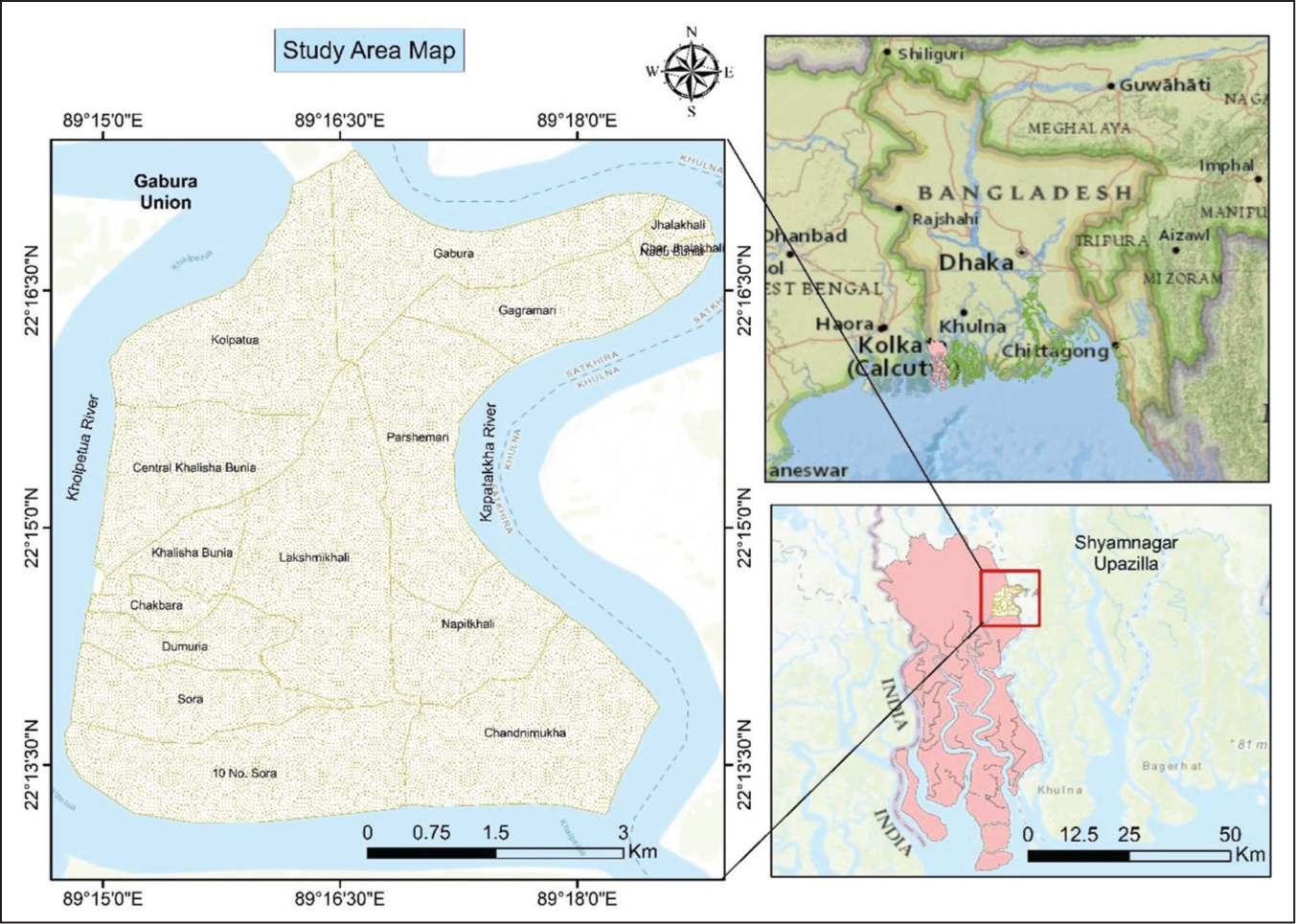
Bangladesh’s coastal areas are particularly susceptible to natural disasters (Shamsuddoha & Chowdhury, 2007). The study was conducted at Gabura (Figure 1), a coastal island union in the Satkhira district of southwest Bangladesh (a union is a collection of villages and the lowest administrative unit). Gabura is located at Shyamnagar Upazila (sub-district) (Figure 1). It was once a port of Sundarbans, the largest mangrove in the world, where people first settled for shelter and living more than a century ago (Alam et al., 2015). The Kholpetua and Kopotakhsa rivers encircle it and divide it from the mainland. There are currently 43,262 people living in 8,321 houses on this island, which has a 33 km2 area (Gabura Union Parishad, 2019). Participants were chosen from different villages of Gabura. Cyclones, tidal surges and saline intrusion are common natural threats that are always present for the population. Gabura Union is particularly vulnerable to climate change and extreme weather events including storm surges and cyclones, according to recent research (Islam et al., 2015). This island’s low elevation (less than 1 m above sea level) frequently causes tidal and storm surge flooding. Two major cyclones in the last 20 years, Sidr in 2007 and Aila in 2009, have severely damaged and destroyed a great deal of this union. This area was submerged by Cyclone Aila and Sidr for an unheard-of period of time, causing substantial loss and destruction to both persons and property. In total, 28 people perished, 11,450 homes were lost and 43 km2 of the shrimp farm regions in Gabura were severely damaged, making the destruction in Aila particularly tragic (Tajrin & Hossain, 2017). A rural administrative body under the Shyamnagar Upazila, Gabura Union is located in Bangladesh’s Satkhira district. In total, 12 villages make up the union, and most of the people living there work in fishing and agriculture (The Dhaka Tribune, 2021). Hurricanes, tidal surges and saline intrusion—all of which happen frequently—have presented the Gabura Union with a lot of difficulties recently (Dhaka Tribune, 2021). In addition to seriously harming the local population, these disasters have also seriously damaged the area’s road, housing and educational systems (Dhaka Tribune, 2021).
The Study Area (Gabura Union).
Data and Methods
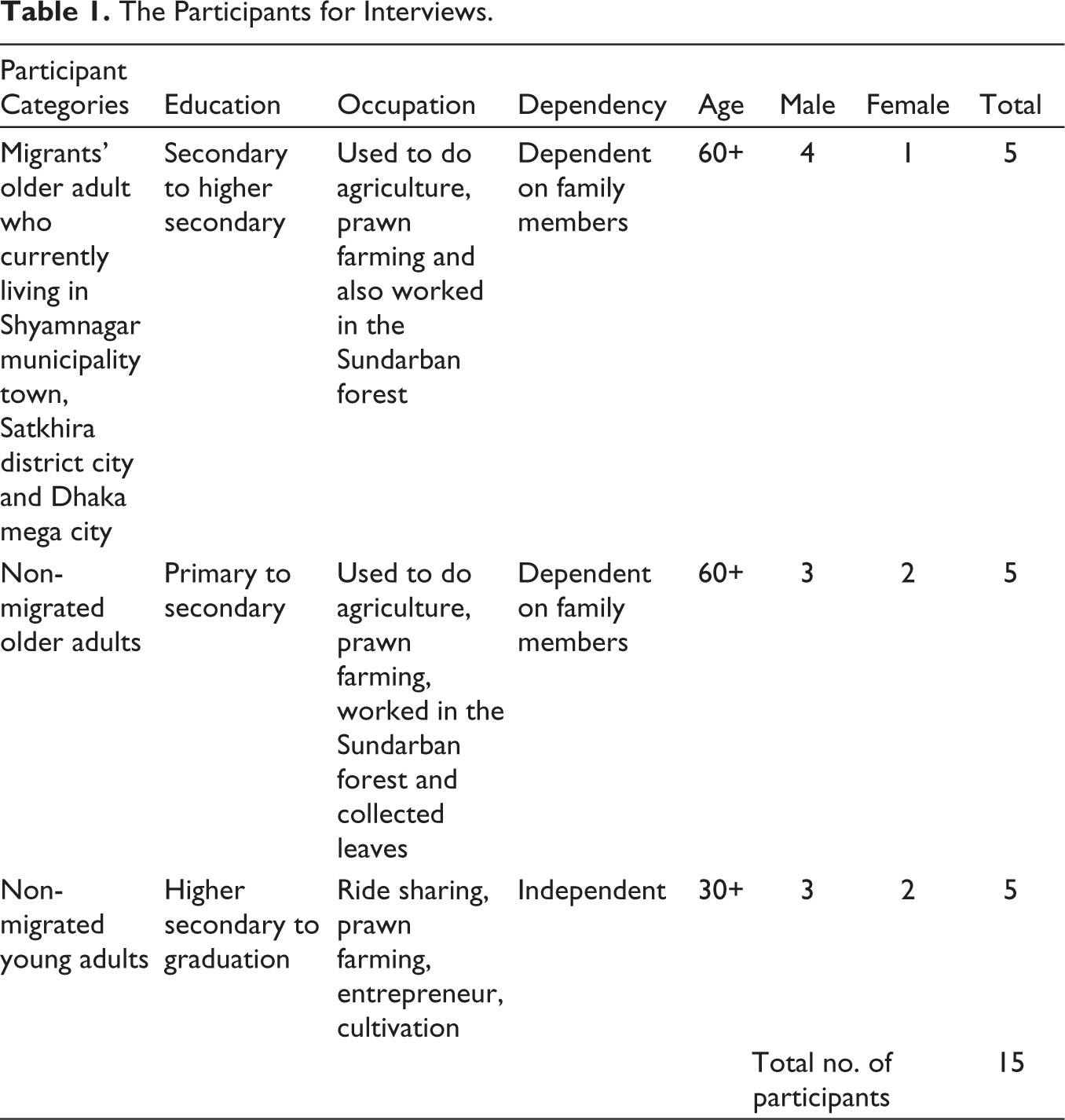
In order to gather data for this study, a qualitative methodology was used, which included semi-structured interviews and focus group discussions (FGDs). The method used to choose the participants was called purposive sampling. This approach was chosen since the research’s target population had to choose from a list of particular characteristics or experiences (Table 1). The participants were divided into three categories. Such as: Category 1: Migrants’ older adult who currently living in Shyamnagar municipality town, Satkhira district city and Dhaka mega city, Category 2: Non-migrated older adults, Category 3: Non-migrated young adults. The age of all the older adults that had been interviewed was above 60 years. The age of young adults was above 30 years. Male and female participant groups, as well as older and younger adults, were taken for interviews. The total number of participants was 15. Participants were drawn from both the migrated and non-migrated groups, as well. The FGDs were conducted separately for men and women in two distinct communities.
The Participants for Interviews.
In the villages of Gabura Union, including Lokkhikhali, Chokbara, Chandimukha and Kholishabunia, interviews were conducted. Interviews also were carried out in Satkhira, Shyamnagar and Dhaka with migrants participants. The young participants were chosen from the Gabura Union. Before an interview, potential participants were contacted. We were able to contact the participants with the assistance of some local gatekeepers. The interviews went more quickly since it was simpler to discover them. Each participant gave their consent before starting the interviews and FGDs. A guide with a list of keywords based on the theme was created for conducting efficient interviews and FGDs.
The questions were left open-ended so that the participants could provide responses and explain their experiences. Depending on the circumstance and context, interviews included a mixture of informal and formal inquiries. The other five interviews were done with migrant participants (who migrated from Gabura) outside the Gabura Union as a place of destination. In total, 10 interviews were collected from the Gabura Union as a place of origin. With the participants’ permission, the interviews were taped so that the information could be reviewed later. While conducting participant interviews, a notepad was typically used to take notes and put down potential follow-up questions. Pseudonyms are used to identify interviews all throughout this chapter.
In the village Kholpetua and Napitkhali in Gabura union, two FGDs with eight people each for males and females were conducted. With the participants’ permission, the FGDs were also recorded, and the participants’ responses were taken down. Information was gathered from both gender groups in an effort to understand how their unique experiences with the cyclones varied. It was observed that they had varied points of view based on gender. Their perspectives, issues, encounters, effects and coping mechanisms varied. Word documents, interview transcripts and digital recording files were all stored, and only the researcher had access to them.
Empirical data have been coded and analysed in a number of steps. To make the transcripts of audio-recorded interviews easier for readers to understand, they were edited, proofread and modified for clarity. The qualitative data were then deductively coded and subjected to a thematic descriptive analysis using NVivo software. Nodes were established for socio-demographic, cyclone experience, immobility and adaptation. Also, semi-nodes were set up under different nodes. After that, the transcriptions were read and categorised under different nodes and semi-nodes. The information was tagged in both nodes when connected to more than one category (or node). By finding and creating categories based on the conceptual framework, it reduced the likelihood of overlooking crucial categories.
Results and Analysis
This result and analysis portion demonstrates the comprehensive perceptions of all the informants on older adults’ experiences prior to, during and post-cyclonic situations, as well as their immobility and whether it is voluntary or not. We covered the causes of older people’s voluntary and/or involuntary immobility when we talked about the essential elements of their immobility. The experiences of the informants on cyclone Aila (2009), Amphan (2020) and other cyclonic scenarios are then included in the discussion. The most severe cyclone, Aila, had a major impact on Gabura residents’ livelihoods. The elderly individuals discussed how cyclones impacted their daily lives and how that affected their decisions to remain immobile as a form of adaptation, as well as the factors that influenced those decisions.
Older Adult’s Immobility to Cyclone
The empirical study suggests that many older people eventually return to their homes, even though many of them initially relocate to a safer location, such as a cyclone shelter, the strong houses of neighbours or occasionally high grounds. Most of the time, this is due to that older people not wanting to leave their familiar surroundings and established way of life, as well as potential difficulties with relocation brought on by their physical limitations.
Evidently, older people are physically weaker and face problems in moving from one place to another place. Social networks, place connection, religious and political beliefs are other factors that influence people’s decisions to remain in climate-risk areas. Participants in the FGD and interviews, provided a number of factors that are used to decide whether the older persons would relocate or not. These factors include attachment to the place, reliability on regional natural resources, livelihood’s dependability on geographical location, inability to adapt to the environment and financial crisis. The next section describes the attachment of older people to Gabura.
Attachment to the Place
The findings of the study suggest that the regional characteristics and ancestry connection had a significant influence on older people who chose to stay. The elderly frequently argued that they had spent their entire lives in this location. They do not want to let go of the many memories they have of Gabura. According to an older informant,
How can I go? Can I leave the house! Everyone lives here. My sons, their wives, and my daughters. How can I live in the city? Why would anyone want to leave their birthplace?
The older people frequently claim that because they do not know many people outside of Gabura, they do not want to move to a new area. They worry that they might not be accepted in the other communities. Therefore, rather than moving to a new location, they would prefer to remain in the cyclone-ravaged Gabura with the people they already know and love. An older resident of Gabura said that,
Everyone in other areas is the same. They don’t care about the poor people. They are busy with themselves. They would just keep their windows and doors closed. They won’t even look at us.
Similar to this, ties to one’s ancestors play a significant role in one’s attachment to a place. Since many of one’s ancestors died and were buried here, one’s elders frequently do not want to leave them behind. In fact, one’s elders frequently become extremely emotional about this and desire to remain in this place until one’s death, by whatever means. An older adult stated, ‘My ancestors died here. We will die here as well’.
The participants reported that there are people who tried and lived outside of Gabura. The majority of elderly people lament the lack of compassion in the neighbourhoods in developing areas. Unlike those who come from the place of origin, they typically pay little attention to migrant populations. One of the older informants provided insight on their neighbourhood after migration in the following words:
No one wants to leave their own area. We love this area more than other places. I lived outside of here. Everyone just sits in their rooms. You won’t see each other’s faces. It’s not like that here. We go here, we go there, talk to people, and do engage in several activities. We don’t know anyone in the other areas.
As a result, the elderly prefer to stay in Gabura rather than move to a place that is safe, despite all of its drawbacks and dangers. According to them, moving has more disadvantages than advantages. The next section demonstrates how reliant on natural resources the older population in Gabura is.
Reliability on the Local Environment
The firsthand account suggests that the older people in Gabura is very much reliant on the natural product of the region on their daily lives. The freshness of the products here is not comparable to the products of the other regions. The active elderly people (60 to 70 years) catch the fishes here on a daily basis for their daily consumption. Some of the older people even migrated to Shyamnagar, Satkhira and Khulna but later returned due to the changes they had to initiate. They were not able to cope up with the food. An older participant exclaimed,
We don’t have a fish problem. There is no fish problem in this area. But in Satkhira, Shyamnagar, Khulna, Dhaka; we could not live there due to the issue of fish as we could not live without eating fish.
This research indicates that the older residents of this region have depended on the rivers that flow by the union on all sides. Their entire existence has been spent primarily reliant on the fish they catch in the river. They need to consider this carefully before deciding to stay put. The dependency of older people’s livelihood on their geographic location is highlighted in the following section.
Livelihood’s Dependability on Geographical Location
The empirical accounts report that older people here are heavily dependent on the geographical location, the rivers and the nearby forests. The most common means of their incomes are fishing. However, fishing from the river is not as common as it was, mainly due to the saltwater getting mixed with the river water during the cyclones, which in terms contaminates the water and negatively impacts on the amount of fish in the rivers. This in terms opened a new way of earning to them in the form of Prawn fisheries. A lot of the active elderly people (60 to 70 years) also do row boats. For a lot of them, collecting leaves and herbs from the nearby forest area is a common option of earning for them as well. Due to the limited options the older people have and experienced throughout their lives; they are very wary about their ability to go out of Gabura. They think that they will not be able to do other type of works. Such an older participant stated,
They are habituated to work in the jungle. It’s not possible to do any other job. There is no employment opportunity. But after every 3 months the pass they get to enter into the jungle, it has been closed. They are dependent on this job from their childhood. They can’t adjust themselves to other jobs.
Notably, the older people also get connected to all the lands they purchased or acquired throughout their lives. They mostly worked on someone else’s lands or fisheries and gather money bit by bit to buy a land. This enforces their ideology of not leaving Gabura. One of such ageing participants shared,
Many times you suffer a lot when you buy a land, then emotions settle after that land. That I could not save this land, what is the benefit of keeping this life! A lot like that. I think so too.
Consequently, the older people also have parental heritage and property passed onto them. They do not want to leave these behind as these are tied to the memories of their ancestors. Some of them are heavily invested in these lands as their ancestors. Given all of these problems, older people in particular may not feel qualified to perform other types of work that would provide a living. This, in turn, influences them to stay in Gabura. The next section explains the inability to adapt to changing environment of older people.
Inability to Adapt to Changing Environment
It has been discovered that the older people’s inability to handle the environment of a region outside of this area frequently acts as a deciding factor for them. According to the findings of this research, they are unable to adapt to environments that are different from those in Gabura. Due to the differences, they experience, they frequently get sick. Such an elderly person gave us insight on this:
When I went to Rangamati, I couldn’t get accustomed to it. I can’t fit in with the environment there. I had skin issues there.
The elderly in Gabura are particularly affected by these problems because they have spent their entire lives in an area with a natural environment that has not been altered by urbanisation, making it difficult for them to adapt to a setting that is different from their own. The next section discusses about the financial crisis of older people in Gabura due to cyclone.
Financial Crisis
Participants clarify that older adults also choose not to migrate when they experience financial hardship and are determined to remain in their place of origin. According to this empirical research, this region’s elderly are generally insolvent to begin with. Additionally, the cyclone Aila wreaked havoc on their homes, livestock and possessions. Most of the assets they have need to be rebuilt or repaired. Due to the limited economic conditions, older people are unable to migrate. One such older participant provided us insight on the difficulty he faced that made him unable to move from Gabura:
But to shift from here to somewhere else, you might need 2–5 lac taka,
1
right? We don’t have that capability. Hence, we have to live here. Even if it is easy or tough for us.
Similarly, when questioned about how difficult it is to leave Gabura, the elderly people responded that it is financially impossible for the majority of Gabura residents. In an ideal world, they would not be able to purchase any valuable land in a large city by selling everything they own here. An older participant argued that,
It’s expensive in Khulna. 1 katha (0.05 bigha) is 1.5 lac taka in Khulna. It’s cheap here but still it’s worth a bit more now. 1 bigha is 3 lac taka here now.
Another problem with sudden relocation was that many older people had no idea where they would go or if they would be able to arrange for a place to stay because they lacked the funds to rent a home for their family. There were not many elderly people with relatives outside of Gabura. A young adult said regarding this type of situation,
There was fear of where to take shelter there. The elderly person thought that even though if he died here, he would stay here. Those who had a good family condition & had the means; for example, brother, may have had a sister’s husband’s house. But there were many others who did not have such relatives. So, they lived here in Gabura.
The next section illustrates that immobility can be an adaptation strategy to cyclone for the old age population.
Immobility as an Adaptation Strategy
To address the problems, enhance planned adaptation, reduce vulnerability and alleviate multidimensional poverty, a variety of strategies or actions can be used. The relationships between marginalisation, susceptibility and poverty may require more consideration in adaptation strategies. This is due to the possibility that investing in land, healthcare, education, water, technology and credit may be more effective at reducing the multidimensional vulnerability of the most disadvantaged groups in communities than proactive or direct efforts like increasing agricultural productivity.
Effective Early Warning Systems and Building Strong Infrastructures
The findings suggest that the people in the region used to be extremely exposed to the destructive effects of cyclones and tidal bores because of their lack of information access and reliance on mud dwellings. Television and cell phones have made it possible for the population to receive early warnings about impending cyclones, enabling them to swiftly seek shelter. Their knowledge and preparedness have greatly grown thanks to this technological advancement, which has decreased the number of fatalities during such incidents. The transition from mud homes to stronger structures also shows a purposeful attempt to improving physical safety. The community is investing in making their existing surroundings safer rather than moving to safer areas. They demonstrate resilience and a strong bond with their land by embracing early warning systems and strengthening their homes in order to adjust to changing conditions without losing their homes or means of subsistence. An older participant expressed his thought on this:
They have television & mobile phones. They get the signal early and go to the shelter. They are a more aware than before. They are making buildings. Previously there were 99% mud houses. Now they are building up to save themselves from flooding caused by the tidal bores.
Therefore, the effective early warning system as well as the increased agricultural productivity is inaugurating immobility as an adaptation strategy. The next section shows how the increased number of cyclone shelters is influencing their immobility.
Increased Number of Cyclone Shelters
The research findings suggest that, methods for mitigating and adapting to climate change are required so that older people can continue to live in their places of origin, even though climate-related movement can offer a pathway for adaptation. Making elderly people more and more aware of how to cope up with such situations. The number of adequate shelters ensures that they are safe during the cyclones. One older informant shared his thoughts on this:
But now everyone goes to the shelter as soon as they get the signal as there are available shelters and they are aware. There are shelters in Chadnimukha, Napitkhali, Lokkhikhali, Dumuria, and Kholishabunia villages.
Recently there has been an increased number of cyclone shelters in the region that help to seek shelter during any cyclone occurs. The elderly are taken to the cyclone shelter to ensure their safety. The next section discusses the financial condition of the elderly that indicates their inability to move to other regions.
Effective Initiatives of the Government
Notably, developing the area as a whole would be an alternative. For older people, modernising and building the required infrastructure may be the safest course of action because it will allow them to feel secure in their homes. An ageing person reported that,
The government is making a new road which will help keep the water from coming inland. It’s a nice initiative of the government. The project has begun starting from Jelekhali. The whole Gabura will have that road, and this will help the people a lot if the road is 100 feet.
Over time, the elderly have modified their requests for assistance. They used to ask for help after a disaster had occurred. They are now more cautious than ever, though. Instead of focusing on healing from problems, their mindset is shifting towards preventing problems in the first place. The government is now paying attention to their calls and needs. An older person said that,
Now the government is more active, and they repair the dam as soon as it gets damaged. People don’t have to work on this anymore, nor do they want to as everyone is busy doing their own activities.
The lives of the elderly population here are getting better over time as the local government works to upgrade the area’s infrastructure and make it safer and more secure every day.
Discussion
In one of Bangladesh’s most cyclone-prone regions, the study offers significant new insights into the lives of the elderly. The findings indicate that the choices older adults make during cyclones are dictated heavily by a complex interplay of emotional attachments, socio-economic status and resilience strategies developed over years of living in a disaster-prone area. Notably, the elderly tend to exhibit a distinct tendency towards immobility, which emerges as a counterintuitive, yet deeply rooted survival strategy (Choudhury, 2022). The emotional and psychological connections that older adults maintain with their environment play a pivotal role in their decision to remain in situ during dangerous weather events (Wahl & Oswald, 2010). Despite the threats posed by cyclones, many older residents of Gabura convey a strong sense of attachment to their homes and communities. This emotional bond, shaped by years of social interaction and familial ties, underlies their reluctance to evacuate even when conditions worsen. The qualitative interviews reveal a recurring theme: the preference for danger at home over the alienation of relocation. This sentiment is poignantly captured in statements highlighting their discomfort with unfamiliar environments and the associated cultural dissonance they experience when they attempt to adapt to new locales.
In addition to emotional ties, practical considerations such as socio-economic factors significantly contribute to older adults’ choices to remain despite the risks (Schröder-Butterfill & Marianti, 2006). Financial constraints act as a major barrier to mobility. The data suggest that many of these individuals lack the financial resources necessary to migrate or to rebuild after cyclones obliterate their homes. Several interviewed participants emphasised the harsh realities of poverty that inhibit their ability to seek safer environments. This financial immobility restricts not just their physical movement but also their ability to access necessary resources for survival, thereby compounding their challenges during disasters.
Another critical aspect of immobility among older adults is their dependence on the local environment. The study emphasises that many elderly residents derive their livelihoods directly from local resources, such as fishing in nearby rivers. Their reliance on these resources is not merely economical; it is also cultural and existential. The knowledge of fish availability and dependence on fishing practices represents more than a means of sustenance; it signifies their identity and way of life. Thus, the interaction between cultural identity and livelihood creates a profound reluctance to abandon their home turf, amplifying their immobility in the face of disaster (Martin, 2016).
The study’s assessment of the resilience strategies employed by older adults addresses their capability to adapt to recurring threats. Interviews yield evidence of a growing awareness regarding cyclone preparedness facilitated by accessible information technologies, such as television and cell phones, which provide early warnings and foster community engagement. The respondents’ testimonies reflect an evolving resilience—while they resist leaving their homes, they adapt by reinforcing them. The communal efforts to build stronger homes and create early-warning systems highlight an admirable agency among the elderly to safeguard their existence in the face of adversity.
Notably, the study advocates for disaster management strategies that incorporate the unique needs of older adults, urging for greater inclusivity. Traditional disaster management frameworks often neglect the specific vulnerabilities of older populations, focusing instead on broader demographic concerns (Schröder-Butterfill & Marianti, 2006). Here, the research strongly highlights the need for policies that reflect the nuanced realities faced by older adults. Given the projected increase in the global aging population, these findings resonate on a broader scale, suggesting that communities worldwide facing similar climate challenges need tailored adaptation strategies that consider the specific aspect of immobility, socio-economic factors, and cultural and social connections. By prioritising older adults’ unique experiences and challenges, a path towards comprehensive global adaptation to climate change impacts, ensuring that no demographic is left behind, can be forged (Gemenne & Blocher, 2017).
Conclusion
The study sheds light on the particular difficulties older adults encounter in the setting of regular TCs in Bangladesh’s coastal areas. Using qualitative research that includes FGDs and in-depth interviews, the study reveals the complex causes of older people’s immobility during disasters. This immobility is a result of a variety of factors, including strong emotional attachments to familiar surroundings, reliance on local resources, logistical difficulties and socio-economic limitations, in addition to personal desire.
The results show that even when there is a direct threat from cyclones, elderly persons frequently decide to stay in their houses. Their actions are heavily influenced by their enduring ties to the land, reliance on agriculture and fishing, and a strong sense of community. Moreover, even when they want to escape, they are unable to do so due to physical and health limits. These difficulties show how important it is to comprehend how resilient older populations are in catastrophe-prone places and how urgent it is to include their unique demands in disaster management frameworks.
Moreover, the research found that efficient early warning systems and robust infrastructure better serve the requirements of the elderly. Also, there is an increased number of cyclone shelters to accommodate more people including the elderly and effective initiatives of the government are noticeable. By shedding light on the unique experiences of older persons, this research advances the larger conversation on climate change, adaption tactics and demographic aging. It highlights that for adaptation measures to be successful, they must take into consideration the particular settings and vulnerabilities of this demographic. It is imperative to develop inclusive policies for disaster management that give older folks’ safety and well-being a top priority. Two recurring themes that highlight the significance of maintaining traditional livelihoods are the dependence on local resources and the resistance to migration. As efforts to improve infrastructure continue, it is equally important to focus on making older people more adaptable so they can deal with the changing environment without losing their cultural and social networks. Older participants’ insights confirm that their sense of attachment and belonging to their houses surpass any potential risks; future adaptation efforts should be guided by this sentiment.
In the end, this research has ramifications that go beyond Bangladesh’s borders. Through an analysis of the relationship between immobility, aging populations and climate change, the study provides insightful insights for communities facing comparable issues around the world. Fostering more inclusive and disaster-resilient societies requires an understanding of older individuals’ resilience and coping mechanisms. To protect older adults’ safety and dignity in the face of oncoming disasters, community leaders and researchers must incorporate the experiences and voices of older adults into climate adaptation efforts as climate-related hazards continue to rise.
Footnotes
Acknowledgements
The people who participated in this research are greatly acknowledged.
Declaration of Conflicting Interests
The authors declared no potential conflicts of interest with respect to the research, authorship and/or publication of this article.
Funding
The authors disclosed receipt of the following financial support for the research, authorship, and/or publication of this article: We are grateful to Jagannath University and Ministry of Science and Technology, Bangladesh for providing funding.
Annexure
Socio-demographic information
Name, age, occupation
Education
Members in the family
Info about family members
Living with whom
Earning status (depended on or self)
Financial condition
Health Condition
Experience of older people to cyclone
What kind of environmental or climatic events/hazards are visible in this area? Did you ever face any cyclone in your life? How many times and when did you face the last cyclone? Experience and situation you faced during last cyclone/super cyclone
What did you/people do before the cyclone landfall? How did you get warning? Who helped you and your family? Who evacuated you and your family? How did you evacuate to safe shelter? How did you save your property? Who assist you to save your property? What did you/people do during the cyclone landfall? Experience in safe place or shelter (e.g., facilities, food, medical issue and gender and elderly issues). What did you/people do after (immediate) the cyclone landfall? How did you come back home after the cyclone? Experiences after coming back home. Environmental changes and environmental issues Consequences of the cyclone; How the cyclone impacted in your life? Food security; transportation; difficulties during cyclone; problems related to mobility Coping with the cyclone; any positive impact; moving to the shelter centre Aid from the government or NGOs or personal Any special care towards older people; any support for mobility
How cyclone impact, influence the decision making of older adult’s immobility as an adaptation strategy
What are the common adaptation strategies of older adult to cyclone? Any changes in livelihood? Any changes in mobility? Difficulties in mobility? Dependency; moving out from residence; Why didn’t you migrate (non-migrated)?; Didn’t you think if you migrate the life would be easier (non-migrated)? Causes to remain at the place of origin (non-migrated) Migration due to cyclone; benefits after migration; difficulties after migration; and How the problems and difficulties can be minimised?
Perception towards older people and their immobility (Young Adults)
Are elderly adults migrated to other places due to cyclone impact? Do you have any older person in your house? How are they related to you? Were you with them when any disaster occurred? How did they react during cyclone? Did he able to move without any support? Did they face any difficulty in mobility during cyclone? Did you support them? How? How did they get over the disaster? How was their health condition? Did they migrate at your place? Did they migrate at any other place? Are they dependent on you? How much are you willing to help them? What can be your measures to help them in adaptation?