




Abstract
This study aimed to deepen the understanding of the motivations and pathways that lead immigrant women to pursue employment in the home-based, elderly care sector in the Spanish countryside. To this end, we examine the individual perspectives of several foreign-born women engaged in this occupation across various small villages in Teruel, a sparsely populated province in eastern Spain. Relying predominantly on the aspirations–capabilities framework, we make the case that employment in the sector is on many occasions exploitative, but that it also may provide an often-needed opportunity for migrants to relocate to the Global North. In the context of our study we argue that these processes of relocation showcased elements of both precarious and improvement migration, and that they were driven primarily by limited economic prospects in many of the interviewees’ countries of origin. Additionally, we explore the relationship between constraints on international mobility and the aspirations of the study participants to improve their life circumstances by examining their migration pathways, the challenges they faced as newcomers, and the specifics of securing jobs and establishing new lives in the Spanish countryside.
Introduction: The Elderly Care–Immigration Nexus in Spain
According to the latest available estimates, approximately 356,000 foreign-born workers were involved in providing home-based elderly care, childcare and other domestic services in Spain in 2017 (Gorfinkiel & Martínez-Buján, 2018, p. 108). In that year, immigrants made up 63% of the workforce in the sector (Gorfinkiel & Martínez-Buján, 2018). The significant representation of individuals with a foreign background in domestic care has led scholars such as León (2010, p. 412) to characterise the industry not only as ‘feminised’ but also as ‘foreignised’. Romero (2012, p. 45) argued that the provision of long-term care (LTC) in the country had become increasingly ‘externalised’ and ‘denationalised’. On their part, Da Roit et al. (2013) suggested that the Spanish system aligns with what they called the ‘southern European migrant-based model’ of care. As León (2010, p. 413) pointed out, several factors help explain the demand and the supply for immigrant labour in this sector. Regarding demand, it is essential to consider, among other aspects, the increasing participation of Spanish women in the labour market and the implications of population ageing. Supply is influenced not only by the relative permeability of borders and the existence of regularisation schemes (Zaguirre, 2010), but also by the large underground economy (León, 2010, p. 414).
These seminal studies, written in the 2010s, naturally did not account for the long-term impact of the COVID-19 pandemic on the sector. Although demand appears to have increased post-pandemic (Conti, 2023), the sector’s fundamental characteristics have arguably remained largely unchanged. However, a significant development related to the pandemic was the 2023 ratification of Convention 189 of the International Labour Organization (ILO). This convention has since strengthened protections for domestic workers, including safeguards such as unemployment coverage, among other provisions (ILO, 2023). 1
The academic literature on the link between the provision of elderly care and immigration in Spain includes a variety of viewpoints and spans several academic disciplines. Macro-level studies have examined this link, focusing on topics such as population ageing (Martínez-Buján, 2005), gender and labour market dynamics (Oso & Parella, 2012), the labour trajectories of these workers (Vidal-Coso & Miret-Gamundi, 2014) and the COVID-19 pandemic (Parrella Rubio, 2020). Micro-level perspectives have been applied to analyse data collected from interviews conducted in Andalusia (de Diego-Cordero et al., 2022), Aragón (Romea & Gómez, 2019) and the Comunidad de Madrid (Rodríguez Rodríguez et al., 2010).
Having said that, a significant gap remains in the literature, particularly concerning empirical studies that examine the lives and personal circumstances of immigrant, home-based, elderly care workers in rural areas of the country. Most previous studies on this topic have predominantly focused on urban areas (e.g., Denti, 2015). Moreover, most research on migration in the Spanish countryside has largely centred on questions related to the primary sector of the economy. Although these foreign residents have become an integral part of the social fabric of many rural communities across the country, there is a lack of research on the reasons for their relocation to the countryside and the strategies that they employ to facilitate the process.
In this study, we explored several of the previously mentioned topics by examining the individual perspectives of 25 foreign-born women employed in the domestic care sector in Teruel, a sparsely populated province in eastern Spain. We addressed three interconnected research questions: (1) What motivations and capabilities drive immigrant women to relocate to rural Spain and to secure employment in the domestic care sector? (2) What differences and common features can be discerned in the migration pathways of these foreign-born women? (3) What constraining and opportunity structures influence and facilitate their migration strategies?
Our paper is divided into several sections. The literature review presents previous relevant research on the elderly care–immigration nexus and further contextualises this relationship. In this section, we also identify our theoretical point of departure. Following this, we present our sample and clarify our methodological approach. The analytical section is divided into four interrelated subsections. First, we describe the interviewees’ motivations for migration and identify associated ‘push’ and ‘pull’ factors. Afterwards, we examine how the participants grappled with several barriers, including restrictive immigration policies. Having done so, we discuss their migration pathways in detail, as well as their initial experiences as newcomers to Spain. The fourth subsection explores how the participants secured employment in the province of Teruel and delves into their experiences in establishing themselves in local villages.
Our main argument is that, for prospective immigrants, employment in the domestic care sector in rural Spain can serve as a means of relocating to the Global North 2 in a tightly restricted international migration environment, thereby providing an opportunity to improve their life circumstances.
Relevant Previous Research and Theoretical Framework
To better grasp Spain’s reliance on foreign-born workers in the private in-home elderly care sector since the late 1990s (Da Roit et al., 2013; Gorfinkiel & Martínez-Buján, 2018, p. 106), we briefly discuss some of the main features that characterise its model of LTC. As Salmerón et al. (2021, p. 172) pointed out, the involvement of the Spanish state in the provision of LTC remained significantly limited well into the 1990s. Up until that point, and almost exclusively, family care had served as the main pillar in this regard. 3 However, the 1990s witnessed early signs of a shift as regional governments began providing LTC services for particularly vulnerable dependents (Salmerón et al., 2021, p. 172). Following the enactment of the Personal Autonomy and Dependent Care Law (LAPAD) in 2006, 4 the state assumed a more prominent role in LTC-related matters. This response aimed to address the so-called ‘care crisis’ (Romea & Gómez, 2019, p. 38) and was meant to signify a departure from what has often been labelled as a ‘familistic model of care’ (Egea, 2023, p. 141).
However, two decades later, the SAAD system of LTC provision exhibits significant shortcomings. Previous research has identified several challenges regarding not only the implementation and delivery of services (Peña-Longobardo et al., 2016), but also financing (Huete-García et al., 2021, pp. 36–38). Indeed, to this day, there is still a heavy reliance on informal care in Spain (see Costa-Font et al., 2022). Several studies have suggested that insufficient public coverage is an important contributing factor to the private sector’s significant involvement in the provision of both institutionalised and in-home care (Egea, 2023, p. 145; Salmerón et al., 2021, p. 173). Foreign-born workers are pivotal in the provision of these services, particularly regarding in-home care.
With that said, it is widely acknowledged in the literature that the industry is notorious for its lack of oversight and the prevalence of cases of abuse, especially among immigrant workers (Menegatti, 2016).These concerns are not only a general apprehension at the global level, but also in Spain (Intermon Oxfam, 2021). Instances of abuse within the sector encompass a broad spectrum, ranging from several forms of labour exploitation to serious cases of human trafficking. However, there is a case to be made that despite these ‘major risks and hazards’, the domestic care sector in Spain offers ‘numerous opportunities’ for foreign-born residents (del Rey et al., 2019, p. 3). Although not always the case, certain employment arrangements can represent a ‘win-win’ scenario for both employers and employees—employees who may benefit in several ways, as we will see.
‘Opportunity’ thus stands out as one of the main drivers that has led foreign-born women over the past three decades to relocate from the ‘periphery’ to the Spanish ‘core’, 5 with the aim of improving their lives and often those of their relatives (del Rey et al., 2019). In a country such as Spain, where ‘there is a tendency for immigrants, especially immigrant women, to work in low productivity sectors and low-skilled occupations’ (Vidal-Coso & Miret-Gamundi, 2014, p. 338), jobs in cleaning, the domestic industry, or, to a lesser extent, hospitality, typically serve as initial entry points into the labour market. However, before striking an agreement with a prospective employer, and prior to the first day at work, a process of relocation takes place. This process, depending on each individual and their circumstances, has different forms and varies in difficulty.
Migration processes, such as the one addressed in this study, can be better understood by drawing from several academic theories and perspectives (Crenshaw, 1989; de Haas, 2021; Erlinghagen, 2021; Lee, 1966). With that said, our analysis relied mainly on de Haas’ (2021) widely adopted aspirations– capabilities framework to explore how our informants navigated their field of opportunity as they aspired to improve their lives and resettle in Spain. de Haas’ framework, which was influenced by Carling’s (2002) aspiration–ability conceptual pair, conceptualises migration as ‘a function of people’s capabilities and aspirations to migrate within given sets of perceived geographical opportunity structures’ (p. 2). While this framework acknowledges the structural constraints that prospective immigrants face in attempting to relocate to a desirable destination, it also emphasises the importance of personal agency. According to de Haas (2021, p. 30), migrants are ‘neither passive subjects, nor actors who react in automated and uniform ways to sets of “push” and “pull” factors’. Rather, they often make active decisions to migrate, navigating limited opportunities and utilising their capabilities, all while driven by multiple aspirations. Based on the concepts of ‘negative liberty’ (freedom from external constraints) and ‘positive liberty’ (freedom to/capabilities), de Haas identifies four types of migration categories: precarious, distress, improvement and free migration (see de Haas, 2021, p. 27, for further details).
Although to a lesser extent, we also draw on the analytical framework of intersectionality to examine the motivations and pathways of our diverse group of interviewees, particularly given the diversity within the group. First proposed by Crenshaw (1989), intersectionality moves beyond single-axis analyses by considering how factors like class, gender, ethnicity, disability and so on interact in complex and cumulative ways, creating distinct experiences of privilege, disadvantage or oppression. Intersectional approaches have previously been employed by scholars to explore questions relevant to our research, including transnational domestic work migration in Europe (Lutz & Palenga-Möllenbeck, 2011), the lived experiences of citizenship among immigrant women in southern Spain (Cherubini, 2011) and the demand for care workers—most of them foreign-born—in southern Italy (Näre, 2013).
Building on these perspectives, our research on feminised migration focuses on national origin and gender as central aspects. However, we also emphasise the importance of considering how these factors intersect with other dimensions, such as age or legal status, which ultimately shape the unique experiences, capabilities and aspirations of the domestic workers in our study. Influenced by Erlinghagen’s life course perspective (2021), our analysis of the aforementioned intersections follows a temporal structure, concentrating on the period that spanned from the interviewees’ contemplation of migration to their eventual securing of a job in the domestic care sector in the province of Teruel.
Study Design
Data were collected from interviews conducted in 2023. Our research mainly examined the individual perspectives of 25 immigrant women who, at the time of the interviews, were employed or had recently been employed as in-home elderly care workers in several villages across the province of Teruel. 6 The lead researcher used a combination of convenience and strategic sampling methods for recruitment, with participants being contacted through a trusted third party.
Ethical considerations were crucial given that some informants were relatively vulnerable due to their lack of formal contracts and/or residency status. Consequently, the interviews were conducted flexibly in a diverse range of settings, including workplaces, private residences and cafés, as well as over the phone when necessary.
The collected data were analysed using thematic analysis. Guided by our research questions, we coded the material, grouped these codes into emerging themes and contrasted them against the theoretical frameworks outlined in the previous section. Additionally, when interpreting and contextualising the data, we incorporated insights from discussions with several other stakeholders. These included local entrepreneurs involved in placement agencies, labour union representatives and think-tank members. Conversations with these stakeholders provided diverse perspectives informed by their respective domains of expertise.
All the interviewees were women who were able to communicate fluently in Spanish. Despite these shared characteristics, they came from a diverse range of backgrounds regarding their upbringing, education, social class and skill sets. Some interviewees had grown up in large metropolises, while others were raised in small towns and villages. Several had studied or worked in prestigious institutions in their countries of origin, but others came from far more modest backgrounds. Among the 25 women interviewed, one was raised in Romania, while the rest had grown up in various countries across Latin America. These included nations in both Central and South America, as well as the Caribbean. Notably, most of the interviewees were Colombian nationals.
The interviewees ranged in age from 20 to 72 years old, with an average age of 47 years. Some had lived in Spain for only a few months, but others had resided in the country for more than 20 years (an average of 9 years). At the time of the interviews, over one-third of the informants were in the process of regularising their legal status in the country through several channels. Slightly more than half were working or had reportedly worked without a formal contract in the past.
The decision to conduct fieldwork in the province of Teruel was deliberate. Located in eastern Spain, Teruel is a mountainous and landlocked province dotted with numerous small towns and villages, some of which are rather isolated. Classified as ‘predominantly rural’ (EUROSTAT, 2023), one of Teruel’s most distinctive traits is its low population density (Southern Sparsely Populated Areas, 2024). Often referred to as part of ‘Empty Spain’ (del Molino, 2022), Teruel has a reputation as a somewhat forgotten territory. Concerns over limited economic opportunities, demographic challenges and poor infrastructure led to the emergence of the political party ‘Teruel Existe’ (Teruel Exists) in the late 1990s (Radio Televisión Española, 2018). Its inception helped foster discussions about the particular challenges faced by sparsely populated areas not only in Spain, but also across Europe (Southern Sparsely Populated Areas, 2024). Today, Teruel’s income per capita slightly surpasses the Spanish average, as indicated by the Spanish Statistical Office, INE (INE, 2021). Its labour market primarily offers opportunities in non-skilled sectors of the economy, with an unemployment rate two points lower than the national average as of late 2023 (INE, 2023). Although the total population in the province has been in long-term decline, recent years have seen growth largely driven by international migration (see data by INE, 2024). Still, smaller municipalities continue to age and to experience significant population decline (INE, 2024), a trend common across most of rural Spain, with a few exceptions (Gómez Valenzuela & Holl, 2024). The provincial capital, the homonymous Teruel, has around 36,000 residents (of 133,000 in the province). However, our research was mainly conducted in small villages with populations ranging from approximately 250 to 2,500.
During the interviews, we asked our participants questions related to their migration journeys, their employment conditions, their daily lives and their future plans, among others. While the domain of employment is particularly significant in the context of our study, our emphasis does not lie in career development and/or career decisions. Rather, we anchored our perspectives on the previously mentioned aspirations–capabilities framework, placing migration related questions—choices, hopes, constraints, as well as gender—at the front and centre.
Driving Factors and Motivations for Migration
It can be challenging to gain a thorough understanding of the reasons that compel individuals to leave their countries of origin (see Czaika et al., 2021, p. 26). In this study, we distinguish between instrumental and intrinsic motivations, which are influenced by a variety of push and pull factors (de Haas, 2021, p. 15; Lee, 1966). According to de Haas (2021, p. 15), instrumental motivations refer to the practical, external factors that drive migration, such as higher wages or improved living standards. Conversely, intrinsic motivations relate to internal and personal desires, including the need to fulfil emotional or social needs, and the quest for autonomy among immigrants.
Instrumental ‘means-to-an-end’ motivations were evident among the majority of our interviewees. The women we interviewed frequently mentioned that, despite the odds, they had deliberately decided to migrate not only to better their circumstances but also those of their families:
It hurts me when my children [back home] tell me that they don’t need a teacher—that what they need is a mother. (…) But they will have a future of their own. The day that I am older, and I die, I will have honoured my responsibilities. (Isabel)
7
Isabel’s story exemplifies how gender, motherhood and migrant aspirations intersect, highlighting the value of employing an intersectional analytical lens in the context of this study. At the time of the interview, Isabel had spent about a year in Spain, away from her children. Despite being financially capable of hiring a private teacher and caregiver who would spend time with her children daily in her country of origin, 8 the separation was emotionally very difficult for Isabel. She explained that she was hoping to reunite with them in Spain after she obtained her status of residence.
Our data analysis revealed that the interviewees were compelled to migrate for more than instrumental reasons. During the interviews, the participants also discussed intrinsic motivations.
9
For example, Katherine talked about the ‘ability to flourish’ in Spain, which she felt was very difficult to achieve in the South American nation where she was raised. Elena, in her mid-50s, decided to take this step because she wished to experience life in Europe at least once in her lifetime. As the quotation below indicates, Karina, who had suffered domestic abuse, left her country of origin hoping to move past that experience. Gender-based violence was a crucial factor in her decision to leave. She noted:
My friend told me about the possibility [of migrating]. At the time, I was going through a very difficult situation with the father of my children. I was a victim of domestic abuse. (…) My friend suggested that I leave [my country]. I was…afraid. But I thought about it…. And I thought about it…. In the end, I made it to Spain with an invitation letter. (Karina)
As Karina described, the early stages of her life in Spain were challenging in several respects. Eventually, she was able to attain balance and build a support network in the village where she resided. In this case, Karina’s ticket to Spain was representative of more than just the start of a physical journey; it symbolised a pathway towards eventual independence and dignified living conditions, free from gender-based violence and domestic abuse.
These motivations can be related to various socio-economic ‘push’ and ‘pull’ factors. Although push–pull factors (Lee, 1966) are often criticised in the literature as being too simplistic or positivistic (de Haas, 2021, pp. 1–3), we argue that they have the potential to complement the framework that we resorted to in this study, offering a better understanding of the interaction between structure and agency (see de Haas, 2021). Regarding push factors, the interviewees expressed concerns about general insecurity and serious political turmoil in some instances. However, the predominant factor in making the decision to migrate, which was shared by all the interviewees, was the persistent economic challenges faced by many of them in their countries of origin:
You just can’t make do. I owned a dog, and it was already so difficult to manage. So imagine with kids and all that…impossible! (Jennifer)
Well, [it was difficult], especially during the COVID pandemic. That’s when I lost my job. Many people lost their jobs. I had the opportunity to come here…and that’s what I did. (Jacqueline)
Jennifer conveyed that she worked as a registered nurse in her home country in Central America. Despite her qualifications, she used to earn a meagre US $180.00 per month before relocating to Teruel. Her words exemplify widespread concerns over low wages, which were particularly expressed by interviewees who had recently arrived in Spain. Arguably, these financial pressures had intensified with heightened inflation after mid-2020. For many of our interviewees, these economic challenges were not solely about earnings, though. The lack of opportunities in the labour market played a role too, as the case of Jacqueline illustrates. Jacqueline was a Colombian national in her mid-40s who had recently moved to a small village in Teruel. Reflecting on the period leading up to her departure, Jacqueline declared that despite having held several administrative roles in the past, including positions in local government, she had been unable to secure viable employment in Colombia. 10
Several pull factors were also identified during our analysis. For example, we recognised various instances of chain migration among the interviewees. In these cases, the involved participants had sought to relocate to Spain to reunite with family members or partners who were already settled in the country. Additionally, our data revealed various other pull factors related to the interviewees’ aspirations and long-term plans. One of them was the perceived enhanced opportunity to secure employment and generate a reasonable income in Spain. Another significant factor was the ability of those who were undocumented to regularise their residence status through several existing programs. 11 Furthermore, the majority of our interviewees were citizens of Latin American nations, which made them eligible for an expedited naturalisation process.12,13 For this cohort, post-colonial ties—such as a shared language and similar cultural traits, as well as more subtle aspects like media exposure (see de Haas, 2021)—also played a role in their choice of Spain as their destination.
Navigating Restrictions and Visa Requirements
Several constraints influence the ability of prospective immigrants to relocate to a desirable destination, including resource accessibility and/or personal life circumstances. Among these constraints, a significant factor is the restrictions imposed by destination countries in the form of visa regimes (de Haas, 2021, p. 8). Unsurprisingly, visa-related considerations emerged as a key theme during our interviews. Restrictions enforced by the Spanish state significantly shaped the trajectories of the participants, both before and after their departure. These regulations, about which the interviewees were well informed, had a significant influence not only on their capacity to enter, but also to reside and work in Spain. Table 1 provides an overview of visa restrictions and the regularisation opportunities available to the interviewees.
Visa Restrictions and Regularisation Opportunities.
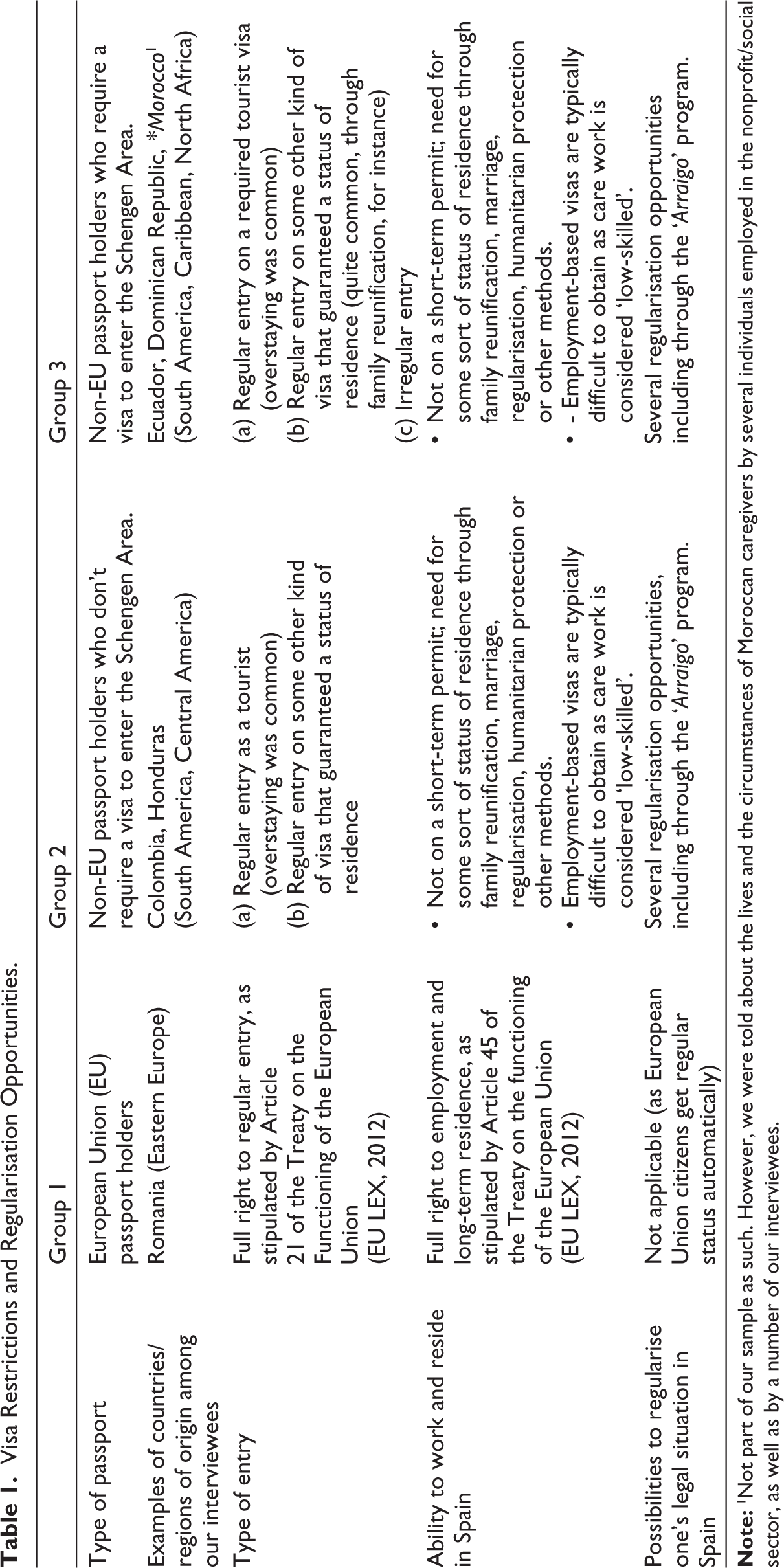
As shown in Table 1, visa restrictions had varying impacts on the interviewees, primarily based on their country of citizenship. While individuals classified under Group 1 were permitted to reside and work in Spain as EU citizens (exemplified by a Romanian interviewee in our sample), 14 those in Group 2 and Group 3, as non-EU nationals, faced different circumstances. Unless they had secured a relevant residence status, the individuals in these groups did not possess the automatic right to reside and to work in Spain. However, there was a distinction between Group 2 and Group 3 regarding visa requirements. Those in Group 2 (e.g., Colombians and Hondurans) were able to visit Spain without the need for a visa, whereas those in Group 3 (e.g., Ecuadorians and Moroccans) were required to obtain a visa—usually a tourist visa—to enter the Schengen Area.
Referring to nations in the Global South, de Haas claimed that legal migration opportunities ‘are mainly the prerogative of elite groups who possess the right diplomas to qualify for a work or study visa, and who have the financial means to pay for their migration’ (de Haas, 2021, p. 7). This remark resonates with the dynamics observed in our data. Visa regimes, which govern legal admission, residence and the ability to work, play a role in perpetuating existing hierarchies and structural inequalities. As Table 1 shows, non-EU citizens were faced with a more constrained pathway—at least from a bureaucratic standpoint. While several of our non-EU interviewees had migrated to Spain through regular avenues, a significant number of non-EU nationals had found accessing the limited formal channels to be unattainable. As a result, this subset of our participants was relegated to undocumented migration, which rendered them more vulnerable and prone to exploitation (de Haas, 2021, p. 7). 15
These instances of undocumented migration suggest that although visa restrictions in this particular case shaped migration pathways, they were not always insurmountable barriers. The participants who lacked the means to secure a legal status of residence were not trapped in immobility. They were, in fact, working in Spain at the time of the interviews. Nevertheless, there were many drawbacks to their uncertain legal status, which was particularly evident in the domain of employment. The undocumented individuals that we interviewed were unable to obtain regular contracts, could not pay their social security contributions, were generally more vulnerable as employees, lacked the flexibility to work in other, more desirable sectors and were entitled to fewer social protections (e.g., unemployment benefits). Yet, despite these and many other concessions and compromises, the majority of this subset of interviewees viewed the process of relocation as a chance to improve their life circumstances and/or those of their dependents.
Acknowledging the significance of these limiting factors, barriers and restrictions, we argue that it is also critical to recognise the agency and the capabilities of immigrant workers, including the interviewees in this study, in advancing their own life journeys. Indeed, our findings suggest that the interviewees leveraged their financial, social and cultural capital to facilitate the realisation of their migration projects. Throughout this process, they took advantage of available opportunity structures, ultimately adapting to their new circumstances.
Among those enabling structures was the ample availability of job opportunities in the domestic care sector in the province of Teruel. The high demand for in-home care workers, which led to numerous—albeit often subpar—offers of employment, can be attributed to several factors. These included Teruel’s increasing dependency ratios in recent years, 16 a local social policy context that favours in-home care yet offers limited social protections, and the domestic care sector’s general lack of appeal to local workers. Additionally, gendered expectations about who should perform this work meant that these opportunities were primarily available for women (see Intermon Oxfam, 2021)—opportunities which, as we have argued, were often taken up by immigrants.
Regarding enabling structures that provide space for the agency of undocumented immigrants more specifically, several additional factors should be considered. First, many of the non-EU interviewees who were unable to secure a status of residence prior to arriving in Spain had accessed the Schengen Area through visa exemption programs, which facilitated their regular entry—followed by overstaying their visas. Second, Spain’s local labour markets, especially in sectors such as domestic care, feature a certain ‘tolerance’ for informal employment (Triandafyllidou, 2013, p. 63), which enables ‘under-the-table’ work. Third, we should also mention not only the state’s limited immigration enforcement capabilities within the country’s internal borders but also the constrained abilities of local administrations when conducting labour inspections, especially in private settings such as individual households. Finally, the existence of a well-established regularisation program called ‘Arraigo’ (which translates as ‘taking roots’/‘settlement’) is noteworthy as well. Through this scheme, applicants can regularise their administrative situations after residing in Spain continuously for three years, possessing a clean criminal record, and having a job offer or relatives in the country, among other requirements (Spanish Ministry for the Inclusion, Social Security, and Migration, 2023). Over the years, several scholars have suggested that the program has been consolidated into an unofficial, back-door migration channel (Zaguirre, 2010, p. 4). According to Zaguirre, the ‘Arraigo’ program has functioned as a means of absorbing much-needed labour in low-skilled and generally unattractive sectors of the economy. In this way, the scheme has primarily served the interests of the state when it comes to regulating these flows—flexibly and in a ‘low-cost’ fashion—while placing immigrant workers who go through this channel in an evidently vulnerable position. 17
Migration Pathways and Initial Experiences of a New Life in Spain
As noted in the previous section, our interviewees’ pathways and what these entailed differed markedly. Some journeys were carefully planned and executed. Others were haphazard, unexpected, or the result of a last-minute decision. For the EU national in our sample, the relocation process was relatively straightforward. However, this process was often more complicated for non-EU nationals, that is, those categorised in Groups 2 and 3, as shown in Table 1. Among those in said groups, some had secured family reunification or employment-based visas. 18 Others—a significant proportion, in fact—had entered the country as tourists, overstayed their visas and ultimately worked towards regularising their legal status in Spain.
Previous studies on the migration of domestic workers, particularly those focusing on (im)migrants from the Global South, indicate that their pathways generally showcase complex, serial or stepwise patterns. Said pathways often include multiple migratory steps across different countries before reaching, if ever, a destination in the Global North (Garvik & Valenta, 2023; Paul, 2015; Parreñas et al., 2019; Valenta, 2022). However, our findings revealed that examples of complex, serial, and/or stepwise migration were scarce among the interviewees. Except for one participant who had unsuccessfully attempted to move to the United States, Spain was the first destination country to which our interviewees had relocated. These findings suggest a clear connection with the various opportunity structures available in the Spanish context, as were discussed in the previous section. Although the migration and re-establishment of the domestic workers interviewed in this study were not without challenges, this process required fewer resources than those needed by other domestic workers in different contexts (Parreñas et al., 2019; Valenta, 2022).
Our data also indicate that a significant proportion of our informants initiated the move themselves or relocated to Spain independently, a pattern often referred to as ‘female-led migration’ (see Romea & Gómez, 2019, pp. 85–87). Others arrived as part of a group or family unit. Crucially, we found that a significant number of our interviewees had some form of connections in the country upon their arrival, such as an acquaintance, a friend or more generally, a relative.
19
Even with such connections, the initial weeks in the country proved to be challenging for many, though. For example, Isabel explained that she barely had any money left when she arrived in Spain because corrupt border guards in her country had demanded a hefty sum before she was allowed to depart. Dayana mentioned that her contact in Spain, who was supposed to be a friend, took advantage of her, charging her for everything, including the invitation letter that permitted her entry into the Schengen Area. Karina expressed comparable sentiments:
I eventually made it to my friend’s. She was living with a cousin of hers back then. I had a very difficult time there. (…) [Once], I was listening to them talk when my friend was told by her cousin: ‘Well, you need to find a place for her to stay because I can’t have her here forever’. That happened 3 days after I had moved in. And my friend told her, ‘Where would she go? She has no job. Nothing’. So I listened to that, and, well…. I went to my room. I did not say anything but cried. (Karina)
Karina’s words capture the uncertainty and adversity that defined her initial period in the country. Regrettably, the situations of a significant number of the participants did not significantly improve in the subsequent weeks. Reflecting on the post-journey period, a member of a regional labour union explained that adjusting to the often-difficult lifestyle was a shock for many immigrant women in the sector, especially for those employed as live-in workers and for those experiencing deskilling:
Imagine what it’s like for them when they are told: ‘Now you are going to be working here, sleeping here, and taking care of these tasks…and you won’t be having much contact with others…and that’s it’. (Labour union worker)
As de Haas points out (2021, p. 9), ‘migration can be a very empowering experience, but can, in other cases, take more exploitative forms’. Prior studies on immigrant domestic workers more specifically, both in Spain and in other national contexts, have highlighted the challenges of labour abuse, precariousness, marginalisation and social isolation within this sector (Intermon Oxfam, 2021; Parreñas et al., 2019). As female immigrants, our informants faced difficulties specifically related to their gender as well, such as the double burden of work and family responsibilities in some instances, among others. While the day-to-day experiences of our interviewees in Teruel varied widely, the above quotation effectively conveyed the struggles encountered by a proportion of them. Yet, despite the hardships faced on multiple fronts, the interviewees persevered, aiming to improve their circumstances and usually those of their relatives over time. In the next and final section, we discuss in detail how the participants in this study secured employment in Teruel and explore their experiences of settling in a rural community.
Aspirations, Capabilities and Facilitators of Employment in Teruel
Securing employment was critical for many of our interviewees, especially for those who were newcomers. During the initial period, a job not only had the potential to help overcome some of the previously discussed challenges, but also ensured a degree of financial independence. We argue that the home-based elderly care sector in Teruel, although problematic in several ways (i.e., long hours, unrealistic expectations, etc.), offered opportunity in that respect. Interestingly, although older workers frequently face ageism when applying for jobs in low-skilled sectors of the Spanish economy, older women are generally seen as more attractive candidates by families looking to hire a caregiver, as one of our informants from a local placing agency revealed. This observation is consistent with findings from Spain and other European Union countries (see, for instance, research on Polish caregivers in Germany; Lutz & Palenga-Möllenbeck, 2011).
Our findings showed that while some interviewees had ‘stumbled’ into the sector, or worked part-time in it to supplement their income, obtaining full-time employment was often their primary aspiration and objective. In the medium to long-term, a job could help meet several financial goals (e.g., repay loans, finance projects at home, etc.), be essential to support dependents, and serve as a path towards legal residence for the undocumented. These aspirations deeply resonated with many of our interviewees. However, employment brought forth new challenges too, such as dealing with often-inadequate job conditions and adapting to the vicissitudes of life in rural Spain.
In the beginning, I did not have my papers. I worked for the older lady for almost three years. [And during that time], I barely had any days off. I did not have any holidays. (…). Her daughter told me that I had no rights whatsoever. (Rosario)
I have had to deal with everything here. With the cold. With how cold people are. With poor working conditions. With my mom’s condition. With everything. (Luz)
Rosario’s insights shed light on the vulnerability that she experienced while being undocumented. Her case is also a testament to a common, yet inadmissible reality shared by many interviewees: having to endure very long days without sufficient rest, including a lack of holidays. Although her situation somewhat improved after she obtained residency, during her interview, she mentioned feeling exhausted by her work as a live-in caregiver. Similarly, Luz expressed her disappointment with the sector. In her case, much of her discontent stemmed from the experience of deskilling. Moreover, Luz, who had been living in Spain for almost a year, had struggled to make long-lasting connections in her village, was not pleased with the weather during the long winters, and faced a difficult personal situation at home.
More interestingly in the context of this study is understanding how the interviewees found and secured positions in the sector across several villages in the province of Teruel. Our findings showed that it was common for these immigrant women to spend some time in a larger city initially—either employed or not—until they became aware of a job opportunity in Teruel. Cara declared:
I first relocated to Valencia. I have a friend there. I spent a month with my friend, more or less. In the beginning, there was no work for me, so I had to wait. I also knew this other woman–the one that you talked to in the village. Through her, I was told that there was a job opportunity here. And that’s what I did–I moved to the village [in this way]. (Cara)
While there were several exceptions,
20
much like in the case of Cara, it was typically an offer of employment that led these immigrant women to the countryside in Teruel. This was facilitated by, among other factors, the availability of work in the province. The findings also showed that while some interviewees had made some type of employment arrangements prior to their arrival—especially those with relatives in the country—, most jobs in the sector were secured when they were in Spain. Estrella’s experience is an example of the former:
For me…well, it did not take that long. I walked out of that plane, and two days later, I had that interview. But that’s because my friend was in touch with the family. (Estrella)
However, for most of the interviewees, finding employment in the sector was generally not this straightforward. Regardless, besides providing insight into the question of pre-arrival arrangements, Estrella’s account was in line with nearly half of the interviewees, whose job at the time of their interviews represented their first employment opportunity in Spain. The experiences of these immigrants suggest that the sector served as an initial entry point into the Spanish labour market and indicate that rural areas can offer that opportunity.
Regarding the job-searching process, the region’s geographical barriers did not significantly obstruct the ability to foster social connections that were critical for securing employment. When we asked the interviewees how they had found their most recent job in the sector, the majority explained that relatives, acquaintances and friends had played a significant role in the process. In other words, word-of-mouth referrals were important in the predominantly rural province of Teruel.
This finding underscores several crucial themes. First, it helps explain, and/or reflects, the high degree of informality typical of the sector. Second, it indicates that private companies in the province played a meagre role in connecting employers and employees. 21 Third, it highlights the vital role of social connections when finding a job in this field, as well as the significance of employers’ recommendations and references. In rural contexts characterised by dense social ties, where strangers are often involved in the in-home care of close family members, credibility and reputation are highly significant for all parties involved, especially for those who hire home care workers. As Jenica explained, ‘References are important, you know; people can be very critical of us’. The fact that all the interviewees in this study spoke Spanish was significant because it enabled many of them to forge long-lasting social connections within these rural communities and to establish trusting relationships.
In addition to word-of-mouth mechanisms, various other channels facilitated connections between employers and employees. Online platforms played a role in job recruitment as well, albeit modestly. 22 Non-governmental organisations, charitable associations and other similar entities were also involved in this respect, although they generally assisted only job seekers who had a legal status of residence in the country. Religious entities (Romea & Gómez, 2019, p. 202) tended to be somewhat more flexible regarding the legal status of job seekers. In the public sector, some comarcas (local-level administrative units) also facilitated connections between employees and employers, both directly and through private companies. Furthermore, it was not unusual for civil servants who were familiar with their villages, such as mayors, to act as informal and informal intermediaries in linking both parties, based on their respective needs for both assistance and work of those residing in their municipality.
Conclusion
This study explored the motivations and pathways that lead immigrant women to pursue employment in the home-based, elderly care sector in the Spanish countryside. Previous research has shed light on the often exploitative and precarious nature of employment within this sector in southern Europe, where informal hiring practices of undocumented immigrants are prevalent. The findings from data gathered in interviews conducted in various villages across the province of Teruel align with these realities. With that said, we argue that for certain categories of immigrants, such employment opportunities may serve as a means of relocating to a desirable destination in the Global North in the context of a highly restricted international migration environment, ultimately offering these individuals a chance to improve their life circumstances.
Against this backdrop, the migration process of the participants in this study may be defined as ‘labour migration, but with caveats’—a process that exhibited features of both ‘precarious’ and ‘improvement’ migration. Our findings revealed that, although there were several exceptions among our interviewees, the primary goal of most of them was to relocate to Spain for employment opportunities. Furthermore, their decision to leave their countries of origin was driven by several instrumental and intrinsic motivations, as well as push and pull factors, including the lack of economic opportunities in many cases.
Structural constraints shaped the ability of the study participants to migrate to Spain, find employment and resettle in the country. Chief among these constraints were several restrictive and enabling migration policies, including visa regulations. In this sense, the national origin of the participants influenced their migration pathways, as well as their employment and resettlement strategies. The findings also showed that visa restrictions in Spain need not always be unsurmountable obstacles. They can, on certain occasions, be circumvented when several factors related to the supply and demand for labour align. As such, we conclude that it is essential to recognise the agency of individual immigrants in navigating their fields of opportunity, including their ability to harness the enabling structures that contribute to the realisation of their migration goals.
Despite the differences in the pathways taken by the interviewees, they shared common features. Unlike it is often the case with immigrant domestic workers in other contexts, the interviewees in the present study did not experience multistage migration to the Global North. Instead, they were able to directly migrate to Spain from their countries of origin, which were usually in the Global South. This frequently involved entering the country as a tourist, overstaying and subsequently seeking regularisation, although this process increased the vulnerability of undocumented workers.
Additionally, we argue that the in-home care sector in the countryside can offer employment opportunities for the immigrant population, serve as an initial entry point into the Spanish labour market, and facilitate the regularisation process for undocumented immigrant workers. The findings of our study revealed that the interviewees secured jobs in the industry when they were already in Spain (although not exclusively), generally after they had spent time in an urban area. Personal contacts played a pivotal role throughout the job-searching process, and word-of-mouth referrals were prevalent in the tight-knit informal networks characteristic of small rural communities in Spain. These connections were particularly significant for the interviewees when facing several challenges during the initial phases of their migration journeys. Our research also highlights the importance of considering the diversity of motivations and pathways among foreign-born care workers.
On the whole, this study has contributed to a body of literature that has largely neglected the rural dimension of the elderly care—immigration nexus in Spain. However, it is important to note that it has several limitations. As a qualitative, interview-based research project, it focused primarily on the experiences of a moderate number of participants, predominantly from Latin America. Future research on foreign caregiver migration to the Spanish countryside should include a broader range of perspectives from countries where Spanish is not widely spoken, such as Morocco, which accounts for a significant percentage of foreign-born caregivers in Spain.
Furthermore, the study was conducted in Teruel, a small province in Spain, which is in and of itself a fairly diverse country. Consequently, the results are not fully generalisable. Still, we argue that the main underlying forces that have given rise to and consolidated the elderly care-immigration nexus in rural Spain—demographic trends, labour market realities, and social and immigration policy design—are not vastly different across other rural contexts in the country. This suggests that the findings in our study do have a degree of representativeness. The insights gained from this study could also potentially serve as a foundation for future comparative qualitative research on these topics, not only within Spain, but also across rural regions in Europe (particularly in the south of the continent).
This specific strand of the literature would also benefit from larger-scale quantitative research, possibly through surveys. In particular, gaining a better grasp of these immigrants’ awareness of available support systems in rural areas during the early stages of migration would be highly valuable. Considering that the dynamics characteristic of the sector are unlikely to change significantly in the near future, this knowledge could help improve protections for foreign-born caregivers in this often-precarious industry.
Footnotes
Declaration of Conflicting Interests
The authors declared no potential conflicts of interest with respect to the research, authorship and/or publication of this article.
Funding
The authors received no financial support for the research, authorship and/or publication of this article.