



Abstract
Teenagers’ mental health is influenced by multiple factors, including physical exercise, peer support, and family functioning. Based on the stress-buffering theory, physical exercise, as a health-promoting behavior, helps alleviate stress, enhance emotional regulation, and thereby strengthen psychological resilience. Meanwhile, social support theory highlights the crucial role of peer support and family functioning as external protective resources in promoting mental health. However, existing research lacks an in-depth examination of how physical exercise as an individual behavior, together with peer support and family functioning as forms of social support, is associated with mental health through the mediating role of psychological resilience. Therefore, this study surveyed 967 adolescents using validated scales to examine the interrelationships between family functioning, physical exercise, peer support, and mental health, while also assessing the potential mediating effects of psychological resilience. The findings indicated that physical exercise, peer support, and family functioning were all positively associated with psychological resilience, which, in turn, mediated their effects on mental health. These results highlight how individual behaviors and social support mitigate stress’s impact on mental health through psychological resilience, providing new theoretical insights and practical implications for mental health interventions.
Introduction
The rapid evolution of the social environment, coupled with rising academic pressure, has made adolescent mental health (MH) issues have become a global concern. The World Health Organization (WHO) highlights adolescence as a critical period for MH development, during which psychological problems often emerge and may impact future social adaptation and overall well-being (Guo & Zhang, 2022; C. Li, 2025; Vijayakumar et al., 2018). In China, where the education system is renowned for its high academic pressure and rigorous exams, the incidence of conditions such as depression, anxiety, and social phobia among adolescents continues to rise (Ma et al., 2024). This competitive academic environment, characterized by intense pressure to perform well in national exams, places tremendous stress on students, which exacerbates their mental health challenges. These issues not only affect adolescent’ academic performance, social interactions, and emotional development but may also lead to severe psychological distress and extreme behaviors, including suicide (M. Jiang et al., 2022). The intense academic competition, combined with familial expectations and social norms, underscores the urgency of addressing mental health concerns among Chinese adolescents. Therefore, promoting adolescent’ MH—particularly by enhancing psychological resilience (PR) to improve their capacity to manage stress and adversity has become a central focus in MH research (H. Cao et al., 2022).
PR refers to an individual’s capacity to adapt effectively and regain normal functioning when confronted with adversity, stress, or challenges (Anderson & Priebe, 2021). In recent years, PR has been increasingly recognized as a core psychological resource underpinning adolescent MH, particularly in high-stress developmental contexts. Empirical studies consistently show that higher levels of PR are associated with lower psychological distress, more effective emotional regulation, and better overall MH outcomes (L. Cao et al., 2024; Spiridon et al., 2021). For adolescents, who are simultaneously navigating academic demands, identity development, and social adjustment, PR plays a crucial role in buffering stress and maintaining psychological well-being.
Existing research has identified multiple factors that may contribute to the development of adolescent PR, among which physical exercise (PE), peer support (PS), and family functioning (FF) are especially salient. PE, as a modifiable health-related behavior, has been shown to promote stress relief, emotional regulation, and adaptive coping, thereby strengthening PR (Kim et al., 2023; Yang et al., 2024). From the perspective of stress-buffering theory (Cohen & Wills, 1985), regular engagement in PE can mitigate the adverse psychological impact of stressors by enhancing individuals’ adaptive capacity. In addition, social support theory posits that access to supportive interpersonal relationships provides individuals with emotional, informational, and instrumental resources that facilitate psychological adjustment and resilience when facing stress (Thoits, 2011). At the social level, PS provides adolescents with emotional understanding, companionship, and informational resources, which are critical for emotion regulation and resilience in the face of academic and interpersonal stress (Heary & Hennessy, 2020; Lai et al., 2022). At the family level, FF reflects the quality of family communication, emotional bonding, and problem-solving processes, all of which constitute a foundational context for adolescents’ psychological security and resilience development (Cheng et al., 2017; Zhou et al., 2024).
Notably, although prior studies have examined PE, PS, and FF separately, several limitations remain. First, existing research has largely focused on single predictors, with limited attention to how individual behaviors and environmental support systems jointly contribute to adolescent MH. Second, few studies have integrated PE, PS, and FF within a unified framework to explain their combined influence on MH through PR. This gap is particularly evident in the Chinese context, where adolescents face intense academic competition, strong family expectations, and relatively concentrated social networks. This limitation is especially salient among adolescents in junior and senior high schools, a stage marked by escalating academic demands and heightened psychological stress, while MH and PR remain highly malleable. Under these conditions, examining how PE (an individual-level behavior) and PS and FF (key sources of environmental support) interact through PR is both theoretically meaningful and practically necessary.
Accordingly, the present study aims to systematically examine the roles of PE, PS, and FF in adolescent MH, with PR as a central mediating mechanism, within the Chinese sociocultural and educational context. By clarifying these pathways, this study seeks to provide a more integrated understanding of adolescent MH and to inform targeted intervention strategies that address both individual behaviors and contextual support systems.
Theoretical Foundation and Literature Review
Theoretical Foundation
The stress-buffering theory, proposed by Cohen and Wills (1985), explains how adaptive resources and behaviors can mitigate the negative effects of stress on individuals’ physical and MH. This theory posits that exposure to stressors does not inevitably lead to adverse psychological outcomes; rather, the availability of effective coping resources can reduce stress appraisal, enhance emotional regulation, and promote psychological adjustment. The stress-buffering framework has been widely applied in health psychology and developmental research to explain how health-related behaviors (Rohrbeck et al., 2024), particularly PE, function as protective factors against stress-related psychological problems. Empirical studies have shown that adolescents who engage in regular PE report lower perceived stress and better emotional regulation, which in turn are associated with higher levels of PR and MH (Kim et al., 2023; Yang et al., 2024). In the present study, stress-buffering theory provides the theoretical basis for conceptualizing PE as an individual-level behavior that enhances adolescents’ PR and, in turn, supports better MH outcomes.
Social support theory emphasizes the role of supportive interpersonal relationships in promoting psychological well-being and MH. Early formulations of this theory highlighted that social ties provide individuals with emotional, informational, and instrumental resources that facilitate coping and adjustment in stressful situations (Cobb, 1976). Subsequent research further clarified the mechanisms through which social support influences MH, including strengthening emotion regulation, fostering a sense of security, and enhancing resilience (Thoits, 2011). A growing body of empirical research has demonstrated that higher levels of PS and FF are associated with lower psychological distress and greater resilience among adolescents, particularly in academic stress contexts (Cheng et al., 2017; Heary & Hennessy, 2020; Lai et al., 2022; Zhou et al., 2024). In adolescence, peer relationships and family environments represent the most salient sources of social support. PS offers emotional understanding and shared experiences that help adolescents manage academic and interpersonal stress, while effective FF provides emotional security and a stable context for adaptive development. In this study, social support theory underpins the inclusion of PS and FF as key environmental resources that contribute to adolescents’ PR and MH.
Integrating stress-buffering theory and social support theory provides a comprehensive framework for understanding adolescent MH from both individual and contextual perspectives. Stress-buffering theory highlights the protective role of adaptive behaviors, whereas social support theory emphasizes the importance of interpersonal resources. In the present research model, PE is conceptualized as an individual-level stress-buffering behavior, while PS and FF are treated as core sources of social support. PR serves as a central mechanism linking these individual and environmental factors to MH outcomes. By integrating these two theoretical perspectives, the proposed framework captures the joint and complementary effects of behavior and social context on adolescents’ MH, offering a theoretically grounded explanation for the hypothesized relationships.
Physical Exercise (PE) and Mental Health (MH)
PE refers to deliberately designed, structured, and repetitive physical activity (Caspersen et al., 1985) that positively influences an individual’s psychological state by improving physical health, particularly among adolescent. Research indicates that enhancements in physical health not only contribute to better physiological functioning but also exert beneficial effects on psychological well-being, especially in adolescent populations (Yang et al., 2024). Therefore, good physical health is closely linked to MH. From the perspective of stress-buffering theory, physical exercise functions as an adaptive behavioral resource that mitigates stress-related psychological harm by enhancing emotional regulation and coping capacity (Cohen & Wills, 1985). On the one hand, PE has been widely recommended as an effective means of enhancing adolescent’ MH (Yang et al., 2024), with existing studies demonstrating its direct positive effects on mental well-being (Chuan & Xiong, 2023; Guo & Zhang, 2022; X. Wang & Fu, 2023). For example, Guo and Zhang (2022) found that regular PE helps release excess energy, reduces anxiety and depression levels, and alleviates emotional distress among adolescent. On the other hand, X. Wang and Fu (2023) reported that PE fosters positive cognition and emotions, thereby contributing to improved mental health. Based on the above analysis, this study proposes the following hypothesis:
Peer Support (PS) and Mental Health (MH)
PS refers to emotional and informational support exchanged among individuals of similar age and social background (Xiong et al., 2021). According to social support theory, supportive interpersonal relationships provide essential psychosocial resources that help individuals cope with stress and maintain psychological well-being (Cobb, 1976). Research has shown that PS not only strengthens adolescent’ PR but also enhances their well-being and socio-psychological adaptability (Heary & Hennessy, 2020; Ho et al., 2022; Suresh et al., 2021). For instance, Ho et al. (2022) investigated the significance of PS for MH and found that PS alleviates psychological stress by providing emotional and informational support, thereby promoting more effective MH practices. Similarly, Suresh et al. (2021) emphasized that PS can improve MH indicators, including anxiety, self-esteem, stress, and depression. Moreover, PS influences behavioral patterns, which in turn affect MH outcomes (van Rijsewijk et al., 2018; Zou et al., 2023). Liu et al. (2024) further highlighted that PS affects adolescent’ feelings of loneliness through the mediating role of PR, and loneliness significantly impacts their MH. This suggests that PS not only directly alleviates psychological stress but also fosters positive behavioral patterns that enhance PR, ultimately promoting mental well-being and strengthening adolescent’ ability to cope with challenges. Accordingly, this study proposes the following hypothesis:
Family Functioning (FF) and Mental Health (MH)
FF encompasses the quality and effectiveness of interactions among family members (Miller et al., 1994), including communication patterns and relational dynamics (Lei & Kantor, 2022). Within the framework of social support theory, the family represents a primary and enduring source of emotional security for adolescents (Thoits, 2011; Zhang et al., 2024). Extensive research has demonstrated a direct relationship between FF and adolescent’ MH (Cheng et al., 2017; Y. Pan et al., 2021; Zhang et al., 2024). For instance, Y. Pan et al. (2021) identified a positive correlation between FF and MH among Chinese vocational school students. Additionally, by serving as a protective factor for MH, FF facilitates positive psychological changes, enabling individuals to exhibit better emotional and behavioral stability (Cheng et al., 2017; Xu et al., 2021; Yen et al., 2013). Al-Smadi et al. (2024) found that individuals raised in supportive family environments exhibit greater resilience, which subsequently strengthens their MH. These findings highlight the protective role of FF in adolescents’ MH. Based on this reasoning, the following hypothesis is proposed:
The Mediating Role of Psychological Resilience (PR)
PR denotes an individual’s capacity to adapt and recover effectively when confronted with stress or adversity (Anderson & Priebe, 2021). According to stress-buffering theory, the protective effects of adaptive behaviors on mental health are largely transmitted through internal coping resources, among which PR plays a central role (Cohen & Wills, 1985). Existing studies have shown that PE indirectly improves MH by enhancing PR (L. Cao et al., 2024). Participating in PE enhances physical fitness while also enabling individuals to cultivate effective stress-coping mechanisms, support emotional regulation, and ultimately enhance overall MH (C. Li, 2025; Xia et al., 2024). For instance, Kim et al. (2023) identified a positive correlation between PE and PR, indicating that regular physical activity enhances resilience, reduces stress-induced negative emotions, and further promotes MH. Based on social support theory, PS and FF serve as crucial social support resources that significantly contribute to enhancing PR and mental well-being (Spiridon et al., 2021; Sun et al., 2024; Üstündağ, 2024). Studies have shown that PS enhances PR through emotional encouragement and social recognition, thereby alleviating negative emotions (Chmitorz et al., 2018; Ho et al., 2022; Solà-Sales et al., 2021). Similarly, Cui et al. (2023) reported that adolescents from well-functioning families exhibit higher levels of PR, which is associated with better MH outcomes. Taken together, these findings indicate that PR serves as a shared mediating mechanism linking PE, PS, and FF to adolescents’ MH.
The proposed theoretical framework of this study is depicted in Figure 1.
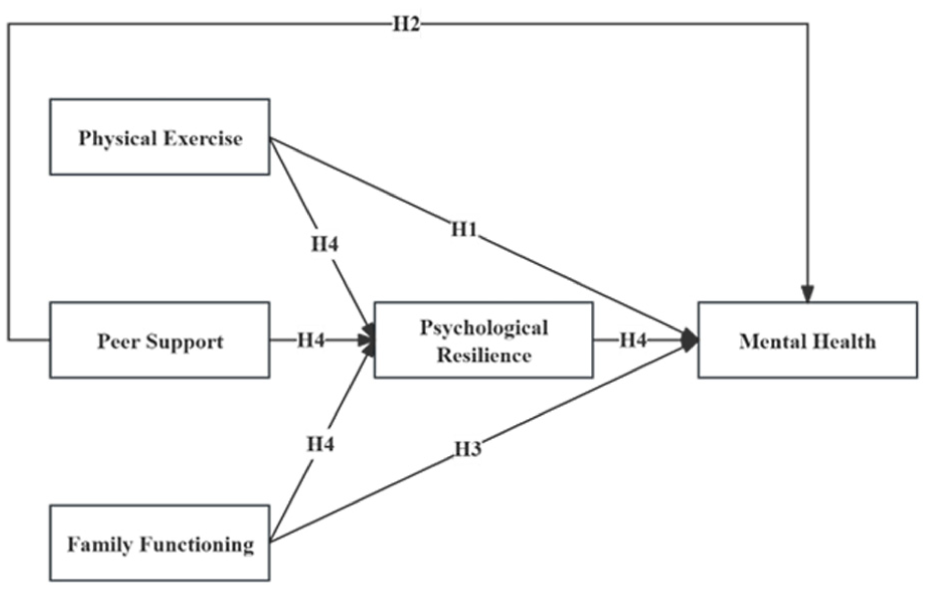
Research model.
Materials and Methods
Participants
Data for this study were collected between February and March 2025 via the online survey platform Questionnaire Star (www.sojump.com). A cluster-based sampling approach was adopted. Specifically, participants were recruited from multiple middle schools located in Chongqing, China. These schools served adolescents at different stages of secondary education. Within each participating school, intact classes were used as the primary sampling units, and all students in the selected classes were invited to complete the online survey. Prior to participation, respondents were informed of the study objectives and assured of anonymity and confidentiality. Participation was entirely voluntary. Ethical approval was obtained from the Ethics Committee of the participating secondary schools, and informed consent was obtained from all participants before survey completion.
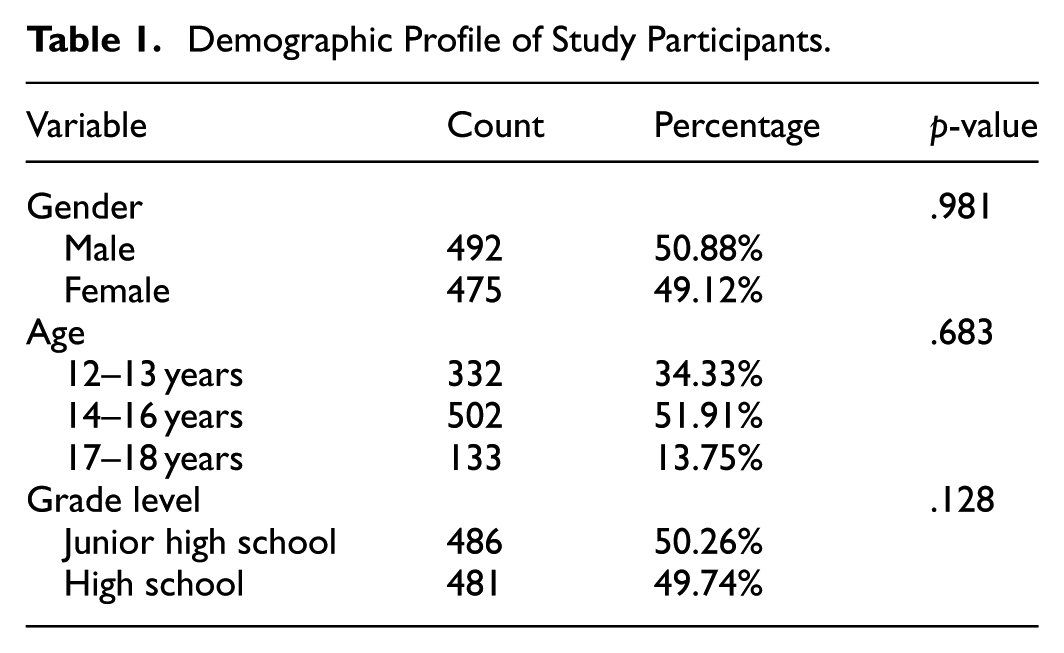
A total of 1,000 questionnaires were distributed in this study. After screening, 967 valid questionnaires were retained, accounting for 96.70% of the total, while 33 questionnaires were excluded due to the following criteria: (1) missing responses to more than five items and (2) non-serious participation (e.g., uniform responses across the majority of items; D. Wang et al., 2012). In this study, the target population was adolescents, including students from junior high school and high school, with an age range of 12 to 18 years. As shown in Table 1, the demographic distribution of participants was as follows: 492 males (50.88%) and 475 females (49.12%), 332 students aged 12 to 13 years (34.33%), 502 students aged 14 to 16 years (51.91%), and 133 students aged 17 to 18 years (13.75%), 431 students from junior high school (50.26%) and 536 students from senior high school (49.74%).
Demographic Profile of Study Participants.
Measurement Instruments
Physical Activity Rating Scale
This study utilized the Physical Activity Rating Scale-3 (PARS-3) to assess adolescent’ participation in PE. The PARS-3 is a widely recognized and extensively applied instrument in China, demonstrating strong validity and reliability across various studies (Yao et al., 2022). Comprising three items, measured using a five-point Likert scale, and is primarily designed to evaluate the intensity, duration, and frequency of PE. To maintain consistency with the original scale, no modifications were made to its original content or structure. The total activity level is determined using the following formula: Activity Level = Intensity Score × (Duration Score−1) × Frequency Score, with possible values ranging from 0 to 100. In this research, the PARS-3 exhibited strong internal reliability, reflected by a Cronbach’s α of .841. Additionally, the Kaiser-Meyer-Olkin (KMO) index reached 0.725, while Bartlett’s sphericity test had statistical significance (p < .001), confirming the scale’s appropriateness for factor analysis.
Peer Support Scale
This study employed the Peer Support Scale used in the research by X. Pan and Yuan (2023) to measure adolescent’ PS. Widely applied in China, this scale has shown robust psychometric properties across multiple studies. It comprises 12 items in 2 dimensions, each assessed on a five-point Likert scale, ranging from 1 (strongly disagree) to 5 (strongly agree). The overall PS score is calculated by adding up all item responses, yielding a possible range of 12 to 60, where higher scores reflect stronger PS. In X. Pan and Yuan (2023), the scale showed excellent internal consistency, reflected by a Cronbach’s α of .902. Similarly, in the present research, the scale maintained robust internal coherence, as evidenced by a Cronbach’s α of .888. KMO index was 0.944, and Bartlett’s test of sphericity was statistically noteworthy (p < .001), making it an appropriate tool for measuring PS among adolescents in this study.
Family Functioning Scale
This study employed the Family Functioning Scale (APGAR), originally developed by Smilkstein (1978), to measure adolescent’ FF. The Chinese adaptation of the APGAR scale has been widely utilized in research, exhibiting robust validity (Huang et al., 2021). The scale comprises five items distributed across three subscales, employing a 0 to 2 scoring system, where 0 = rarely, 1 = sometimes, and 2 = almost always. The total score is calculated by summing of all items scores, with interpretation as follows: 7 to 10: indicates good FF, 5 to 6 Suggests moderate Family Dysfunction, 0 to 4 Reflects severe Family Dysfunction. In Huang et al. (2021), the scale demonstrated high reliability, with a Cronbach’s α of .874. In the present study, the scale exhibited good internal consistency, as reflected by a Cronbach’s α of .792. KMO index was 0.745, and Bartlett’s test of sphericity yielded statistically noteworthy results (p < .001), verifying the scale’s appropriateness for factor analysis.
General Health Questionnaire-12
The General Health Questionnaire-12 used in this study was based on the scale designed by Goldberg and Williams (1988) and has been widely extensively applied in China(Liang et al., 2016) . This instrument comprises 12 items designed to assess 2 core dimensions: social dysfunction and psychological distress. This scale employs a four-point Likert rating method, where responses range from 1 (never) to 4 (frequently). In the present study, the GHQ-12 was coded to reflect positive mental health. Specifically, negatively worded items (Items 7–12) were reverse-scored prior to analysis, such that higher total scores indicated better MH rather than greater psychological symptoms. This coding approach has been adopted in previous research when GHQ-12 is used to capture overall mental well-being (Y. Hu et al., 2007). The overall score is derived by adding up all item responses, where elevated scores reflect better MH outcomes. This study showed that the scale had robust internal coherence, with a Cronbach’s α of .855. KMO measure yielded a value of 0.833, and Bartlett’s test of sphericity was statistically noteworthy (p < .001), confirming the scale’s suitability for factor analysis.
Connor-Davidson Resilience Scale
The Connor-Davidson Resilience Scale, updated by Ye et al. (2017), was employed in this study and has been extensively applied in research across China. This instrument comprises 10 items designed to assess PR as a single-dimensional construct. Responses are scored on a five-point Likert scale, ranging from 1 (strongly disagree) to 5 (strongly agree), with higher total scores reflecting enhanced resilience. In this research, the scale exhibited robust internal reliability, as reflected by a Cronbach’s α of .882. The KMO measure produced a value of 0.824, and Bartlett’s test of sphericity showed statistically meaningful results (p < .001), validating the scale’s appropriateness for factor analysis.
Statistical Analysis
This study utilized IBM SPSS 27.0 for statistical analysis. First, an analysis of potential method bias was carried out to examine any biases in the measurement instruments used in this research. Prior to hypothesis testing, the normality assumption was examined by assessing the skewness (SK) and kurtosis (Kur) of all main study variables, and the results indicated that the data approximately followed a normal distribution, supporting the use of parametric analyses. Second, Pearson’s correlation analysis was used to examine the associations among PE, PS, FF, PR, and MH. Third, confirmatory factor analysis (CFA) using AMOS was carried out to assess how well the model fits the data. Given that the study employed measurement instruments with different Likert response formats, CFA was conducted at the latent construct level to evaluate the measurement quality. Factor loadings, composite reliability (CR), average variance extracted (AVE), and discriminant validity were examined to ensure that heterogeneous response formats did not adversely affect the measurement properties of the constructs. Fourth, mediation analysis was performed using the SPSS PROCESS macro, with the bootstrap method applied to test indirect effects. Model 4 was selected for testing, where PE (X1), PS (X2), and FF (X3) were set as independent variables, PR (M) as the mediator, and MH (Y) as the dependent variable. To determine the mediation effect, a bootstrapping procedure with 5,000 resamples was conducted. The mediation effect was considered statistically noteworthy at the at the α = .05 level if the bias-corrected 95% Bootstrap confidence interval (CI) did not contain zero.
Result
Measurement Model
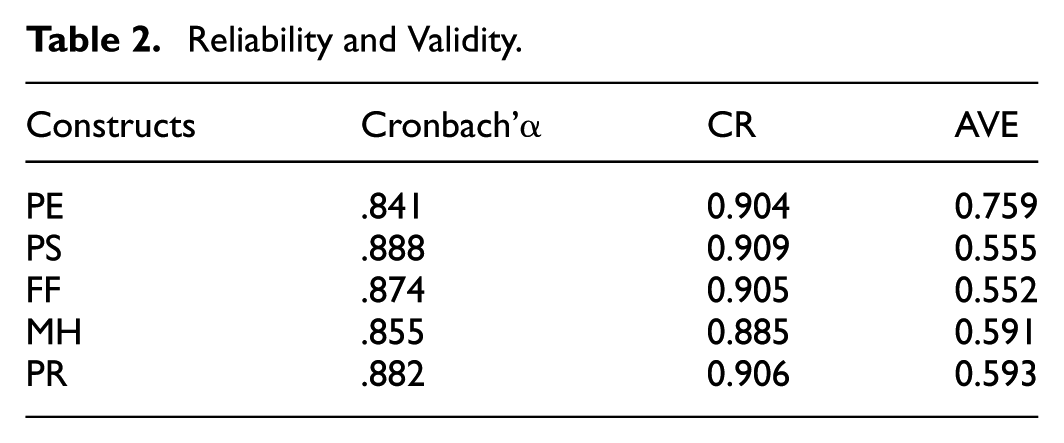
Following Hair et al. (2021), the measurement model was evaluated in terms of indicator reliability and internal consistency. Although an outer loading of 0.708 is commonly recommended, indicators with loadings between 0.60 and 0.70 may be retained when CR and AVE exceed the recommended thresholds (Hair et al., 2021). As shown in Table 2, all constructs demonstrated satisfactory reliability and convergent validity. Specifically, the outer loadings ranged from 0.852 to 0.885 for PE, 0.656 to 0.715 for PS, 0.653 to 0.767 for FF, 0.615 to 0.778 for MH, and 0.631 to 0.819 for PR. In addition, CR values ranged from 0.885 to 0.909 and AVE values ranged from 0.552 to 0.759, all exceeding the recommended cut-off values, indicating adequate convergent validity.
Reliability and Validity.
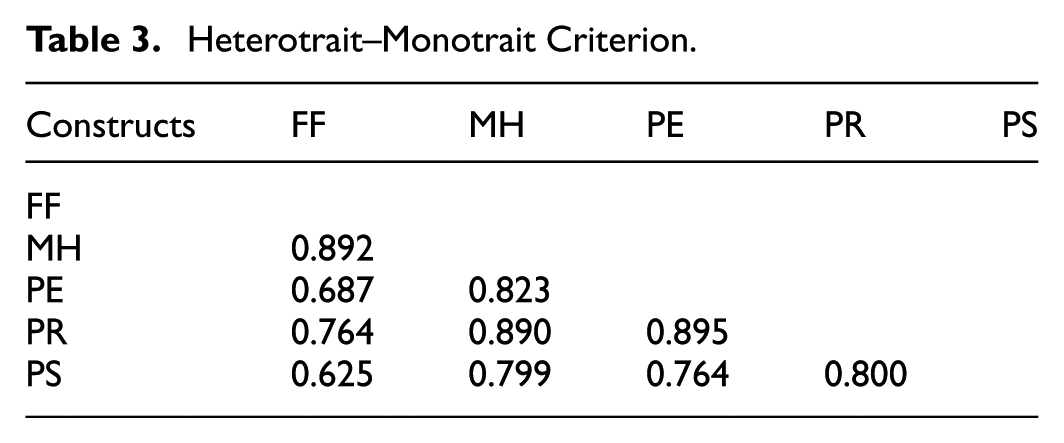
Henseler et al. (2015) proposed the Heterotrait-Monotrait ratio (HTMT) as a more stringent criterion for assessing discriminant validity. As shown in Table 3, all HTMT values were below the recommended threshold of 0.90, supporting acceptable discriminant validity among the constructs (Hair et al., 2021).
Heterotrait–Monotrait Criterion.
Common Method Bias Test
Harman’s single-factor test was conducted to assess common method bias (CMB) in this study. The exploratory factor analysis revealed six factors with eigenvalues exceeding 1. The first factor accounted for 36.473% of the variance, which falls below the 40% critical value. Thus, an inherent method bias is unlikely to have significantly affected the results of this study.
Collinearity Test
To ensure the stability of the model and the validity of the interpretations, this study conducted a detailed diagnosis of collinearity among the independent variables. Using SPSS, the tolerance and variance inflation factor (VIF) values were computed to check for any multicollinearity concerns. As shown in Table 4, all variables exhibited tolerance values exceeding 0.1 and VIF values below 3.3. A tolerance value above 0.1 indicates no severe collinearity issues, while a VIF value below 3.3 is considered ideal. These findings indicate that multicollinearity does not pose a significant issue in this research, ensuring the reliability of regression estimates and the accuracy of variable interpretations.
Collinearity Diagnostics for the Structural Model.
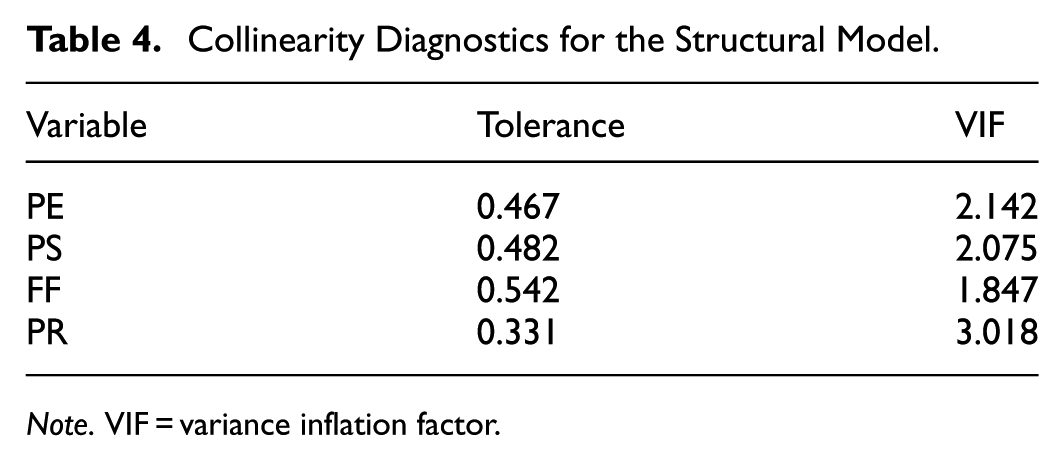
Note. VIF = variance inflation factor.
Correlations Among Study Variables
This study conducted a correlation analysis on PE, PS, FF, PR, and MH. As shown in Table 5, the correlation analysis provides the means (M), standard deviations (SD), SK, Kur, and correlation coefficients for each variable. The skewness and kurtosis values for all variables were within acceptable ranges (|Sk| < 2, |Kur| < 7), indicating that the data approximately followed a normal distribution and satisfied the assumptions for parametric analyses. Pearson’s correlation analysis indicated that PE, PS, FF, PR, and MH were significantly positively correlated (p < .001). These findings provide support for hypotheses H1, H2, and H3.
Analysis of Correlated Variables.
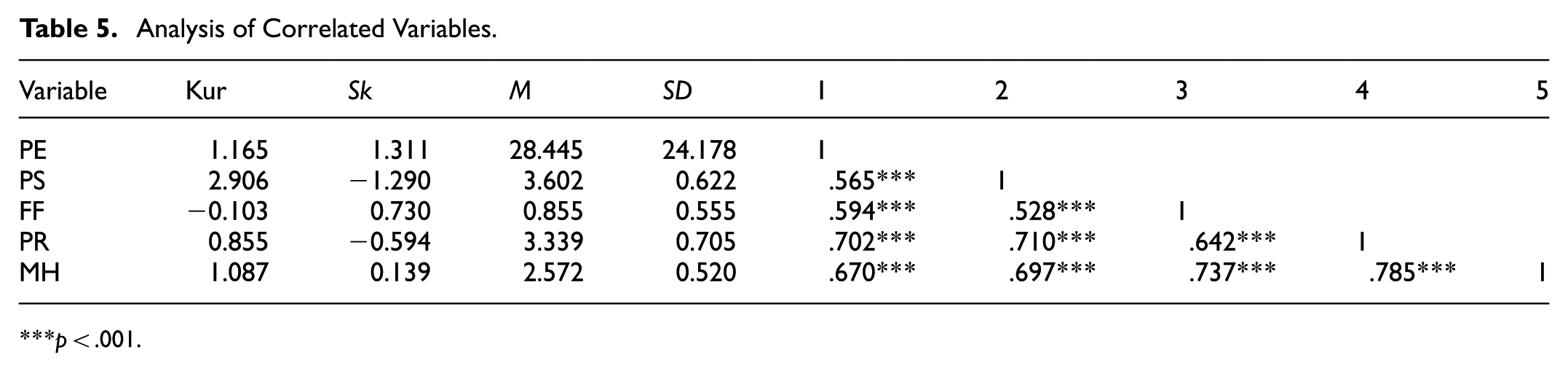
p < .001.
Group Difference Analysis
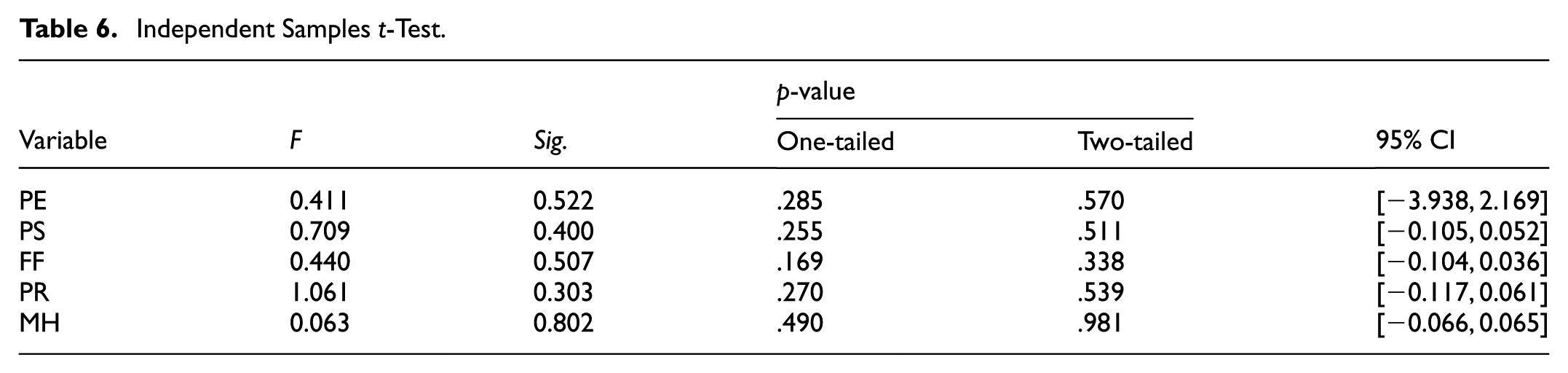
To examine potential group differences in the main study variables, independent samples t-tests were conducted. As shown in Table 6, no significant differences were observed for PE, PS, FF, PR, or MH (all p > .05), suggesting that group differences were unlikely to bias subsequent analyses.
Independent Samples t-Test.
Confirmatory Factor Analysis
To test the adequacy of the proposed model in relation to the collected data, Confirmatory Factor Analysis was carried out. Table 7 illustrates that the final model displayed a good fit, as indicated by key statistical indices. The Chi-square/degree of freedom ratio (CMIN/DF) was 2.257, falling within the acceptable range, confirming model adequacy. The Root Mean Square Error of Approximation (RMSEA) was 0.080, which is within the acceptable range. The Goodness-of-Fit Index (GFI) was 0.916, and the Adjusted Goodness-of-Fit Index (AGFI) was 0.903, both greater than 0.900, indicating good fit. The Comparative Fit Index (CFI) was 0.949, the Incremental Fit Index (IFI) was 0.950, and the Tucker-Lewis Index (TLI) was 0.944, with all three indices meeting the ideal threshold of 0.900 (L. Hu & Bentler, 1999). Considering these indices collectively, the overall fit of the measurement model aligns with theoretical expectations, suggesting that the model fits well and can be accepted.
Model Fit Indices for the Structural Equation Models.
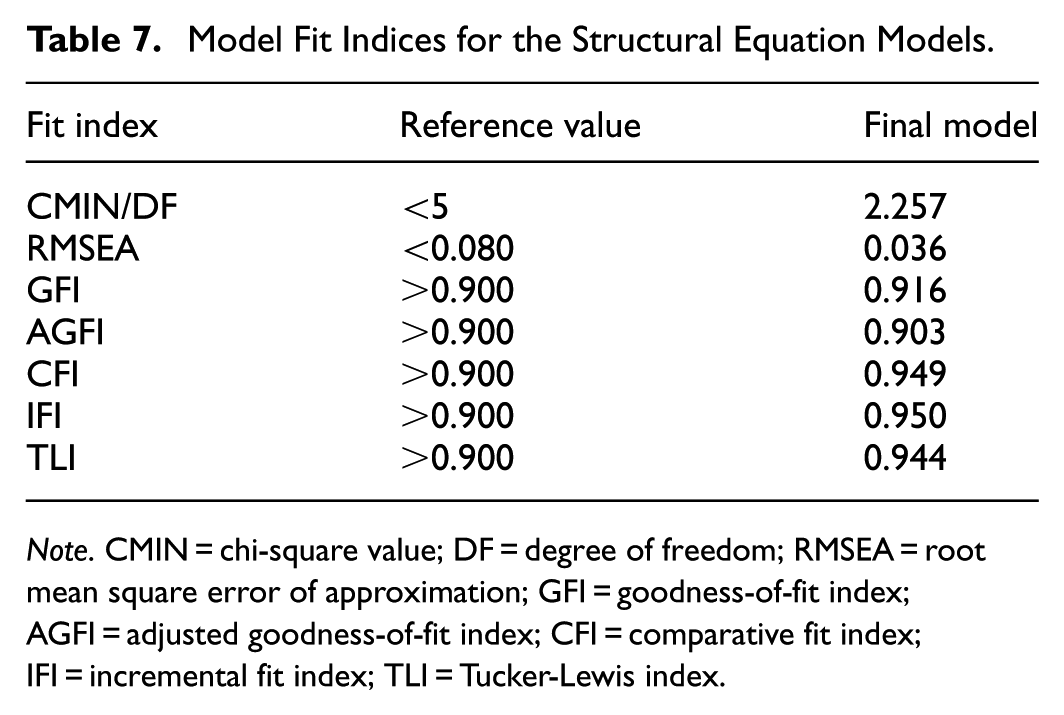
Note. CMIN = chi-square value; DF = degree of freedom; RMSEA = root mean square error of approximation; GFI = goodness-of-fit index; AGFI = adjusted goodness-of-fit index; CFI = comparative fit index; IFI = incremental fit index; TLI = Tucker-Lewis index.
Mediation Effect Analysis
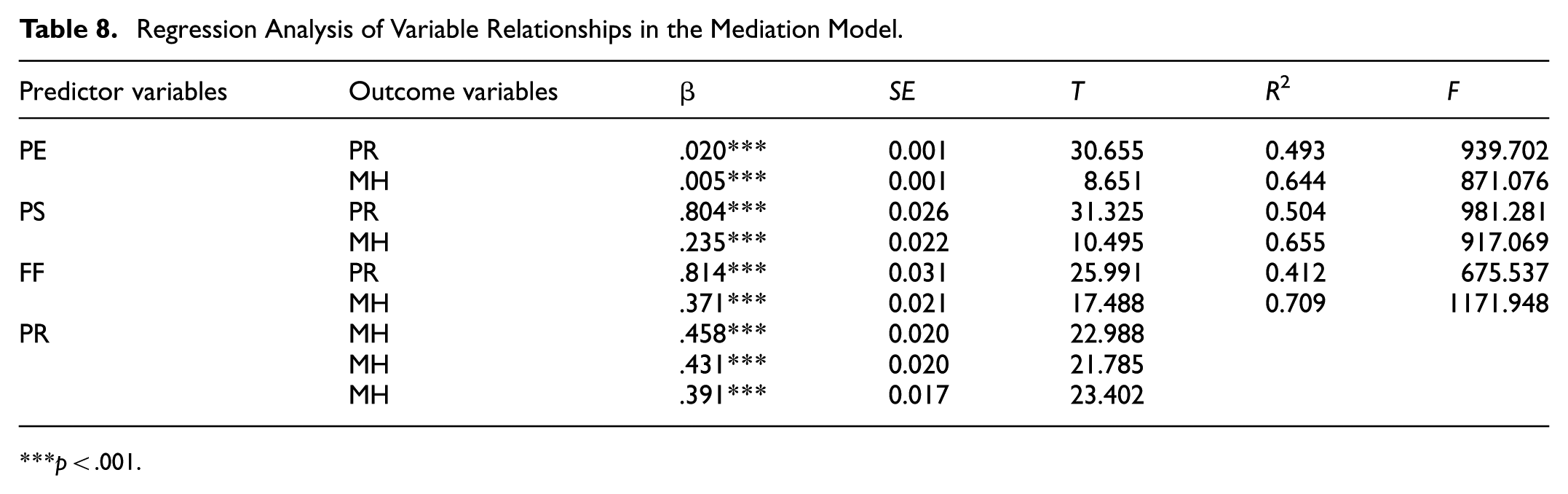
Once demographic factors, such as gender, age, and grade level, were controlled for, the regression analysis results are provided in Table 8. PE exerted a positive influence a positive effect on PR (β = .020, p < .001) and MH (β = .005, p < .001). PS positively influenced PR (β = .804, p < .001) and MH (β = .235, p < .001). Similarly, FF positively affected PR (β = .814, p < .001) and MH (β = .371, p < .001).
Regression Analysis of Variable Relationships in the Mediation Model.
p < .001.
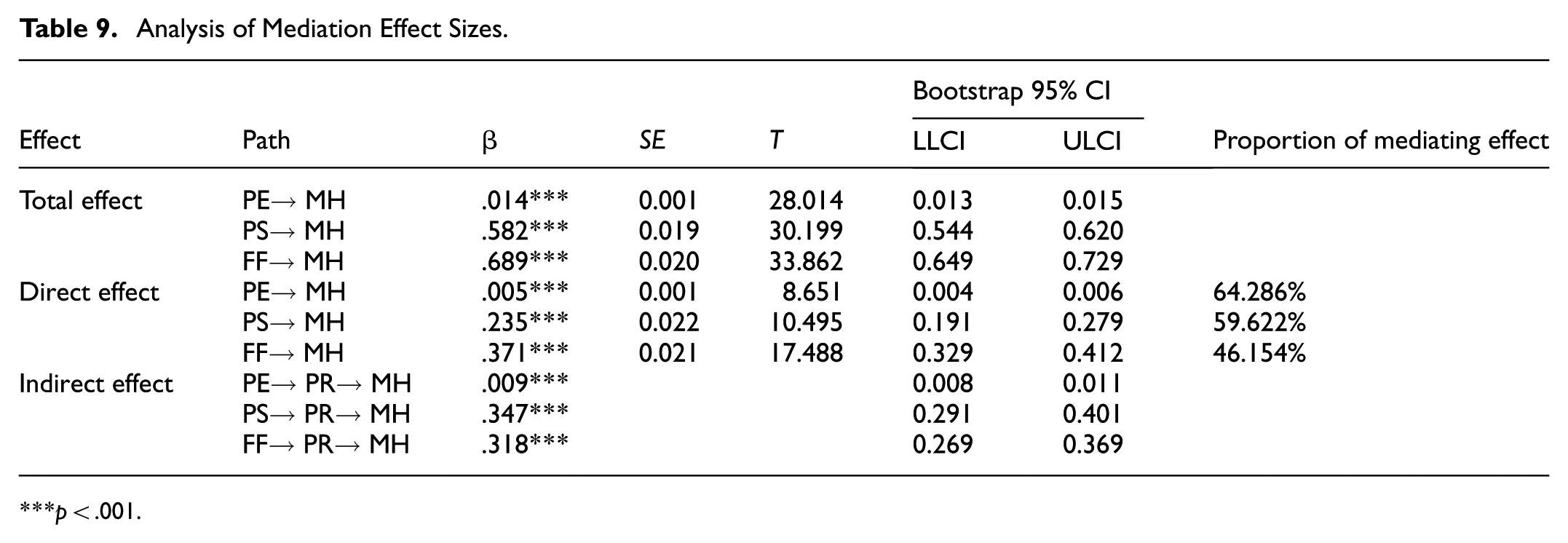
The mediation effects indicate (as shown in Table 9, Figures 2–4): In terms of total effects, PE, PS, and FF have significant positive impacts on MH. Regarding direct effects, PE, PS, and FF also show statistical significance in relation to MH. PE has an indirect positive effect on MH through PR (β = .009, 95% CI [0.008, 0.011]), PS has an indirect positive effect on MH through PR (β = .347, 95% CI [0.291, 0.401]), and FF has an indirect positive effect on MH through PR (β = .318, 95% CI [0.269, 0.369]). Therefore, H4 was supported.
Analysis of Mediation Effect Sizes.
p < .001.

Mediation model of physical exercise, psychological resilience, and mental health.

Mediation model of peer support, psychological resilience, and mental health.
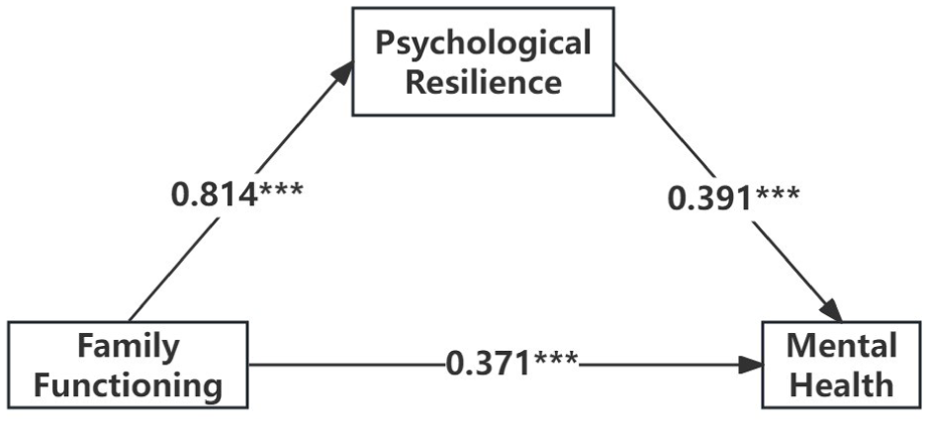
Mediation model of family functioning, psychological resilience, and mental health.
Discussion
This study explored how PE, PS, and FF influence adolescent’ MH and assessed the mediating effect of PR. The results indicated that PE, PS, and FF were significantly positively correlated with MH, with PR playing a mediating role. This suggests that PR may be a key mechanism through which PE and social support influence MH. Importantly, although all predictors were significantly related to MH, their effects differed markedly in magnitude, suggesting that adolescents’ mental health is shaped by distinct pathways rather than uniform influences across domains. The subsequent section will further discuss the study’s findings.
Physical Exercise, Peer Support, Family Functioning, and Mental Health
Based on the descriptive statistics, adolescents in the present sample reported varying levels of PE rather than a simple absence or presence of exercise. This variability provides an important context for interpreting the observed association between PE and MH. Based on the correlation analysis, PE, PS, and FF were all strongly and positively associated with adolescents’ MH, with correlation coefficients ranging from .670 to .737, indicating substantial effect sizes. Specifically, FF showed the strongest association with MH (r = .737), followed by PS (r = .697) and PE (r = .670). Overall, these findings are consistent with prior research on the positive associations of PE, PS, and FF with adolescents’ MH (Chuan & Xiong, 2023; Ho et al., 2022; X. Wang & Fu, 2023). From the perspective of the stress–buffering model, engagement in PE may help adolescents cope with academic and daily stress by alleviating physiological stress responses and enhancing emotional regulation, thereby weakening the adverse effects of stress on MH (Bird et al., 2021; Vancini et al., 2021). This interpretation is also supported by evidence that the frequency and intensity of physical activity are closely related to MH outcomes (W. Li et al., 2024). In contrast, social support theory emphasizes that PS and FF promote MH through emotional reassurance, practical assistance, and stable relational resources that facilitate effective stress coping (Cohen & Wills, 1985). Empirical studies have shown that high-quality PS reduces adolescents’ anxiety and depressive symptoms while enhancing self-esteem and well-being (Dong et al., 2023; Liu et al., 2024), whereas a supportive family environment is associated with lower psychological distress and greater life satisfaction (Henry et al., 2024; Molina Moreno et al., 2024). Moreover, the strength of these associations may vary across sociocultural contexts. In collectivistic societies such as China, close family ties and strong peer connectedness are culturally emphasized, which may reinforce the associations of PS and FF with adolescents’ MH (Shi et al., 2022; Yang et al., 2024). By contrast, in more individualistic European or North American contexts, adolescents may rely more on formal psychological services within social welfare systems, and parental involvement may be less intensive, potentially leading to different patterns of association between PE, PS, FF, and MH (Biddle et al., 2019; Rueger et al., 2016).
The Mediating Effects of Psychological Resilience
The present study provides evidence that PR mediates the associations between PE, PS, FF, and MH, while also revealing pronounced differences in the strength of these mediation pathways. Within the framework of the stress-buffering model, PR can be conceptualized as a key psychological resource that attenuates the impact of stress on MH (Cohen & Wills, 1985). However, the extent to which different antecedents contribute to this buffering process appears to vary substantially.
Regarding PE, the results indicate a statistically significant but very small direct association with MH (β = .005), as well as a small indirect effect via PR (β = .009). Although PE was positively related to PR (β = .020), its contribution to the stress-buffering process was limited in magnitude. These small coefficients suggest that, at the individual level, increases in physical exercise alone are unlikely to produce immediate or substantial improvements in adolescents’ overall mental health. Rather, the practical significance of PE lies in its cumulative and supportive role, particularly in large populations where even small effects may translate into meaningful public health benefits when sustained over time. In exam-oriented academic settings, adolescents are exposed to persistent academic stressors that are not easily modified by behavioral factors alone (S. Jiang et al., 2021). Within the stress-buffering framework, PE primarily enhances adolescents’ stress tolerance and recovery capacity, which constitute core components of PR, rather than exerting a strong direct influence on MH (Yıldırım et al., 2022). Accordingly, once PR is incorporated into the model, the association between PE and mental health is largely transmitted through the resilience pathway, resulting in a markedly attenuated direct relationship (Lin et al., 2024). From a practical perspective, this pattern indicates that PE may be more effective as a complementary component within broader, multi-level mental health interventions, rather than as a stand-alone strategy for improving adolescents’ mental health.
In contrast, PS demonstrated a strong association with PR (β = .804), which in turn was robustly linked to MH (β = .458), producing a substantial indirect effect (β = .347). According to social support theory, peer relationships provide emotional reassurance, companionship, and validation, all of which are highly salient during adolescence (Cobb, 1976). During this developmental stage, peers constitute a primary source of emotional and social resources, shaping adolescents’ stress appraisal and coping processes (Qi et al., 2022). These support processes may directly strengthen PR by helping adolescents reinterpret stressors, regulate negative emotions, and maintain psychological stability under pressure (Shao & Kang, 2022). Consequently, PS appears to play a central role in activating the stress-buffering function of PR, leading to more pronounced MH benefits.
A similar pattern was observed for FF, which showed a strong positive association with PR (β = .814) and a sizeable indirect effect on MH through PR (β = .318). Within the stress-buffering framework, FF represents a stable and continuous source of emotional and instrumental support that can mitigate the accumulation of stress (Cohen & Wills, 1985). High levels of FF may enhance PR by providing consistent emotional security, effective communication, and adaptive coping models, thereby reducing adolescents’ vulnerability to stress-related psychological difficulties (Zhang et al., 2024). In this sense, FF operates as a foundational support context that reinforces the resilience pathway linking environmental resources to MH.
Taken together, the differential effect sizes across pathways suggest that social support-based factors (PS and FF) are more directly involved in the stress-buffering process than PE. While PE contributes positively to PR and MH, its relatively small coefficients indicate that its buffering role is weaker when examined alongside interpersonal and familial support resources. This pattern is consistent with both the stress-buffering model and social support theory, which emphasize that resources closely aligned with individuals’ social environments are more effective in alleviating stress-related psychological outcomes.
Implications and Limitations
Theoretical Implications
The theoretical innovation of this study is reflected in the following three aspects. First, by integrating the stress-buffering theory and the theory of social support, this study proposes a multidimensional theoretical model that systematically examines the protective roles of PE, PS, and FF—positioned at different levels—through the mediating mechanism of resilience. This integrative framework not only incorporates individual behaviors (PE) and social support resources (PS and FF) within a unified theoretical structure, but also reveals how these factors jointly promote mental health by enhancing individual resilience. The construction of this model addresses the limitations of previous studies that tended to focus on isolated factors or simplistic pathways.
Second, this study deepens the understanding of the mediating role of resilience in the relationship between various support resources and MH. While previous research has primarily emphasized the independent effects of social support or individual behaviors, this study highlights the central role of resilience as a mediating variable that transforms external support and behavioral engagement into positive psychological outcomes. By empirically validating the mediating effect of resilience, the study elucidates its adaptive function in integrating diverse sources of support, thereby enriching the theoretical foundation of resilience and underscoring its pivotal role in adolescent mental health.
Finally, by constructing and validating a theoretical model that captures the interactive effects of multiple support resources and resilience, this study transcends the limitations of earlier research that often focused on single variables or linear pathways. Compared with prior models, the framework proposed here offers a more comprehensive and systematic explanation of how individual behaviors and social support resources jointly influence adolescent mental health through resilience. This advancement provides a robust theoretical foundation for future research.
Practical Implications
In practice, this study provides scientific evidence and effective pathways for promoting adolescent’ MH, offering diversified intervention approaches. First, at the school level, the study’s findings confirm the important roles of PE and PS in enhancing PR and improving MH. Schools should recognize the mediating role of PR between PE, PS, and adolescent’ MH to further enhance students’ mental well-being. It is recommended that schools offer a variety of PE courses and activities to encourage students to actively participate. Schools should create a positive and supportive campus culture, fostering mutual support among students by organizing interest groups, clubs, and peer-help projects, allowing adolescent to choose activities based on their interests. Additionally, schools should implement MH Education programs to raise awareness of MH, improve adolescent’ MH literacy, and enhance their psychological adjustment abilities. Second, at the family level, the study highlights a notable positive relationship between FF and adolescent’ PR and MH. Parents should actively create a warm and harmonious family atmosphere, establish equal, respectful, and trusting parent-child relationships, strengthen communication, pay attention to emotional changes in their children, and provide emotional support and encouragement. Furthermore, parents should actively engage in PE, setting an example for a healthy lifestyle. It is important for parents to encourage their children to take part in social activities to improve their social skills. These are all effective ways to enhance adolescent’ PR and improve their MH.
Limitations
Although this study has made significant progress in exploring the relationships among PE, PS, FF, PR, and MH, several limitations should be acknowledged, providing directions for future research. First, this study employed a cross-sectional research design, which may limit the ability to establish causal relationships between the variables due to the potential time-related associations. Because all main variables were measured at a single time point, the observed associations should not be interpreted as evidence of causal relationships, and the directionality among the variables cannot be definitively determined. Future research could use longitudinal studies to further validate the dynamic relationships between these variables, tracking changes in the same group of participants over time to explore the causal relationships among PE, PS, FF, and MH. Second, although this study considered the mediating role of PR, it did not comprehensively control for other factors that could influence the research results, such as personality traits. Therefore, future studies should consider and control for more potential variables to enhance the accuracy of the research conclusions. Lastly, this study relied on self-report data, which may introduce social desirability bias and recall bias, potentially reducing the objectivity of the data. Although Harman’s single-factor test indicated no serious common method bias, its limited sensitivity means that common method variance and social desirability effects cannot be completely ruled out in cross-sectional, single-source self-report data. Future research could incorporate multi-source data to improve the reliability of the results.
Conclusion
This study examined the associations of PE, PS, and FF with adolescent’ MH and tested the mediating role of PR. The results indicated that PE, PS, and FF all have significant positive effects on adolescent’ MH. Furthermore, PR mediated the relationship between PE, PS, FF, and MH. This study not only enriches the theoretical model of factors influencing adolescent’ MH, but also deepens the understanding of the mechanisms of PR. It provides new perspectives for future research and offers scientific evidence and effective pathways for promoting adolescent’ MH. The study underscores the crucial role of PR in MH interventions and encourages adolescent to actively engage in PE, build positive Peer Relationships, and improve FF.
Footnotes

Ethical Considerations
The researchers confirms that all research was performed in accordance with relevant guidelines/regulations applicable when human participants are involved (e.g., Declaration of Helsinki or similar). This study was approved by the Ethics Committee of Chongqing University (Approved No. CU-008).
Consent to Participate
The participants received oral and written information and provided written informed consent before participating in the study.
Author Contributions
Conceptualization: Ke Ren; Methodology: Li Zhang; Formal analysis and investigation: Li Zhang; Writing–original draft preparation: Ke Ren; Writing–review and editing: Fei Liu; Supervision: Fei Liu. All the authors have read and agreed to the published version of the manuscript.
Funding
The authors disclosed receipt of the following financial support for the research, authorship, and/or publication of this article:
Declaration of Conflicting Interests
The authors declared no potential conflicts of interest with respect to the research, authorship, and/or publication of this article.
Data Availability Statement
The data that support the findings of this study are available on request from the corresponding author*.