




Abstract
Considering the need to achieve global food sustainability and contribute to environmental sustainability, it is essential to explore strategies to enhance the acceptability of insect-based foods, particularly in regions where such consumption is not part of traditional dietary patterns. This study investigated the effects of packaging communication, insect-based ingredient information, and personal recommendations on e-commerce platforms on consumers’ purchase intention, brand perception, and taste perception of insect-based foods. A 2 × 2 × 2 factorial design was applied, testing three factors: positive versus negative word-of-mouth (WOM), ingredient information indicating insect flour versus oat flour, and packaging featuring a cricket cartoon versus packaging without such imagery. The sample consisted of 245 consumers aged 18 to 25 years. The results showed significant main effects of WOM on brand perception, whereas ingredient information and packaging imagery did not exert independent effects on taste perception or purchase intention. Moreover, interaction effects among the three factors were observed. Overall, the findings suggest that young adults demonstrate a general openness to trying novel foods and display a willingness to experiment with alternative dietary options.
Plain Language Summary
To achieve more sustainable food systems worldwide and reduce environmental impact, it is important to understand how to make insect-based foods more acceptable, especially in places where eating insects is not common. This study examined what influences people’s willingness to buy these products, how they view the brand, and what they expect the taste to be like when shopping on online platforms. Three types of cues were tested: whether other people’s opinions were positive or negative, whether the product stated it was made with insect flour or oat flour, and whether the package showed a cartoon cricket or not. A total of 245 young adults aged 18 to 25 took part. Overall, other people’s opinions and recommendations had the strongest impact on how participants perceived the brand. By themselves, the ingredient label and the cartoon image on the package did not clearly change either expected taste or willingness to buy. However, when these cues appeared together, their combination could make a difference. In short, young adults seemed fairly open to trying new foods and willing to experiment with alternative options.
Introduction
Edible insects have gained importance for global food security, partly due to the 2013 report by the United Nations Food and Agriculture Organization (FAO, 2021), which highlights their nutritional role, consumption benefits, and significant environmental advantages due to their lower water and space requirements and reduced emissions (Kauppi et al., 2019). In many cultures worldwide, insects form a regular part of the diet (Olivadese & Dindo, 2023). However, in Western societies dietary practices generally exclude insects (Kröger et al., 2022). In Latin America, there are some exceptions in certain regions of Mexico, Brazil, and Guatemala, where crickets, ants, and specific worm species are consumed (Abril et al., 2022; Granados-Echegoyen et al., 2024). In Colombia, the consumption of ants is common in the northwest, primarily as a snack rather than a staple food, and this practice is not widespread across other regions (Pérez-Grisales & Uribe-Soto, 2022).
While evidence highlights the benefits of insect consumption, particularly in terms of protein and vitamin content (Aidoo et al., 2023; Zhou et al., 2022). Nevertheless, cultural beliefs and fears associated with insects—often socialized from early stages among younger generations—represent a primary barrier to market acceptance and integration of insects into various food-related applications (Stone et al., 2023; Szlachciuk & Żakowska-Biemans, 2024; Szulc, 2023). Consequently, understanding the social and psychological variables associated with the acceptability of insect-based foods is essential for market penetration and achieving food sustainability, a critical objective for poorer and developing countries.
Consuming insects transcends mere economic exchange; it involves an ingestion process integrated with human diet patterns, which vary based on geographical and cultural contexts (Gravel & Doyen, 2020). In Western societies, psychological barriers to insect consumption have been identified, often tied to negative emotions and attitudes toward insects, which consequently affect consumption practices (Batat & Peter, 2020). Acceptance of insects across various regions, particularly in Latin America, requires transforming perceptions rooted in fear, disgust, and beliefs about the potential harm of insect consumption. Despite growing interest in insect consumption within some population segments, a considerable gap remains between initial curiosity and real acceptance due to the interaction between emotional responses towards insects and the rational aspects of consumption, including product preparation, familiarity, and individual traits linked to neophobia, such as disgust sensitivity, animal empathy, and gender (Çınar et al., 2021; Tan et al., 2016).
Although disgust and neophobia may be related, they are not identical concepts, as unfamiliar foods do not necessarily elicit disgust (La Barbera et al., 2021). Some studies indicate that taste plays a pivotal role in shaping food preferences, with positive tasting experiences promoting greater familiarity and, consequently, higher consumption intention. Furthermore, crunchy textures are shown to increase the likelihood of ingestion (Sogari et al., 2023; Wendin et al., 2021). These factors can be strategically addressed through packaging design, enhancement of organoleptic properties, and marketing communication strategies. However, it remains essential to understand how these product attributes influence the overall perception of insect-based foods. Consequently, understanding the social and psychological variables associated with the acceptability of insect-based foods is essential for market penetration and achieving food sustainability, a critical objective for poorer and developing countries (Euromonitor International, 2021).
Theoretical Framework
The Theory of Planned Behavior (TPB) constitutes one of the most influential frameworks for explaining and predicting intentional behavior across consumer, health, and sustainability contexts (Canova et al., 2020). As such, the intention to perform a specific behavior is the proximal determinant of the behavior itself and is explained by three core components: attitude toward the behavior, the subjective norm, and perceived behavioral control (PBC; Ajzen, 2011). Attitudes refer to evaluative beliefs about consuming insect-based foods, subjective norms capture perceived social approval conveyed through eWOM, and purchase intention reflects the motivational readiness to engage in future consumption; attitude corresponds to the individual’s favorable or unfavorable evaluation of performing the behavior; the subjective norm refers to the perceived social pressure, specifically the perception of approval or disapproval from significant others; and PBC relates to the perceived ease or difficulty of performing the behavior, based on perceived resources, opportunities, and barriers. In the food domain, the TPB has been widely utilized to understand the purchase intention of organic and sustainable products, demonstrating that a combination of favorable attitudes, supportive subjective norms, and high PBC is associated with a greater likelihood of choosing healthy and pro-environmental foods (Bazhan et al., 2024; Hoang et al., 2022).
The Theory of Planned Behavior (TPB) has led to extensions that incorporate moral and contextual variables, which are particularly relevant when consumer behavior is associated with ethical, environmental, or sustainability considerations (Ajzen, 2020). In these approaches, the inclusion of personal or internal moral norms allows researchers to capture the weight of pro-environmental and social responsibility values in the formation of behavioral intention, moving beyond the classic components of the TPB (attitude, subjective norm, and perceived behavioral control). This reinforces the idea that intention does not depend solely on a utilitarian evaluation of the product, but also on the perceived coherence between the consumption choice and personal values linked to sustainability and environmental impact (Le & Nguyen, 2022).
Applying the TPB and its extensions to the study of insect-based foods (IBFs) allows for the breakdown of the psychological determinants of purchase intention in contexts where these products are not part of the traditional diet. The attitude toward IBFs is shaped by beliefs concerning the expected consequences of consumption, such as taste, safety, quality, or environmental benefits, but also by affective responses that act as barriers, particularly disgust and food neophobia. These dimensions consistently appear as relevant predictors and obstacles in the empirical and review evidence regarding the acceptance of insects as food (Bae & Choi, 2021). In this scenario, explicit ingredient information and certain graphic elements of the packaging operate as communication stimuli that can either activate or attenuate inferences and affective reactions. For example, it has been observed that visual cues associated with familiarity or safety signals can reduce disgust, while explicit images of the insect may increase it, thereby modulating product evaluation and willingness to try (Naranjo-Guevara et al., 2023).
The subjective norm acquires relevance in young populations where social influence is articulated primarily via digital communication. Electronic word-of-mouth (e-WOM) on social networks and e-commerce platforms constitutes a central source of social information about the acceptability and desirability of novel products. Accumulated evidence shows that e-WOM robustly influences evaluations and purchasing decisions, operating as a social signal that guides judgments under uncertainty (Ismagilova et al., 2020). In the case of IBFs, furthermore, available synthesis suggests that acceptance is favored when social influence stems from more qualified recommendations or peer experiences, which is consistent with the role of the subjective norm as the perceived social pressure to “try” unconventional foods (Kröger et al., 2022).
This theorical explanation is complemented by a consumer-psychology account derived from social learning, in which modeling is regarded as a key mechanism through which new eating patterns emerge. eWOM can be interpreted as symbolic modeling and digital persuasion, insofar as it exposes consumers to experience-based narratives that illustrate how and why a consumption behavior is valid, acceptable, or desirable, thereby helping individuals cope with fears associated with insects and other non-traditional foods (Golmaryami et al., 2024). Moreover, eWOM effects in digital environments can be explained through two social influence pathways: an informational route, whereby high-quality reviews provide diagnostic input that facilitates product evaluation and informed decisions, and a value-expressive route, whereby influence operates through identification with individuals or reference groups whose values consumers aspire to adopt (Zhao et al., 2018). In both pathways, recommendations do not merely transmit information; they function as norm-laden social cues that shape attitudes, perceived risk, and willingness to act.
Aligned with this perspective, the persuasive power of WOM in social networks and e-commerce can also be interpreted through the Social Influence Engine Model, which integrates traditional social influence processes with emergent influence variables specific to virtual environments. This model accounts for moderators of persuasion as well as structural features of digital content—such as post formats, discussion dynamics, and review characteristics—offering a framework to explain why certain eWOM messages exert stronger effects on evaluations and purchasing decisions (Tejada-Orozco et al., 2024; Zhao et al., 2018). In this study, the term word-of-mouth (WOM) is used in its electronic form (eWOM), referring specifically to consumer-generated reviews and recommendations displayed in digital and e-commerce environments.
Taken together, these approaches support an integrated view of IBF acceptability as a multicausal process in which digital social influence signals (WOM/eWOM) interact with product communication cues (ingredient information and packaging) to jointly shape attitudes, subjective norms, and PBC, while also activating moral considerations central to TPB-A in sustainability-related consumption (Rozenkowska, 2023; Zhou et al., 2022).
Previous Studies
To promote the adoption of insect-based foods in Western countries, it is essential to address entomophobia through interventions that explore persuasive pathways and decision-making processes. Gumussoy et al. (2021) found that sustainability arguments and information about the production of insect flour effectively reduced disgust, while arguments focused on taste did not. This suggests that increasing familiarity with insect-based foods, rather than using purely logical arguments, is more effective in changing perceptions of disgust. Moreover, targeting the ideational component of disgust may further reduce negative reactions to these foods. Incorporating insects as a food source in Western societies is more likely to succeed when insects are included in familiar foods, which can reduce neophobic reactions and negative attitudes towards insect-based foods (Mikulec et al., 2024; Verbeke, 2015). As House (2016) observed, research on the acceptance of insects as food in Western contexts has predominantly focused on individual cognitive processes in food choices, often neglecting social and contextual factors. Consumer acceptance is generally framed as a broad issue, with limited attention given to specific demographic segments more inclined to adopt insect-based foods, such as younger individuals, who may act as early adopters as they explore alternative dietary options (Alemu et al., 2017).
Reducing negative emotions associated with food is essential for encouraging product trials, as self-reported willingness to innovate in protein consumption often requires time to materialize (Onwezen et al., 2022). Moreover, explicit descriptions and representations of insect-based foods should generally be avoided, as these increase perceived risks and decrease consumption intentions (Baker et al., 2016). For example, Marquis et al. (2023) investigated the effects of visual cues and information on insect-based foods, focusing on young consumers’ emotions, perceptions, and acceptance. Eight packaging versions were evaluated by Colombian and French respondents, revealing significant positive effects of visual elements on emotions, anticipated product enjoyment, taste, and purchase intentions, with different impacts on functional versus hedonic products, differences were also observed based on the respondents’ gender and nationality.
Similarly, Motoki et al. (2020) demonstrated that the acceptability of insect-based foods is significantly influenced by contextual, particularly social, factors (e.g., companions, friends, and family) and setting (e.g., cafeterias, bars, food festivals). Additionally, celebrity endorsements can promote trials of insect-based foods, depending on perceived trustworthiness, knowledge, and suitability as promoters—particularly athletes for male consumers and actors or actresses for female consumers (Park et al., 2022).
Regarding the importance of interpersonal communication in fast food contexts, Jibril and Adzovie (2022) explored the moderating role of traditional media advertising and electronic word-of-mouth (e-WOM), finding that convenience and time, menu pricing, and taste and preference significantly influenced establishment choice, with e-WOM serving as a central moderator of preference for establishments. Moreover, Wai Lai (2020) identified similar results in restaurant settings, examining variables that drive WOM. Although food plays an important role, snack type and Michelin-level cuisine interact to generate higher satisfaction and increase recommendation likelihood, with a greater effect on snack consumption.
In another study, Umaimah and Adnans (2023) examined the partial and simultaneous effects of e-WOM and price perception on purchase decisions for food products, finding that both e-WOM and price positively affected purchase decisions individually and combined. This reinforces the notion that sharing recommendations on e-commerce pages is associated with higher purchase intentions, especially for unfamiliar food products, as e-WOM reduces uncertainty. Positive emotions serve as moderators in these contexts, driving high consumption intentions within social settings involving close associates and in locations typically associated with these emotions, particularly when using figurative names.
In terms of product-packaging characteristics, Lombardi et al. (2019) demonstrated that providing information on the positive effects of edible insects and using familiar foods in which insects are not visible increases willingness to eat insects, although a high correlation was found between psychographic scales, food neophobia, beliefs and attitudes toward insects, and the intention to use insect-based products. Knowledge also has an indirect effect on consumption intention. For example, Motoki et al. (2020) studied the effects of brand names and packaging information. The authors used real product names (without images) for insect-based foods (“worm flour burger” and “cricket chocolate bar”), finding that people were more willing to eat insect foods when positive emotions such as fun and excitement were associated with them, rather than calming emotions such as romance or tranquility, suggesting existing fears regarding these products.
Product packaging serves as an inexpensive and effective communication tool. For instance, Naranjo-Guevara et al. (2023) examined its communication potential to reduce disgust towards insect-based products in Germany. Their results showed that images of familiar ingredients, organic eco-labels associated with Ento (insects), and transparent package windows helped reduce disgust, while protein content and sustainability information were less effective. Additionally, images of crickets significantly increased disgust, as the cricket depicted on the packaging was a realistic, colored illustration. Although a brand was included, brand perception and associations were not analyzed after exposure to the packaging.
Existing evidence also emphasizes the significance of experiential contexts in promoting the trial and adoption of insect-based foods. Delicato et al. (2020) demonstrated that incorporating insect ingredients into familiar food products can facilitate greater acceptance in Western countries. Similarly, Cicatiello et al. (2020) found that generalized distrust of novel foods, along with a preference for transparency regarding ingredients, negatively impacted the overall taste ratings of tested products. In this regard, Cifci et al. (2020) identified four key constructs to enhance habitual consumption intentions for insect-based foods: public outreach initiatives, the development of palatable products, culinary experiences, and the use of authority-driven arguments to mitigate food neophobia from a science-based perspective within a marketing framework (Chow et al., 2021; Dion-Poulin et al., 2021). These constructs could play a pivotal role in the design of strategic interventions aimed at dismantling market-access barriers, although their applicability and effectiveness require further validation.
Progress in this area is illustrated by Puteri et al. (2023), who analyzed marketing mix strategies to enhance the appeal and acceptance of insect-based food products. Their study emphasizes the importance of aligning product attributes with the specific preferences of target consumers; using more subtle insect labelling; employing value-added or competition-based pricing strategies; ensuring consistent product availability in the market; and promoting products more effectively through advertising, tasting activities, and social influence via user recommendations. Therefore, this study aimed to evaluate the impact of packaging-related communication and personal recommendations on purchase intention and taste perception of insect-based foods, contributing valuable insights into interventions that could enhance market access for these products, particularly within Colombian context.
This research sought to answer the following questions: Do positive word-of-mouth (WOM) recommendations, as compared to negative ones, lead to more favorable brand perception and increased purchase intention? Does the inclusion of an insect-related image on packaging and the presentation of insect-based ingredient information affect taste perception or purchase behavior? Moreover, do these variables interact in ways that amplify or mitigate consumer responses to insect-based foods? Addressing these questions provides empirical insights to inform effective strategies for improving the market integration of insect-based food products in everyday diets.
Method
Design
An experimental 2 × 2 × 2 factorial design was used with three factors: (a) Factor 1: Social Recommendation (Word of Mouth [WOM]), (b) Factor 2: Food Information, and (c) Factor 3: Packaging Information. This design involved the formation of eight experimental groups to assess the comparative effect of social and product-related aspects on taste perception, brand beliefs, and purchase intention. The study was explicitly designed as a minimal-risk procedure, consistent with typical research in consumer psychology. Participation involved a single brief session in a university setting, during which students evaluated a cookie made with conventional oat flour and completed self-administered questionnaires about their perceptions, without any invasive procedures or physiological manipulation.
No sensitive clinical information or direct personal identifiers were collected, and responses were handled anonymously or under pseudonymized codes. Although some groups were informed that the product contained “insect flour,” all participants in fact consumed the same standard oat-based product, so there was no biological risk associated with ingestion. Any potential psychological discomfort arising from the idea of eating insects was mitigated by emphasizing the voluntary nature of participation, the possibility of withdrawing at any time without penalty, and, in the protocol, by providing a post-experimental explanation of the informational manipulation. The composition and allocation of the experimental groups are detailed in Table 1.
Description of Experimental Groups.

Procedure
To participate in the study, everyone was required to complete a form and sign an informed consent document, in accordance with the inclusion criteria. Once selected, participants completed a demographic questionnaire that included questions about their dietary patterns and preferences. Following this initial phase, participants entered the experimental room, where they were exposed to the stimuli assigned to their randomly allocated group.
With respect to Factor 1, Social Recommendation, this variable was manipulated through word-of-mouth (WOM) comments displayed on a landing page designed to showcase the product and its visual features, simulating an e-commerce platform. This factor had two levels: (a) Positive WOM, consisting of 20 total comments, of which 15 were favorable, 3 neutral, and 2 unfavorable; and (b) Negative WOM, consisting of 20 total comments, of which 15 were unfavorable, 3 neutral, and 2 favorable. The inclusion of neutral and opposing comments within each condition aimed to replicate realistic consumer review pages, which rarely consist solely of positive or negative feedback.
Regarding Factor 2, Food Information, this variable also had two levels: (a) information indicating that the food was primarily made with insect flour; and (b) information indicating that the food was entirely made with oat flour. The food consisted of a cookie packaged in a transparent bag to display its texture; all cookies contained oat flour. However, groups G1, G2, G9, and G11 received information suggesting that the cookie was made with insect flour.
Factor 3, Packaging Information, involved a fictional brand named “Delicake” and had two levels: (a) packaging featuring nature-themed images, the brand logo, and a cartoon-style icon depicting a smiling cricket; and (b) packaging featuring nature-themed images and the brand logo, but without the cricket cartoon.
Three dependent variables were assessed using multi-item instruments on 7-point Likert-type scales (7 = I liked it very much; 6 = I liked it; 5 = I liked it a little; 4 = I neither liked nor disliked it; 3 = I disliked it a little; 2 = I disliked it; 1 = I disliked it very much). The scale items were constructed as statements (appropriate for measurement with a Likert scale of attitudes) and a cognitive validation of the comprehension and wording of each item was developed, with 3 expert judges).
Brand perception (i.e., beliefs about the fictional brand, e.g., “Regarding the cookie brand, please rate the brand on the following aspects”) was measured with a 10-item scale demonstrating good internal consistency (Cronbach’s α = .865). Taste perception was captured through a 13-item scale in which participants evaluated the product’s sensory and overall liking attributes (i.e., “Regarding the food you just tasted, please indicate how much you liked the following characteristics of it, being”); reliability was high (Cronbach’s α = .898). Finally, future purchase intention toward the brand was assessed immediately after exposure to the experimental stimuli and product consumption using a 3-item scale, which showed excellent internal consistency (Cronbach’s α = .938).
Statistical Analysis
First, the data were examined to ensure compliance with the assumptions of normality and homogeneity of variance required for parametric tests. Levene’s test was used to assess the homogeneity of variance across groups for each dependent variable. Independent samples t-tests were conducted to evaluate mean differences across experimental conditions for brand perception, taste perception, and purchase intention. These tests aimed to compare the influence of the manipulated factors, such as word-of-mouth (WOM), packaging type, and information type, on participants’ responses.
Subsequently, a Multivariate Analysis of Variance (MANOVA) was conducted to assess potential interaction effects of the independent variables on the dependent variables. This technique is still used in experimental research (Huang, 2020). The use of MANOVA allowed for the examination of the combined impact of multiple factors on brand perception, taste perception, and purchase intention, while controlling for Type I error rates.
Prior to conducting the MANOVA, Box’s test was applied to ensure the assumption of homogeneity of covariance matrices. The analysis included interaction effects between packaging type and information type, as well as a three-way interaction involving WOM, packaging type, and information type. These multivariate tests were followed by Type IV sum of squares to further investigate between-subject effects for each dependent variable. The data were analyzed using SPSS version 30.0.
Ethical Considerations
The experimental procedure, protocols, instruments, and participant selection process were approved by the Institutional Ethics Committee, ensuring compliance with ethical research requirements for human participants according to global standards, specifically adhering to the Declaration of Helsinki and Law 1090 of 2006, applicable in Colombia. A specific informed consent form was developed for this study, covering all methodological aspects, and participants provided informed consent prior to participation. The consent informed participants that the product content could differ from what was presented (e.g., it might not actually contain insect flour), as the objective was to evaluate perceptions of products advertised on an e-commerce page. Signing the consent form was voluntary.
Sample
The study included 245 young adults (64.5% female, 34.7% male, and 0.8% other) aged between 18 and 25 years (M = 19.85, SD = 2.02), from socioeconomic strata 3, 4, and 5 in Bogotá, Colombia. Participants reported never having consumed insect-based foods or traditional whole insects, such as ants or worms. A pre-screening protocol was implemented through an online form to confirm eligibility criteria, which included being within the target age range, residing in the specified socioeconomic strata, and reporting no prior consumption of insect-based foods or traditional whole insects (e.g., ants or worms).
Only those meeting all criteria were invited to participate in face-to-face experimental sessions conducted at the university campus. Although the sample was distributed across eight experimental groups in a 2 × 2 × 2 factorial design, the total sample size (n = 245) was consistent with similar experimental studies in food psychology using between-subjects designs (Berger & Wyss, 2020; White et al., 2022). Furthermore, this sample size was considered sufficient to detect small-to-moderate effect sizes (f = .25) with a power of .80 at an alpha level of .05 in factorial designs, as estimated using G*Power software (Faul et al., 2007). Nonetheless, the sample size per group is acknowledged as a limitation and is discussed accordingly.
Results
Table 2 shows the demographic characteristics of the sample. It is noted that there were more female than male participants, with a larger proportion of individuals from middle socioeconomic strata. Most participants were single university students, consistent with the selected age range.
Sample Characteristics.

To examine differences between positive and negative WOM, we first evaluated mean differences for the factors manipulated in the experiment across each dependent variable. An independent samples t-test indicated significant differences in brand perception according to positive and negative WOM (t[242] = −2.346, p = .018). Participants exposed to positive WOM had a more favorable brand perception (M = 5.12, SD = .98) than those exposed to negative WOM (M = 4.82, SD = 1.01). The effect size for this difference was small (Cohen’s d = .30). Additionally, no significant differences were observed in taste perception based on positive and negative WOM (t[242] = .916, p = .361). No differences in future purchase intention were observed based on WOM type (t[243] = 1.056, p = .292). Furthermore, there were no significant differences in taste perception based on packaging type (with or without insect image; t[242] = .882, p = .379). Similarly, no differences were found in brand perception (t[242] = 1.985, p = .051) and purchase intention (t[243] = 1.650, p = .100). Regarding differences based on information type provided (wheat flour vs. insect flour), there were no significant differences in taste perception (t[242] = .544, p = .587), brand perception (t[242] = −1.023, p = .308), or purchase intention (t[242] = −.336, p = .737).
MANOVA Test
Prior to the MANOVA analysis, the homogeneity of covariance assumption was verified using Box’s test, which yielded non-significant results (F[38.738] = .882, p = .689), indicating that this assumption was met. As shown in Table 3, using Pillai’s Trace as a multivariate test, significant interaction effects were found for Packaging Type and Information Type combinations (V = .047, F = 3.082, p < .05), as well as for the combination of all three independent variables (V = .061, F = 4.042, p < .01). In general, the interaction of all conditions increased the effects on taste perception, brand image, and purchase intention (Intersection V = .766, F = 202.423, p < .001).
Multivariate Analysis of Variance (MANOVA)—Significant Effects.
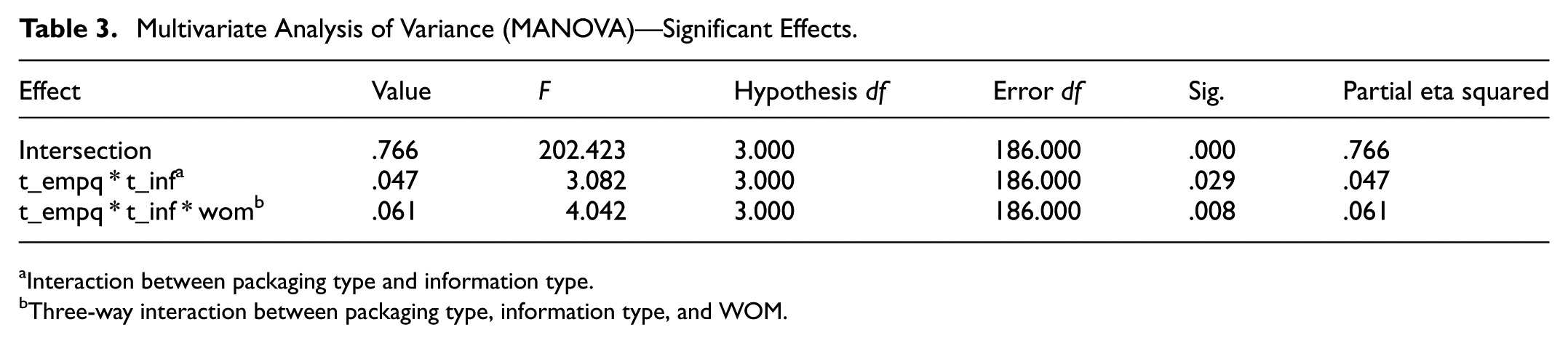
Interaction between packaging type and information type.
Three-way interaction between packaging type, information type, and WOM.
Analyzing the Type IV sum of squares for between-subjects effects reveals that the combination of Packaging Type and Information Type has significant effects on purchase intention (MC = 14.542; F[9.044], p < .01). For the combination of all three independent variables, significant between-subject effects were found for taste perception (MC = 10.684; F[10.550], p < .01) and brand perception (MC = 7.428; F[7.810], p < .01). Given the significant interaction terms, directionality is interpreted from the pattern of cell means reported in Table 3 (M and SD for the eight experimental conditions), rather than relying on graphical displays. Descriptive statistics by group are presented in Table 4.
Descriptive Statistics by Experimental Condition for Taste Perception, Brand Perception, and Purchase Intention.

Note. Values are presented as M (SD). WOM = word-of-mouth.
Although several interaction effects reached statistical significance, their substantive interpretation should be approached with caution. The observed interactions indicate that consumer responses to insect-based foods are not driven by isolated cues, but rather by the joint configuration of social recommendations, ingredient information, and packaging elements. Importantly, the associated effect sizes were small, suggesting that these interactions contribute incrementally—rather than decisively—to explaining variation in taste perception, brand perception, and purchase intention.
From a substantive perspective, these interaction effects should be interpreted as evidence of conditional sensitivity to combined cues rather than as indicators of strong or robust behavioral drivers. That is, the presence of positive or negative WOM may slightly alter how packaging and ingredient information are interpreted, however, these effects cannot be interpreted in isolation, nor can they be applied in the hope that they alone will guide consumer behavior. Consequently, the findings underscore the complexity of evaluative processes in novel food contexts, and show the importance of thoroughly considering the marketing mix to promote food acceptability.
Discussion
The present study aimed to test hypotheses regarding the main and interaction effects of food information (insect flour vs. oat flour), the presence of an abstract insect image on packaging (present or absent), and the influence of positive or negative recommendations on a simulated e-commerce page on taste perception, brand image, and purchase intention. The findings indicated that the only variable with a significant main effect was word-of-mouth (WOM) on brand perception, as participants exposed to positive comments on the e-commerce page reported a more favorable brand image.
Theoretical Implications
From a theoretical perspective, the results suggest that consumer evaluations of insect-based foods are not driven by isolated informational cues, but rather by the joint configuration of social and product-related signals. The absence of independent effects for ingredient disclosure and packaging imagery, alongside the presence of interaction effects, aligns with prior research on food neophobia and entomophagy and supports the interpretation of these results through consumer attitudinal processes.
Within the framework of the Theory of Planned Behavior (TPB; Ajzen, 2011) and its extended formulations, digital word-of-mouth (eWOM) appears to operate primarily through the subjective norm component, shaping perceptions of social acceptability and credibility and thereby strengthening brand evaluations more than immediate purchase intentions. In contrast, ingredient information and packaging cues -more closely related to attitudinal beliefs and perceived behavioral control- did not exert measurable effects when presented in isolation. This pattern is consistent with the notion that, in novel food contexts characterized by uncertainty and potential neophobia, single informational cues are insufficient to substantially alter intentions (House, 2016). Finally, the results support the TPB-A proposition that for sustainability-linked products, moral and contextual considerations can amplify normative influence in digital settings, so that effective strategies should align social validation (WOM) with credible product communication (ingredients and packaging) to foster stronger intentions over time (Zhou et al., 2022).
From a consumer psychology perspective, the findings of this study highlight the relevance of social learning as a key mechanism for developing new eating patterns. Modeling and its dimensions serve as a primary strategy to demonstrate new ways of addressing fears associated with the consumption of insects and other non-traditional foods. Modeling underlies the persuasive power of word-of-mouth (WOM), along with other forms of digital persuasion, all of which are grounded in social influence as the core driver of behavioral shifts and emerging trends (Golmaryami et al., 2024).
The transformative effect of eWOM on entomophobia can also be explained through the two pathways of social influence. According to Zhao et al. (2018), social influence operates through an informational route, which emerges mainly from the perception of high-quality reviews that enable consumers to better understand a product, evaluate it more effectively, and make informed decisions. The second route, the value-expressive pathway, centers on identification processes, which occur when an individual adopts a behavior because they wish to associate with another person or group representing desirable values. In this process, consumers aspire to emulate others—often members of a reference group—whose behavior they admire or seek to align with.
On the other hand, the impact of eWOM reveals the persuasive power of social networks and electronic commerce, supporting the Social Influence Engine Model (Tejada-Orozco et al., 2024). This model integrates traditional frameworks of social influence within group persuasion with new influence variables emerging from virtual environments. It accounts for moderating variables of persuasion processes as well as the structural components of posts on social media platforms, including discussion groups and online reviews (Zhao et al., 2018). The study highlights the role of digital social influence in shaping perceptions of sustainable but non-traditional foods. While insect-based foods show promise for environmental sustainability, their adoption depends not only on individual attitudes, but also on socially mediated processes of normalization and legitimization. Understanding these mechanisms is essential for designing communication strategies aimed at fostering gradual, socially supported food transitions.
Marketing Implications
Regarding marketing implications, the results provide useful insights for analyzing and addressing potential target markets, particularly among young adults. The study revealed that the young participants exhibited a higher willingness to consume insect-based foods compared to similar studies conducted among young adults in Europe (Çınar et al., 2021; Tan et al., 2016). This suggests that specific consumption patterns characteristic of Colombian youth, which are also common among Centennials in other regions, influence their propensity for exploration and innovation across various product categories, particularly food. It may imply that they make more objective and less biased judgments about product attributes, regardless of whether these are insect- or oat-based foods.
Additionally, as Giray (2022) points out, young people place significant value on information available online, particularly from social influencers and word-of-mouth (WOM) on e-commerce platforms, due to their high levels of technological literacy and deep engagement with mobile devices and applications. This explains why peer recommendations tend to have a greater influence on brand perception than packaging or food content. Sahil et al. (2022) highlight the interest of individuals born between 1997 and 2016 in environmental and global economic issues, noting that this generation increasingly makes both individual and family decisions. In this regard, the present study provides promising evidence for insect-based food brands seeking to penetrate the Colombian and broader Latin American youth markets (Costa-Neto, 2016). The findings suggest that this demographic is highly responsive to peer recommendations, particularly in digital environments, with positive outcomes when social influence is combined with packaging and informational strategies. As shown in this study, accessing this market segment requires an integrated approach that aligns product design with digital marketing strategies, as isolated interventions may not sufficiently influence purchase intention and, therefore, may fail to encourage product trials, which are critical in the early stages of consumption.
Similarly, WOM serves as a digital nudge strategy, as recommendation systems form part of the online user experience, allowing for information filtering and automatic selection and ranking of presented content (Jesse & Jannach, 2021). It is essential to explore various ways of integrating available nudges into recommendation systems to achieve sustained market penetration among young people, promote product trials, and eventually modify consumption patterns for insect-based foods. These strategies could also help build brand loyalty and recognition for companies marketing sustainable food products.
Thus, efforts by companies, international organizations, and governments to shift consumer habits toward the adoption of novel foods—often perceived with food neophobia—require a deep understanding of the social determinants of eating behavior and persuasion mechanisms in digital environments. Communication and marketing campaigns that do not incorporate these models will continue to be comparatively ineffective in achieving meaningful changes toward sustainable eating behaviors.
Sustainability Considerations
From a sustainability perspective, the study underscores that the adoption of insect-based foods depends not only on individual attitudes but also on socially mediated processes of normalization and legitimization. Although insect-based foods hold promises as environmentally sustainable alternatives, their acceptance requires communication strategies that resonate with collective values and social norms, particularly in digital contexts.
The findings suggest that fostering sustainable dietary transitions involves more than highlighting environmental benefits; it requires understanding how social influence mechanisms operate in online environments to reduce perceived risk and challenge food-related taboos. Accordingly, efforts by companies, institutions, and policymakers to promote insect-based foods should integrate sustainability messaging with socially validated narratives, recognizing that digital social influence plays a central role in shaping perceptions of legitimacy and acceptability.
Finally, while the relatively neutral responses observed among young adults may be viewed as encouraging, they should be interpreted cautiously. The absence of strong negative reactions represents a promising starting point rather than definitive evidence of acceptance, reinforcing the need for further research examining sustained exposure, real consumption contexts, and more diverse populations.
While the results suggest a relatively neutral or non-rejecting response to insect-related cues among this sample of young adults, these findings should not be interpreted as evidence of broad market readiness or high acceptance of insect-based foods. Rather, the absence of strong negative reactions should be viewed as promising rather than definitive.
Moreover, although young consumers are often described as more open to food innovation, the present findings do not directly demonstrate heightened acceptance or preparedness for insect-based foods. Instead, they indicate that, within this sample, evaluations were not strongly polarized by ingredient disclosure or packaging imagery alone.
Implications for Research and Practice
In terms of food consumption, Colombia, Latin America, and other regions have witnessed transformations in dietary habits among certain population segments, promoting conscious consumption practices aligned with a critical, ecological, solidarity-based, and ethical view of consumption rooted in consumer citizenship. However, conclusive data remains lacking to determine the characteristics and size of these segments, as well as the most effective communication mechanisms to promote behavioral change towards alternative food sources.
From a managerial and practical perspective, the findings of this study suggest that market penetration strategies for insect-based foods should not rely solely on packaging design or ingredient disclosure in isolation, as these signals are insufficient on their own to significantly alter purchase intent in contexts of uncertainty. Instead, an integrated marketing approach is required, where electronic word-of-mouth (eWOM) acts as a central catalyst. Since positive peer recommendations in digital environments proved to be the most robust determinant for improving brand image, companies should prioritize managing high-quality reviews and social validation through influencers. These mechanisms function as digital “nudges” that operate through subjective norms, reducing perceived risk and increasing the product’s social acceptability, which is critical for facilitating the transition from curiosity to actual product trial.
Furthermore, the study reveals a significant strategic opportunity in the Latin American young adult segment, which exhibits lower levels of neophobia and greater openness to food innovation compared to other regions. To capitalize on this disposition, practical interventions must align product communication with the values of sustainability, social responsibility, and environmental ethics that characterize this generation. The effectiveness of the strategy, therefore, lies in using social learning and modeling on digital platforms to dismantle entomophobia. By orchestrating consistency between transparent product information (ingredients and packaging) and positive normative pressure from online reference groups, brands can build a more coherent product evaluation that fosters sustainable behavioral changes and long-term brand loyalty.
In general, from a managerial standpoint, the results indicate that isolated interventions—such as ingredient disclosure or packaging design alone—are unlikely to produce substantial shifts in purchase intention for insect-based foods. Instead, digital WOM emerges as a central catalyst that enhances brand legitimacy and perceived acceptability. Consequently, firms should prioritize integrated communication strategies that align product information with credible social validation in digital environments, rather than relying on single-cue marketing tactics.
Limitations and Future Research
On the other hand, the research reported in this article has certain limitations that should be considered in future studies. First, participants did not actually taste insect flour but instead consumed an oat-based product; therefore, future research should explore taste perception of cricket flour foods in combination with packaging and recommendation systems.
Second, another limitation of this study concerns the per-cell sample size inherent to the 2 × 2 × 2 factorial design, which may have limited statistical power to detect small interaction effects. Accordingly, the absence of main effects or effects for specific condition combinations should be interpreted cautiously, as null findings may reflect either a true absence of effect or insufficient sensitivity to effects of small magnitude. Although key assumptions for the multivariate analysis were examined and supported the use of MANOVA, and a robust multivariate test statistic was employed, replication with larger per-cell samples and more heterogeneous populations is recommended to enhance estimate stability and strengthen external validity. Although random assignment to the eight conditions of the factorial design strengthens internal validity by minimizing pre-existing systematic group differences, the use of non-probability recruitment introduces self-selection bias at the sample level. This compromises representativeness and external validity. Consequently, generalization of the results must be approached with caution, and replication is recommended using more heterogeneous samples and recruitment procedures that ensure broader population coverage.
Third, another limitation of the study is the measurement of key constructs using brief indicators (e.g., single items), which restricts the possibility of estimating internal reliability and evaluating the factor structure of the measures using confirmatory factor analysis (CFA). Future research should use validated multi-item scales for brand perception, taste perception, and purchase intention, allowing for the evaluation of internal consistency, factor validity, and improved operational accuracy of the constructs. Additionally, future studies could benefit from examining the effects of alternative content formats in recommendation systems, such as influencer videos, testimonials, and interactive media.
Conclusions
The results indicate that, in an e-commerce context for insect-based foods, WOM valence is primarily associated with brand evaluations, rather than with direct changes in purchase intention or taste perception. Substantively, this pattern suggests that third-party recommendations and reviews may function as cues of legitimacy and trustworthiness that enhance brand-level judgments, without necessarily producing an immediate shift in purchasing intentions or in anticipated sensory responses.
Second, the evidence supports the view that ingredient information and visual packaging cues do not exert meaningful effects when presented in isolation. Instead, effects emerge when these cues are combined and when they are embedded within a WOM context, which is consistent with the observed interaction effects across experimental conditions. This reinforces the notion that persuasion for non-traditional foods operates as an integrated signaling system in which impact depends on the coherence among what the product communicates, how it is visually framed, and the surrounding digital social environment. Importantly, in the absence of a formal decomposition of interactions, the findings should not be interpreted as identifying a single “optimal” cue combination.
Within this young adult sample, there was no evidence of a generalized rejection that could be attributed solely to ingredient disclosure or packaging graphics. Rather, the pattern of results suggests that perceived acceptability and purchase intention are conditional on the joint configuration of product cues and digital social influence.
Accordingly, a cautious practical implication is that stand-alone interventions (packaging-only or information-only) are unlikely to yield substantial effects, whereas integrated approaches that align product communication with social signals in digital environments better match the empirical pattern. At the same time, because the study did not involve actual consumption of insect-flour products, inferences about real purchasing behavior and repeated consumption should be made cautiously and tested in future research incorporating authentic sensory exposure.
Thus, regarding the openness or preparedness of young consumers should be framed cautiously. The present study provides preliminary evidence that extreme rejection is not inevitable in this demographic; however, it does not establish strong acceptance or sustained purchase intention. Further research using diverse samples, real insect-based products, and repeated exposure designs is required before drawing firmer conclusions about market readiness among younger consumers.
Footnotes
Acknowledgements
We thank the Fundación Universitaria Konrad Lorenz for its support in the development of the project, as well as the research assistants who contributed to the data collection.
Author Note
This project is part of the academic and research initiatives of Latin American research groups aimed at promoting alternative food sources to ensure food sustainability for low-income population segments who lack guaranteed access to protein sources.

Ethical Considerations
The experimental procedures, protocols, instruments, and participant recruitment and selection processes were approved by the Institutional Ethics Committee, in accordance with the Declaration of Helsinki and Colombia’s Law 1090 of 2006. The Committee approved the full three-phase research program in Session No. 14 (October 26, 2021). The study reported in this article corresponds to Phase III of the program “From Brain to Table: Acceptability of Insect-Based Foods.” The Committee also reviewed and approved the informed consent forms for all phases and study procedures.
Funding
The authors disclosed receipt of the following financial support for the research, authorship, and/or publication of this article: Fundacion Universitaria Konrad Lorenz, Grant/Award Number: 2022001B—Konrad Lorenz University.
Declaration of Conflicting Interests
The authors declared no potential conflicts of interest with respect to the research, authorship, and/or publication of this article.
Data Availability Statement
Data can be requested from the corresponding author.*