



Abstract
This study examined the effects of perceived teacher support on foreign language emotions (enjoyment, anxiety, and boredom) of primary school students and explored whether these effects varied by gender using multigroup analysis. A questionnaire survey was administered to 405 primary school students in China. Results showed that emotional support was positively associated with enjoyment and negatively associated with boredom, whereas instrumental support was associated with greater enjoyment and lower anxiety. Appraisal support was negatively related to boredom in males but not in females, whereas emotional support was negatively related to anxiety in females but not in males. Informational support had no significant relationship with any emotional outcome. These findings highlight the importance of tailored support strategies in foreign language teaching to meet diverse emotional needs of primary school students. Educational implications are discussed.
Plain Language Summary
We studied how different types of support from teachers influence how primary school children feel when learning a foreign language. We examined positive and negative emotions including enjoyment, anxiety, and boredom in 405 Chinese students. We found that when teachers show care and understanding (emotional support) and provide practical help (instrumental support), students enjoy their lessons more. Practical help also reduces students’ worries about learning the language. Interestingly, male and female students respond differently to certain types of support. When teachers give feedback about performance, it helps reduce boredom in males but doesn’t affect females the same way. On the other hand, providing emotional support helps reduce anxiety in females but doesn’t have the same effect on males. These findings are important because they show that teachers need to use different approaches when supporting male and female students in language classes. Understanding these differences can help teachers create better learning environments where all students feel comfortable and excited about learning a foreign language.
Introduction
Students experience a wide range of emotions during foreign language learning, including enjoyment, anxiety, and boredom. These emotions significantly influence their motivation and learning outcomes. Emotional factors have received considerable attention in studies of foreign language learning, particularly due to the recent emphasis on learners’ psychological well-being. Previous studies have found that foreign language learners’ emotions are shaped not only by learner-internal factors such as attitudes toward learning (Dewaele et al., 2018), motivation, and personality traits (Pan & Zhang, 2023), but also by external factors including teacher-student interaction (Li, 2022), classroom atmosphere (Dewaele & MacIntyre, 2019), and peer support (Dewaele & MacIntyre, 2014). Among these factors, learners’ emotions are particularly susceptible to the influence of factors related to teachers (Dewaele & MacIntyre, 2019). Teachers can adopt effective instructional strategies to foster a positive learning environment and enhance learner engagement. Such approaches involve providing encouragement, building trust and respectful relationships, maintaining a friendly demeanor, and using jokes in classroom interactions (Dewaele & MacIntyre, 2014). Perceived teacher variables such as attitudes toward teachers, frequency of using the target language and teacher predictability can significantly predict learners’ enjoyment in language learning (Dewaele & Dewaele, 2020). Moreover, teachers’ use of humor in classrooms can enhance students’ attention, confidence, and increase teacher-student solidarity (Gonulal, 2018).
Teacher support is the multifaceted assistance provided by teachers, including emotional care, practical resources, feedback, and knowledge transfer (Tardy, 1985). It plays a crucial role in shaping students’ learning experiences. So far previous studies have focused on how certain teacher behaviors or personality traits influence learning, but there has been a lack of comprehensive investigation into the effects of different types of teacher support on learners’ emotional experiences. Although teacher support has an important influence on foreign language learning, it is still not clear what kinds of teacher support can effectively foster positive emotions and alleviate negative ones. Besides, most research has examined emotional experiences of college students or high school students, but little attention has been given to younger foreign language learners in primary schools. Younger learners often face many challenges in foreign language learning due to their limited cognitive abilities, lack of metalinguistic awareness, and underdeveloped self-regulation. Consequently, they are more likely to experience negative emotions such as anxiety or boredom. Such negative emotions can be more pronounced in children as they lack the coping strategies developed at a later age. In this context, classroom pedagogy such as the communicative teaching approach outlined in the Common European Framework of Reference for Languages (Council of Europe, 2020) can be important in mitigating their learning difficulties. Given young learners’ high dependency on teachers for cognitive scaffolding and emotional support, teacher support emerges as a critical factor in their learning. Therefore, it is important to explore how targeted teacher support can improve the learning experience of primary school students. This study investigates the influence of different types of teacher support on the emotions of primary school students, and how such effects vary across gender. The findings help to inform the development of supportive teaching practices that enhance young learners’ emotional well-being and improve their learning outcomes.
Perceived Teacher Support and Foreign Language Emotions
Perceived Teacher Support
Perceived teacher support is an important concept in educational psychology, and is of particular interest in the context of foreign language learning. As a multifaceted construct, teacher support is recognized as a type of social support within the classroom setting (Tardy, 1985), and has been defined through many lenses. Ryan and Patrick (2001) maintained that perceived teacher support reflects students’ trust in teachers and relationships with them. When students encounter learning difficulties, teacher support can help them stay motivated to learn. Kerres and Kilpatrick (2002) highlighted that teacher support reflects students’ perceptions of the assistance they receive, which can lead to improved learning outcomes and fewer negative experiences. In classrooms, teacher support can be reflected in teachers showing concern for students, providing assistance, and fostering friendly communication. According to Tardy (1985)’s social support model, teacher support can be divided into four dimensions: emotional support, instrumental support, appraisal support, and informational support. Emotional support mainly refers to teachers’ care, trust, and empathy for students. Instrumental support involves providing tangible assistance, resources, or strategies to help with academic tasks. Informational support refers to the transfer of knowledge. Appraisal support is the feedback from teachers to students. These dimensions cover a wide range of support that teachers provide to students in different contexts including foreign language learning. In the present study, teacher support is characterized as a comprehensive array of assistance provided by teachers and is examined through these four dimensions. By adopting this multidimensional framework, we aim to capture how different types of teacher support may shape learners’ emotional experiences and identify effective support strategies to create a favorable learning experience.
Emotions in Foreign Language Learning
Emotion is defined as “a complex reaction pattern, involving experiential, behavioral and physiological elements” in the APA Dictionary of Psychology. It has become one of the most important topics in studies of foreign language learning due to its significant impact on learners’ motivation, engagement, and learning outcomes (e.g., X. Liu et al., 2018) . Early research primarily focused on negative emotions such as foreign language anxiety and generally demonstrated that anxiety was linked to poor academic performance and reduced engagement (Gardner & Maclntyre, 1993; Horwitz & Young, 1991; MacIntyre & Gardner, 1989; Young, 1986). Recently, there has been a shift toward positive emotions in studies of foreign language learning, reflecting an understanding that both positive and negative emotions should be considered to create engaging learning experiences for language learners. The most studied emotional variables include foreign language enjoyment, foreign language classroom anxiety and foreign language boredom.
Foreign Language Enjoyment
Numerous studies have explored enjoyment (e.g., Dewaele & MacIntyre, 2014; Dewaele et al., 2018; Li et al., 2018), making it one of the most thoroughly investigated positive emotions in studies of foreign language learning. Csikszentmihalyi (1990) defined enjoyment as a positive affective state in which individuals have the skills necessary to cope with challenges. Previous studies have found that when learners enjoy language learning, they are more likely to concentrate, strive for higher aims and engage in learning activities. They can tackle challenging tasks that match or even exceed their capabilities and derive satisfaction from their success (Dewaele & MacIntyre, 2016). Evidence suggests that learners’ enjoyment is shaped by teacher behaviors such as the use of foreign language in class (Dewaele & Dewaele, 2017), teacher predictability (Dewaele et al., 2018), and the use of humor (Dewaele et al., 2022). For example, teacher predictability had a significant negative effect on enjoyment (Dewaele et al., 2018), suggesting that greater predictability in teacher behaviors was linked to lower levels of enjoyment. However, there is a lack of comprehensive investigation into the relationship between foreign language enjoyment and teacher support, particularly among younger learners in primary schools. More efforts are needed to identify effective teaching strategies to foster positive learning experience among this particular group of learners.
Foreign Language Classroom Anxiety
Foreign language classroom anxiety is “a distinct complex of self-perceptions, beliefs, feelings and behaviors related to classroom learning arising from the uniqueness of the language learning process” (Horwitz et al., 1986, p. 128). It negatively affects learning outcomes (Dewaele & MacIntyre, 2014; MacIntyre et al., 2003), and students’ general well-being (Botes et al., 2022). Teachers play an essential role in mitigating students’ anxiety by creating a supportive learning environment, and plenty of studies have explored the association between anxiety and teacher support. However, findings are largely inconsistent. Some studies provide evidence that teacher support helps to reduce anxiety in foreign language learning (e.g., H. Liu et al., 2025; Piechurska-Kuciel, 2011). Piechurska-Kuciel (2011) observed that students who perceived their teachers as emotionally supportive, respectful, and considerate experienced lower levels of anxiety. H. Liu et al. (2025) described teacher support as a multifaceted concept that involves instructional guidance, practical help, and emotional support. Their findings revealed that perceived emotional and instrumental teacher support indirectly reduced foreign language anxiety through the mediation of L2 grit. Conversely, the series of studies by Dewaele and colleagues reported no significant influence of teacher support on anxiety (e.g., Dewaele et al., 2019, 2023; Jin & Dewaele, 2018). Jin and Dewaele (2018) investigated learners’ perceptions of teachers’ care and liking, concluding that emotional support did not significantly predict anxiety levels. Dewaele et al. (2023) documented that teachers’ unpredictability had a positive impact on enjoyment, but did not affect foreign language classroom anxiety significantly. Similarly, Dewaele et al. (2019) found in a sample of 210 Spanish learners that teacher’s friendliness and foreign accent influenced enjoyment more than anxiety. They suggested that anxiety may primarily stem from internal factors rather than external ones. Given these conflicting findings, it is necessary to further explore the connection between teacher support and foreign language anxiety.
Foreign Language Learning Boredom
Boredom is a negative affective state featuring the lack of both internal and external excitement (Steinberger et al., 2016). It is a combination of disappointment, annoyance, and dissatisfaction (Danckert & Allman, 2005; Kruk & Zawodniak, 2018). Although among the most common emotions experienced in schools (Pekrun et al., 2010), it has received limited attention in studies of foreign language learning until recently (Li & Han, 2024). Recent studies have explored the sources of boredom and strategies to alleviate it (e.g., Zawodniak et al., 2021), and highlighted that it is driven by both learner characteristics and environmental factors (Li & Han, 2024). Among these, teachers play an important role in reducing students’ boredom (Pawlak et al., 2021; Zawodniak et al., 2017). Although several studies have demonstrated that boredom hindered foreign language learning (Derakhshan et al., 2021; Pekrun et al., 2010), little research has explored how boredom can be reduced through effective teacher support, especially among primary school students. Since boredom undermines motivation, strategy use and learning outcomes (Daniels et al., 2008; Pekrun et al., 2010; Tze et al., 2013), understanding the role of teacher support in reducing boredom can provide valuable insight into effective teaching practices in foreign language classrooms.
Relationship Between Teacher Support and Foreign Language Emotions
Teacher support is closely associated with foreign language learners’ affective states (Lei et al., 2018), as teachers can provide assistance to foster self-confidence and interest in learning. Many studies have identified teacher behaviors and characteristics as key predictors of learners’ emotions in language learning. For instance, learners tend to experience higher levels of enjoyment when teachers are more friendly toward students or use more humor in their lessons (e.g., Dewaele et al., 2019, 2022). In their meta-analysis, Lei et al. (2018) defined teacher support through multiple indicators including general teacher support, teacher involvement, care, and assistance. They found that such support positively correlates with positive emotions such as enjoyment, interest, and hope, while negatively relating to negative emotions such as anxiety, depression, and boredom. However, some studies provided counterevidence showing teacher support does not always lead to positive learning experience (Jia & Cheng, 2024). In some cases, too much support may even disrupt language learning. Jia and Cheng (2024) reported cultural differences in students’ responses to four types of social support from teachers (emotional, informational, self-esteem, and network support). Chinese students reported more negative emotions in class compared to American students. Kiuru et al. (2015) found that instructional support does not always improve academic outcomes.
The discrepant findings might be attributed to different conceptualizations of teacher support or different methodologies across studies. Most studies have examined certain types of teacher support such as emotional support or instructional support, but there remains a lack of comprehensive investigations that incorporate multiple dimensions of teacher support within a single framework. Besides, most studies targeted college students or secondary school students. Although some research examined primary school students’ perceptions of teacher support in math learning (Zhuo et al., 2025), Chinese reading (Zhao et al., 2019) or general learning contexts (Kikas & Tang, 2019), how teacher support influences the emotions of younger learners in foreign language classrooms is still under-explored. Thus, the present study investigates the role of perceived teacher support in fostering positive learning experiences and reducing negative emotions among primary school students, focusing on how four types of teacher support (instrumental, informational, emotional, and appraisal support) influence the emotional experience of younger learners.
Gender Differences in the Effect of Teacher Support on Learning Emotions
The effectiveness of teacher support varies considerably depending on individual learner differences. There is no single type of teacher support that universally suits all learners. Whether teacher support can create positive learning experiences often depends on learners’ characteristics. Research suggests that gender mediates the relation between teacher support and learner emotions. For example, female students may respond more positively to supportive interactions that address their emotional needs (Lei et al., 2018). Many studies provide empirical evidence for gender differences in how teacher support influences learners’ affective states across different academic contexts. Sylva et al. (2012) observed that female students relied more on teachers’ encouragement and feedback for emotional support and they were more positive about such support. Gándara and Laesecke (2022) found that teachers’ inclusive practice significantly improved females’ school attendance. Conversely, in Zhang et al. (2020)’s study, males benefited more from teacher support in developing divergent thinking. Some studies highlighted gender differences in perceived teacher support, with females often reporting more support from teachers compared to males (Bokhorst et al., 2010; H. Liu & Li, 2023). Given the different learning attitudes and behaviors between male and female primary school students in foreign language learning (Menard-Warwick et al., 2014), the impact of teacher support on foreign language emotions may vary by gender. Thus, this study will also explore how the relationships between teacher support and foreign language emotions differ across gender.
Research Questions and Hypotheses
This study seeks to answer the following two research questions: (1) How does perceived teacher support influence foreign language emotions (enjoyment, anxiety, and boredom) among primary school students? (2) Do these influences vary by gender?
According to the Expectation Value Theory (EVT) (Wigfield & Eccles, 2000), students’ motivation is shaped by their expectations for success and the value they assign to learning tasks. Teacher support significantly influences students’ expectancy and their value beliefs. For example, if students consider teaching practices as supportive, they are more likely to perceive academic tasks as valuable, which fosters stronger positive emotions and reduces negative emotions. In this study, we propose a hypothesized structural model, as shown in Figure 1. The model includes the effects of four teacher support variables on three emotional factors (i.e., enjoyment, anxiety, and boredom). This study also explores whether the structural model varies across gender groups using a multigroup analysis approach.

The hypothesized model.
Specifically, we propose the following hypotheses: (1) Perceived teacher support negatively predicts anxiety in foreign language learning (Hypothesis 1). Students who perceive greater instrumental, emotional, appraisal, and informational support from teachers tend to have lower anxiety (Hypothesis 1a-d). (2) Perceived teacher support negatively predicts foreign language boredom (Hypothesis 2). Those who perceive more instrumental, emotional, appraisal, and informational support experience less boredom in learning a foreign language (Hypothesis 2a-d). (3) Perceived teacher support is positively associated with foreign language enjoyment. Students who perceive more instrumental, emotional, appraisal, and informational support report greater enjoyment in foreign language learning (Hypothesis 3a-d). (4) The effect of perceived teacher support on emotions differs significantly between males and females (Hypothesis 4). As females are more responsive to social or emotional cues (Lithari et al., 2010), the influence of teacher support might be stronger in female students compared to their male peers. These hypotheses are summarized in Table 1.
Summary of Research Hypotheses.

Methodology
Participants
In this study, 405 students (209 females, 191 males; 5 did not report gender) from four primary schools in China participated in the survey. Their ages ranged from 9 to 14 years (M = 11.8, SD = 1.1). All of them were native speakers of Chinese and were officially enrolled in primary school English classes at the time of the survey. Convenience sampling was used to recruit the participants. Written informed consent was obtained from participants and their guardians before the survey. This study was approved by the Ethics Committee of the authors’ institution. Students’ participation was voluntary and non-evaluative. Teachers were not present while students completed the survey. No classroom grades, placement, or teacher evaluations were affected by their responses. Students were told they could skip any question or withdraw at any time without penalty. As the study used a questionnaire survey, it involved minimal risk to participants.
Measures
The questionnaire used in the present study was in Mandarin Chinese, participants’ native language. The first few questions gathered information concerning participants’ demographic details including their age, gender, grade, perceived proficiency, etc. Subsequent items measured perceived teacher support and foreign language emotions including enjoyment, anxiety, and boredom. Responses were rated on a five-point scale (1 = Strongly disagree, 2 = Mildly disagree, 3 = Not sure, 4 = Mildly agree, and 5 = Strongly agree).
Perceived teacher support was assessed using the teacher subscale of the Child and Adolescent Social Support Scale (Malecki et al., 2000). The items were slightly adjusted to reflect the context of foreign language learning. For example, “My teacher cares about me” was changed to “My English teacher cares about me.” The scale consists of 12 items, with three items measuring each dimension of teacher support: instrumental support, informational support, emotional support, and appraisal support. The reliability test yielded a Cronbach’s alpha of .92, indicating good reliability. For reference, emotional support refers to teacher care and encouragement, instrumental support to practical assistance and resources, appraisal support to evaluative feedback, and informational support to explanations of course content.
Foreign language enjoyment was measured using the items from the scale in Dewaele and MacIntyre (2014)’s study. The items assess the extent to which students experience enjoyment in foreign language classes. A sample item is “It’s fun in English class.” The items were translated into Chinese. The scale demonstrated good internal consistency, with a Cronbach’s alpha of .83. Anxiety was measured using the items from the Foreign Language Classroom Anxiety Scale (Dewaele & MacIntyre, 2014). A sample item is “Even if I am well prepared for English class, I feel anxious about it.” The Cronbach’s alpha coefficient of the scale is .86, which shows that it has good internal consistency. The Foreign Language Learning Boredom Scale (Li et al., 2023) was used to assess students’ level of boredom in foreign language classes. A sample item is “The English class bored me.” The Cronbach’s alpha coefficient of the scale was .75, reflecting acceptable reliability.
Data Analysis
Descriptive analysis was first performed to provide a comprehensive overview of the data. Structural equation modeling (SEM) was then used to test the research hypotheses regarding the relationships between teacher variables and emotional variables. After modeling, we reported the model fit indices including the Chi-square/df ratio (χ2/df), the comparative fit index (CFI), the Tucker-Lewis index (TLI), the root mean square error of approximation (RMSEA), and the standardized root mean square residual (SRMR). CFI values above 0.95, TLI above 0.90, and χ2/df ratio below 3.0 typically indicate good model fit (Bentler, 1990; Bentler & Bonett, 1980; Bollen, 1989). Finally, multigroup comparison was performed through a structural invariance test to estimate gender differences in the relationships among constructs, and a critical ratio test was conducted to evaluate variations in path coefficients across genders.
Results
Descriptive Statistics
Descriptive statistics are presented in Table 2, including the mean, standard deviation, skewness, and kurtosis of all measures. Skewness values are typically considered acceptable within the range of −3 to +3, and kurtosis values are acceptable between −10 and +10 (Kline, 2011). As shown in Table 2, all measures are distributed normally.
Descriptive Statistics.

Independent t-tests were performed to explore the gender differences in enjoyment, anxiety, boredom, and perceived teacher support. Results revealed significant gender differences in enjoyment, boredom, and overall teacher support (ps < .05). Male students reported a significantly higher level of boredom (t = −2.63, p < .05) and a lower level of enjoyment than female students (t = 2.70, p < .05). They also perceived significantly less support from their teachers compared with their female peers. Specifically, females reported a higher level of instrumental support (t = 2.47, p < .05) and informational support (t = 2.58, p < .05), but the two groups did not differ significantly in emotional support (t = 1.14, p = .256) or appraisal support (t = 1.17, p = .243). No statistically significant gender difference was found in the level of anxiety (t = −1.73, p = .085).
Results of Model Testing
We tested the hypothesized model to explore the relationship between teacher support and foreign language emotions (enjoyment, anxiety, and boredom). The initial hypothesized model did not fit well with the data, χ2/df = 3.97, CFI = 0.957, TLI = 0.945, RMSEA = 0.086, SRMR = 0.056. We modified the model by removing the link between informational support and anxiety. The revised model demonstrated a good fit, χ2/df = 2.02, CFI = 0.986, TLI = 0.981, RMSEA = 0.050, SRMR = 0.042. These results suggest that the revised model adequately represents the relationships among constructs. The final structural model is presented in Figure 2.
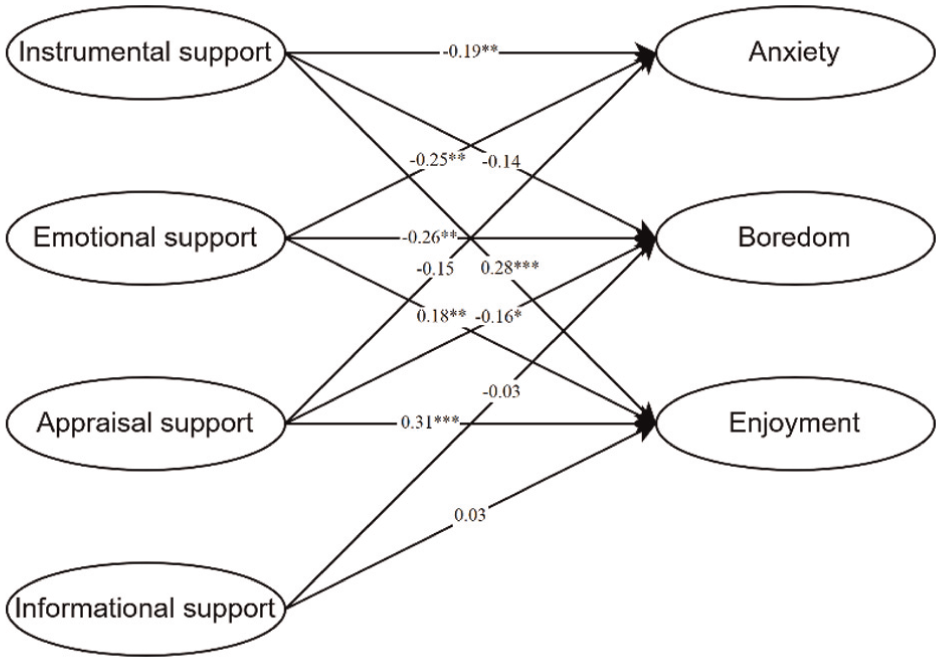
The structural model.
The regression path coefficients are summarized in Table 3. Emotional support had a significant impact on all emotional variables including enjoyment, boredom, and anxiety (ps < .01), indicating that learners who perceived stronger emotional support felt less anxious and bored, and experienced greater enjoyment. These findings support Hypotheses 1b, 2b, and 3b. Instrumental support had a negative effect on anxiety and a positive effect on enjoyment. Students who perceived more instrumental support reported lower anxiety and higher enjoyment, suggesting that practical strategies and resources effectively shape students’ emotional responses to language learning. Thus, Hypotheses 1a and 3a are supported. However, no statistically significant relationship was found between instrumental support and boredom, refuting Hypothesis 2a. This suggests that providing practical assistance alone might not effectively reduce students’ boredom. Appraisal support negatively predicted boredom and positively predicted enjoyment. With more feedback from teachers, students felt less bored and more engaged, a finding that supports Hypothesis 2c and 3c. Appraisal support did not significantly predict students’ anxiety, leading to the rejection of Hypothesis 1c. Informational support had no significant relationship with anxiety, boredom, or enjoyment. Accordingly, Hypotheses 1d, 2d, and 3d are all rejected. This finding suggests that providing knowledge and explanations alone may not be sufficient to address students’ emotional needs.
Summary of Regression Path Coefficients in the Model.

We also examined the influence of perceived proficiency on teacher support, and found that proficiency significantly predicted instrumental (β = .021, t = 5.09, p < .001), informational (β = .019, t = 4.60, p < .001), emotional (β = .019, t = 5.17, p < .001), and appraisal support (β = .018, t = 4.37, p < .001). These findings suggest that students who felt more confident in their English skills perceived greater teacher support during foreign language learning.
Multigroup Comparison
We performed a structural invariance test to explore how the relationships between teacher support and foreign language emotions vary by gender. A baseline model was first estimated, with factor loadings constrained to be the same across groups while allowing parameters to vary. Results showed that the model was a good fit with the data (χ2/df = 2.11, CFI = 0.966, TLI = 0.959, RMSEA = 0.075, SRMR = 0.062). Then a more restrictive model was tested in which all structural path coefficients were constrained to be equal across groups. We compared this model with the baseline model in terms of model fit indices and found a significant difference in fit (Δχ2 = 30.93, p < .05), indicating that the unconstrained model better represented the data. Structural path coefficients were different between male and female groups.
To further locate the source of the gender differences, we conducted a critical ratio test to compare parameter values. The results are summarized in Table 4. Results revealed significant differences between male and female groups in two path coefficients: the effect of appraisal support on boredom and emotional support on anxiety. Critical ratio values exceed 1.96 (p < .05), indicating that the differences are statistically significant. Specifically, appraisal support had a significant effect on boredom among male students (β = −.38, p < .001), but not among females (β = .002, p = .984). Emotional support had a significant effect on anxiety among females (β = −.41, p < .001), but not among males (β = .08, p = −.515). Male students who perceived more appraisal support experienced less boredom during learning, and females perceiving more emotional support had lower anxiety. Although the critical ratio test showed that there was a significant gender difference in the effect of informational support on boredom, the effect was not statistically significant in either group. No significant gender differences were found in other regression coefficients. These findings partially support Hypothesis 4, which posits that there are gender differences in the effects of teacher support, although the effects were not consistently stronger for female students.
Summary of Differences in Parameter Values Between Two Gender Groups.

p < .05. **p < .01. ***p < .001.
Discussion
This study examined the effect of perceived teacher support on foreign language emotions, specifically enjoyment, anxiety, and boredom, among a group of primary school students. A major contribution is that it revealed how different types of teacher support influence students’ emotional experiences, and how this effect differs between males and females. We found that emotional support was positively associated with learners’ enjoyment and negatively associated with boredom. This finding aligns with Bieg et al. (2013) who observed that teachers’ care significantly influenced enjoyment in academic tasks, and Q. Liu and Zhou (2024)’s study that reported a direct positive impact of teachers’ emotional support on enjoyment. It is also supported by the studies that show emotionally supportive teacher-student interaction is related to reduced negative emotions (e.g., La Paro et al., 2004). Teachers’ care and encouragement foster a safe and engaging environment where students feel valued and motivated. In such settings, they consider language learning to be more enjoyable and less tedious, and thus they feel more comfortable making mistakes, which is essential for language acquisition. This emotional scaffolding not only enhances immediate learning experiences but also contributes to students’ persistence in language learning.
Instrumental support was positively associated with enjoyment and negatively associated with anxiety, suggesting that learners who perceive more practical assistance and guidance from teachers have lower anxiety and greater enjoyment. This is supported by prior research showing that teachers’ assistance reduced students’ anxiety and can bring about greater enjoyment (e.g., Datta & Talukdar, 2017; Piechurska-Kuciel, 2011). However, these findings are not consistent with the series of studies by Dewaele and colleagues (e.g., Dewaele et al., 2019, 2023; Jin & Dewaele, 2018). They reported no critical role of teachers in mitigating anxiety. This discrepancy might be related to different research foci. Dewaele and colleagues examined teachers’ use of foreign language, humor, and personality traits. Such factors, as Bandura (1977) mentioned, are not as effective as students’ own successful experience in enhancing self-efficacy. Our study focused on instrumental support such as clear instructions or resources which can directly help students overcome difficulties in learning. Such practical assistance enables students to experience success at first hand, which Bandura (1977) identified as the most powerful source of self-efficacy. This type of support effectively lowers academic stress by reducing task difficulty and building up students’ confidence.
This study also found that informational support did not significantly predict any affective outcome. One possible explanation is informational support mainly involves delivering factual knowledge and instructions, which does not directly address younger learners’ emotional concerns. As students in primary schools are at the early stage of cognitive development, they may not recognize the value of the information provided, especially if it doesn’t address their immediate concerns. Interestingly, informational support was found to be the most prevalent among all support types, reflecting the teacher-centered pedagogical approach. Teachers often prioritize content delivery to meet curriculum demands and prepare students for examinations (G. Hu, 2002). Our findings question the effectiveness of such an approach as providing information alone is not strongly linked to students’ positive emotional outcomes. Rather, it should be complemented with emotional or instrumental support such as encouragement or assistance to create a more supportive learning environment.
Appraisal support was positively associated with enjoyment, which indicates that learners receiving more feedback from teachers are more likely to enjoy language learning. This finding aligns with previous studies demonstrating strong links between teacher appraisal and students’ enjoyment (e.g., Anthony et al., 2019; Forsblom et al., 2022). As Chinese primary school students have limited exposure to English outside classrooms and fewer opportunities for external validation, teacher appraisal becomes particularly critical. Constructive feedback helps students overcome challenges and maintain interests in learning.
This research revealed a close association between perceived proficiency and teacher support. Students who reported higher proficiency perceived higher levels of emotional, informational, instrumental, and appraisal support. This is because students with higher proficiency are generally more confident and motivated. They are more likely to ask questions, participate in discussions, and engage with teachers, thereby eliciting more supportive responses. This finding is in line with Huang et al. (2024)’s study which identified a strong connection between teacher support and language progress. However, as the design of this study does not allow us to establish causality, it remains unclear whether higher proficiency drives increased teacher support, or whether feeling supported by teachers enhances language proficiency. Further longitudinal or experimental studies are needed to clarify the direction of this relationship.
Another major finding from this study is the significant gender differences in how perceived teacher support influences learner emotions. Specifically, appraisal support negatively predicted boredom in males but not females. This finding is in line with prior studies showing that boys benefited more from teacher feedbacks (Katz et al., 2006; Lietaert et al., 2015; Zhou et al., 2019) and teacher support (Zhang et al., 2020). It may be attributed to gender differences in motivation. Males are more inclined to be motivated by achievements, making them more sensitive to evaluation of their accomplishments. Positive appraisals bring them a stronger sense of competence, making them more engaged and less bored. On the contrary, female students have stronger intrinsic motivation in language learning (X. Hu & McGeown, 2020; Oga-Baldwin & Fryer, 2020). Their experience of boredom may be influenced more by what they learn rather than how they are evaluated. We also found that emotional support was associated with reduced anxiety in females, but not males. This might be because females are interpersonally more sensitive than males (Briton & Hall, 1995; Spence et al., 1975) and thus they are more responsive to emotional interaction. As foreign language learning is highly anxiety-inducing, emotional support is particularly strongly associated with a greater sense of security for female learners. Emotional support works less effectively for males as they are less sensitive emotionally. We also noted that male students were significantly less proficient at English than females (t = 3.10, p < .01), suggesting that their anxiety may come from limited language competence, which emotional support alone cannot readily address. These findings call for gender-sensitive pedagogical strategies to maximize the effectiveness of teacher support in creating positive learning experiences.
The gender differences in students’ perceptions may reflect the influence of traditional gender role expectations in Chinese culture. The value placed on achievement and competition is usually observed among males (X. Xu et al., 2022). From early schooling, performance-based feedback including praise often serves as a source of motivation, which makes them highly responsive to evaluative feedback regarding outcomes. In contrast, females tend to value social connection, modesty, and interpersonal harmony (X. Xu et al., 2022). They are likely to be more attuned to the socio-emotional climate of the classroom and more responsive to affective cues from teachers. This is supported by evidence showing that Chinese girls regard teacher-student relational quality as essential to their academic experience (D. Xu & Li, 2018). Culturally embedded gender norms may shape students’ emotional responses to teacher support. As gender roles and expectations vary across cultures, findings from this study should be interpreted with caution when applied to educational settings that differ in cultural and gender norms.
Conclusion
The present study found that various types of teacher support have differential effects on enjoyment, anxiety, and boredom, with effects varying by gender. Emotional and instrumental support were particularly strongly associated with greater enjoyment and lower levels of boredom and anxiety. Appraisal support had a negative relationship with boredom in males but not females, while emotional support had negative association with anxiety in females but not in males. These findings provide valuable insights into the complex teacher-student relationship and carry important pedagogical implications. To make language learning more engaging, teachers should show care and empathy by actively listening to students, understanding their feelings and addressing their concerns. During anxiety-inducing situations such as public speaking, teachers should provide encouragement and reassurance to female students to reduce their stress. For male students, offering frequent and specific appraisal support, such as praising their progress or effort, is more likely to create an engaging environment in which they are more motivated to learn a foreign language. Moreover, teachers should provide necessary assistance including learning materials or clear instructions to help students complete learning tasks. Given the limited impact of informational support, teachers are encouraged to embed knowledge delivery in emotionally engaging contexts. This could involve using interactive and collaborative methods such as role-play or group learning activities to make learning more interesting.
The present study is not without limitations. A methodological limitation of this study is that our SEM and multigroup SEM analyses treated students as independent observations and did not model the clustering of students within classrooms or under the same teachers. This might bias standard errors and inflate precision of parameter estimates. Future research should adopt multilevel SEM or other clustering-adjusted methods to model classroom- or teacher-level variance and provide more accurate inferences. Second, this study adopted a cross-sectional design, making it difficult to explore the long-term impact of teacher support on foreign language emotions. As students’ emotional experience can be highly dynamic, longitudinal studies are needed to explore the role of teacher support in learners’ emotional development. For example, teacher support may exert an increasingly stronger effect on anxiety as learners progress to more advanced stages of learning when learning tasks get more challenging. Furthermore, as data were collected from primary school students using questionnaires, their responses might be affected by social desirability or limited self-awareness. Although we mitigated these concerns through various means such as anonymous administration, bias cannot be entirely ruled out. Future studies should adopt age-appropriate tools such as gamified questionnaires to enhance their engagement and comprehension. Classroom observation could also offer direct insights into students’ behaviors and interactions in real-time, reducing reliance on self-reported data and minimizing social desirability bias. Another limitation of this study is the lack of consideration for teacher-related factors such as gender, teaching experience, and personal attitudes, all of which may influence students’ perceptions of teacher support. For instance, female teachers are often perceived as more nurturing than male teachers in elementary settings (Dickey, 2017). Future research should explore how these teacher characteristics affect the effectiveness of support. In addition, learner-related factors such as aptitude, personality, and learning style may also modulate how students respond to teacher support. For example, students with lower language aptitude might benefit more from teachers’ assistance. Understanding these modulating factors will help teachers develop more targeted strategies to meet diverse needs of primary school students.
Footnotes
Acknowledgements
The authors would like to thank the participants for their time and contribution to this study.

Ethical Considerations
This study was approved by the Institutional Review Board of Beijing Foreign Studies University (20241209).
Consent to Participate
All participants provided written informed consent for their participation.
Funding
The authors disclosed receipt of the following financial support for the research, authorship, and/or publication of this article: This work was supported by the Later-stage Funding Project of the National Social Science Fund of China (grant numbers 25FYYB082).
Declaration of Conflicting Interests
The authors declared no potential conflicts of interest with respect to the research, authorship, and/or publication of this article.
Data Availability Statement
The datasets analyzed during the current study are available from the corresponding author* on reasonable request.