




Abstract
In the face of growing globalization and international market integration, there is a rising demand for the English Graduation Benchmark (EGB) policy in Taiwanese higher education. While previous research has addressed students’ views on the EGB policy and its positive and negative effects on learning and teaching, medical university students’ perspectives still need to be explored. This study surveyed 755 students from 7 medical disciplines at a Taiwanese university, examining their experiences and attitudes toward the EGB policy. Four aspects were examined: students’ general opinion on the policy (GO), learning efforts put (LE), washback effect (WE), and support needed (SN). Findings indicate a broad consensus among students on the policy’s potential benefits, particularly in enhancing employability and prospects for further studies. Students primarily relied on vocabulary memorization and grammar study to boost their English skills. Delving into their emotional responses, the washback effect of the policy appeared minimal. Notably, the academic discipline emerged as a significant determinant of students’ views: College of Pharmacy students showed the highest support for the policy and the most pronounced washback effect. In contrast, the College of Medical Sociology and Psychology students expressed the highest demand for institutional support.
Plain Language Summary
The purpose of this study was to examine the perspectives of medical university students in Taiwan regarding the English graduation benchmark (EGB) policy. Variables used in the study included gender, grade level, discipline, and language proficiency. A revised questionnaire was utilized to gauge students’ general views on the policy, their learning efforts, the potential washback effect, and the support they required. The students largely accepted the policy, believing it enhanced their competitiveness for future career opportunities and further education. However, the policy did not elicit a significant positive washback effect on their learning. The students’ motivation to learn was found to be low, and they were hesitant to enroll in additional English-related courses. This reluctance can be attributed to the fact that college English education in Taiwan has frequently been unable to meet the learning needs of students, making it challenging for them to master the language. The influence of the EGB policy was more pronounced among female students than their male counterparts. Senior students displayed a neutral stance toward the policy, potentially due to their prolonged exposure to English learning and preparation for the policy’s requirements. Notably, students from the College of Pharmacy were most impacted by the policy, indicating both their current English proficiency levels and the significance of English in their prospective careers. Intermediate-level students expressed the strongest support for the policy. To corroborate participants’ self-assessments, alternative evaluation methods are necessary. A qualitative approach would be beneficial in providing a clearer insight into students’ experiences with the EGB policy.
Keywords
Introduction
English has gained unparalleled prominence globally as the most widespread second/foreign language (L2). Despite not holding the position of the most commonly spoken first language (L1), it undeniably holds a preeminent status as the most influential L2, primarily due to its role as the official language in numerous countries worldwide. According to the British Council’s (2013)“The English Effect” report, the count of English speakers reached a staggering two billion in 2020, which continues to surge. The importance of English proficiency cannot be overstated, as it facilitates information access and effective communication across global borders.
In Taiwan, the fervor for English learning has been likened to a persistent “fever” (Krashen, 2006) or an unwavering “whole-nation movement” that has endured for decades. The importance of English is evident as it echoes across compulsory foreign language courses from elementary through tertiary education levels and is deeply embedded in both school admissions criteria and job applications. Recognizing this global and domestic emphasis on English, Taiwan’s Ministry of Education (MOE) has introduced a slew of administrative and educational policies, notably the English Graduation Benchmark (EGB) policy. All these policies converge on a single aim: to boost the English language proficiency of Taiwanese citizens. This focus isn’t solely on language acquisition but also on fostering effective communication skills and cultivating a global perspective. Ultimately, these endeavors are geared towards expediting Taiwan’s internationalization and enhancing its global standing and competitiveness.
The global integration of English language education has brought about remarkable shifts and captured significant interest. As English cements its role as a global lingua franca, its impact spreads across various academic sectors, notably medical education. In this internationalized medical education environment with distinct language demands, English proficiency isn’t just academically indispensable but is also paramount for budding healthcare practitioners.
The EGB policy, designed to measure students’ proficiency in English, plays a crucial role in higher education, including in medical universities. English proficiency is essential for medical students for academic pursuits such as understanding textbooks and research articles and practical applications in patient care and international collaboration. This study focuses on medical students to underscore the importance of English in medical education and practice, providing insights into the intersection of language proficiency with medical professionalism and competency. By exploring medical students’ views on the EGB policy, this research aims to offer valuable insights that could shape educational policies and practices within medical universities. Understanding the specific challenges, and attitudes medical students have towards English proficiency benchmarks will assist in refining the policy to better meet the needs of future medical professionals. Furthermore, while this study concentrates on medical students, its findings could have broader implications for implementing EGB across other specialized fields. Understanding the impact of English proficiency policy on medical students’ academic and professional readiness may offer valuable perspectives for similar evaluations in fields such as engineering, law, or business, where specific linguistic skills are equally important.
The Purpose of the Study
In an era marked by globalization and the internationalization of markets, the preeminence of English is set to continue. This trend underscores a growing demand for individuals with proficiency in the English language. As possessing an English certification is often viewed as a passport to higher education and better career opportunities, the EGB policy’s relevance in Taiwan is unlikely to wane. While existing studies have delved into students’ perceptions of the policy and its consequent effects on education, the majority have honed in on technical programs or the broader higher education sector. The intricate relationship between the EGB policy and the unique cultural context of learners—specifically, medical university students—remains a relatively untapped area in the literature that intersects EGB and medical education. This observed gap inspired the inception of the current study.
The existing body of research on the EGB policy reveals a range of perspectives held by learners concerning its implications for learning behaviors. While the majority of studies have recorded students’ inclination towards the policy, acknowledging its significance for their forthcoming career opportunities and academic accomplishments, some instances of dissent or disapproval have also emerged. Furthermore, the policy’s influence on teachers’ instructional practices has yielded divergent outcomes, with certain educators refraining from making substantial modifications to their curriculum or lesson plans following the policy’s introduction. However, it’s worth noting that most of these discussions have predominantly centered around technical programs or general higher education. So far, there have been no studies exploring the EGB policy and its particular effects on students at medical universities. This group of learners recognizes a strong appreciation for English proficiency in the context of their future professional paths (Hwang & Lin, 2010), yet their specific English language requirements have been somewhat overlooked (Chia et al., 1999). To gain a deeper understanding of the dynamics surrounding the EGB policy and its interaction with medical students, this study aimed to examine the extent to which students believe in and respond to the EGB policy’s implementation within a medical university situated in Taiwan. To comprehensively understand the experiences and perspectives of medical university students regarding the EGB policy, this study addresses the following research questions:
What were the general attitudes of medical university students toward the EGB policy?
What efforts did medical university students undertake to meet the requirements of the EGB policy?
Did the implementation of the EGB policy result in any washback effect on the learning of medical university students?
What forms of support did medical university students require from the school to help them achieve the EGB policy’s benchmark?
Did the experiences and attitudes of medical university students differ based on factors such as gender, discipline, English proficiency, and years in school?
Literature Review
The EGB Policy in Higher Education in Taiwan
Wu (2012) emphasized that Taiwan’s educational system leans heavily towards examinations as tools to improve teaching and learning. In 2003, motivated to bolster students’ English proficiency and prepare them for expected language demands in both domestic and global job markets, the MOE encouraged higher education institutions (HEIs) in Taiwan to implement EGB policy. Also known as the English Exit Exam or graduation threshold, this policy is applicable to both undergraduate and graduate students (Hsieh, 2017; Hsu & Wang, 2006; Newfields & Pan, 2011; 2012; C. M. Shih, 2010; Wu, 2012). The EGB policy requires students to take a Standard English Proficiency Test (SEPT) and achieve a specified standard to prove adequate English proficiency for graduation (Tsai & Tsou, 2009). The exact benchmark or score varies depending on the institution’s ranking and departmental affiliation. For example, National Taiwan University (NTU), a renowned institution, requires students to obtain a high-intermediate GEPT (General English Proficiency Test) certification (CEFR B2) or its equivalent. Conversely, many private technical universities accept a GEPT elementary certification (CEFR A2) (Hsieh, 2017).
Initially, fewer than 10% of universities adopted the EGB policy. However, its adoption rate surged in 2004 with the introduction of the Policy Guidelines for the Next Four Years. These guidelines mandated a CEFR B1 English proficiency level as a prerequisite for all HEIs. What was initially positioned as an “encouragement” quickly evolved into a stringent regulation. As a result, the success rate of students became a pivotal evaluation metric for educational institutions, with implications for the distribution of educational funds (Y. H. Chen et al., 2013; Chu & Yeh, 2017; C. M. Shih, 2012). In a bid to optimize success rates, numerous HEIs launched English self-study centers, integrated courses tailored to the test, and offered external incentives to both support and spur students to meet the stipulated benchmark.
Data from the MOE shows that in 2006, 53 universities had implemented a graduation benchmark. By 2011, this figure had doubled to over 100, and by 2017, it had reached 150. While the MOE did not prescribe specific Standard English Proficiency Tests (SEPTs) for this benchmark, it granted universities the autonomy to select suitable tests. Frequently opted tests include the General English Proficiency Test (GEPT), Test of English as a Foreign Language (TOEFL), International English Language Testing System (IELTS), College Student English Proficiency Test (CSEPT), and Test of English for International Communication (TOEIC). It’s worth noting that TOEIC had a remarkable 879,677 examinees in 2021, as per Educational Testing Service (2022). Additionally, since its inception in 2000, the GEPT has gained traction among HEI students, largely attributed to its cost-effectiveness relative to other international SEPTs.
EGB Policy and Its Related Implementing Issues
Research concerning English proficiency exams has revealed mixed opinions among learners about the EGB policy and its washback effect—defined as the influence of testing on curriculum design, teaching practices, and learning behaviors. A notable exception is the rare disapproval of the policy by learners (Tsai & Tsou, 2009). Some students who resist the policy argue that SEPTs do not genuinely represent their English proficiency (Tsai & Tsou, 2009). Echoing this sentiment, Chu (2017) posits that SEPTs do not adequately equip students from technological universities with the technical vocabulary and both oral and written skills required in their specialized sectors for future employment. On the contrary, Gan et al. (2004) maintain that SEPTs enable high-proficiency learners to effectively assess and demonstrate their English expertise.
Numerous studies have documented a general favorability among students toward the EGB policy (Cheng, 2008; Lai & Tu, 2020; Liao, 2010; Liauh, 2010; Liauh & Wu, 2011; Netta & Trisanwati, 2020; Parlindungan et al., 2021; Rahayu, 2019; P. C. Shih, 2013). This inclination persists even among those who did not pass the tests (Tang, 2011). Interestingly, female students have shown a more significant preference for the requirement than their male peers (Liauh, 2010; P. C. Shih, 2013).
When considering English proficiency levels, Lee and Wu (2017) found that intermediate-level students were more compliant with the policy than others. The endorsement stemmed from a belief that having an English proficiency certification would be invaluable for their future professions and further academic endeavors (Jou, 2010). Lai and Tu (2020) observed that technological university students felt that the EGB policy marginally boosted their motivation to study English, viewing it as advantageous for their impending career trajectory.
Parallel sentiments were echoed in Indonesia, where Rahayu (2019) identified that higher education students specializing in tourism unanimously acknowledged the importance of English proficiency, especially for facilitating international communication during their training and subsequent careers. Netta and Trisanwati (2020) highlighted a tendency among non-English majors to support the EGB policy, valuing English proficiency for its perceived benefits in future job prospects and higher education opportunities.
While the EGB policy has had a positive influence on learners, its impact remains somewhat limited (Hsu & Wang, 2006; Wudthayagorn, 2022). Bui and Pham’s (2019) report underscores this sentiment, noting that although the establishment of EGB bolstered the English proficiency of Vietnamese students, it concurrently escalated their anxiety levels associated with learning and test orientation. Notably, the regulation did not compel students to intensify their studies (Newfields & Pan, 2011, 2012). Many perceived that the mandate primarily benefited high achievers—those adept at tapping into a variety of self-learning resources and mastering traditional receptive and productive skills essential for test preparation (Chu, 2009; Pan, 2014).
Hsu and Wang’s (2006) study offers a slightly different perspective. They noted an upsurge in the intrinsic motivation of highly competent students due to the policy. This boost in motivation translated into heightened dedication towards test preparation and completion. This positive trajectory was particularly pronounced among female learners, who, in response to the policy, enrolled in more English courses and dedicated additional time to their English studies.
Conversely, students at a lower proficiency level, especially those from technical colleges, exhibited a range of negative emotions including anxiety, frustration, and pressure, which can be categorized as demotivating factors. They felt pressured to study for the tests (Tsai & Tsou, 2009). Despite this pressure, they did not necessarily increase the time or effort dedicated to studying English (Pan, 2018). Their motivation was largely utilitarian, spurred by the imperative to meet diploma requirements. As a result, they came to expect direct classroom instruction tailored to exam preparation (Newfields & Pan, 2011).
Another persistent narrative in discussions surrounding the benchmark policy concerns its influence on teaching behavior. While school administrators held a generally optimistic view of the policy’s effects (Chu & Yeh, 2017), empirical studies indicate that its impact, be it positive or negative, didn’t deeply permeate classroom practices (Chu & Yeh, 2017; Pan, 2014; C. M. Shih, 2010). Teachers largely maintained their existing syllabi and lesson plan structures (Tsay, 2013). Instructional content and pedagogy continued to focus on enhancing foundational language skills, with class time rarely, if ever, dedicated to exam-specific preparation (Newfields & Pan, 2011).
English Learning in the Medical Context
In the field of research examining the nexus between language proficiency and medical education, numerous studies delve into the connection between language background, English language skills, and medical communication abilities of undergraduate medical students. These studies underscore the vital importance of English proficiency in the medical education sphere.
In Australia, Chur-Hansen et al. (1997) conducted a study to investigate the influence of language background and English language proficiency on medical students’ communication skills. This research compared the SEPT scores of both English-speaking and non-English-speaking medical students. The results showed that although language background affected students’ written and oral English proficiency, it did not lead to significant differences in their medical communication skills. In a related study from Iran, Hanafi and Soleimani (2013) observed a marked desire among male medical students to improve their English proficiency, highlighting the recognized importance of English in medical education.
Haghdoost et al. (2013) investigated the correlation between English language proficiency and academic performance among medical students in Iran. Their research established that medical students with superior English fluency demonstrated enhanced academic performance. Similarly, in Taiwan, Hwang and Lin (2010) assessed medical university students’ perceptions and linguistic needs surrounding the English language. Their findings revealed that for Taiwanese medical students, English is crucial for academic success, notably in understanding textbooks and medical journals. On a related note, Karimkhanlouei (2012) emphasized the importance of proficient reading skills for medical students, especially when engaging with handouts and online resources. This sentiment was mirrored in a study by Taşçı (2007) in Turkey. Taşçı identified a recurring theme: the necessity for medical students to bolster their English reading skills, particularly when embarking on research for problem-based learning modules.
Methodology
The Instrument and Procedure
A two-part questionnaire developed and revised by adjusting the statements from different surveys used in several earlier studies regarding the EGB policy (Hsu & Wang, 2006; Liao, 2010; Liauh & Wu, 2011; Tang, 2011) was administered. The first part contains questions related to student demographics, including gender, grade level, the college they are at, English placement level in their freshman year, and whether they have passed the graduation benchmark. The second part contained 50 items that addressed students’ reactions to the policy, organized into four sections (factors). Section A listed statements of students’ general opinions on EGB policy (GO). Section B included items related to the students’ learning efforts for SEPTs (LE). Section C looked at the potential washback effect on students’ learning behavior (WE). Section D contained items concerning the support the students need from the school in order to achieve the threshold (SN). The survey items were translated verbatim into Chinese.
To strengthen the validity and credibility of the research instrument, a comprehensive expert validation process beyond the initial language confirmation and translation accuracy checks was undertaken (Bruce, 2018). The original and translated questionnaire versions underwent a rigorous expert validation process. This involved consulting a panel of academic experts in educational policy and survey design. These experts reviewed the questionnaire for content validity, ensuring that the items comprehensively covered the intended aspects of student reactions to the EGB policy. Based on their feedback, the survey statements were refined to more accurately capture the constructs of general opinions on the policy (GO), learning efforts for SEPTs (LE), the potential washback effect on learning behavior (WE), and the support needed from the school (SN). Students were asked to rate each item on a four-point Likert scale according to their degree of agreement (4 = totally agree, 3 = agree, 2 = disagree, 1 = totally disagree). In order to prevent the respondents from making a false choice or not taking the survey seriously, a “neutral” option was excluded from the Likert scale (Dörnyei, 2003).
A pilot study involving 151 students was conducted to test the questionnaire before launching the main study. Stratified random sampling was used to select a diverse group of students from each college within KU, ensuring representation across various academic disciplines. This sample, constituting about 1% to 2% of KU’s total student population, was chosen to mirror the university’s diversity in fields of study and academic levels. The main goal of the pilot study was to detect any issues with the Survey Monkey questionnaire, such as ambiguous phrasing or technical problems. After the pilot study, an Exploratory Factor Analysis (EFA) on the collected data to scrutinize the questionnaire’s structure and verify that the items in each section accurately represented the targeted constructs was performed. The EFA validated a four-factor structure corresponding with our predefined sections, affirming the questionnaire’s construct validity. All items demonstrated significant factor loadings higher than the accepted benchmark of 0.40, signifying robust associations with their designated constructs. A Cronbach’s alpha was also conducted to assess the questionnaire’s reliability. The results yielded a reliability range from .72 to .90 across the questionnaire, indicating satisfactory internal consistency among the items within each section. This consistency level supports the reliability of grouping items under each factor, as it suggests that they measure the same underlying construct effectively, enabling their further use in detailed analysis. The questionnaire was finalized based on the results of the pilot survey. The final version featured a total of 48 items, with the distribution as follows: GO (9 items), LE (14 items), WE (17 items), and SN (8 items).
The Setting and Participants
Data were generated at K University (hereafter KU), a medical university situated in Taiwan. It is composed of the College of Medicine, College of Dental Medicine, College of Pharmacy, College of Nursing, College of Health Sciences, College of Life Sciences, and College of Medical Sociology and Psychology. There are currently above 7,500 registrants at KU. Almost all registered students must complete their high school diploma and obtain specific scores on the English test at College Entrance Exam (CEE) or College Entrance Examination in Specified Subjects (CEESS) for admission. The sample was also selected for the main study using stratified random sampling. The rationale for employing stratified random sampling in both the pilot and main studies was to ensure a representative sample and enhance the accuracy and reliability of the study findings. This approach guarantees that the sample mirrors the composition of the entire student body at KU, making it representative of the broader population (Creswell, 2014). Such a sample allows for the generalization of the study findings to the entire KU student population with reasonable accuracy. The sample sizes for both the pilot and primary studies were determined using Cochran’s formula, a widely accepted method for calculating appropriate sample sizes for survey-based research involving categorical data. This formula considers the desired confidence level, margin of error, and population size to provide a sample size that ensures the study’s findings are statistically significant and representative of the broader population (Field, 2018). For a university with over 7,500 students, assuming a 95% confidence level and a margin of error of 5%, the calculated sample size ensured adequate statistical power for the analysis.
To facilitate the stratified random sampling strategy, we emailed the Survey Monkey questionnaire to students to capture a comprehensive snapshot of the student demographics and opinions. To protect participants’ privacy and ensure the confidentiality of their responses, the questionnaire was designed to collect data without any personally identifiable information. Furthermore, all digital data were stored on secure, password-protected servers, with access restricted to only those research team members directly involved in data analysis. In total, 755 valid responses were received. As illustrated in Table 1, the majority of the student participants were female (61%) and in the College of Health Science (30%) and Medicine (24%). For their years in school, over half were first-year students (29%) and seniors (28%). One-quarter (25%) were in year 3 and less than a fifth (18%) were sophomores. The students reported a lack of mastery of English, with 38% at the elementary level and 40% at the intermediate level. Even so, the majority (64%) have taken SEPTs and achieved the graduation benchmark.
Student Participant Profile (N = 755).

Data Analysis
The survey data was analyzed and calculated using Statistical Product and Service Solutions 22 (SPSS 22) for means (M), standard deviations (SD), and frequency (F) to find out students’ experience and attitudes toward EGB policy. In addition to basic descriptive statistics, the interactions between the four factors (general opinions, GO; learning effort, LE; washback effect, WE; supported needed, SN) and independent variables (gender, discipline, English proficiency, and years in school) were tested for statistically significant differences via Independent t-test and One-Way ANOVA (Analysis of Variance).
Results
Students’ General Opinions on the EGB Policy (GO)
The quantitative analysis from the students’ responses (Table 2) indicates an overall favorable attitude towards the EGB policy, with 85% of students acknowledging their agreement with the policy’s objectives. This high level of acceptance is essential, suggesting that most students recognize the value of English proficiency within their professional and academic futures. More than half of the students (52%) explicitly supported the policy’s necessity, underscoring a critical recognition of English’s role in their career advancement and higher education opportunities. This is further evidenced by the 56% of students motivated to participate in SEPTs, indicating an active engagement with the policy’s requirements. The confidence among students regarding their ability to meet the EGB policy before graduation (88%) is particularly revealing. It suggests not only a high self-efficacy in language learning but also reflects positively on the resources and support systems provided by the institution. The fact that a significant portion of students believe achieving the policy would enhance their competitiveness in future endeavors (62%) indicates the policy’s perceived relevance to real-world professional and academic scenarios. However, the responses regarding the policy’s influence on learning affection and academic studies (59% and 61%, respectively) highlight an area for further exploration. While the policy does not seem to impact these areas detrimentally, the lack of substantial positive effects on motivation (49%) and effort input (43%) suggests the need for a critical examination of how the policy’s implementation might be optimized to foster greater intrinsic motivation and engagement with the English language.
Students’ Opinions on the EGB Policy (N = 755).

Learning Effort Put (LE)
The data analysis results show a significant commitment among students to meet the EGB benchmarks, with 79% actively working to improve their English proficiency (Table 3). A traditional focus on vocabulary and grammar, noted by 82% and 81% of students, respectively, raises concerns about the completeness of their learning strategies. This is especially true considering the low emphasis on productive skills like speaking (36%) and writing (25%). Such a discrepancy hints at a possible misalignment between the policy’s goals and the student’s chosen learning activities, likely influenced by the SEPT’s assessment criteria. Using English media as a learning resource, with over half of the students engaging with English TV programs or internet content (54%, 55%, and 65%, respectively), showcases a mix of formal and informal learning methods. However, the limited focus on reading (39% for print materials and 48% for online resources) and the notable neglect of speaking (36%) and writing (25%) underscore a significant gap in preparing students for practical English usage. This observation calls for a reassessment of the learning objectives highlighted by the EGB policy and its evaluation methods, urging a shift towards a more rounded approach that equally cultivates all language skills. Furthermore, the extensive efforts to collect test-related information and acquire materials (77% and 78%) reveal the students’ methodical approach to fulfilling EGB demands. Such efforts reflect the high importance of the policy and underscore the financial burden on students, suggesting a need for more accessible resources and support mechanisms.
The Efforts the Students Put to Achieve the EGB Policy (N = 755).

Washback Effect (WE)
Table 4 displays findings related to the potential washback effect of the EGB policy on student learning behaviors. The results indicate that a significant majority, about 69% of students, recognized the positive impact of the policy on their English studies. Almost three-fifths (59%) stated that they now have a clearer learning objective due to the policy. A notable portion expressed that the policy intensified their study regimen (54%) and heightened their inclination to seek information in English (58%). Nearly 60% felt that their English proficiency had seen improvements as a result.
Potential Washback Effect on Students’ English Learning Behavior (N = 755).

However, not all results were positive: the policy didn’t lead to increased motivation (44%) or confidence (27%) in a majority of students. Learning behaviors, such as consistent studying (39%) and utilization of certain learning methods (25%), remained relatively stable. Even though over half of the students (51%) were more earnest about their English classes, there was a hesitancy to further invest in learning. This was evident in the limited interest in attending additional English courses (22%), paying more attention in those courses (35%), and dedicating more time to reading (34%), listening (46%), and writing tasks (23%).
The analysis underscores a constrained washback effect of the EGB policy on the learning behaviors of medical students. This observation aligns with findings from Wudthayagorn’s (2022) study in Thailand, suggesting that while an exit examination policy might heighten student awareness and motivation towards English, it doesn’t necessarily guarantee enhancements in learning behaviors or English proficiency.
Needed Support (SN)
Table 5 enumerates the support students believe they need from the school. A striking 98% underscored the pivotal role that educational institutions must play in aiding students to navigate the policy. Within the six main items listed, the opportunity for on-campus SEPTs was the most sought after, with 97% of respondents highlighting its importance. This was followed by free resources for self-study (95%), increased information about the various SEPTs (93%), and additional SEPTs-related workshops (92%).
The Support the Students Needed (N = 755).

Interestingly, a majority of students expressed a desire for more SEPTs-related courses. However, they showed a clear preference for these courses to be elective (88%) rather than mandatory (35%). This high percentage underscores the students’ strong desire for institutional support. Yet, two seemingly contrasting statistics suggest the medical students’ ambivalent feelings toward course-related assistance. On one side, they recognize the potential benefits of SEPTs-related courses in preparing for and even meeting the EGB policy. However, they might be wary of overcommitting to English studies through obligatory courses, preferring instead the flexibility of elective offerings. This could also hint at a view among students that, while important, English might be seen as an additional layer of complexity in their already demanding academic and professional training, prompting a desire for greater autonomy in course selection.
The Influence of Gender, Discipline, English Proficiency, and School Years on Students’ Experiences and Attitudes Toward the EGB Policy
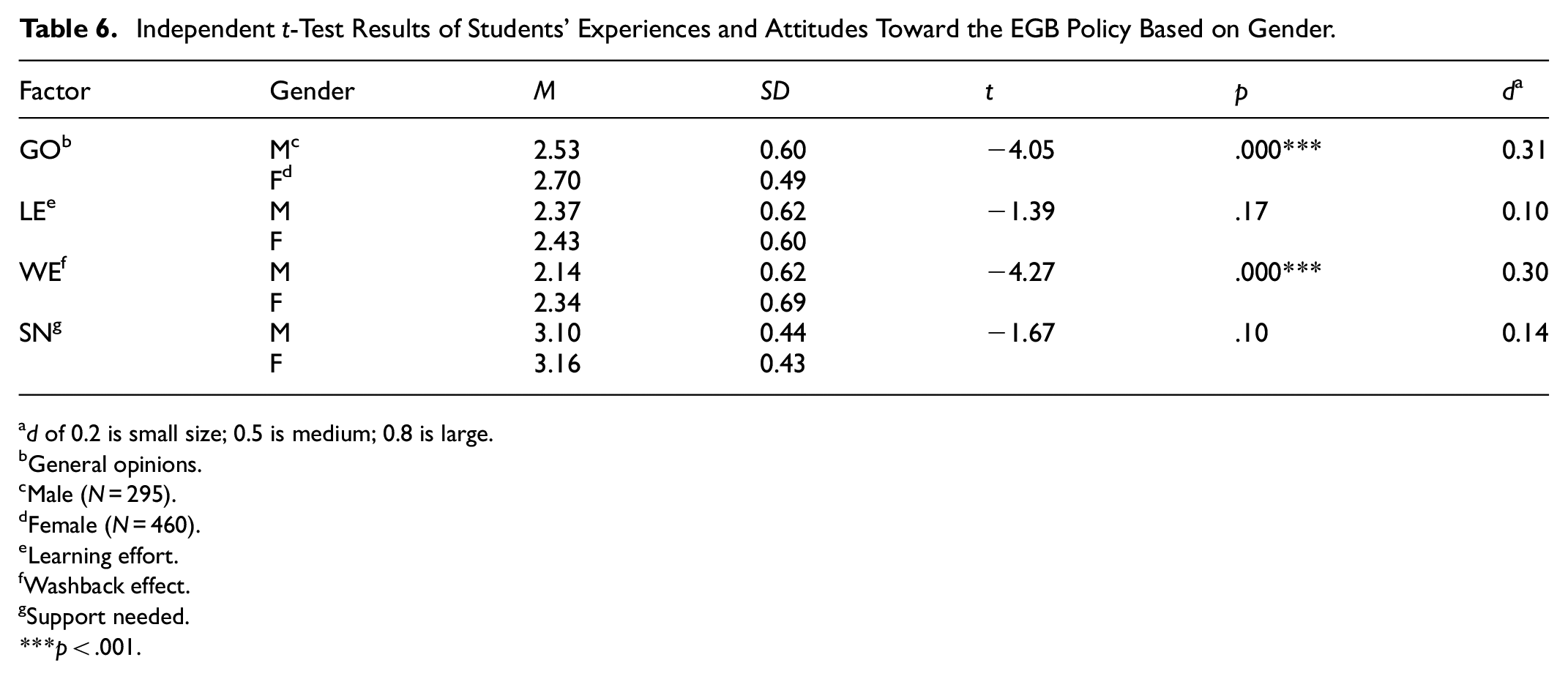
An independent t-test was conducted to examine the differences in experiences and attitudes between male and female learners towards the EGB policy. The results shown in Table 6 indicate a statistically significant interaction between gender and learners’ general opinion (t(753) = −4.05, p < .001, d = 0.31) as well as the washback effect (t(753) = −4.27, p < .001, d = 0.30). Female students had a more positive attitude towards the EGB policy (M = 2.70, SD = 0.47) than their male counterparts (M = 2.53, SD = 0.60). Moreover, the policy had a stronger washback effect on females (M = 2.34, SD = 0.69) compared to males (M = 2.14, SD = 0.62). While not statistically significant, female students (M = 2.43, SD = 0.60 for LE and M = 3.16, SD = 0.43 for SN) appeared to exert more learning effort and sought more support than male students (M = 2.37, SD = 0.62 for LE and M = 3.10, SD = 0.44 for SN).
Independent t-Test Results of Students’ Experiences and Attitudes Toward the EGB Policy Based on Gender.
d of 0.2 is small size; 0.5 is medium; 0.8 is large.
General opinions.
Male (N = 295).
Female (N = 460).
Learning effort.
Washback effect.
Support needed.
p < .001.
One-way ANOVA was run to see the effects of grade level, discipline, and English proficiency. The result was presented in Table 7. The ANOVA results revealed significant relationships between the three variables and in almost all factors related to medical students’ experience and attitude towards EGB policy. The effects of grade level on students’ general opinions (GO, F(3, 751) = 3.90, p = .01 < .05), learning effort (LE, F(3, 751) = 4.77, p = .003 < 0.1), and support needed (SN, F(3, 751) = 3.00, p = .03 < .05) were found to be significant. The freshmen (M = 2.73, SD = 0.40) showed the most positive attitudes towards the policy. The sophomore (M = 2.55, SD = 0.42) put the greatest learning effort into the policy. The juniors (M = 3.19, SD = 0.54) were found to request the most support from the school.
ANOVA Results of Students’ Experiences and Attitudes Toward the EGB Policy Based on Grade Level, Discipline, and English Proficiency.

d of 0.2 is small size; 0.5 is medium; 0.8 is large.
General opinions.
Freshmen (N = 218).
Medicine (N = 181).
Elementary (N = 287).
Sophomore (N = 139).
Dental Medicine (N = 38).
Intermediate (N = 302).
Junior (N = 188).
Pharmacy (N = 53).
Advanced (N = 166).
Senior (N = 210).
Nursing (N = 23).
Health Science (N = 227).
Life Science (N = 113).
Medical Sociology and Psychology (N = 120).
Learning effort.
Washback effect.
Support needed.
p < .05. **p < .01. ***p < .001.
Discipline was found to have significance on students’ general opinion (GO, F(6, 748) = 5.73, p = .000 < .001), washback effect (WE, F(6, 748) = 1.82, p = .001 < .01), and support needed (SN, F(6, 748) = 3.19, p = .004 < .01). The students of the College of Pharmacy demonstrated the highest level of support for the policy, as evidenced by their mean score of 2.88 and standard deviation of 0.37. Additionally, this group of students also experienced the greatest washback effect from the policy, with a mean score of 2.58 and a standard deviation of 0.55. Those at the College of Medical Sociology and Psychology (M = 3.24, SD = 0.47) had the highest demand for support from the school.
There was also an interaction between language proficiency and students’ general opinion (GO, F(3, 751) = 15.71, p = .000 < .001), washback effect (WE, F(3, 751) = 5.57, p = .001 < .01), and support needed (SN, F(3, 751) = 7.96, p = .000 < .001). Intermediate-level students were the most favorable to the policy (M = 2.63, SD = 0.50) and affected the greatest by the policy (M = 2.25, SD = 0.64). The students of advanced-level (M = 3.28, SD = 0.43) requested the highest level of support from the school. Although a number of statistics remained insignificant, the emerging trend confirmed that gender, discipline, English proficiency, and school years influenced students’ experiences and attitudes towards the EGB Policy.
Discussion
This study surveyed 755 medical university students to explore their experiences and attitudes towards the EGB policy. The findings reveal that students both recognized and accepted the policy. This is consistent with observations made by Huang et al. (2006) and Su (2005). Furthermore, the medical students believed that meeting the benchmarks of the policy would bolster their competitiveness in their future careers and academic endeavors. This sentiment resonates with the findings of Jou (2010) and Lai and Tu (2020), who conducted research on students in broader higher education and technical programs in Taiwan.
Rahayu’s (2019) research on Indonesian higher education students specializing in tourism revealed a unanimous appreciation of English proficiency for enhancing international communication skills. This insight resonates with our findings, highlighting a universal acknowledgment of English’s essential role in global professional environments across disciplines. Further, Netta and Trisanwati’s (2020) study among non-English major students revealed a positive stance towards the EGB policy, viewing English proficiency as a critical factor in boosting future job prospects and higher education opportunities. This parallels the sentiment among medical students in our study, who also regard English proficiency as essential to their future success in the increasingly globalized medical field. However, Chu’s (2017) observation indicated that the SEPTs undertaken by students from technological universities to fulfill the graduation benchmark do not effectively address their learning needs. As a result, she recommended that the design and structure of the EGB policy should consider the English language requirements of students for their future careers. Similarly, Parlindungan et al. (2021) emphasized the need for regular updates to the benchmarks of English proficiency policies to align with evolving professional requirements and learning standards. This recommendation resonates to our finding, suggesting that continuous refinement of the EGB policy could further enhance its effectiveness and relevance for medical students, ensuring their English skills meet both current and future demands of the medical profession.
The favorable response to the EGB policy among medical university students may be attributed to several key factors. These include its alignment with effective language learning strategies outlined in Oxford’s (1990) Strategy Inventory for Language Learning (SILL), its promotion of intrinsic motivation and autonomy as highlighted by Ryan and Deci’s (2002) Self-Determination Theory (SDT) (Deci & Ryan, 1985), and its approach to mitigating common demotivating factors in language learning, as discussed by Kikuchi and Sakai (2009). Oxford’s (1990) SILL underscores the importance of metacognitive, cognitive, and social strategies for successful language learning. The EGB policy’s positive reception suggests that students recognize it as a tool that embodies these strategies. For example, the policy encourages self-regulated learning—a crucial metacognitive strategy—by highlighting the significance of English proficiency for their future careers and motivating them to achieve the set benchmarks. Similarly, Deci and Ryan’s (1985, 2000) SDT distinguishes between intrinsic and extrinsic motivation, proposing that learners are more motivated and perform better when they view their learning as autonomous and self-directed. The students’ acceptance of the EGB policy appears to reflect their intrinsic motivation to learn English, seeing its relevance and value for their personal and professional growth. Consequently, when the policy is executed in a manner that supports students’ autonomy, competence, and relatedness—the core components of SDT—it cultivates an environment conducive to internal motivation towards enhancing their English skills. Furthermore, Kikuchi and Sakai’s (2009) investigation into demotivating factors in English learning suggests that the design and implementation of the EGB policy may be effectively addressing or circumventing these issues. By establishing clear benchmarks and offering customized English learning resources, the policy likely diminishes students’ feelings of uncertainty and incapacity, which are recognized as significant demotivating factors.
The medical students involved in this study exhibited high confidence in their English proficiency. This firm confidence could be attributed to the fact that a significant portion (more than one-third) of the participants belonged to departments such as Medicine, Dental Medicine, Pharmacy, and Nursing, which are known for attracting students with a solid foundation in English language. However, it is essential to acknowledge that this research was conducted within a specific context, and the findings might not be universally applicable to all medical students or different scenarios. Nonetheless, the conclusions drawn from this study suggest that students’ English language background and prior knowledge may significantly influence their perceived level of English proficiency.
The present study has indicated that the EGB policy’s positive washback effects on learners are somewhat limited (Hsu & Wang, 2006), resulting in minimal changes to their English learning practices (Newfields & Pan, 2011, 2012). While the policy yielded positive outcomes, students needed to be more motivated to learn and were hesitant to enroll in additional English-related courses. They also needed to exhibit more support to invest additional effort into language learning. Wall (2005) proposed that changes resulting from test-based policies tend to be more surface-level than substantive. Tests are more likely to impact learning content rather than learning behavior. Beyond these observations, students’ disinclination and insufficient motivation could be partly attributed to the fact that English education at the college level in Taiwan often fails to address students’ learning needs and foster their English proficiency (I. J. Chen et al., 2016).
Chao and Huang (2016), as well as Chien and Hsu (2011), have corroborated that “fluency in communication” is considered the most crucial aspect for college students. In the current study, the medical students expressed a desire for more elective courses related to SEPTs. Consequently, course and curriculum design should be tailored to meet learners’ communicative needs. Policy implementation should be integrated into a comprehensive curriculum plan and needs analysis. To achieve positive and robust outcomes, there must be alignment between students’ needs, goals, and curricular content. Only when a high level of alignment is achieved will students’ motivation be enhanced, as they will be learning what they desire, and what they desire to learn will also be covered in the tests.
Tsai and Tsou (2009) suggested that learning motivation is pivotal in determining whether the EGB policy can effectively enhance the quality of foreign language teaching in Taiwanese HEIs. In the classroom, a range of motivational strategies should be employed, spanning from macro-level techniques, such as creating an enjoyable and supportive classroom atmosphere and ensuring engaging and stimulating learning experiences, to micro-level approaches that involve boosting learner satisfaction, encouraging goal-oriented learning, and fostering learner autonomy (Dörnyei, 2001).
Among all the methods aimed at enhancing English proficiency, the most commonly chosen methods were vocabulary memorization and grammar study, which align with the traditional learning approaches prevalent among the participants, as Newfields and Pan (2011) noted. This choice of learning methods reflects the Chinese-influenced learning ideology and the prevailing English education landscape in Taiwan, where rote memorization has been deemed the most effective approach to acquiring English, and a strong command of syntax has been equated with English proficiency (Masuhara & Tomlinson, 2008). Interestingly, this study also revealed that the students preferred listening to reading activities. This finding resonates with the observations made by Behzadi and Lashkarian (2015) and Chang and Feng (2010), who highlighted that many learners believed their listening skills to be weaker than their reading skills. As a result, listening was perceived as the aspect requiring the most attention (Chia et al., 1999).
In a broader context, the students in this study appeared to wholeheartedly embrace SEPTs, as they invested time and resources into them. They welcomed on-campus SEPTs and actively sought out SEPTs-related information and workshops. This enthusiastic response indicates their willingness to take internationally recognized English proficiency assessments. This acceptance can be attributed to their belief in the pivotal role of English proficiency certification for their future academic and career advancement (Jou, 2010). Moreover, for learners with a high level of proficiency, participation in SEPTs is an opportunity to assess and validate their English language skills (Gan et al., 2004).
Statistical analysis reveals significant and insignificant correlations between gender and students’ experiences and attitudes toward the EGB policy. Contrary to the observations made by Hanafi and Soleimani (2013), who indicated that on the whole, male medical students exhibited positive emotional, cognitive, and behavioral responses to learning English, the female medical students in this study were more markedly and positively influenced by the EGB policy than their male counterparts. This finding aligns with reports from Liauh (2010) and P. C. Shih (2013) on technological and vocational institutes. Liauh (2010) noted that girls were more agreeable to establishing an English graduation threshold and exhibited more significant concern about the test’s rules and outcomes, motivating them to exert more effort to pass the threshold. P. C. Shih (2013) reported that females were more likely to adopt deep approach measures, such as identified regulation and mastery-approach goals, to achieve their test objectives.
The gender disparity prompts a deeper examination of potential factors contributing to female students’ more favorable response to the EGB policy. Past studies indicate that female students are generally more willing to engage in communicative language learning activities (Gholami, 2015) and employ a broader range of effective learning strategies than their male counterparts (Tam, 2013). These propensities may lead to enhanced language acquisition and proficiency among female students. The inclination towards communicative language learning activities could facilitate a more immersive and interactive learning environment conducive to acquiring language skills effectively. This engagement in communicative practices likely nurtures a cheerful disposition towards language policies such as the EGB, as female students may perceive these policies as opportunities to apply further and develop their language skills in meaningful contexts. Moreover, female students adopting a broader array of learning strategies might contribute to a more adaptive and flexible approach to language learning. These strategies, ranging from metacognitive to affective, allow female learners to navigate the challenges of language acquisition with greater resilience and resourcefulness. Such strategic diversity could enhance their ability to meet the demands of the EGB policy, thereby fostering more positive attitudes towards its implementation and outcomes.
This study highlighted that factors such as grade level, discipline, and English proficiency play significant roles in shaping medical university students’ experiences and perceptions regarding the EGB policy. The findings showed distinctions among freshmen, sophomores, and juniors in their emphasis on the policy, whereas seniors demonstrated a more neutral stance. This neutral perspective among seniors could stem from their accumulated experience, heightened awareness of the policy, and the various English learning strategies and techniques they’ve acquired over their academic journey. These insights accentuate the need to factor in students’ unique backgrounds and prior knowledge when formulating language policies and structuring English language courses in higher education.
Students at the College of Pharmacy displayed significant support for the EGB policy, a sentiment rooted in their current level of English proficiency and the language’s critical role in their future professional endeavors. Compared to their peers in the College of Medicine and the College of Dental Medicine, Pharmacy students had a lower baseline of English proficiency. However, given the specific requirements of their future roles, they recognized a more urgent need to improve their language skills. As future pharmacists, they are expected to read prescriptions accurately and communicate effectively with international pharmaceutical companies in English. This scenario underscores the importance of a strong command of the language, making the EGB policy particularly relevant and beneficial for them. Their support for the policy likely stems from an acute awareness of the practical implications of English proficiency in their chosen career path, highlighting how professional requirements can significantly influence students’ attitudes toward language learning policies.
On the other hand, students at the College of Medical Sociology and Psychology exhibited the greatest need for support from the school in improving their English skills. This need was evidenced by their comparatively lower test scores in the CEE and CEESS, suggesting a lower overall language competence within this group. These students’ heightened need for support can be attributed to the discipline-specific academic and professional expectations that require proficient English communication skills. Given that their field may involve extensive research, international collaboration, and the need to stay updated with global trends in sociology and psychology, a firm grasp of English becomes indispensable. This group’s distinct academic and professional landscape may amplify the perceived challenges of achieving language proficiency, thereby influencing their perceptions of the EGB policy as a necessary but daunting requirement.
Intermediate-level students strongly preferred the policy, and the washback effect was most pronounced among learners in this category. These findings are consistent with those reported by Lee and Wu (2017) in their study on Taiwanese university students’ perceptions of the EGB policy. Their research revealed that intermediate-level students displayed the most positive attitudes toward the language requirement for graduation, suggesting that these attitudes could positively influence their perceptions of the test’s value, performance, and motivation to learn. Consequently, schools and educators should prioritize cultivating positive attitudes among students when implementing the graduation benchmark requirement, irrespective of their English proficiency. Advanced students require the highest level of school support, aligning with the observations of Chu (2009) and Pan (2014) that proficient learners tend to be self-directed, utilizing various self-learning resources. These students are also more inclined to participate in SEPTs to validate their English competence (Gan et al., 2004).
Based on the result of the current study, it is recommended that a comprehensive strategy to enhance the EGB policy should be adopted at the studied medical university or similar institutions seeking to improve their students’ English proficiency. This approach should include developing and integrating English courses specifically designed to meet the unique needs of students across various departments. With a particular focus on the medical and healthcare contexts, the objective is to ensure that the learning experience is both relevant and directly beneficial for students’ future careers. To maintain the effectiveness of this approach, it is essential to regularly assess and update the EGB policy and the SEPT cut-off scores. These updates should reflect the evolving professional requirements and learning standards. School authorities are encouraged to provide many English learning resources and opportunities to support these efforts. This includes elective courses on SEPT preparation, medical English vocabulary, and enhancing communication skills. Establishing dedicated centers that offer tutoring, workshops, and speaking clubs is recommended to encourage active English usage outside of traditional classroom settings.
Additionally, implementing various motivational techniques in the classroom is advised to foster a supportive learning environment. This environment should promote goal-oriented learning and encourage students to become more autonomous in their studies. Teachers are encouraged to adopt diverse teaching methods that cater to students’ varied learning preferences, emphasizing activities that improve listening and reading skills. A priority should be placed on teaching methods that enhance fluency in communication, such as task-based learning, to better prepare students for real-world professional English usage. Providing real-world practice opportunities, such as internships or exchange programs with international students and professionals, is also highly recommended. Attention should be given to supporting students with lower English proficiency, especially those in departments with a higher demand for English, such as Pharmacy. For students with high proficiency, introducing advanced English courses and opportunities for SEPT certification is suggested to validate their skills for future academic and professional pursuits. Moreover, advanced learners should be provided with self-directed learning resources and guidance to personalize their English learning path to their interests and career goals.
Conclusions and Limitations
Medical university students in this study seemed to readily accept the EGB policy, even though it did not significantly prompt a radical shift in their learning behaviors for the test. This observation mirrors findings in non-medical higher education contexts. Prior research suggests that implementing a graduation benchmark can indeed bolster students’ learning when their attitudes and necessities are taken into account (Hsu & Wang, 2006; Newfields & Pan, 2011, 2012). The perceptions of medical students regarding the EGB policy are in line with their counterparts in diverse academic disciplines. However, while it is vital to set an English proficiency benchmark, it shouldn’t be the only mechanism to amplify overall English aptitude among students from various academic sectors. Revamping the English curriculum and invigorating student motivation stand out as pivotal elements.
The initial discussion of the study’s methodology rightly acknowledges the reliance on survey methods as a primary limitation, highlighting the potential constraints it places on the depth of understanding regarding students’ perspectives on the EGB policy. However, it is essential to further elaborate on additional limitations that may impact the study’s findings and their applicability.
First, the demographic representativeness of the participants warrants further examination. The study predominantly focused on a single medical university in Taiwan, which may limit the diversity of student experiences and backgrounds. Such a focus raises questions about the generalizability of the findings to other institutions within Taiwan and other countries with similar educational policies. It is crucial to consider whether the selected sample adequately represents the broader population of medical university students, including variations in age, gender, academic year, department, and prior English language exposure. The influence of these demographic factors on students’ responses to the EGB policy could significantly shape the study’s conclusions.
Moreover, the potential impact of students’ backgrounds on their responses has been identified as a critical area for further inquiry. Students’ previous interactions with the English language, including their methods of learning and the contexts in which they have used English, likely influence their attitudes toward the EGB policy and their self-assessed proficiency. For instance, students with more opportunities to engage in English outside of academic settings may view the EGB policy differently from those whose exposure is primarily classroom-based. Additionally, cultural factors and students’ motivations for learning English (e.g., for academic success, professional advancement, or personal interest) may also affect their perspectives.
Acknowledging these limitations, the need to integrate qualitative research methods in future studies is evident. Interviews and focus groups can offer more affluent, more detailed insights into how students perceive the EGB policy, providing a richer understanding of their experiences. Such qualitative approaches would enable researchers to explore the subtle differences in students’ attitudes and behaviors that surveys alone cannot capture. By incorporating these methods, future research can better account for the complex interplay of individual backgrounds, educational experiences, and cultural contexts that influence students’ responses to the EGB policy.
In light of these considerations, it is recommended that subsequent studies undertake a more comprehensive investigation into the effects of students’ backgrounds and prior interactions with English on their attitudes toward the EGB policy. This could involve a mixed-methods approach that combines quantitative data from surveys with qualitative insights from interviews and focus groups. Additionally, expanding the study to include multiple medical universities across different regions could enhance the generalizability of the findings. Such an approach would address the limitations identified and contribute to a deeper, more holistic understanding of the factors influencing students’ engagement with the EGB policy.
Footnotes

Ethical Considerations
This study involved human participants who voluntarily completed a survey after being informed of the study’s purpose, procedures, and their rights as participants; therefore, written informed consent was not required in accordance with ethical guidelines for minimal-risk research. Anonymity and confidentiality were strictly maintained, and no personally identifiable information was collected.
Funding
The author(s) received no financial support for the research, authorship, and/or publication of this article.
Declaration of Conflicting Interests
The author(s) declared no potential conflicts of interest with respect to the research, authorship, and/or publication of this article.
Data Availability Statement
The data that support the findings of this study are available from the corresponding author upon reasonable request.