




Abstract
Effective leadership depends substantially on how leaders communicate, yet existing measures of communication style lack theoretical coherence and practical usability. This study developed and validated an 18-item short form of the Communication Styles Inventory (CSI) for use in leadership research and practice. Based on a large sample of full-time managers in Japan, we selected highly informative and gender-invariant items across the six CSI dimensions using modern psychometric methods. The resulting short form demonstrated clear factorial validity and reliability in an independent sample. The instrument preserves the conceptual richness of the original CSI while substantially reducing respondent burden. This short form provides a practical tool for assessing leaders’ communication tendencies and can support research examining how communication style functions as a behavioral link between personality and leadership behavior.
Plain Language Summary
Leaders often communicate in different ways—but how they communicate can have a big impact on their teams. To better understand and evaluate leadership communication, researchers need reliable tools. One such tool is the Communication Styles Inventory (CSI), a questionnaire that measures different communication styles. However, the original version is long and time-consuming to complete. This study created a shorter, easier-to-use version of the CSI that still captures key aspects of how leaders communicate. The researchers used survey data from more than 1,800 full-time managers working in Japan. They carefully selected the most important items from the original questionnaire and tested whether the short version worked well across different groups. The result was an 18-question version of the CSI that takes less time to complete but still provides useful insights. This tool can help companies, researchers, and HR professionals better understand leadership communication and support leadership development more efficiently.
Keywords
Introduction
Recent scholarship has increasingly emphasized that leadership is enacted through communication rather than merely supported by it. From a leadership-as-practice perspective, leadership emerges in ongoing interactional processes through which meaning, direction, and shared understanding are co-constructed among organizational members (Carroll, 2025). Because leadership is accomplished through communication, the manner in which leaders communicate—that is, their communication style—plays a central role in shaping how others interpret, respond to, and engage with leadership attempts.
Empirical research supports this interactional view. Men et al. (2025), for instance, demonstrated that engaging and relational communication by leaders promotes employee motivation and commitment in fast-paced startup environments. Saputra (2021), meanwhile, showed that communication behavior is closely intertwined with leadership effectiveness and work motivation across organizational settings. Together, these studies highlight communication style as a key mechanism through which leadership is enacted and as a meaningful predictor of employee outcomes. Nevertheless, existing leadership communication research has been limited by a lack of concise and psychometrically robust instruments that can be used efficiently in applied settings. The present study, therefore, aimed to respond to this need by developing and validating a short form of the Communication Styles Inventory (CSI) specifically for leadership contexts.
Leadership behaviors are not only enacted through actions such as consideration and initiating structure (Judge et al., 2004), or embodied in charismatic traits (Judge & Piccolo, 2004), but are also conveyed, interpreted, and negotiated through interactional communication styles (Clutterbuck & Hirst, 2002; Zulch, 2014). Understanding how leaders communicate is therefore central to fostering effective leader–follower dynamics (Steyn, 2012; Van der Walt et al., 1996). This perspective underscores the importance of examining communication style not merely as an interpersonal preference but as an enacted leadership mechanism.
As a comprehensive measure of interpersonal communication, CSI holds promise as a tool for examining leadership communication (De Vries et al., 2009, 2010, 2013). Although originally developed for general use, CSI’s six dimensions—expressiveness, preciseness, verbal aggressiveness, questioningness, emotionality, and impression manipulativeness—align closely with leadership-related communication behaviors. Empirical studies have shown that CSI-based styles predict key outcomes such as team commitment, knowledge sharing, and leader–member exchange (LMX), beyond traditional constructs such as charisma or consideration (Brown et al., 2019; De Vries et al., 2010). Furthermore, Koutsoumpis and De Vries (2022) demonstrated links between CSI and personality traits (e.g., HEXACO), indicating that communication style may serve as a behavioral conduit connecting personality and leadership behavior.
Despite its theoretical and empirical value, the original CSI contains 96 items, which limits its practicality for leadership research, in which shorter, targeted instruments are needed to minimize respondent fatigue and maximize data quality. To address this gap, the primary objective of this research was to develop and validate a psychometrically sound, 18-item short form of the CSI specifically tailored for the leadership context. We employed a sequential two-study design to ensure both statistical precision and conceptual continuity. The following sections detail the study’s development and validation process, which transitions from item-level refinement using item response theory (IRT) to model-level confirmation using confirmatory factor analysis (CFA).
This study’s contributions are threefold. First, it provides a psychometrically sound short form of the CSI, suitable for leadership research and practice. Second, it retains the original six-factor structure, allowing for theoretical continuity. Third, it highlights communication style as a measurable mechanism linking personality traits and leadership outcomes, offering new directions for both theory building and practical application.
The remainder of this article is structured as follows. The next section reviews previous short-form CSI developments and clarifies the need for a new version tailored to leadership contexts. This is followed by two empirical studies: Study 1 describes the development process using IRT and differential item functioning (DIF) analyses, and Study 2 presents the validation of the short form using CFA. The final section discusses the study’s theoretical and practical implications, its limitations, and the directions for future research.
Literature Review
Recent research on leadership-as-practice emphasizes that leadership emerges through ongoing communicative interactions rather than individual traits alone (Men et al., 2025; Saputra, 2021). This highlights the need for measurement tools that reliably capture communication behavior in leadership contexts. Although previous attempts have been made to shorten the CSI, such efforts have largely failed to preserve its theoretical structure or its generalizability to leadership settings. Moreover, existing short-form adaptations of the CSI have not been validated using managerial samples and have not preserved the full six-dimensional structure needed to comprehensively analyze leadership communication.
Communication Style
Several scales have measured communication styles in specific contexts. Examples include scales designed for physician–patient interactions (Sustersic et al., 2018), partner communication (Noller & White, 1990), parent–child communication (Ritchie & Fitzpatrick, 1990), sales interactions (Notarantonio & Cohen, 1990), cross-cultural situations (Adair et al., 2016), and chatbot–consumer interactions (Cai et al., 2024). Additionally, research has developed general communication style scales, such as the Communicator Style Measure (CSM; Norton, 1978, 1983), Relational Communication Style Scale (Burgoon & Hale, 1987), Communication Style Scale (CSS; Gudykunst et al., 1996), and CSI (De Vries et al., 2009). In developing the CSI, De Vries et al. (2009, p. 179) defined communication style as “the characteristic way a person sends verbal, paraverbal, and nonverbal signals in social interactions denoting (a) who he or she is or wants to (appear to) be, (b) how he or she tends to relate to people with whom he or she interacts, and (c) in what way his or her messages should usually be interpreted.”
According to De Vries et al. (2013), the CSI is a superior measure because of several notable advantages. First, it is based on a behavior-oriented definition of communication style, distinctly capturing verbal, paraverbal, and nonverbal behavioral patterns. This approach clearly differentiates it from previous measures such as Norton’s (1983) scales, which often involve internal cognitive and affective processes (e.g., feelings and inferred meanings). Second, earlier measures (particularly CSS and CSM) tended to predominantly emphasize positive communication traits, limiting their capacity to represent a comprehensive range of styles. By contrast, the CSI includes both positive and negative styles such as aggressiveness, emotionality, preciseness, expressiveness, and impression manipulativeness. Third, the CSI aligns well with the communication dimensions identified in existing scales, ensuring theoretical continuity with previous research. Fourth, it demonstrates strong construct validity through established associations with HEXACO personality traits (De Vries, 2013; Koutsoumpis & De Vries, 2022). Furthermore, despite its generic nature, CSI has proven to be highly applicable across various contexts, including leadership (Brown et al., 2019; Crews et al., 2019; De Vries et al., 2010), education (Dhillon & Kaur, 2021, 2023), and healthcare settings (Molero Jurado et al., 2021).
Communication Style and Leadership
The relationship between leadership and communication style is critical, as a leader’s communication manner significantly influences leadership effectiveness and employee outcomes. Tannenbaum et al. (1961, p. 24) defined leadership as “interpersonal influence, directed through the communication process, toward the attainment of some goal or goals,” highlighting communication as a central element of leadership rather than a supportive one. The significance of studying communication styles in leadership is underscored by findings such as those by Baker and Ganster (1985), who demonstrated that consistent, friendly, and open communication by leaders significantly enhances satisfaction across subordinate groups.
Communication style also serves as a direct mechanism linking leadership behavior to critical employee outcomes. De Vries et al. (2010) identified specific communication style characteristics—such as preciseness, assuredness, and supportiveness—that closely align with charismatic, task-oriented leadership styles, suggesting that effective leaders strategically utilize communication to fulfill their roles. Brown et al. (2019) showed that communication attributes such as expressiveness, preciseness, and questioningness are essential for cultivating high-quality LMX relationships, underlining the relational power of leadership communication.
Penley and Hawkins (1985) broadened this understanding by highlighting the nuanced differences in communication styles between human-oriented (consideration) and task-oriented (initiating structure) leadership dimensions. Their review clarified that human-oriented leadership is highly communicative and driven by relational aspects such as warmth and interpersonal concern. By contrast, task-oriented leadership predominantly emphasizes informational content. Recent studies, including Mikkelson et al. (2019), have extended this line of research by showing that intimate communication behaviors positively influence both relations- and task-oriented leadership styles. Overall, these insights underscore the importance of examining communication style as a core component of leadership research, offering valuable insights into how leaders’ communicative behaviors shape their effectiveness and broader organizational outcomes.
The Need for a Short Form of the CSI
Although the CSI has several notable strengths, its substantial length, comprising 96 items, places a considerable burden on respondents. As Rolstad et al. (2011) noted, lengthy questionnaires tend to increase respondent fatigue, reduce data quality, and increase the risk of non-responses or careless answers. Similar concerns have been raised by Meade and Craig (2012) and Huang et al. (2012), who found that scale length significantly contributed to inattentive responses in survey data. Thus, numerous studies have highlighted the need for shorter questionnaire forms (e.g., O’Reilly-Shah, 2017; Stanton et al., 2002).
Several attempts have been made to shorten the CSI. For instance, Pérez-Fuentes et al. (2021) applied exploratory and confirmatory factor analyses based on a sample of 2,313 Spanish nurses, resulting in an 18-item scale with a six-factor structure. Although concise and useful, this scale is specific to nursing context, differing from the leadership context of the present study. Another attempt by Diotaiuti et al. (2020) also adopted exploratory and confirmatory factor analyses, using a sample of 1,230 Italian adults, which resulted in an 18-item scale comprising three factors: impression manipulativeness, emotionality, and expressiveness. While this scale has high generalizability across contexts, it does not retain the comprehensive six-factor structure of the original CSI, thereby undermining one of CSI’s main advantages—namely, that it comprehensively covers various communication styles. Consequently, using existing shortened CSI scales in leadership contexts is deemed inappropriate, highlighting the need to develop a new short-form CSI specifically tailored to leadership settings.
The Present Research
To address the need for a shorter yet theoretically grounded measure of leadership communication, this research followed a sequential two-study design. The primary objective was to develop and validate an 18-item short form of the CSI. This study addressed the following three research questions:
Our method was structured to reconcile statistical precision with practical utility. In Study 1, we employed IRT and DIF to refine the item pool. Unlike traditional methods, this approach allows for an item-level evaluation of discrimination and difficulty, ensuring the scale is informative across different levels of the trait. The results of Study 1 directly informed the final item selection, which was then subjected to rigorous factorial validation using CFA in Study 2. This stepwise integration ensures that the final scale is not only parsimonious but also psychometrically robust and conceptually aligned with the original 96-item version.
Study 1: Short-Form Scale Development
Method
Ethical Considerations and Informed Consent
This study was conducted in accordance with the Declaration of Helsinki and APA Ethical Principle 8.05. Consistent with APA guidelines for dispensing with informed consent in specific contexts, this research involved only anonymous questionnaires, where the disclosure of responses would not place participants at risk of criminal or civil liability or damage their financial standing, employability, or reputation. To ensure this, all data were collected anonymously, and no identifiable personal or organizational information was recorded. While the study met the criteria for low-risk research, electronic informed consent was nonetheless obtained from all participants to ensure autonomy. Participants were informed that participation was voluntary and they could withdraw at any point. Only those who provided explicit consent were directed to the survey.
Sample
This study conducted an online survey of full-time employees with subordinates across diverse industries in Japan in June 2025.
A screening survey confirmed participants’ full-time employment status and managerial roles. In total, 1,500 employees completed the main survey, which included the CSI and the Directed Questions Scale (DQS; Maniaci & Rogge, 2014). Of these, 266 were excluded owing to DQS failure, indicating inattentive or careless responding. The final sample consisted of 1,234 managerial employees (60.2% men; M_age = 48.6 years, SD = 10.1), including junior managers (38.1%), middle managers (36.5%), general managers (20.3%), and corporate officers or higher (4.8%). Most participants were married (70.1%) and supervised an average of 9.7 subordinates (SD = 9.6).
Industry distribution among respondents was as follows: manufacturing (25.4%); medical and welfare (8.4%); construction (7.0%); transport and shipping (4.8%); service (12.1%); trading, wholesale, and retail (9.9%); finance, securities, and insurance (7.2%); education (3.4%); information and communications (6.9%); real estate (3.4%); electricity, gas, and water utilities (1.7%); publishing and printing (0.3%); non-profit organizations (1.1%); media, mass communications, and advertising (0.6%); and other (7.8%).
Table 1 summarizes the demographic characteristics of the sample. Diversity in terms of managerial level and team responsibility increased the external relevance of the findings for leadership communication research and practice.
Demographic Characteristics of the Sample.

Note. Industry classification categories were simplified for presentation purposes. M = mean; SD = standard deviation.
Measure
The original CSI was developed in English and translated into Japanese using a back-translation procedure (Brislin, 1980). Separate bilingual researchers conducted the translation and back-translation independently, and discrepancies were resolved through discussion. The CSI consists of six dimensions, and each was originally measured using 16 items (De Vries et al., 2013). In the present study, responses were collected on a six-point Likert scale ranging from 1 (completely disagree) to 6 (completely agree).
Data Analysis Strategy
The development and validation of the short-form CSI followed a systematic, stepwise approach designed to reconcile statistical precision with practical utility. To ensure the fairness and informativeness of the final scale, the method was arranged in four stages, as follows:
Step 1: Testing Assumptions. First, to satisfy the unidimensionality assumption of IRT, we conducted separate CFAs for each of the six CSI dimensions (expressiveness, preciseness, verbal aggressiveness, questioningness, emotionality, and impression manipulativeness) using the lavaan package in R (Rosseel, 2012). This ensured that each item set measured a single underlying construct before proceeding to item-level modeling.
Step 2: Item Calibration and Selection. Next, we applied IRT to identify the most potent items. Although CFA is commonly employed for scale validation, IRT offers distinct advantages for scale shortening by evaluating each item based on its ability to discriminate between individuals and its measurement precision across the latent trait continuum (Baker & Kim, 2017; Embretson & Reise, 2000). Specifically, the Graded Response Model (GRM; Samejima, 1969) was employed. Items were evaluated based on three criteria: (1) high-discrimination parameters (a > 1.0), (2) well-distributed threshold parameters (b), and (3) local independence. For each subdimension, the three most informative items were selected to minimize respondent burden while maximizing information.
Step 3: Evaluating Fairness across Gender. To ensure measurement equivalence, DIF analyses were conducted using logistic regression for polytomous items. Items with statistically significant uniform or non-uniform DIF were considered for removal to ensure that the final selection prioritized both psychometric quality and gender invariance. All IRT and DIF analyses were performed using the mirt package in R (Chalmers, 2012).
Step 4: Cross-Validation. Finally, the 18 items identified through the IRT and DIF processes in Study 1 were subjected to rigorous factorial validation in Study 2. Using an independent sample, we employed CFA to test the construct validity and reliability of the resulting short form. This sequential transition from item-level refinement (Study 1) to model-level confirmation (Study 2) ensured a robust and replicable instrument.
Results
Before conducting the IRT analyses, basic descriptive statistics were computed for all 96 original CSI items (Table 2). The item means ranged from 2.39 to 4.19 (on a six-point Likert scale), with standard deviations between .89 and 1.29. Skewness ranged from −.01 to .55 and kurtosis from .02 to .91, indicating acceptable normality and variability in response distributions. Although a few items (e.g., Q6, Q11, and IM15) showed a slightly elevated kurtosis, no extreme ceiling or floor effects were observed. These distributional properties support the appropriateness of IRT as an analytical approach for scale refinement.
Basic Descriptive Statistics of the 96 Original CSI Items.
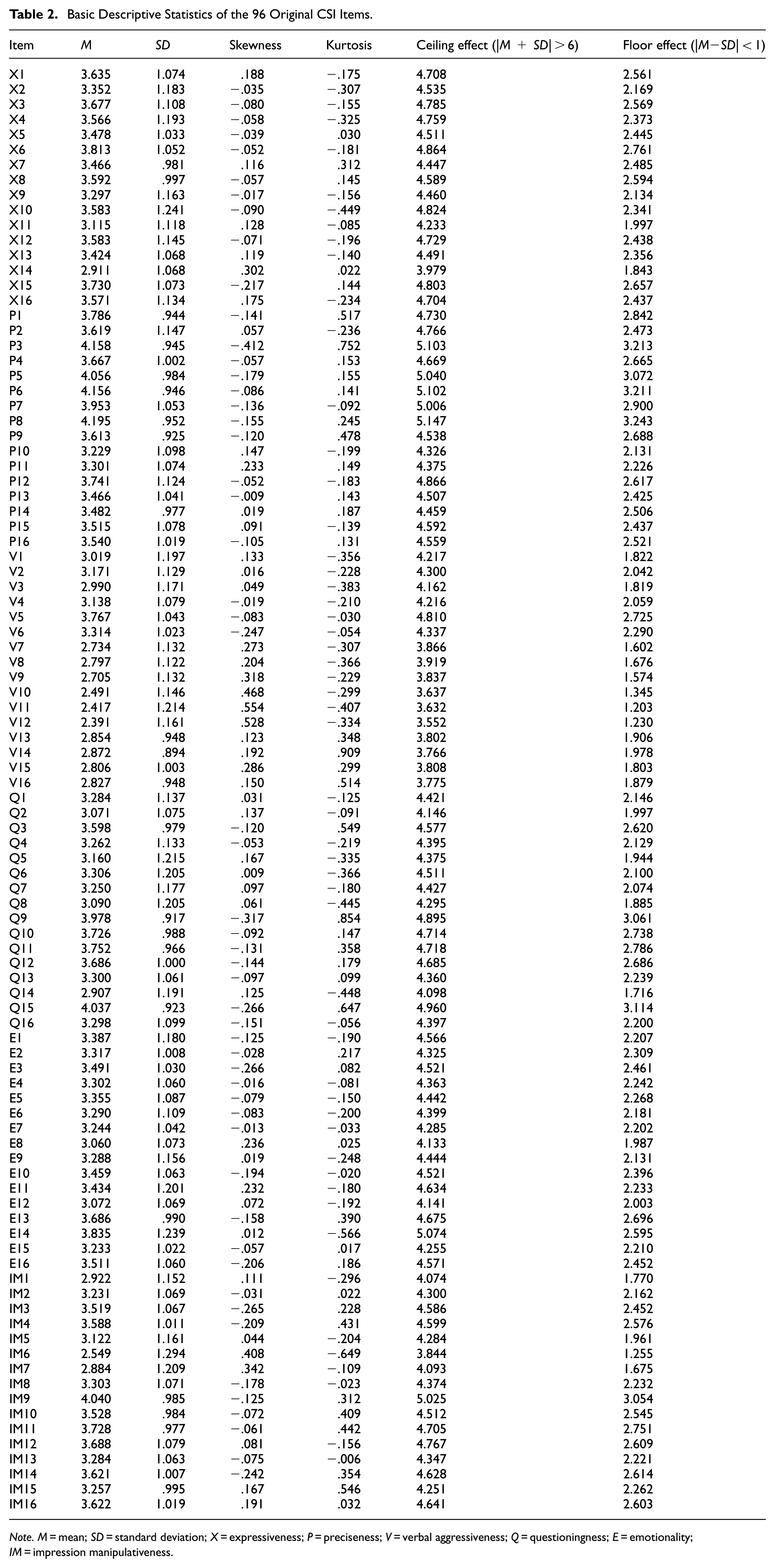
Note. M = mean; SD = standard deviation; X = expressiveness; P = preciseness; V = verbal aggressiveness; Q = questioningness; E = emotionality; IM = impression manipulativeness.
To evaluate the unidimensionality of each CSI subdimension prior to the IRT analyses, we conducted separate CFAs for the six dimensions (Table 3). Although the CFI and TLI values were below the conventional .90 threshold, this pattern is not unexpected for scales with relatively large item sets that tap nuanced, closely related behavioral tendencies. In the original CSI, several items in each dimension are intentionally worded to capture subtle variations of similar communicative behaviors, which can introduce mild item redundancy and slight within-factor facet structure. These characteristics can suppress incremental model fit indices such as CFI/TLI, even when a construct is substantively unidimensional. Importantly, the RMSEA and SRMR values were within acceptable ranges (both < .10), and all factor loadings were statistically significant, indicating coherent latent structures. Therefore, the assumption of unidimensionality was considered sufficiently supported, and GRMs were appropriately applied in the subsequent IRT analyses.
CFA Fit Indices for Each CSI Subdimension.

Note. CFI = comparative fit index; TLI = Tucker–Lewis index; RMSEA = root-mean-square error of approximation; SRMR = standardized root-mean-square residual.
All standardized factor loadings were statistically significant (z > 1.96), with values ranging from .42 to .83, indicating that each item contributed meaningfully to its latent construct. These findings provide sufficient empirical and theoretical justifications for applying unidimensional GRMs to each subdimension.
GRMs were estimated to identify the most psychometrically informative items. Model fit was assessed using item-fit statistics and residual analyses, which supported model adequacy. Based on the item discrimination parameters (a > 1.0) and well-distributed threshold parameters (b), three items per dimension were selected, resulting in an 18-item short form with six subscales.
To examine gender-related item bias, DIF analyses were conducted using Lord’s χ2 method implemented in the mirt package (Chalmers, 2012). Both uniform and non-uniform DIF were tested between male and female respondents. Items were flagged based on statistical significance (p < .01) and practical importance (Δa > .25). Theoretical relevance, content balance, and redundancy were considered in the final item selection. Items with substantive DIF were removed, and GRMs were reestimated to confirm model fit and parameter stability. The final 18-item version included only DIF-free items, thus supporting gender-based measurement invariance (Table 4).
Final 18 Items Selected Based on IRT and DIF Analyses.

Notes. M = mean; SD = standard deviation; DIF = differential item functioning; X = expressiveness; P = preciseness; V = verbal aggressiveness; Q = questioningness; E = emotionality; IM = impression manipulativeness.
It is important to clarify that DIF detection was primarily based on statistical significance (p < .01). We used the Δa index as a supplementary indicator to assess the practical magnitude of DIF only when statistical DIF was present. Therefore, some retained items exhibited Δa values greater than .25 (e.g., X11, V3), but these items did not show statistically significant DIF (p > .01) and demonstrated strong discrimination and theoretical relevance. Accordingly, they were retained in the final short form.
Finally, CFA was conducted to examine the factorial validity of the short form. The six-factor model showed a good fit with the data (CFI = .921, TLI = .901, RMSEA = .058, SRMR = .069). These results support the structural validity of the 18-item version of the CSI.
Study 2: Validation of the Short Form
Method
Ethics and Informed Consent
The ethical protocols and informed consent procedures for Study 2 were identical to those employed in Study 1. This study was conducted in accordance with the Declaration of Helsinki and APA Ethical Principle 8.05. All data were collected anonymously to ensure that participation posed no risk to the individuals’ employability or reputation. Prior to commencing the survey, electronic informed consent was obtained from all participants, who were informed of their right to withdraw at any time.
Sample
This study conducted an online survey of full-time employees and subordinates across diverse industries in Japan in July 2025. Prior to commencing the survey, the respondents were informed of their right to participate or withdraw from the study at any point without penalty, and submission of the survey implied informed consent.
A screening survey confirmed participants’ full-time employment status and managerial roles. A total of 700 employees completed the main survey, which included the CSI and DQS. Of these, 100 were excluded owing to DQS failure, which indicated inattentive or careless responding. The final sample consisted of 600 managerial employees (50.2% men; M_age = 48.9 years, SD = 9.7), including junior managers (44.2%), middle managers (34.8%), general managers (17.8%), and corporate officers or higher (3.2%). Most participants were married (67.5%) and supervised an average of 11.8 subordinates (SD = 10.4).
Industry distribution among respondents was as follows: manufacturing (20.3%); medical and welfare (8.7%); construction (6.8%); transport and shipping (6.3%); service (12.3%); trading, wholesale, and retail (13.3%); finance, securities, and insurance (6.8%); education (4.5%); information and communications (5.5%); real estate (3.3%); electricity, gas, and water utilities (1.8%); publishing and printing (0.7%); non-profit organizations (2.0%); media, mass communications, and advertising (0.7%); and other (6.8%). Table 1 shows the demographic characteristics of the sample.
Measure
The short-form CSI developed in Study 1 comprised six dimensions, each with three items. In Study 2, responses were collected on a six-point Likert scale ranging from 1 (completely disagree) to 6 (completely agree).
Data Analysis Strategy
To validate the 18-item short form developed in Study 1, we conducted rigorous psychometric evaluation using an independent sample. The following steps were taken to ensure structural integrity, reliability, and validity:
Step 1: Factorial Validation. We performed CFA to replicate the original six-factor structure. Each latent factor—expressiveness, preciseness, verbal aggressiveness, questioningness, emotionality, and impression manipulativeness—was modeled using the three items selected in Study 1. The model was estimated using the robust maximum likelihood estimator in Mplus, Version 8.6 (Muthén & Muthén, 2017), which provides standard errors and fit indices robust to non-normality.
Step 2: Model Fit Evaluation. Model fit was assessed using multiple indices following the thresholds suggested by Hu and Bentler (1999). Specifically, values of CFI and TLI ≥ .90 and RMSEA and SRMR ≤ .08 were used to indicate an acceptable fit between the proposed model and the observed data.
Step 3: Convergent and Internal Reliability. Beyond factorial structure, we evaluated the internal quality of each dimension. Average variance extracted (AVE) and composite reliability (CR) were calculated. Following Hair et al. (2010), values above .50 for AVE and .70 for CR were considered indicative of adequate convergent validity and internal consistency.
Step 4: Discriminant Validity. Finally, to ensure that the six dimensions represent distinct constructs, discriminant validity was assessed using the Fornell–Larcker criterion (Fornell & Larcker, 1981). This involved comparing the square root of the AVE for each factor with its correlations with other latent factors.
Results
Prior to CFA, basic descriptive statistics were computed for the 18 short-form CSI items. As shown in Table 5, the means ranged from 2.78 to 4.23 (on a six-point Likert scale), with standard deviations between 1.00 and 1.25. Skewness and kurtosis values were within acceptable ranges, indicating an approximately normal distribution. Extreme ceiling or floor effects were not observed. These results support the appropriateness of the items for subsequent latent variable modeling.
Descriptive Statistics of the 18 Short-Form CSI Items (Study 2).

Notes. M = mean; SD = standard deviation; X = expressiveness; P = preciseness; V = verbal aggressiveness; Q = questioningness; E = emotionality; IM = impression manipulativeness.
To evaluate the factorial validity of the short-form CSI, we conducted CFA on the six-factor model. The overall model demonstrated good fit, indicating that the intended structure was retained in the shortened version. Specifically, the fit indices were within commonly accepted ranges (CFI = .905, RMSEA = .052, SRMR = .059).
The TLI value (.879) was slightly below the traditional .90 guideline; however, this is a known tendency when each latent factor is represented by only three indicators, as TLI more heavily penalizes models with fewer items (Marsh et al., 2004). Given that other indices were within acceptable ranges and all factor loadings were significant, the measurement model can be considered structurally sound.
In summary, the CFA results provide strong support for the factorial validity of the 18-item short-form CSI, confirming that it reliably captures the original six communication style dimensions in a concise format.
The standardized factor loadings for all items were statistically significant and within an acceptable range (Figure 1), further supporting the adequacy of the measurement model. Convergent validity was evaluated using the AVE and CR of each factor. As shown in Table 6, all AVE values exceeded the recommended threshold of .50 (ranging from .497 to .740), except for questioningness (.497), which was marginally below it. CR values ranged from .743 to .895, surpassing the recommended .70 cutoff. These results indicate adequate internal consistency and convergent validity across all dimensions.

Standardized factor loadings from the CFA of the 18-item short-form CSI (study 2).
AVE and CR for Each CSI Dimension.

Notes. AVE = average variance extracted; CR = composite reliability; X = expressiveness; P = preciseness; V = verbal aggressiveness; Q = questioningness; E = emotionality.
Together, these results strongly support the psychometric soundness of the 18-item short form of the CSI, demonstrating acceptable item distributions, factorial validity, and construct reliability in an independent sample of leaders. These findings suggest that the short-form CSI is a valid, reliable tool for assessing leaders’ communication styles in practical research settings.
To enhance comprehension, Table 7 summarizes the key model fit indices from Studies 1 and 2, allowing for the efficient comparison of factorial validity across the two samples.
Summary of Model Fit Indices Across Studies.

Note. Slightly lower TLI values are common when each latent factor is represented by only three indicators because TLI more heavily penalizes model complexity (Marsh et al., 2004).
General Discussion
Previous short-form adaptations of the CSI have often prioritized brevity at the expense of theoretical integrity or were developed using non-managerial samples. The present study has filled this gap by developing and validating a leadership-specific short form that retains the six-dimensional structure and demonstrates strong psychometric properties in a managerial population. This approach strengthens both the theoretical continuity of the CSI framework and its practical applicability to leadership communication research.
We developed and validated an 18-item short form of the CSI tailored to leadership contexts. Importantly, the study was designed to not only reduce the length of the scale but also ensure that the shortened version retains theoretical coherence and fairness in measurement. To achieve this, we used IRT and DIF analysis, which enabled the item-level evaluation of psychometric informativeness and ensured that the scale functions equivalently across gender groups. We selected these methods because traditional factor-analytic approaches (e.g., EFA, CFA) have limited ability to evaluate item precision and detect subgroup bias during scale reduction. By using IRT, we were able to reconcile the theoretical model with empirical observations at the item level, ensuring that the selected items are not just statistically significant but are the most sensitive indicators of latent communication traits. Thus, this methodological choice aligns directly with the study’s objective to develop a psychometrically robust, practically usable measurement tool for leadership research and practice. Study 1 used IRT and DIF analyses to refine the scale, whereas Study 2 confirmed its factorial validity and reliability using an independent managerial sample. Together, the findings demonstrate that the short-form CSI maintains the conceptual richness of the original scale while reducing respondent burden, thereby enhancing its practical applicability in leadership research.
This study makes three key contributions. First, it provides a psychometrically sound short form of the CSI suitable for leadership research and practice. Second, it retains the original six-factor structure, allowing for theoretical continuity with the full version. Third, it positions communication style as a measurable mechanism linking personality traits and leadership outcomes, offering new opportunities for theory building in leadership communication research.
Research on leadership-as-practice suggests that leadership emerges via communicative interactions rather than individual traits alone (Men et al., 2025; Saputra, 2021). Yet, existing short-form adaptations of the CSI have not been validated using managerial samples, and they do not preserve the six-dimensional structure necessary for analyzing leadership communication. We addressed this gap by developing a short-form CSI specifically grounded in leadership contexts.
Theoretical Implications
This study contributes to leadership theory by positioning communication style as a behavioral conduit through which personality traits (e.g., HEXACO) translate into leadership behaviors. Different from prior research, which often treats personality and leadership behavior as distinct domains, our findings highlight communication style as a critical mediating mechanism. By retaining all six dimensions of the original CSI, our short form enables a fine-grained examination of how specific communication behaviors relate to leader effectiveness, relational quality (e.g., LMX), and broader organizational outcomes (De Vries et al., 2013). It also allows researchers to explore communication style as a behavioral mechanism linking stable personality traits with dynamic leadership behaviors (Koutsoumpis & De Vries, 2022), presenting new avenues for theoretical development.
Practical Implications
Beyond its psychometric rigor, our short-form CSI has value for HR professionals, managers, and organizations. Its brevity allows for the efficient assessment of communication styles in leadership development programs and managerial coaching, as well as 360-degree feedback, without inflating survey length or respondent burden. Because the instrument preserves the original six-factor framework, practitioners can pinpoint actionable strengths (e.g., expressiveness, preciseness) and risk areas (e.g., verbal aggressiveness, emotionality) at the factor level, enabling targeted, individualized interventions and progress monitoring over time. The gender-invariance checks in our item selection further support fair use in development and evaluation contexts, reducing the likelihood that feedback or decisions reflect measurement bias rather than true differences.
The scale’s parsimony also makes it suitable for large organizational surveys and HR analytics systems, where questionnaire real estate is scarce. The short-form CSI can be embedded alongside engagement, LMX, or leadership-behavior modules to model how communication style relates to outcomes such as commitment, knowledge sharing, or team climate. This aligns with recent work that foregrounds leadership-as-practice and the centrality of communicative behavior in contemporary settings (e.g., Men et al., 2025; Saputra, 2021). Moreover, the tool holds relevance for digitally mediated and hybrid work, where interactional behaviors are critical for maintaining shared understanding and coordinated action. In this regard, recent studies underscore how communication processes shape collaboration in virtual or immersive contexts (e.g., Aziz et al., 2025). In short, our 18-item short-form CSI provides a practical, fair, and theoretically coherent diagnostic that can be deployed at scale to inform development pathways, team interventions, and leadership pipelines.
Previous short-form adaptations either sacrificed the six-dimensional structure or were not validated on managerial samples, limiting their use in leadership practice. By contrast, our short-form CSI retains full conceptual coverage and demonstrates psychometric soundness in a managerial population, directly addressing a gap in the research and clarifying the tool’s relevance to leadership research and application.
Limitations and Future Research
Despite its contributions, this study has several limitations. First, the validation sample consisted exclusively of full-time managers in Japan, which may limit the generalizability of the findings to other cultural contexts and occupational groups. Replication in more diverse populations would strengthen the external validity of the short-form CSI.
Second, although the short form preserved the six-factor structure of the original scale, some conceptual nuance may have been reduced during item reduction. For example, the expressiveness dimension in the full CSI comprises four facets—talkativeness, conversational dominance, humor, and informality (De Vries et al., 2009)—whereas the short-form version primarily reflects talkativeness and humor. As a result, aspects such as assertive conversational control (conversational dominance) and casual communication tone (informality) may be underrepresented. Future research should examine whether this refined operationalization of expressiveness yields comparable predictive validity to the full facet-level measurement, particularly regarding interpersonal influence, leader–follower dynamics, and perceptions of leadership effectiveness.
Third, this study focused primarily on psychometric validation. While establishing factorial validity and reliability is essential, it does not address the extent to which the short form predicts leadership-related outcomes. Future research should therefore examine its predictive validity in relation to leadership behaviors, team functioning, and organizational outcomes. In addition, the current study relied solely on self-reported data. Incorporating ratings from peers, subordinates, or supervisors would further enhance ecological validity and reduce potential self-presentation bias.
Fourth, while our use of IRT and CFA allowed for rigorous alignment between the six-factor model and the observed data, we should acknowledge what these statistical models can and cannot tell us. These models provide a mathematically optimized representation of communication styles, yet they remain approximations of complex human interaction. While they confirm the structural integrity of the scale, they cannot capture the full idiosyncratic or situational variations in leadership communication that may occur in real-world “leadership-as-practice” contexts. Therefore, the short-form CSI should be viewed as a tool for identifying broad behavioral tendencies rather than an exhaustive map of all communicative nuances.
These limitations suggest several avenues for future research. Researchers may investigate cross-cultural equivalence, examine the scale’s predictive utility in various leadership contexts, and explore its relationships with established leadership constructs such as transformational or servant leadership. Future work may also assess whether communication style functions as a mediator or moderator between personality and leader effectiveness. Finally, research could explore how organizations integrate the short-form CSI into leadership selection, development programs, and performance management systems to evaluate its longitudinal impact on communication effectiveness and organizational outcomes.
Footnotes

Ethical Considerations
The study was conducted through an online survey in June 2025, targeting full-time employees with managerial responsibilities across various industries in Japan. A commercial research firm administered the survey in accordance with established ethical procedures. As no personally identifiable information was collected and the procedures posed minimal risk to the participants, formal ethical review by an institutional review board was not required under the prevailing ethical guidelines for social science research in Japan.
Consent to Participate
Prior to beginning the survey, the participants were informed that their participation was voluntary and that they could withdraw at any time without penalty. Consent was obtained through submission of the completed survey.
Author Contributions
The author confirms sole responsibility for all aspects of the study, including conceptualization, methodology, data analysis, and manuscript preparation.
Funding
The author disclosed receipt of the following financial support for the research, authorship, and/or publication of this article: This work was supported by the Ministry of Education, Culture, Sports, Science and Technology (MEXT)/Japan Society for the Promotion of Science (JSPS) KAKENHI Grant Number 23K01522.
Declaration of Conflicting Interests
The author declared no potential conflicts of interest with respect to the research, authorship, and/or publication of this article.
Data Availability Statement
The data that support the findings of this study are not publicly available but may be made available from the corresponding author upon reasonable request.*