




Abstract
This study explores the factors influencing users’ behavioral intention to adopt campus self-service printing, with a focus on the educational technology context. Utilizing a hybrid framework combining the innovation diffusion theory and the technology acceptance model, a survey was conducted with 868 respondents to establish a comprehensive research model. The results reveal that relative advantages, trialability, visibility, result demonstrability, and perceived ease of use (PEOU) all have positive relationships with the behavioral intention to adopt campus self-service printing. Additionally, relative advantages, result demonstrability, and PEOU are positively associated with perceived usefulness. Furthermore, relative advantages, visibility, and result demonstrability are linked to PEOU. These findings contribute valuable insights into how educational institutions can better understand and foster the adoption of self-service printing technology. The study also provides actionable recommendations for campus policymakers, highlighting the importance of promoting relative advantages, enhancing visibility, and ensuring ease of use to increase technology acceptance. By aligning with the needs and perceptions of users, institutions can more effectively implement and improve self-service printing services, contributing to the advancement of educational technology on campuses.
Plain Language Summary
This study looks at what encourages university students to use self-service printers on campus. These printers let students print documents on their own without help, anytime and anywhere. They are often placed in libraries or student areas and can be used by uploading files from a phone or computer. The researchers surveyed 868 students in China to find out which factors matter most when deciding to use these printers. They focused on two key ideas: how useful and easy the printers are to use, and how students see them compared to traditional printing methods. The study found that students are more likely to use self-service printers when they believe the printers are: 1. More convenient and efficient than traditional printing. 2. Easy to use without needing extra help. 3. Visible and available, for example, when they see others using them. 4. Able to show quick and clear results, like getting the print job done fast. Interestingly, the ease of use turned out to be more important than how useful the printers seemed. Just seeing how to use them or being able to try them out also made students more confident in using them. This research can help schools and technology providers improve these printing services. For example, they can place printers in popular locations, keep the interfaces simple, and offer brief demos for new users. Overall, the study helps universities understand what makes students adopt new tech tools and how to make campus life more convenient.
Keywords
Introduction
The emergence of the smart campus paradigm has notably strengthened the information infrastructure within higher education institutions, fostering the integration of technology across university campuses (Zhu, 2022). Self-service technologies offer organizations the opportunity to reduce labor costs while providing diverse and efficient service delivery options (Collier & Kimes, 2013). In contrast, traditional printing systems have predominantly relied on manual operations and centralized service models, where users often had to transfer files via USB drives or email. This process led to extended waiting times, particularly during peak periods such as midterms and finals. The inefficiencies associated with these methods frequently resulted in overcrowding and delays, failing to meet the increasing demand for printing services during critical academic periods. To address these challenges, self-service printing technologies have been developed to provide more streamlined and efficient campus services.
Unlike traditional printing methods, self-service printing empowers users to independently manage their printing tasks without the need for assistance from service personnel. These systems enable users to print documents at any time and from any location, overcoming the constraints of conventional printing models. By allowing document uploads via mobile devices, self-service printing eliminates the need for USB drives, thereby enhancing efficiency for both academic and professional tasks. Typically located in libraries, print shops, or office environments, self-service printing stations feature intuitive interfaces that enable users to upload files, customize print settings (such as paper size or color), and complete payments autonomously (see Figure 1). For service providers, these technologies help reduce labor costs and enhance service availability, contributing to the advancement of educational technology and the digital transformation of the workplace.

The operations of self-service printing.
Despite the significant implications of self-service printing as an innovative educational device, limited attention has been devoted to understanding the antecedents of behavioral intention to adopt such technologies. However, compared to other new technologies, the adoption of self-service printing is not only often driven by task-specific and time-sensitive needs, such as students printing assignments under tight deadlines, which highlights its context-dependent utility, but also users often allow access to it this technologies on campuses. The Innovation Diffusion Theory (IDT) provides a comprehensive framework for examining the factors influencing the adoption of new technologies (AI-Jabri et al., 2012). Previous studies have explored a variety of innovation-related factors that drive adoption behaviors (Agag & El-Masry, 2016; AI-Rahmi et al., 2019; Brancheau & Wetherbe, 1990; Cheng, 2017; Pinho et al., 2021). Likewise, the Technology Acceptance Model (TAM), developed by Davis (1989), has become one of the most widely utilized models for studying technology adoption, emphasizing the critical roles of perceived usefulness (PU) and perceived ease of use (PEOU) in shaping user behavior (Agag & El-Masry, 2016). However, few studies have investigated the combined effect of IDT and TAM in the specific context of self-service printing.
To bridge this gap, this study proposes an integrated model that identifies the key factors influencing users’ behavioral intention to adopt self-service printing technologies. The primary aim of this research is to explore the determinants driving the adoption of self-service printing and to offer valuable insights into both the theoretical and practical implications of these factors.
Literature Review
Integration of IDT and TAM: IDT-TAM Model
IDT provides a robust framework for understanding the factors that influence individuals’ decisions to adopt new technologies or innovations (Rogers & Shoemaker, 1983). At the core of IDT are four key innovation attributes: relative advantage, trialability, visibility, and result demonstrability, which play a crucial role in shaping adoption behaviors (Rogers, 2003). Empirical studies have consistently demonstrated IDT’s strong predictive capability in explaining the adoption of technological innovations across diverse contexts (Cheng, 2017; Pinho et al., 2021; Yuen et al., 2021; Zhang et al., 2015). Traditional printing methods are often characterized by inefficiency, inconvenience, time consumption, and high labor intensity, heavily relying on human intervention and mechanical resources. In contrast, campus self-service printing systems empower users to independently complete their printing tasks without the need for external assistance, improving operational efficiency and significantly reducing waiting times commonly associated with conventional printing services. Consequently, IDT offers a pertinent theoretical framework for understanding the behavioral intentions that drive the adoption of self-service printing technologies. Despite its relevance, limited research has focused specifically on the innovation attributes of self-service printing, thereby presenting an opportunity to explore these attributes in the context of behavioral intention. This study focuses on the four core innovation attributes – relative advantage, trialability, visibility, and result demonstrability – to examine their impact on users’ behavioral intention.
TAM, introduced by Davis (1989) as an extension of the Theory of Reasoned Action, is widely recognized as a reliable framework for predicting technology adoption and acceptance (López-Nicolás et al., 2008). TAM identifies two primary constructs – PU and PEOU – as key determinants of attitudes and behavioral intentions toward technology adoption. The model proposes three fundamental relationships: (1) PEOU positively influences PU, (2) PEOU directly affects behavioral intention, and (3) PU directly impacts behavioral intention (López-Nicolás et al., 2008). Numerous empirical studies have confirmed the robustness of TAM in predicting individuals’ intentions to adopt various technologies (Matemba & Li, 2018), including virtual classrooms (Kemp et al., 2024), online education systems (Dindar et al., 2021), and digital learning tools (Wohlfart & Wagner, 2025).
Previous studies have suggested that the combination of IDT and TAM is complementary. Specifically, IDT helps address TAM’s tendency to oversimplify adoption behavior and overlook the role of social and innovation-related factors (López-Nicolás et al., 2008). Therefore, the integration of these two models provides a more holistic understanding of determinants influencing technology adoption. While previous research has validated the applicability of this integrated model (e.g., Agag & El-Masry, 2016; Ward, 2013), there is a lack of application to educational technologies. Therefore, this study integrates IDT with TAM, forming a unified framework, IDT-TAM model, to understand the behavioral intentions of campus users regarding self-service printing.
IDT and Behavioral Intention
Relative advantages refer to the degree to which an innovation is perceived as superior to existing methods or solutions (Rogers & Shoemaker, 1983). Yuen et al. (2020) suggest that individuals assess innovations based on their perceived effectiveness, convenience, and value. For instance, Lyu et al. (2023) found that the adoption of e-waste recycling platforms was primarily driven by the relative advantages these platforms offered, such as greater convenience and efficiency compared to traditional recycling methods. Similar findings have been observed in studies on mobile payments (Johnson et al., 2018) and online education (Breiki et al., 2023). In the context of self-service printing, significant relative advantages are evident compared to traditional methods. For example, self-service printing bypasses long queues, enabling users to upload documents directly from mobile devices without the need for USB drives, thus exemplifying its relative advantages. Previous studies have also established that relative advantages are a direct predictor of behavioral intention to adopt new technologies (Johnson et al., 2018; Matemba & Li, 2018).
Trialability refers to the extent to which potential adopters can experiment with new technologies before fully committing to their use (AI-Jabri et al., 2012). Rogers (2003) argues that opportunities for trial reduce concerns about usability, performance, and security, thereby enhancing the likelihood of adoption. In other words, the ability to test an innovation before making a commitment can help users become more comfortable with the technology (Johnson et al., 2018). In the case of self-service printing, offering trial periods with volunteer assistance and instructional materials can alleviate potential users’ concerns. These trial opportunities can motivate potential adopters by fostering a greater sense of familiarity and trust in the technology.
Observability refers to the visibility and demonstrability of the benefits of an innovation, which positively correlates with the likelihood of its adoption (Shaw et al., 2022). This construct includes both visibility and result demonstrability (Moore & Benbasat, 1991). In this study, visibility is defined as the ability to access self-service printing at any time and from any location, while result demonstrability pertains to the immediate visibility of the effects of self-service printing, as well as the ability to communicate these benefits to others (AI-Jabri et al., 2012). For campus self-service printing, strategically placing printing devices in high-traffic areas, such as libraries and dormitories, enhances visibility and accessibility. AI-Jabri et al. (2012) argue that individuals are more likely to adopt innovations when the effects or benefits of these innovations are visible. Therefore, visibility and result demonstrability are key predictors of user adoption.
PU, PEU and Behavioral Intention
Extensive research has investigated the influence of PU and PEOU on technology acceptance intention, with a broad consensus that both constructs are positively related to behavioral intention (AI-Rahmi et al., 2019; Yuen et al., 2021). PEOU refers to the degree to which users perceive a technology as requiring minimal physical or mental effort to use (Moore & Benbasat, 1991). Davis (1989) further emphasized that PEOU serves as an antecedent to PU, suggesting that PEOU positively influences PU. Building on this foundational relationship, we propose the following hypotheses:
IDT and PU
Relative advantages reflect both the tangible and intangible benefits of an innovation (Knudsen & Roman, 2015). However, Luo et al. (2021) argue that being perceived as advantageous does not necessarily equate to being perceived as useful, as the benefits provided by an innovation may not align with the needs of the users. This suggests a need to further explore the relationship between relative advantages and PU. Previous studies have posited that relative advantages are positively related to PU (AI-Rahmi et al., 2019; Oh & Yoon, 2014; Yuen et al., 2021). Therefore,
Trialability, as a predictor, allows users to test and experiment with the technology, which can significantly influence their decision to adopt it. Although prior studies have suggested that trialability is not significantly related to PU (Menzli et al., 2022), AI-Rahmi et al. (2019) found that trialability is positively associated with PU. Thus,
Visibility and result demonstrability, as two key dimensions of observability, are crucial factors in predicting user acceptance of technological innovations. Pang et al. (2025) elaborated on the concept of observability, suggesting that it consists of two elements: visibility (the opportunity to see others using the innovation) and result demonstrability (the opportunity to understand the benefits and effects of the innovation). Lee et al. (2011) proposed that observability is associated with PU, and in particular, Yuen et al. (2021) argued that result demonstrability is linked to PU. Although fewer studies have explored the relationship between visibility and PU, we contend that once individuals observe others using a new technology, they are more likely to consider adopting it, as they perceive the technology as useful. Therefore, we propose the following hypotheses:
IDT and PEOU
PEOU can be assessed by evaluating whether using a technology requires minimal mental or physical effort (Deng et al., 2018). AI-Rahmi et al. (2019) suggest that relative advantages are positively associated with PEOU. Similarly, Yuen et al. (2021) argue that trialability, visibility, and result demonstrability are linked to PEOU. However, AI-Rahmi et al. (2019) found that trialability is not significantly related to PEOU in the context of online education. This discrepancy indicates a need to further investigate the relationship between trialability and PEOU in different contexts, such as self-service printing.
Therefore, the current study proposes the following hypotheses:
The conceptualized structural model is presented in Figure 2.

Research model.
Methodology
Data Collection
Data were collected between September and October 2024 via an online survey on the Sojump platform (www.wjx.cn), a Chinese crowdsourcing platform similar to Amazon Mechanical Turk. The platform’s random sampling method enhances the study’s external validity (Cheung et al., 2017). Participants were randomly invited from various provinces and cities across China. The participant pool comprised 898 individuals, and consent was obtained via email and a survey platform. After reviewing the data and excluding responses with signs of malicious or invalid answers (e.g., completing the survey in less than 120 s), and those from participants who reported never using self-service printing, the final valid sample size was 868, resulting in a response rate of 96.66%.
The demographic characteristics of the sample are summarized in Table 1. Among the respondents, 533 (61.4%) were male, and 335 (38.6%) were female. In terms of age distribution, 461 (53.1%) were between the ages of 18 and 25, while 367 (42.3%) were in the 26 to 34 age range. Regarding educational attainment, 601 (69.2%) held a bachelor’s degree, 145 (16.7%) had a junior college degree, and 93 (10.7%) had obtained a post-graduate degree. In relation to printing frequency, 484 (55.8%) reported printing materials frequently, 194 (22.4%) always printed, 156 (18%) sometimes printed, and the remaining 34 (3.9%) seldom printed materials.
Participants’ Socio-Demographic Characteristics.

Measures
The present study aims to develop a theoretical model to predict and explain the behavioral intention to adopt self-service printing, and to test the model empirically. The questionnaire consists of three sections. The first section includes items designed to assess users’ relative advantages, trialability, visibility, and result demonstrability, adapted from the measurement scales of Amaro and Duarte (2015), Moore and Benbasat (1991), Venkatesh and Davis (2000), and Yuen et al. (2020), based on the IDT. The second section consists of 11 items evaluating PU, PEOU, and behavioral intention (BI) to use self-service printing, adapted from the measurement scales of Davis (1989) and Venkatesh and Davis (2000; see Supplemental Materials A). The third section collects demographic information from respondents, such as gender, age, educational level, and frequency of printing. The initial version of the questionnaire was developed in English, after which the items were translated into Chinese. To ensure content validity, some wording adjustments were made to the items to better suit the context of the study.
Common Method Bias, CMB
CMB may arise when both the independent and dependent variables are measured using the same method (Podsakoff et al., 2003). To assess the potential presence of CMB, we conducted Harman’s one-factor test (Malhotra et al., 2006; Podsakoff & Organ, 1986). The results revealed that no single factor explained the majority of the variance in the data, indicating that common method bias was not a significant issue in this study. Consequently, common method bias was not considered a major concern in our analysis.
Results
Measurement Model
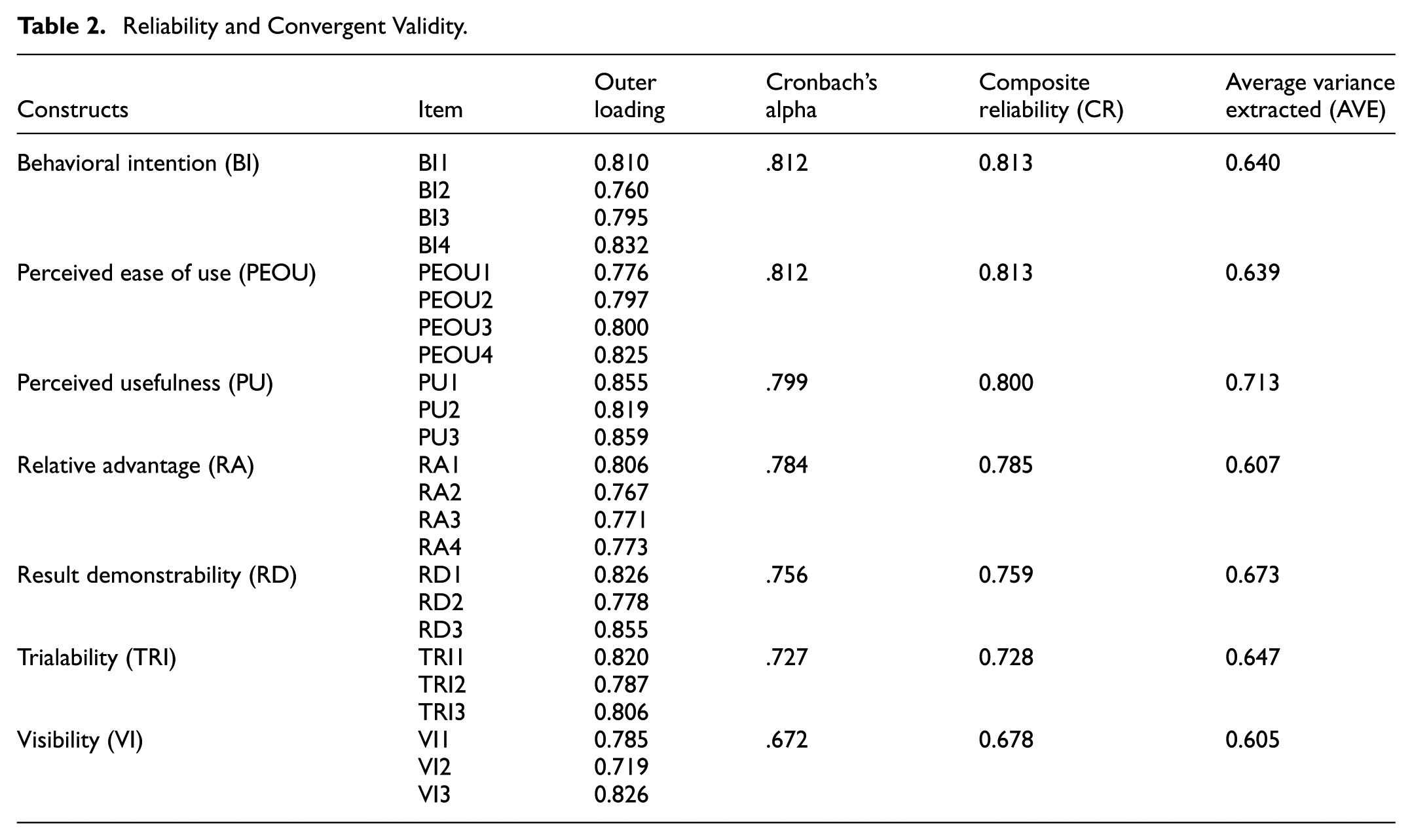
Data analysis was conducted using SPSS 26.0 and SmartPLS 4.0 software. To evaluate the internal consistency of the constructs, both Cronbach’s alpha (CA) and composite reliability (CR) were employed. The obtained values for CA and CR were above .70, indicating strong internal reliability (see Table 2). Additionally, average variance extracted (AVE) and outer loadings were used to assess convergent validity (Hair et al., 2017b). The results indicated that the AVE values exceeded 0.50, and the outer loadings ranged from 0.760 to 0.859, demonstrating good convergent validity.
Reliability and Convergent Validity.
Furthermore, discriminant validity was assessed using both the Fornell-Larcker criterion and cross-loadings. The results, presented in Tables 3 and 4, demonstrate good discriminant validity of the model, as all values exceed the 0.700 threshold, in accordance with the criterion established by Hair et al. (2017b).
Discriminant Validity Assessment.

Note. The bolded value is the square root of the construct. AVE, and the rest are the correlation coefficients; BI = behavioral intention; RD = result demonstrability; PEOU = perceived ease of use; PU = perceived usefulness; VI = visibility; TRI = trialability; RA = relative advantages.
Cross-Load Value.

Note. Loadings: (preferable > = 0.7; acceptable > = 0.5); VIF = variance inflation factor (less than 0.5); Bold values indicate the highest loading of each indicator on its corresponding construct.
Structural Model
The structural model of PLS-SEM was assessed using SmartPLS 4.0 with bootstrapping set to 5,000 samples (Hair et al., 2017a). Goodness-of-fit (GoF) is a key indicator for evaluating the structural model’s adequacy in PLS path modeling (Tenenhaus et al., 2005). For the proposed research model, a GoF value of 0.657 was obtained, which surpasses the baseline value of 0.36, indicating a large effect size of R2 (see Table 5). This satisfactory model fit suggests that the measures used in the study are suitable for further testing of the causal model and the research hypotheses.
Goodness of Fit.

Table 6 illustrates standard coefficients (β), standard error (SE), t-value, p-value, confidence interval, VIF, and f2 of 15 hypotheses. According to Table 6 and Figure 3, the relationship between relative advantages (β = .310, t = 7.356, p < .001), trialability (β = .131, t = 3.821, p < .001), visibility (β = .101, t = 2.721, p < .01), result demonstrability (β = .281, t = 5.390, p < .001) and BI to use self-service print have positive and significant relationships, supporting
Research Hypotheses and Path Coefficients.

Note. Two-tailed percentile bootstrapping test based on 5,000 subsamples at 5% significance level was used; ns = p value more than .05; R-squared (R2) = substantial > = .67, moderate > = .33, and small > = .19 as suggested by (Chin, 1998).

Structural model.
Regarding the relationship between PU, PEOU and behavioral intention, PU (β = −.034, t = 0.041, p > .05) did not have a significant effect on BI, whereas PEOU (β = .182, t = 4.461, p < .001) have a significant effect on BI. Thus, the
Additionally, relative advantages (β = .134, t = 1.967, p < .05), result demonstrability (β = .400, t = 6.631, p < .001), and PEOU (β = .436, t = 5.587, p < .001) have positive and significant effect on PU. However, trialability (β = −.057, t = 1.816, p > .05), visibility (β = −.035, t = 0.892, p > .05) did not have significant effect on PU. Consequently,
Furthermore, relative advantages (β = .443, t = 6.880, p < .001), visibility (β = .134, t = 2.434, p < .05), result demonstrability (β = .206, t = 3.251, p < .01) are positively and significantly related to PEOU; while trialability (β = .079, t = 1.876, p > .05) has no significant effect on PEOU. Therefore, the
Mediation Analysis
A bootstrap approach was further used to analyze the mediating effects (Hair et al., 2017a; Wang et al., 2023). Table 7 shows the β, standard error (SE), t-value, and p value of mediation path. The results show that PEOU plays a mediating role between relative advantages (β = .081, t = 3.599, p < .001), result demonstrability (β = .037, t = 2.687, p < .01), and behavioral intention.
Mediation Calculation.

Discussion
This study employed a hybrid theoretical model (IDT-TAM model) to examine the factors influencing users’ behavioral intentions to adopt self-service printing technologies on campus. The integrated model was employed to analyze the effects of relative advantages, trialability, visibility, result demonstrability, PU, and PEOU on adoption intentions for self-service printing.
Relative advantages were found to be the most significant determinant in predicting self-service printing adoption, with a β-value of .310 and an f2 value of 0.104. This finding strongly supports
The trialability hypothesis (
Observability, including both visibility and result demonstrability, was shown to positively influence adoption intentions, thus supporting
PU, contrary to expectations, did not significantly influence adoption intentions, and thus,
The study also confirmed that relative advantages have a significant positive relationship with both PU (
Interestingly, visibility, a component of observability, did not significantly affect PU (
Finally, contrary to earlier studies (Luo & Cao, 2024; Yuen et al., 2021), trialability was not significantly related to PU (
Implications and Limitations
Theoretical Implications
First, it validates the hybrid IDT-TAM framework as a robust theoretical lens for examining the adoption of educational technology, a relatively underexplored area. While prior studies have extensively applied IDT and TAM in domains such as mobile commerce (Agag & El-Masry, 2016), AI-driven technologies, and online education, this study uniquely extends their integration to self-service printing, offering valuable insights.
Second, the study refines the concept of observability, distinguishing it into two sub-dimensions: visibility and result demonstrability. This differentiation contributes to a more nuanced understanding of how these elements influence technology adoption, particularly within the framework of IDT. While previous studies generally focused on the overall impact of observability on technology adoption (e.g., AI-Jabri et al., 2012), this research highlights the distinct roles that visibility and result demonstrability play. This theoretical refinement deepens the understanding of the multi-dimensional nature of observability and enriches the literature on innovation diffusion by offering a more granular view of how users’ perceptions of a technology’s advantages can influence their adoption behaviors.
Third, it emphasizes the critical role of mediators – PU and PEOU – within the IDT-TAM framework. While PU and PEOU have been studied extensively in the context of TAM (AI-Rahmi et al., 2019; Luo & Cao, 2024; Yuen et al., 2021), this research empirically validates their role as mediators between the attributes of IDT and the adoption decision. This finding underscores the importance of mediating variables in explaining technology adoption, particularly in educational contexts.
Besides, by integrating both IDT and TAM and incorporating various innovation attributes (e.g., relative advantage, trialability, visibility, and result demonstrability), this study provides a multi-dimensional theoretical perspective on technology adoption. This approach enables a more comprehensive understanding of the factors that drive users’ decisions to adopt educational technologies like self-service printing.
Practical Implications
From a practical perspective, the findings offer valuable actionable recommendations for technology providers and stakeholders involved in the adoption of self-service printing technologies, particularly in educational contexts.
First, the study identifies relative advantages as the most significant factor in predicting the adoption of self-service printing technology. Therefore, technology vendors should emphasize the relative advantages of their products, such as enhanced convenience and efficiency, to encourage user adoption. Marketing strategies should focus on demonstrating how self-service printing can simplify the document printing process, making it more efficient and accessible compared to traditional methods.
Second, the findings suggest that PEOU has a stronger influence on adoption intentions than PU. Consequently, technology providers should prioritize improving the usability of self-service printing devices. Simplifying user interfaces, streamlining operational workflows, and ensuring compatibility across different devices will help make the technology more accessible and intuitive for users, increasing the likelihood of adoption. As suggested by Davis (1989), a technology that is easier to use is more likely to be accepted by users, making PEOU a key factor to address during technology updates and improvements. In practice, implement a ≤3-step end-to-end workflow, enable single sign-on via campus ID with mobile-wallet payment, and provide an accessible UI (e.g., large fonts and screen-reader labels).
Third, the study also highlights the importance of observability, which includes visibility and result demonstrability. To enhance user engagement, self-service printing technology should be placed in visible and easily accessible locations on campus or within educational institutions. Moreover, the tangible benefits of using self-service printing, such as quick and efficient printing with clear results, should be showcased. Strategic placement of devices, along with clear demonstrations of how the technology works, can improve users’ perceptions and encourage greater adoption.
Fourth, regarding trialability – the opportunity for users to experiment with the technology before fully committing to it – was found to positively influence adoption, especially in initial stages. Educational institutions and technology vendors should provide opportunities for users to test out self-service printing systems, particularly during the early adoption phases. This could involve offering trial periods or hands-on demonstrations that help users familiarize themselves with the technology without the risk of committing to it immediately.
Additionally, while PEOU was found to be a significant factor, there may still be a need for user education and training to maximize the ease of use and adoption intention. Institutions can offer guidelines, tutorials, and support services to ensure that users feel comfortable with the technology, helping them to quickly adapt and fully leverage the benefits of self-service printing.
Limitations and Future Studies
Despite its contributions, this study has several limitations. First, the reliance on a cross-sectional self-report survey design limits the ability to draw causal inferences, highlighting the need for future research employing longitudinal or experimental designs to yield more reliable results. Second, this study adopted SmartPLS as the main analytical approach, which is well-suited for prediction-oriented and theory-extension research involving complex relationships among latent variables. However, we acknowledge that the exclusive reliance on PLS-SEM may limit the generalizability of the findings from a traditional econometric perspective. Future studies could apply additional econometric techniques, such as multiple regression or hierarchical modeling, to cross-validate the results and provide further robustness to the proposed model. Third, as the sample comes from Sojump-recruited Chinese university campuses and a specific self-service printing setting, generalization beyond this context is uncertain; replication across multiple sites with probability or stratified sampling is recommended.
Conclusion
In the current study, the hybrid IDT-TAM framework was validated in the context of self-service printing, offering valuable insights into users’ perceptions regarding the adoption of this technology. Conducted through an online survey with 868 respondents, the research incorporated key factors from both the IDT and the TAM. The study considered relative advantages, trialability, visibility, and result demonstrability from IDT, along with perceived usefulness and perceived ease of use from TAM. Additionally, it explored the potential mediating roles of PU and PEOU in linking the attributes of innovation diffusion to users’ behavioral intentions to adopt self-service printing. The findings of this study contribute both theoretical and practical insights, particularly in advancing the fields of digital education and service innovation, emphasizing how innovation adoption can be influenced by a combination of perceived advantages and usability factors.
Supplemental Material
sj-docx-1-sgo-10.1177_21582440261423796 – Supplemental material for Unpacking the Adoption of Campus Self-Service Printing: A Fusion of Innovation Diffusion and Technology Acceptance Models in Educational Technology
Supplemental material, sj-docx-1-sgo-10.1177_21582440261423796 for Unpacking the Adoption of Campus Self-Service Printing: A Fusion of Innovation Diffusion and Technology Acceptance Models in Educational Technology by Xiaoxue Zhang, Hongtao Luo and Zizhong Zhang in SAGE Open
Footnotes

Ethical Considerations
All procedures performed in studies involving human participants were in accordance with the ethical standards of the institutional and/or national research committee and with the 1964 Helsinki Declaration and its later amendments or comparable ethical standards.
Consent to Participate
Informed consent was obtained from all individual participants included in this study.
Funding
The authors received no financial support for the research, authorship, and/or publication of this article.
Declaration of Conflicting Interests
The authors declared no potential conflicts of interest with respect to the research, authorship, and/or publication of this article.
Data Availability Statement
Data will be made available on request.
Supplemental Material
Supplemental material for this article is available online.
References
Supplementary Material
Please find the following supplemental material available below.
For Open Access articles published under a Creative Commons License, all supplemental material carries the same license as the article it is associated with.
For non-Open Access articles published, all supplemental material carries a non-exclusive license, and permission requests for re-use of supplemental material or any part of supplemental material shall be sent directly to the copyright owner as specified in the copyright notice associated with the article.
